
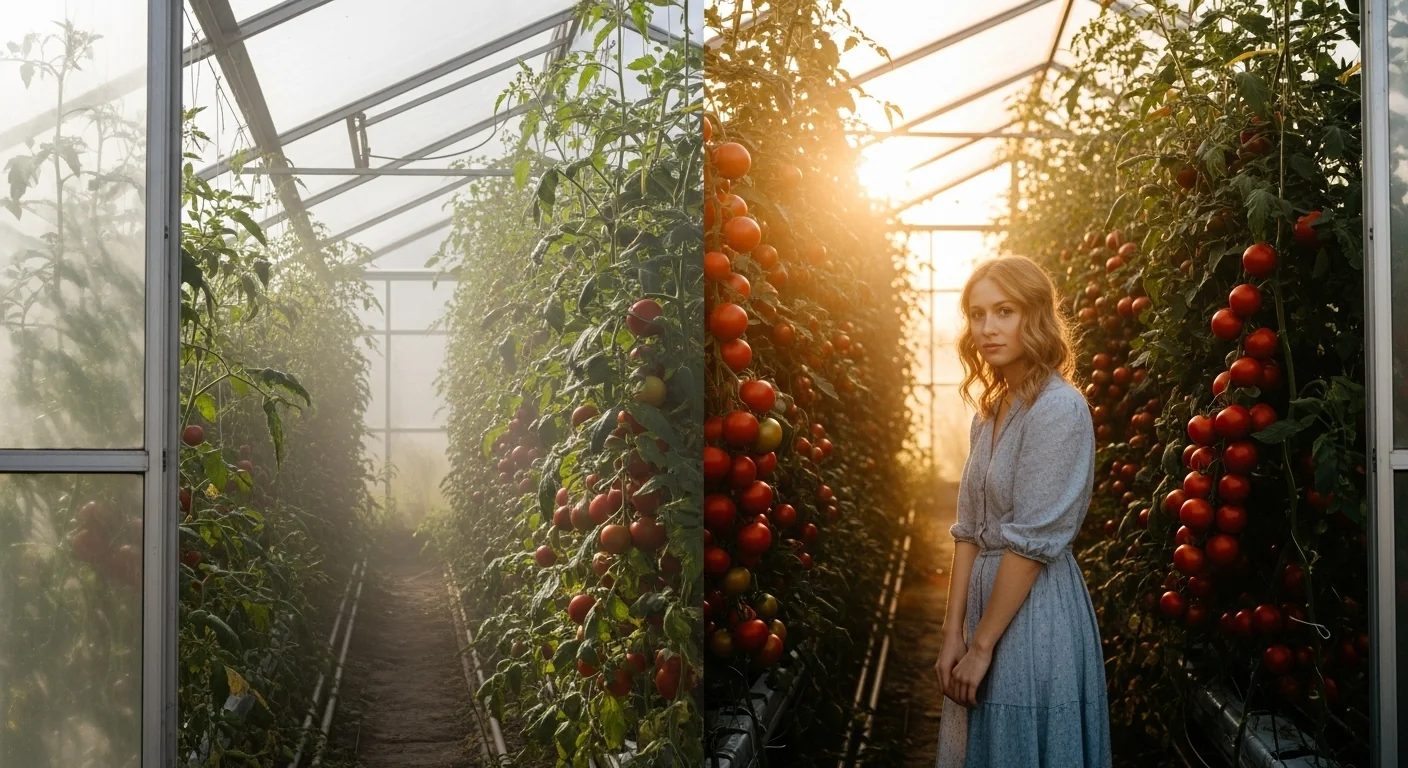
Visible brightness is a poor proxy for plant-available light. A greenhouse covered with 5-year-old polyethylene film can appear nearly identical in brightness to one covered with new film, yet deliver measurably fewer photons in the 400-700 nm range that drives photosynthesis. That gap is not random — it is predictable, calculable, and directionally tied to the age and type of your glazing material.
This tool calculates your indoor Daily Light Integral (DLI) by combining your outside solar DLI with the transmission characteristics of your specific covering material, adjusted for age-related PAR degradation and the number of glazing layers you are running. It does not account for site-specific shading from structural members, accumulated dust, or localized condensation patterns. For a deeper look at how raw outside DLI is measured and interpreted, the DLI calculator at The Yield Grid covers the fundamentals of Daily Light Integral and how latitude and season affect baseline solar availability.
After running this calculator, you will know whether your current glazing is delivering enough light for your target crops — and by exactly how much mol/m²/d you would gain by replacing it with new film.
Use the Tool
Greenhouse Glazing PAR Transmission & Poly Aging
Expose the hidden DLI losses from aging greenhouse plastic. Know exactly what light your crops are receiving.
Greenhouse Plastic Light Transmission Calculator| Age (yrs) | PAR% | Internal DLI | DLI Lost | Status |
|---|
- Suntex 4-yr 6-mil Greenhouse Poly
- Wiggle Wire & Aluminum Channel Lock
- Greenhouse Repair Tape
- Apogee DLI Meter
How This Calculator Works
This calculator quantifies the “Invisible UV Starvation” effect: As greenhouse plastic ages, UV degradation causes micro-yellowing that blocks vital PAR wavelengths — even though the interior still looks bright to the human eye. Plants rely on absolute photon counts, not relative brightness.
Formula Steps (step-by-step):
Glass = 90% | 6-mil Poly = 85% | 8mm Polycarbonate = 82%
(manufacturer new-film baseline)
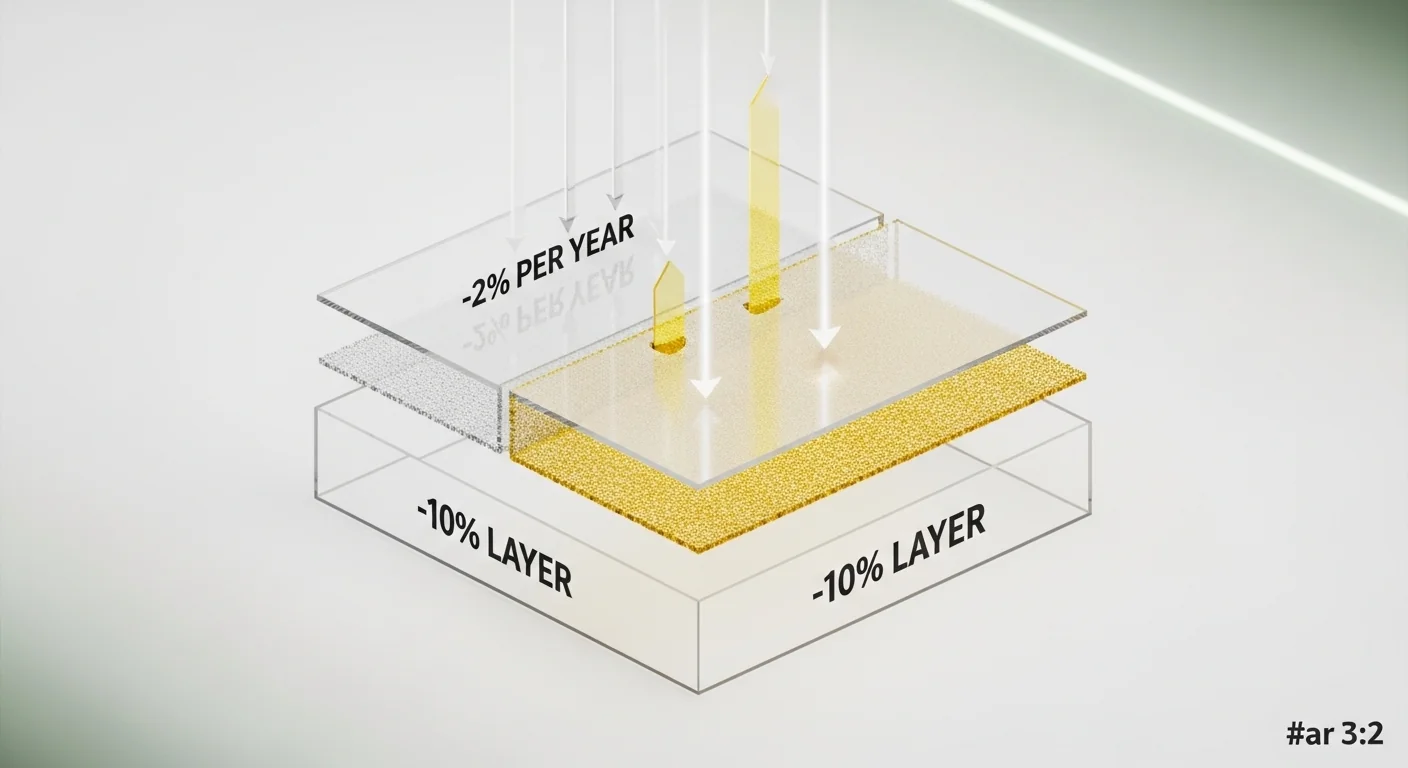
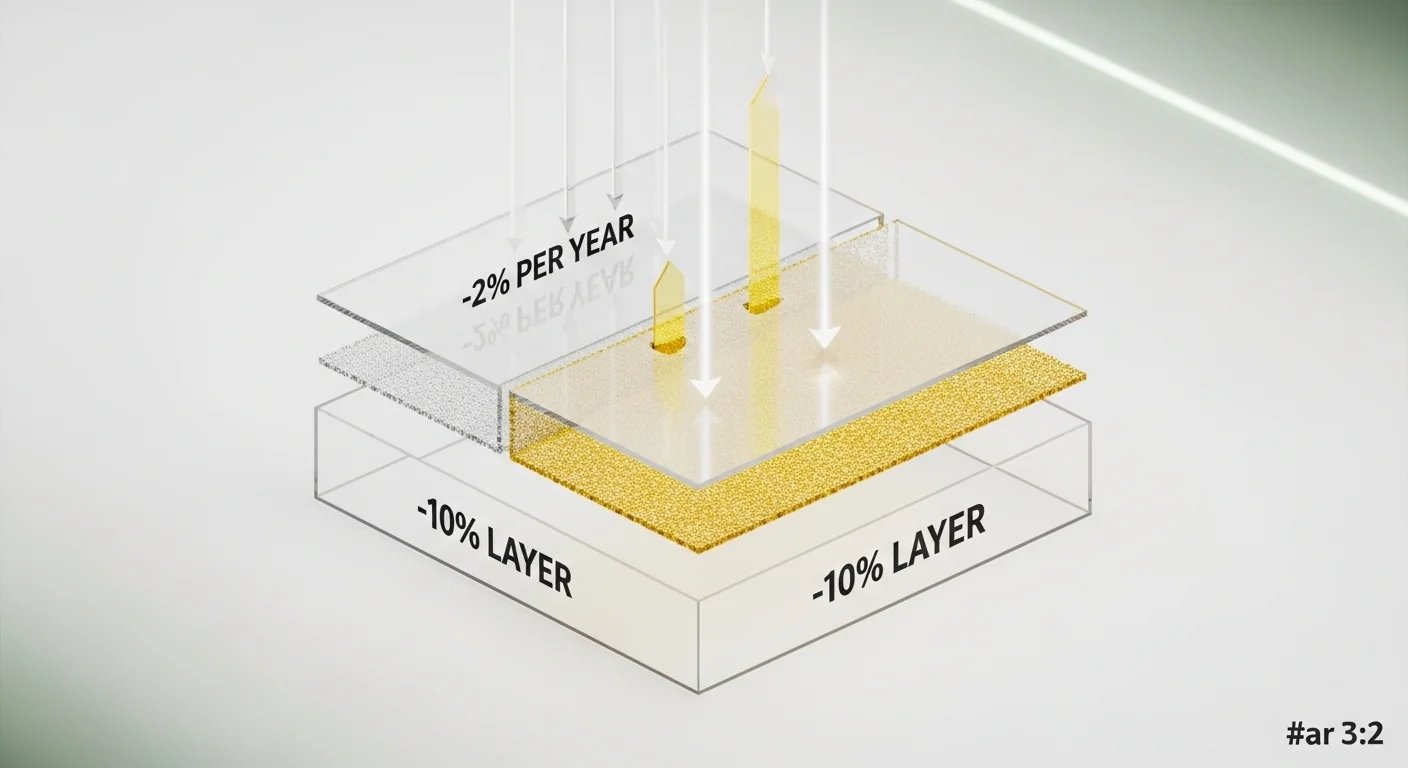
Degradation (%) = Age (years) × 2% per year
(industry average UV aging rate for greenhouse films)
Internal PAR% = Initial PAR% − Degradation
Minimum floor: 30% (physically degraded plastic)
If Double Inflated: Internal PAR% × 0.90 (≈10% additional loss per layer)
Indoor DLI (mol/m²/d) = Outside DLI × (Internal PAR% / 100)
If Indoor DLI < 10 mol/m²/d → Low-light crop warning
If Indoor DLI < 17 mol/m²/d → Yield-limiting threshold for tomatoes
Assumptions & Limits:
- Degradation rate of 2%/year is an industry average; actual rate varies by climate, UV index, and film quality.
- Glass is assumed non-degrading for PAR purposes in this model.
- Double-inflated layer penalty of 10% applies to the second layer only.
- DLI thresholds are generalized crop references; consult crop-specific guides for precision targets.
- Outside DLI varies by latitude, season, and cloud cover — use a PAR meter (e.g., Apogee) for site-specific data.
- Calculator does not account for condensation, dirt accumulation, or structural shadowing.
Before entering values, have three pieces of information ready: the material type installed on your greenhouse (check any remaining packaging or your installer’s invoice if unsure), the approximate age in years since installation, and your local outside DLI for the current season. Outside DLI varies by location and month — a PAR meter or a regional solar radiation database will give you the most accurate figure. If you are considering supplemental lighting to compensate for transmission losses, the greenhouse supplemental lighting calculator can help you size artificial light to close the DLI gap identified here.
Quick Start (60 Seconds)
- Covering Material Type: Select glass, 6-mil poly, or 8mm polycarbonate. If you have a different thickness of poly, use 6-mil poly as the closest baseline. The initial PAR percentage is material-specific and cannot be estimated from visual inspection alone.
- Number of Glazing Layers: Choose single layer or double-inflated. A double-inflated system uses two layers of film pressurized with an inflation blower — if you have a blower running, you are in double-inflated territory.
- Age of Covering: Enter years since installation, in whole years or half-year increments. Do not enter the age of your greenhouse structure — only the current film or panel. If replaced partway through a season, round down.
- Outside Solar DLI: Enter in mol/m²/d. Typical summer values in USDA Zone 6 range from 35 to 55; winter values drop to 8 to 20. Do not enter PPFD (µmol/m²/s) by mistake — those are instantaneous measurements, not daily totals.
- Units check: DLI uses mol/m²/d. If your source gives you kJ/m²/day or Wh/m², the values are not directly interchangeable — use a conversion tool or solar radiation reference specific to PAR wavelengths.
- Hit Calculate only once all four fields are filled. The widget will not run partial calculations, and leaving any field blank will trigger an inline error instead of producing a result.
Inputs and Outputs (What Each Field Means)
| Field | Unit | What It Means | Common Mistake | Safe Entry Guidance |
|---|---|---|---|---|
| Covering Material Type | Select | Determines the baseline PAR transmission of brand-new material: Glass at 90%, 6-mil poly at 85%, 8mm polycarbonate at 82%. | Selecting glass when running corrugated polycarbonate panels, or vice versa. | Verify material type on any remaining packaging or purchase records before entry. |
| Number of Glazing Layers | Select | Single layer transmits light through one film surface. Double-inflated systems add a second layer, applying an additional 10% PAR reduction for the thermal barrier benefit. | Choosing “double” for a greenhouse with a single rigid panel on each bay side. | If an inflation blower is present and running, the system is double-inflated. If not, select single. |
| Age of Covering (Years) | Years (0 to 20) | Years since the current glazing was installed. Drives the degradation calculation at 2% PAR loss per year of service life. | Entering the age of the greenhouse frame rather than the current film replacement date. | Half-year increments (e.g., 3.5) are accepted. When in doubt, round up to be conservative. |
| Outside Solar DLI | mol/m²/d | The total photosynthetically active photon flux received at your location on a given day or as a seasonal average. This is the input the greenhouse modifies downward. | Entering maximum peak-summer DLI when calculating winter transmission, which overstates results significantly. | Use a seasonal average for your target crop period, not a single clear-sky peak day value. |
| Actual Indoor DLI (Primary Output) | mol/m²/d | The estimated crop-available DLI at the plant canopy level, after all glazing losses are applied. The number your crops actually experience. | Treating this as exact rather than as a model estimate — real values vary by canopy position and structural shadowing. | Compare to crop-specific DLI targets (tomatoes: 17 to 25+, lettuce: 10 to 14 mol/m²/d). |
| Internal PAR% | Percent | The fraction of outside PAR photons that pass through your glazing system after age-related degradation and layer penalties are applied. | Assuming this matches the manufacturer’s rated new-film transmission after several years of use. | Values below 65% warrant serious evaluation of replacement or supplemental lighting. |
| DLI Lost vs New | mol/m²/d | The DLI difference between what you would receive with brand-new film of the same material and layer configuration versus your current aged covering. | Ignoring this figure because the absolute indoor DLI is still technically above a crop minimum. | Even moderate losses compound across a full growing season into measurable yield reductions. |
Worked Examples (Real Numbers)
Scenario 1: New 6-mil Poly, Single Layer, Strong Summer Outside DLI
- Material: 6-mil poly (Initial PAR: 85%)
- Layers: Single
- Age: 0 years (Degradation: 0%)
- Outside DLI: 40 mol/m²/d
Internal PAR% = 85% minus 0% = 85%
Indoor DLI = 40 x (85 / 100) = 34.0 mol/m²/d
Result: 34.0 mol/m²/d indoor DLI — above the high-production threshold for most fruiting crops.
At installation, 6-mil poly transmits enough PAR to support tomatoes, cucumbers, and peppers even with a modest reduction from the outside environment. This is the performance baseline that ages from this point forward.
Scenario 2: 5-Year-Old 6-mil Poly, Single Layer, Same Outside DLI
- Material: 6-mil poly (Initial PAR: 85%)
- Layers: Single
- Age: 5 years (Degradation: 5 x 2% = 10%)
- Outside DLI: 40 mol/m²/d
Internal PAR% = 85% minus 10% = 75%
Indoor DLI = 40 x (75 / 100) = 30.0 mol/m²/d
Result: 30.0 mol/m²/d indoor DLI — 4.0 mol/m²/d lost compared to new film.
The greenhouse interior still appears bright. Crops are not failing visibly. But the operation is now delivering 4 fewer mol/m²/d than it was at year zero — a deficit that accumulates to roughly 1,460 mol/m² over a full growing year, entirely from glazing aging alone.
Scenario 3: 7-Year-Old 8mm Polycarbonate, Double-Inflated, Winter DLI
- Material: 8mm polycarbonate (Initial PAR: 82%)
- Layers: Double-inflated (apply 10% additional layer penalty)
- Age: 7 years (Degradation: 7 x 2% = 14%)
- Outside DLI: 18 mol/m²/d (winter, northern climate)
Step 1 — Internal PAR after age: 82% minus 14% = 68%
Step 2 — Double-layer penalty: 68% x 0.90 = 61.2%
Indoor DLI = 18 x (61.2 / 100) = 11.0 mol/m²/d
Result: 11.0 mol/m²/d indoor DLI — technically above the low-light threshold but well below fruiting crop minimums.
In winter, this scenario delivers barely enough light for lettuce and herbs but leaves tomatoes and peppers in a yield-limiting state. The combination of aged panels plus double-layer loss plus low winter sun creates a compounding deficit that supplemental lighting or film replacement can address.
Reference Table (Fast Lookup)
The table below shows 6-mil poly single-layer performance across ages at a fixed outside DLI of 30 mol/m²/d. Use it to quickly locate your approximate loss without running the calculator for every scenario.
| Age (Years) | Degradation Applied | Internal PAR% | Indoor DLI (mol/m²/d) | DLI Lost vs New Film | Tomato Crop Status |
|---|---|---|---|---|---|
| 0 (New) | 0% | 85% | 25.5 | 0.0 | Optimal |
| 1 | 2% | 83% | 24.9 | 0.6 | Optimal |
| 2 | 4% | 81% | 24.3 | 1.2 | Optimal |
| 3 | 6% | 79% | 23.7 | 1.8 | Adequate |
| 4 (end of rated life for standard poly) | 8% | 77% | 23.1 | 2.4 | Adequate |
| 5 | 10% | 75% | 22.5 | 3.0 | Adequate |
| 7 | 14% | 71% | 21.3 | 4.2 | Adequate (marginal in winter) |
| 10 | 20% | 65% | 19.5 | 6.0 | Adequate (approaching threshold) |
| 12 | 24% | 61% | 18.3 | 7.2 | Near yield threshold |
| 15 | 30% | 55% | 16.5 | 9.0 | Below tomato minimum |
All values computed from the model formula: Initial PAR (85%) minus age-based degradation (2% per year), multiplied by the outside DLI (30 mol/m²/d). Single-layer only. For double-inflated results, multiply the Indoor DLI column by 0.90.
How the Calculation Works (Formula + Assumptions)
Show the calculation steps
Step 1 — Establish Initial PAR Percentage
Each material type has a rated transmission for Photosynthetically Active Radiation (400-700 nm) when brand new: Glass = 90%, 6-mil poly = 85%, 8mm polycarbonate = 82%. These represent baseline manufacturer averages, not laboratory-precise values for a specific film brand.
Step 2 — Calculate Age-Related Degradation
Degradation (%) = Age (years) x 2%
A greenhouse film that is 5 years old has degraded by 10 percentage points from its initial rating. This 2%/year rate reflects average field degradation observed across UV-stabilized polyethylene greenhouse films in mid-latitude conditions.
Step 3 — Compute Internal PAR Percentage
Internal PAR% = Initial PAR% minus Degradation%
A physical floor of 30% is applied — degraded film cannot transmit less than this threshold in the model, though real-world degraded material may approach or exceed physical deterioration before this point is reached.
Maximum capped at 100% (no scenario produces greater-than-rated transmission from aging).
Step 4 — Apply Double-Layer Penalty (if applicable)
If Double Inflated: Internal PAR% = Internal PAR% x 0.90
This approximates the roughly 10% additional transmission loss introduced by a second film layer in a pressurized double-poly system. The penalty is applied to the already-degraded internal PAR value, not the original baseline.
Step 5 — Calculate Actual Indoor DLI
Indoor DLI (mol/m²/d) = Outside DLI x (Internal PAR% / 100)
Rounding: Results are displayed to one decimal place. The intermediate Internal PAR% calculation is kept at full floating-point precision before rounding the final DLI output.
Step 6 — Crop Threshold Comparison
The result is compared to two reference thresholds:
– Below 10 mol/m²/d: Critical — most food crops are severely light-limited
– Below 17 mol/m²/d: Yield-limiting for fruiting crops (tomatoes, cucumbers, peppers)
– At or above 25 mol/m²/d: High-production range for fruiting crops
Assumptions and Limits
- The 2% per year degradation rate is a generalized industry average. Films with stronger UV inhibitor packages (such as 4-year-rated commercial greenhouse poly) may degrade more slowly in the early years. Films in high UV-index climates or under poor storage conditions before installation may degrade faster.
- Glass is modeled as non-degrading for PAR transmission. While real glass does accumulate surface contamination, that is a maintenance factor rather than a material degradation factor and is excluded from this model.
- The double-layer penalty of 10% is an approximation. Actual loss in a double-inflated system varies with the air gap distance and the specific film combination used. Manufacturer data for your specific inflated film system should be consulted for precision.
- Structural shadowing from purlins, bows, gutters, and end walls is not included. In practice, structural components reduce available light by an additional 5 to 20% depending on greenhouse design and orientation.
- The tool models a single uniform PAR percentage across the entire greenhouse footprint. Canopy-level DLI is not uniform — north-facing benches and areas near end walls receive less than the model output suggests.
- Outside DLI is taken as a user-supplied constant. Seasonal variation, cloud cover patterns, and altitude effects are not modeled. A single day’s DLI can vary by a factor of two or more from the monthly average.
- Condensation, dust accumulation, and algae growth on film surfaces are not included. These are additive losses on top of what the calculator produces.
Standards, Safety Checks, and “Secret Sauce” Warnings
The most important thing this tool surfaces is not a number — it is a mismatch between what you observe with your eyes and what your crops actually receive. Understanding where the model’s warning zones come from helps you evaluate results critically rather than accepting them at face value.
Critical Warnings
- The invisible UV starvation window (years 3 to 5 for standard poly): PAR degradation from UV micro-yellowing of polyethylene film happens in wavelengths that human vision largely compensates for. The interior of a greenhouse with 4-year-old poly can read as fully bright to a person walking through while delivering measurably fewer photons per square meter than the same space did at year one. This tool makes that invisible loss visible as a concrete mol/m²/d number.
- Below 17 mol/m²/d is yield-limiting, not just suboptimal: At indoor DLI values below 17 mol/m²/d, fruiting crops like tomatoes do not merely produce less — they shift resource allocation in ways that compound negatively across a season. The 17 mol/m²/d figure is a widely cited threshold in controlled environment agriculture literature, not a marketing benchmark.
- Double-inflated systems trade light for heat retention: The thermal advantage of a double-poly inflated system is real and significant for heating cost reduction. The light cost is also real. In low-outside-DLI climates or during winter months, the combination of aged film and a double-layer system can push indoor DLI below crop minimums even when the outside environment alone would be adequate. Run the numbers before winter, not during it.
- The 4-year replacement window for standard poly is not a marketing claim: Standard 6-mil greenhouse poly is UV-stabilized for approximately 4 years of service. After year 4, the UV stabilizer package is typically depleted, and degradation rate can accelerate. The calculator models a constant 2%/year rate, but real-world performance after the stabilizer is exhausted may decline faster.
Minimum Standards for Fruiting Crop Production
- Tomatoes, cucumbers, and peppers: 17 mol/m²/d minimum indoor DLI for consistent fruit set and sizing.
- Leafy greens and herbs: 10 to 14 mol/m²/d indoor DLI is generally sufficient for commercial production.
- Seedlings and transplants: 12 to 16 mol/m²/d supports vigorous, non-etiolated growth in most species.
Competitor Trap: Most articles on greenhouse plastic light transmission present PAR percentages as static material properties and stop there. They list “6-mil poly = 85% transmission” without accounting for age, layer count, or the compounding effect of both. A grower reading those articles walks away thinking their 7-year-old double-poly greenhouse is transmitting 85% of incoming PAR — when the actual figure, after accounting for degradation and layer loss, is closer to 64%. That 21-point gap is not a rounding error; it is a yield decision hiding in plain sight. If you are planning grow light supplementation around a static PAR rating, you are sizing to a number your covering has not achieved in years. The grow light cost calculator can help you determine whether supplemental lighting to close that gap is more economical than film replacement.
For growers managing multiple environmental parameters simultaneously, it is worth noting that DLI is only one axis of crop optimization. Crop steering programs use DLI as one input alongside vapor pressure deficit, irrigation timing, and temperature differentials. The crop steering calculator on The Yield Grid integrates several of these variables for a more complete production model.
Common Mistakes and Fixes
Mistake: Using Peak Summer DLI as the Year-Round Input Value
Entering the highest outside DLI your location sees — often a July or August clear-sky figure — produces an indoor DLI result that is only accurate for those specific weeks. For fall and winter production, outside DLI may be a fraction of peak-summer levels depending on latitude. Running the calculator with an accurate seasonal DLI for the production period you are planning is the only way to get a decision-useful number.
Fix: Use monthly average DLI data for your target growing window, not the best-day figure available from your weather station or meter.
Mistake: Ignoring Layer Count When Evaluating Older Polycarbonate
Rigid polycarbonate panels, unlike inflated poly film, use their own wall structure to create an insulating air gap. Twin-wall and triple-wall polycarbonate panels are inherently multi-layer systems. The “number of glazing layers” field in this calculator refers to film layers in an inflated system — not the internal walls of a polycarbonate panel. Entering “double” for a twin-wall polycarbonate panel applies an incorrect additional penalty on top of the material’s already-included multi-wall rating.
Fix: For polycarbonate panels, select single layer regardless of internal wall count. The 8mm polycarbonate initial rating in this model already reflects typical twin-wall transmission characteristics.
Mistake: Comparing Greenhouse DLI to Full-Sun Outdoor Crop Requirements
Published DLI targets for fruiting crops sometimes appear in outdoor or research greenhouse contexts where structural shadowing is minimal and glazing is pristine. A production target of 30+ mol/m²/d is realistic for a high-glass research greenhouse but does not translate directly to what a commercial poly greenhouse can realistically deliver in most climates. Shade management, on the other hand, is a real consideration in summer — if your results are too high in peak summer and you are concerned about heat stress, the shade cloth percentage calculator can help you model the trade-off between light reduction and temperature control.
Fix: Calibrate your crop DLI targets to controlled environment agriculture benchmarks, not field production literature.
Mistake: Treating the Calculated Indoor DLI as Uniform Across the Entire Structure
The model produces a single average DLI figure based on a uniform transmission assumption. Actual indoor DLI is not uniform. North benches, areas beneath structural members, and zones near end walls receive systematically less light than the average suggests. A result of 22 mol/m²/d average does not mean every bench position in the greenhouse sees 22 mol/m²/d. Crops placed in lower-light zones may be receiving considerably less.
Fix: Use a handheld PAR meter to spot-check DLI at canopy level across multiple bench positions, particularly in zones used for light-demanding crops. Monitoring vapor pressure deficit in different zones alongside DLI gives a more complete climate picture — the VPD calculator is a useful companion tool for this kind of zone-by-zone environmental audit.
Mistake: Deferring Film Replacement Until Visual Yellowing Is Obvious
By the time polyethylene film shows visible yellowing to a person standing inside the greenhouse, the UV stabilizer package has been significantly depleted and PAR degradation is well advanced. Waiting for visual confirmation of aging means operating in a degraded light environment for an extended period without a clear trigger to act. Standard 4-year greenhouse poly does not announce the end of its service life with a visible signal — the service life is a time-based rating, not an appearance-based one.
Fix: Track installation date in writing and schedule replacement evaluation at year 3 to 4 for standard 6-mil poly, regardless of visual appearance.
Next Steps in Your Workflow
Once you have your indoor DLI figure, the most productive next step is to compare it against your target crops’ minimum and optimal DLI requirements for the specific production period you are planning. If the result falls below your crop minimum, you have two main levers: replace the glazing to restore PAR transmission, or add supplemental lighting to compensate for the deficit. The economics of those two options depend on your energy costs, replacement material cost, growing season length, and crop value. For greenhouses in climates with cold winters, glazing condition also interacts directly with heating load — poorly maintained or cracked film allows air infiltration that increases heat demand independent of light transmission. The greenhouse heater sizing calculator is a useful follow-on tool if your film replacement evaluation also involves an assessment of your thermal envelope.
If your DLI result is adequate for your crops but you are running a tightly controlled production environment, the next variables to evaluate are CO2 concentration and VPD. Light-saturated crops that are CO2-limited or experiencing vapor pressure stress will not convert available DLI into the yield gains the photon count suggests. The CO2 calculator can help you model ambient and enriched CO2 dynamics to determine whether carbon availability is constraining the potential of the light your crops are already receiving.
FAQ
What is PAR and why does it matter more than total sunlight?
PAR stands for Photosynthetically Active Radiation — the 400 to 700 nanometer wavelength band that plants use directly for photosynthesis. Total solar radiation includes infrared and ultraviolet wavelengths that contribute to heat load but not directly to carbon fixation. Greenhouse glazing ratings expressed in PAR transmission are therefore more relevant to crop production decisions than broad-spectrum solar transmittance ratings.
Why does poly film lose PAR transmission as it ages?
Polyethylene greenhouse film contains UV stabilizer additives that protect the polymer chains from photodegradation. As these additives are depleted by prolonged UV exposure, the polymer matrix begins to yellow and become more opaque to shorter PAR wavelengths. The process is cumulative and irreversible — there is no treatment that restores transmission once degradation has occurred.
Is 2% per year an accurate degradation rate for all greenhouse films?
It is a broadly applicable average for UV-stabilized polyethylene films in mid-latitude conditions. Actual degradation rates vary with UV index at the installation site, film quality and UV additive package, temperature cycling stress, and whether the film was properly stored before installation. High-altitude installations or films with minimal UV stabilization may degrade faster than 2% annually.
Do polycarbonate panels degrade the same way poly film does?
Polycarbonate degrades through a different mechanism — surface yellowing from UV exposure causes light to scatter and absorb rather than transmit cleanly. Quality polycarbonate panels include a co-extruded UV-protective layer on the outer surface. When that layer is scratched or worn away, degradation accelerates. The 2% per year rate used in this model is a conservative approximation applied for estimation purposes; actual polycarbonate degradation curves are not strictly linear.
Does glass really not degrade in PAR transmission?
Structural glass PAR transmission is effectively stable over the operational lifespan of a greenhouse. Glass does not contain UV-degrading polymer chains. However, glass surface contamination — mineral deposits from irrigation water splash, algae, or lichen growth — can reduce transmission significantly over time. This model does not account for surface fouling, which is a maintenance variable rather than a material degradation variable.
What outside DLI value should I use if I do not have a PAR meter?
Regional solar radiation databases provide monthly average DLI values by latitude. The USDA UV Index maps, NASA POWER climate data, and several university extension services publish monthly DLI tables for common greenhouse production regions. For decision-making purposes, use a seasonal monthly average for the production window in question rather than a single-day measurement or a peak-summer figure.
Conclusion
The central finding this calculator delivers is simple: greenhouse plastic light transmission is not a fixed material property. It is a time-sensitive value that declines predictably with age, and the decline happens below the threshold of human visual detection long before it becomes obvious. A grower who has not replaced standard poly in five or more years is operating in a light environment that is measurably different from what the material was rated to deliver at installation — and that difference is expressed directly in the indoor DLI number their crops experience every day.
The single most consequential mistake to avoid is sizing supplemental lighting or crop selection around a manufacturer’s new-film PAR rating when your glazing is several years into service. The calculator gives you a time-adjusted, layer-adjusted indoor DLI you can use with confidence. From there, the decision to replace film, add supplemental light, or adjust crop selection is yours to make — but it is a decision you can now make with a concrete number rather than an assumption. For growers managing ventilation and climate alongside light, the greenhouse fan calculator is another planning tool in this same workflow.