
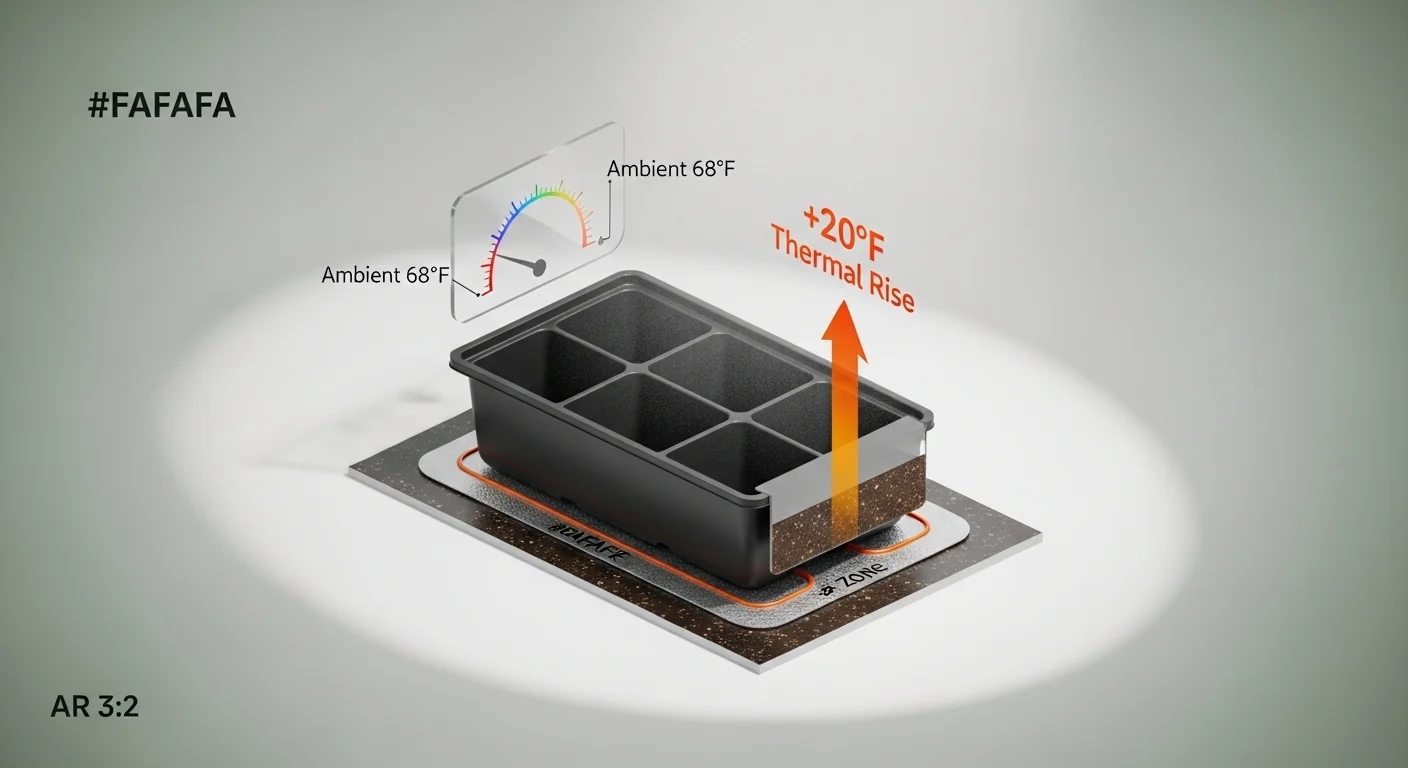
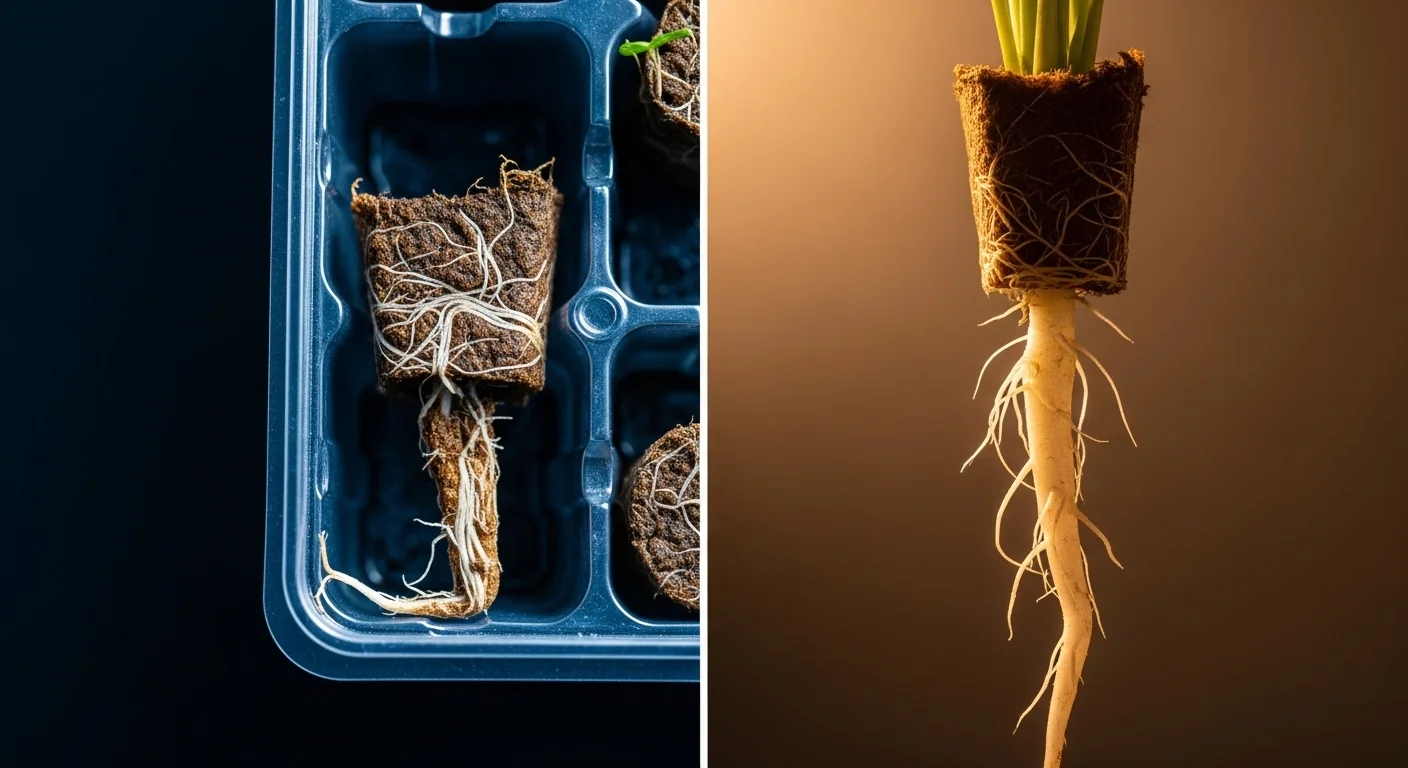
Heat mats fail growers not because they lack power, but because they are paired incorrectly with room conditions or run without any temperature control. A mat that raises soil temperature 20°F above ambient becomes a root-killing device the moment ambient creeps above 68°F and no thermostat probe is in the loop. This is the calculation most guides skip: the relationship between ambient temperature, mat watt density, and the actual soil temperature the roots experience.
This tool computes the recommended watt capacity for your propagation setup based on the number of standard 10×20 trays, your room’s ambient temperature, and your target soil temperature. It then applies a deterministic thermal safety check to flag configurations where soil temperature will exceed the root-death threshold under uncontrolled conditions. It does not model dome condensation, radiant heat from grow lights, or soil-type thermal conductivity differences, each of which can shift real-world results by several degrees.
After running this calculator, you will know the minimum mat wattage to reach your target temperature, whether your current ambient conditions make a thermostat probe mandatory rather than optional, and the exact temperature threshold your setup must stay below to protect new taproots. For anyone sizing heat systems at the room or greenhouse level, the greenhouse heater sizing guide addresses the broader thermal envelope beyond the mat itself.
Use the Tool
Seedling Heat Mat Wattage Sizer
Size your heat mat & thermostat — prevent cooked roots, maximize germination.
60°F Ideal
78°F Caution
85°F Danger
95°F+
| Trays | Mat Area (sq ft) | Base Watts | Thermostat Needed? |
|---|
How this calculator works
Formula steps (in plain language):
Key safety threshold — the “Cooked Clone” rule: A heat mat running uncontrolled in a room at 68°F+ can push soil to 88–95°F within hours. At 88°F, delicate taproots suffer stress; above 90°F they brown and rot. A thermostat probe controller is the only reliable safeguard — it cuts power when the probe hits your set point.
Units: °F for temperature, W (Watts) for power, sq ft for area, 15 W/sq ft is the industry-standard watt density for propagation heat mats.
Assumptions & Limits
- Each tray is a standard 10″ × 20″ (1.38 sq ft) propagation flat.
- Watt density assumes 15 W/sq ft, the industry standard for seedling & clone propagation mats.
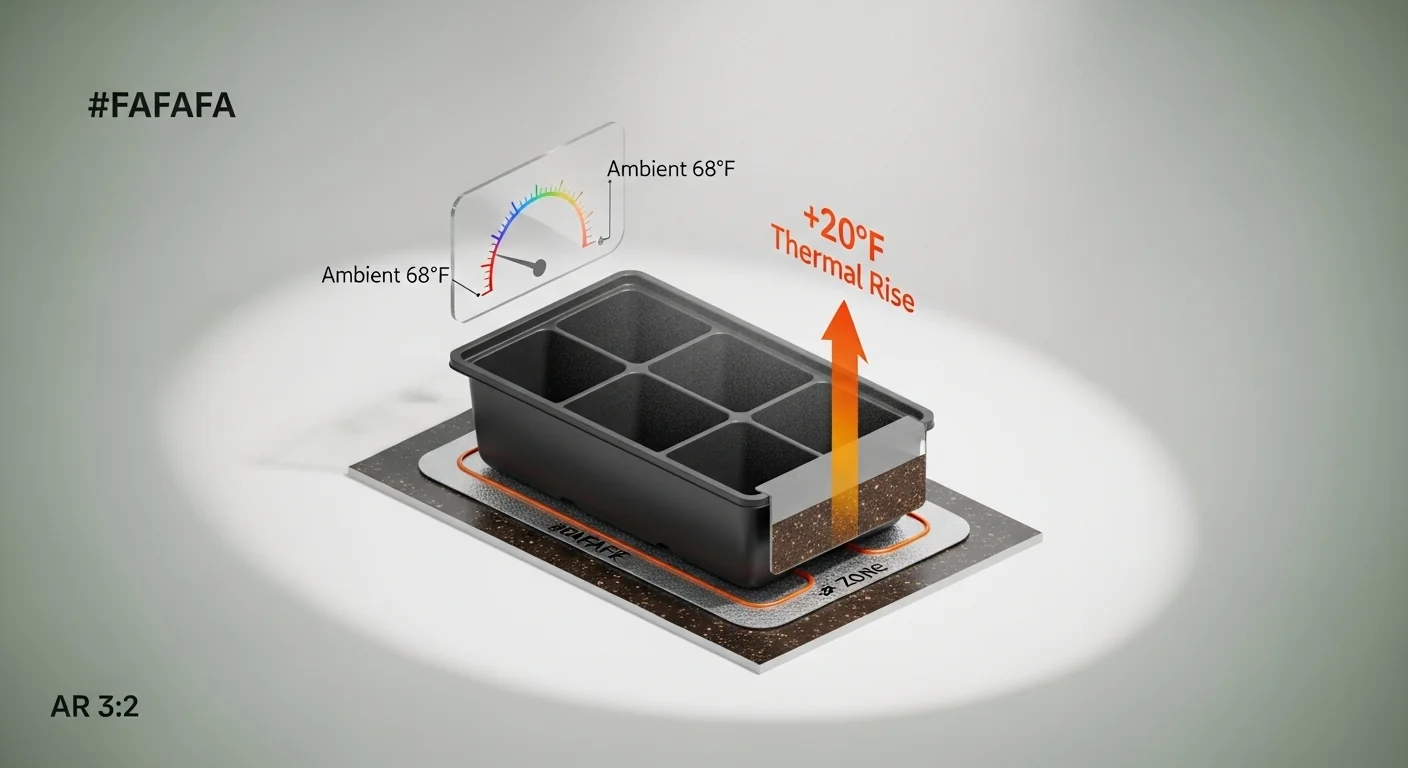
- Thermal rise modeled as +20°F above ambient for an uncontrolled mat; real-world values range 15–25°F depending on dome insulation, air circulation, and mat brand.
- A vented 7″ dome adds 2–5°F of additional insulation; factor this into your target temp.
- This tool assumes a flat, indoor grow surface with no direct sunlight heating.
- Accuracy: ±5°F. Always verify with a physical soil thermometer probe.
- Not a substitute for manufacturer guidelines. Always match mat wattage to the thermostat controller’s rated amperage.
- Ambient temperature valid range: 40°F – 95°F. Target temperature valid range: 60°F – 90°F.
Before entering values, have three pieces of information ready: the count of standard 10×20 trays you plan to run simultaneously, an accurate ambient air temperature reading taken at tray height (not a thermostat reading from a wall across the room), and your target soil or rooting-plug temperature in °F. Select “Yes” for the thermostat field only if you own a probe-type controller where the probe can be inserted directly into the rooting medium. If you use a simple on/off timer or a strip outlet, select “No.” For reference on heat load sizing in enclosed grow spaces, the greenhouse heater size calculator handles larger-scale thermal planning.
Quick Start (60 Seconds)
- Number of 10×20 Trays: Count only the trays sitting directly on the heat mat surface. Trays stacked above or beside the mat do not contribute to mat area. Enter a whole number from 1 to 50.
- Ambient Room Temperature (°F): Measure at tray height, not ceiling height. In a sealed tent or grow room, the floor zone can be 5°F to 8°F cooler than the air temperature displayed on a wall controller. Use 40–95 °F.
- Target Soil / Rooting Plug Temp (°F): For most seeds and clones, 72–80 °F is the accepted safe range. Do not enter your thermostat set point here; enter the temperature you want the rooting medium to reach. Valid range: 60–90 °F.
- Thermostat Probe Attached? Select “Yes” only for a probe controller with a physical sensor inserted into the grow medium. Timers, Wi-Fi plugs, and smart strips do not qualify as thermostat control for this calculation’s safety logic.
- Common input error: Entering the tent air temperature rather than the floor ambient. The mat sits on the floor; its thermal baseline is the floor-zone air temperature, not the display on a wall controller.
- Do not leave any field blank before clicking Calculate. The tool validates all fields and will not display results until every input passes range checks.
- Recheck after layout changes: Adding a dome, moving the mat, or switching rooms all change the effective ambient. Recalculate whenever the physical setup changes.
Inputs and Outputs (What Each Field Means)
| Field | Unit | What It Means | Common Mistake | Safe Entry Guidance |
|---|---|---|---|---|
| Number of 10×20 Trays | Count (whole number) | The count of standard propagation flats placed directly on the heat mat surface. Each flat covers 1.38 sq ft. | Counting trays on a rack above the mat rather than those in direct contact with it. | 1 to 50 trays. Whole numbers only. Non-integers are rejected. |
| Ambient Room Temperature | °F | The actual air temperature at tray height where the mat is operating, measured before the mat is switched on. | Using the thermostat set point for the room rather than a measured floor-zone temperature. | 40–95 °F. Measure with a probe thermometer placed at tray surface level. |
| Target Soil / Rooting Plug Temp | °F | The soil or rooting-medium temperature you want to maintain for germination or clone propagation. | Entering ambient air temperature instead of the desired rooting-medium temperature. | 60–90 °F. Optimal for most crops: 72–80 °F. |
| Thermostat Probe Attached | Yes / No | Whether a probe-type temperature controller with its sensor inserted into the rooting medium is actively controlling the mat. | Selecting “Yes” for a simple timer or smart plug that has no temperature-sensing probe. | Select “Yes” only if a probe is physically inserted into the grow medium and the controller cycles the mat on/off based on that reading. |
| Recommended Mat Wattage (output) | Watts (W) | The minimum mat wattage required to heat the total tray area using the 15 W/sq ft industry standard density. | Assuming a lower-wattage mat will “get there eventually.” Undersized mats plateau below target temperature in cold ambients. | Match or exceed this number when selecting a mat. Rounding up to the nearest available mat size is correct practice. |
| Total Mat Area (output) | sq ft | The total surface area covered by the entered tray count (Trays × 1.38 sq ft). | Attempting to cover a larger mat area with a mat sized for fewer trays. | Used for cross-checking against the physical mat dimensions listed by the manufacturer. |
| Estimated Peak Soil Temp (output) | °F | The estimated maximum soil temperature if the mat runs without thermostat control (Ambient + 20 °F thermal rise). | Assuming the mat will self-limit. Standard heat mats have no internal temperature sensor and will continue heating indefinitely. | If this value exceeds 88 °F, thermostat control is not optional. |
Worked Examples (Real Numbers)
Example 1: Hobbyist, 2 Trays, Mild Basement
- Trays: 2
- Ambient: 62 °F
- Target soil temp: 78 °F
- Thermostat probe: Yes
Area = 2 × 1.38 = 2.76 sq ft
Watts = 2.76 × 15 = 41.4 → rounded to 41 W
Estimated peak (uncontrolled) = 62 + 20 = 82 °F
Required temperature lift = 78 − 62 = 16 °F
Result: 41 W with thermostat set to 78 °F. The mat can deliver the required 16 °F lift easily. Uncontrolled peak of 82 °F is in the caution zone but below the root-death threshold, making the thermostat a strong recommendation here rather than a hard requirement. With a probe controller in place, this setup is safe and correctly sized.
Example 2: Small Nursery, 6 Trays, Cold Warehouse
- Trays: 6
- Ambient: 50 °F
- Target soil temp: 76 °F
- Thermostat probe: Yes
Area = 6 × 1.38 = 8.28 sq ft
Watts = 8.28 × 15 = 124.2 → rounded to 124 W
Estimated peak (uncontrolled) = 50 + 20 = 70 °F
Required temperature lift = 76 − 50 = 26 °F
Result: 124 W minimum. A thermostat is required. The required lift of 26 °F exceeds the standard 20 °F thermal rise capacity of a bare mat, which means the mat alone may not reach the target without an enclosed dome to trap heat. The thermostat probe placed inside a rooting plug prevents overshoot once the dome is added. A cold warehouse environment also increases the risk of uneven mat heating at the tray edges; monitor corner tray temperatures separately.
Example 3: Clone Station, 4 Trays, Warm Grow Room (No Thermostat)
- Trays: 4
- Ambient: 74 °F
- Target soil temp: 78 °F
- Thermostat probe: No
Area = 4 × 1.38 = 5.52 sq ft
Watts = 5.52 × 15 = 82.8 → rounded to 83 W
Estimated peak (uncontrolled) = 74 + 20 = 94 °F
Result: 83 W calculated, but this configuration is flagged as dangerous. With no thermostat and an ambient of 74 °F, the uncontrolled soil temperature will reach approximately 94 °F. At that temperature, newly formed taproots die within hours. The 4 °F gap between ambient and target is also so narrow that any thermostat set point control is hard to maintain without a sensitive probe controller. This is the exact scenario the tool is designed to intercept: the wattage calculation looks reasonable, but the thermal runaway risk makes plug-in operation unacceptable.
Reference Table (Fast Lookup)
All values assume 15 W/sq ft watt density, 1.38 sq ft per standard 10×20 tray, 20 °F uncontrolled thermal rise, and a target soil temperature of 78 °F. “Max Safe Ambient (No Thermostat)” is the highest ambient temperature at which the uncontrolled mat keeps soil below 88 °F (the root-stress threshold); this column is derived from the formula: 88 − 20 = 68 °F for all configurations.
| Trays | Mat Area (sq ft) | Recommended Watts | Temp Lift Needed (78°F target, 65°F ambient) | Max Safe Ambient Without Thermostat (°F) | Thermostat Status |
|---|---|---|---|---|---|
| 1 | 1.38 | 21 W | 13 °F | 68 °F | Recommended |
| 2 | 2.76 | 41 W | 13 °F | 68 °F | Recommended |
| 3 | 4.14 | 62 W | 13 °F | 68 °F | Required (above 30 W threshold) |
| 4 | 5.52 | 83 W | 13 °F | 68 °F | Required |
| 6 | 8.28 | 124 W | 13 °F | 68 °F | Required |
| 8 | 11.04 | 166 W | 13 °F | 68 °F | Required |
| 10 | 13.80 | 207 W | 13 °F | 68 °F | Required |
| 12 | 16.56 | 248 W | 13 °F | 68 °F | Required |
| 16 | 22.08 | 331 W | 13 °F | 68 °F | Required; consider multi-zone controllers |
| 20 | 27.60 | 414 W | 13 °F | 68 °F | Required; verify circuit amperage (414 W / 120 V = 3.45 A minimum) |
Key derived insight: The “Max Safe Ambient Without Thermostat” column is a fixed 68 °F regardless of tray count. Wattage does not change this threshold. The thermal runaway risk is an ambient temperature problem, not a wattage problem, which is why simply buying a smaller mat does not make plug-in operation safe in a warm room.
How the Calculation Works (Formula + Assumptions)
Show the calculation steps
Step 1 – Total Mat Area
Each standard 10×20 tray measures 10 inches by 20 inches = 200 square inches = 1.388… sq ft, rounded to 1.38 sq ft in this tool.
Total Area (sq ft) = Number of Trays × 1.38
Step 2 – Recommended Wattage
The propagation industry standard watt density for seedling heat mats is 15 W per square foot. This figure is derived from commercially available mat specifications and is consistent across VIVOSUN, Jump Start, and Hydrofarm product lines at standard tray sizing.
Recommended Watts = Total Area × 15
Output is rounded to the nearest whole watt.
Step 3 – Estimated Uncontrolled Peak Soil Temperature
A standard propagation heat mat running continuously adds approximately 20 °F above the ambient air temperature at the rooting medium. This is a conservative midpoint of the documented 15–25 °F rise range.
Peak Soil Temp (no thermostat) = Ambient °F + 20
Step 4 – Danger Threshold Check
If Peak Soil Temp exceeds 88 °F, the tool flags the configuration as a root-danger zone. If it exceeds 90 °F, a thermal runaway warning is triggered. These thresholds are derived from horticultural data on root-zone heat tolerance in seedlings and cuttings.
Step 5 – Required Temperature Lift (Delta T)
Delta T = Target Soil Temp − Ambient Temp
If Delta T is 2 °F or less, the tool flags a marginal lift warning: the mat will cycle constantly and the thermostat will struggle to maintain stable control.
Rounding rules: Area is computed to 2 decimal places internally. Wattage output is rounded to the nearest whole watt. Temperature values are rounded to the nearest whole degree Fahrenheit.
Assumptions and Limits
- Each tray is assumed to be exactly a standard 10×20 inch (1.38 sq ft) propagation flat. Jumbo flats, square pots, or custom containers require manual area calculation and will not match these outputs.
- The 20 °F thermal rise is a modeled average. Real-world thermal rise varies from 15 °F to 25 °F depending on mat brand, rooting medium thermal conductivity, dome height, and ventilation rate.
- The 15 W/sq ft watt density is the propagation industry standard for seedling mats. High-output propagation heating cables operate at higher densities and are outside this tool’s scope.
- This tool models a single-layer flat configuration. Stacking or multi-tier setups require zone-by-zone calculations.
- No correction is applied for radiant heat from grow lights, which can add 2 °F to 10 °F to the rooting zone depending on fixture type and distance.
- Circuit safety is not modeled. For large multi-tray setups, always verify that mat wattage plus other connected loads stay within the circuit breaker’s rated capacity.
- Accuracy of results is approximately ±5 °F relative to actual measured soil temperature. A physical soil thermometer probe remains the definitive verification tool.
- The tool is calibrated for Fahrenheit. No Celsius conversion is built in; convert ambient and target temperatures manually before entry if working in metric units.
Standards, Safety Checks, and “Secret Sauce” Warnings
The single most underreported hazard in propagation heating is not equipment failure; it is correct equipment operated incorrectly. A properly rated mat run without a probe controller is more dangerous in practical terms than an undersized mat, because it will consistently overshoot in any room where ambient temperature is above 68 °F.
Critical Warnings:
- The 68 °F ambient ceiling for uncontrolled operation: Standard heat mats add approximately 20 °F of thermal rise above ambient. With no thermostat probe, any ambient at or above 68 °F will push soil temperature into the 88 °F root-stress zone. This is not a margin-of-safety rule; it is derived directly from the thermal rise formula.
- Taproots die at 90 °F: Newly formed taproots in rooting plugs have a narrow viable temperature window. Above 90 °F, root cell proteins begin to denature. The progression from healthy white roots to brown, mushy, dead tissue can occur within 2 to 4 hours of sustained exposure. The loss is typically total: there is no recovery from thermally cooked roots.
- Probe placement determines accuracy: A thermostat probe taped to the bottom of a tray, clipped to a metal rack, or hanging in open air does not measure soil temperature. It measures surface or air temperature, which can be 8 °F to 15 °F cooler than the rooting plug interior. The probe must be inserted into the center of a rooting plug at tray mid-depth to give a reading the controller can act on correctly. Checking VPD alongside temperature helps confirm your propagation environment is within range; the VPD calculator is a practical companion tool for this.
- Dome insulation adds heat load: A 7-inch vented propagation dome can add 2 °F to 5 °F to the internal air temperature above what the mat alone produces. In warm ambient conditions, this additional insulation effect compounds the thermal runaway risk. Factor this into your target temperature before entering values. Managing heat load in enclosed spaces is addressed in more detail through the grow room AC sizing calculator.
Minimum Standards:
- Any heat mat setup operating in ambient conditions above 68 °F must use a probe-type thermostat controller. This is not a preference; it is a minimum viable safety configuration for the tray and clone values this tool is designed for.
- Thermostat controllers must be rated for the total mat wattage. At 120 V, a 10-amp controller handles up to 1,200 W. Verify that total connected wattage stays below the controller’s amperage rating.
- Rooting plug temperature should be verified independently with a handheld soil thermometer after initial setup and after any layout change. Calculator output is a sizing guide, not a real-time measurement.
Competitor Trap: Most seedling heat mat sizing guides recommend a mat and move on, treating the thermostat as optional accessory advice buried in a footnote. That framing makes the wattage calculation the main deliverable when the actual decision point is whether the ambient temperature makes uncontrolled operation physically dangerous. A grower who buys the correctly sized mat and skips the thermostat because the guide implied it was optional will still lose their crop to thermal runaway in a typical 70 °F grow room. The wattage number is only useful when paired with the ambient temperature safety check, which is why this tool runs both calculations together and locks out silent pass-through when the uncontrolled peak temperature exceeds the root-death threshold.
Common Mistakes and Fixes
Mistake: Using Wall Thermostat Air Temperature as the Ambient Input
Wall thermostats and environmental controllers measure air temperature at the sensor’s mounted height, typically 4 to 6 feet off the floor. Floor-level air, where propagation trays sit, is consistently cooler in conditioned spaces, sometimes by 5 °F to 8 °F. Entering the wall reading understates actual ambient temperature, which causes the tool to underestimate the thermal runaway risk. For airflow and temperature stratification in grow tents, the grow tent fan size calculator addresses how ventilation affects temperature gradients.
Fix: Place a probe thermometer or digital hygrometer at tray-surface height for 10 to 15 minutes before measuring ambient temperature. Use that reading as the tool input.
Mistake: Selecting “Yes” for Thermostat When Using a Timer or Smart Plug
Timers, Wi-Fi outlets, and smart plugs cycle the mat on a schedule, not in response to a temperature reading. They do not prevent thermal runaway. A mat running on a timer in a 74 °F room will reach soil temperatures of approximately 94 °F during any “on” cycle long enough for the mat to reach steady state, regardless of how frequently the schedule cycles.
Fix: Use the “No” selection for any control method that does not involve a physical temperature probe reading the rooting medium. Only a probe-type controller qualifies.
Mistake: Sizing the Mat to the Tray Count but Ignoring the Controller’s Watt Rating
A correctly sized 124 W multi-tray mat paired with a low-rated controller creates a different failure mode: the controller may overheat, weld its relay contacts open, or simply fail, leaving the mat running uncontrolled. Entry-level probe controllers are often rated for 8 amps (960 W at 120 V), which is adequate for most hobby setups, but check before connecting.
Fix: Verify that the thermostat controller’s watt or amp rating exceeds the total connected mat wattage. When running multiple mats, either use a high-amperage controller or split mats across two independently controlled circuits.
Mistake: Placing the Thermostat Probe Under the Tray Rather Than Inside a Rooting Plug
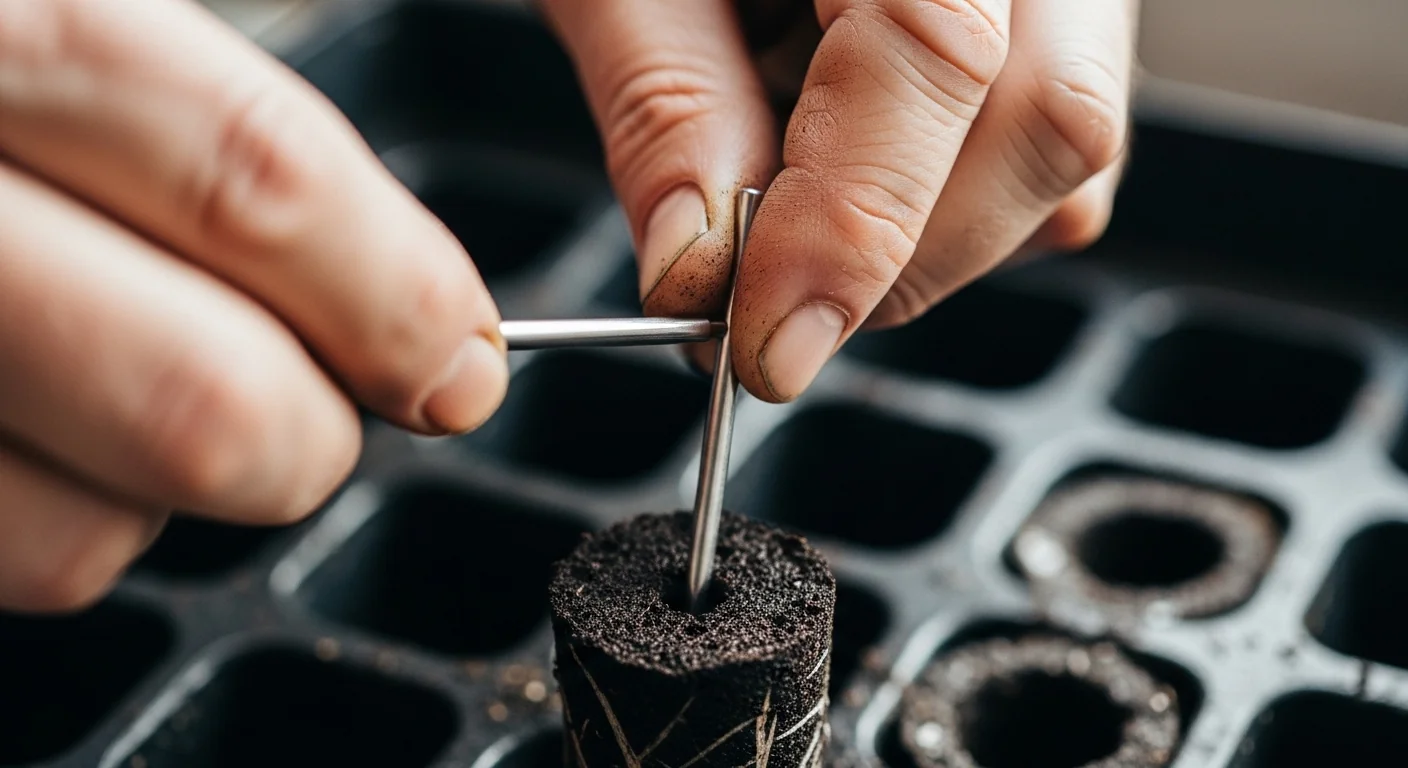
This is the single most common cause of “controlled” setups still cooking roots. The tray bottom is in direct contact with the mat surface and reads a temperature 10 °F to 15 °F higher than the rooting plug interior. When the probe is positioned there, the controller cuts power far too early, leaving the rooting medium significantly cooler than the set point. If it is taped to the tray bottom, the opposite problem occurs: the reading is so high that the controller keeps the mat off, leaving roots cold. Managing humidity inside the dome when temperatures are correct is a separate concern the grow room dehumidifier calculator can help address.
Fix: Insert the probe into the center of a filled rooting plug at mid-depth, oriented horizontally. This gives the controller the actual rooting-medium temperature it needs to regulate correctly.
Mistake: Assuming a Smaller Mat Wattage Eliminates the Thermal Runaway Risk
Growers sometimes reason that a lower-wattage mat is “safer” in a warm room because it produces less heat. This is incorrect. A 20 W mat and a 60 W mat both operate at approximately 15 W per square foot; the 20 W mat simply covers fewer trays. Both will add the same 15–20 °F of thermal rise above ambient per square foot when running continuously. The risk is proportional to ambient temperature and the absence of probe control, not to total wattage.
Fix: Do not use mat wattage as a proxy for thermal risk management. Use the ambient temperature threshold (68 °F maximum without a probe controller) as the governing safety criterion regardless of mat size.
Next Steps in Your Workflow
Once you have your wattage recommendation and have confirmed your setup passes the thermal runaway check, the immediate next step is physical verification. Set up the mat with your chosen controller, insert the probe into a rooting plug filled with your preferred medium (Rapid Rooter peat plugs and Rockwool both have different thermal properties), and allow the system to reach steady state for one to two hours before introducing cuttings or seeds. Measure the soil temperature with a separate handheld thermometer probe inserted into a second plug in the center of the tray. If the measured temperature is within 2 °F of your target, the setup is calibrated. If there is a larger gap, adjust the thermostat set point incrementally and recheck rather than making large corrections. For growers moving seedlings from propagation to an active grow environment, calculating your daily light integral is the logical follow-on step once root development is confirmed.
Beyond calibration, build a simple recheck habit into your propagation workflow. Any time ambient conditions change, such as a seasonal shift, an HVAC adjustment, or moving the setup to a different room, recalculate using updated ambient temperature inputs. The margin between a safe soil temperature and a lethal one is narrow enough that a 6 °F ambient increase can shift a borderline configuration into the danger zone. Tracking water temperature during fertigation is also relevant at this stage; cold irrigation water can temporarily drop rooting-plug temperatures and cause moisture stress in young roots, a problem the water temperature calculator addresses directly.
FAQ
What is the optimal seedling heat mat temperature for most vegetable seeds?
Most vegetable and herb seeds germinate reliably between 72 °F and 80 °F at the soil surface. Tomatoes, peppers, and basil are on the warmer end of that range, preferring 75–80 °F. Lettuce, spinach, and brassicas germinate well at 65–70 °F and can be harmed by prolonged exposure above 80 °F. Soil temperature at the seed, not air temperature, is the relevant measurement.
How does a propagation dome affect heat mat temperature?
A vented 7-inch dome traps humid air above the tray, adding an insulating layer that raises internal air and soil surface temperature by roughly 2 °F to 5 °F above what the mat alone produces. In cool ambient conditions this is beneficial. In warm rooms it amplifies thermal risk. Venting the dome partially when temperatures inside approach 80 °F is standard practice to avoid condensation-related mold and heat stress.
Can I run two heat mats off one thermostat controller?
Yes, provided the combined wattage of both mats does not exceed the controller’s rated capacity. At 120 V, a 10-amp controller handles up to 1,200 W. Add the wattage of both mats, confirm the total is below the controller’s limit, and use a single probe inserted into the center tray of the combined layout. Edge trays may run slightly cooler; check them independently with a handheld probe during initial calibration.
Why does my thermostat probe read a different temperature than my soil thermometer?
Probe placement and probe tip design account for most of the discrepancy. A thermostat probe resting on top of a plug reads surface temperature, which is cooler than mid-depth rooting-zone temperature. Thin wire probes also respond faster and may show ambient fluctuations that a slower thermometer probe averages out. Insert both probes to the same depth in the same plug and allow both to stabilize for five to ten minutes before comparing readings.
What happens to clones if rooting plug temperature exceeds 90°F?
Newly forming roots in cuttings are metabolically active and highly temperature-sensitive. Sustained exposure above 90 °F denatures root cell proteins, disrupts water uptake, and causes the root tips to brown and die. This process is irreversible; there is no recovery once thermal damage occurs. The cutting may remain green for 12 to 24 additional hours before wilting, which leads growers to misdiagnose the failure as a humidity or cutting technique problem rather than a root-zone temperature problem.
Is a seedling heat mat the same as an electric propagation heating cable?
No. Heat mats are flat, low-profile resistive heating elements sized to cover one or more propagation trays with a fixed watt density, typically around 15 W per square foot. Heating cables are flexible, adjustable-length resistive wires embedded in soil or growing beds, often with higher watt-per-foot ratings. The wattage sizing formula in this calculator applies specifically to flat propagation mats and is not accurate for heating cables in soil beds or media fills.
Conclusion
Seedling heat mat temperature management is a two-part problem: getting the wattage right for your tray count is the first part, and ensuring the ambient conditions do not turn that correctly sized mat into a root-killing device is the second. The formula is straightforward. The 68 °F ambient ceiling for uncontrolled operation is the number most guides omit, and it is the number that separates successful propagation runs from unexplained crop losses.
The most avoidable failure in heat mat propagation is skipping a thermostat probe because the mat “feels warm enough” or because the wattage recommendation appeared modest. Every additional degree of ambient temperature shrinks the margin between your target soil temperature and the 90 °F cook threshold. Size the mat for your tray count, run a probe controller in any room above 68 °F, and verify with a physical soil thermometer after setup. For growers also managing heating at the room or structure level, the greenhouse heater size calculator handles the larger thermal envelope that the mat and dome operate within.