
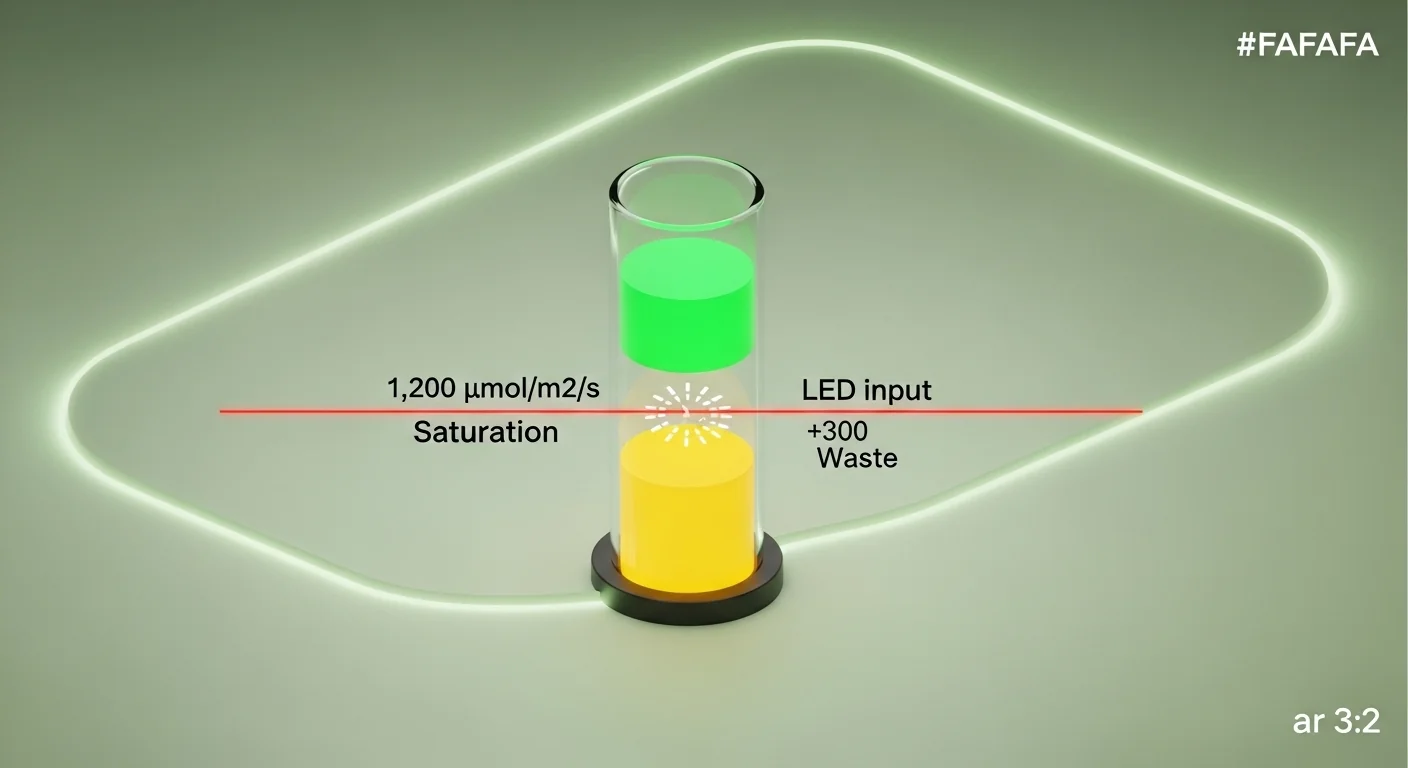
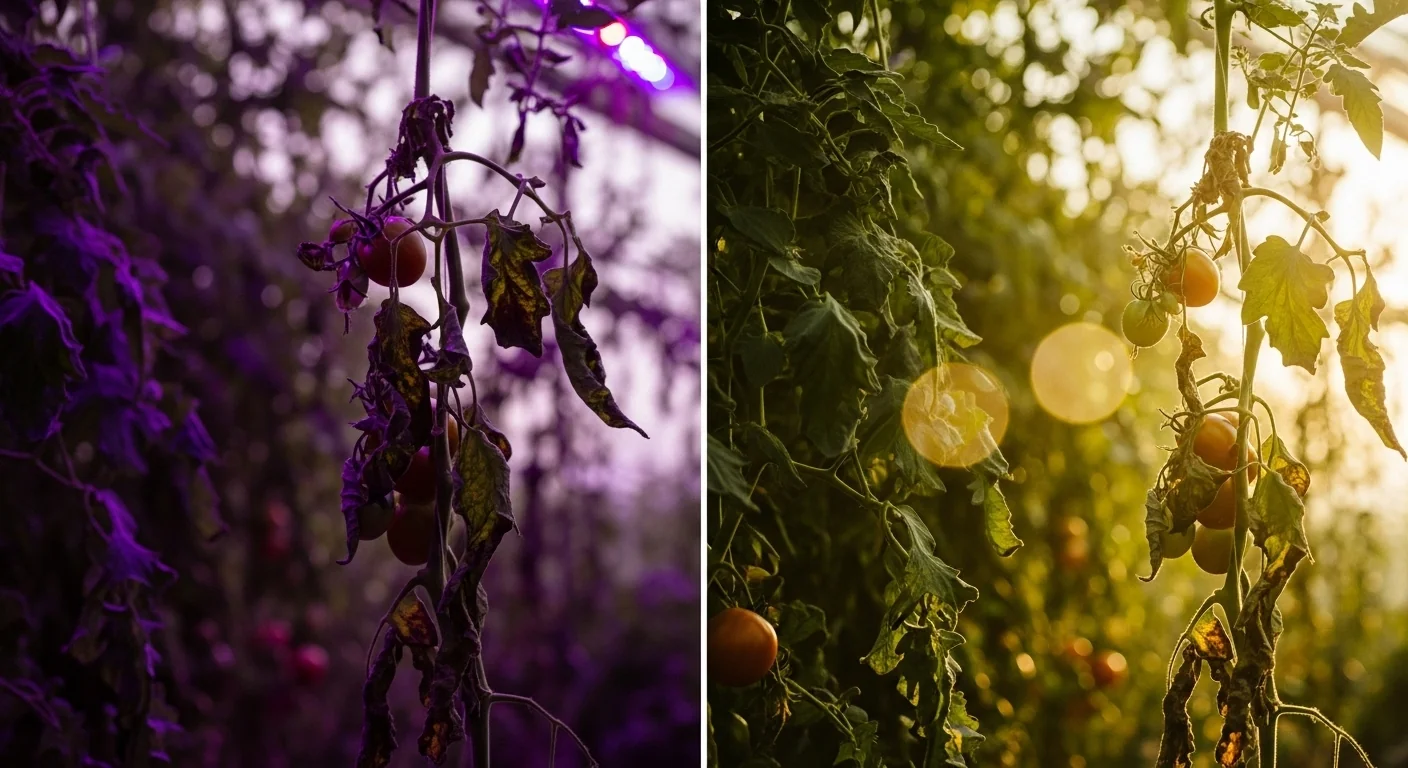
Growers commonly frame the supplemental lighting problem as a simple hours-of-light question, but the actual bottleneck is the DLI deficit: the gap between what the sun delivers on your worst winter days and what your target crop physiologically requires. That gap is not fixed across the season, across geographies, or even across cloudcover patterns within the same week. Treating it as a constant leads to schedules that either leave crops chronically underfed or that run fixtures into peak solar irradiance windows where the plant’s photosynthetic system is already saturated and the extra PPFD converts to canopy heat rather than carbohydrates.
This calculator takes four measured or spec-sheet inputs and returns the hours of supplemental lighting needed to close your specific DLI deficit. It tells you whether your planned schedule covers that deficit, whether your total photoperiod exceeds documented crop safety thresholds, and whether your fixture’s PPFD overlaps with peak solar irradiance in a way that produces waste heat. What it does not do is account for greenhouse glazing transmittance loss, canopy PPFD uniformity variation across the growing footprint, or multi-zone fixture configurations. Use it as a precision scheduling baseline, not as a substitute for canopy-level PAR measurements. If you want to understand your baseline solar DLI input before running this tool, the DLI calculator can help you translate your location’s average daily radiation into mol/m²/d.
After running the numbers, you will know exactly how many hours per day your fixture needs to run to meet your crop’s DLI target, whether to flag a photoperiod or heat-waste risk before committing to that schedule, and whether a different PPFD output fixture would let you close the deficit in fewer, better-timed hours.
Use the Tool
Daily Supplemental DLI Offset Calculator
Greenhouse supplemental lighting — eliminate waste, maximize photosynthesis
| Crop | Target DLI | Deficit at Your Solar | Hours Req. at Your PPFD |
|---|
How This Calculator Works
Step 1 — DLI Deficit
Subtract your measured solar DLI from the crop’s target DLI to find how much light still needs to come from your fixtures:
Units: mol/m²/d
If Solar DLI already meets or exceeds the target, no supplemental lighting is needed.
Step 2 — Hours Required
Convert the DLI deficit into hours using your fixture’s PPFD. The conversion factor 0.0036 transforms µmol/m²/s × hours into mol/m²/d:
Because: 1 mol/m²/d = 1 µmol/m²/s × 3600s ÷ 1,000,000 × hours
Step 3 — Supplemental DLI Delivered
Calculate how much DLI your fixture actually delivers in your desired hours:
Step 4 — Photosynthetic Saturation Check (Secret Sauce)
Most crops have a light saturation point. Above this, additional PPFD adds heat — not photosynthesis:
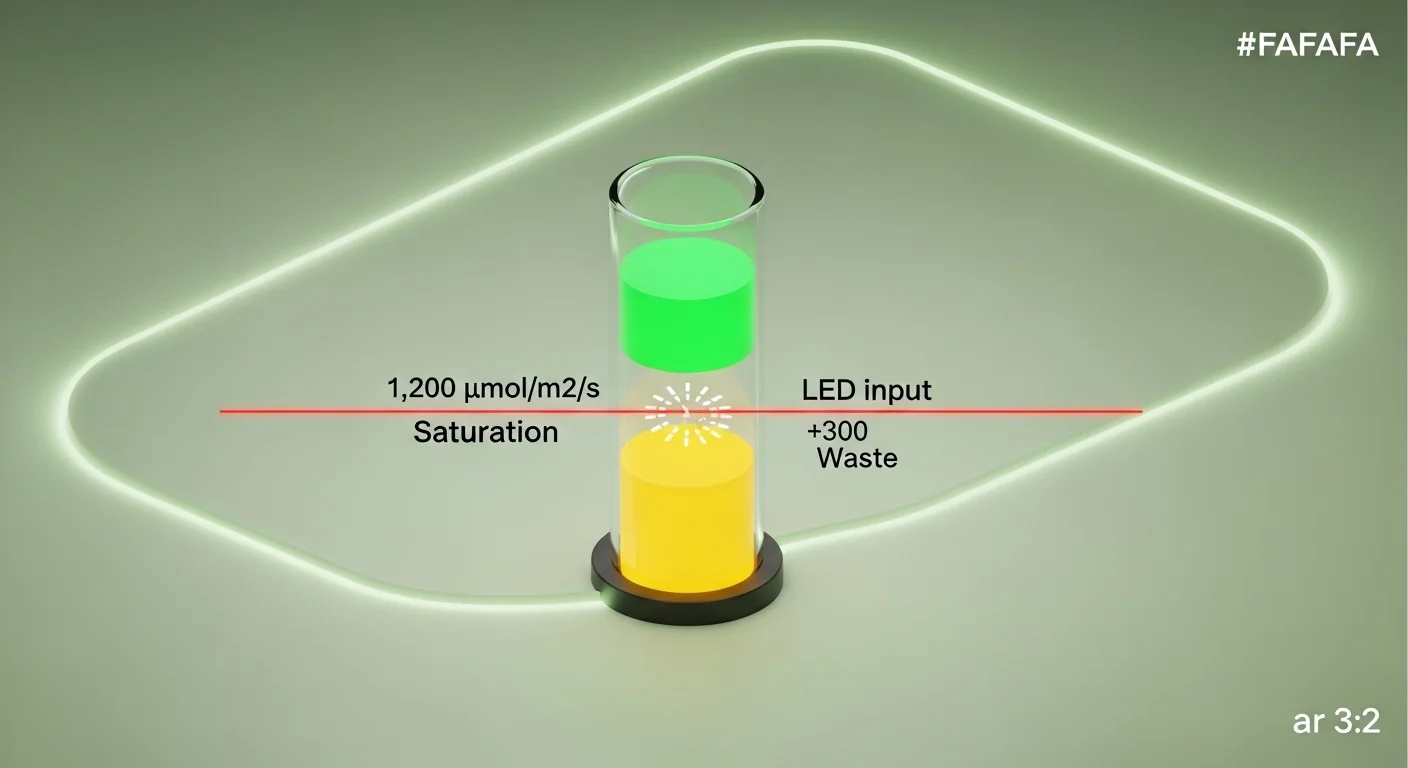
If Solar PPFD (noon peak ~1,000) + LED PPFD > 1,200 → WASTE WARNING
The tool flags heat-waste overlap when your LED adds PPFD during peak solar hours where total PPFD would exceed the crop saturation point.
Assumptions
- PPFD is uniform across the canopy (use your PAR meter to verify footprint).
- Solar DLI is a daily average — actual noon peak varies.
- Tomato photosaturation point: 1,200 µmol/m²/s.
- Total photoperiod = solar daylight (~12 hrs assumed) + supplemental hours.
- No light loss from greenhouse glazing accounted for by default.
Assumptions & Limits
This tool is designed for commercial greenhouse and controlled environment agriculture supplemental lighting decisions. Key assumptions and limits:
- Solar DLI range: 0 to 60 mol/m²/d. Enter measured or NREL data for your location.
- Target DLI range: 1 to 80 mol/m²/d. Crop-specific values from university extension guides.
- PPFD range: 1 to 3,000 µmol/m²/s. Commercial LEDs typically output 400–2,000 µmol/m²/s at canopy.
- Photoperiod stress: Tomatoes are particularly sensitive to photoperiod > 18 hrs/day (long-day stress).
- Saturation ceiling: Uses 1,200 µmol/m²/s for tomatoes. Adjust for other crops accordingly.
- Noon heat waste: Flagged when combined LED + solar PPFD exceeds saturation point during peak hours.
- No glazing transmittance correction: Glass/poly films reduce solar DLI by 10–30%. Adjust solar DLI input accordingly.
- DLI assumes continuous delivery: Pulsed lighting schedules may differ from PPFD × hours calculations.
- This calculator is an educational aid and does not replace on-site measurement with a calibrated quantum PAR sensor (e.g., Apogee SQ-520).
Before entering values, have the following ready: your location’s average winter solar DLI (available from NREL’s National Solar Radiation Database or comparable regional datasets), your crop’s published target DLI, and the canopy-level PPFD output of your specific fixture as measured with a calibrated quantum sensor rather than taken from a manufacturer’s ceiling-mount spec. If you want to cross-check what running those supplemental hours will cost in electricity, the grow light cost calculator can run that side of the equation.
Enter Solar DLI and Target Crop DLI in mol/m²/d, your fixture’s canopy PPFD in µmol/m²/s, and your intended daily supplemental run time in hours. The tool runs all calculations client-side on your device and produces results only after all four fields contain valid values within their stated ranges.
Quick Start (60 Seconds)
- Solar DLI (mol/m²/d): Use your regional winter average, not a single sunny-day reading. Northern US winter values typically fall between 5 and 15 mol/m²/d. NREL’s NSRDB or your local extension office publishes monthly averages by county.
- Target Crop DLI (mol/m²/d): Use published crop-specific targets: tomatoes 20–30, lettuce 12–17, cucumbers 20–25, basil 14–18. Do not average across crops in a mixed planting without running separate calculations for each species.
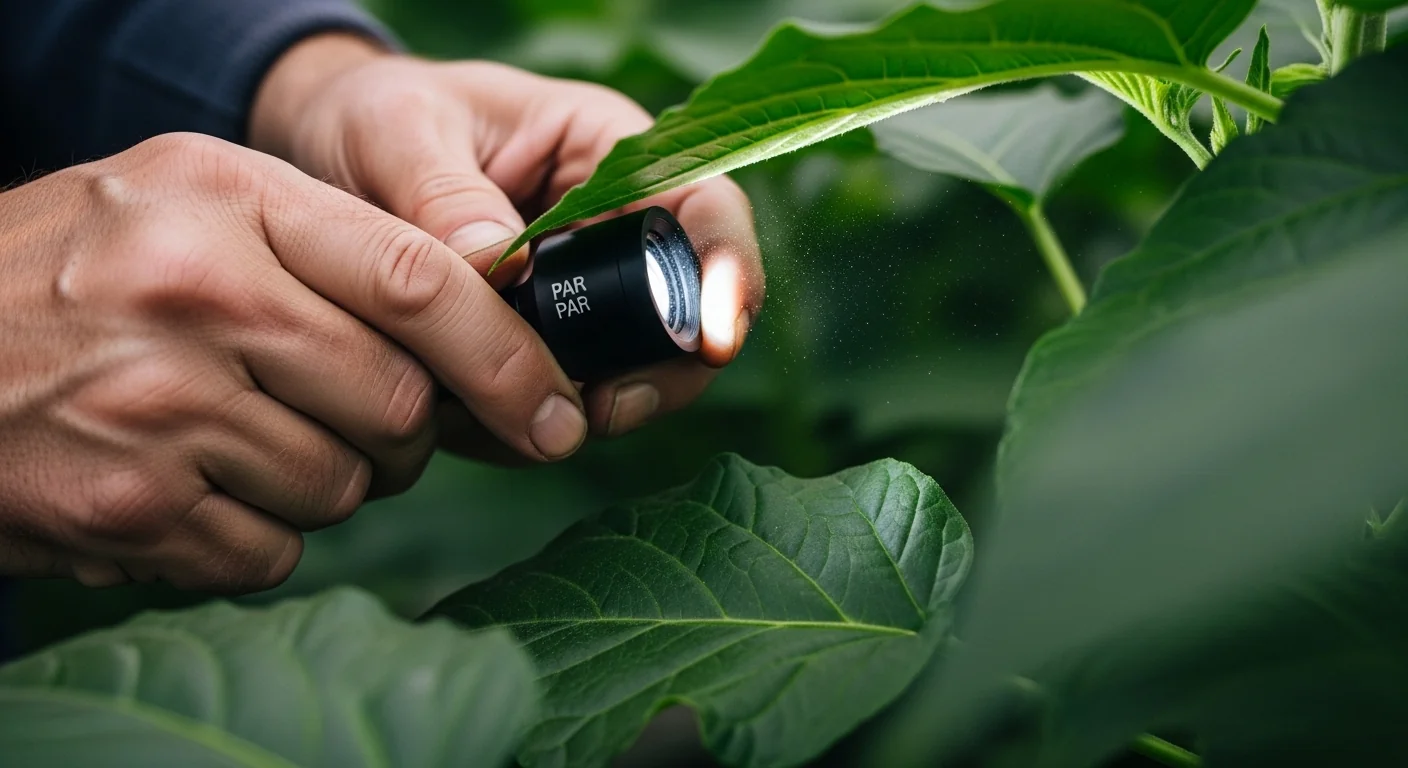
- LED Fixture PPFD (µmol/m²/s): Use canopy-level measurements from a quantum PAR sensor, not ceiling-mount or theoretical fixture output. Canopy PPFD can be 20–40 points lower than ceiling PPFD at typical mounting heights. Manufacturer specs are measured at a fixed distance under controlled conditions.
- Desired Supplemental Hours (hrs/day): Enter your planned run time. The tool will tell you whether it is enough to close the deficit and whether it pushes total photoperiod past the 18-hour threshold relevant for tomatoes.
- Watch the coverage gauge: The gauge shows what fraction of target DLI your combined solar plus supplemental input achieves. Aim for 100–115 points; anything higher signals a schedule reduction opportunity that saves power without sacrificing yield.
- Check all warning flags: The warnings box runs four deterministic checks. A heat-waste flag means your fixture is running during peak solar irradiance windows and delivering PPFD the crop cannot convert. That is recoverable with a simple controller time-block, not a fixture replacement.
- Read the reference table: After calculation, the in-tool crop table recomputes required hours for common crops at your specific PPFD and solar DLI inputs, letting you quickly compare a fixture change scenario without re-entering data.
Inputs and Outputs (What Each Field Means)
| Field | Unit | What It Measures | Common Entry Mistake | Safe Entry Guidance |
|---|---|---|---|---|
| Solar DLI | mol/m²/d | Total photosynthetically active radiation delivered by the sun in one day at canopy level, integrated from sunrise to sunset | Using a bright-day reading instead of the monthly low average; this overestimates solar contribution and undersizes supplemental hours | Use the monthly 10th-percentile value for your location rather than the median; protects against the worst consecutive overcast periods |
| Target Crop DLI | mol/m²/d | The minimum daily light integral documented in crop-physiology literature to sustain target yield and quality for the specified species | Using the high end of a published range (e.g., 30 instead of 20 for tomatoes) when at the vegetative stage rather than peak fruiting | Match the target to the current growth stage; vegetative and fruiting phases often have different requirements within the same species |
| LED Fixture PPFD | µmol/m²/s | Photosynthetic Photon Flux Density at canopy level; the instantaneous light intensity the fixture delivers where plants actually intercept it | Copying the spec-sheet PPFD measured at 18 inches without correcting for actual mounting height; real canopy PPFD is routinely lower | Measure at canopy center with an Apogee SQ-520 or equivalent quantum sensor; take at least 5 readings across the footprint and use the average |
| Desired Supplemental Hours | hrs/day | The number of hours per day you plan to operate the fixture; compared against the calculated required hours to flag under- or over-supply | Setting this to 18 or 20 hours without checking whether the total photoperiod (solar daylight + supplemental) exceeds crop-safe limits | Start with the required hours output from the tool, then adjust for controller limitations; confirm total photoperiod stays within species tolerance |
| Hours Required (output) | hrs/day | The daily runtime your fixture needs at its current PPFD to fully close the DLI deficit | Treating this as the only number that matters and ignoring whether running those hours pushes past noon-peak overlap or photoperiod limits | Use this as your target but review all four warning flags before committing to the schedule |
| DLI Deficit (output) | mol/m²/d | The difference between target crop DLI and measured solar DLI; the quantity that supplemental lighting must supply | Assuming the deficit is constant across the winter; it narrows significantly in late winter as day length increases | Recalculate monthly as your solar DLI rises; this allows progressive dimming or schedule reduction rather than running at peak winter settings year-round |
| Supplemental DLI Delivered (output) | mol/m²/d | The DLI actually provided by your fixture during your planned run hours, calculated as PPFD times 0.0036 times hours | Assuming this value equals the deficit; if the desired hours exceed required hours, supplemental DLI will overshoot and waste energy | Compare against DLI Deficit to identify overshoot; reduce hours to bring supplemental DLI within 10–15 points of the deficit |
| Total Photoperiod (output) | hrs/day | Solar daylight hours (assumed 12) plus your planned supplemental run hours; used to check species-specific photoperiod tolerance | Assuming solar daylight hours are negligible in winter; even a 9-hour winter day adds significantly to the total photoperiod calculation | Verify the 12-hour solar assumption matches your actual latitude and season; adjust the supplemental schedule to keep total photoperiod within documented crop limits |
| Coverage vs Target (output) | fraction shown as a gauge value | Total DLI (solar plus supplemental) divided by target DLI, displayed as a gauge from 0 to 150; shows whether the plan meets, falls short of, or exceeds crop requirements | Treating 100 as a hard requirement and 101 as acceptable without checking whether the excess represents meaningful energy cost over a 180-day winter season | Target 100–115 for most crops; anything above 130 at sustained solar DLI levels signals a schedule that can be reduced without yield impact |
Worked Examples (Real Numbers)
Scenario 1: Winter Tomato, Pacific Northwest (High Deficit, High PPFD)
- Solar DLI: 8 mol/m²/d
- Target Crop DLI: 25 mol/m²/d
- LED Fixture PPFD: 600 µmol/m²/s
- Desired Supplemental Hours: 12 hrs/day
DLI Deficit = 25 − 8 = 17 mol/m²/d
Hours Required = 17 ÷ (600 × 0.0036) = 17 ÷ 2.16 = 7.87 hrs
Supplemental DLI Delivered = 600 × 0.0036 × 12 = 25.92 mol/m²/d
Total Photoperiod = 12 (solar) + 12 = 24 hrs
Result: 7.87 hours required; planned 12-hour schedule delivers 25.92 mol/m²/d against a 17 mol/m²/d deficit and pushes total photoperiod to 24 hours.
Two critical flags appear here. First, noon-peak combined PPFD (1,000 solar + 600 fixture = 1,600 µmol/m²/s) exceeds the tomato photosaturation ceiling of 1,200 µmol/m²/s, meaning 400 µmol/m²/s is producing heat, not photosynthesis. Second, the 24-hour total photoperiod significantly exceeds the 18-hour documented safety threshold for tomatoes. Simply blocking the fixture between approximately 10 a.m. and 2 p.m. and cutting runtime to 7.9 hours solves both problems simultaneously.
Scenario 2: Commercial Lettuce, Mid-Atlantic Winter (Low Deficit, Low
PPFD)
- Solar DLI: 12 mol/m²/d
- Target Crop DLI: 14 mol/m²/d
- LED Fixture PPFD: 200 µmol/m²/s
- Desired Supplemental Hours: 4 hrs/day
DLI Deficit = 14 − 12 = 2 mol/m²/d
Hours Required = 2 ÷ (200 × 0.0036) = 2 ÷ 0.72 = 2.78 hrs
Supplemental DLI Delivered = 200 × 0.0036 × 4 = 2.88 mol/m²/d
Total Photoperiod = 12 + 4 = 16 hrs
Combined Noon PPFD = 1,000 + 200 = 1,200 µmol/m²/s (at threshold)
Result: 2.78 hours required; the planned 4-hour schedule delivers a slight overshoot with no photoperiod or heat-waste warnings triggered.
This is a well-controlled scenario. The small DLI deficit means even a low-output fixture can close the gap in under three hours, the total photoperiod of 16 hours is within documented lettuce tolerance, and the combined noon PPFD sits exactly at the 1,200 µmol/m²/s boundary. Reducing the schedule from 4 hours to 2.8 hours would cut supplemental energy use without any measurable crop impact.
Scenario 3: Cannabis Vegetative Stage, Northern Climate Deep Winter
(Extreme Deficit)
- Solar DLI: 5 mol/m²/d
- Target Crop DLI: 30 mol/m²/d (vegetative)
- LED Fixture PPFD: 800 µmol/m²/s
- Desired Supplemental Hours: 16 hrs/day
DLI Deficit = 30 − 5 = 25 mol/m²/d
Hours Required = 25 ÷ (800 × 0.0036) = 25 ÷ 2.88 = 8.68 hrs
Supplemental DLI Delivered = 800 × 0.0036 × 16 = 46.08 mol/m²/d
Total Photoperiod = 12 + 16 = 28 hrs
Result: Only 8.68 hours required; the planned 16-hour schedule massively overshoots the deficit and produces a biologically impossible total photoperiod of 28 hours per day.
This scenario illustrates a frequent error in controlled environments with very high PPFD fixtures: the fixture is powerful enough to close the deficit in roughly 9 hours, but the grower schedules it for 16 out of habit. The overshoot delivers 46 mol/m²/d against a 30 mol/m²/d target, and the combined noon PPFD of 1,800 µmol/m²/s (1,000 solar + 800 fixture) creates sustained heat-waste conditions. The fix is to run the fixture for 8.7 hours in split morning and evening blocks, avoiding the 10 a.m.–2 p.m. solar peak window entirely.
Reference Table (Fast Lookup)
All deficit and hours-required values are computed at Solar DLI = 10 mol/m²/d using the formula: Hours Required = (Target DLI − Solar DLI) ÷ (PPFD × 0.0036). Values exceeding 18 hours are flagged as they approach or exceed photoperiod limits for sensitive crops; values exceeding 24 hours are physically impossible under a single-fixture schedule.
| Crop | Target DLI (mol/m²/d) | Deficit at Solar DLI 10 | Hours Req. at 200 PPFD | Hours Req. at 400 PPFD | Hours Req. at 600 PPFD | Photoperiod Alert |
|---|---|---|---|---|---|---|
| Lettuce | 14 | 4 mol/m²/d | 5.56 hrs | 2.78 hrs | 1.85 hrs | None documented |
| Herbs / Basil | 16 | 6 mol/m²/d | 8.33 hrs | 4.17 hrs | 2.78 hrs | None documented |
| Strawberry | 20 | 10 mol/m²/d | 13.89 hrs | 6.94 hrs | 4.63 hrs | None documented |
| Cucumber | 22 | 12 mol/m²/d | 16.67 hrs | 8.33 hrs | 5.56 hrs | None documented |
| Tomato | 25 | 15 mol/m²/d | 20.83 hrs ⚠ | 10.42 hrs | 6.94 hrs | Max 18 hrs total photoperiod |
| Pepper | 25 | 15 mol/m²/d | 20.83 hrs ⚠ | 10.42 hrs | 6.94 hrs | Check variety sensitivity |
| Cannabis (vegetative) | 30 | 20 mol/m²/d | 27.78 hrs ✖ | 13.89 hrs | 9.26 hrs | 18 hrs minimum for veg (long-day) |
| Cannabis (flowering) | 40 | 30 mol/m²/d | 41.67 hrs ✖ | 20.83 hrs ⚠ | 13.89 hrs | 12 hrs required to maintain flowering |
⚠ Exceeds or approaches 18-hour total photoperiod threshold when combined with 12 hours of solar daylight. ✖ Physically impossible to achieve with a single daily runtime; requires either higher PPFD or multiple fixture zones.
How the Calculation Works (Formula + Assumptions)
Show the calculation steps
Step 1: Determine the DLI Deficit
Subtract the measured solar DLI from the target crop DLI. If the result is zero or negative, the sun alone meets crop requirements and no supplemental lighting is needed for that period.
DLI Deficit (mol/m²/d) = Target Crop DLI − Solar DLI
Step 2: Convert PPFD to DLI per Hour
A fixture running at PPFD µmol/m²/s for one hour delivers:
DLI per hour = PPFD × 3,600 seconds ÷ 1,000,000 = PPFD × 0.0036 (mol/m²)
The factor 0.0036 comes from converting seconds to hours (3,600) and micromoles to moles (divided by 1,000,000). No rounding is applied to this constant in the calculation; outputs are rounded to two decimal places.
Step 3: Calculate Required Hours
Hours Required = DLI Deficit ÷ (PPFD × 0.0036)
This gives the minimum daily runtime to close the deficit at the current fixture PPFD. It does not account for whether those hours can be safely scheduled given photoperiod or noon-overlap constraints.
Step 4: Calculate Supplemental DLI at Planned Hours
Supplemental DLI Delivered = PPFD × 0.0036 × Desired Hours
This shows whether the planned schedule undershoots, meets, or exceeds the deficit. Total DLI = Solar DLI + Supplemental DLI Delivered.
Step 5: Photoperiod and Saturation Checks
Total Photoperiod = 12 (assumed solar daylight hours) + Desired Supplemental Hours.
If Total Photoperiod exceeds 18 hours, a photoperiod stress flag is triggered for tomatoes.
Peak Combined PPFD = 1,000 (assumed solar noon PPFD) + Fixture PPFD.
If Peak Combined PPFD exceeds 1,200 µmol/m²/s (tomato saturation point), a heat-waste flag is triggered.
Assumptions and Limits
- Solar daylight assumed at 12 hours: The tool uses 12 hours as a fixed solar daylight length. At latitudes above 45°N in December, actual daylight may be 8–9 hours; at lower latitudes or in late winter, it may be 13–14 hours. This assumption affects the total photoperiod calculation but not the DLI deficit or required hours calculation.
- Solar noon PPFD assumed at 1,000 µmol/m²/s: The heat-waste overlap check uses this as a fixed assumption for peak clear-sky solar irradiance at canopy level. On overcast days this value is far lower and no overlap risk exists; on high-altitude or very-clear days it may be higher. Greenhouse glazing typically reduces this by 10–30 points before it reaches the canopy.
- Photosaturation ceiling set at 1,200 µmol/m²/s for tomatoes: This threshold is drawn from published crop physiology data for tomatoes. Other crops have different saturation points; lettuce saturates near 400–600 µmol/m²/s, cannabis can utilize PPFD beyond 1,500 µmol/m²/s under elevated CO2 conditions.
- No glazing transmittance correction applied: Greenhouse polyethylene film transmits approximately 70–90 points of available solar radiation; glass panels transmit 80–92 points. Solar DLI entering through covering material is reduced proportionally. Enter a solar DLI value already corrected for your specific glazing type, or factor in the transmittance loss manually before entering the Solar DLI field.
- Canopy PPFD uniformity assumed at 1.0: Real fixture footprints have center-to-edge PPFD gradients of 20–40 points in typical commercial configurations. The tool uses a single PPFD value. For multi-fixture grids, measure at multiple canopy points and use the average.
- Continuous delivery assumed: The formula treats PPFD delivery as constant across the planned hours. Pulsed lighting at frequencies below full plant response, or fixtures with significant warm-up periods, may deliver slightly less DLI per hour than the formula suggests.
- CO2 enrichment not considered: Under elevated CO2 (above 800 ppm), many crops show elevated light saturation points and can productively use PPFD levels that would be wasteful at ambient CO2. The 1,200 µmol/m²/s tomato saturation threshold applies to standard atmospheric CO2 concentrations.
Standards, Safety Checks, and “Secret Sauce” Warnings
Critical Warnings
- The Overlapping Solar Ceiling trap: When a fixture’s PPFD added to ambient solar PPFD at noon exceeds a crop’s light saturation point, the excess photons cannot drive additional photosynthesis. They are absorbed by leaf tissue and re-emitted as heat, raising canopy temperature and increasing transpiration demand. A commercial tomato operation running a 1,000 µmol/m²/s fixture continuously is donating free heat to its crop during the four brightest midday hours every clear day. The financial cost compounds quickly across a full winter season. The solution is a controller time-block, not a fixture replacement.
- Photoperiod stress at 18+ hours for tomatoes: Tomatoes are classified as day-neutral plants, but extended continuous photoperiods above 18 hours per day have been documented to reduce fruit set, cause epinasty, and disrupt circadian-linked hormone cycling. This is a physiological threshold, not an electrical safety issue. The total photoperiod shown in the tool’s output is the number to watch; running a fixture for only 6 hours still creates an 18-hour total photoperiod if ambient daylight runs to 12 hours.
- Under-supply risk of the fixed-schedule approach: Growers who set a supplemental lighting schedule once in November and do not recalculate as solar DLI rises in February and March progressively overshoot their deficit, wasting energy during the last third of the supplemental season. Monthly recalculation of the DLI deficit is a minimal maintenance step that directly reduces operating cost.
- PPFD uniformity mismatch: Using a manufacturer’s peak PPFD figure when the actual canopy average is materially lower means the required hours calculation will understate the actual runtime needed. The crop receives less DLI than planned. Measure first, calculate second.
Minimum Standards
- Verify canopy PPFD with a calibrated quantum PAR sensor at a minimum of five footprint positions before finalizing any supplemental schedule; single-point center measurements are not representative for fixtures with wide beam angles.
- For photoperiod-sensitive crops, calculate total photoperiod (solar daylight hours + supplemental hours) and confirm it remains within published species limits before programming your controller.
- Recalculate the DLI deficit at monthly intervals through the supplemental lighting season to reduce runtime as natural day length extends.
Competitor trap: A large category of greenhouse lighting guides and calculators online presents the DLI-to-hours formula correctly but makes no mention of the photosaturation ceiling, assuming more hours and more PPFD always produce more growth. This is accurate until the combined solar and fixture PPFD reaches the crop’s saturation point. Beyond that threshold, additional PPFD load accelerates canopy heating and vapor pressure deficit stress rather than photosynthesis. Guides that skip the saturation check are solving half the problem. Growers who apply those answers in high-PPFD commercial environments experience real, measurable yield consequences during high-irradiance weeks, not theoretical ones. Pairing your supplemental schedule with a well-calibrated VPD target confirms whether your lighting plan is staying within the combined temperature and humidity envelope the crop can actually tolerate.
For operations using shade cloth as a supplemental light-management tool during peak solar periods, the shade cloth percentage calculator can help determine what density is needed to bring peak PPFD back below crop saturation thresholds without running a separate dimming controller.
Common Mistakes and Fixes
Mistake: Using Ceiling-Mount PPFD from the Spec Sheet
Fixture PPFD is measured at a fixed distance under laboratory conditions. Canopy-level PPFD in a working greenhouse at realistic mounting heights is consistently lower, often significantly so depending on the fixture’s beam angle, mounting height above canopy, and any inter-canopy obstruction. Entering the spec-sheet figure means the required hours calculation underestimates actual needed runtime, and the crop ends up light-deprived. Fix: measure with a quantum sensor at five or more canopy positions and use the measured average.
Mistake: Ignoring Greenhouse Glazing Transmittance in the Solar DLI Input
Solar DLI data from NREL or weather stations represents above-atmosphere or open-field radiation. A greenhouse covering material, whether polyethylene film, polycarbonate, or glass, transmits only a fraction of that value to the canopy. Entering uncorrected outdoor solar DLI overstates the solar contribution and understates the supplemental hours needed. The greenhouse plastic light transmission calculator can help you apply the correct transmittance factor for your covering type before entering Solar DLI into this tool. Fix: multiply your outdoor solar DLI by your glazing transmittance factor before entering the value.
Mistake: Setting a Fixed Schedule for the Entire Winter
A schedule calibrated for a December solar DLI of 7 mol/m²/d is running a large daily surplus by mid-February when solar DLI climbs to 12 or 15 mol/m²/d in most temperate regions. That surplus represents weeks of unnecessary energy consumption without crop benefit. Fix: recalculate the DLI deficit and required hours monthly; most lighting controllers support scheduled setpoint changes that can automate the seasonal reduction.
Mistake: Confusing Total DLI with Supplemental DLI
The DLI deficit is the gap between what the sun provides and what the crop needs. It is not the total DLI the crop must receive. Growers who calculate hours required to deliver the full target DLI from their fixture alone, ignoring the solar contribution, run supplemental hours far beyond what is needed and routinely trigger oversupply and heat-waste conditions simultaneously. Fix: always subtract solar DLI from the target before calculating required supplemental hours, which is exactly the sequence this tool follows. For a deeper understanding of how crop steering interacts with these light targets across growth phases, the crop steering calculator models how DLI targets shift between vegetative and generative phases.
Mistake: Scheduling Supplemental Lights Through Peak Solar Hours
Running a high-output fixture continuously from pre-dawn through mid-afternoon overlaps the four to six hours of peak solar irradiance where the combined canopy PPFD exceeds the crop’s photosaturation ceiling. The plant cannot use the combined PPFD for additional photosynthesis; the surplus energy heats the leaf surface, raises transpiration demand, and increases cooling load on the greenhouse HVAC system. This is not a theoretical inefficiency; it compounds into a measurable energy cost across a full supplemental season. Fix: program the controller to block fixture output from approximately 10 a.m. to 2 p.m. on clear days, or use a PAR-responsive dimming controller that automatically throttles fixture output when ambient PPFD rises.
Next Steps in Your Workflow
Once you have confirmed your required hours, the next priority is programming a controller that can execute a split-block schedule rather than a simple on/off timer. Split blocks, with supplemental lighting running in a pre-dawn window and again in a late-afternoon window, avoid the noon-peak overlap problem entirely and let you run the full required hours without triggering heat-waste conditions. A well-managed greenhouse climate requires more than light, and changes to the supplemental lighting schedule often interact with heating load, particularly pre-dawn lighting periods in cold climates where fixtures contribute meaningful heat to the structure. The greenhouse heater sizing calculator can help you model whether a schedule change shifts your heating requirements in ways that affect system sizing.
The second lever to consider after lighting is CO2 enrichment. Under well-managed supplemental light levels, CO2 can be the next limiting factor in photosynthesis rate, particularly in sealed or semi-sealed greenhouse structures during winter when ventilation is reduced. Higher CO2 concentrations also elevate the effective light saturation point for many crops, meaning a grower who has already optimized their DLI delivery may unlock additional productivity by pairing it with controlled enrichment. The CO2 enrichment calculator models injection rates and duration for common greenhouse volumes.
FAQ
What is DLI and why does it matter for greenhouse supplemental
lighting?
Daily Light Integral is the total amount of photosynthetically active radiation a plant receives over a full day, measured in mol/m²/d. It integrates both intensity and duration. Two greenhouses can have very different DLI values even at the same latitude if one has better glazing transmittance or operates more supplemental hours. Crops have documented minimum DLI thresholds below which yield and quality decline measurably.
How do I find my winter solar DLI?
NREL’s National Solar Radiation Database provides monthly average solar irradiance by location in the continental US; similar data exists for European growing regions through PVGIS. Convert the average daily irradiance value to mol/m²/d using the relationship that 1 MJ/m²/d of PAR is approximately 4.6 mol/m²/d. Greenhouse glazing reduces this value further; apply your covering’s transmittance factor before entering the number.
What PPFD value should I enter for my fixture?
Use a canopy-level measurement from a calibrated quantum PAR sensor, not the spec-sheet figure. Take readings at the center and four corners of the fixture footprint. Average those values. Spec-sheet PPFD is measured at a fixed reference distance under controlled conditions and routinely overstates what plants actually receive at real-world mounting heights in commercial structures.
Why does the tool flag a heat-waste warning even when my plant looks healthy?
Visual crop health is a lagging indicator. Photosaturation waste operates silently: the plant looks fine because it is receiving sufficient total DLI, but it is consuming more electrical energy than needed to achieve it, and its leaf surface temperature is higher than necessary. The economic cost of the waste accumulates across weeks and months before it appears as a detectable physiological symptom.
Can I use this calculator for cannabis?
Yes, with caveats. The tool handles cannabis DLI targets correctly; input the appropriate target for vegetative (approximately 30 mol/m²/d) or flowering (approximately 40 mol/m²/d) phases. Note that cannabis in the flowering phase requires a strict 12-hour photoperiod, which the tool’s photoperiod output will reflect. Also note that cannabis under elevated CO2 can productively use PPFD above the 1,200 µmol/m²/s tomato saturation threshold, so the heat-waste flag should be interpreted in context of your CO2 enrichment program.
Does running more supplemental hours always increase yield?
Not beyond a crop’s DLI saturation threshold, and not without considering whether additional photoperiod hours push past documented plant stress limits. Yield response to DLI follows a diminishing-returns curve for most crops. Above the optimal DLI range, additional light hours may increase energy consumption and canopy temperature stress without producing commensurate yield or quality improvements. The reference table in this tool shows the required hours for each crop; running beyond that figure is where diminishing returns begin.
Conclusion
The single most important habit this tool can reinforce is the monthly recalculation rhythm. A schedule set for peak winter conditions is often still running at full intensity in late February when solar DLI has risen by 5 or more mol/m²/d in most temperate growing regions. That gap between the schedule and the actual deficit represents real operating cost with no crop benefit. For operations that also manage CO2, temperature, and humidity as a system, the VPD calculator is the logical companion tool: it confirms that the climate envelope surrounding your light levels remains within the range where those photons actually translate into photosynthesis rather than transpiration stress.