
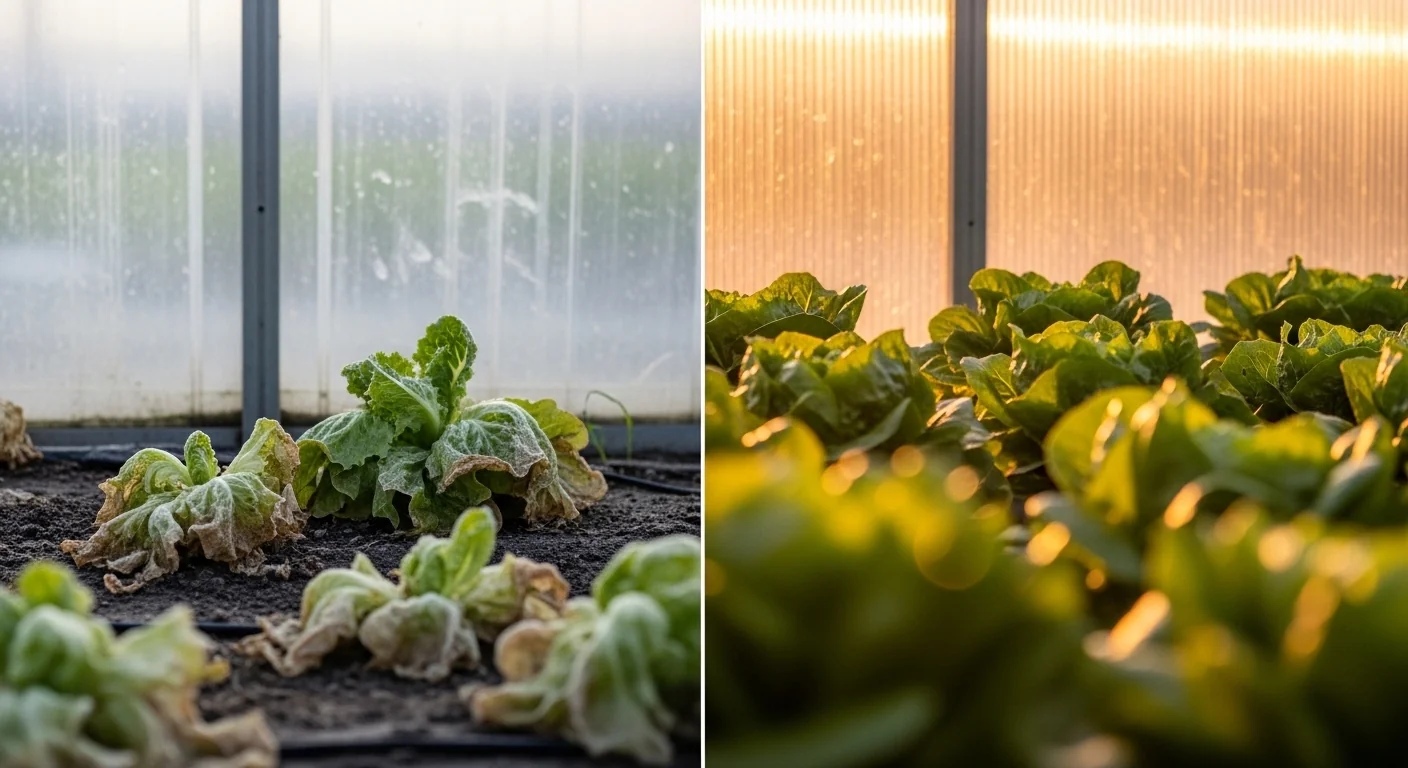
Sizing a greenhouse heater is not about buying the biggest unit that fits your budget. The calculation is driven by three specific numbers: the total surface area of your walls and roof, the temperature differential your structure must maintain, and the thermal resistance (R-value) of your covering material. Get any one of those wrong and you either freeze your crop or burn through a 100-lb propane tank every night. Most growers discover this the hard way, mid-January, when the temperature drops and the heater can’t keep up.
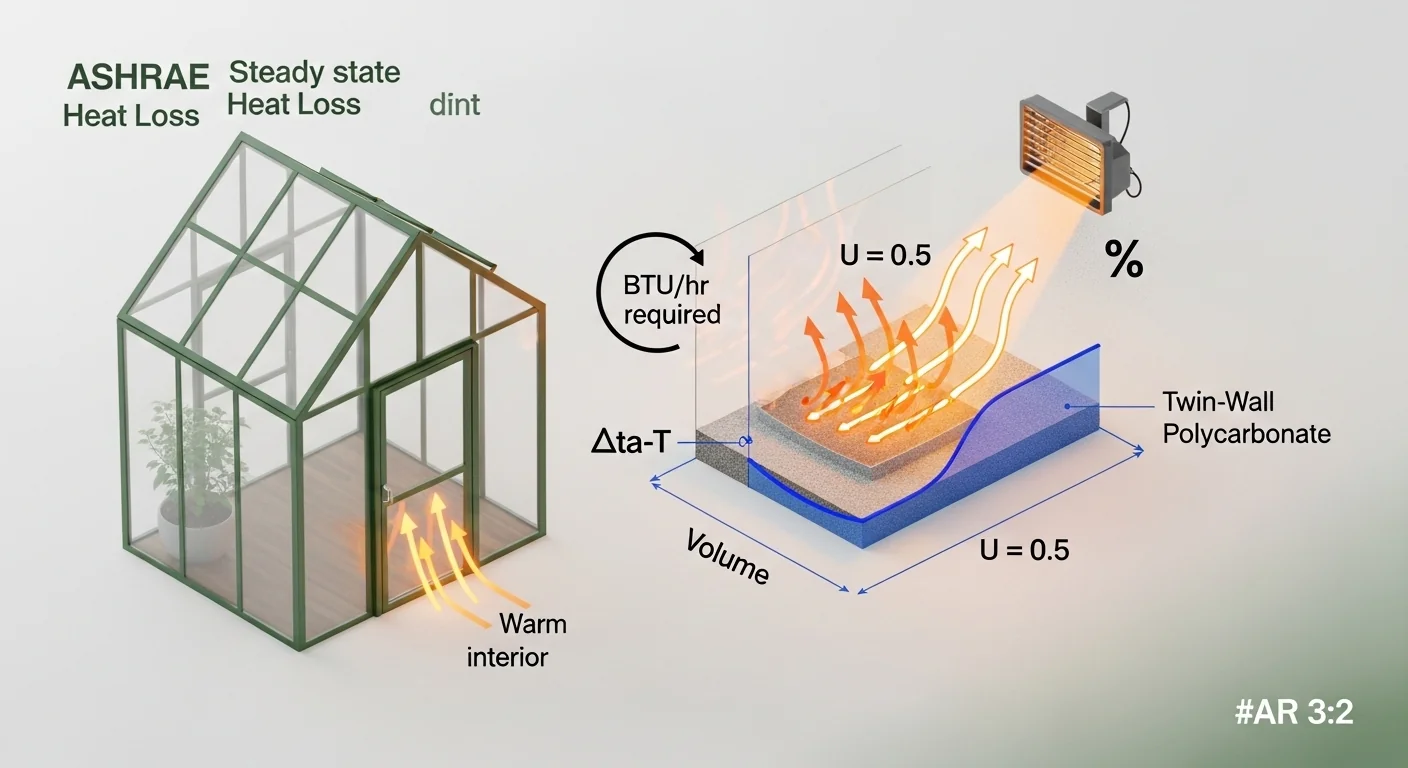
This tool calculates peak steady-state heat loss using the ASHRAE conduction formula: BTU/hr = Surface Area x Delta-T x U-value. It gives you the minimum heater output required under your coldest design conditions. What it does not calculate is infiltration loss from door gaps or foundation seams, solar heat gain during daylight hours, or the thermal mass effects of soil and water. Those factors are real, which is why a 15-25% safety margin is applied in practice. For managing humidity alongside temperature, the dew point calculator covers the related condensation risk that cold-wall greenhouses routinely face in winter.
After running your numbers, you will know the minimum BTU/hr your heater must deliver on the coldest night of the year and whether your current covering material is costing you significantly more in fuel than an upgrade would.
Use the Tool
Greenhouse Heater Sizing Calculator The Yield Grid
Size your greenhouse heater correctly for winter. Prevent frozen crops and wasted propane — get the exact BTU/hr your structure needs.
| Surface Area (ft²) | Material | ΔT (°F) | BTU/hr Needed | Propane Tanks/Night* |
|---|
*100-lb propane tank ≈ 2.16M BTU. Running 10 hrs/night. Row matching your input is highlighted.
How This Calculator Works
This calculator uses the standard ASHRAE steady-state heat loss formula for greenhouse structures:
- Determine U-value from your covering material:
Single-Layer 6-mil Poly →U = 1.2 BTU/hr·ft²·°F(R ≈ 0.83)
Twin-Wall 8mm Polycarbonate →U = 0.5 BTU/hr·ft²·°F(R ≈ 2.0) - Calculate ΔT — the temperature difference you must maintain:
ΔT = Inside Target Temp − Lowest Outside Temp - Calculate required BTU/hr:
BTU/hr = Surface Area × ΔT × U-value - Size your heater to at least this BTU/hr capacity. Add 10–20% safety margin for infiltration losses not modeled here (door gaps, foundation losses, wind infiltration).
Note: This is a steady-state conduction loss model. It does not account for infiltration/air leakage, solar heat gain, ground conduction, or radiant heat exchange — which is why a 15–25% safety factor is standard practice.
Assumptions & Limits
- Material U-values: Single-poly U = 1.2 (R ≈ 0.83) per ASHRAE; Twin-wall 8mm PC U = 0.5 (R ≈ 2.0) per manufacturer specs. Actual values vary ±15% by brand and installation quality.
- Steady-state model only: Calculates peak design-hour heat loss. Does not model thermal mass, solar gain, humidity, or night-time radiant cooling.
- No infiltration losses: Air leakage through vents, doors, and perimeter gaps typically adds 10–30% to heat loss. Always add a 15–25% safety margin to your heater size.
- Propane estimate: Based on 91,500 BTU/gallon × 100 lbs ÷ 4.24 lbs/gallon ≈ 2.16M BTU per 100-lb tank, running 10 hours/night at full load.
- Floor area input: Used for reference context only — it does not affect the BTU calculation. Heat loss is driven by surface area, not floor area.
- Valid ranges: Inside temp 32–100°F; Outside temp −60 to 60°F; Surface area 10–100,000 ft².
- Double-layer inflated poly: Traps an air gap and achieves R ≈ 1.5–2.0, similar to twin-wall polycarbonate. If you have this system, select “Twin-Wall” as the closest approximation.
Before you start, have two measurements ready: your total glazed surface area (walls plus roof, not just floor area) and the design low temperature for your location. The surface area figure is the one most growers underestimate because they confuse it with floor square footage. A 20 x 40 ft greenhouse with 8-ft sidewalls and a peaked roof has roughly 1,600 to 2,000 ft² of surface area, not 800. If you also need to size your ventilation equipment for warmer months, the greenhouse fan calculator runs a complementary airflow calculation for that side of the climate equation.
Quick Start (60 Seconds)
- Greenhouse Floor Area (ft²): Enter length times width. This field is for reference context in the output table. It does not directly affect your BTU result.
- Total Wall and Roof Surface Area (ft²): This is the number that drives the calculation. Add up all glazed panels: sidewalls, end walls, and roof. Do not use floor area here. When in doubt, measure each panel individually and sum them.
- Covering Material: Select Single-Layer 6-mil Poly (U = 1.2) or Twin-Wall 8mm Polycarbonate (U = 0.5). If you run a double-layer inflated poly system, select Twin-Wall as the closest approximation since the air gap achieves similar insulating performance.
- Inside Target Temperature (°F): Enter the minimum temperature your crops require, not your ideal comfort temperature. Valid range is 32 to 100°F. Most cool-season crops tolerate 40-45°F minimums.
- Lowest Outside Winter Temperature (°F): Use the coldest recorded overnight low for your area, not an average. This is your design condition. If you are unsure of your local design low, check your county’s historical climate data. Valid range is -60 to 60°F.
- Common unit mistake: Everything must be in degrees Fahrenheit and square feet. Do not mix Celsius or metric measurements.
- The inside temp must exceed the outside temp by at least 1 degree for the calculation to run. The tool validates this and flags the error inline.
Inputs and Outputs (What Each Field Means)
| Field | Unit | What It Means | Common Mistake | Safe Entry Guidance |
|---|---|---|---|---|
| Greenhouse Floor Area | ft² | The ground footprint of the structure (length x width). Used for reference context in the output table only. | Treating this as the primary heat loss driver. | Enter length x width. Does not affect BTU output directly. |
| Total Wall and Roof Surface Area | ft² | The actual glazed/covered envelope area through which heat escapes. This is the critical input. | Using floor area instead of surface area underestimates heat loss by a factor of 1.5x to 3x depending on greenhouse geometry. | Measure all four walls plus roof panels. For peaked roofs, use the actual sloped panel dimensions. |
| Covering Material | Selection | Determines the U-value (thermal conductance). Single poly: U = 1.2. Twin-wall 8mm: U = 0.5. | Selecting single poly when a double-layer inflated system is installed. The air gap in inflated double poly performs closer to twin-wall. | Double-layer inflated poly: select Twin-Wall as the closest available option. |
| Inside Target Temperature | °F | The minimum temperature the structure must maintain at the coldest point of the night. | Setting this too high (e.g., 70°F for crops that tolerate 45°F) dramatically inflates the heater requirement. | Use the crop’s actual minimum threshold, not room temperature comfort level. Valid: 32-100°F. |
| Lowest Outside Winter Temperature | °F | The design low: the coldest night your heater must handle. This sets the peak heat demand scenario. | Using average winter temperature instead of the design low. Averages undersize the heater for the actual worst-case night. | Pull the historical single-night minimum for your location. Valid: -60 to 60°F. |
| BTU/hr Required (output) | BTU/hr | The minimum continuous heat output your heater must sustain to maintain the inside temperature under peak conditions. | Treating this as the exact heater size to buy rather than the minimum threshold before adding a safety margin. | Add 15-25% to the result when selecting actual heater capacity to account for infiltration losses. |
Worked Examples (Real Numbers)
Example 1: Small Hobby Greenhouse, Single-Layer Poly, Mild Climate
- Surface area: 400 ft²
- Covering material: Single-layer 6-mil poly (U = 1.2)
- Inside target temperature: 55°F
- Lowest outside temperature: 20°F
- Delta-T: 35°F
Result: 400 x 35 x 1.2 = 16,800 BTU/hr
A 17,500 BTU/hr or 20,000 BTU/hr propane or natural gas unit-heater covers this load with appropriate margin. Propane consumption at full output for 10 hours overnight is under 0.08 tank equivalents, making operating cost manageable at this scale.
Example 2: Mid-Size Commercial House, Twin-Wall Polycarbonate, Cold Climate
- Surface area: 1,200 ft²
- Covering material: Twin-wall 8mm polycarbonate (U = 0.5)
- Inside target temperature: 65°F
- Lowest outside temperature: 10°F
- Delta-T: 55°F
Result: 1,200 x 55 x 0.5 = 33,000 BTU/hr
A 40,000 BTU/hr unit-heater provides the 20% safety margin over the design load. Despite the 55°F Delta-T, twin-wall glazing holds the demand well below what the same structure covered in single poly would require (which would be 79,200 BTU/hr).
Example 3: Large Single-Poly Greenhouse, The Propane Bankruptcy Scenario
- Surface area: 3,200 ft²
- Covering material: Single-layer 6-mil poly (U = 1.2)
- Inside target temperature: 70°F
- Lowest outside temperature: 15°F
- Delta-T: 55°F
Result: 3,200 x 55 x 1.2 = 211,200 BTU/hr
At this output running 10 hours overnight, the structure consumes approximately 211,200 BTU/hr x 10 hrs / 2,160,000 BTU per tank = 0.98 propane tanks per night. That is one 100-lb tank every single night. Switching to twin-wall on the same structure reduces the requirement to 88,000 BTU/hr, cutting nightly propane consumption by roughly 58%.
Reference Table (Fast Lookup)
All rows use a design Delta-T of 50°F, which represents a common winter scenario (inside 65°F, outside 15°F). The “With 20% Margin” column reflects the actual minimum heater capacity to purchase. Propane consumption is estimated at 10 operating hours per night against a 100-lb tank (approximately 2,160,000 BTU per tank).
| Surface Area (ft²) | Material | U-value | Delta-T (°F) | Raw BTU/hr | With 20% Margin (BTU/hr) | Propane Tanks/Night (100-lb, 10 hrs) |
|---|---|---|---|---|---|---|
| 200 | Single-Layer Poly | 1.2 | 50 | 12,000 | 14,400 | 0.06 |
| 200 | Twin-Wall 8mm | 0.5 | 50 | 5,000 | 6,000 | 0.02 |
| 500 | Single-Layer Poly | 1.2 | 50 | 30,000 | 36,000 | 0.14 |
| 500 | Twin-Wall 8mm | 0.5 | 50 | 12,500 | 15,000 | 0.06 |
| 1,000 | Single-Layer Poly | 1.2 | 50 | 60,000 | 72,000 | 0.28 |
| 1,000 | Twin-Wall 8mm | 0.5 | 50 | 25,000 | 30,000 | 0.12 |
| 2,000 | Single-Layer Poly | 1.2 | 50 | 120,000 | 144,000 | 0.56 |
| 2,000 | Twin-Wall 8mm | 0.5 | 50 | 50,000 | 60,000 | 0.23 |
| 3,500 | Single-Layer Poly | 1.2 | 50 | 210,000 | 252,000 | 0.97 |
| 3,500 | Twin-Wall 8mm | 0.5 | 50 | 87,500 | 105,000 | 0.40 |
How the Calculation Works (Formula + Assumptions)
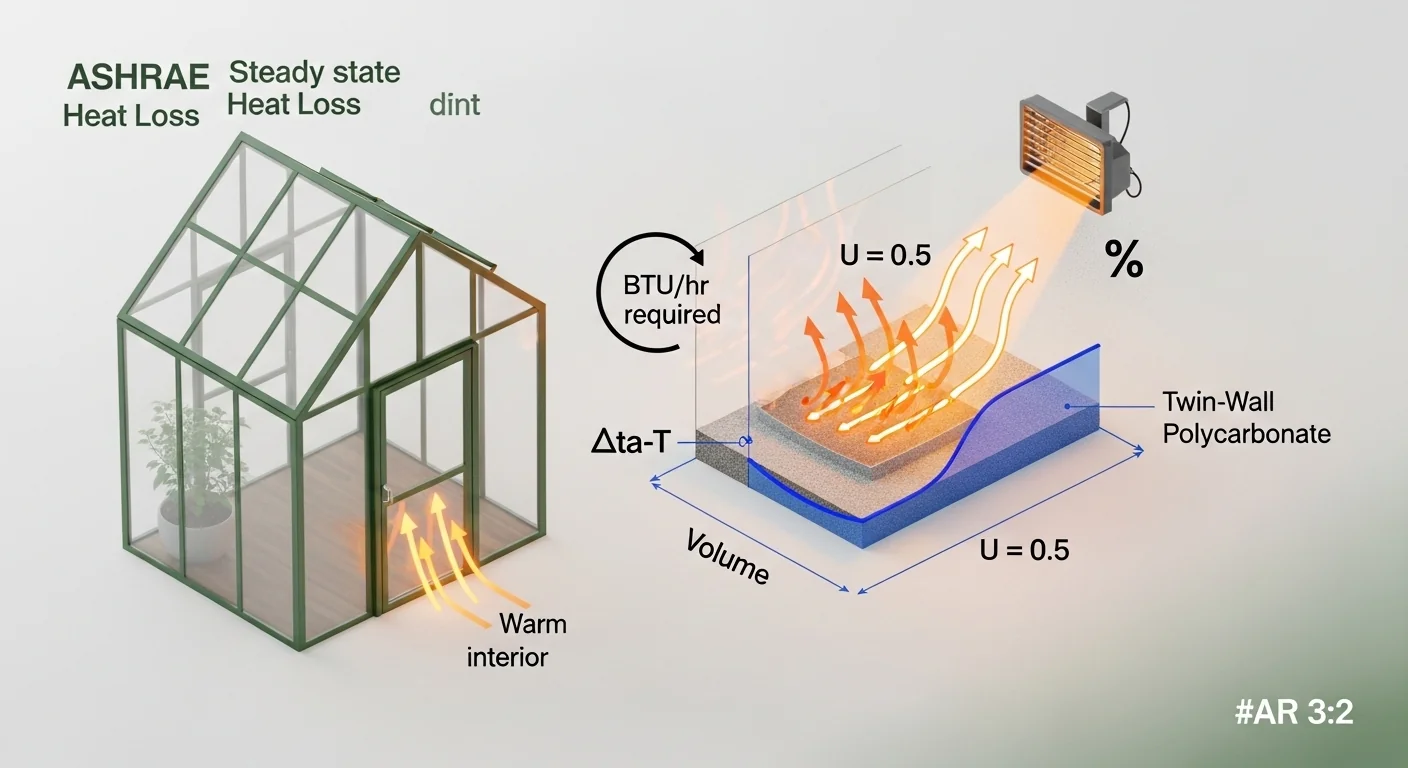
Show the calculation steps
Step 1: Identify the U-value from your covering material.
U-value is the thermal conductance of the glazing material, measured in BTU per hour per square foot per degree Fahrenheit (BTU/hr·ft²·°F).
- Single-layer 6-mil polyethylene: U = 1.2 (R-value = 1 / 1.2 = 0.83)
- Twin-wall 8mm polycarbonate: U = 0.5 (R-value = 1 / 0.5 = 2.0)
Step 2: Calculate Delta-T.
Delta-T is the temperature difference the structure must bridge at peak demand.
Delta-T = Inside Target Temperature – Lowest Outside Temperature (in °F)
Step 3: Apply the ASHRAE steady-state heat loss formula.
BTU/hr = Surface Area (ft²) x Delta-T (°F) x U-value (BTU/hr·ft²·°F)
Rounding rule: Results are rounded to the nearest whole number. When selecting a heater, always round up to the next available commercial heater rating.
Unit conversion note: No unit conversions are required if you enter surface area in square feet and temperatures in Fahrenheit, which are the units required by this tool.
Assumptions and Limits
- Steady-state model only: The formula calculates peak conduction heat loss at a single frozen moment in time. It does not model thermal mass, the warming effect of sunlight during the day, or the cooling lag provided by water, soil, or concrete inside the structure.
- No infiltration losses modeled: Air leakage through vents, doors, perimeter gaps, and foundation joints typically adds 10 to 30% to real-world heat demand. The 15-25% safety margin recommendation exists precisely to compensate for this.
- Material U-values are nominal: The values used (1.2 for single poly, 0.5 for twin-wall) are standard engineering approximations. Actual performance varies by brand, age of glazing, installation quality, and whether film is taut or sagging.
- Propane consumption estimate: Calculated as BTU/hr x 10 operating hours, divided by 2,160,000 BTU (the approximate heat content of a 100-lb propane tank). Actual consumption varies based on altitude, ambient temperature, and heater efficiency rating.
- Double-layer inflated poly: A blower-inflated double-poly system creates an air gap that raises insulating performance to approximately R-1.5 to R-2.0. The tool approximates this by allowing users to select Twin-Wall as the nearest equivalent. If your blower fails, performance reverts to single-poly behavior.
- Floor area is contextual, not computational: The floor area input is used to populate the reference output table and is not used in the BTU calculation. Heat escapes through the envelope, not the floor, in most glazed structures.
- Valid temperature ranges: Inside temp: 32 to 100°F. Outside temp: -60 to 60°F. Results outside these ranges are not validated and may not reflect real greenhouse conditions.
Standards, Safety Checks, and “Secret Sauce” Warnings
Critical Warnings
- The Thin-Film Freeze / Propane Bankruptcy: A 20 x 40 ft single-poly greenhouse (approximately 2,400 ft² surface area) trying to hold 70°F against a 15°F outdoor low needs around 211,000 BTU/hr. At 10 operating hours per night, that is nearly one 100-lb propane tank consumed nightly. The calculation does not lie: this cost is entirely predictable before you install anything. Switching to a double-layer inflated poly system or twin-wall polycarbonate before purchasing the heater changes the entire economics of the structure.
- Extreme Delta-T Requirement: When your design Delta-T exceeds 60°F (for example, holding 70°F inside while it drops to 0°F or below outside), the heater must be sized for continuous-duty operation, not peak-cycle use. Standard residential or shop heaters are often not rated for sustained high-output duty in extreme cold. At these conditions, install a redundant backup heater or a low-temperature alarm system. The tool’s gauge bar turns red above 150,000 BTU/hr to flag this zone.
- Single-Season Payback on Glazing Upgrades: The formula shows that twin-wall polycarbonate (U = 0.5) requires 58% less BTU/hr than single-layer poly (U = 1.2) for the same surface area and Delta-T. In high-fuel-cost climates or structures with large surface areas, the payback period on glazing upgrades can be a single heating season.
- Design Low vs. Average Low: Sizing your heater to handle average winter temperatures rather than the single coldest night creates a predictable failure point. Use the first-frost-date and historical low data for your specific region, not regional averages, when setting the outside temperature input. The first frost date calculator can help you identify the timing of your local temperature extremes.
Minimum Standards
- Always add a minimum 15% safety margin to the raw BTU/hr output when selecting a heater. ASHRAE practice for greenhouse design uses 10 to 25% depending on construction quality and infiltration risk.
- Install a Wi-Fi-enabled thermostat with a low-temperature alarm. A heater that fails at 2 AM on the coldest night of the year is a total-crop event without a remote alert system.
- For structures above 100,000 BTU/hr demand, specify a heater rated for continuous-duty operation (not intermittent). Modine Hot Dawg and similar commercial unit-heaters are built for this. Residential propane furnaces repurposed for greenhouse use often are not.
- If running propane, audit tank capacity against the nightly consumption figure the tool outputs. A 100-lb tank at 0.5 tanks per night empties in two nights. A 500-lb bulk tank at the same rate lasts roughly five nights without a refill.
Competitor Trap
Many greenhouse heater sizing guides instruct growers to multiply their floor area by a “rule of thumb” BTU factor (commonly 20 to 50 BTU per square foot of floor). This approach ignores the actual thermal envelope entirely. A squat, wide structure and a tall, narrow structure with identical floor areas can have radically different surface areas and therefore radically different heat loss figures. The only variable that determines heat loss through the covering is the surface area of that covering, multiplied by its thermal conductance and the temperature differential. A floor-area shortcut can undersize or oversize the heater by a factor of two or more depending on the roof pitch and sidewall height of the structure.
For grow tents and indoor grows that need BTU sizing for summer cooling rather than winter heating, the grow room AC sizing calculator applies the same Delta-T logic in reverse to size cooling equipment.
Common Mistakes and Fixes
Mistake: Using Floor Area Instead of Surface Area
This is the most common error in greenhouse heater sizing. A 20 x 40 ft greenhouse has 800 ft² of floor area, but its walls and roof together can easily span 1,800 to 2,200 ft² of glazed surface. Heat does not escape through the floor at meaningful rates in most glazed structures. Every BTU calculation must be built on envelope surface area. Measure the actual panel dimensions or calculate them from structure drawings before entering any number into this tool.
Fix: Calculate wall area as perimeter times height, then add roof area using actual sloped dimensions, not the floor projection.
Mistake: Sizing to the Average Low Instead of the Design Low
Using January’s average overnight low instead of the coldest recorded single night creates a heater that is adequate most nights but fails precisely when it is needed most. The design low is not a pessimistic estimate; it is the basis for infrastructure sizing in engineering practice. A heater that cannot hold temperature on one night in a hundred can cause a full crop loss.
Fix: Pull historical climate data for your county or zip code and use the 99th percentile design temperature, which is the figure used in ASHRAE-based building design.
Mistake: Ignoring Infiltration in Older or DIY Structures
The formula models only conduction through the glazing. A structure with leaky door frames, open ridge vents, gaps at the foundation, or aging poly that has lost its seal can have infiltration losses that rival the conduction load. Growers who run the tool, buy the exact calculated heater size, and then find it struggling are almost always dealing with substantial infiltration loss that the formula cannot predict.
Fix: Add 20 to 30% to the calculated BTU/hr in older structures or any greenhouse where air sealing has not been recently audited. For seedling operations where temperature floors are critical, the seedling heat mat temperature calculator addresses the localized bench-level temperature management that a heater alone cannot provide.
Mistake: Setting the Target Temperature Too High
Growers who set their inside target to 70°F because that is comfortable for humans rather than crop-appropriate are dramatically inflating their BTU requirement. Cool-season crops like lettuce, spinach, and herbs tolerate night temperatures of 40 to 50°F. Each 10°F reduction in the target temperature reduces the heater requirement proportionally when the Delta-T is adjusted accordingly.
Fix: Research the minimum viable night temperature for each crop variety and use that figure as the inside target, not the grower’s comfort temperature.
Mistake: Not Accounting for Material Degradation Over Time
Single-layer polyethylene film loses clarity and structural integrity over two to four seasons. As the film ages and sags, its effective insulating properties decline and infrared radiation loss increases. A heater sized for new poly may become undersized as the covering ages, even if no other variable changes.
Fix: Re-run the calculator each time the glazing is replaced or upgraded. Keep records of the installation date and plan for re-assessment at the two-season mark on poly-covered structures.
Next Steps in Your Workflow
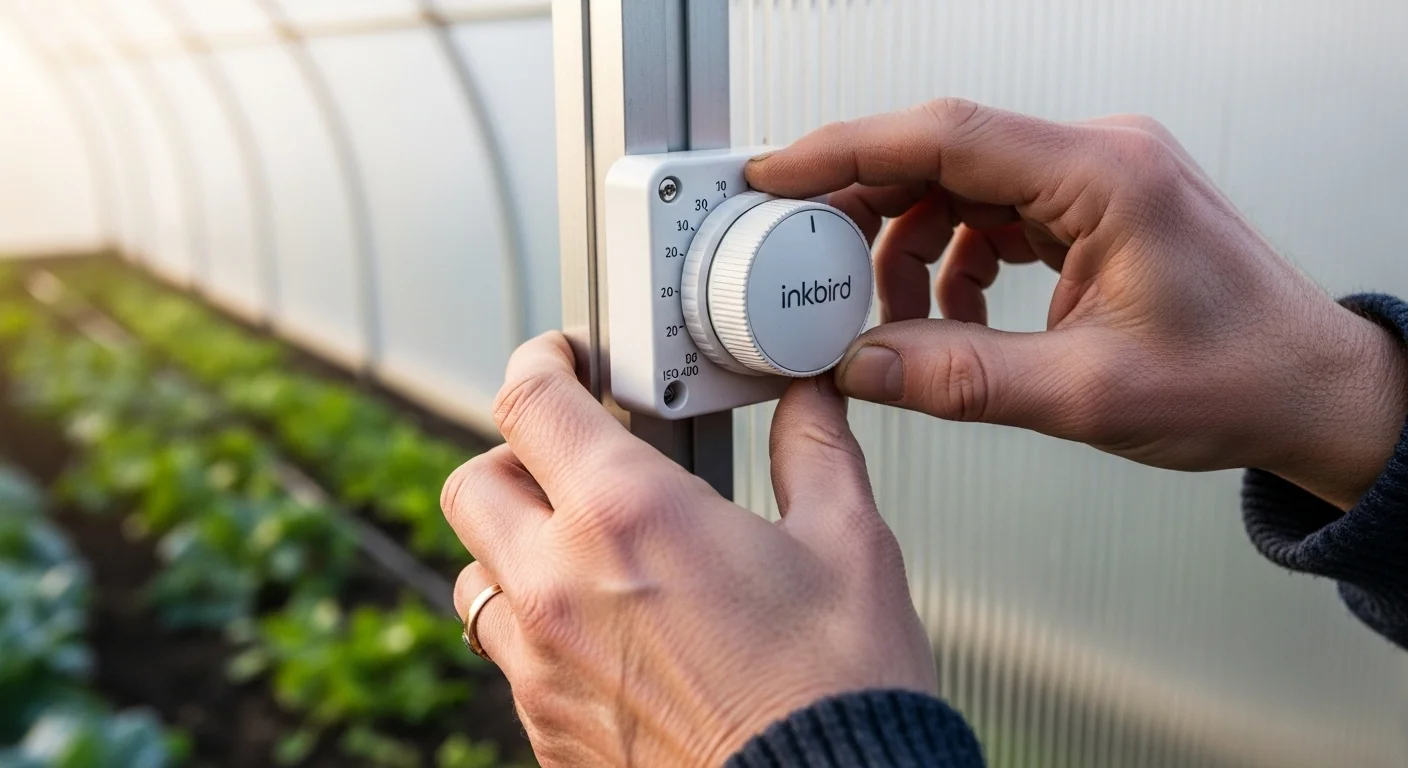
Once you have your BTU/hr figure, the immediate next step is selecting a heater rated at least 15 to 25% above that number, then confirming your fuel supply infrastructure can sustain the calculated nightly consumption. For propane users, this means verifying tank capacity and refill scheduling before the coldest stretch of the season arrives. The BTU/hr calculation is the starting point for procurement, not the end of the design process. You also need to decide on thermostat placement, whether to run a single unit-heater or multiple distributed units, and how you will monitor the structure remotely.
Temperature is only one of the climate variables that drives winter crop performance. Once your heating system is confirmed, use the VPD calculator to verify that your temperature and humidity combination stays within the vapor pressure deficit target for your crop, since a well-heated but poorly humidified greenhouse can still stress plants in ways that are invisible until harvest. For structures that also run supplemental lighting in short winter days, the greenhouse supplemental lighting calculator helps integrate heat output from lighting fixtures into the overall thermal budget.
FAQ
What is the difference between R-value and U-value for greenhouse glazing?
R-value measures thermal resistance: how well a material slows heat transfer. U-value is the inverse (1 divided by R-value) and measures thermal conductance: how quickly heat moves through the material. The ASHRAE heat loss formula uses U-value directly. Single-layer poly has R approximately 0.83 and U approximately 1.2. Twin-wall 8mm polycarbonate has R approximately 2.0 and U approximately 0.5.
Why does surface area matter more than floor area for greenhouse heating calculations?
Heat escapes through the glazed envelope of the structure, which includes walls and roof panels, not through the floor. Floor area determines your growing capacity. Surface area determines your heating load. A greenhouse with a steep roof pitch has considerably more surface area per unit of floor space than a low-profile hoop house with the same footprint, and therefore a higher BTU requirement at the same temperatures.
How much does switching from single poly to twin-wall polycarbonate reduce heating costs?
Because twin-wall (U = 0.5) has less than half the thermal conductance of single poly (U = 1.2), the required BTU/hr for an identical structure under identical conditions is reduced by 58% when switching materials. This reduction applies directly to fuel consumption and operating cost, assuming the heater modulates or cycles accordingly.
Should I size my heater exactly to the BTU calculation or add a margin?
Always add a margin. The formula calculates only steady-state conduction loss through the glazing. It does not capture air infiltration, wind-driven convection, or foundation losses. Standard engineering practice for greenhouse heating design calls for a 15 to 25% safety factor applied on top of the raw calculation result. Use the raw figure to compare options; use the margined figure to make the purchase.
What outside temperature should I use for the design condition?
Use the coldest single overnight temperature your location has recorded or is statistically likely to experience during your growing season. This is the 99th percentile design temperature used in ASHRAE-based building design. Using a 30-year average low instead of the actual design low will produce an undersized heater that fails at exactly the moment it must perform at maximum capacity.
Can this calculator size a heater for a grow tent or indoor grow space?
The formula applies to any enclosed structure where heat loss is primarily through the covering material. For grow tents, the covering material R-value is essentially negligible (thin fabric), so the U-value would be very high, and the calculated BTU demand will reflect that. However, grow tents inside a conditioned building typically need supplemental heat only to maintain a temperature slightly above the room ambient, which changes the Delta-T significantly from a freestanding outdoor greenhouse scenario.
Conclusion
Greenhouse heater sizing is a deterministic calculation, not an estimate. The BTU/hr your structure needs on its coldest night is a direct product of surface area, Delta-T, and covering material U-value. None of those three variables are optional, and substituting floor area for surface area or using average temperatures instead of design lows produces a result that is wrong by design. The formula is straightforward enough to run in seconds with accurate inputs, which is exactly what this tool does.
The single most important mistake to avoid is buying a heater before auditing the covering material. A 20 x 40 ft single-poly greenhouse in a cold climate is capable of consuming a 100-lb propane tank every night at typical winter setpoints. The same structure re-covered in twin-wall polycarbonate cuts that demand by more than half. If you are planning any expansion of your operation for the next season, run both material options through the tool before any procurement decisions are made. For a full picture of your winter climate management stack, the grow room dehumidifier calculator addresses the moisture management side that heating systems directly affect by lowering relative humidity as temperatures rise.