
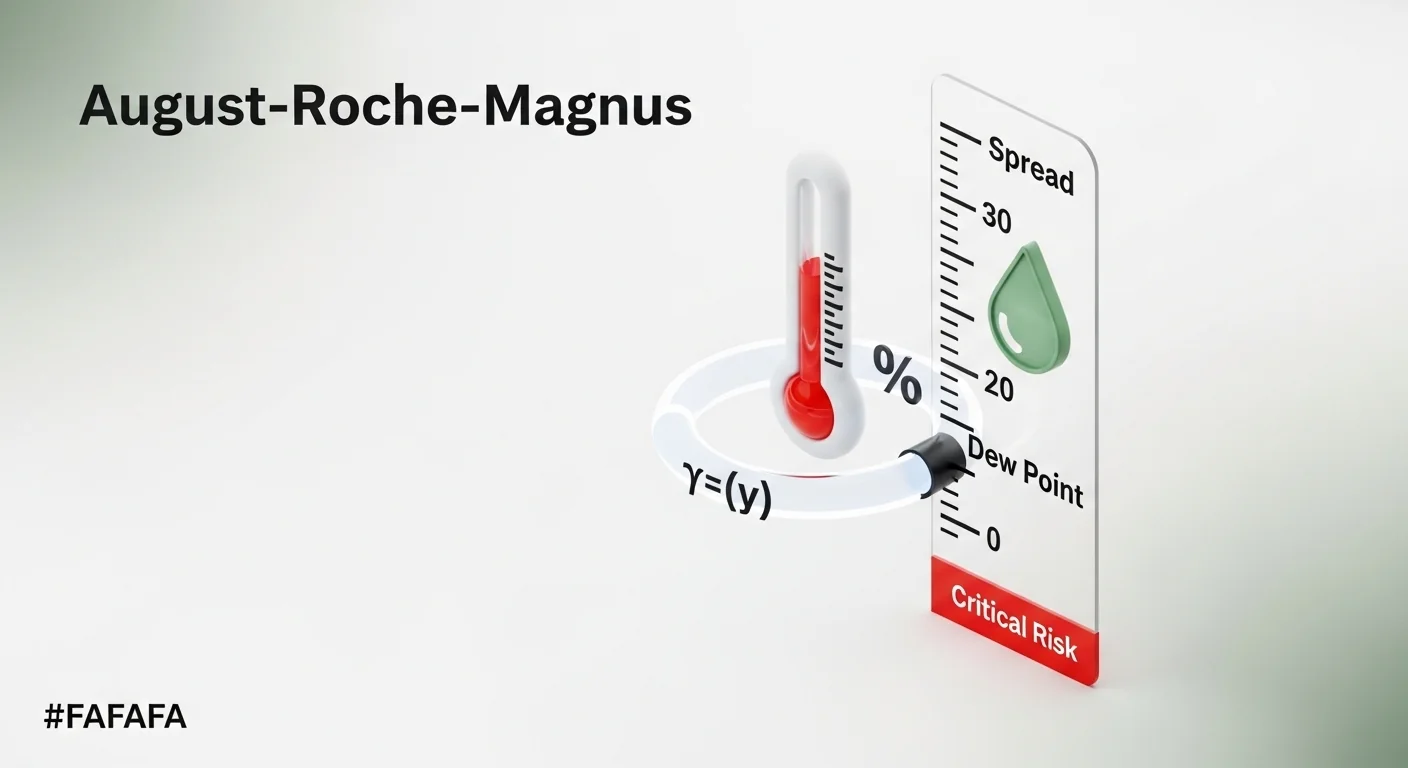
Most growers think about temperature and humidity as two separate dials. The problem is that mold does not care about either number on its own. What matters is the gap between your air temperature and the temperature at which water vapor in that air turns into liquid water on your plants. That threshold is the dew point, and it is what this calculator determines using the August-Roche-Magnus formula.
This tool takes two measurements, air temperature and relative humidity, and returns a precise dew point temperature plus the spread between your current air temp and that threshold. It does not predict disease outcomes, account for leaf wetness duration, or substitute for airflow management. For a broader picture of atmospheric moisture stress on your crop, the VPD calculator addresses vapor pressure deficit, which governs transpiration rather than condensation directly.
Once you have your dew point, you can determine whether your planned night-time temperature setback will push leaf surfaces below condensation threshold, which is the single most actionable decision this tool enables.
Use the Tool
Before running the calculation, have two numbers ready: the current air temperature at canopy level (not at the sensor mounted high on the wall) and the relative humidity reading from a calibrated hygrometer at the same height. Readings taken near the ceiling or at floor level will skew your result. If you are calculating dew point for a humidity-enriched propagation zone, the greenhouse misting calculator can help you model the RH output from your misting system before you run this check.
Quick Start (60 Seconds)
- Select your unit first. Choose °F or °C using the toggle before entering any numbers. The tool will convert an existing temperature value when you switch, but confirm it matches your thermometer reading.
- Enter air temperature at canopy height. Valid range is -40°F to 140°F (-40°C to 60°C). If you are measuring in a walk-in cooler or a high-desert greenhouse in summer, double-check you are within this range before calculating.
- Do not round your humidity input aggressively. Entering 70 instead of 73 shifts the dew point by roughly 1.5°F at typical grow-room temperatures. Use your hygrometer’s displayed reading, not a rough estimate.
- Relative humidity must be between 1 and 100. Do not enter a decimal like 0.75 meaning 75%. Enter the full number: 75.
- Read the spread, not just the dew point. The spread between your air temp and dew point is what determines risk. A dew point of 65°F is harmless at 80°F but critical at 67°F.
- Re-run at night conditions. Enter the temperature your space actually reaches after lights-out or during the coldest pre-dawn window. Daytime calculations do not reflect the true risk period.
- Use the Reset button between scenarios. If you are comparing daytime vs. night-time conditions, reset between calculations to avoid mixing up results in the reference table.
Inputs and Outputs (What Each Field Means)
| Field | Unit | What It Means | Common Mistake | Safe Entry Guidance |
|---|---|---|---|---|
| Air Temperature | °F or °C | Ambient air temperature at canopy level in your grow space | Using sensor mounted high on the wall rather than at plant height | Read at canopy height; valid from -40 to 140°F (-40 to 60°C) |
| Relative Humidity | % (1 to 100) | The ratio of current water vapor in the air to the maximum vapor the air can hold at that temperature | Entering 0.75 instead of 75, or using an uncalibrated sensor | Enter the full integer or one decimal; calibrate sensor monthly |
| Dew Point Temperature (output) | °F or °C | The temperature at which your current air mass will begin depositing liquid water on surfaces | Treating dew point as a fixed property of the room rather than recalculating when RH changes | Recalculate any time humidity or temperature shifts by more than 5 units |
| Spread (output) | °F or °C | Degrees between your current air temperature and the dew point; the “safety margin” before condensation occurs | Ignoring the spread entirely and only reading the dew point number | A spread of 14°F (8°C) or more provides a robust buffer against typical night drops |
| Risk Level (output) | Safe / Low / Elevated / Critical | Categorical assessment derived from the spread magnitude; maps to Botrytis germination likelihood | Treating “Low Risk” as “no action needed” without accounting for planned setbacks | Always interpret risk relative to your planned night setback, not current daytime conditions |
Worked Examples (Real Numbers)
Scenario 1: Warm Humid Flowering Room
- Air temperature: 80°F (26.7°C)
- Relative humidity: 70%
Result: Dew point = 69.3°F (20.7°C); Spread = 10.7°F (5.9°C); Risk = Low Risk
The spread of 10.7°F is workable for daytime, but a 12°F lights-out setback to 68°F would push air temperature below the dew point entirely, causing active condensation on every cool surface in the room. The night temperature must stay above 69.3°F, or humidity must be reduced before lights go out.
Scenario 2: Cool Propagation Chamber at High Humidity
- Air temperature: 65°F (18.3°C)
- Relative humidity: 85%
Result: Dew point = 60.4°F (15.7°C); Spread = 4.6°F (2.6°C); Risk = Elevated Risk
A spread under 5°F at propagation humidity levels is dangerous. Young cuttings with low transpiration have leaf surfaces that routinely run 3 to 5°F cooler than ambient air. That gap alone is sufficient to cross the dew point threshold. Reducing RH to 75% at this temperature raises the spread to approximately 9°F and drops the risk to the safe zone.
Scenario 3: Hot Dry Midsummer Greenhouse
- Air temperature: 95°F (35.0°C)
- Relative humidity: 40%
Result: Dew point = 66.9°F (19.4°C); Spread = 28.1°F (15.6°C); Risk = Safe
High temperatures create wide spreads even at moderate humidity. The 28°F buffer means that unless night temperatures fall dramatically below 67°F, condensation is not a concern. The risk in this scenario shifts toward heat stress and elevated vapor pressure deficit rather than surface moisture, which is a separate calculation.
Reference Table (Fast Lookup)
| Air Temp (°F) | RH (%) | Dew Point (°F) | Spread (°F) | Spread (°C) | Risk Level |
|---|---|---|---|---|---|
| 75 | 60 | 60.2 | 14.8 | 8.2 | Safe |
| 75 | 70 | 64.6 | 10.4 | 5.8 | Low Risk |
| 75 | 80 | 68.4 | 6.6 | 3.7 | Elevated Risk |
| 75 | 90 | 71.9 | 3.1 | 1.7 | Critical |
| 80 | 60 | 64.9 | 15.1 | 8.4 | Safe |
| 80 | 75 | 71.3 | 8.7 | 4.8 | Low Risk |
| 70 | 85 | 65.3 | 4.7 | 2.6 | Elevated Risk |
| 65 | 85 | 60.4 | 4.6 | 2.6 | Elevated Risk |
| 60 | 90 | 57.1 | 2.9 | 1.6 | Critical |
| 85 | 50 | 64.3 | 20.7 | 11.5 | Safe |
| 65 | 75 | 56.9 | 8.1 | 4.5 | Low Risk |
| 80 | 70 | 69.3 | 10.7 | 5.9 | Low Risk |
All dew point values above are computed using the August-Roche-Magnus formula with constants a = 17.625 and b = 243.04. Spread values are derived: Spread (°F) = Air Temp (°F) – Dew Point (°F). Risk thresholds are based on spread in Celsius: Safe at 8°C or above, Low Risk at 4-7.9°C, Elevated Risk at 2-3.9°C, Critical below 2°C.
How the Calculation Works (Formula + Assumptions)
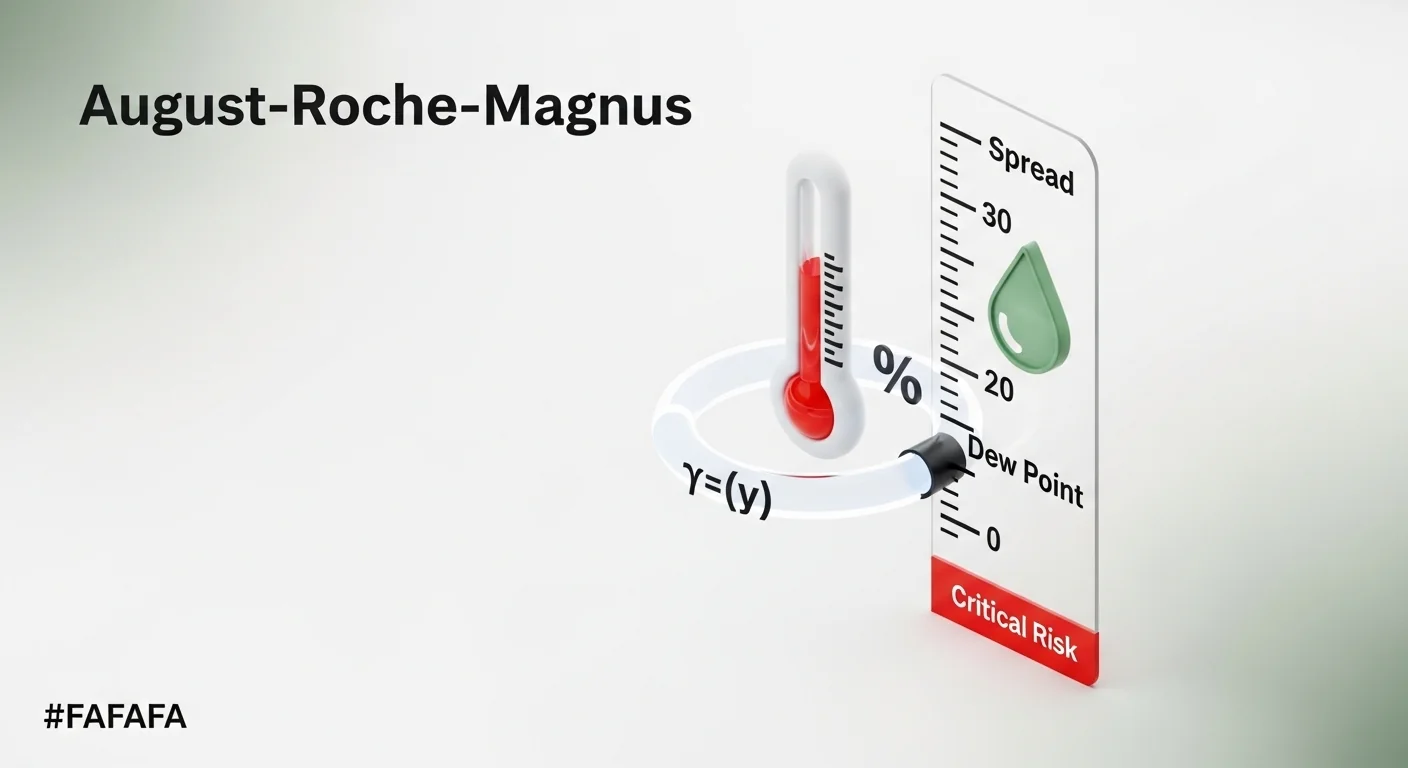
Show the calculation steps
Step-by-Step Formula
The calculator uses the August-Roche-Magnus approximation, the most widely cited formula for dew point estimation in the range of temperatures relevant to indoor and greenhouse growing.
- Convert air temperature to Celsius if the user inputs Fahrenheit: T_C = (T_F – 32) x 5 / 9
- Compute the gamma (y) term: y = (a x T_C) / (b + T_C) + ln(RH / 100), where a = 17.625 and b = 243.04
- Calculate dew point in Celsius: T_dp_C = (b x y) / (a – y)
- Convert back to Fahrenheit if that unit was selected: T_dp_F = T_dp_C x 9/5 + 32
- Calculate spread: Spread = Air Temp – Dew Point (in the chosen unit). Risk thresholds are evaluated using the spread in Celsius.
Rounding: Results are displayed to one decimal place. Internally, all computations retain full floating-point precision before rounding for display.
Assumptions and Limits
- Valid air temperature range: -40°C to +60°C (-40°F to +140°F). Outside this range, the Magnus approximation error increases substantially.
- Formula accuracy: within approximately 0.35°C (0.63°F) across the valid range under standard atmospheric pressure. Accuracy degrades slightly at very high temperatures above 50°C.
- Altitude is not accounted for. At elevations above 5,000 feet, actual dew point may differ slightly from sea-level calculations due to reduced atmospheric pressure.
- The calculator uses air temperature, not leaf surface temperature. Leaf surfaces commonly run 2°F to 5°F below ambient air at night due to radiative cooling. This gap narrows the real-world safety margin compared to what the spread figure suggests.
- Wind speed and airflow are not factored in. Moving air delays condensation onset; stagnant air allows leaf surface temperatures to drop faster toward ambient dew point.
- Humidity stratification is not modeled. In large greenhouses, RH near the floor can be 10 to 15 percentage points higher than at canopy mid-height during cold nights, making the effective dew point there significantly higher than the canopy reading.
- The tool calculates the thermodynamic threshold for condensation, not the biological threshold for Botrytis infection. Spore germination requires both dew-point contact and a minimum wetness duration. A brief touch of dew is less risky than sustained condensation over several hours.
Standards, Safety Checks, and “Secret Sauce” Warnings
Critical Warnings
- Night setbacks are the primary risk window. If leaf temperature drops below the calculated dew point at any point during the dark period, Botrytis cinerea spore germination is possible. This is not a marginal statistical risk; condensation on leaf surfaces is a direct trigger. The dew point temperature this calculator returns is the hard limit for your night-time setback target.
- Leaf surface temperature is lower than air temperature. The calculated dew point uses air temperature. Because leaf surfaces cool faster than ambient air at night, especially in still air, the real condensation threshold is reached at air temperatures 2°F to 5°F higher than the dew point. Treat the spread as a gross measure and apply that additional buffer when setting your minimum night temperature.
- High RH at any temperature creates a narrow margin. At 90% RH, the dew point is within 3°F to 5°F of air temperature regardless of whether that temperature is 60°F or 80°F. The humidity number is not safe because the temperature is high. Run this calculation at every combination of temperature and humidity you plan to operate in, not just peak conditions.
- Stagnant air accelerates surface cooling. Airflow keeps leaf surface temperatures closer to ambient air temperature. Without circulation, radiative cooling widens the gap between air and leaf temp, reducing your effective safety margin below what the spread figure shows. Proper canopy airflow is a condensation-prevention tool, not just a heat management tool. For airflow sizing guidance, the greenhouse fan calculator can help determine whether your current circulation is adequate.
Minimum Standards
- Target a spread of at least 14°F (8°C) between air temperature and dew point to maintain a buffer that accommodates normal leaf surface cooling during the dark period.
- At relative humidity above 80%, actively reduce RH before implementing any night-time temperature setback. Do not rely on temperature management alone when humidity is this high.
- Recalculate dew point whenever season changes shift your overnight low by more than 5°F. For growers in climates with cold winters, the first frost date calculator can help identify the seasonal window when outdoor air infiltration becomes a condensation risk inside unheated greenhouses.
Competitor Trap: Many dew point guides for growers present the dew point number alone and label it “safe” or “unsafe” based on whether it is below room temperature. This framing misses the core risk entirely. The danger is not the absolute dew point value; it is the relationship between dew point and the minimum temperature your space reaches after lights-out or during cold nights. A dew point of 68°F is listed as fine in a 75°F room. But if that room drops to 70°F overnight, condensation occurs on every leaf surface, every pot, and every cold structural surface. The spread against the minimum night temperature is the number that matters, not the comparison against daytime air temperature.
Common Mistakes and Fixes
Mistake: Calculating Dew Point at Daytime Temperature and Ignoring
Night Conditions
Growers run the calculator at their peak daytime temperature of 82°F and see a comfortable spread of 12°F. The lights go out, temperature drops to 70°F, and the dew point of 70°F means the room is at saturation. The calculation was not wrong; it was applied to the wrong conditions. Fix: Always run a second calculation using your actual minimum overnight temperature as the air temperature input, with the RH you expect at that hour.
Mistake: Trusting a Single Hygrometer Mounted Away from the Canopy
Wall-mounted sensors placed 18 inches below the ceiling report significantly lower humidity than what exists at canopy level in dense plantings, especially during the dark period when plants are not transpiring and air stratifies. This leads to calculating a falsely favorable dew point. Fix: Place at least one sensor at mid-canopy height and use that reading for dew point calculations. If you use a dehumidifier, check whether the unit’s built-in sensor is positioned to read canopy air, which is often addressed by the unit’s placement, not just its settings. The grow room dehumidifier calculator can help you size equipment to actually reach target humidity at canopy level.
Mistake: Treating RH Reduction and Temperature Setback as
Independent Decisions
Some growers lower nighttime temperature to reduce VPD and run the dehumidifier to pull RH down separately, without checking how the combination moves the dew point. Dropping temperature from 78°F to 68°F while only reducing RH from 75% to 70% actually narrows the spread considerably, sometimes dropping from a safe 11°F buffer to an elevated-risk 5°F. Fix: Calculate dew point for the specific combination of night temp and post-dehumidification RH you plan to operate at, not the values in isolation.
Mistake: Assuming Condensation Only Occurs on Plant Surfaces
Metal racking, plastic trays, irrigation lines, and duct surfaces are all thermal sinks that reach temperatures well below ambient air. When these surfaces drop below the dew point, they create reservoirs of standing water that allow Botrytis spores to spread via splash and airborne dispersal, even if leaf surfaces themselves never technically condense. Fix: When the spread is under 8°F, treat all cold structural surfaces as condensation risks, not just plant material.
Mistake: Recalculating Only When a Problem Is Visible
By the time Botrytis is visible on plant tissue, the pathogen has been actively spreading for days. Gray mold sporulates aggressively; each visible lesion represents a population that already colonized surrounding tissue. Dew point monitoring should be a preventive checkpoint, not a diagnostic response. Fix: Build dew point checks into your regular environmental review, ideally after any change to heating, cooling, or dehumidification settings.
Next Steps in Your Workflow
Once you know your dew point and have confirmed that your minimum night temperature maintains an adequate spread, the next variable to address is your heating system’s ability to hold that minimum temperature consistently. A furnace or heater that cycles on and off in large swings can allow brief temperature dips below the dew point threshold even if the set point is correct. Checking that your heating capacity matches the thermal load of your space is the logical follow-on step after running this calculator. The greenhouse heater sizing calculator gives you a load-matched BTU target to verify your equipment is sufficient to hold that minimum.
Airflow is the second lever. A well-sized dehumidifier paired with undersized circulation fans creates pockets of stagnant high-humidity air near the canopy where condensation risk is highest, even if the overall room average reads safe. Making sure your canopy airflow rate is matched to your grow space before relying on the dew point number you just calculated is worth the check. The grow tent fan size calculator provides a circulation CFM target based on space dimensions, which you can compare against your current equipment spec.
FAQ
What is the dew point, in plain terms?
The dew point is the temperature at which the water vapor already present in your air will condense into liquid water on any surface that reaches or drops below that temperature. It is a property of the air mass itself, determined by how much moisture is in it. Higher humidity at any given temperature means a higher dew point.
Why does the dew point matter more than relative humidity alone?
Relative humidity tells you how full the air is relative to its capacity at its current temperature. The dew point tells you where the condensation line actually sits in absolute terms. Two rooms can have the same dew point of 65°F but wildly different RH readings if their temperatures differ. For condensation risk, the dew point is the actionable number.
What is a safe dew point spread for a flowering cannabis or tomato
crop?
A spread of at least 14°F (8°C) between your air temperature and dew point provides a margin that accommodates the normal 2°F to 5°F drop in leaf surface temperature below ambient air. Below 7°F (4°C) spread, risk is elevated. Below 3.6°F (2°C), condensation on leaf surfaces is likely at any point during the night cycle.
How does dew point relate to VPD?
Vapor pressure deficit and dew point are both derived from the same two inputs: temperature and relative humidity. VPD quantifies the atmospheric drying force acting on plants via transpiration. Dew point quantifies the condensation threshold. They describe different aspects of the same air mass. High VPD means aggressive plant transpiration; low spread to dew point means high condensation risk. Both can be simultaneously problematic if temperature drops sharply overnight.
Can I use this calculator for outdoor or unheated greenhouses?
Yes, with caution. The formula is equally valid outdoors. The challenge is that outdoor conditions change more rapidly and the air temperature can drop below the dew point during clear cold nights even when afternoon conditions appeared safe. For unheated structures, calculate dew point using the forecasted overnight low, not the current daytime temperature.
Does the Magnus formula give the same result as a psychrometric chart?
For the temperature ranges encountered in greenhouse and indoor growing (roughly 50°F to 100°F), the Magnus formula and a standard psychrometric chart will agree to within about 0.5°F. The differences become more significant at extreme temperatures near the edges of the formula’s valid range. For grow-room decisions, the Magnus formula result is accurate enough for all practical purposes.
Conclusion
The single most consequential mistake to avoid is calculating dew point using daytime temperature and treating that result as valid for the entire 24-hour period. Botrytis does not appear during the day. It colonizes during the cold, dark, still hours when the spread between air temperature and dew point collapses. Run this calculation using your minimum overnight temperature and your expected overnight humidity, and build your environmental controls around that number. If you are evaluating how CO2 supplementation and temperature interact during lights-on periods that affect your nighttime baseline, the greenhouse CO2 calculator can help model daytime enrichment alongside the temperature targets you set using this tool.