
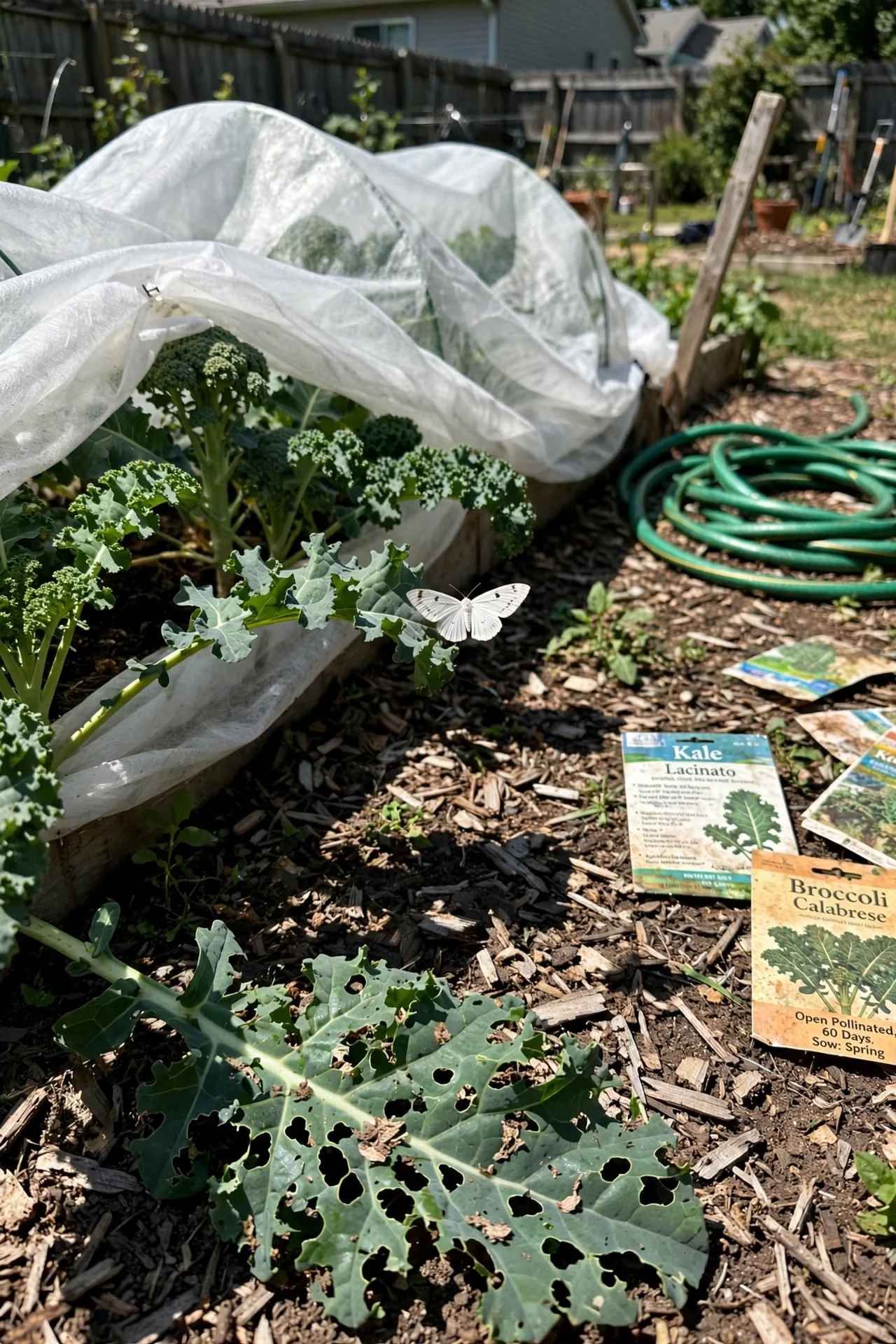
Most gardeners spot holes in their cabbage leaves and reach for the same spray they used last year, without asking the one question that determines whether any control actually works: which life stage are you intercepting? A cabbage worm is not just a worm. It is the feeding larva of a white butterfly that laid an egg that could have been blocked, crushed, or parasitized days earlier. If you aim every control at the larva, you are fighting the most resilient link in the chain.
This guide reframes every cabbage worm control method around the moment of interruption: adult moth, egg, or larva. You will know which tools match each window, why some fail when timing is wrong, and how to stack interventions so you are never chasing damage after it is done.
We cover physical barriers, biological insecticides, beneficial organisms, cultural practices, and the decision logic that connects them. Excluded are broad-spectrum synthetic insecticides that harm pollinators and non-target arthropods, and any method without clear life-stage targeting.
By the end, you will know exactly which option fits your garden size, how much time you are committing, and where to place your effort for the largest reduction in worm pressure with the least wasted work.
Bottom line: The control that works is the one applied at the right life stage; if you do not know whether you are targeting adults, eggs, or larvae, you are guessing.
The Yield Grid Decision Grid
Choose your path based on what you observe in your garden right now. Each branch points to the options that target the pest at its most vulnerable point in that moment.
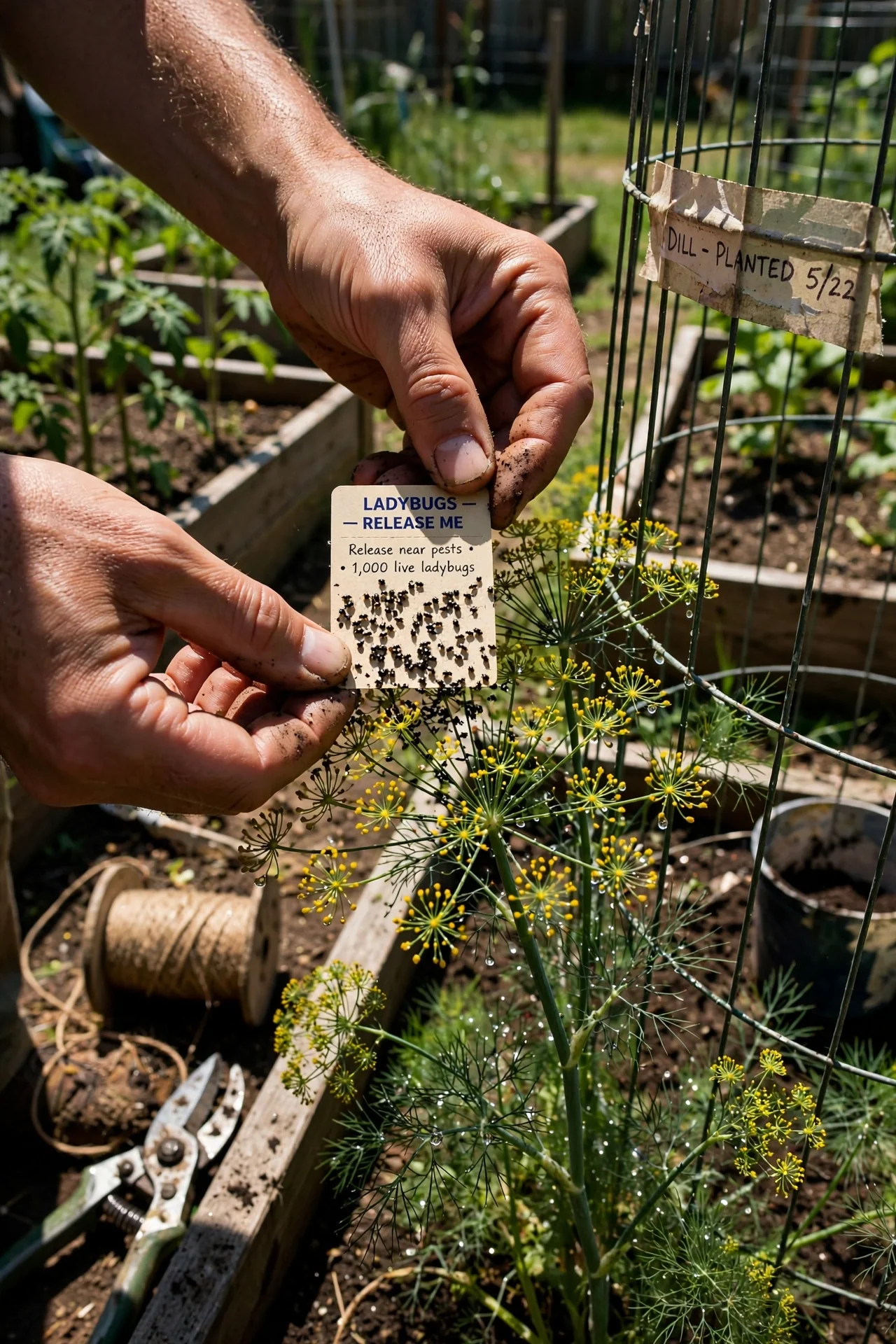
Branch 1: You see white moths fluttering around your brassicas. The adult female is searching for a place to lay eggs. Interception at this stage prevents damage before it exists. Priority tools: physical barriers, trap crops, and cultural timing. Recommended: Items 1, 8, and 10 below. If you want a deeper look at caterpillar-specific biological sprays for later stages, see our guide on Bt for caterpillars.
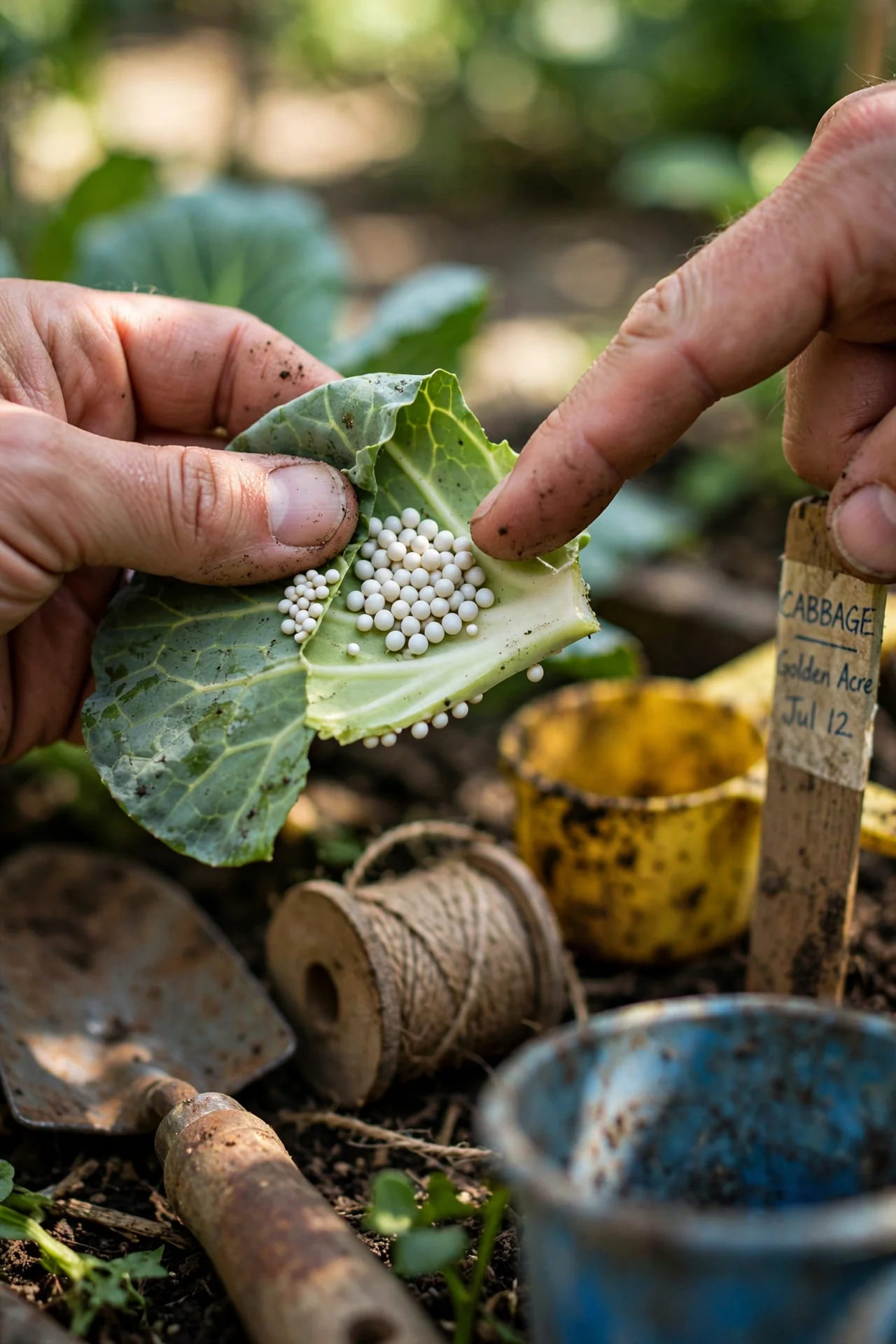
Branch 2: You find tiny white or yellow eggs on leaf undersides. You are in a narrow window of days before hatch. Destruction, smothering, or parasitism of eggs stops the generation cold. Priority tools: manual removal, oil smothering, and parasitic wasps. Recommended: Items 2, 5, and 7 below.
Branch 3: You have visible green caterpillars chewing leaves or boring into heads. The feeding is underway. You need ingestion-based or contact killers that work fast on soft-bodied larvae, plus a plan to clean up and prevent the next generation. Recommended: Items 3, 4, 6, and 9 below.
Quick Comparison Table
| Option | Key mechanism | Best for | Decision Grid Branch | Effort Score |
|---|---|---|---|---|
| 1. Floating Row Cover | Physical exclusion of adult moths | Small to medium beds, early season | Branch 1 | 1 |
| 2. Hand-Picking & Egg Removal | Manual destruction of eggs and larvae | Tiny gardens, low infestation | Branch 2 & 3 | 5 |
| 3. Bt (Bacillus thuringiensis) | Stomach toxin ingested by larvae | Larval stage, all garden sizes | Branch 3 | 5 |
| 4. Spinosad | Nervous system overstimulation | Heavy larval pressure, multiple caterpillar species | Branch 3 | 5 |
| 5. Neem Oil | Growth regulator and egg smotherer | Mixed egg and larval stages | Branch 2 & 3 | 4 |
| 6. Diatomaceous Earth | Desiccation of soft-bodied larvae | Dusting around stems, dry conditions | Branch 3 | 3 |
| 7. Parasitic Wasps | Egg parasitism by Trichogramma spp. | Preventive, larger gardens with habitat | Branch 2 | 3 |
| 8. Trap Crops | Lures moths away from main crop | Garden borders, diverse plantings | Branch 1 | 1 |
| 9. Insecticidal Soap | Contact desiccation of small larvae | Light infestations, tank-mixing | Branch 3 | 4 |
| 10. Cultural Controls | Timing, sanitation, rotation | Every garden, every season | Branch 1 | 1 |
1. Floating Row Cover: The Only Method That Prevents Eggs From Ever Touching Leaves
Best for: Branch 1
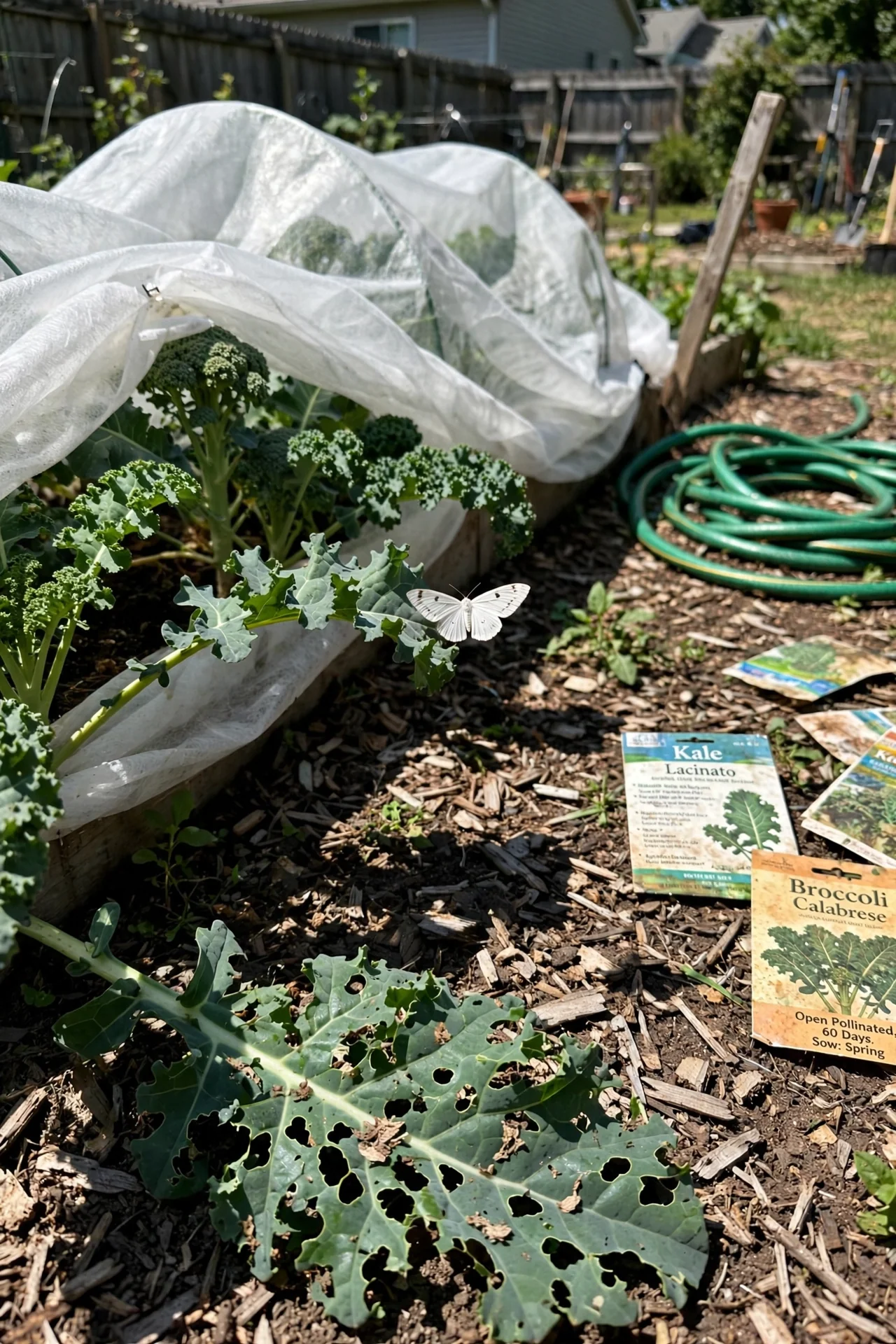
What it is: A lightweight, spun-bonded fabric laid directly over brassica crops or supported on low hoops. It allows light, air, and water through while blocking adult moths from accessing leaves. The lightest grade (0.5 oz per square yard) is sufficient for insect exclusion and can remain in place all season without overheating plants. Heavier grades (1.25 oz) are unnecessary for cabbage worm control and reduce light transmission. Who it is for: Anyone planting cabbage, broccoli, kale, cauliflower, or Brussels sprouts in beds smaller than 500 square feet. Large commercial plantings find removal for weeding impractical. Steps: (1) Prepare the bed and transplant seedlings. (2) Lay the fabric directly on top of plants, leaving slack for growth; for hoops, arch 9-gauge wire or PVC every 4 feet. (3) Bury all edges under at least 2 inches of soil, leaving no gaps, because a female moth will find any opening. (4) Remove only at harvest, or temporarily for weeding, then replace immediately. Common mistake: Installing the cover after moths are already present and trapping them inside. Place the cover immediately at transplanting or at the first sighting of white butterflies, whichever comes first. For an alternative mesh barrier approach, see our article on bird netting for the garden.
2. Hand-Picking and Egg Removal

Best for: Branch 2 and Branch 3
Use when: You manage fewer than 20 brassica plants and can inspect them twice weekly. Squash eggs between your fingers before they hatch (white, ribbed, laid singly on undersides); drop larvae into soapy water. Skip when: You have more than 20 plants or cannot commit to twice-weekly inspections. Missing one cycle allows a generation to reach pupation inside your planting, restarting the problem within two weeks. The edge case: hand-picking remains effective as a supplement to Bt or spinosad even in larger gardens, because removing large, late-instar larvae that survived a spray prevents them from pupating.
3. Bt (Bacillus thuringiensis kurstaki): The Larval Stomach Toxin That Stops Feeding Within Hours
Best for: Branch 3
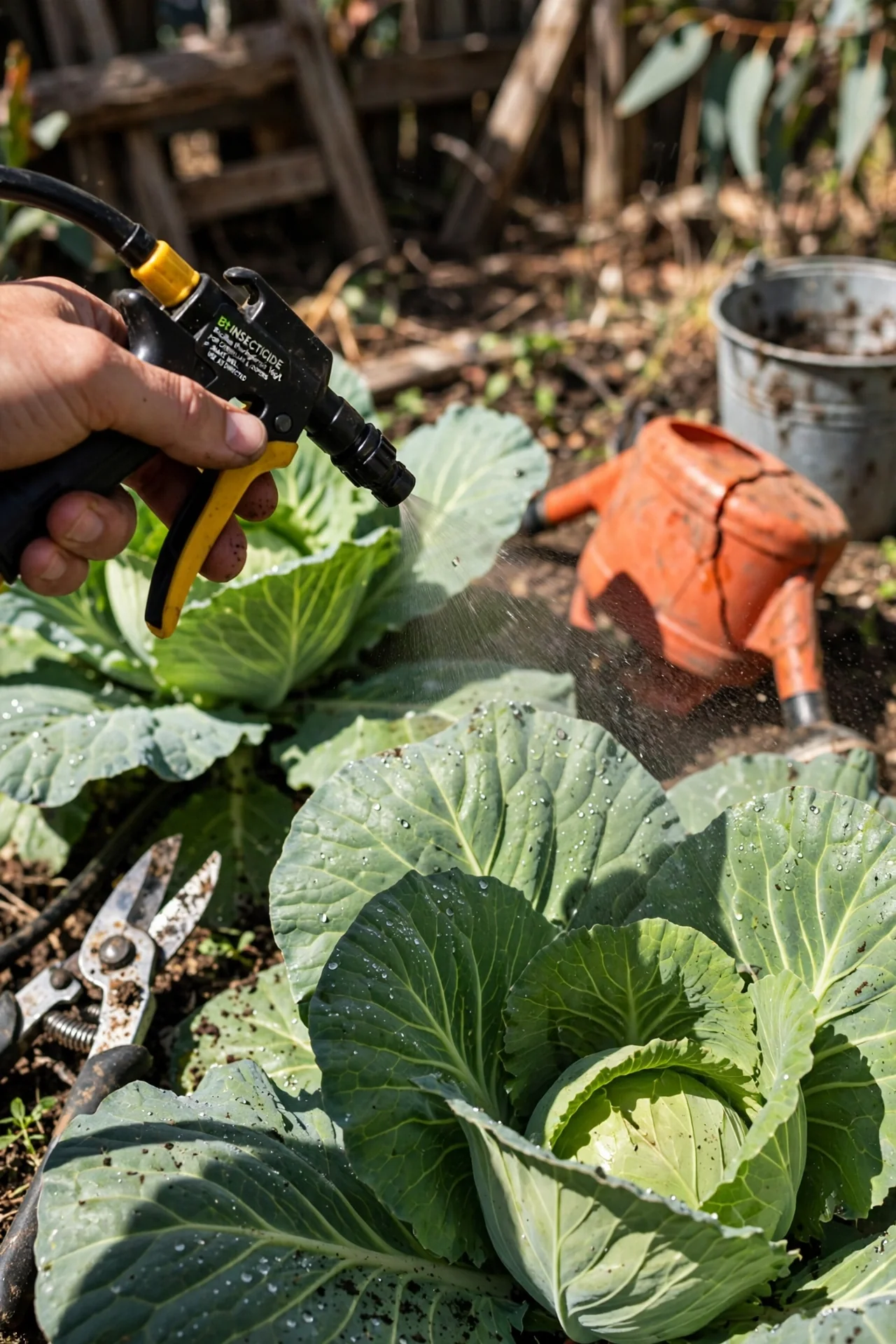
The threshold that matters: Bt is effective only when larvae are small, specifically first and second instars (under 1/2 inch). Once caterpillars exceed 3/4 inch, they consume enough leaf area to cause visible damage before the toxin kills them, and they may survive sublethal doses. Application rule: Mix 1 to 1.5 tablespoons per gallon of water. Spray in late afternoon because UV radiation degrades Bt within 24 hours. Reapply every 5 to 7 days while larvae are active, and after any rainfall exceeding 0.5 inch. Coverage must reach both leaf surfaces, as larvae often feed on undersides. A sticker-spreader like insecticidal soap at 1.5 oz per gallon improves adhesion. Do not store mixed Bt beyond 24 hours. For a related larval pest that responds to identical Bt protocols, read our page on tomato hornworm control.
4. Spinosad: The Broad-Spectrum Biological That Also Reaches Leaf Miners and Beetles
Best for: Branch 3
What it is: A fermentation-derived insecticide from the soil bacterium Saccharopolyspora spinosa. Approved for organic production when formulated without synthetic inert ingredients. Unlike Bt, which must be ingested, spinosad works both by ingestion and contact, overstimulating the insect nervous system. When to use: Heavy larval pressure across multiple caterpillar species, or when you also need to control flea beetles, leaf miners, or thrips in the same planting. Spinosad persists on leaf surfaces longer than Bt (approximately 7 to 10 days of residual activity), so reapplication intervals stretch to 7 to 10 days instead of 5 to 7. Application workflow: (1) Scout for the smallest larvae you can find. (2) Mix according to the label (typical home garden concentration is 0.5 to 1.0 fl oz per gallon). (3) Spray in early morning or late evening when bees are not foraging, because spinosad is toxic to bees when wet. (4) Observe the pre-harvest interval (typically 1 to 3 days for cabbage, depending on formulation). (5) Upgrade option: For farms or large gardens, a pump sprayer with a wand that reaches leaf undersides cuts application time by half compared to a hand sprayer. A similar borer-caterpillar treatment logic appears in our article on squash vine borer control.
5. Neem Oil

Best for: Branch 2 and Branch 3
Use when: You have a mixed population of eggs, small larvae, and adult whiteflies or aphids on the same plants. Neem oil, at a concentration of 0.5% to 1% azadirachtin, disrupts larval molting, deters oviposition, and smothers eggs on contact. Skip when: Temperatures exceed 90°F (32°C), because oil can cause leaf burn on stressed brassicas. Also skip when larvae are large (over 3/4 inch), because growth-regulating effects take too long to prevent feeding damage. Apply every 7 to 14 days and after rain. Do not tank-mix with sulfur sprays. For a complete breakdown of neem’s multiple modes of action, see neem oil for bugs.
6. Diatomaceous Earth

Best for: Branch 3
Threshold rule: Diatomaceous earth (DE) works only when dry. It lacerates the cuticle of soft-bodied larvae, causing desiccation. Humidity or rain neutralizes it within hours. Adjustment: Use food-grade DE, not pool-grade. Dust a thin ring around plant stems and on lower leaf surfaces where small larvae travel. Reapply after every rain or heavy dew. DE is a secondary support tool, not a standalone solution for active infestations. It is best paired with Bt or spinosad, targeting larvae that fall to the soil or crawl between plants. For full guidelines on selecting and applying garden-grade DE, visit diatomaceous earth for the garden.
7. Parasitic Wasps and Beneficial Insects: The Egg Parasitoids That Work Before You See Damage

Best for: Branch 2
What they are: Tiny Trichogramma wasps (smaller than a pinhead) that lay their own eggs inside the eggs of cabbage moths. When the wasp larva develops, it consumes the host egg, which turns black and never hatches. Other beneficials include Cotesia glomerata, a braconid wasp that parasitizes larvae, and generalist predators such as lacewings and predatory stinkbugs. Who this is for: Gardeners managing 200 square feet or more of brassicas who can commit to reducing or eliminating broad-spectrum sprays for the season. Beneficial insects require a spray-free environment to establish, and they need nearby nectar sources (dill, fennel, yarrow, alyssum) to sustain adult wasps. Steps: (1) Order Trichogramma cards from an insectary and release them at the first sign of moth activity. A typical release rate for home gardens is approximately 10,000 wasps per 1,000 square feet, split into two releases one week apart. (2) Sow insectary plants in borders or between rows at the same time. (3) Cease all broad-spectrum insecticide use for at least 6 weeks before and after release. (4) Monitor for blackened host eggs as confirmation of parasitism. Common mistake: Releasing wasps after spraying Bt heavily, which removes the host eggs the wasps need. Bt and parasitic wasps are compatible if Bt is applied selectively to larvae, not broadcast over egg-covered leaves. For the full roster of garden-friendly predators and parasitoids, see beneficial insects for the garden.
8. Trap Crops
Best for: Branch 1
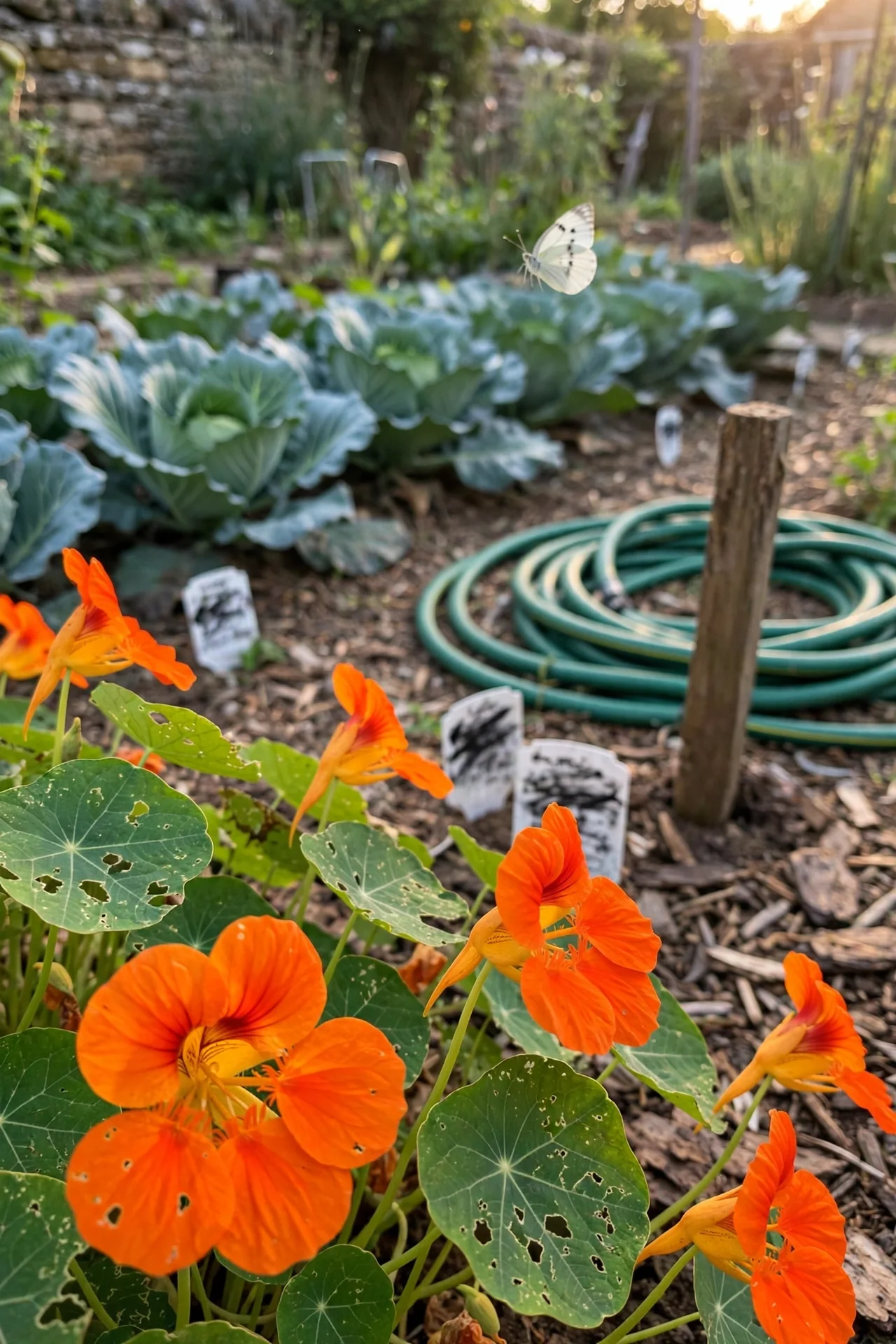
Use when: You have garden borders or sacrificial space and want to pull egg-laying moths away from your main crop. Nasturtiums are the most documented trap crop for cabbage white butterflies; plant them 3 to 5 feet away from brassicas. Collards and mustard greens also serve as perimeter trap crops. Skip when: Your garden is too small to separate trap crops from main crops by at least 3 feet, as moths may hop between the two. The edge case: trap crops work best when planted 2 to 3 weeks before your main brassica crop, because moths select hosts based on plant size and leaf area. If trap and main crops are the same age, attraction is diluted. For broader companion-planting strategies that include trap cropping, read companion planting for pests.
9. Insecticidal Soap
Best for: Branch 3
10-minute workflow: (1) Mix commercial insecticidal soap concentrate at the labeled rate (typically 2.5 to 5 tablespoons per gallon). (2) Fill a clean sprayer; residual herbicide in a used sprayer will damage brassicas. (3) Spray only where you see small larvae. Soap must contact the caterpillar’s body to work; it has no residual activity. (4) Wait 24 hours and evaluate. If larvae persist, upgrade to Bt or spinosad. Soap is a contact-only desiccant, not a systemic or stomach poison. It is most useful as a tank-mix sticker for Bt (1.5 oz per gallon) or as a knockdown for very small larvae on seedlings. For a detailed guide on soap use and safety, see insecticidal soap.
10. Cultural Controls: The Seasonal Decisions That Reduce Pest Pressure Before Planting

Best for: Branch 1
What they are: A bundle of timing, sanitation, and rotation practices that lower the baseline population of cabbage worms in your garden. These are not emergency interventions; they are infrastructure decisions you make once per season that pay out across every brassica plant. Who this is for: Every gardener, regardless of scale, because cultural controls cost nothing and carry no risk to beneficial organisms. Key practices: (1) Plant brassicas in early spring to harvest before the second generation of moths peaks in midsummer. In regions with a defined winter, an early spring crop can escape entirely. (2) Remove all brassica crop debris at the end of the season, including roots and fallen leaves, because cabbage worm pupae overwinter in plant residue and soil. Turning the soil in fall exposes pupae to freezing and predation. (3) Rotate brassicas to a different bed each year, because pupae emerge as adults the following spring within a few feet of where they overwintered. A 3-year rotation cycle is the practical minimum for home gardens. (4) Avoid planting brassicas near ornamental cabbage or nasturtiums left standing through winter, as these harbor overwintering pupae. Common mistake: Cleaning up debris but leaving pupae on wooden raised-bed frames, where they survive just as well as in soil. Scrape and brush bed frames during fall cleanup.
Starter Stack (What to Choose First)
Branch 1 Starter: Floating Row Cover + Trap Crop Border
Install a lightweight row cover over your brassica bed at transplanting (one-time setup, approximately $12 to $25 for a 7 ft by 50 ft roll of 0.5 oz fabric). Plant nasturtiums or collards in a border 3 to 5 feet away, sown 2 weeks before your main crop, at a seed cost of about $3 to $5 per packet. The cover excludes the moths that bypass the trap crop, and the trap crop pulls moths away from any edges left unsealed. Together, they create two independent points of failure for egg-laying adults. Budget range: $15 to $30 for a 50-square-foot bed. Time commitment: 1 to 2 hours at planting, then zero weekly maintenance except occasional weeding access.
Branch 2 Starter: Hand-Picking Routine + Neem Oil Backup
Commit to a 15-minute inspection and egg-crushing pass twice per week on fewer than 20 plants (time cost: approximately 0.5 hours per week). Keep a ready-mixed neem oil spray (0.5% to 1% azadirachtin) for days when you find more eggs than you can crush in that window. Neem extends the egg-killing window by coating surfaces the moths avoid, and it suppresses any larvae that hatch between inspections. Budget range: $8 to $18 for a pint of cold-pressed neem oil concentrate, enough for a full season on a small plot. Time commitment: 30 minutes per week of active scouting, plus 10 minutes of spraying on neem days.
Branch 3 Starter: Bt Spray Regimen + Spinosad Reserve
Start with Bt as your primary larval control (approximately $10 to $18 for a 16 oz concentrate that makes up to 32 gallons of finished spray). Spray every 5 to 7 days in late afternoon on actively feeding larvae. If Bt fails to control larger caterpillars or if you also face flea beetle pressure, upgrade one application to spinosad (approximately $15 to $25 for a pint of concentrate) and extend the reapplication interval to 7 to 10 days. Do not tank-mix Bt and spinosad; rotate them in sequence. Budget range: $25 to $45 for both products, covering a full season on a 200-square-foot brassica planting. Time commitment: 20 to 30 minutes per spray session, once per week.
When This Won’t Work
Failure condition 1: You apply Bt or spinosad to large, late-instar larvae. Caterpillars over 3/4 inch have already consumed significant leaf area and may survive sublethal doses of Bt. Spinosad works on larger larvae but cannot reverse the damage already done. If you have large worms boring into cabbage heads, there is no spray that removes frass (droppings) from inside the head. At this point, the only action is to harvest what is salvageable, soak heads in salted water to float out remaining worms and frass, and focus on preventing the next generation with row covers.
Failure condition 2: You rely exclusively on one method across multiple moth generations. In regions with two to three generations per season (most of the US, UK, Canada, Australia, Germany, India, and South Africa), a single method like Bt sprayed weekly will select for larvae that emerge during spray gaps. The fix is to switch mechanism between generations: row covers for generation one, Bt for generation two, and a combination of hand-picking and parasitic wasps for generation three. Alternating modes of action is more important than finding the single best product. For more on caterpillar-specific control that accounts for multiple generations, see Bt for caterpillars.
Choosing the Right Option for Your Situation
Budget Threshold
If your budget for cabbage worm control is under $20 for the season, prioritize floating row cover (a one-time purchase reusable for multiple seasons) and hand-picking. These two methods require no consumable products. At $20 to $50, add one biological spray (Bt or spinosad) and a small bottle of neem oil. Above $50, add beneficial insect releases and a second spray for rotation.
Time Threshold
If you have fewer than 30 minutes per week to spend on pest control, rely on row covers and cultural controls (Effort Score 1), because these are set-and-forget. If you can commit 30 to 60 minutes per week, add one spray regimen (Bt or spinosad). Hand-picking combined with spraying demands more than 60 minutes per week on plantings larger than 100 square feet and is not sustainable for most gardeners with full-time jobs.
Technical Constraint: Tank Mixing Compatibility
Do not combine Bt and spinosad in the same tank. Do not mix neem oil with sulfur sprays or copper fungicides. If you use insecticidal soap as a sticker for Bt, mix soap at 1.5 oz per gallon of Bt solution, not as a separate application. Always test a new spray combination on three to five leaves and wait 24 hours before broad application, because phytotoxicity varies by temperature, humidity, and cultivar.
Yes/No Checklist:
Are you seeing white moths? If yes, start with Branch 1 (row cover or trap crop). If no, go to the next question.
Are you finding eggs on leaf undersides? If yes, start with Branch 2 (hand removal or neem oil). If no, go to the next question.
Do you have green caterpillars actively feeding? If yes, start with Branch 3 (Bt or spinosad).
Are you in your second or third generation of moths this season? If yes, switch your control mechanism from the one you used in the previous generation.
Expert Q&A
How long do cabbage worm eggs take to hatch?
Eggs hatch in 3 to 7 days depending on temperature, with faster development at higher temperatures. At 20°C (68°F), eggs typically hatch in about 4 to 5 days. Below 10°C (50°F), egg development slows significantly. This narrow hatching window is why egg removal must happen at least twice per week to be effective. If you inspect only on weekends, you may miss an entire hatch cycle.
Why did Bt fail even though I sprayed correctly?
The most common reason: larvae were past the second instar when you sprayed. Bt is a stomach toxin that requires ingestion; large caterpillars eat more, but they also have a higher body mass that dilutes the toxin. A second common cause: spraying in direct morning sun, which degrades Bt within 2 to 4 hours before larvae consume it during their primary feeding period at dusk. Spray in late afternoon instead.
Can I use floating row covers on crops that need pollination?
Brassicas (cabbage, broccoli, kale, collards, Brussels sprouts) do not require insect pollination: they are primarily wind-pollinated or self-fertile for the vegetative parts we harvest. You can leave row covers on these crops from transplant to harvest without removing them. If you are growing brassicas for seed production, remove covers during flowering to allow pollinator access, then replace them after seed set.
What is the difference between a cabbage looper and an imported cabbage worm?
Imported cabbage worms are velvety green larvae of the cabbage white butterfly (Pieris rapae); they have a faint yellow-orange stripe down the back and five pairs of prolegs. Cabbage loopers (Trichoplusia ni) are smooth, pale green, and move in an inchworm motion because they lack prolegs in the middle of the body. Both are controlled by the same Bt and spinosad products, but loopers tend to feed more aggressively on outer leaves while imported cabbage worms more often bore into heads.
Does neem oil kill beneficial insects?
Neem oil affects insects that chew or suck treated plant tissue; it has lower direct toxicity to adult parasitic wasps and bees when applied in the evening after bees have returned to the hive. However, neem can smother soft-bodied beneficial larvae (lacewing larvae, lady beetle larvae) on contact. To minimize impact, spray neem only on leaf surfaces where pest eggs and larvae are confirmed, not as a broadcast coverage spray, and avoid spraying open flowers.
Conclusion
The decision that matters most in cabbage worm control is not which product label you buy but which life stage you intercept. If you track the white moth, crush the egg, and only then spray the larva, you have three control points instead of one, and your odds of damage-free harvest shift decisively. The most common mistake is spraying Bt on large caterpillars after holes appear and calling it a product failure when it was a timing failure.
Your next step: Identify which branch matches what you see in your garden today. If you see moths, install a row cover before the weekend ends. If you see eggs, do a 15-minute crush pass now. If you see feeding larvae, mix Bt or spinosad and apply it this evening. Then, before the next generation arrives, read our guide on cutworm prevention to extend the same life-stage logic to soil-dwelling caterpillars that attack your transplants from below.