
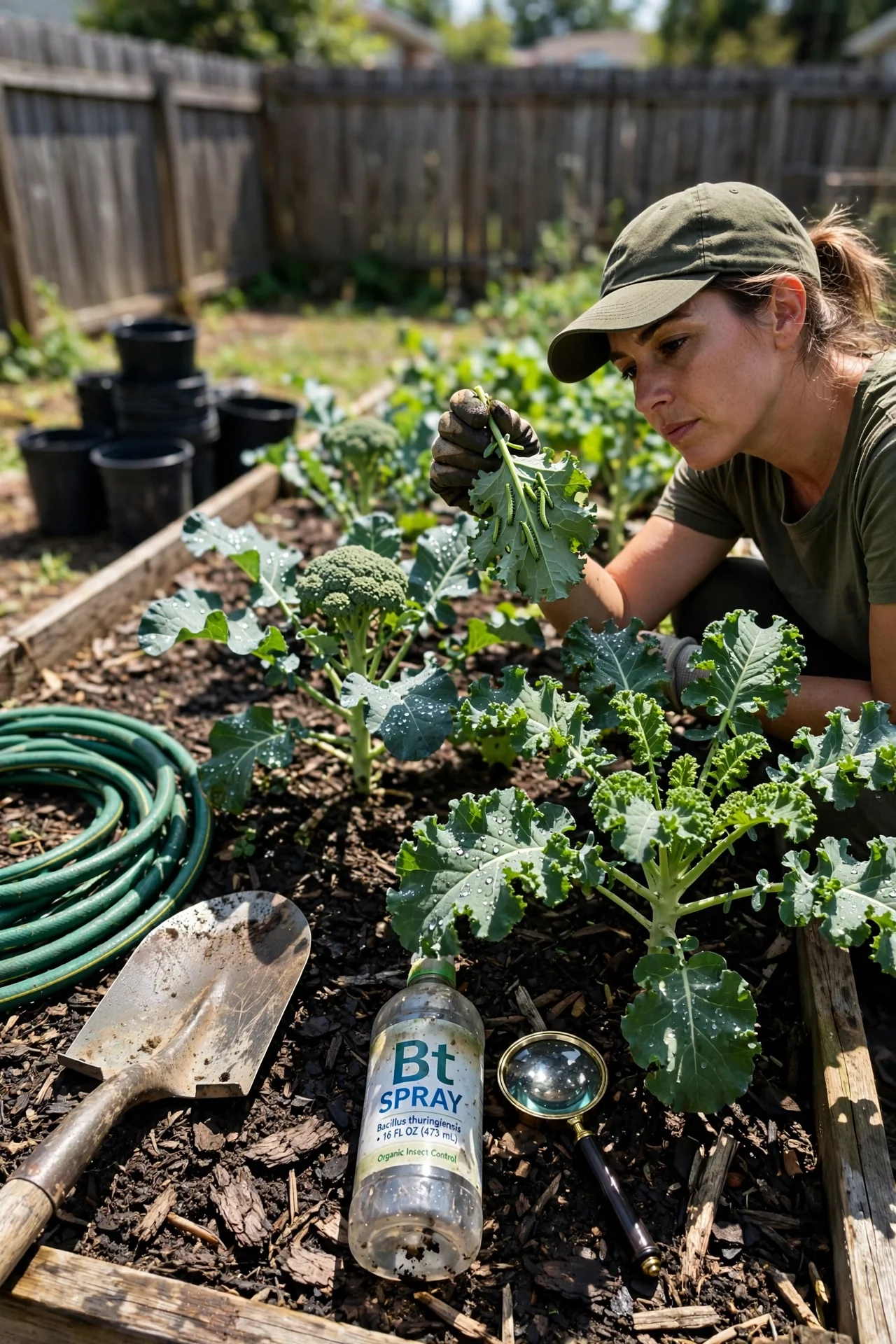
Most BT advice treats all caterpillars as equal. They are not. A cabbage looper on kale, a hornworm stripping a tomato plant, and a squash vine borer tunneling inside a stem are three completely different problems. Using the same BT product across all of them wastes product and leaves you thinking the spray simply did not work.
This guide covers Bacillus thuringiensis subspecies kurstaki (Btk) and subspecies aizawai (Bta), the two commercially available BT strains that target caterpillars. It does not cover Bt israelensis (mosquito and fungus gnat larvae) or Bt tenebrionis (Colorado potato beetle larvae). We focus on foliar spray applications for vegetable gardens, fruit trees, and ornamentals across temperate and subtropical growing regions including the US, UK, Canada, Australia, India, South Africa, and New Zealand.
You will walk away knowing which strain to pick for your caterpillar species, when spraying actually works, and where BT fails so you can choose an alternative before losing more foliage. We structure the choices around three distinct decision branches, with items ranked by effort and situational fit.
Bottom line: If caterpillars are small, feeding on exposed leaves, and you can spray during cool, low‑UV hours, BT works; if they are large, boring inside stems, or rain washes your spray away within 24 hours, choose a different tool.
The Yield Grid Decision Grid
Choose your branch before scanning the list. If you apply a Branch‑3 product to a Branch‑1 situation, you will waste time; if you use Branch‑1 logic on a Branch‑3 problem, you will lose plants. The three branches are:
- Branch 1 (Early Strike): You inspect plants at least twice weekly. Caterpillars are in the first or second instar (under 12 mm / ½ inch) and actively chewing leaf surfaces. Damage is light, limited to shot‑holes or marginal notches. Temperature during application will stay between 20 °C and 30 °C (68 °F to 86 °F) for at least 6 hours afterward. Recommended: Items 1, 4, 7 below.
- Branch 2 (Damage Control): Caterpillars are mixed sizes, some exceeding 2.5 cm (1 inch). Defoliation is noticeable. You need to stop further feeding today, and you are willing to reapply more frequently or add a feeding stimulant. Recommended: Items 2, 5, 8 below.
- Branch 3 (Season‑Long Prevention): You have a history of caterpillar pressure on a specific crop (e.g., brassicas, tomatoes, fruit trees). You want to integrate BT into a planned IPM calendar alongside cultural controls. Recommended: Items 3, 6, 9, 10 below. See also our beneficial insects guide for complementary biological controls.
Quick Comparison Table
| Option | Key Mechanism | Best For | Decision Grid Branch | Effort Score (1–5) |
|---|---|---|---|---|
| Btk liquid concentrate | Cry toxins bind to midgut receptors of Lepidoptera larvae | Early instar leaf‑chewing caterpillars on vegetables | Branch 1 | 3 |
| Btk ready‑to‑use spray | Pre‑diluted Btk suspension, immediate application | Gardeners with fewer than 10 affected plants | Branch 2 | 2 |
| Bta (aizawai) concentrate | Cry toxins with different receptor affinity; effective on Btk‑resistant populations | Diamondback moth, Spodoptera, Helicoverpa where Btk fails | Branch 3 | 4 |
| Btk dust (Dipel) | Spore‑and‑crystal dry formulation; adheres to leaf surfaces | Low‑humidity climates; treating undersides of dense foliage | Branch 1 | 3 |
| Btk with feeding stimulant | Molasses or milk powder increases ingestion rate | Large larvae that eat less per body weight | Branch 2 | 4 |
| Btk bran bait for cutworms | Carrier bait attracts soil‑surface feeding larvae | Nocturnal cutworms that hide during the day | Branch 3 | 5 |
| Btk with spreader‑sticker | Surfactant improves coverage and rainfastness | Waxy leaves (brassicas, citrus) or rainy‑season applications | Branch 1 | 4 |
| Post‑rain reapplication protocol | Replace BT residues washed off by rainfall | Regions with frequent afternoon thunderstorms | Branch 2 | 5 |
| Proper storage and shelf‑life tracking | Maintains spore viability; degraded by heat and UV | Gardeners who buy concentrate for multi‑season use | Branch 3 | 1 |
| Skip BT: spinosad or manual removal | Contact and ingestion insecticide or physical removal | Large larvae over 3 cm, stem borers, or rain‑only access windows | Branch 3 | 2 |
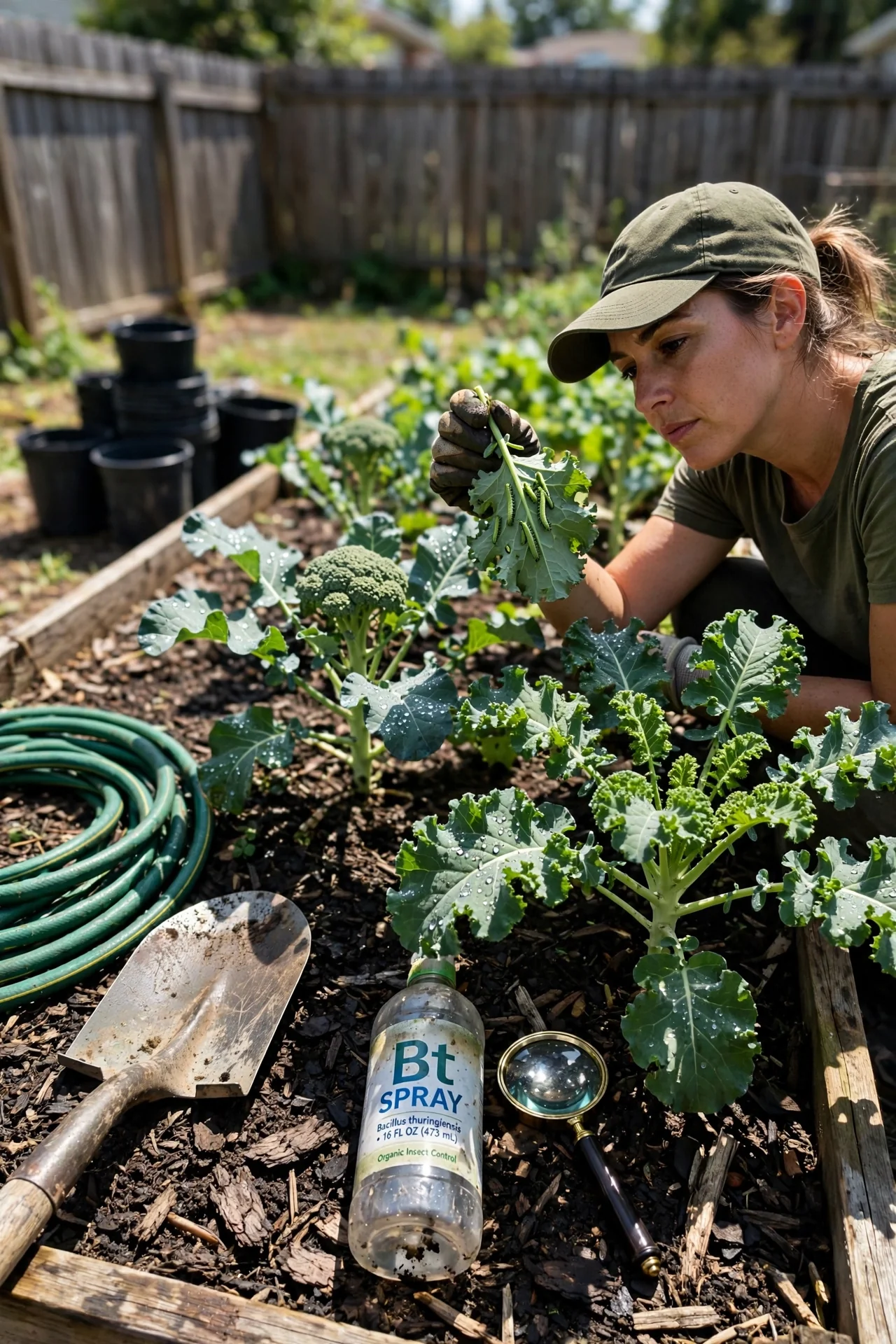
Btk Liquid Concentrate (e.g., Thuricide, Dipel, Monterey Bt)
Best for: Branch 1
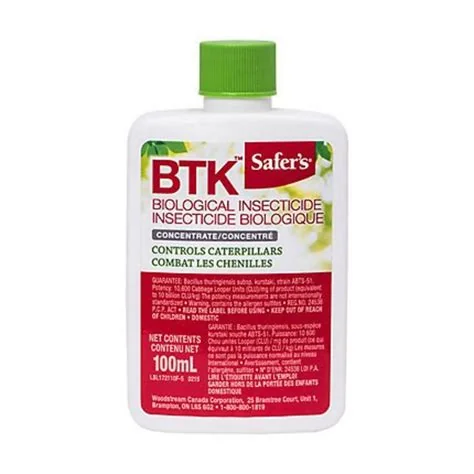
What it is: A suspension of Bacillus thuringiensis kurstaki spores and Cry toxin crystals. Mix with water at 1 to 4 teaspoons per gallon (5 to 20 ml per 4 L) depending on brand, and spray to coat both leaf surfaces. The toxin activates in the alkaline gut of caterpillars, paralyzing the digestive tract within hours. Feeding stops before death, which takes 2 to 5 days.
Edge case: This product requires caterpillars to consume treated foliage. If larvae are inside rolled leaves (leafrollers) or silken webs (fall webworm), coverage rarely reaches them. Open the shelter manually or prune it out before spraying.
Steps: Shake concentrate vigorously. Mix only the amount you need for one session; discard unused mix after 24 hours. Apply late afternoon to minimize UV degradation. Repeat every 5 to 7 days while larvae are active. Mistake: Storing diluted BT overnight. The spores lose viability, and bacteria can ferment, causing nozzle clogs.
Related: For a full breakdown of target species, see our cabbage worm control guide.
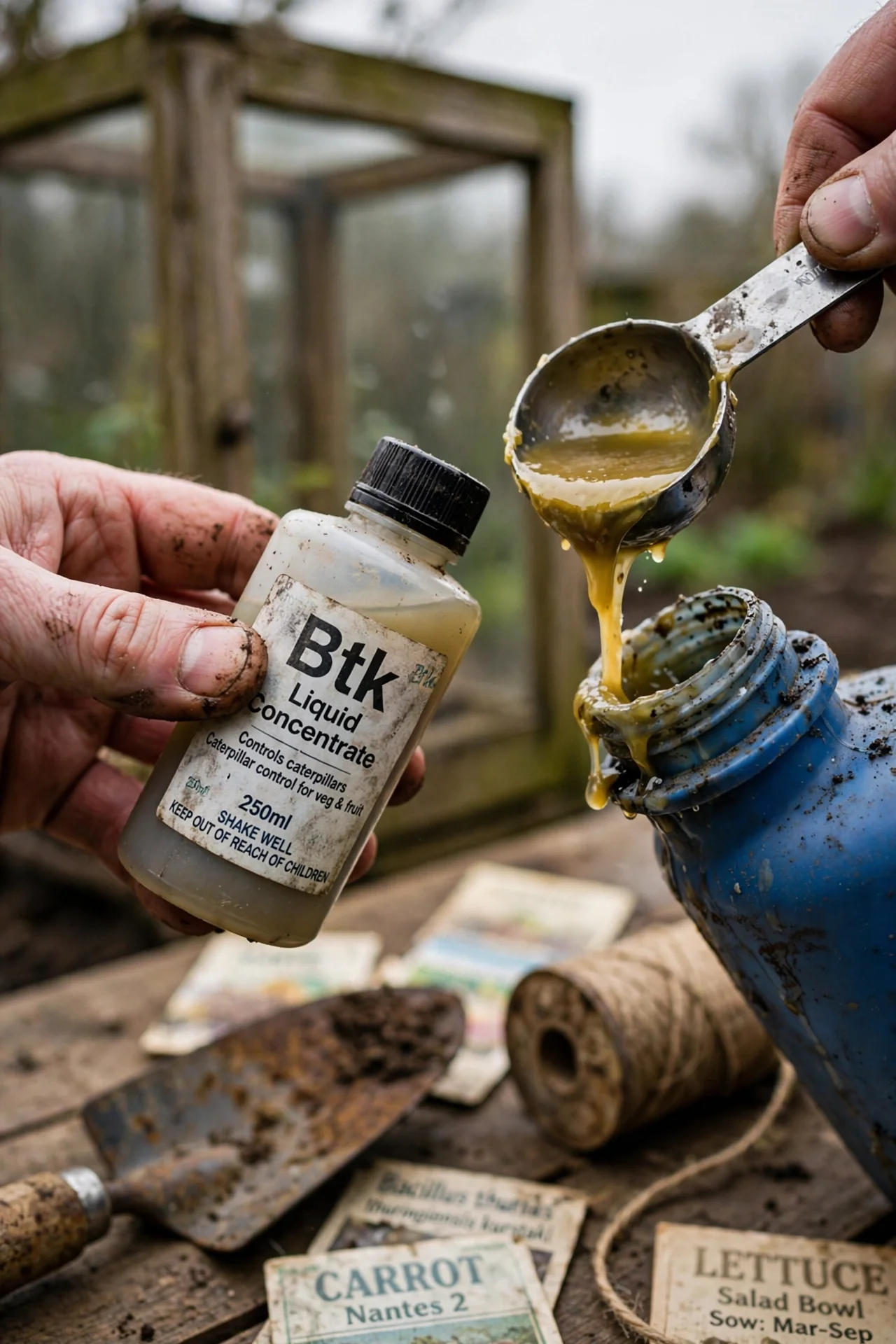
Btk Ready‑to‑Use Spray Bottle
Best for: Branch 2
Pros: No mixing; grab and spray when you spot the first caterpillars. Re‑entry interval as short as 4 hours on edible crops. Cons: Higher cost per application; difficult to achieve thorough coverage on more than a handful of plants. Edge case: Works best on potted plants and small raised beds where you can rotate the pot for full leaf access. For in‑ground rows, upgrade to a pump sprayer with concentrate.
Related: See how ready‑to‑use sprays fit into a larger pest strategy at our tomato hornworm control page.
Bta (Bacillus thuringiensis aizawai) Concentrate
Best for: Branch 3
Bta is the backup strain when Btk stops working. It contains different Cry protein classes (Cry1A, Cry1C, Cry1D) that bind to separate receptor sites in the caterpillar gut. This matters in two scenarios: (a) diamondback moth populations that have developed Btk resistance, common in warm climates with continuous brassica production; and (b) Spodoptera species (armyworms) that show lower natural susceptibility to Btk.
Constraint: Bta is harder to find at retail garden centers. You may need to order online or through agricultural supply stores. The mixing ratio is similar to Btk (typically 1 to 2 tablespoons per gallon), but always follow the specific label. Do not assume Bta and Btk are interchangeable for every caterpillar. Check the label for your target species.
Related: Integrate Bta into a broader IPM rotation; our beneficial insects overview explains how natural enemies complement microbial sprays.
Btk Dust (Dipel Dust)

Best for: Branch 1
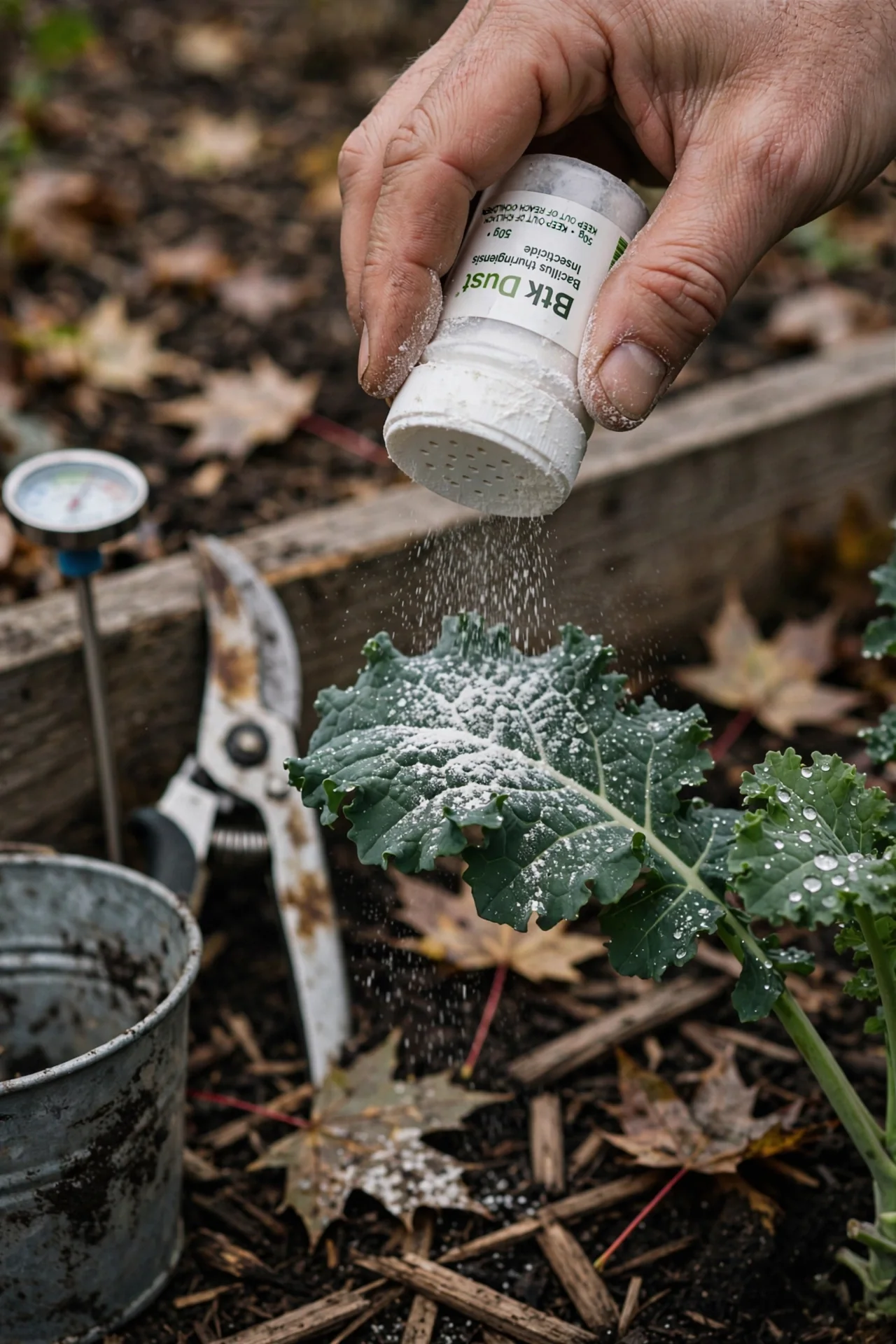
What it is: A dry, talc‑based formulation of Btk spores and crystals. Applied with a dust applicator or shaker can, it settles on leaves and remains effective as long as it stays dry. This format excels in arid climates (relative humidity below 50 percent) where liquid sprays evaporate before ingestion.
Constraint: Dust only sticks where you apply it. You must coat the underside of leaves, which requires bending, lifting, and often kneeling. On plants taller than waist height, coverage is inconsistent. Reapply after any moisture event, including heavy dew.
Steps: Dust early morning when leaves are slightly damp from dew; this improves adhesion. Apply no more than a thin, even film: clumps waste product and can shade leaf tissue. Mistake: Dusting on windy days. Even a light breeze drifts product onto flowering plants where pollinators may contact it. Apply only when wind is below 5 mph (8 km/h).
Related: For a dusting alternative that also targets non‑caterpillar pests, see our diatomaceous earth guide.
Btk with Feeding Stimulant (Molasses or Milk Powder)
Best for: Branch 2
When to use: Caterpillars are in the third or fourth instar and consuming less leaf area relative to body mass. Adding 1 teaspoon of unsulfured molasses or skim milk powder per gallon of Btk mix encourages faster ingestion, increasing the toxin dose before the spray degrades. Skip if: Bees are actively foraging on target plants; the sugars may attract them. Apply only at dusk when bees have returned to the hive.
Related: Learn about plants that attract beneficial insects away from cash crops in our companion planting for pest management guide.
Btk Bran Bait for Cutworms
Best for: Branch 3
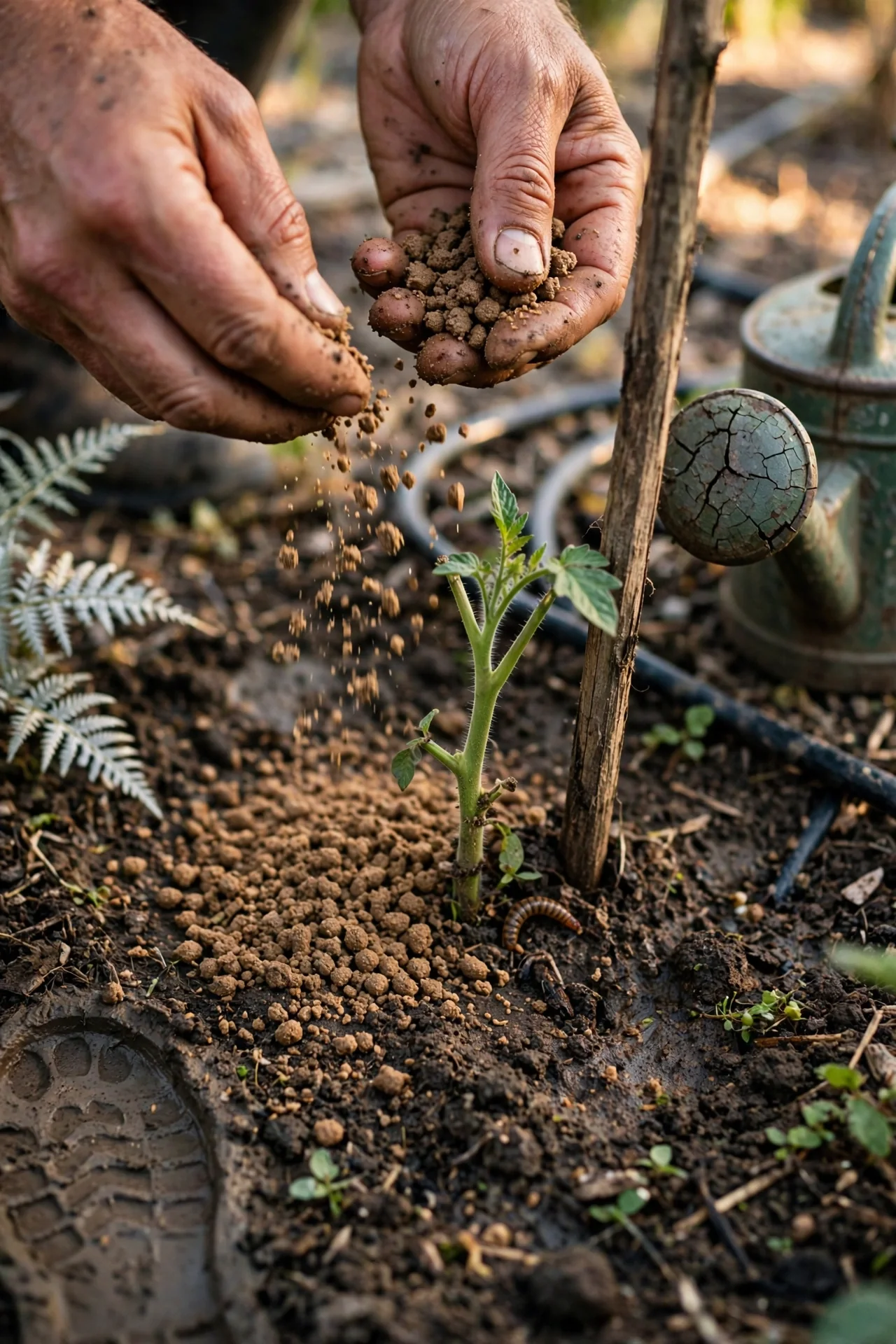
Cutworms feed at night at the soil surface and hide in the top centimeter of soil during daylight. Standard foliar sprays miss them. Instead, mix 2 tablespoons of Btk concentrate with 1 kg (about 2 lb) of wheat bran and enough water to moisten. Add 1 tablespoon of molasses as a phagostimulant. Scatter the bait around plant stems at dusk, targeting the area where stems meet soil.
Threshold rule: Use this method only when soil temperature at a 5 cm (2‑inch) depth exceeds 10 °C (50 °F) at night. Below that, cutworm feeding activity drops and bait is ignored. Reapply every 3 nights until damage stops.
Related: For identification and non‑chemical controls, visit our cutworm prevention page.
Btk Tank‑Mix with Spreader‑Sticker
Best for: Branch 1
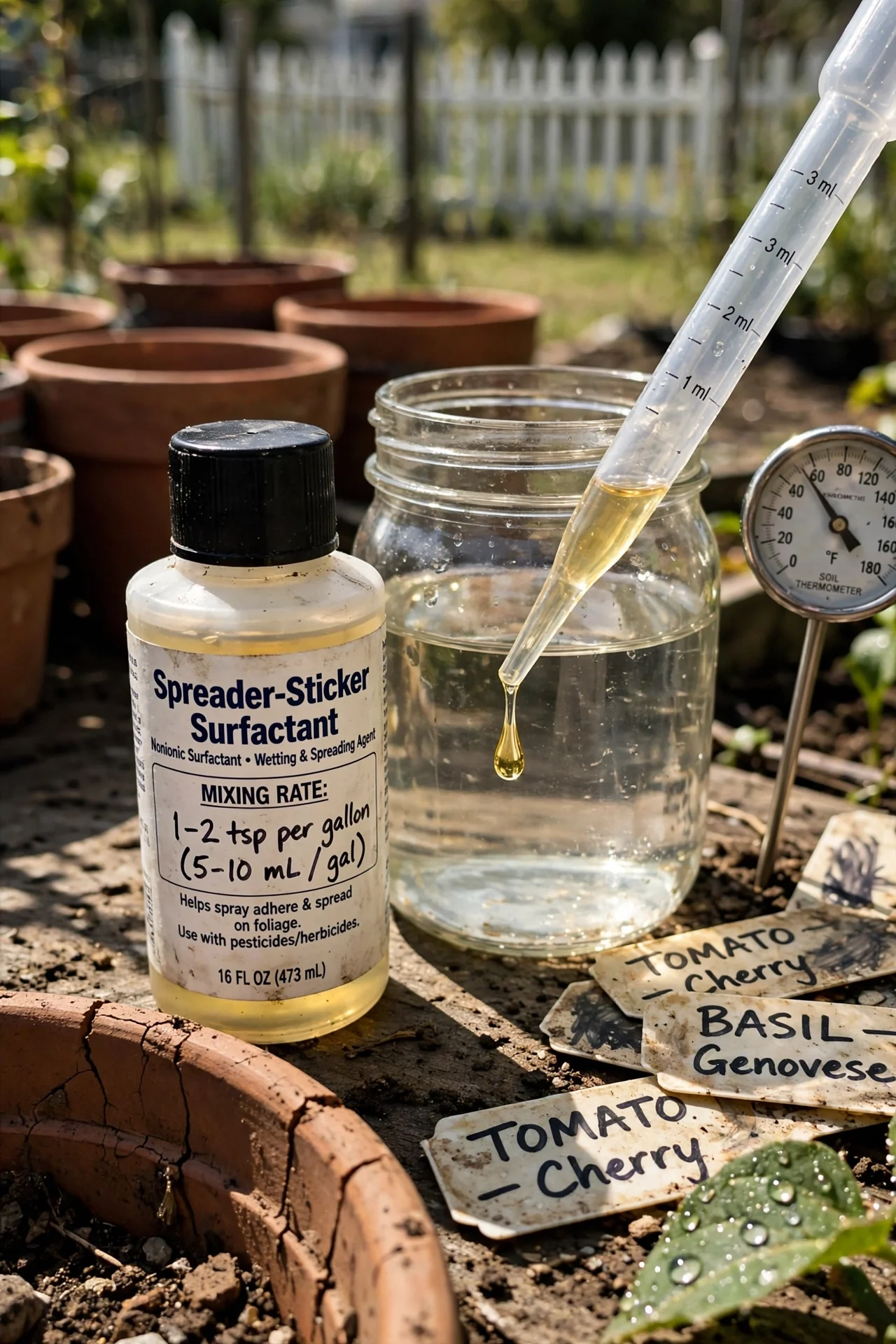
What it is: A non‑ionic surfactant or horticultural spreader‑sticker added to your Btk spray mix. It reduces surface tension so droplets spread across waxy leaves (cabbage, kale, collards, citrus) instead of beading and rolling off. It also improves rainfastness, buying you an extra 24 to 48 hours of residue if a light shower passes through.
Constraint: Spreader‑stickers can increase the risk of phytotoxicity (leaf burn) if applied when temperatures exceed 32 °C (90 °F). Always run a jar test first: mix a small batch and observe for separation or gel formation. Do not combine with Bordeaux mixture or lime sulfur, as alkaline pH above 8 degrades BT toxins within minutes.
Steps: Fill your spray tank halfway with water, add the measured Btk concentrate, then add spreader‑sticker at the labeled rate (typically 0.25 to 0.5 teaspoon per gallon). Top off with water and agitate. Spray immediately; do not let the tank mix sit. Mistake: Using dish soap as a substitute. Household detergents can contain degreasers that strip protective wax from leaves and are not pH‑neutral.
Related: See our horticultural oil overview for alternative tank‑mix partners that address multiple pest types.
Post‑Rain Reapplication Protocol
Best for: Branch 2
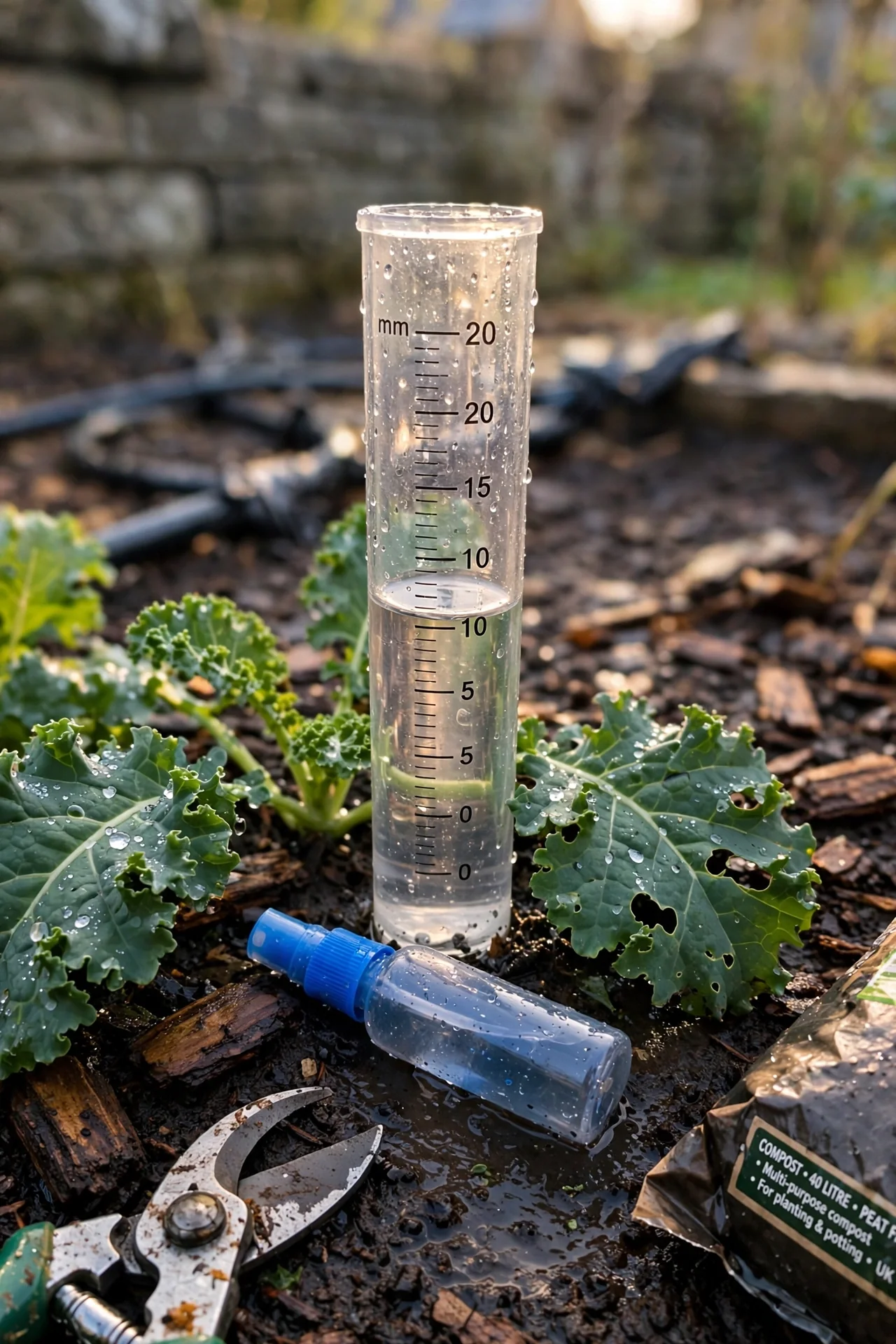
Rule: If rainfall exceeds 5 mm (0.2 inch) within 24 hours of application, respray. BT residues are water‑soluble protein crystals; they wash off leaf surfaces more easily than synthetic insecticides. In monsoon or tropical wet‑season climates, plan for a reapplication window every 72 hours during active caterpillar periods. Adjustment: If you added a spreader‑sticker (Item 7), extend the threshold to 12 mm (0.5 inch) of rain before respraying. Keep a rain gauge near the garden to make go/no‑go decisions without guessing.
Related: Understand how weather interacts with other control methods; our squash vine borer control guide discusses timing constraints for stem‑boring caterpillars.
Proper Storage and Shelf‑Life Tracking
Best for: Branch 3
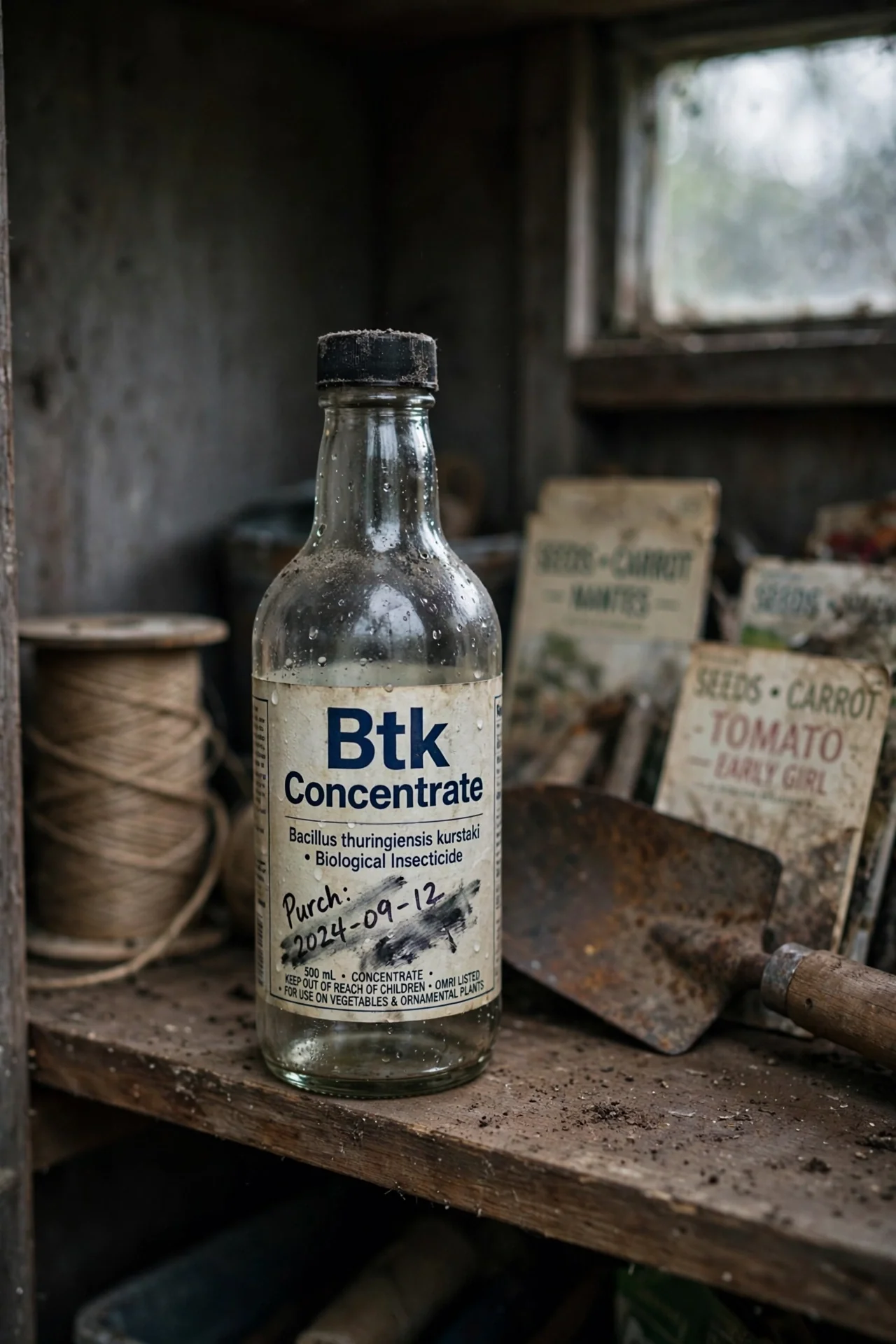
BT is a living bacterial product. Store liquid concentrate between 4 °C and 24 °C (40 °F to 75 °F), away from direct sunlight. Never freeze; ice crystals rupture spore coats. Dry formulations (dust, granules) tolerate a wider range but still degrade above 30 °C (85 °F). Most products carry a 2‑year shelf life from the manufacture date when stored correctly. Write the date of purchase on the bottle with a permanent marker. If the mix has a sour odor or fails to control caterpillars that are the correct species and size, the product has likely lost viability.
Skip BT: When Spinosad or Manual Removal Is the Right Call
Best for: Branch 3
Skip BT if: (a) caterpillars exceed 3 cm (1.2 inches) in length; their larger body mass requires a toxin dose that is difficult to deliver via foliar spray before the product degrades. (b) The caterpillar is inside a stem, fruit, or gall (e.g., squash vine borer, corn earworm inside the ear, codling moth inside apple). BT cannot reach internal feeders. (c) Rain is forecast for the next 12 hours and you have no spreader‑sticker on hand.
Alternative: Spinosad (Saccharopolyspora spinosa) works as both a contact and ingestion toxin, is effective on larger larvae, and has a 4‑hour rainfast window. For small plantings, hand‑removing caterpillars and dropping them into soapy water remains a zero‑cost, zero‑residue option that requires no purchase.
Related: For a botanical alternative that covers a different spectrum of pests, see our neem oil for bug control guide.
Starter Stack (What to Choose First)
Branch 1: Early Strike Stack
Combine a Btk liquid concentrate (Item 1) with a spreader‑sticker (Item 7). Together, a 16‑oz (473 ml) concentrate bottle and a small surfactant bottle cost roughly USD 18 to 25 and cover about 1,000 square feet (93 m²) for an entire growing season. The surfactant pays for itself by reducing reapplication frequency after light rain and improving coverage on waxy brassica leaves. Mix fresh each time and apply at the first sign of shot‑hole damage.
Branch 2: Damage Control Stack
Start with a Btk ready‑to‑use spray (Item 2) for immediate response, then add a feeding stimulant (Item 5) once you confirm caterpillars are in the third instar or larger. The ready‑to‑use bottle gives you a same‑day solution; the molasses upgrade boosts ingestion on the next scheduled spray. Budget roughly USD 12 to 18 upfront, and expect to reapply every 5 days during active feeding.
Branch 3: Season‑Long Prevention Stack
Invest in a Btk concentrate (Item 1 or Item 3 if you suspect Btk resistance) and a bran bait kit for soil‑level feeders (Item 6). Map out application dates on a calendar aligned with pest degree‑day models for your region. This stack requires the highest planning effort but the lowest per‑application cost over a full season. A concentrate bottle plus bran and molasses runs approximately USD 25 to 35 and can last two seasons if stored properly (Item 9).
When This Won’t Work
Condition 1: The caterpillar is not a Lepidoptera larva. Sawfly larvae (Hymenoptera) look like caterpillars but have more than five pairs of prolegs and lack the hooked crochets on their prolegs. BT does not affect sawflies because the toxin receptors are absent in their gut epithelium. Check the leg count before spraying. If you count six or more pairs of abdominal prolegs, switch to insecticidal soap or spinosad.
Condition 2: The caterpillar is inside the plant. Once a caterpillar tunnels into a stem, fruit, or leaf mine, BT on the exterior cannot reach it. Examples include squash vine borer larvae inside cucurbit stems, codling moth larvae inside apples, and leaf miners between epidermal layers. Systemic insecticides or targeted manual extraction (splitting the stem and removing the larva) are the only effective options. Our squash vine borer control guide covers detection and removal steps.
In both cases, continuing to spray BT wastes time and product while the pest advances. Stop, identify the organism correctly, and move to an appropriate control method.
Choosing the Right Option for Your Situation
Budget Threshold
Concentrate offers the lowest cost per application: roughly USD 0.15 to 0.30 per gallon of mixed spray. Ready‑to‑use bottles run USD 0.80 to 1.20 per gallon equivalent. If you treat more than 200 square feet (19 m²) per season, the concentrate pays for itself within the first three applications. Small‑space gardeners with fewer than 10 plants are better served by a ready‑to‑use format to avoid storing opened concentrate that may expire.
Time Threshold
A full mixing, spraying, and cleanup cycle takes 25 to 45 minutes for a home garden under 500 square feet (46 m²). If you can commit to that window every 5 to 7 days during pest season, concentrate with a pump sprayer is your most flexible tool. If you cannot guarantee that rhythm, choose the ready‑to‑use spray for spot treatments, accepting that you will pay more per application and may need to supplement with manual removal.
Technical Constraint: Water pH
BT toxins break down rapidly at pH above 8. If your tap water is alkaline (common in hard‑water regions), test it with a pool strip or pH meter before mixing. If pH exceeds 8, buffer the water with a pinch of citric acid or use distilled water. Do not use water from a water softener that uses sodium chloride; the sodium competes with spore viability. This single variable accounts for many reports of BT failure when all other conditions appear correct.
Yes/No Checklist:
1. Are the caterpillars on the leaf surface and actively chewing? (If no, stop; BT cannot work.)
2. Is the largest caterpillar under 2.5 cm (1 inch)? (If no, consider spinosad or manual removal.)
3. Is the water pH below 8 and the forecast temperature between 20 °C and 30 °C (68 °F to 86 °F) for the next 6 hours? (If no, postpone spraying.)
4. Do you have a rain gauge and a plan to reapply after 5 mm (0.2 inch) of rain? (If no, add a spreader‑sticker to your purchase list.)
Expert Q&A
Will BT kill monarch caterpillars on my milkweed?
Yes. Btk is toxic to all Lepidoptera larvae, including monarchs. If you wish to preserve monarchs, do not apply BT to milkweed or any plant where monarch eggs or caterpillars are present. Hand‑relocate monarch caterpillars to a protected enclosure before treating nearby plants.
Why did BT work last year but not this year on my brassicas?
The most likely cause is resistance development in diamondback moth populations, which is documented in regions with year‑round brassica production. Switch to Bta (Item 3) and rotate with spinosad to slow further resistance. Also confirm that your BT concentrate has not expired; a loss of viability mimics resistance.
Can I mix BT with liquid fertilizer or seaweed extract in one tank?
Yes, but only if the combined pH remains between 6 and 7. Always jar‑test a small quantity first. Avoid mixing with fertilizers containing copper, boron, or high concentrations of phosphorus, as these can reduce spore viability. Apply the tank mix immediately; do not store overnight.
How long after spraying can I harvest and eat the vegetables?
There is no pre‑harvest interval for Btk on most labels; you can harvest and eat produce on the same day after washing with water. However, wash thoroughly to remove spore residue, and if you used a spreader‑sticker, confirm its specific pre‑harvest interval, which is typically 0 to 1 day.
Does BT harm earthworms in my garden soil?
No. Earthworms are annelids, not arthropods. The Cry toxins in BT require specific receptor proteins found only in certain insect orders. Earthworms lack these receptors entirely and are unaffected by foliar or soil‑applied BT products.
Conclusion
The most common mistake is spraying BT on large caterpillars and declaring it ineffective. BT is a narrow‑window tool: it works on small, exposed, actively feeding larvae and does almost nothing outside that window. If you match the strain to the caterpillar, apply at the correct instar, and account for UV, rain, and water pH, you will get reliable control. If any one of those variables is misaligned, switch to spinosad, manual removal, or a systemic product.
Next step: identify the caterpillars on your plants today. Use a hand lens to check proleg count and instar size. Then follow the Decision Grid branch that matches your situation, and pick one item from the Starter Stack to begin. If you are still unsure whether the pest is a caterpillar or something else, our insecticidal soap guide can help you choose a broader‑spectrum starting point.