
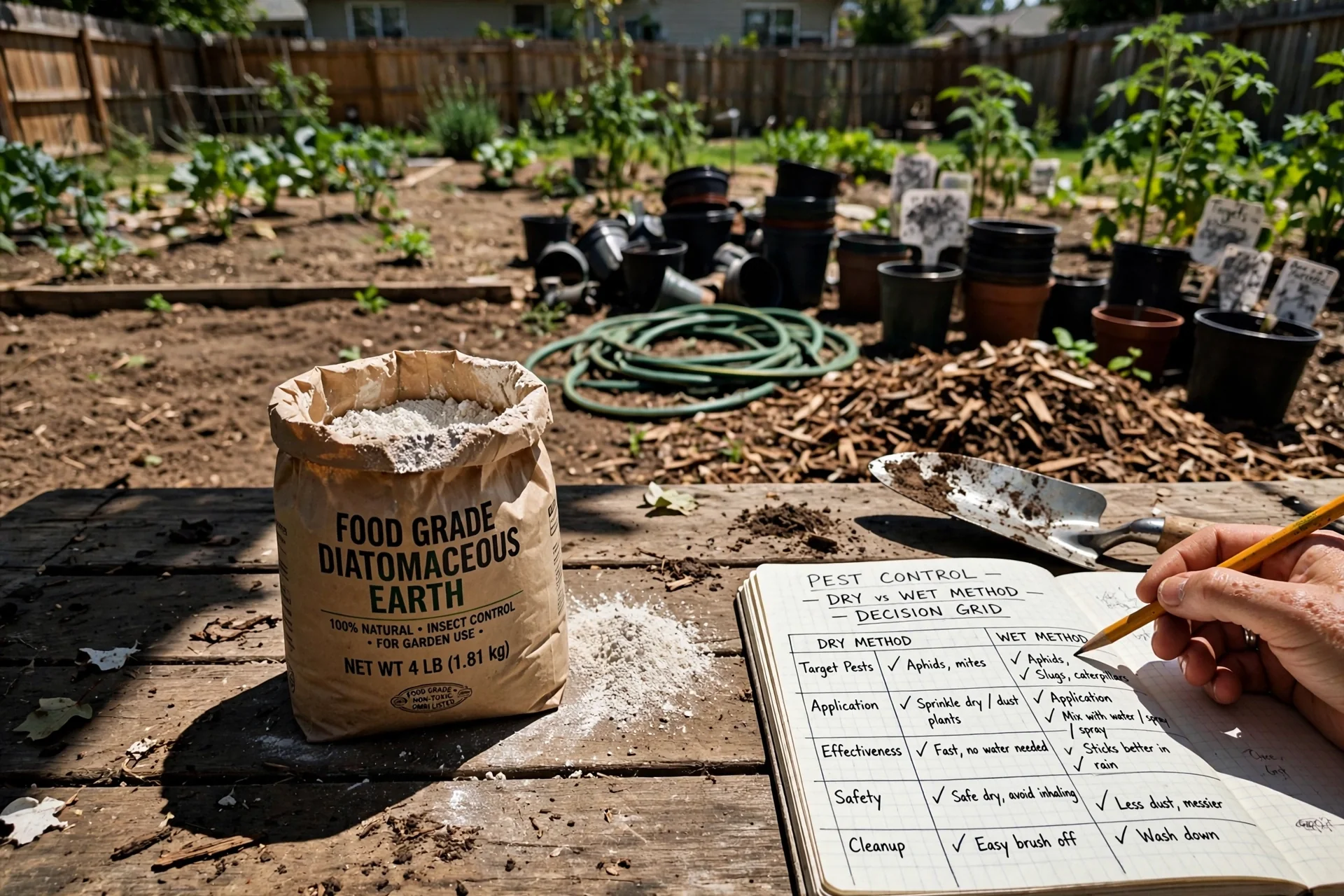
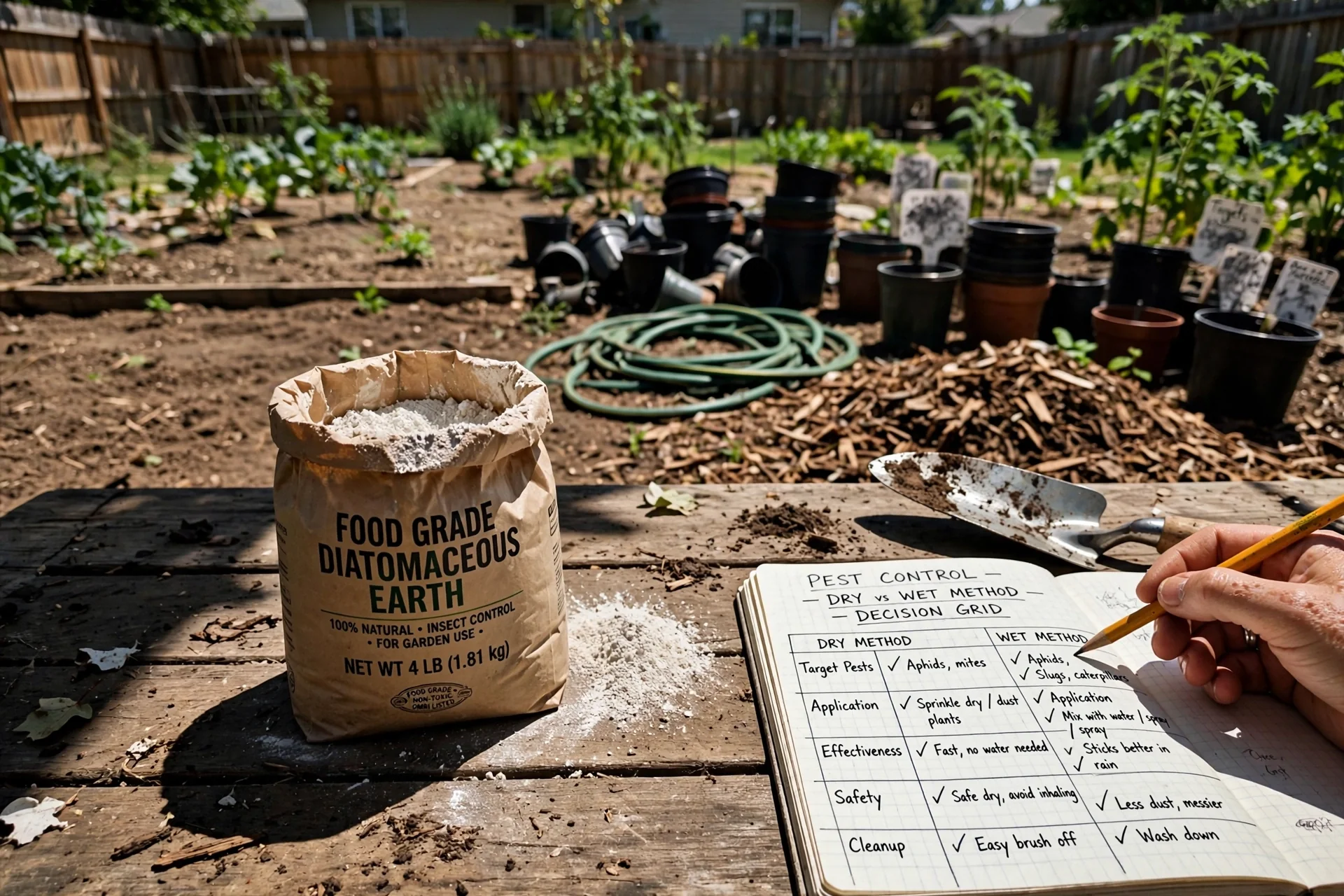
Most gardeners think of diatomaceous earth as a one‑size‑fits‑all dust. The reality is that its performance is almost entirely determined by whether you match the application method to two conditions: the moisture environment and the target pest’s behavior. If you use a dry‑dusting routine during a rainy week, you will get zero residual control, and if you spray a wet mix on a pest that lives deep in the soil, you will miss it completely. This article reframes DE as a set of distinct tactical choices, not a single product.
This guide covers food‑grade diatomaceous earth used outdoors in vegetable gardens, flower beds, and around garden structures. It deliberately excludes pool‑grade DE (which is heat‑treated and contains crystalline silica levels unsafe for plants), indoor pest control, and uses on pets or livestock. We also stay away from “cosmetic” soil‑amendment claims that lack measurable garden outcomes; the focus is on practical pest suppression.
By the end, you will be able to pick a method based on your rainfall pattern, target pest, and available time, and understand exactly when that method stops working. You will also see which combinations give you overlapping protection without doubling your workload.
Bottom line: Dry DE applications fail within hours of rain or heavy dew, so treat moisture as the primary decision gate before you open the bag.
The Yield Grid Decision Grid
Branch 1: Dry climate or guaranteed 48‑hour dry window.
You live in an arid region or you can confidently avoid rain and overhead irrigation for two full days. Humidity is below 60 percent most afternoons. Your main pests are soft‑bodied, leaf‑dwelling insects such as aphids, spider mites, or young caterpillars. In these conditions, dry dusting gives rapid knockdown because the powder stays abrasive and does not clump.
Recommended: Items 1, 4, 8 below.
Branch 2: Persistent soil‑dwelling pests or root‑zone protection.
You are losing seedlings to cutworms, finding root maggots in turnips, or seeing fungus gnat larvae in containers. Soil moisture is a given, so dry surface applications are useless. Your best move is to get DE into the top few inches of soil or onto the seed itself.
Recommended: Items 3, 5, 6 below.
Branch 3: Humid, rainy, or coastal garden with frequent wetting.
You garden where afternoon thunderstorms, coastal fog, or heavy dew are common during your pest season. Dry DE turns to paste overnight. You need a wet‑spray method or a physical barrier that can be renewed quickly and cheaply after each rain event.
Recommended: Items 2, 4, 9 below. Also review beneficial insect habits before spraying, because wet DE can still harm pollinators if applied to open flowers.
Quick Comparison Table
| Option | Key mechanism | Best for | Decision Grid Branch | Effort Score |
|---|---|---|---|---|
| 1. Dry Dusting Foliage | Abrasive powder desiccates insects on contact | Aphids, mites, thrips on leaves | Branch 1 | 3 |
| 2. Wet Spray Foliar | DE suspension dries into a clinging residue | Large leaf canopies, windy sites | Branch 3 | 4 |
| 3. Soil Drench | DE particles coat soil surfaces and larvae | Cutworms, root maggots, fungus gnat larvae | Branch 2 | 2 |
| 4. Perimeter Barrier | Physical barrier abrades crawling insects | Ants, earwigs, slugs entering beds | Branch 1 or 3 | 3 |
| 5. Seed Treatment | DE coats seed, protecting against soil‑borne pests | Beans, corn, squash at planting | Branch 2 | 1 |
| 6. Compost & Soil Amendment | DE mixed into medium deters pests and adds silica | Fungus gnats in compost, general soil conditioning | Branch 2 | 1 |
| 7. Greenhouse Application | Dry DE applied to benches and crevices | Thrips, whiteflies in enclosed spaces | Branch 1 | 3 |
| 8. Spot Treatment | Targeted dusting into pest hiding spots | Earwigs, pillbugs under pots or boards | Branch 1 | 3 |
| 9. DE + Other Substances | DE mixed with soap or oil improves adhesion | Persistent soft‑bodied pests in humid zones | Branch 3 | 4 |
| 10. Reapplication Timing | Decision rules for renewing any method | All methods after rain or heavy dew | All branches | 2 |
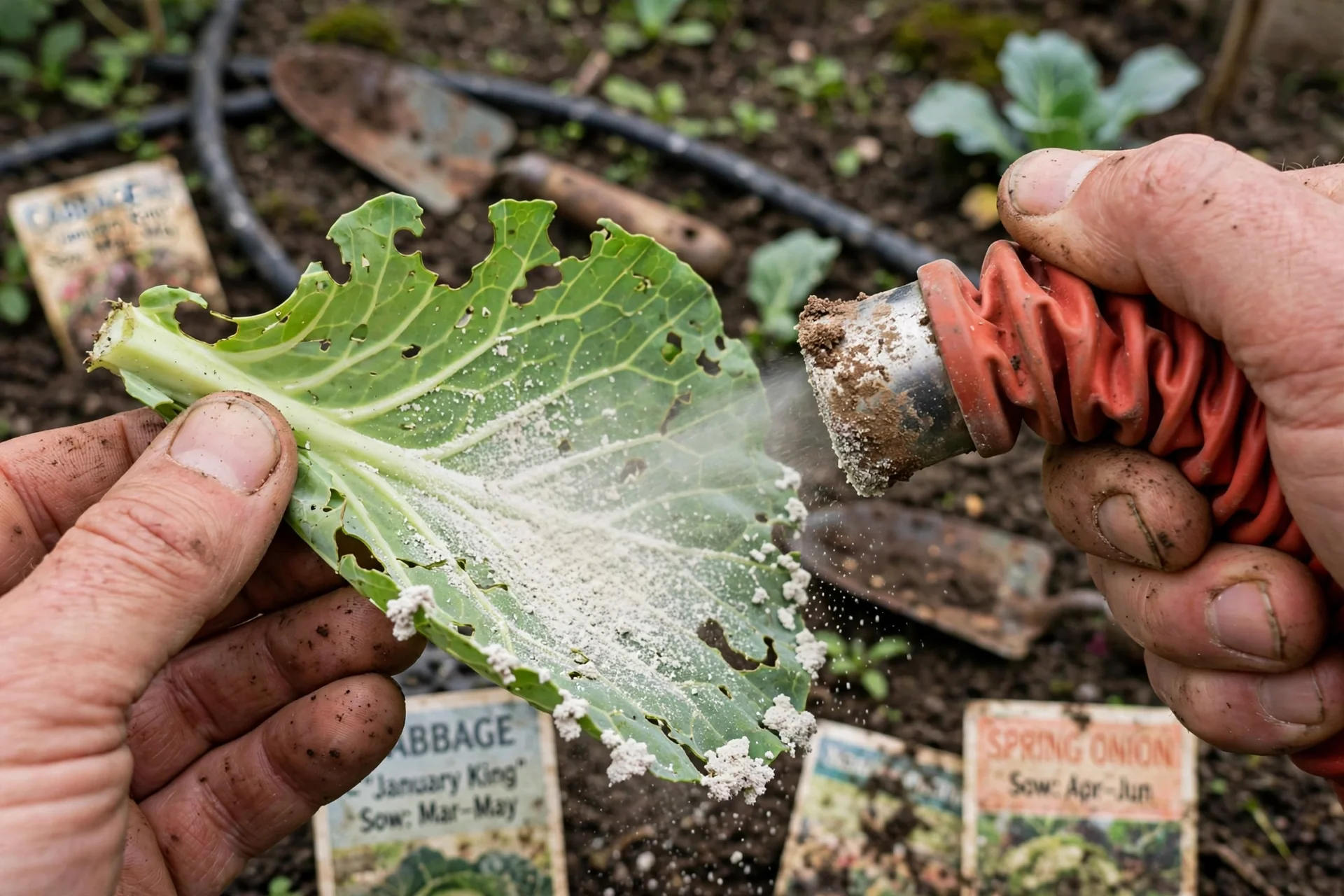
1. Dry Dusting Foliage
Best for: Branch 1
What it is: Applying food‑grade DE powder directly to leaf surfaces, stems, and the surrounding soil with a handheld duster or a fine‑mesh sieve.
What it targets: Soft‑bodied insects that feed on foliage: aphids, spider mites, whiteflies, thrips, and early‑instar caterpillars. It also suppresses some beetle larvae on leaves.
Steps: (1) Check the 48‑hour forecast and confirm no rain or overhead watering. (2) In early morning or late evening, when bees are less active, load the duster. (3) Apply a thin, even layer to the tops and undersides of leaves; avoid blossoms. (4) Re‑apply after any rain event or heavy dew that visibly dampens the powder.
Common mistake: Applying too heavily until leaves appear white. This can clog stomata and reduce photosynthesis. A light dusting is sufficient; you should still see green through the powder.
If aphids are your main concern, pairing dry dusting with a targeted aphid control plan can reduce the number of re‑applications needed during peak season.
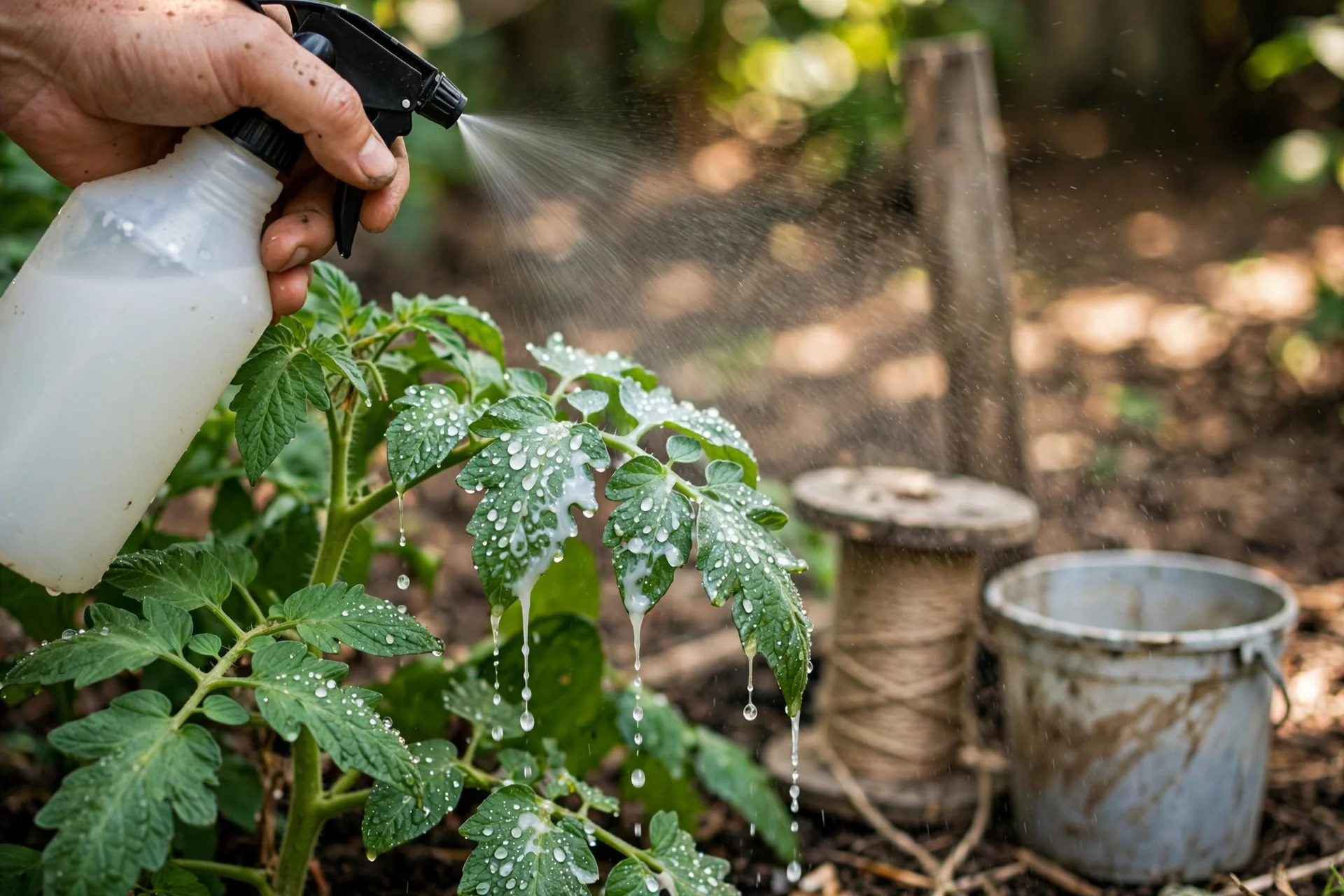
2. Wet Spray Foliar
Best for: Branch 3
Use when: You need to cover large plants quickly and dry dust would drift or clump. Wet spray also reduces airborne inhalation risk, making it safer for the applicator.
Skip when: Rain is expected within 6 hours of spraying; the DE will wash off before the water evaporates and leaves a residue. Also skip if you cannot avoid open flowers, because the wet slurry can trap bees just as effectively as dry powder.
Edge case: In very high humidity (above 85 percent), the spray may never fully dry, which means the DE never becomes abrasive. In that environment, a perimeter barrier may outperform a foliar spray.
3. Soil Drench
Best for: Branch 2
Threshold rule: Use a soil drench when you find more than one cutworm per square foot of soil surface, or when seedlings are being severed at the base overnight. Mix 2 tablespoons of food‑grade DE per gallon of water, stir vigorously, and pour 1 cup of the suspension around the stem of each plant. The water carries DE particles into the top inch of soil where larvae rest.
Adjustment: In heavy clay soils, increase the volume of water but keep the DE ratio the same; the suspension needs extra liquid to penetrate. In sandy soil, reduce the water volume slightly to avoid washing the DE past the root zone.
For persistent cutworm problems, this drench works alongside cutworm prevention tactics such as cardboard collars and nighttime handpicking.
4. Perimeter Barrier
Best for: Branch 1 or 3
10‑minute workflow:
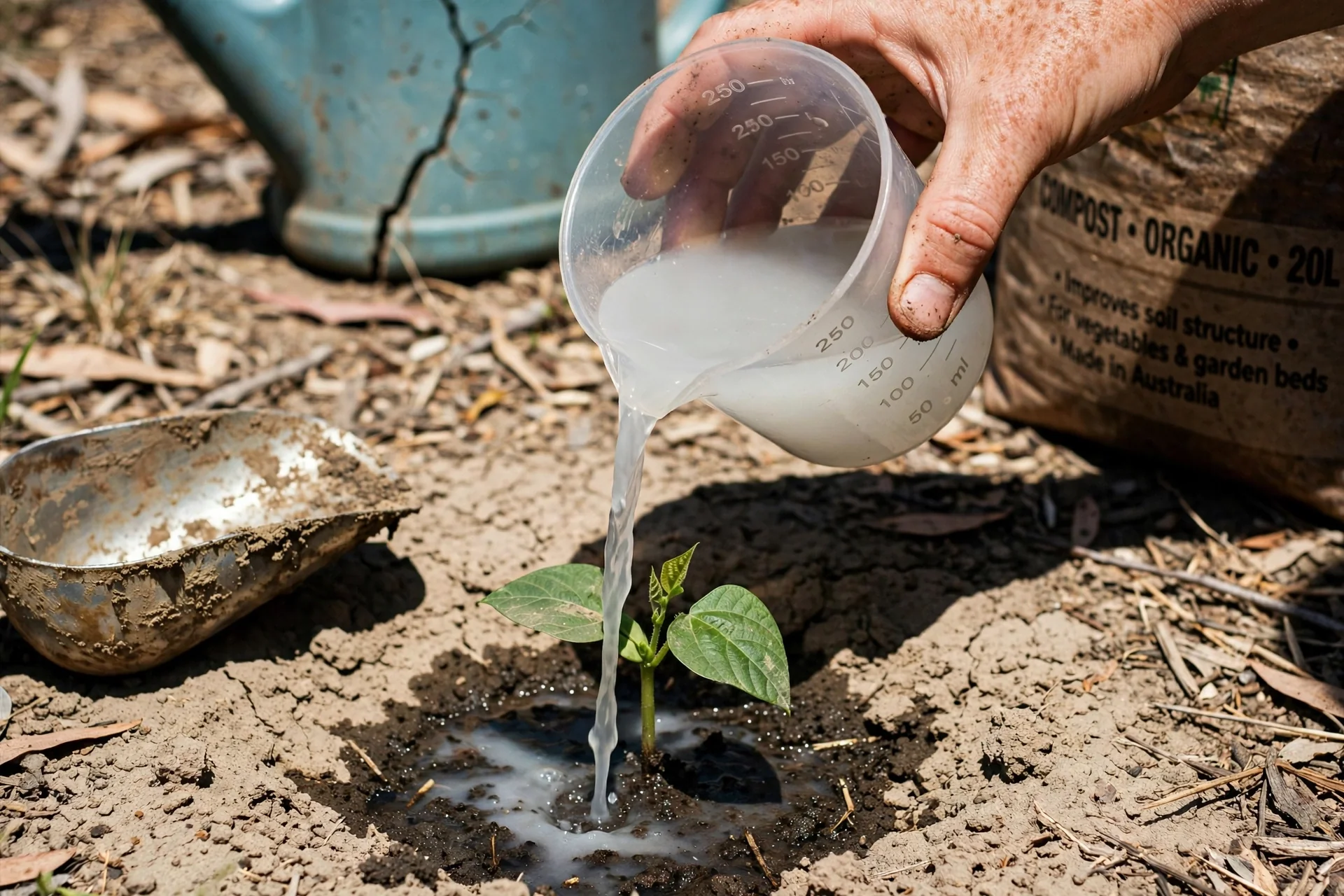
(1) Clear a 4‑inch‑wide strip of bare soil around the bed or structure you want to protect.
(2) Pour a continuous line of dry DE along the center of that strip; a band roughly 1/8 inch thick and 2 inches wide is adequate.
(3) Inspect the barrier after every rainfall or heavy dew; if gaps appear, close them immediately.
(4) For slug‑prone areas, double the width to 4 inches, because slugs can arch over a thin line.
Upgrade option: Combine the DE barrier with a copper tape strip on the outside edge for a dual‑mode defense that works even when the DE is damp.
5. Seed Treatment
Best for: Branch 2
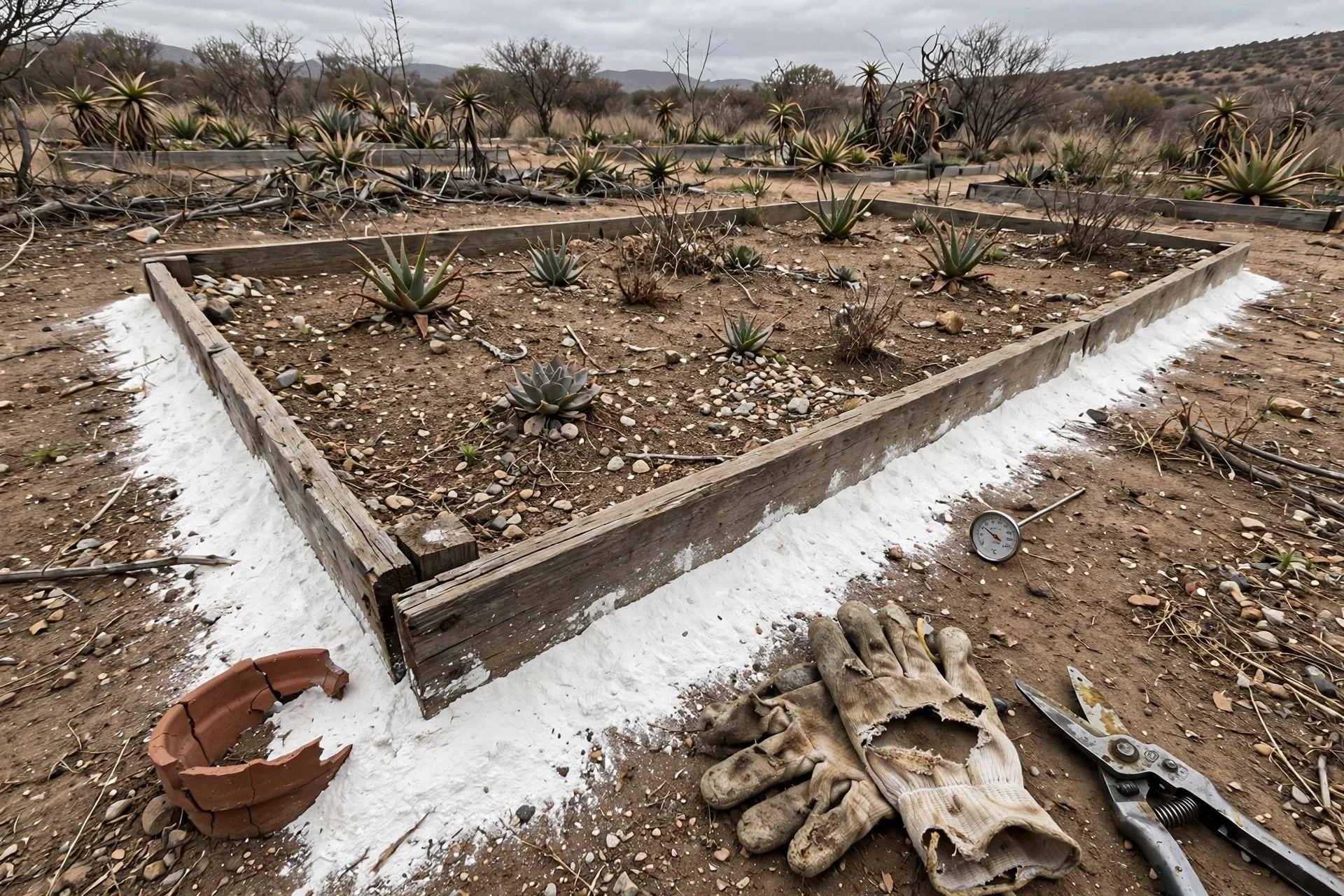
What it is: Dusting seeds with a thin coat of food‑grade DE immediately before sowing.
Why it works: The DE creates a desiccating micro‑environment around the seed, deterring soil‑borne pathogens and early‑season pests like seed‑corn maggots.
Steps: Place seeds in a jar, add a small pinch of DE, close the lid, and shake gently until seeds are lightly coated. Sow immediately.
Mistake to avoid: Soaking seeds before treatment; DE clumps on wet seeds and can interfere with germination.
6. Compost & Soil Amendment
Best for: Branch 2
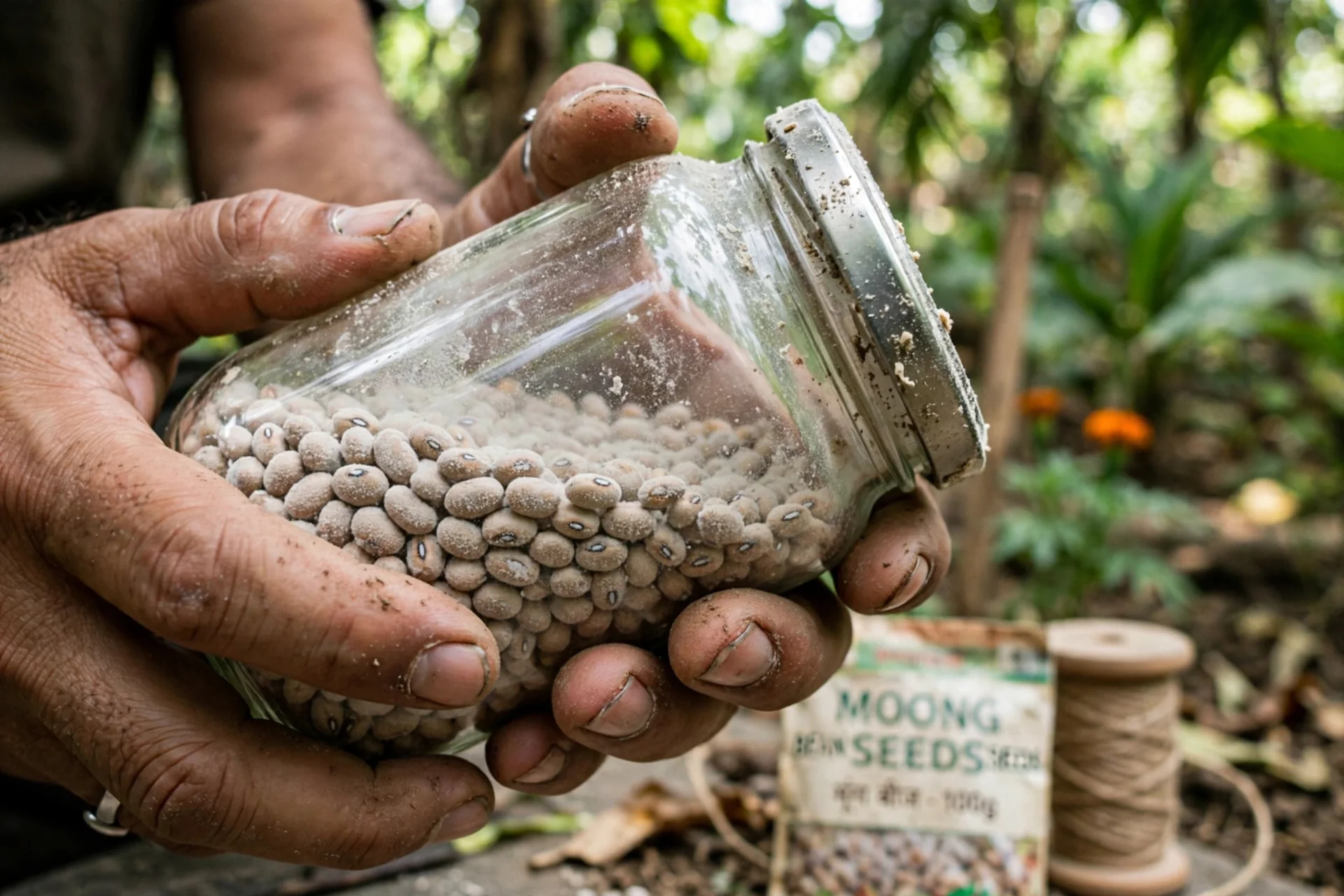
Use: Mix 1 cup of food‑grade DE into every cubic foot of finished compost or potting mix to suppress fungus gnat larvae and add plant‑available silica.
Pros: Once mixed, no reapplication is needed for a full growing season. Silica may strengthen cell walls, making plants less susceptible to piercing‑sucking insects.
Cons: DE loses its abrasive texture when thoroughly moistened and incorporated, so its pest‑control effect fades within weeks. It also does nothing against pathogens already established in plant tissue.
Edge case: In worm bins, avoid adding DE; it can irritate earthworms and reduce decomposition rates.
7. Greenhouse Application
Best for: Branch 1
Threshold rule: If yellow sticky cards in your greenhouse catch more than 10 thrips per card per week, a dry DE treatment on benches, floor cracks, and around pot rims is warranted. Use a puffer duster to reach crevices without creating airborne clouds. Reapply when sticky card counts stay above 5 per week after the initial treatment.
Adjustment for humidity: In greenhouses where relative humidity regularly exceeds 80 percent, switch to a wet‑spray method on hard surfaces only, because dry DE will absorb moisture from the air and lose effectiveness within hours.
For a full thrips management strategy that includes biological controls, see our thrips control guide.
8. Spot Treatment for Hiding Pests
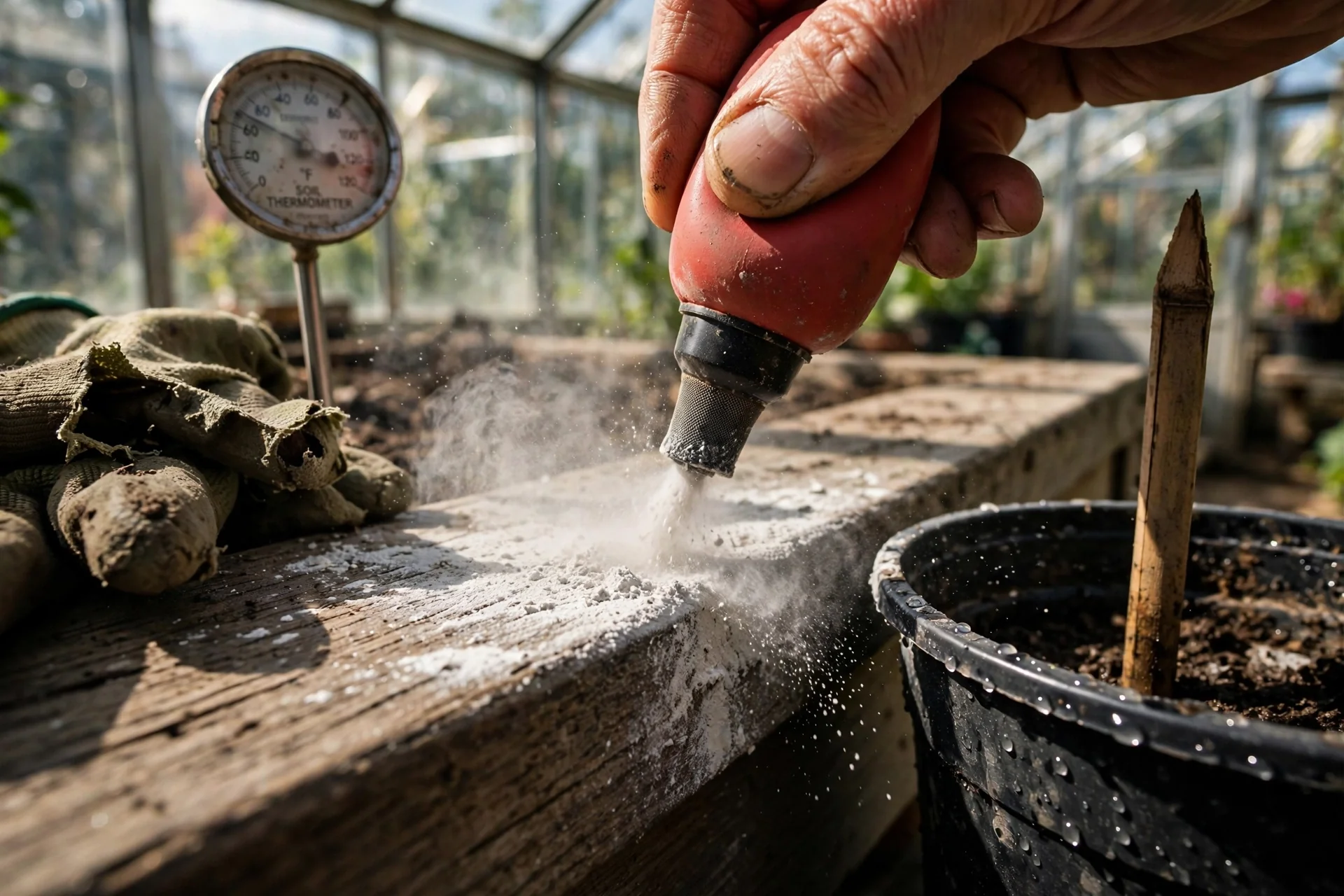
Best for: Branch 1
10‑minute workflow:
(1) Identify daytime hiding spots: under pots, beneath boards, inside hollow stems, or within leaf litter at the base of plants.
(2) Lightly puff DE into each crevice; a small artist’s brush can push powder into tight spots.
(3) Check the spots after 48 hours; remove any pest bodies to avoid attracting scavengers.
Upgrade option: Place a few upturned citrus halves near the hiding spots the night before; pests will congregate underneath, and you can apply DE directly to that concentrated area the next morning.
9. DE Combined With Other Substances
Best for: Branch 3
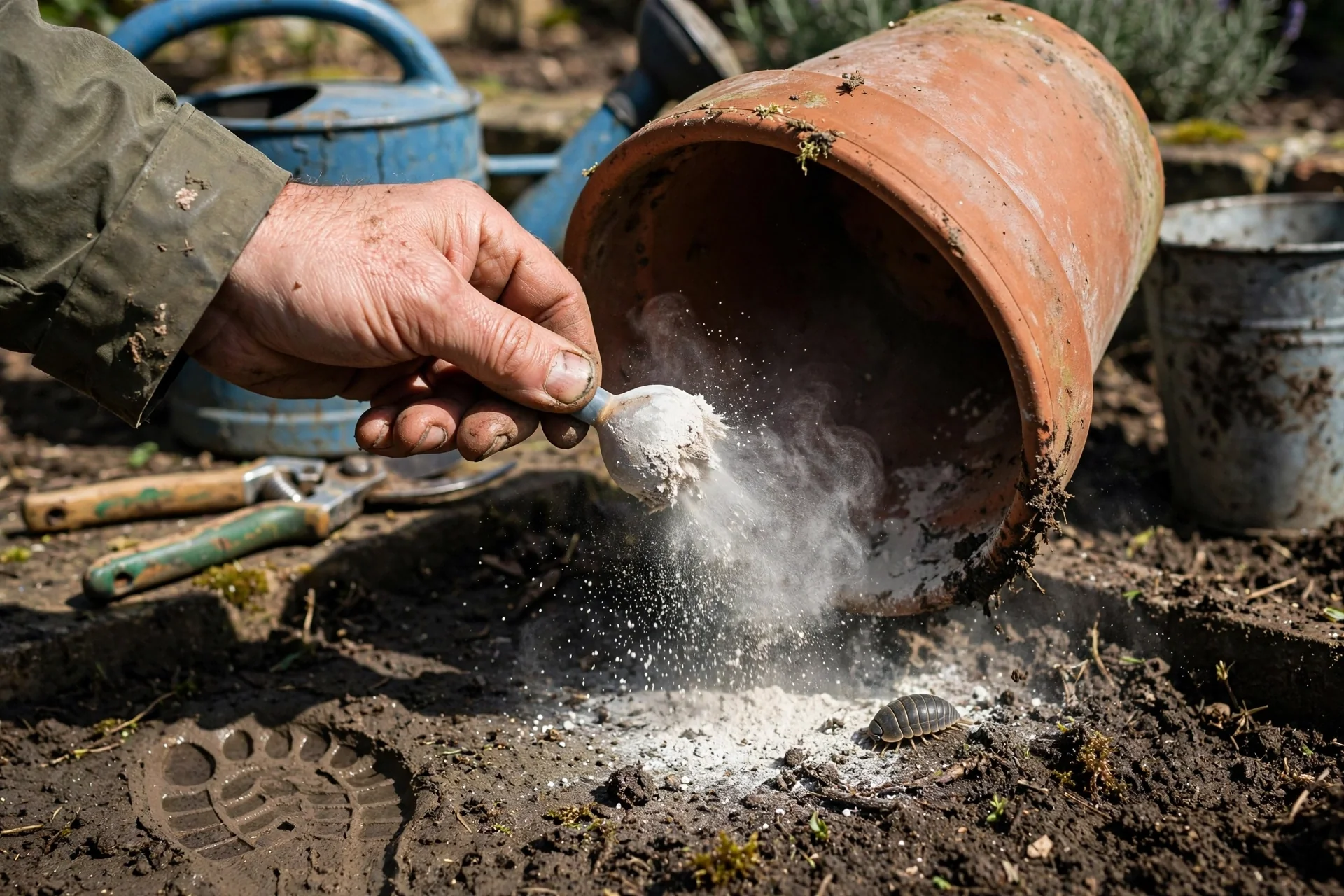
What it is: Adding DE to a dilute insecticidal soap or horticultural oil solution to improve leaf coverage and residual activity.
Why it can help: Soap helps the DE suspension adhere to waxy leaves; oil slows evaporation, giving the DE more time to settle into a uniform film.
Steps: Mix 1 tablespoon DE per gallon of prepared soap or oil solution, shake continuously during application, and spray to the point of light runoff.
Mistake: Using this mix in temperatures above 85°F (29°C) can cause leaf burn on sensitive crops like squash or beans. Apply only in early morning or late evening.
If you already use insecticidal soap, blending it with DE can bridge the gap between a contact‑kill only strategy and a longer‑lasting physical barrier. See our organic aphid spray recipes for compatible soap concentrations.
10. Reapplication Timing: The Rule That Determines Success
Best for: All branches
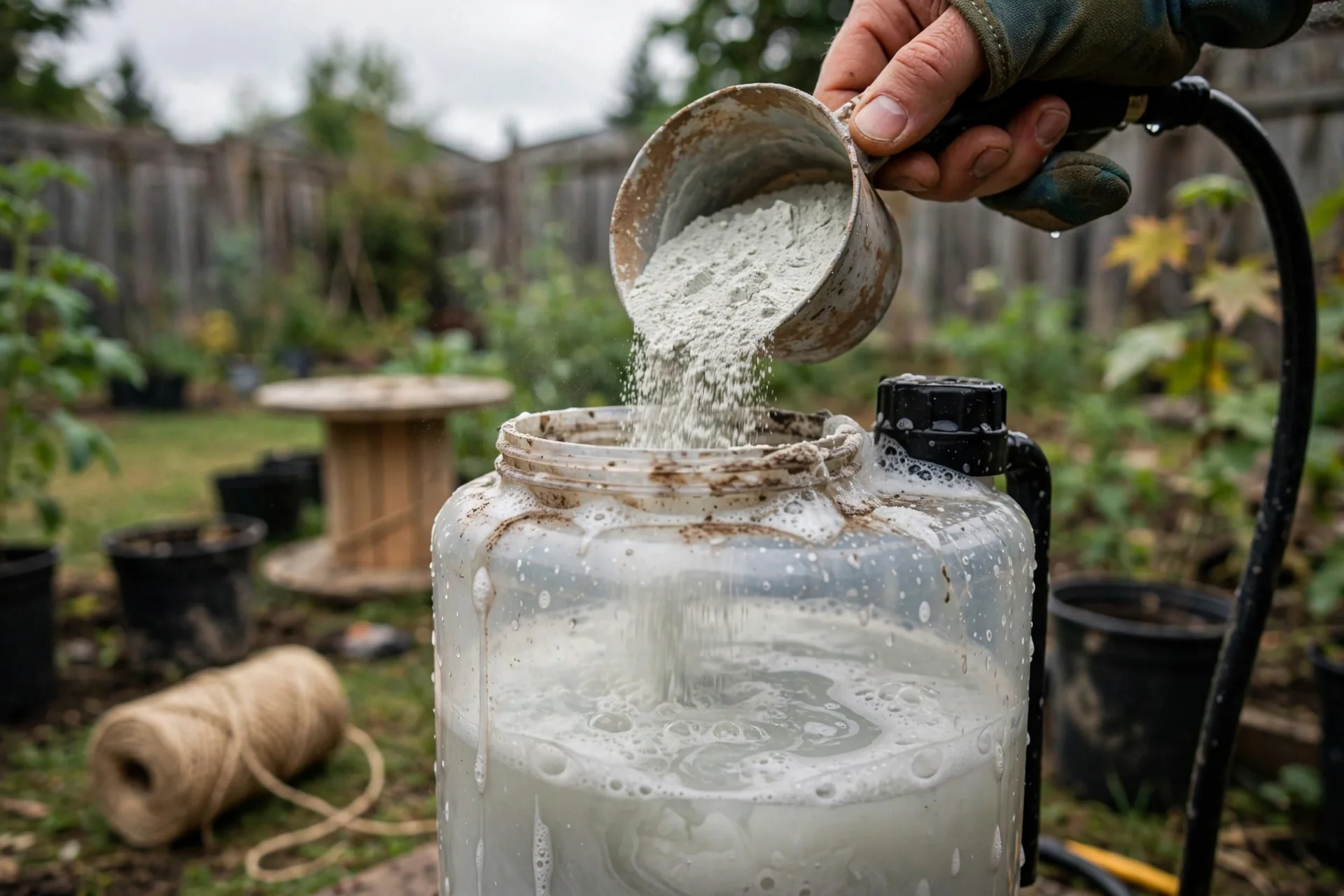
Use this rule: Any dry DE application should be considered “expired” after any event that visibly darkens the powder. This includes rain, overhead irrigation, and heavy dew that forms droplets on leaves. In practice, during a week with two morning dews, you may need three applications.
Skip when: You are using a soil‑incorporated method (items 3, 5, or 6) where moisture is part of the design and the DE is expected to be damp. Those methods are renewed on a seasonal, not daily, schedule.
Edge case: In regions with consistent afternoon breezes above 10 mph, dry DE can be physically blown off leaves even without rain. After a windy day, inspect foliage before assuming protection remains.
Starter Stack (What to Choose First)
Branch 1: Dry‑climate gardener
Start with Item 1 (Dry Dusting Foliage) and Item 4 (Perimeter Barrier). The foliage dusting handles the pests you can see; the barrier stops the ones crawling in from surrounding soil or mulch. Together they create a vertical‑and‑horizontal defense. Estimated cost: a 2‑lb bag of food‑grade DE ($8–$14 US) plus a basic duster ($12–$20). Time investment: roughly 20 minutes per application cycle in a 200 sq ft garden, repeated after each rain.
Branch 2: Soil‑pest gardener
Start with Item 3 (Soil Drench) and Item 5 (Seed Treatment). The drench protects established transplants; the seed treatment protects the next sowing. This front‑loaded approach means you apply once at planting and once more mid‑season if monitoring shows new damage. Estimated cost: $10–$16 for DE and a dedicated watering can with a mixing screen. Time investment: about 15 minutes for seed treatment and 30 minutes for drenching a standard 4‑by‑8‑foot bed.
Branch 3: Humid‑region gardener
Start with Item 2 (Wet Spray Foliar) and Item 9 (DE Combined With Other Substances). The wet spray gets DE onto leaf surfaces without the drift or clumping problems of dry dusting; adding a small amount of insecticidal soap improves adhesion during intermittent drizzle. Reapply every 7–10 days during active pest season. Estimated cost: $15–$25 for DE plus a pump sprayer and compatible soap concentrate. Time investment: approximately 25 minutes per application for a mixed vegetable garden.
When This Won’t Work
Failure condition 1: The target pest has a thick, waxy cuticle. DE works by abrading the thin wax layer of soft‑bodied insects. Beetles with hardened exoskeletons (adult Japanese beetles, Colorado potato beetles) can often survive a dusting because the powder cannot scratch their integument deeply enough to cause lethal dehydration. If you are targeting adult hard‑shelled beetles, switch to a contact insecticide or physical removal. Our neem oil guide covers an alternative that disrupts feeding and reproduction rather than relying on abrasion.
Failure condition 2: You cannot maintain a dry application surface for at least 24 hours. In continuously wet environments (rainforest edges, gardens under mist irrigation, maritime fog belts), DE stays damp and non‑abrasive around the clock. In those situations, even the best wet‑spray method will underperform because the residue never dries into its sharp crystalline form. The more reliable alternative in persistently wet gardens is a combination of physical barriers (copper tape, fine netting) and biological controls such as predatory mites or nematodes.
Choosing the Right Option for Your Situation
Budget threshold
Food‑grade DE is inexpensive per pound, but the hidden cost is the applicator. A quality bellows duster ($15–$25) improves coverage and reduces waste compared to a kitchen strainer. If your pest‑control budget is under $20 total, choose Items 1 and 3 (dry dusting and soil drench) and use a repurposed fine‑mesh sieve for both.
Time threshold
If you can dedicate only 30 minutes per week to pest management, avoid methods that require frequent reapplication: items 2, 4, and 9 will consume your entire window. Instead, lean on items 3, 5, and 6 that require one or two deliberate applications per season.
Technical constraint: food‑grade vs. pool‑grade
Only amorphous (food‑grade) DE is safe for garden use. Pool‑grade DE contains crystalline silica, which is a respiratory hazard and can damage soil biology over time. Check the label: if the product mentions “filter grade” or “calcined,” do not use it on plants or soil. Food‑grade DE is labeled as such and is regulated for use in grain storage and animal feed.
Yes/No Checklist
- Can you guarantee at least 24 hours of dry conditions after application? Yes ─ use a dry method. No ─ use a wet or soil‑incorporated method.
- Is your target pest soft‑bodied and active on leaf surfaces? Yes ─ proceed with DE. No ─ consider an alternative contact or systemic option.
- Do you have a food‑grade DE product, not pool‑grade? Yes ─ safe to proceed. No ─ stop and obtain the correct product.
- Can you avoid applying DE to open flowers during pollinator activity? Yes ─ apply in early morning or evening. No ─ choose a selective method that spares pollinators.
Expert Q&A
How long does it take for diatomaceous earth to kill an insect?
Death is not instant. A small soft‑bodied insect like an aphid may succumb within 4 to 12 hours of continuous contact under dry conditions. Larger insects or those with a thicker wax layer can take 24 to 48 hours. The key variable is the insect’s activity level: the more it moves through the powder, the faster abrasion accumulates.
Does diatomaceous earth expire or lose effectiveness over time?
DE does not have an expiration date if kept dry. Its killing mechanism is physical, not chemical, so shelf life is indefinite. However, if the product absorbs moisture from humid air and clumps, those clumps will not disperse properly and should be discarded. Store in an airtight container away from dampness.
Can I mix diatomaceous earth with water and store the solution for later use?
Mixing DE with water creates a suspension, not a solution. The particles settle within minutes. You must shake or agitate the mixture continuously during application. Storing a wet mix for more than a few hours invites microbial growth and clumping; discard any unused suspension at the end of the day.
Is diatomaceous earth safe for pets that walk through treated areas?
Food‑grade DE is considered low‑risk for brief skin contact, but it can dry out paw pads with repeated exposure. Keep pets off freshly treated areas until the powder has settled (usually 30 minutes for dry applications). Never apply DE directly to an animal unless the product is specifically labeled for that use.
Does diatomaceous earth work on slugs and snails?
DE can deter slugs and snails when applied as a continuous dry barrier at least 2 inches wide. However, slugs can produce enough slime to temporarily neutralize a thin band, and DE becomes ineffective when wet. A copper barrier or iron‑phosphate bait is often more reliable in consistently moist conditions.
Conclusion
The single decision that determines whether DE works in your garden is not which brand you buy, but whether you choose a method that stays dry long enough to abrade your target pest. If you garden where moisture is unpredictable, pair a wet‑spray method with a perimeter barrier so you always have one active layer.
The most common mistake is treating DE like a one‑and‑done powder. It is a temporary physical film, not a long‑lasting residue. Check your application after every rain or heavy dew, and renew it without waiting to see pest damage. Companion planting strategies can reduce the pest pressure that forces such frequent renewal, giving DE a better chance to perform.