
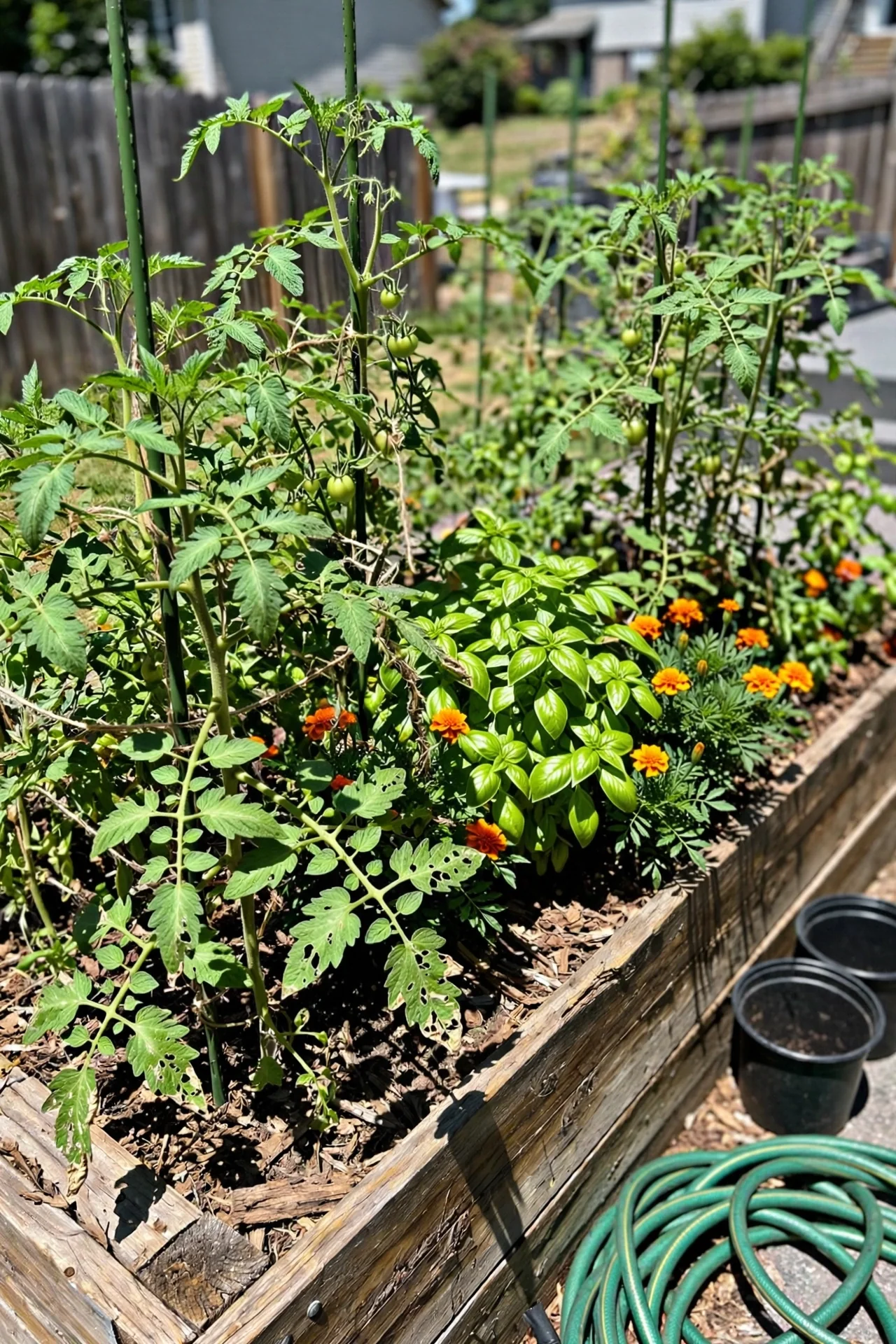
Gardeners have been told for decades that aromatic herbs repel pests by overwhelming their sense of smell. Plant basil near tomatoes, the advice goes, and whiteflies will flee the scent. But research from Warwick HRI tells a different story. In controlled studies, artificial green paper placed near crops reduced pest colonisation just as effectively as living aromatic plants. The pests were not avoiding scent. They were landing on the wrong green objects and giving up.
This article reframes companion planting for pest control around that evidence. It covers plants that physically disrupt host-finding, plants that act as sacrificial traps, and plants that build a resident population of predatory insects, all backed by field research rather than gardening folklore. It does not cover nutrient-sharing partnerships like the Three Sisters, pollinator-only plantings, or weed-suppression groundcovers.
By the end, you will be able to identify which of three pest-control strategies fits your garden, pick specific plants matched to your pest problem, and invest effort where the research says it counts. Every recommendation includes the measurable condition or constraint that determines whether it works.
Bottom line: Choose companion plants that visually confuse, trap, or recruit predators, not because they smell strong, but because the evidence says the mechanism is physical disruption, not repellency.
The Yield Grid Decision Grid
Choose your branch based on the pest situation you are facing right now. Each branch reflects a different mechanism supported by field research.
Branch 1: I can see active pest damage and I want to disrupt host-finding immediately. This approach uses plants with contrasting leaf shapes, colours, or physical structures that cause pest insects to make “inappropriate landings” on non-host plants, a phenomenon documented by Finch and Collier (2000) at Warwick HRI. Pests land, detect the wrong plant, and leave the area. Recommended: Items 1, 2, 3, 4 below.
Branch 2: I am willing to sacrifice a plant to draw pests away from my vegetables. Trap cropping exploits the fact that many pests prefer certain plant species over others. The trap plant gets damaged; your crop stays clean. This branch works only if you plant the trap before pest pressure peaks and monitor it regularly. Recommended: Items 5, 6, 7, 8 below.
Branch 3: I want to invest in a long-term resident population of predatory insects. Insectary plants provide nectar and pollen that sustain parasitoid wasps, hoverflies, lacewings, and lady beetles throughout the growing season. This is a season-long strategy, not a quick fix. For a deeper understanding of how beneficial insects patrol a garden, see our guide on building a beneficial insect population. Recommended: Items 9, 10, 11, 12 below.
Quick Comparison Table
| Option | Key Mechanism | Best For | Decision Grid Branch | Effort Score (1–5) |
|---|---|---|---|---|
| Marigolds (Tagetes spp.) | Root exudates suppress nematodes; visual contrast disrupts whitefly landings | Root-knot nematodes, whiteflies, thrips | Branch 1 | 2 |
| Basil (Ocimum basilicum) | Leaf shape and colour diversity break up host-plant silhouettes | Tomato hornworm egg-laying moths, thrips | Branch 1 | 2 |
| Garlic & Chives | Allium family foliage creates vertical structural contrast; contact-deters some aphids | Aphids, carrot fly, onion fly | Branch 1 | 1 |
| Rosemary & Lavender | Woody, needle-like foliage provides persistent physical disruption year-round | Cabbage white butterfly, carrot fly, bean beetles | Branch 1 | 1 |
| Nasturtiums (Tropaeolum majus) | Preferred host plant; draws aphids and flea beetles away from crops | Blackfly on broad beans, aphids on brassicas, cucumber beetles | Branch 2 | 2 |
| Radish (as trap crop) | Glucosinolate profile attracts flea beetles away from young brassicas | Flea beetles on eggplant, cabbage, and kale seedlings | Branch 2 | 2 |
| Dill & Fennel | Dual-use: trap crop for aphids plus insectary for parasitoid wasps | Cabbage worms, aphids on brassicas, tomato hornworm | Branch 2 | 3 |
| Mustard Greens (as trap crop) | Fast-growing brassica sacrificial planting; preferred by harlequin bugs and flea beetles | Harlequin bugs, flea beetles, cabbage worms on kale and collards | Branch 2 | 3 |
| Sweet Alyssum (Lobularia maritima) | Long-blooming nectar source for hoverflies; research shows increased hoverfly egg production | Aphids on any crop; indoor and greenhouse pests | Branch 3 | 2 |
| Borage (Borago officinalis) | Nectar-rich flowers attract parasitoid wasps that target hornworms and caterpillars | Tomato hornworm, cabbage looper, codling moth | Branch 3 | 2 |
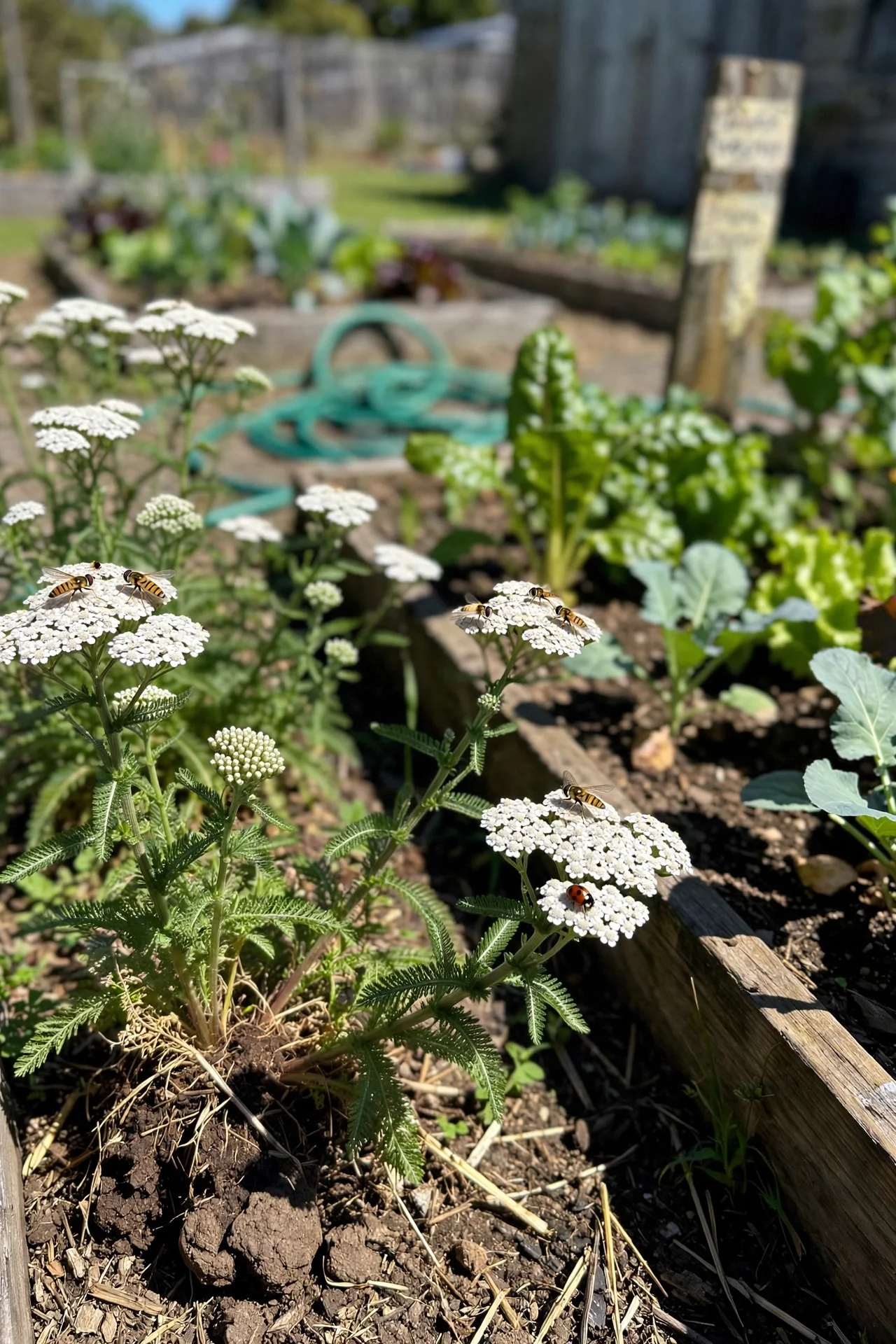
| Yarrow (Achillea millefolium) | Shallow nectar accessible to short-tongued parasitoid wasps and hoverflies | Generalist aphid control; leaf miner parasitoids | Branch 3 | 1 |
| Cosmos (Cosmos bipinnata, C. sulphureus) | Sustains lady beetle (Harmonia axyridis) populations; field studies show increased predator retention | Aphids, spider mites, whiteflies in greenhouse and field settings | Branch 3 | 2 |
Marigolds (Tagetes spp.)
Best for: Branch 1
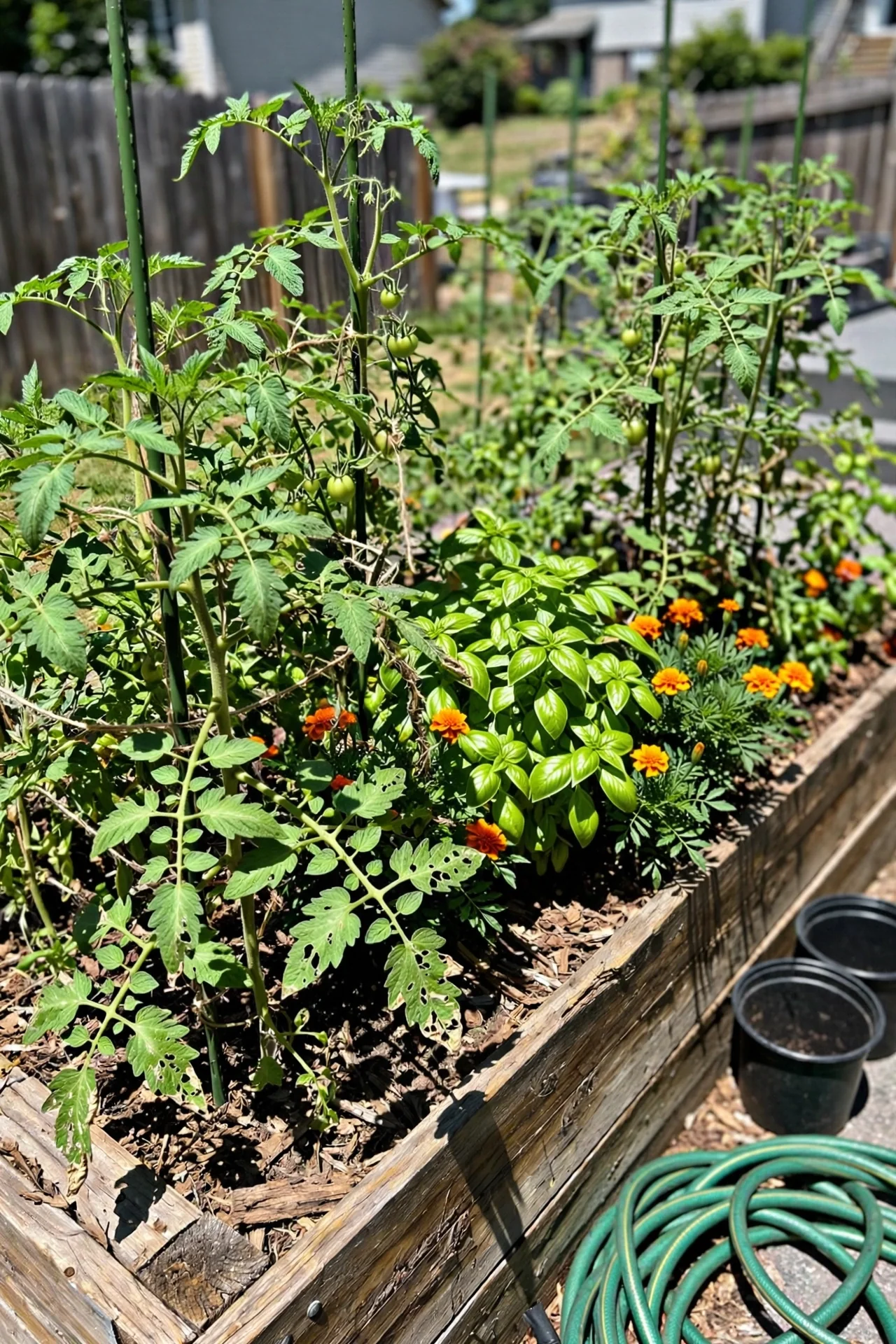
What: French marigolds (Tagetes patula) suppress root-knot nematodes through thiophene compounds exuded from their roots into the soil. This mechanism is distinct from above-ground pest disruption and requires the marigolds to be grown as a living mulch or incorporated into the soil after the season. African marigolds (Tagetes erecta) are taller and provide structural contrast that disrupts whitefly host-finding when interplanted with tomatoes and peppers.
For: Gardeners dealing with nematode-damaged roots (stunted growth, knobby roots on carrots and tomatoes) or persistent whitefly pressure in greenhouse and outdoor settings.
Steps: 1) Identify which marigold type you need: French marigolds for nematode suppression, African marigolds for above-ground structural disruption. 2) For nematode control, plant French marigolds as a solid block or inter-row cover for at least one full growing season before the susceptible crop; incorporation of plant residue into soil improves suppression. 3) For whitefly disruption, interplant African marigolds at a ratio of roughly one marigold per three tomato or pepper plants. 4) Remove spent flowers to prevent self-seeding, which can become a nuisance in small gardens.
Common mistake: Planting a single marigold at the end of a row and expecting whole-garden nematode control. Root exudates have a limited soil radius; the effect is localised to the root zone and immediate surrounding soil.
Basil (Ocimum basilicum)
Best for: Branch 1
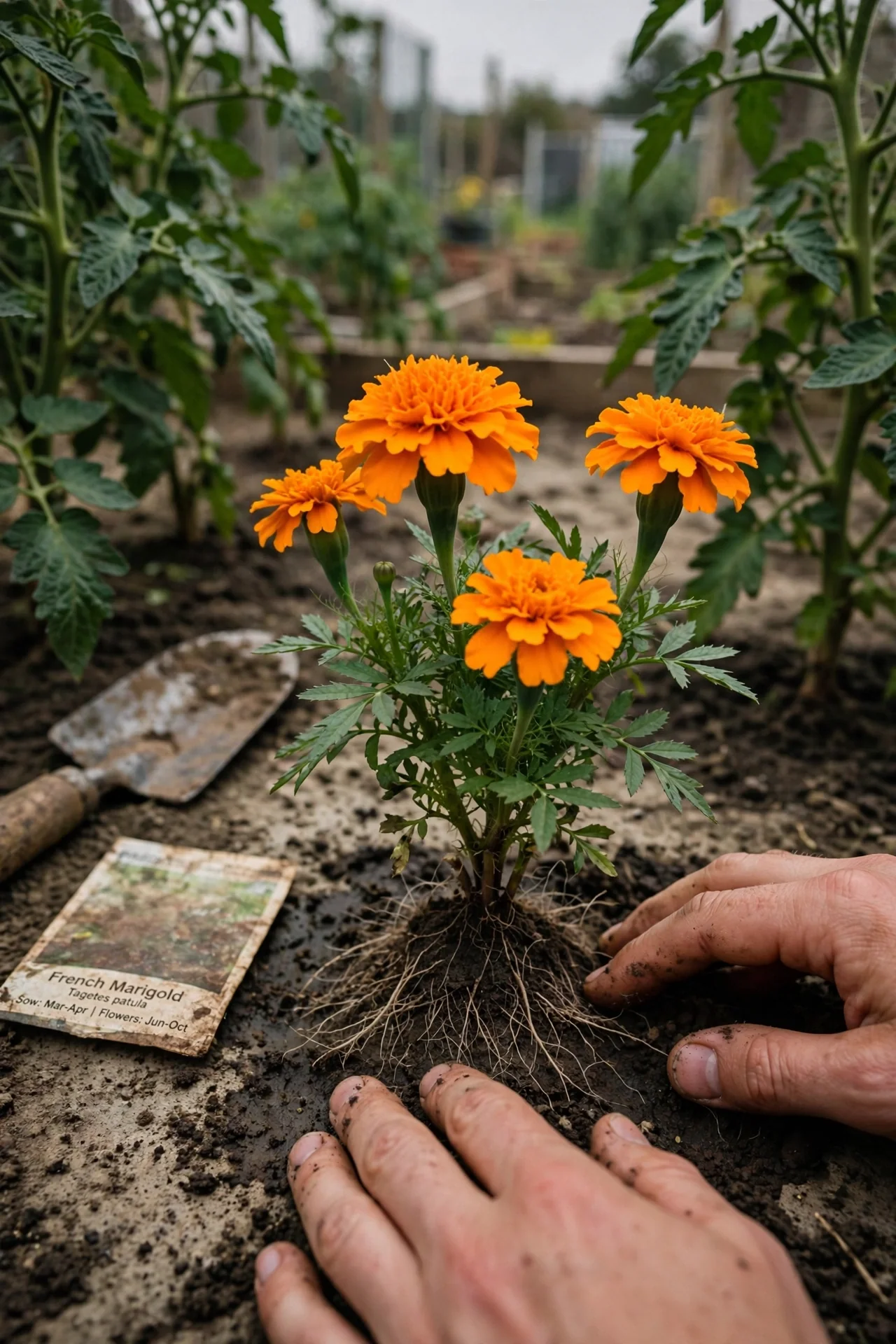
Use: Interplant basil among tomatoes and peppers to disrupt host-finding by thrips and the moths that lay tomato hornworm eggs. The contrast between broad tomato leaves and smaller, differently textured basil foliage increases inappropriate pest landings.
Skip if: You are growing basil primarily to repel pests through scent alone. Warwick HRI studies found that non-aromatic green surfaces reduced pest colonisation as effectively as aromatic plants; the mechanism is visual, not olfactory.
Edge case: In high-humidity climates, basil planted too densely around tomatoes can restrict airflow and promote fungal disease. Space basil at least 12 inches from tomato stems in humid growing zones.
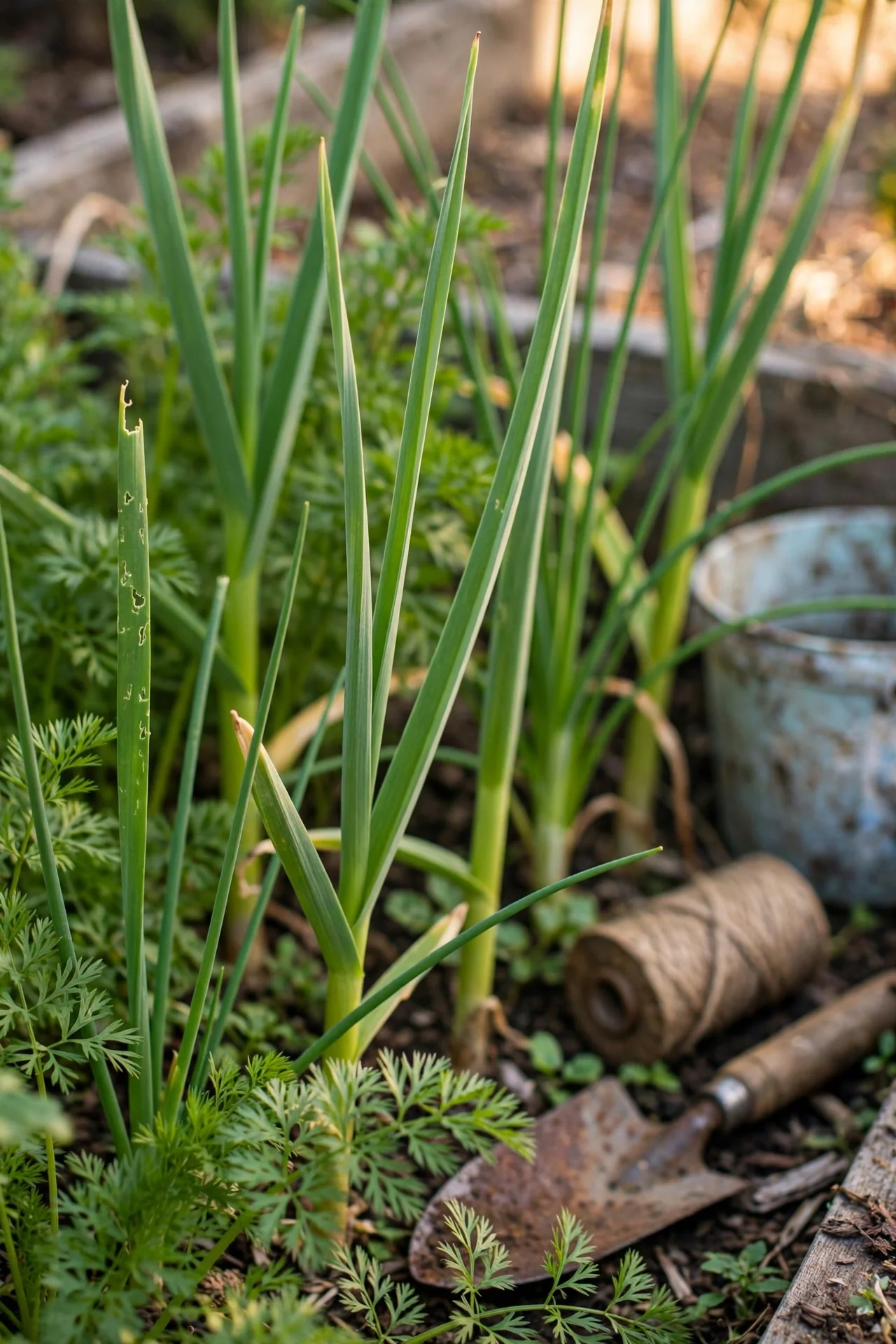
Garlic & Chives (Allium sativum, Allium schoenoprasum)
Best for: Branch 1
Threshold rule: Allium companion planting provides measurable disruption for carrot fly when garlic or chives are interplanted at a minimum density of one allium per four carrot plants. Below this ratio, the vertical structural contrast is insufficient to disrupt the low-flying pest’s host-location pattern. Chives are perennial; plant once and they return for multiple seasons with near-zero maintenance. For a complementary spray option during heavy aphid outbreaks, see our guide on organic aphid spray methods.
Adjustment: In small containers, chives outperform garlic because garlic requires a minimum soil depth of 8 inches for bulb development. Chives thrive in pots as shallow as 6 inches and still produce the upright foliage structure that confuses low-flying pests.
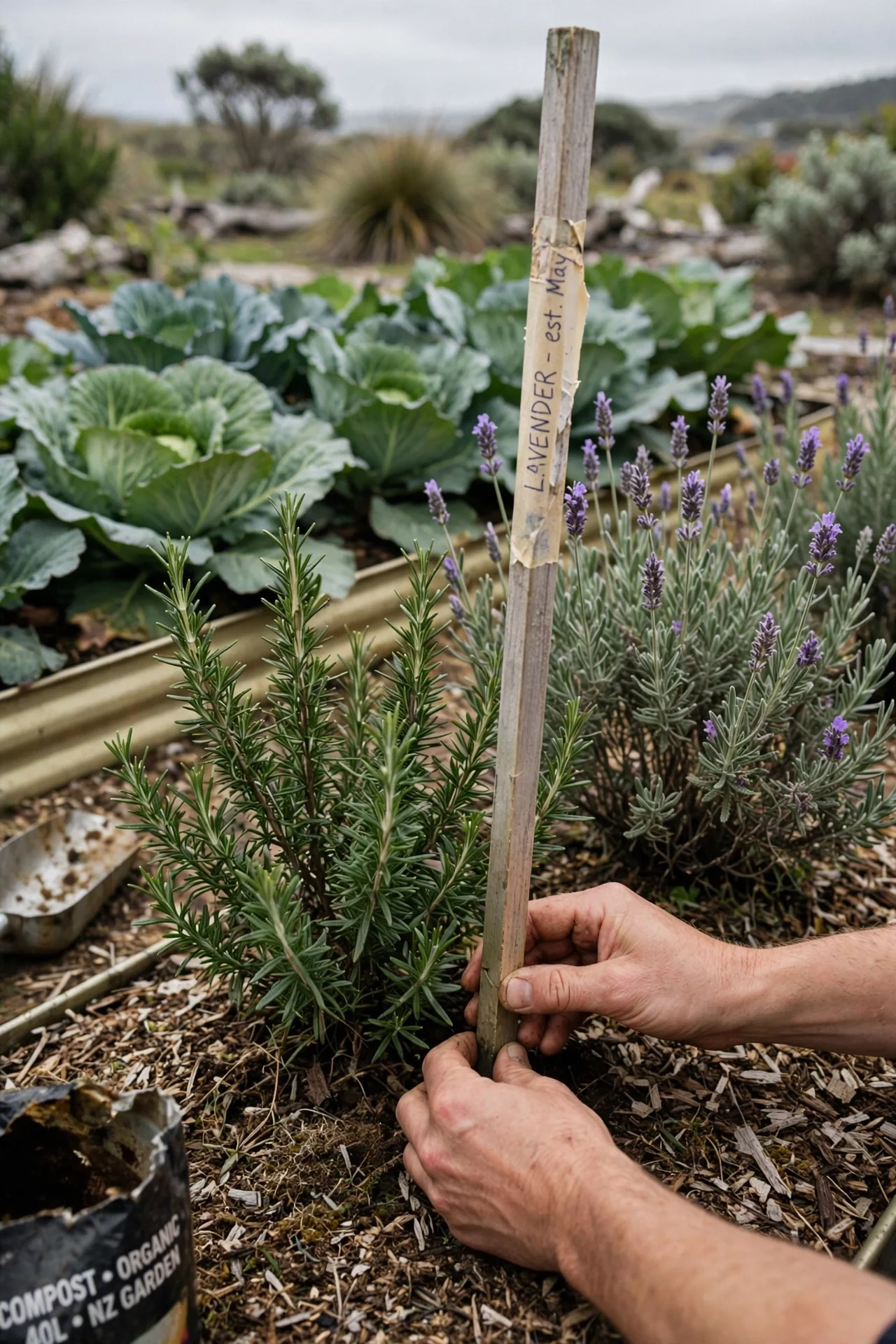
Rosemary & Lavender (Salvia rosmarinus, Lavandula angustifolia)
Best for: Branch 1
10-minute workflow: 1) Purchase one established rosemary plant and one lavender plant (starting from seed for woody perennials adds 12 to 18 months before meaningful pest-disruption benefit). 2) Plant rosemary at the sunny edge of brassica beds; its needle-like leaf texture and year-round presence create a permanent visual disruption zone. 3) Plant lavender along the outer border of carrot and bean beds; the contrast between fine, grey-green lavender foliage and broad crop leaves confuses adult cabbage white butterflies looking for landing sites. 4) Water once at planting; both species need well-draining soil and will decline with supplemental irrigation beyond establishment.
Upgrade option: Add a third woody perennial, English thyme (Thymus vulgaris), between the rosemary and lavender for three distinct foliage textures (needle, broad-grey, tiny-oval) in a tight space, maximising the visual diversity that the appropriate/inappropriate landing theory predicts will reduce pest colonisation.
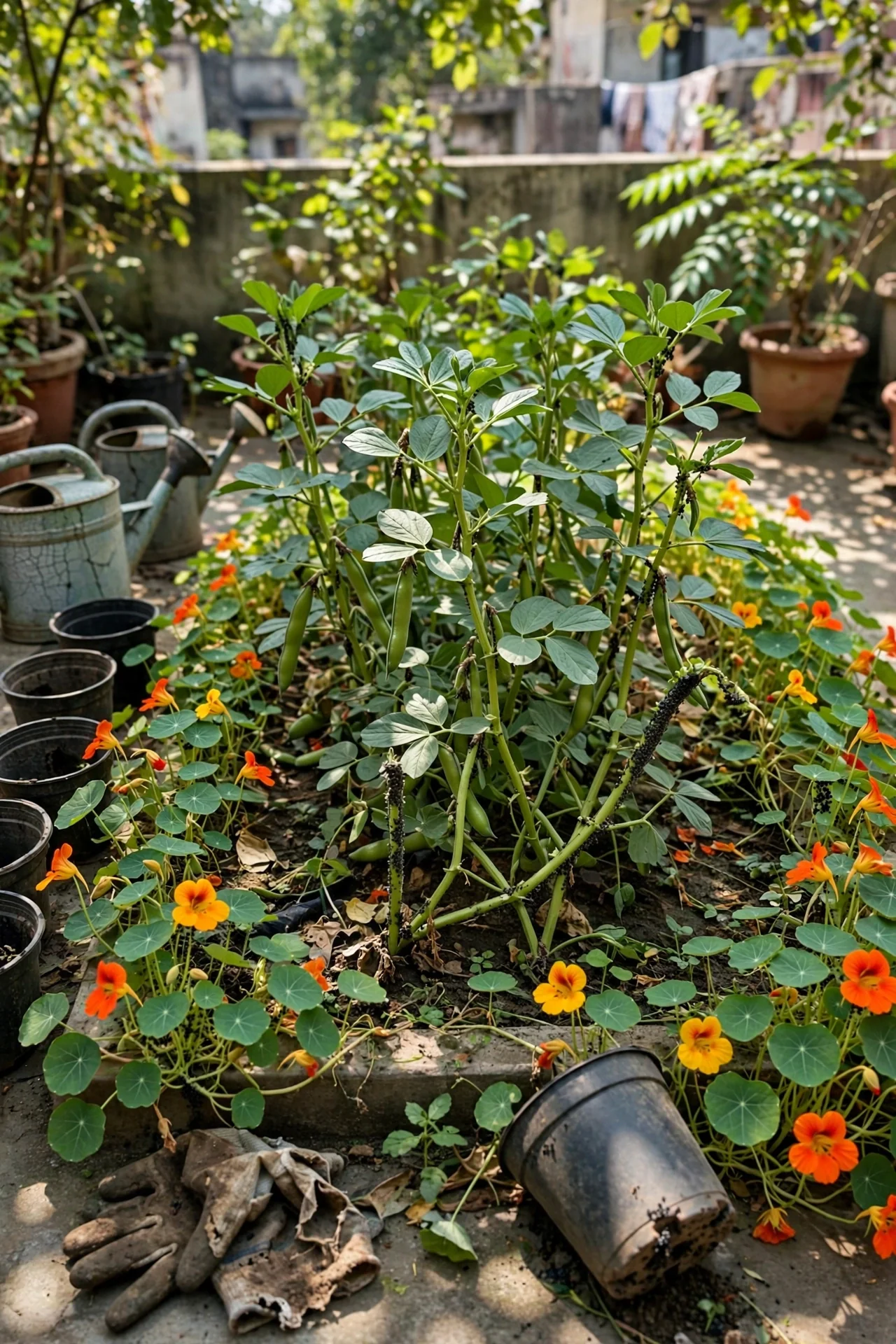
Nasturtiums (Tropaeolum majus)
Best for: Branch 2
What: Nasturtiums function as a trap crop by being more attractive to black bean aphids (Aphis fabae), cabbage white caterpillars, and flea beetles than the vegetables they protect. Research shows nasturtiums are more effective as a trap crop in spring than in autumn, likely due to faster growth rates and more tender foliage early in the season.
For: Anyone growing broad beans, runner beans, kale, cabbage, or broccoli who notices early-season aphid clustering or flea beetle shot-holes on young leaves.
Steps: 1) Sow nasturtium seeds two weeks before planting your main crop so they are established and attractive when pest pressure builds. 2) Plant nasturtiums around the perimeter of the bed, not randomly interplanted; perimeter placement makes it easier to monitor and remove pest-loaded plants. 3) Check nasturtiums every three to four days during the growing season; when a plant becomes heavily infested with black aphids, cut it at soil level, bag it, and remove it from the garden. 4) Resow nasturtiums every four to six weeks for continuous trap coverage through summer.
Common mistake: Letting pest-loaded nasturtiums remain in the garden indefinitely. When aphid colonies become overcrowded, they produce winged offspring that disperse to new hosts, including your vegetables. Learn more about this lifecycle in our guide to managing aphids.
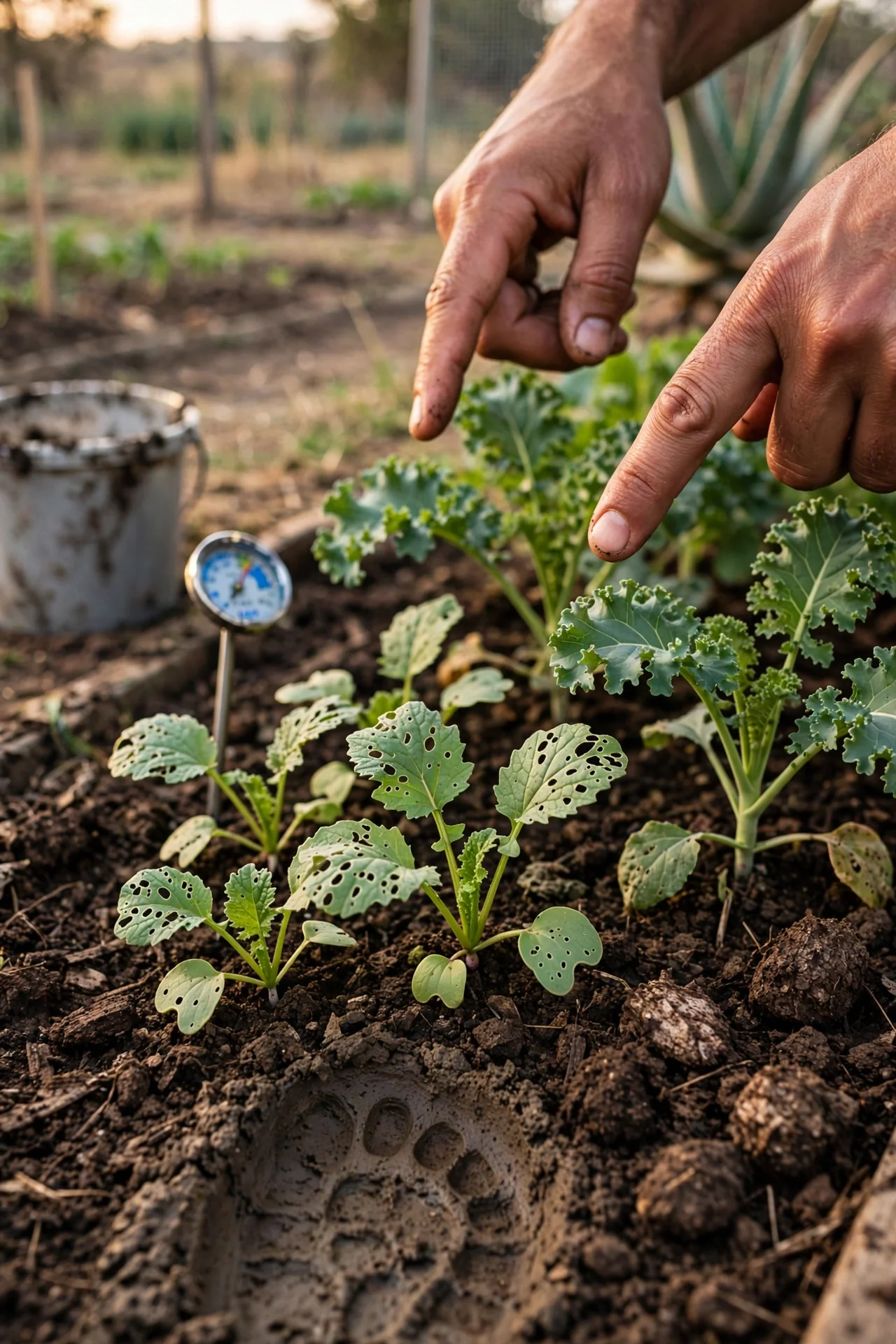
Radish (as Trap Crop)
Best for: Branch 2
Use: Sow radish seeds in a border strip around young brassica seedlings (cabbage, kale, broccoli) and eggplant. Flea beetles preferentially feed on radish leaves, which contain the same glucosinolate compounds they seek in other brassicas but are produced in higher concentrations.
Skip if: Your soil temperature exceeds 75°F (24°C) for more than four consecutive days. Radishes bolt quickly in heat and lose their attractiveness as trap crops once flowering begins. Switch to mustard greens as your trap crop in warm conditions.
Edge case: Radish roots remain edible even after leaf damage from flea beetles. If the root is intact, you can harvest and eat it, so the trap crop provides a secondary yield. See our guide to flea beetle damage for identification help.
Dill & Fennel
Best for: Branch 2
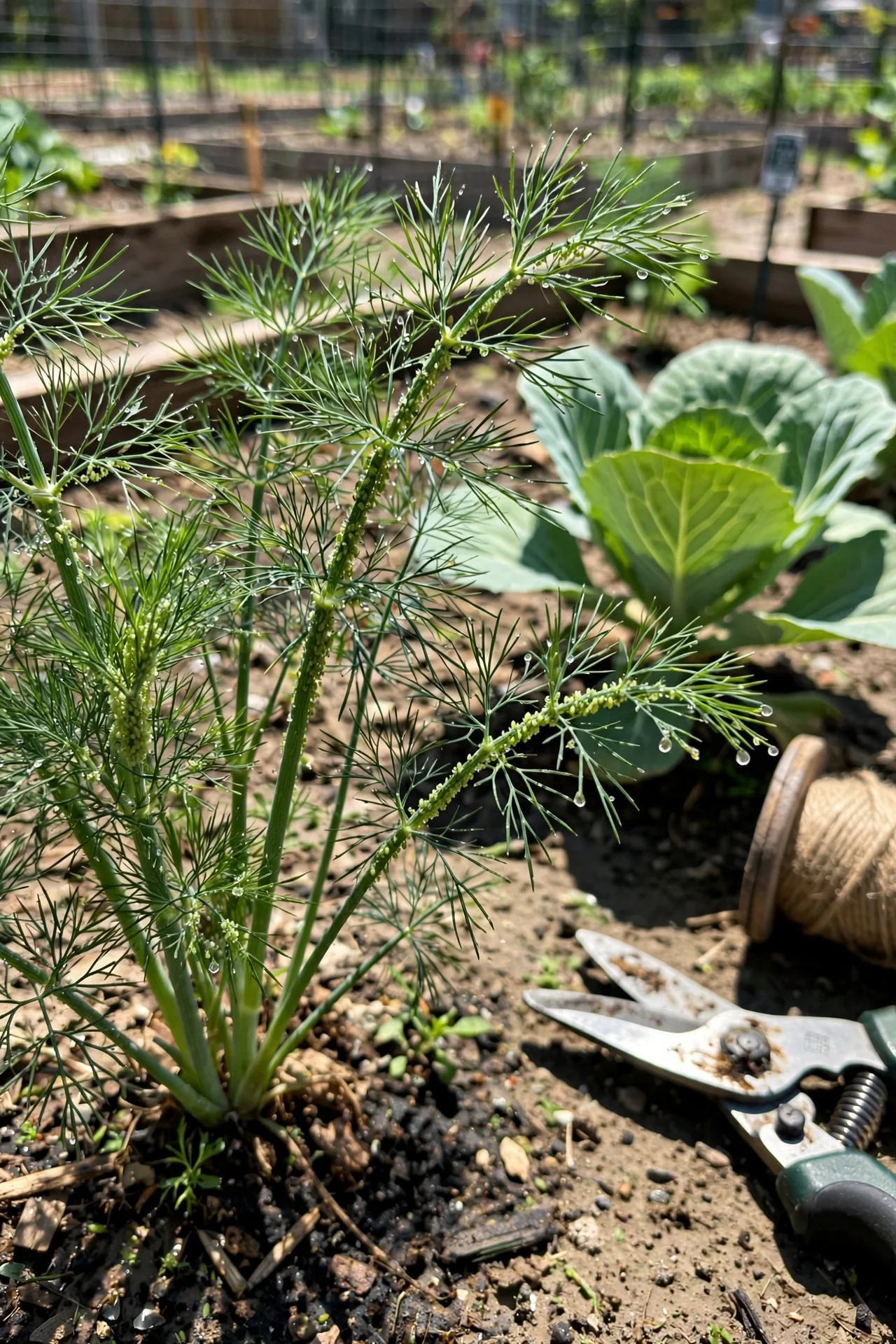
Threshold rule: Dill and fennel function as dual-purpose plants: their foliage is a trap for aphids (particularly black bean aphid) and their flowers are insectary sites for parasitoid wasps. The trap function activates when plants reach at least 6 inches tall and produce sufficient leaf surface area to attract aphids. The insectary function begins when flowers open, approximately 55 to 65 days after sowing for dill, longer for fennel. Sow dill in succession every three weeks to maintain both functions simultaneously, as plants that are flowering have tougher leaves less attractive to aphids.
Adjustment: Never plant fennel near bush beans. Fennel produces allelopathic compounds that suppress bean growth, a documented incompatibility. Dill does not share this constraint and is the safer option for mixed vegetable beds. For more on caterpillar pests that dill helps manage, see our cabbage worm management guide.
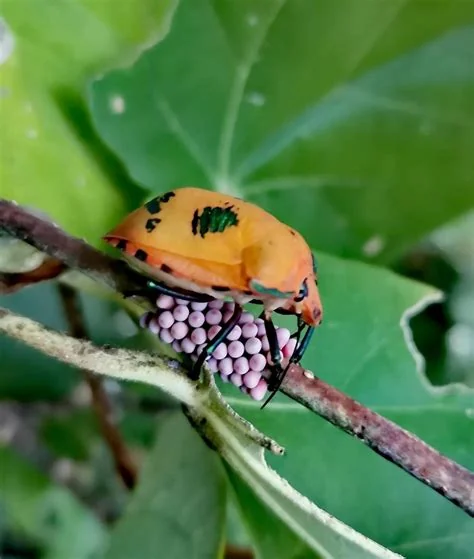
Mustard Greens (as Trap Crop)
Best for: Branch 2
10-minute workflow: 1) Buy a packet of Southern Giant Curled Mustard or Florida Broadleaf mustard seed. 2) Sow mustard seed in a continuous line around the perimeter of kale, collard, or turnip beds two weeks before transplanting your main crop. 3) Watch for harlequin bugs and flea beetles congregating on mustard leaves; mustard greens are more attractive to both pests than kale. 4) When the mustard strip shows heavy feeding damage, cut the entire plant line at soil level with shears, bag and remove. Resow in the same strip immediately.
Upgrade option: Southern Giant Curled Mustard acts as a “double trap” because its glucosinolate profile not only attracts pests but also disrupts the reproductive cycle of certain piercing-sucking insects, reducing the number of viable eggs laid compared with a standard trap crop.
Sweet Alyssum (Lobularia maritima)
Best for: Branch 3
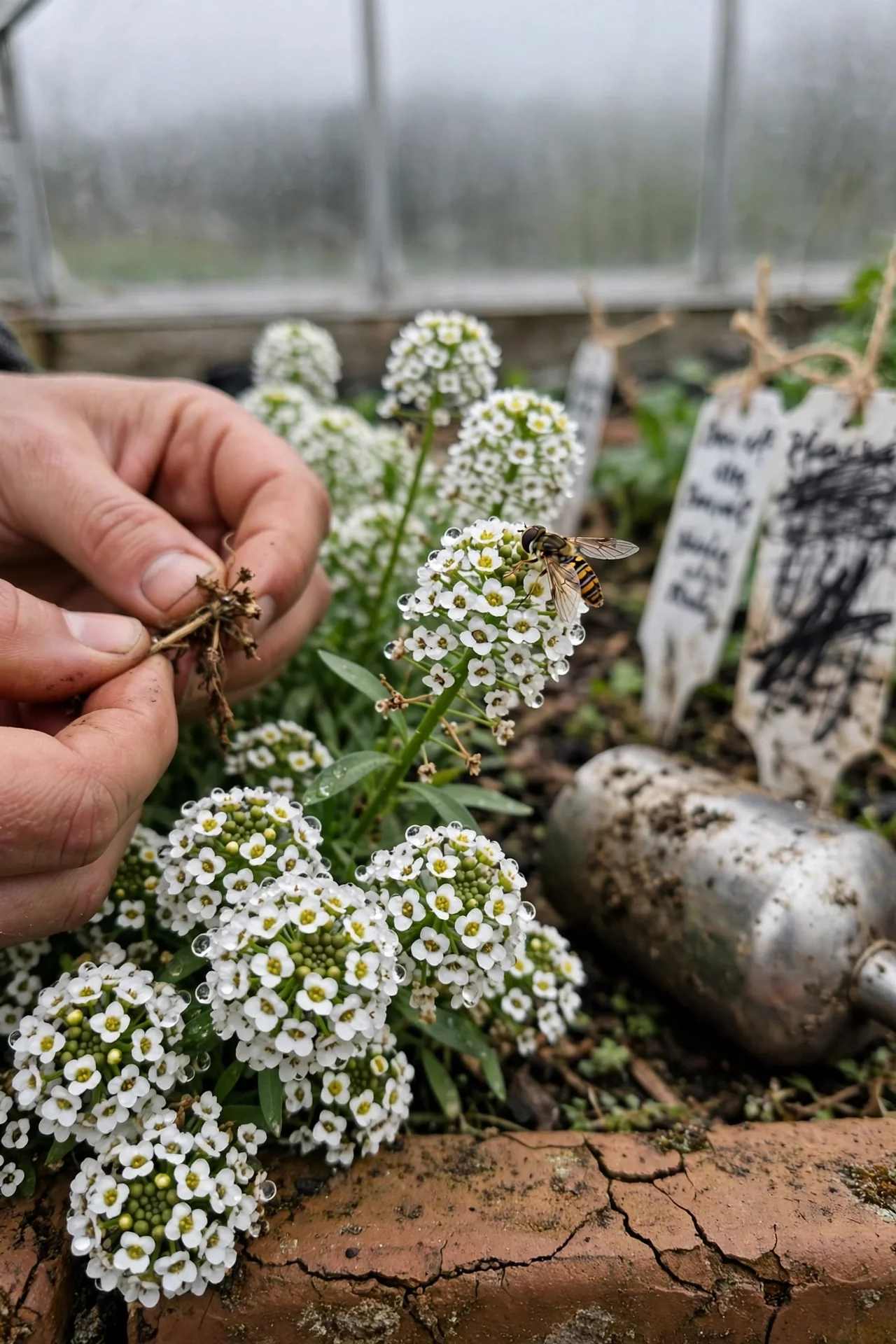
What: Sweet alyssum is the most research-backed insectary plant available to home gardeners. A study at Oregon State University found it attracted the highest numbers of aphidophagous hoverflies among 11 candidate species tested. A separate controlled study demonstrated that the presence of alyssum flowers significantly increased hoverfly egg production, resulting in more larvae and lower aphid counts on adjacent crops, without affecting hoverfly survival rates.
For: Gardeners dealing with persistent aphid pressure on any crop, including greenhouse and indoor settings. Alyssum is low-growing (4 to 6 inches), self-seeding, and stays in bloom longer than most insectary annuals.
Steps: 1) Scatter alyssum seed along the edges of vegetable beds or between rows in early spring. 2) Seed germinates in 5 to 10 days at soil temperatures above 55°F (13°C). 3) Once flowering begins (approximately 6 weeks after sowing), hoverflies and minute pirate bugs will begin visiting within days. 4) Allow alyssum to set seed at the end of the season; it returns reliably the following year in USDA zones 5 and above.
Common mistake: Planting alyssum only in spring. In hot-summer climates, alyssum fades by mid-July. Sow a second round in partial shade in late July for autumn beneficial insect support.
Borage (Borago officinalis)
Best for: Branch 3
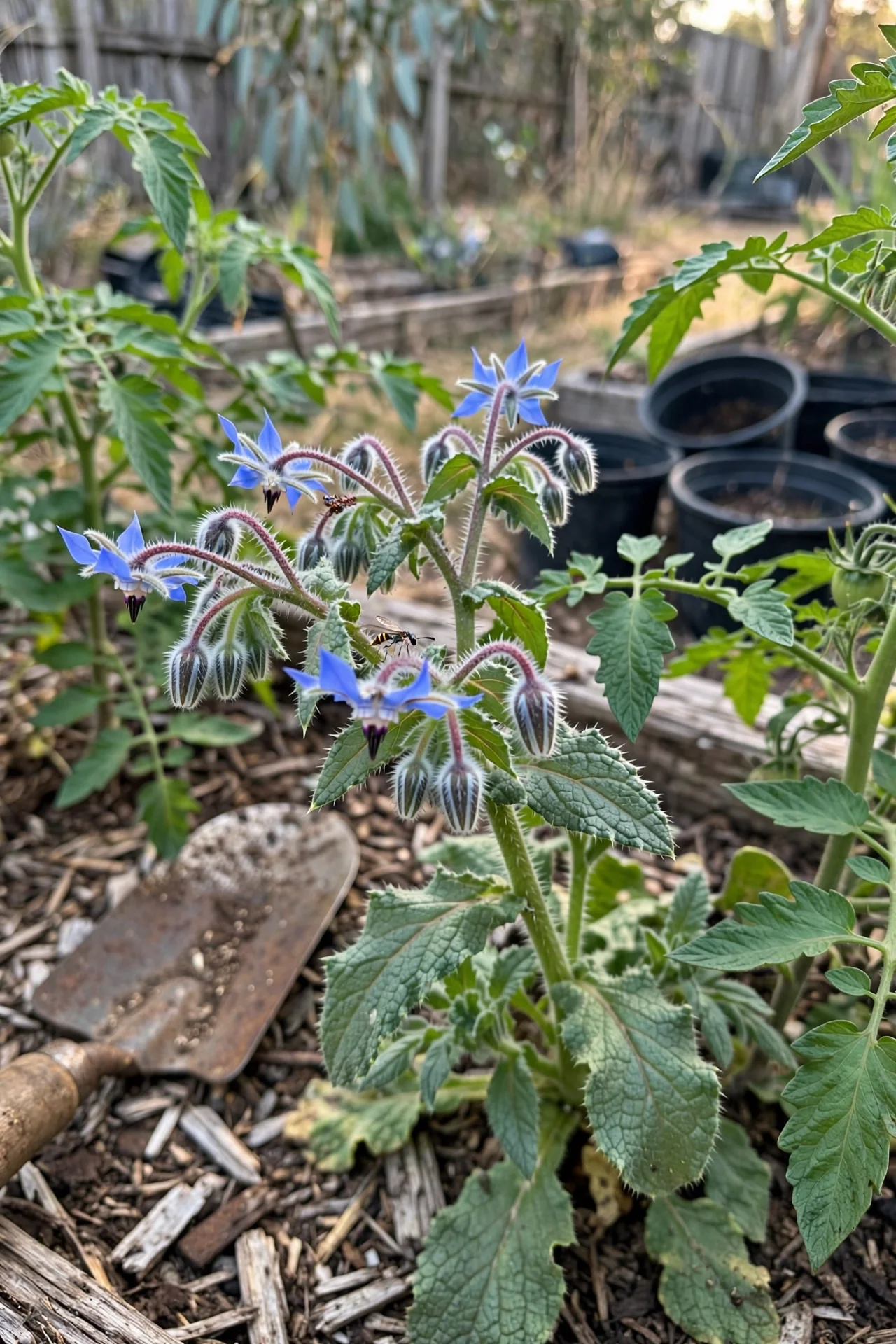
Use: Plant borage between tomato plants and near squash. Its nodding blue flowers produce nectar continuously and are accessible to parasitoid wasps (especially Braconidae) that lay eggs inside tomato hornworms and cabbage loopers. The wasps are attracted to the nectar, not “sent” to attack pests, so borage must be present throughout the pest lifecycle for the predatory effect to accumulate.
Skip if: You have limited space and cannot accommodate a plant that reaches 2 to 3 feet tall and self-seeds aggressively. Borage spreads; removing unwanted seedlings each spring is part of the commitment. In gardens smaller than 100 square feet, substitute sweet alyssum for pollinator support and rely on direct removal for hornworm infestations.
Edge case: Borage leaves are edible and taste like cucumber when young, but develop prickly hairs as they mature. If you plan to harvest leaves for culinary use, pick them before flower stalks appear at about 8 weeks after germination.
Yarrow (Achillea millefolium)
Best for: Branch 3
Threshold rule: Yarrow provides the most benefit as an insectary plant when at least three plants are established per 100 square feet of garden. Its shallow, flat-topped flower clusters (umbels) are accessible to short-tongued parasitoid wasps and hoverflies that cannot reach nectar in deep-tubed flowers. Research at Oregon State University confirmed that yarrow attracted significantly higher hoverfly visitation than marigold, sage, or dill across an entire growing season.
Adjustment: Yarrow is drought-tolerant and spreads by rhizomes. In fertile, irrigated garden soil, it can become aggressive. Plant yarrow in a dedicated strip outside the main growing area, or contain it by sinking a 12-inch root barrier around the planting zone.
Cosmos (Cosmos bipinnata, C. sulphureus)
Best for: Branch 3
10-minute workflow: 1) In late spring, scatter cosmos seeds in a sunny strip along the south-facing edge of vegetable beds. 2) Thin seedlings to 12 inches apart once they reach 4 inches tall. 3) Within 60 to 70 days, flowers open and begin attracting lady beetles (Harmonia axyridis) and lacewings. A 2025 study in Scientia Horticulturae found that cosmos significantly enhanced lady beetle retention and pest suppression in greenhouse trials. 4) Deadhead spent flowers weekly to extend bloom through first frost.
Upgrade option: For greenhouse pest control, grow cosmos in 3-gallon containers positioned at the corners of the structure. The flowers attract and sustain predators that patrol the enclosed space, particularly effective against aphids and spider mites. See our guide to whitefly management for additional greenhouse strategies.
Starter Stack (What to Choose First)
Branch 1: Physical Disruption Starter Stack
Garlic & Chives plus Marigolds. Together these cover two distinct mechanisms: garlic and chives provide vertical foliage contrast that disrupts low-flying pests (carrot fly, onion fly) through inappropriate landings, while French marigolds address soil-borne nematodes through root exudates. Both are low-effort: garlic and chives are planted once (chives return perennially), and marigolds require only deadheading. Estimated cost: $5 to $12 for seed packets covering 100 square feet. Time to effect: Garlic and chives begin disrupting pest landings once foliage reaches 8 inches tall (approximately 4 weeks after sprouting). Marigold nematode suppression requires one full growing season of root contact with soil.
Branch 2: Trap Crop Starter Stack
Nasturtiums plus Radish. Nasturtiums pull aphids from beans, brassicas, and cucurbits; radishes pull flea beetles from young kale, cabbage, and eggplant. Both germinate quickly (radish in 3 to 5 days, nasturtium in 7 to 10 days), so they can be deployed after pest damage is first observed. The key synergy: nasturtiums provide a long-season trap, while radishes provide a fast-response trap that can be sown and sacrificed within 30 days. Estimated cost: $3 to $8 for seed. Time to effect: Radishes are ready to trap flea beetles within 14 days of sowing; nasturtiums reach functional trap size in 4 to 6 weeks.
Branch 3: Insectary Starter Stack
Sweet Alyssum plus Borage. Sweet alyssum attracts hoverflies, the most voracious aphid predators among beneficial insects, and stays in bloom for months. Borage attracts parasitoid wasps that target tomato hornworms and cabbage loopers. Both are easy from seed and self-sow reliably. The synergy: alyssum handles aphids at ground and low-crop level while borage handles caterpillar pests on tall crops like tomatoes and trellised squash. Estimated cost: $4 to $10 for seed. Time to effect: Alyssum flowers within 6 weeks and begins attracting hoverflies immediately. Borage flowers within 8 weeks; parasitoid wasp populations build over the following 4 to 6 weeks.
When This Won’t Work
Failure condition 1: Pest pressure arrives before companion plants are established. Companion planting is preventive, not reactive. If aphids or flea beetles are already heavily present when you sow companion seeds, the pests will colonise your vegetables before the trap or insectary plants have produced meaningful foliage or flowers. Companion seeds sown after pest onset provide no protection for the current crop cycle. The alternative: for immediate pest suppression, use a short-residual contact treatment such as insecticidal soap or spider mite control techniques while establishing companions for the next planting cycle.
Failure condition 2: Monoculture pest populations that are host-specific and unaffected by generalist disruption. Some pests are so tightly adapted to their host plants that interplanting provides negligible protection. Squash vine borers, for example, locate cucurbits through specific chemical cues and are not meaningfully disrupted by the presence of non-host companions. Similarly, Colorado potato beetles overwinter in soil near previous potato plantings and emerge directly onto host plants regardless of companion diversity. The alternative: for host-specialist pests, rotation (minimum three-year cycle for Solanaceae and Cucurbitaceae) and physical exclusion (floating row covers during adult flight periods) are more reliable than companion planting alone.
Failure condition 3: Garden size below the functional threshold. Companion planting for pest control relies on spatial separation between the companion and the crop. In gardens smaller than approximately 50 square feet (4.6 square metres), the proximity of all plants is so close that pest insects can move easily between trap, companion, and crop. The disruption effect collapses because there is insufficient distance for inappropriate landings to result in the pest leaving the area entirely. The alternative: in very small gardens, prioritise physical barriers (insect netting, cloches) and manual removal over companion planting for pest management.
Choosing the Right Option for Your Situation
Budget Threshold
If your annual garden budget is below $25, focus exclusively on Branch 2 (trap crops). Radish, nasturtium, and mustard seed are inexpensive, and a single packet of each covers multiple sowings across a season. Avoid investing in perennial insectary plants (Branch 3) until you can afford established plants rather than seed, as most perennials take two years from seed to reach functional flowering size.
Time Threshold
If you garden fewer than three hours per week, select Branch 1 plants exclusively. Garlic, chives, rosemary, and lavender are plant-once interventions. Trap crops require weekly monitoring and timely removal of pest-loaded plants, and insectary plants need deadheading and seasonal maintenance that may exceed a low-time budget.
Technical Constraint: Soil-Borne Pest Identification
Companion planting is least effective when the target pest lives in the soil. Root-knot nematodes are the one partial exception (French marigolds provide documented suppression), but other soil pests like wireworms, cutworms, and root maggots are not meaningfully controlled by any companion plant. Confirm whether your pest is above-ground before choosing a companion strategy. If you cannot see the pest feeding on leaves or stems, companion planting is probably the wrong tool.
Yes/No Checklist
1. Can you identify the specific pest causing damage? (Yes: proceed. No: identify first, then return to the Decision Grid.)
2. Are companion seeds or plants available to establish before the pest’s peak activity window? (Yes: proceed. No: use a direct treatment first.)
3. Is your garden larger than 50 square feet and the pest above-ground? (Yes: companion planting is a viable strategy. No: consider physical barriers.)
4. Are you willing to remove and dispose of pest-loaded trap plants when needed? (Yes: Branch 2 is open to you. No: choose Branch 1 or 3 only.)
Expert Q&A
Does companion planting work against slugs and snails?
No companion plant repels slugs or snails. Research shows that plant diversity can sometimes increase slug habitat because moist, shaded soil under companion foliage creates favourable conditions for them. Slug control requires separate strategies: beer traps, copper tape barriers, iron phosphate baits, or hand-picking at dusk.
Can I use companion planting indoors for houseplant pests?
Sweet alyssum and dwarf cosmos can be grown in small pots near houseplants to attract hoverflies and lady beetles in a greenhouse or sunroom setting. However, in a fully indoor environment without natural beneficial insect populations, companion plants provide no pest control benefit because there are no predators to attract.
Why did my marigolds not stop whiteflies on my tomatoes?
Marigolds disrupt whitefly host-finding through visual contrast, not repellency. If marigolds are the same height as tomato foliage or are planted too far away (more than 3 feet), the visual disruption effect is negligible. The marigold foliage must be in the whitefly’s field of view during landing approach for the inappropriate-landing mechanism to function.
How close do companion plants need to be to work?
For visual disruption plants (Branch 1), research suggests a maximum effective distance of 3 to 4 feet from the crop being protected. For trap crops (Branch 2), perimeter planting is effective; the trap should be within 5 feet of the crop row. For insectary plants (Branch 3), within 10 to 15 feet is effective because beneficial insects actively forage across this range.
Are there any companion plants that make pest problems worse?
Yes. Nasturtiums, while excellent trap crops, are in the Brassica family. Planting them near cabbage, kale, or broccoli can attract cabbage white butterflies to the area, increasing egg-laying pressure on all brassicas in the vicinity. Use nasturtiums as a trap for beans and cucurbits, not for brassicas. Similarly, fennel suppresses bean growth through allelopathy and should be isolated from legume beds.
Conclusion
The most common mistake in companion planting for pest control is choosing plants based on fragrance reputation rather than matching the mechanism to the pest. If you know your pest is above-ground, you have identified it, and your garden exceeds 50 square feet, start with the one branch from the Decision Grid that fits your situation and plant two items from that branch’s Starter Stack this season.
Companion planting is one tool among many in an integrated pest management approach. For pest outbreaks that arrive before companions are established, a targeted physical or biological control may be needed. See our Japanese beetle management guide for an example of combining multiple approaches for a single persistent pest.