
Calculating a custom NPK fertilizer blend requires more than guesswork. Each bag of fertilizer contributes a specific proportion of nitrogen (N), phosphate (P₂O₅), and potash (K₂O) based on its guaranteed analysis. The math determines exactly how many pounds of each product you need to hit a target application rate without wasting material or risking turf damage.
This NPK fertilizer calculator computes the required product amounts for up to three fertilizer sources, scales the quantities to your lawn or field size, and calculates the cost per pound of each nutrient. It does not account for soil nutrient carryover, organic matter mineralization, or site-specific factors that require a soil test to evaluate.
After using this tool, you will know the exact pounds of each fertilizer product to purchase and the true cost efficiency of your blend before you load the spreader.
Use the Tool
| Product | Analysis | Amount Needed | Per 1,000 sq ft |
|---|
| Product | Analysis | Typical $/lb N | Release |
|---|---|---|---|
| Urea | 46-0-0 | $0.50–0.70 | Fast |
| Ammonium Sulfate | 21-0-0 | $0.60–0.85 | Fast |
| Poly-Coated Urea | 44-0-0 | $1.00–1.40 | Slow |
| Triple Superphosphate | 0-46-0 | — | — |
| Muriate of Potash | 0-0-60 | — | — |
| Sulfate of Potash | 0-0-50 | — | — |
How This Calculator Works
Formula Steps:
- Required Product (lbs per 1,000 sq ft) = Target Rate ÷ (Bag Analysis % ÷ 100)
- Total Product Needed = Required per 1,000 sq ft × (Total Area ÷ 1,000)
- Cost per lb of Nutrient = Bag Price ÷ (Bag Weight × Nutrient % ÷ 100)
Example: To apply 1 lb N per 1,000 sq ft using 46-0-0 Urea:
- Product needed = 1 ÷ 0.46 = 2.17 lbs per 1,000 sq ft
- For 5,000 sq ft: 2.17 × 5 = 10.87 lbs total
Assumptions & Limits:
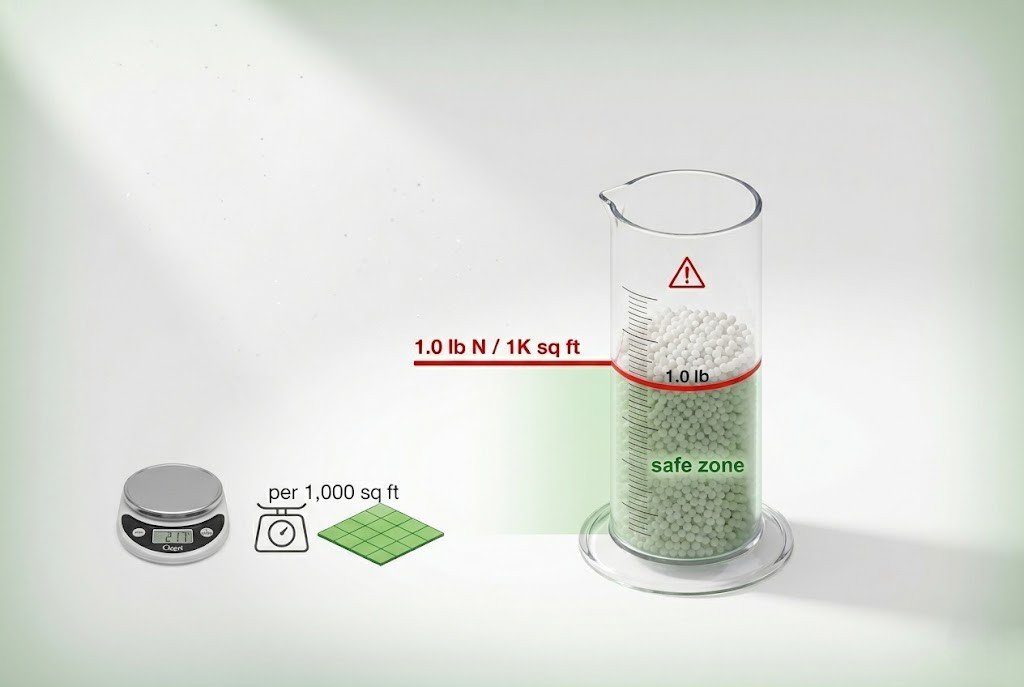
- Fast-release N (Urea, Ammonium Nitrate) should not exceed 1.0 lb N per 1,000 sq ft in a single application to avoid turf burn.
- Calculations assume 100% product purity as labeled.
- Actual spreading may require calibration; recommend using a broadcast spreader with platform scale for accuracy.
- Soil testing is recommended before application to confirm nutrient needs.
Before running the calculator, gather the guaranteed analysis (the three-number N-P-K ratio printed on each bag), the bag weight in pounds, and the current price you paid or expect to pay. You also need your target application rate in pounds of N, P₂O₅, and K₂O per 1,000 square feet and the total area you plan to treat. If your soil test report shows recommendations in pounds per acre, divide by 43.56 to convert to pounds per 1,000 square feet.
For a deeper look at nitrogen-specific calculations and slow-release timing, the Nitrogen Calculator provides additional guidance on splitting applications across the growing season.
Quick Start (60 Seconds)
- Target N Rate: Enter the pounds of nitrogen per 1,000 sq ft. For cool-season turf maintenance, 0.5 to 1.0 lb N is typical. Do not exceed 1.0 lb of fast-release N in a single application.
- Target P₂O₅ Rate: Enter the pounds of phosphate per 1,000 sq ft. Many established lawns need little to no phosphorus unless a soil test indicates deficiency.
- Target K₂O Rate: Enter the pounds of potash per 1,000 sq ft. Potassium supports stress tolerance; rates of 0.5 to 1.0 lb K₂O are common for fall applications.
- Lawn/Field Area: Enter the total square footage. Measure with a tape or use a mapping tool. Overestimating area wastes fertilizer; underestimating leads to inconsistent coverage.
- Bag Analysis (N-P-K): Enter the three numbers from the bag label for each product. A 46-0-0 bag means 46% nitrogen, 0% phosphate, 0% potash by weight.
- Bag Weight and Price: Enter the actual bag weight in pounds and the price you paid. This enables accurate cost-per-nutrient calculations.
- Release Type (Bag 1): Select fast-release (urea, ammonium nitrate) or slow-release (polymer-coated, SCU). This triggers the burn-risk warning if you exceed safe thresholds.
Inputs and Outputs (What Each Field Means)
| Field | Unit | What It Means | Common Mistake | Safe Entry Guidance |
|---|---|---|---|---|
| Target N Rate | lbs per 1,000 sq ft | Desired nitrogen delivery to soil | Entering total lbs instead of rate per 1,000 sq ft | Stay at or below 1.0 for fast-release sources |
| Target P₂O₅ Rate | lbs per 1,000 sq ft | Desired phosphate delivery | Applying P without a soil test showing deficiency | Check local regulations; some areas restrict P application |
| Target K₂O Rate | lbs per 1,000 sq ft | Desired potash delivery | Confusing K₂O with elemental K (multiply K by 1.2 to get K₂O) | 0.5 to 1.0 lb K₂O is typical for most turf |
| Lawn/Field Area | sq ft | Total treatment area | Using lot size instead of actual turf area | Subtract driveways, beds, and hardscape from total |
| Bag N/P/K % | Percentage | Guaranteed analysis from label | Entering decimal (0.46) instead of whole number (46) | Use the exact numbers printed on the bag |
| Bag Weight | lbs | Net weight of one bag | Using the wrong bag size when products come in multiple sizes | Verify the weight matches the price you entered |
| Bag Price | USD | Purchase price for one bag | Entering price per pound instead of price per bag | Include tax if you want true cost |
| Release Type | Selection | How quickly nitrogen becomes plant-available | Assuming all urea is slow-release | Standard urea is fast; polymer-coated or SCU is slow |
| Total Product (Output) | lbs | Combined weight of all products needed | Treating this as bags needed (it is pounds, not bags) | Divide by bag weight to determine bags to purchase |
| Cost per lb N (Output) | USD per lb | Price efficiency of nitrogen source | Comparing without considering release type | Lower is more economical, but slow-release costs more for a reason |
Worked Examples (Real Numbers)
Example 1: Standard Lawn Maintenance Blend
- Target: 1.0 lb N, 0 lb P₂O₅, 0.5 lb K₂O per 1,000 sq ft
- Area: 5,000 sq ft
- Bag 1: 46-0-0 Urea, 50 lb bag, $25, fast-release
- Bag 2: 0-46-0 TSP, 50 lb bag, $30 (not used for this blend)
- Bag 3: 0-0-60 MOP, 50 lb bag, $28
Result: Bag 1 requires 2.17 lbs per 1,000 sq ft (1.0 / 0.46). For 5,000 sq ft, that is 10.87 lbs of urea. Bag 3 requires 0.83 lbs per 1,000 sq ft (0.5 / 0.60), totaling 4.17 lbs of MOP. Grand total: 15.04 lbs of product. Cost per lb N: $1.09 ($25 / (50 x 0.46)).
Example 2: New Lawn Establishment with Phosphorus
- Target: 0.75 lb N, 1.0 lb P₂O₅, 0.75 lb K₂O per 1,000 sq ft
- Area: 3,000 sq ft
- Bag 1: 21-0-0 Ammonium Sulfate, 50 lb bag, $18, fast-release
- Bag 2: 0-46-0 TSP, 50 lb bag, $30
- Bag 3: 0-0-50 SOP, 50 lb bag, $45
Result: Bag 1 needs 3.57 lbs per 1,000 sq ft (0.75 / 0.21), or 10.71 lbs for 3,000 sq ft. Bag 2 needs 2.17 lbs per 1,000 sq ft (1.0 / 0.46), or 6.52 lbs total. Bag 3 needs 1.5 lbs per 1,000 sq ft (0.75 / 0.50), or 4.5 lbs total. Grand total: 21.73 lbs. Cost per lb N: $1.71; cost per lb P₂O₅: $1.30; cost per lb K₂O: $1.80.
Example 3: High-Traffic Sports Turf Recovery
- Target: 1.5 lb N, 0.25 lb P₂O₅, 1.0 lb K₂O per 1,000 sq ft
- Area: 10,000 sq ft
- Bag 1: 44-0-0 Poly-Coated Urea, 50 lb bag, $55, slow-release
- Bag 2: 11-52-0 MAP, 50 lb bag, $35
- Bag 3: 0-0-60 MOP, 50 lb bag, $28
Result: Bag 1 needs 3.41 lbs per 1,000 sq ft (1.5 / 0.44), or 34.09 lbs for 10,000 sq ft. Bag 2 needs 0.48 lbs per 1,000 sq ft (0.25 / 0.52), or 4.81 lbs total. Bag 3 needs 1.67 lbs per 1,000 sq ft (1.0 / 0.60), or 16.67 lbs total. Grand total: 55.57 lbs. Because slow-release urea is used, no burn warning triggers despite the 1.5 lb N rate.
Reference Table (Fast Lookup)
| Product | Analysis | Typical $/Bag (50 lb) | Cost per lb N | lbs Product per 1 lb N | Release Type |
|---|---|---|---|---|---|
| Urea | 46-0-0 | $22-28 | $0.96-1.22 | 2.17 | Fast |
| Ammonium Sulfate | 21-0-0 | $16-22 | $1.52-2.10 | 4.76 | Fast |
| Ammonium Nitrate | 34-0-0 | $28-35 | $1.65-2.06 | 2.94 | Fast |
| Poly-Coated Urea (SCU) | 44-0-0 | $50-65 | $2.27-2.95 | 2.27 | Slow |
| Milorganite | 6-4-0 | $15-18 | $5.00-6.00 | 16.67 | Slow |
| Triple Superphosphate | 0-46-0 | $28-35 | N/A | N/A | N/A |
| Muriate of Potash (MOP) | 0-0-60 | $25-32 | N/A | N/A | N/A |
| Sulfate of Potash (SOP) | 0-0-50 | $40-55 | N/A | N/A | N/A |
| MAP | 11-52-0 | $32-40 | $5.82-7.27 | 9.09 | Fast |
| DAP | 18-46-0 | $35-45 | $3.89-5.00 | 5.56 | Fast |
The "lbs Product per 1 lb N" column is derived from the formula: 1 / (N% / 100). For a 46-0-0 product, that equals 1 / 0.46 = 2.17 lbs of product to deliver 1 lb of actual nitrogen.
How the Calculation Works (Formula + Assumptions)
Show the calculation steps
Step 1: Calculate Required Product per 1,000 sq ft
For each nutrient target, divide by the corresponding bag percentage expressed as a decimal:
Required lbs of Product = Target lbs / (Bag Analysis % / 100)
Example: To deliver 1.0 lb N using 46-0-0 Urea: 1.0 / 0.46 = 2.17 lbs of product per 1,000 sq ft.
Step 2: Scale to Total Area
Multiply the per-1,000-sq-ft amount by the area multiplier:
Total lbs = Required per 1,000 sq ft x (Total Area / 1,000)
Example: For 5,000 sq ft: 2.17 x 5 = 10.87 lbs total.
Step 3: Calculate Cost per Pound of Nutrient
Divide the bag price by the total nutrient weight in the bag:
Cost per lb N = Bag Price / (Bag Weight x (N% / 100))
Example: For a $25 bag of 50 lb Urea at 46% N: $25 / (50 x 0.46) = $25 / 23 = $1.09 per lb N.
Rounding Rules: All product amounts round to two decimal places. Bag counts round up to the nearest whole bag (you cannot buy partial bags).
Unit Conversions: The calculator works in pounds and square feet. To convert acres to square feet, multiply by 43,560. To convert from lbs/acre to lbs/1,000 sq ft, divide by 43.56.
Assumptions and Limits
- The calculator assumes 100% nutrient availability as stated on the guaranteed analysis label. Actual plant uptake depends on soil conditions, pH, temperature, and microbial activity.
- Calculations do not account for nutrient contributions from soil organic matter, previous fertilizer residue, or irrigation water mineral content.
- The cost calculations assume you purchase whole bags. Buying in bulk or by the ton may yield different per-pound costs.
- Fast-release nitrogen volatilization losses (urea can lose up to 30% of N to the atmosphere on hot, moist days without incorporation) are not factored into the result.
- Blending multiple products by hand may produce uneven nutrient distribution compared to factory-blended formulations.
- The tool does not validate whether your target rates are appropriate for your grass species, climate zone, or current soil nutrient levels.
- Phosphorus regulations vary by state and municipality. Check local ordinances before applying P to established turf.

Standards, Safety Checks, and Warnings
Critical Warnings
- Fast-release nitrogen burn threshold: Applying more than 1.0 lb of fast-release N (urea, ammonium nitrate, ammonium sulfate) per 1,000 sq ft in a single application creates high salt-index stress. The fertilizer draws moisture out of grass blades through osmosis, causing rapid desiccation and brown patches within 24-48 hours.
- Split application requirement: When your calculated fast-release N rate exceeds 1.0 lb per 1,000 sq ft, you must divide the total into separate applications spaced at least 4-6 weeks apart, or substitute a slow-release source.
- Hot weather amplification: At soil temperatures above 80F (27C), volatilization accelerates and salt damage worsens. The 1.0 lb threshold should be reduced to 0.5-0.75 lb during summer heat.
- No irrigation buffer: Failing to water in fast-release nitrogen within 24 hours of application increases both burn risk and atmospheric N loss.
Minimum Standards
- Always base target rates on a current soil test (within the last 2-3 years) to avoid over-application of nutrients already present in adequate quantities.
- Calibrate your broadcast spreader before each application. Use a catch-pan test or weigh the output over a known area to verify the setting matches your calculated rate.
- Verify bag analysis matches your entry. Reformulations and regional variations can result in different nutrient percentages than expected.
Competitor Trap: Many online NPK calculators omit the release-type distinction entirely, treating all nitrogen sources as interchangeable. They produce mathematically correct but practically dangerous results by calculating a rate of 1.5 or 2.0 lb N per 1,000 sq ft without any warning. Applying this rate with fast-release urea on a warm afternoon will burn a lawn overnight. The missing variable is not the math but the physical chemistry of salt index and volatilization. Any calculator that does not flag fast-release N above 1.0 lb per 1,000 sq ft is incomplete.
For lawns with soil pH issues affecting nutrient availability, the Soil pH Lime Calculator can help determine amendment rates. If you need to lower pH for acid-loving plants or to improve micronutrient availability, see the Lower Soil pH Calculator.

Common Mistakes and Fixes
Mistake: Entering the N-P-K analysis as decimals instead of whole numbers
Users sometimes enter 0.46 for 46% nitrogen, which produces results that are 100x too high. The calculator expects the number printed on the bag. If your bag says 46-0-0, enter 46, not 0.46.
Fix: Look at the bag label and enter the exact numbers shown without converting to decimals.
Mistake: Using lot size instead of actual turf area
A 10,000 sq ft lot might have only 6,000 sq ft of turf after subtracting the house footprint, driveway, sidewalks, and landscape beds. Using the full lot size wastes fertilizer and overloads non-target areas.
Fix: Measure or estimate the actual grass coverage. Subtract impervious surfaces and non-turf areas before entering the number.
Mistake: Ignoring the release type and exceeding the burn threshold
Selecting slow-release by mistake when using standard urea, or dismissing the warning and applying anyway, results in severe turf damage. The tool flags this for a reason.
Fix: Confirm the release type on your bag. Standard urea (46-0-0) is fast-release unless labeled polymer-coated, sulfur-coated, or "controlled release."
Mistake: Comparing cost per pound of N without considering release type
Slow-release nitrogen costs more per pound but provides extended feeding, reduces application frequency, and lowers burn risk. Choosing the cheapest N source purely on cost ignores these operational benefits.
Fix: Factor in the number of applications required per season, labor time, and risk of damage when comparing fertilizer economics.
Mistake: Applying phosphorus without a soil test or in a restricted area
Many established lawns have adequate or excessive soil phosphorus from years of complete fertilizers. Adding more contributes to runoff pollution and provides no benefit. Some states and municipalities ban or restrict P application on established turf.
Fix: Obtain a soil test before adding phosphorus. Check local regulations. For new seeding or sodding, starter fertilizer with P is appropriate.

Related Tools and Next Steps
After calculating your NPK blend, these tools can help with adjacent decisions:
Ensure your spreader delivers the correct rate with the Fertilizer Spreader Calibration Calculator, which walks through catch-pan testing and setting adjustments.
For liquid concentrate mixing, the Fertilizer Dilution Calculator handles the volume-to-rate conversions.
If using fertigation or injection systems, the Fertilizer Injector Calculator computes proper injection ratios.
To understand nitrogen loss from surface-applied urea, the Urea Volatilization Calculator estimates atmospheric N loss under various conditions.
For comprehensive lawn care planning, the Lawn Fertilizer Calculator provides a simplified interface focused on common turf scenarios.
When building or amending soil from scratch, the Soil Mix Calculator determines component ratios for custom blends.
If salt accumulation becomes a concern in low-rainfall areas, the Fertilizer Salt Index Calculator helps evaluate product choices.
FAQ
What does N-P-K stand for on a fertilizer bag?
N-P-K represents the guaranteed analysis of nitrogen (N), phosphate (P₂O₅), and potash (K₂O) expressed as percentages by weight. A 10-10-10 fertilizer contains 10% nitrogen, 10% phosphate, and 10% potash. The remaining 70% consists of carrier material, filler, and coating compounds.
Why is the safe threshold for fast-release nitrogen set at 1.0 lb per 1,000 sq ft?
Urea and ammonium-based fertilizers have high salt indices. Applying more than 1.0 lb of actual N from these sources creates osmotic stress in plant cells, pulling water out of leaf tissue faster than roots can replace it. This threshold is an industry guideline derived from decades of turf research and field observation.
Can I use this calculator for agricultural crops instead of lawns?
The formulas apply to any crop, but the inputs are scaled to pounds per 1,000 sq ft. For field crops typically measured in pounds per acre, convert your target rates by dividing by 43.56. The burn threshold warnings are turf-specific and may not apply to row crops or orchards.
How do I know if my soil needs phosphorus or potassium?
A laboratory soil test is the only reliable method. Home test kits provide rough estimates but lack the precision for fertilizer rate decisions. Most university extension services and private labs offer affordable soil testing with specific nutrient recommendations for your region and crop.
What is the difference between MOP and SOP for potassium?
Muriate of potash (MOP, 0-0-60) is potassium chloride, the most common and economical K source. Sulfate of potash (SOP, 0-0-50) is potassium sulfate, preferred for chloride-sensitive crops and situations where sulfur is also needed. SOP costs more but avoids chloride accumulation in soil.
How often should I recalculate my fertilizer blend?
Recalculate whenever you change products, bag sizes, or target rates. Annual soil testing may shift your target N-P-K ratios. Price fluctuations also affect cost-per-nutrient comparisons, making it worth rechecking before each seasonal purchase.
Conclusion
The NPK fertilizer calculator removes the estimation from custom blending by converting bag analysis percentages into exact product weights and true nutrient costs. The integrated burn-warning threshold for fast-release nitrogen addresses the single most common and damaging mistake in DIY fertilizer application.
Before your next application, verify your target rates against a current soil test, confirm your spreader calibration, and respect the 1.0 lb fast-release N limit. Skipping any of these steps risks wasted product, environmental runoff, or a brown lawn that takes weeks to recover. For soil amendment calculations beyond NPK, the Compost Calculator provides volume and coverage estimates for organic matter applications.