
Raised bed gardening fails or succeeds at the soil layer. A bed filled with native dirt compacts within weeks, starving roots of oxygen. A bed filled with bagged “garden soil” drains poorly and crusts over after a few waterings. The difference between mediocre harvests and abundant yields often comes down to one decision: the soil mix recipe you choose before planting a single seed.
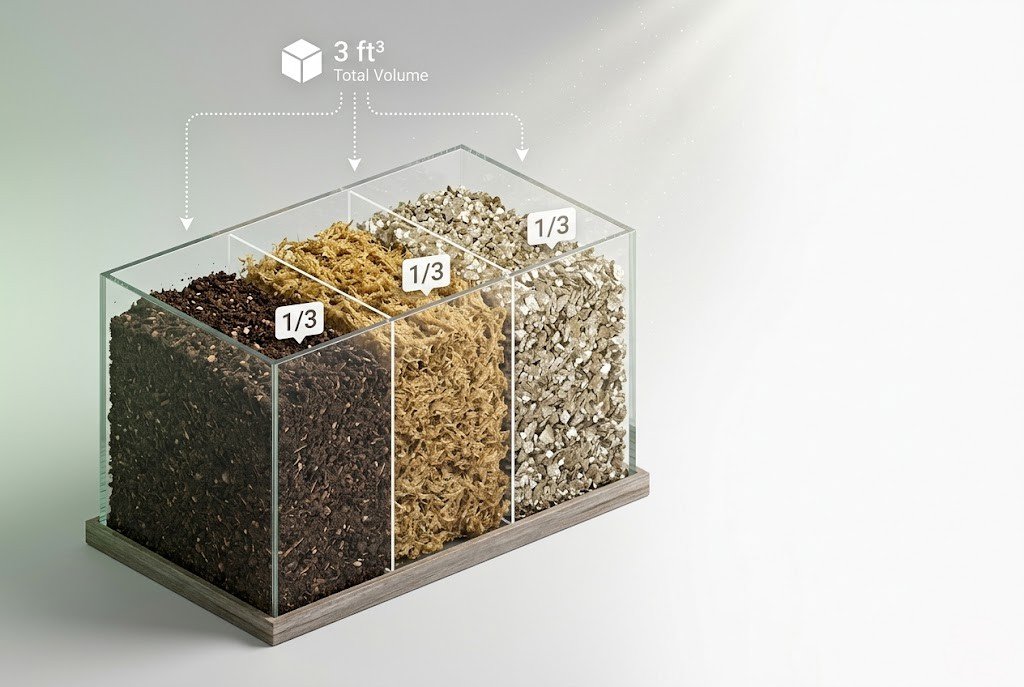
This soil mix calculator computes the exact cubic footage of compost, peat moss, and coarse vermiculite required to fill any raised bed using the Mel’s Mix formula. It does not estimate fertilizer needs, pH adjustments, or native soil amendments. The output is a precise shopping list for three ingredients in equal parts.
After entering your bed volume, you will know exactly how many cubic feet of each ingredient to purchase, eliminating guesswork and preventing costly over-buying or mid-project shortages.
Use the Tool
- 🟤 Compost (blended)
- 🟫 Peat Moss
- 🟠 Coarse Vermiculite
| Bed Size (cf) | Each Ingredient (cf) | Approx. Bags* |
|---|---|---|
| 4 | 1.33 | ~1 bag each |
| 8 | 2.67 | ~2 bags each |
| 12 | 4.00 | ~2-3 bags each |
| 16 | 5.33 | ~3 bags each |
| 24 | 8.00 | ~4 bags each |
| 32 | 10.67 | ~5-6 bags each |
*Based on standard 2 cf bags. Actual bag sizes vary.
📐 How This Calculator Works
Formula: Each ingredient = Total Volume ÷ 3
This calculator uses Mel Bartholomew’s famous “Mel’s Mix” recipe from Square Foot Gardening:
- 1/3 Blended Compost — Use at least 5 different sources for best results
- 1/3 Peat Moss — Provides moisture retention and aeration
- 1/3 Coarse Vermiculite — Ensures drainage and root growth
Steps:
- 1. Enter your total bed volume in cubic feet
- 2. Calculator divides by 3 for each ingredient
- 3. Results show exact cubic feet needed
⚙️ Assumptions & Limits
- Recipe assumes Mel’s Mix standard ratio (1:1:1)
- Compost should be from 5+ different organic sources for nutrient diversity
- Use coarse-grade vermiculite (not fine) for proper drainage
- Peat moss can be substituted with coco coir at same ratio
- Volume input should not exceed 500 cf for single bed calculations
- Mix will settle ~10-15% after watering; consider adding extra
Before using the calculator, measure your raised bed’s interior dimensions. You need the length, width, and depth in feet. Multiply these three numbers to get total cubic feet. If your bed is 4 feet long, 4 feet wide, and 1 foot deep, enter 16 as your total volume. For irregularly shaped beds, calculate the volume of each section separately and add them together.

If you need help determining volume for beds with unusual depths or shapes, the raised bed soil calculator can assist with dimensional conversions.
Quick Start (60 Seconds)
- Total Bed Volume (cf): Enter the interior volume of your raised bed in cubic feet. Calculate this by multiplying length × width × depth in feet.
- Decimal values accepted: Enter 8.5 for a bed measuring 4.25 × 2 × 1 feet. The calculator handles partial cubic feet.
- Common mistake: Confusing interior and exterior dimensions. Measure inside the frame walls, not outside.
- Unit consistency: All inputs and outputs use cubic feet (cf). Convert from gallons by dividing by 7.48, or from liters by dividing by 28.32.
- Maximum input: The calculator accepts volumes up to 500 cubic feet. Larger projects should calculate in sections.
- Click Calculate: Results appear instantly with a shopping list showing exact cubic feet for each ingredient.
- Reset function: Use the Reset button to clear all fields and start a new calculation.
Inputs and Outputs (What Each Field Means)
| Field Name | Type | Unit | What It Means | Common Mistake | Safe Entry Guidance |
|---|---|---|---|---|---|
| Total Bed Volume | Input | cubic feet | Interior volume of the raised bed container | Using exterior dimensions instead of interior | Measure inside frame; multiply L × W × D |
| Total Volume (output) | Output | cubic feet | Confirms entered volume for verification | None | Check this matches your calculation |
| Compost | Output | cubic feet | Volume of blended compost needed (1/3 of total) | Using single-source compost | Source from 5+ different organic materials |
| Peat Moss | Output | cubic feet | Volume of peat moss needed (1/3 of total) | Using fine peat instead of sphagnum | Sphagnum peat moss preferred |
| Coarse Vermiculite | Output | cubic feet | Volume of vermiculite needed (1/3 of total) | Using fine-grade vermiculite | Coarse or horticultural grade only |
Worked Examples (Real Numbers)
Example 1: Standard 4×4 Raised Bed
- Bed dimensions: 4 ft × 4 ft × 0.5 ft deep
- Total volume: 4 × 4 × 0.5 = 8 cubic feet
Result: Compost: 2.67 cf | Peat Moss: 2.67 cf | Vermiculite: 2.67 cf
This standard square foot garden bed requires approximately 3 bags of each ingredient if purchasing standard 1 cubic foot bags, or about 1.5 bags each if using 2 cubic foot bags.
Example 2: Long Narrow Bed Along a Fence
- Bed dimensions: 8 ft × 2 ft × 1 ft deep
- Total volume: 8 × 2 × 1 = 16 cubic feet
Result: Compost: 5.33 cf | Peat Moss: 5.33 cf | Vermiculite: 5.33 cf
This configuration works well for root vegetables and vining crops. The depth allows for carrots and parsnips while the length accommodates trellised cucumbers or beans.
Example 3: Deep Bed for Root Crops
- Bed dimensions: 4 ft × 4 ft × 1.5 ft deep
- Total volume: 4 × 4 × 1.5 = 24 cubic feet
Result: Compost: 8.00 cf | Peat Moss: 8.00 cf | Vermiculite: 8.00 cf
Deep beds support long-rooted vegetables like carrots, parsnips, and daikon radishes. The extra depth also provides better moisture retention during hot weather and room for potato growing.
Reference Table (Fast Lookup)
| Bed Dimensions (L × W × D) | Total Volume (cf) | Each Ingredient (cf) | Approx. 2cf Bags Each | Best Use Case |
|---|---|---|---|---|
| 2 ft × 2 ft × 0.5 ft | 2 | 0.67 | 1 | Herbs, lettuce |
| 4 ft × 4 ft × 0.5 ft | 8 | 2.67 | 2 | Square foot garden |
| 4 ft × 4 ft × 1 ft | 16 | 5.33 | 3 | Most vegetables |
| 4 ft × 8 ft × 0.5 ft | 16 | 5.33 | 3 | Shallow-rooted crops |
| 4 ft × 8 ft × 1 ft | 32 | 10.67 | 6 | Mixed vegetable garden |
| 4 ft × 4 ft × 1.5 ft | 24 | 8.00 | 4 | Root vegetables |
| 3 ft × 6 ft × 1 ft | 18 | 6.00 | 3 | Narrow pathway bed |
| 4 ft × 12 ft × 1 ft | 48 | 16.00 | 8 | Large production bed |
| 5 ft × 10 ft × 1 ft | 50 | 16.67 | 9 | Market garden bed |
For container gardening with pots and planters instead of raised beds, the potting soil calculator provides volume calculations for round and tapered containers.
How the Calculation Works (Formula + Assumptions)
Show the calculation steps

Core Formula:
Each Ingredient Volume = Total Bed Volume ÷ 3
Step-by-step process:
- Accept total bed volume input in cubic feet
- Validate input is a positive number between 0.1 and 500
- Divide total volume by 3 to get individual ingredient amounts
- Round results to two decimal places for practical measurement
- Display shopping list with all three ingredient quantities
Rounding rule: Results are rounded to the nearest hundredth (0.01 cf). For purchasing, round up to the nearest whole bag to ensure adequate coverage.
Unit handling: All calculations use cubic feet. No internal unit conversions occur. Users must convert inches or meters to feet before entry.
Assumptions and Limits
- The formula assumes the standard Mel’s Mix ratio of exactly 1:1:1 by volume. Variations like 40/30/30 splits require manual adjustment.
- Compost is assumed to be blended from at least five different organic sources. Single-source compost (pure mushroom compost, for example) may create nutrient imbalances.
- Vermiculite must be coarse or horticultural grade. Fine vermiculite compacts and reduces drainage, defeating the purpose of the mix.
- Peat moss is measured by loose volume, not compressed bale weight. A 3.8 cf bale of peat moss yields approximately 3.8 cf when fluffed.
- The mix settles 10 to 15 percent after initial watering. Consider adding 10 to 15 percent extra volume to compensate.
- This calculator does not account for amendments like lime, fertilizer, or mycorrhizae that may be added separately.
- Volume inputs above 500 cf should be calculated in sections to maintain accuracy and manageability.
- Coco coir can substitute for peat moss at a 1:1 ratio if sustainability concerns apply.
For projects involving significant compost quantities, the compost calculator helps estimate material needs for on-site composting.
Standards, Safety Checks, and Warnings
Critical Warnings
- Single-source compost risk: Using only one type of compost (such as pure mushroom compost or only manure-based compost) creates nutrient imbalances and potential salt buildup. The original Mel’s Mix specification requires blending at least five different compost sources.
- Fine vermiculite failure: Fine-grade vermiculite compacts over time and holds too much moisture. This creates waterlogged conditions that suffocate roots and promote fungal disease. Only coarse or horticultural-grade vermiculite maintains the air pockets needed for healthy root development.
- Volume settling: Fresh mix settles 10 to 15 percent after the first thorough watering. Beds filled exactly to the rim will appear underfilled within days. Calculate for the settled volume or add extra material upfront.
- Measurement confusion: Mixing cubic feet calculations with inch-based or metric measurements causes significant errors. A bed measured as 48 × 48 × 12 inches equals 16 cubic feet, not 48 or 576.
Minimum Standards
- Compost should come from a minimum of five different organic sources for adequate nutrient diversity.
- Vermiculite grade must be coarse (particles 2 to 4 mm) or labeled “horticultural grade.”
- All three ingredients must be measured by volume, not weight, to maintain the correct ratio.
- Mix ingredients thoroughly before filling beds. Layering creates drainage problems and uneven root growth.
Competitor Trap: Many online calculators and gardening guides suggest substituting perlite for vermiculite to reduce cost. While perlite improves drainage, it lacks vermiculite’s cation exchange capacity and moisture-holding properties. Perlite-based mixes dry out faster and hold fewer nutrients, requiring more frequent watering and fertilization. The original Mel’s Mix specification calls for vermiculite specifically because of these properties. Substituting perlite changes the mix’s performance characteristics in ways that may not become apparent until mid-season stress.
Understanding the carbon-to-nitrogen balance in your compost component improves results. The compost C:N ratio calculator explains optimal ranges for garden application.
Common Mistakes and Fixes
Mistake: Using Exterior Frame Dimensions
Measuring the outside of a raised bed frame instead of the interior space inflates volume calculations. A bed with 2-inch thick walls loses 4 inches in both length and width. For a 4×4 foot frame with 2-inch lumber, interior dimensions are 3.67 × 3.67 feet, reducing volume by nearly 16 percent.
Fix: Always measure from inside wall to inside wall at the soil line.
Mistake: Confusing Compressed and Loose Peat Moss Volume
Baled peat moss is compressed for shipping. A “3.8 cubic foot” bale refers to loose, fluffed volume, not compressed bale size. Failing to fluff peat moss before measuring leads to under-application.
Fix: Break up and fluff compressed peat moss before measuring volume. Work in a contained area to prevent wind loss.
Mistake: Substituting Fine-Grade Vermiculite
Hardware stores often stock only fine vermiculite intended for seed starting. Fine particles compact under watering pressure, eliminating air spaces and creating waterlogged conditions.
Fix: Source coarse or horticultural-grade vermiculite from garden centers, agricultural suppliers, or specialty retailers. Verify particle size is 2 to 4 mm.
Mistake: Layering Instead of Mixing
Adding ingredients in layers (compost on bottom, peat in middle, vermiculite on top) creates stratified drainage problems. Water pools at layer boundaries, and roots struggle to penetrate unmixed zones.

Fix: Mix all three ingredients thoroughly on a tarp or in a wheelbarrow before filling the bed. For large volumes, mix in batches and combine in the bed.
Mistake: Not Accounting for Settling
Fresh mix contains air pockets that collapse after the first watering cycle. A bed filled to the brim settles 1 to 2 inches below the frame edge within a week.
Fix: Calculate 10 to 15 percent extra volume, or plan to top off beds after initial settling.
Related Tools and Next Steps
After calculating your Mel’s Mix quantities, these related tools help with connected gardening tasks:
Calculate the total soil volume for beds of various shapes with the raised bed soil calculator, which handles irregular dimensions and depth variations.
If substituting coco coir for peat moss, the coco coir calculator helps determine brick-to-volume conversions for compressed coir products.
Established raised beds benefit from annual compost additions. The compost calculator estimates how much finished compost to add as a top dressing.
Peat moss naturally acidifies soil over time. If pH testing reveals values below 6.0, the soil pH lime calculator determines appropriate lime applications.
For ongoing fertilization after planting, the NPK calculator helps balance nitrogen, phosphorus, and potassium inputs based on crop needs.
Container gardeners working with pots rather than raised beds can use the potting soil calculator for cylindrical and tapered vessel volumes.
FAQ
What is Mel’s Mix and why use it for raised beds?
Mel’s Mix is a soil recipe developed by Mel Bartholomew for Square Foot Gardening. It combines equal parts blended compost, peat moss, and coarse vermiculite. The formula creates a lightweight, well-draining growing medium that resists compaction and provides balanced moisture retention. Unlike native soil, it maintains structure over multiple growing seasons without amendment.
Can I substitute perlite for vermiculite in Mel’s Mix?
Perlite can replace vermiculite but changes mix performance. Vermiculite holds more water and has cation exchange capacity that retains nutrients. Perlite drains faster and holds fewer nutrients. Beds with perlite require more frequent watering and fertilization. For the original recipe’s performance characteristics, use coarse vermiculite.
How do I convert inches to cubic feet for the calculator?
Measure length, width, and depth in inches. Multiply all three numbers together. Divide the result by 1,728 (the number of cubic inches in a cubic foot). For example: 48 × 48 × 12 = 27,648 cubic inches. Divided by 1,728 equals 16 cubic feet.
Does Mel’s Mix need fertilizer added?
Fresh Mel’s Mix contains nutrients from the compost component but may not provide complete nutrition for heavy-feeding crops. After the first growing season, add compost annually as a top dressing. For crops like tomatoes or peppers, supplemental fertilization during the growing season improves yields.
How long does Mel’s Mix last before needing replacement?
Properly maintained Mel’s Mix lasts indefinitely with annual compost additions. The vermiculite and peat moss do not break down significantly. Add 1 to 2 inches of fresh blended compost each spring to replace nutrients removed by previous crops. Complete replacement is unnecessary under normal use.
Is coco coir a good substitute for peat moss in this recipe?
Coco coir works as a 1:1 volume replacement for peat moss. It offers similar water retention and aeration properties. Coco coir has a more neutral pH than acidic peat moss, which may benefit plants sensitive to low pH. It also represents a more renewable resource than harvested peat bogs.
Conclusion
The soil mix calculator removes guesswork from raised bed preparation by providing exact ingredient quantities based on the proven Mel’s Mix formula. Entering your bed’s cubic footage yields a precise shopping list showing how much compost, peat moss, and coarse vermiculite to purchase. The equal-parts ratio ensures the drainage, moisture retention, and nutrient-holding capacity that makes this recipe effective.
The most common failure point is ingredient quality, not quantity. Using single-source compost or fine-grade vermiculite undermines the formula regardless of how accurately you measure volumes. Blend compost from at least five sources, verify vermiculite is coarse grade, and mix thoroughly before filling. With quality ingredients in the right proportions, Mel’s Mix creates growing conditions that support productive harvests season after season. For beds requiring pH adjustment after peat moss acidification, the soil pH lime calculator provides application guidance.