
Where Garden Strategy Meets Structured Soil

Firewood Calculator: Measure Your Cord, Catch Shortfalls, and Know Your Heat Before You Buy

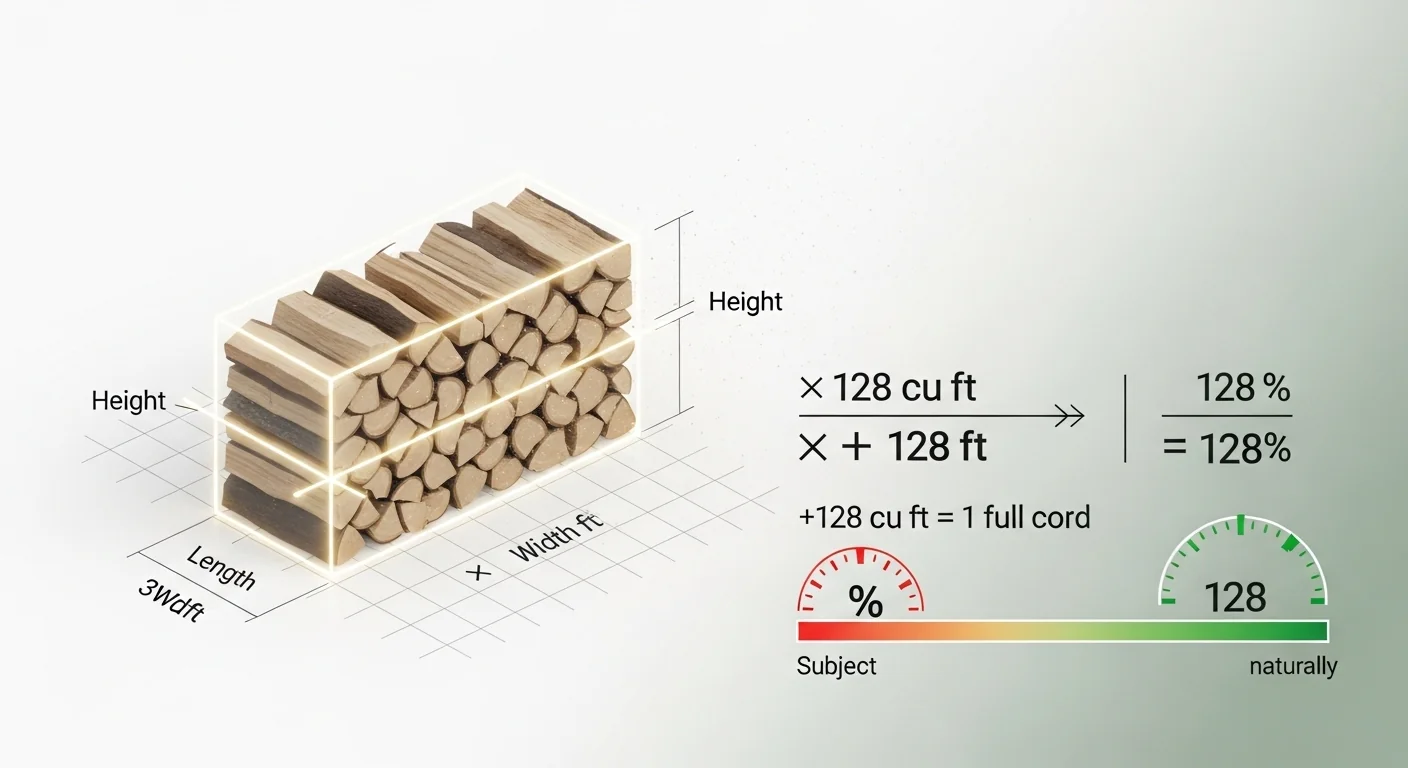
Firewood cord calculator logic showing length width height multiplication divided by 128 cubic feet

Buying or measuring firewood is deceptively straightforward until the stack arrives and something feels off. A delivery described as a “cord” might occupy far less space than the legal standard, or a stack you’ve been building all season might fall short of what’s actually needed. The problem is almost always the same: volume gets estimated by eye rather than calculated from dimensions. Stack length, depth (log length), and height each multiply together, and even a modest error in one dimension compounds into a significant shortfall of actual cubic feet.

This tool calculates gross stack volume in cubic feet, converts it to full cords and face cords, and flags whether your measurement meets the 128-cubic-foot legal standard for a full cord. It also estimates heat potential in BTUs based on wood species. What it does not do is account for air gaps between logs, green wood moisture loss, or regional cord definitions that occasionally differ from the federal standard. Understanding those limits is just as important as the output number. If you want to go further into the physical properties of individual logs, the log weight calculator covers density and weight by species in the same homesteading context.

Once you have your cubic feet and cord count, you can make a direct, defensible decision: did you receive a full cord, how much heat can you realistically expect this season, and whether it is worth calling your supplier before stacking anything else.

Use the Tool
  • Material Quality:​​ Precision steel construction with polyurethane coating ensures lasting durability
  • ​​Dual Measurement System:​​ Clear metric (110cm) and imperial (44″) scales with left-to-right readability
  • ​​Universal Adhesion:​​ Strong self-adhesive backing attaches securely to wood, metal, and plastic surfaces
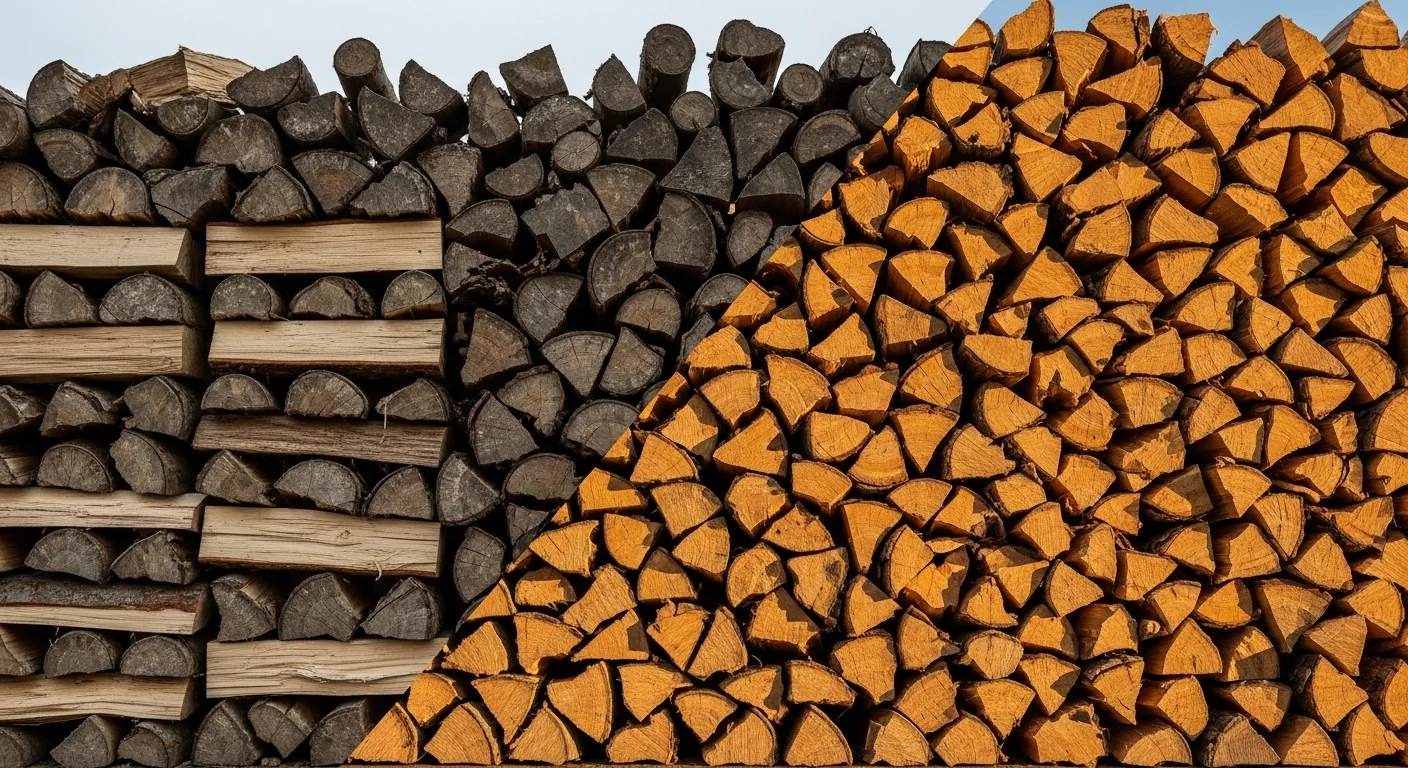
Firewood cord calculator showing short loose stack versus proper full cord volume
The visual difference between an under-delivered pile and one that truly meets the legal cord standard is unmistakable once measured properly.
:root { –fwcord_accent: #2D5A27; –fwcord_accent_light: #F4F7F0; –fwcord_accent_dark: #1e4019; –fwcord_secondary: #595959; –fwcord_text: #595959; –fwcord_bg: #FFFFFF; –fwcord_border: #D8E4D3; –fwcord_danger: #C0392B; –fwcord_warn: #E67E22; –fwcord_safe: #2D5A27; –fwcord_muted: #888888; –fwcord_radius: 14px; –fwcord_shadow: 0 12px 35px rgba(0,0,0,.06); –fwcord_font: system-ui, -apple-system, Segoe UI, Roboto, Arial, sans-serif; } /* Reset & Isolation */ #fwcord_widget *, #fwcord_widget *::before, #fwcord_widget *::after { box-sizing: border-box; margin: 0; padding: 0; font-family: var(–fwcord_font) !important; color: inherit; } #fwcord_widget { background: var(–fwcord_bg); color: var(–fwcord_text); font-size: 16px; line-height: 1.5; max-width: 820px; margin: 0 auto; padding: 0; border-radius: var(–fwcord_radius); box-shadow: var(–fwcord_shadow); border-top: 6px solid var(–fwcord_accent); overflow: hidden; } /* Header */ .fwcord_card_header { background: linear-gradient(135deg, var(–fwcord_accent) 0%, var(–fwcord_accent_dark) 100%); padding: 32px; display: flex; align-items: center; gap: 20px; border-bottom: 4px solid var(–fwcord_warn); } .fwcord_header_icon { flex-shrink: 0; width: 56px; height: 56px; background: rgba(255,255,255,0.15); border-radius: 12px; display: flex; align-items: center; justify-content: center; box-shadow: 0 4px 10px rgba(45,90,39,0.2); } .fwcord_card_header h2 { font-size: clamp(20px, 3vw, 26px) !important; font-weight: 800 !important; color: #ffffff !important; line-height: 1.2 !important; margin: 0 0 6px 0 !important; letter-spacing: -0.01em !important; } .fwcord_card_header p { font-size: 14px !important; color: rgba(255,255,255,0.9) !important; margin: 0 !important; line-height: 1.5 !important; font-weight: 400 !important; } /* Body */ .fwcord_body { padding: 32px; } /* Grid layout */ .fwcord_grid { display: grid; grid-template-columns: 1fr; gap: 24px; margin-bottom: 24px; } @media (min-width: 720px) { .fwcord_grid { grid-template-columns: 1fr 1fr 1fr; } .fwcord_full { grid-column: 1 / -1; } } /* Field */ .fwcord_field { display: flex; flex-direction: column; gap: 8px; position: relative; } .fwcord_label { display: flex; align-items: center; gap: 8px; font-size: 14px !important; font-weight: 800 !important; color: var(–fwcord_accent) !important; letter-spacing: 0.05em; text-transform: uppercase; } .fwcord_hint { font-size: 13px !important; color: var(–fwcord_muted) !important; line-height: 1.4 !important; margin-top: 2px; } .fwcord_input_wrap { position: relative; } .fwcord_input_wrap input, .fwcord_select_wrap select { width: 100%; min-height: 52px; font-size: 16px !important; padding: 10px 52px 10px 16px; border: 1.5px solid var(–fwcord_border) !important; border-radius: 10px; background: #fafafa !important; color: var(–fwcord_text) !important; transition: all 0.2s ease; outline: none; appearance: none; -webkit-appearance: none; box-shadow: inset 0 2px 4px rgba(0,0,0,0.02) !important; } .fwcord_select_wrap select { padding: 10px 42px 10px 16px; background-image: url(“data:image/svg+xml,%3Csvg xmlns=’http://www.w3.org/2000/svg’ width=’16’ height=’16’ viewBox=’0 0 24 24′ fill=’none’ stroke=’%23595959′ stroke-width=’2′ stroke-linecap=’round’ stroke-linejoin=’round’%3E%3Cpolyline points=’6 9 12 15 18 9’/%3E%3C/svg%3E”) !important; background-repeat: no-repeat !important; background-position: right 16px center !important; cursor: pointer; } .fwcord_input_wrap input:focus, .fwcord_select_wrap select:focus { border-color: var(–fwcord_accent) !important; background: #ffffff !important; box-shadow: 0 0 0 4px rgba(45,90,39,0.1) !important; } .fwcord_input_wrap input.fwcord_invalid { border-color: var(–fwcord_danger) !important; background: #fff5f5 !important; box-shadow: 0 0 0 4px rgba(192,57,43,0.1) !important; } .fwcord_unit_badge { position: absolute; right: 16px; top: 50%; transform: translateY(-50%); font-size: 13px !important; font-weight: 800 !important; color: var(–fwcord_muted) !important; pointer-events: none; } .fwcord_error { font-size: 13px !important; color: var(–fwcord_danger) !important; font-weight: 700 !important; min-height: 18px; display: none; animation: fadeIn 0.3s ease; } .fwcord_error.fwcord_show { display: block; } /* Buttons */ .fwcord_btn_row { display: flex; gap: 16px; flex-wrap: wrap; margin-top: 12px; } .fwcord_btn_primary { flex: 1 1 200px; min-height: 56px; background: var(–fwcord_accent) !important; color: #ffffff !important; border: none !important; border-radius: 10px; font-size: 16px !important; font-weight: 800 !important; cursor: pointer; letter-spacing: 0.04em; text-transform: uppercase; transition: all 0.2s ease; box-shadow: 0 4px 14px rgba(45,90,39,0.25) !important; display: flex; align-items: center; justify-content: center; gap: 8px; } .fwcord_btn_primary:hover { background: #3a7533 !important; transform: translateY(-2px); box-shadow: 0 6px 20px rgba(45,90,39,0.35) !important; } .fwcord_btn_primary:active { transform: translateY(1px); box-shadow: 0 2px 8px rgba(45,90,39,0.2) !important; } .fwcord_btn_secondary { flex: 0 1 140px; min-height: 56px; background: #fafafa !important; color: var(–fwcord_secondary) !important; border: 1.5px solid var(–fwcord_border) !important; border-radius: 10px; font-size: 15px !important; font-weight: 700 !important; cursor: pointer; transition: all 0.2s ease; padding: 0 24px; } .fwcord_btn_secondary:hover { border-color: var(–fwcord_accent) !important; background: var(–fwcord_accent_light) !important; color: #222 !important; } /* Animations */ @keyframes slideDownFader { from { opacity: 0; transform: translateY(-15px); } to { opacity: 1; transform: translateY(0); } } @keyframes fadeIn { from { opacity: 0; } to { opacity: 1; } } /* Results panel */ #fwcord_results { min-height: 220px; display: none; margin-top: 32px; } #fwcord_results.fwcord_show { display: block; animation: slideDownFader 0.5s cubic-bezier(0.16, 1, 0.3, 1) forwards; } /* Primary result hero */ .fwcord_result_hero { background: linear-gradient(135deg, var(–fwcord_accent) 0%, var(–fwcord_accent_dark) 100%); border-radius: 12px; padding: 32px 24px; margin-bottom: 24px; color: #fff !important; display: flex; align-items: center; gap: 24px; flex-wrap: wrap; box-shadow: 0 4px 12px rgba(0,0,0,0.1); } .fwcord_hero_main { flex: 1; min-width: 200px; } .fwcord_hero_label { font-size: 14px !important; font-weight: 800 !important; text-transform: uppercase; letter-spacing: 0.1em; color: rgba(255,255,255,0.8) !important; margin-bottom: 8px; } .fwcord_hero_value { font-size: clamp(40px, 6vw, 64px) !important; font-weight: 900 !important; color: #fff !important; line-height: 1 !important; letter-spacing: -0.02em; } .fwcord_hero_unit { font-size: 18px !important; font-weight: 700 !important; color: rgba(255,255,255,0.9) !important; margin-left: 8px; } .fwcord_hero_sub { font-size: 15px !important; color: rgba(255,255,255,0.95) !important; margin-top: 12px; line-height: 1.6 !important; } .fwcord_hero_metrics { display: flex; gap: 16px; flex-wrap: wrap; } .fwcord_metric_box { background: rgba(255,255,255,0.15); border: 1px solid rgba(255,255,255,0.2); border-radius: 10px; padding: 16px 20px; text-align: center; min-width: 110px; } .fwcord_metric_val { font-size: 24px !important; font-weight: 800 !important; color: #fff !important; line-height: 1 !important; display: block; margin-bottom: 4px; } .fwcord_metric_lbl { font-size: 12px !important; font-weight: 800 !important; color: rgba(255,255,255,0.85) !important; text-transform: uppercase; letter-spacing: 0.05em; } /* Gauge bar */ .fwcord_gauge_section { background: #ffffff; border: 1px solid rgba(216, 228, 211, 0.6); border-radius: 12px; padding: 24px; margin-bottom: 24px; box-shadow: 0 2px 8px rgba(0,0,0,0.02); } .fwcord_gauge_label_row { display: flex; justify-content: space-between; align-items: center; margin-bottom: 12px; } .fwcord_gauge_title { font-size: 14px !important; font-weight: 800 !important; color: var(–fwcord_accent) !important; display: flex; align-items: center; gap: 8px; text-transform: uppercase; letter-spacing: 0.05em; } .fwcord_gauge_pct_lbl { font-size: 14px !important; font-weight: 800 !important; color: var(–fwcord_text) !important; } .fwcord_gauge_track { height: 24px; background: #e8ede6; border-radius: 12px; position: relative; box-shadow: inset 0 2px 4px rgba(0,0,0,0.08); } .fwcord_gauge_fill { height: 100%; border-radius: 12px; transition: width 0.8s cubic-bezier(0.34, 1.56, 0.64, 1), background 0.4s; min-width: 0; box-shadow: inset 0 2px 4px rgba(255,255,255,0.2); } .fwcord_gauge_marker { position: absolute; top: -2px; bottom: -2px; width: 4px; background: #333; border-radius: 2px; box-shadow: 0 0 0 2px #fff, 0 2px 4px rgba(0,0,0,0.3); } .fwcord_gauge_sub { font-size: 14px !important; color: var(–fwcord_text) !important; margin-top: 12px; line-height: 1.5 !important; } /* Rip-off detector */ .fwcord_detector { border-radius: 12px; border: 2px solid; padding: 20px 24px; margin-bottom: 24px; transition: all 0.3s ease; } .fwcord_detector_header { display: flex; align-items: center; gap: 12px; margin-bottom: 12px; flex-wrap: wrap; } .fwcord_detector_title { font-size: 15px !important; font-weight: 800 !important; text-transform: uppercase; letter-spacing: 0.05em; } .fwcord_badge { display: inline-flex; align-items: center; gap: 6px; padding: 6px 12px; border-radius: 24px; font-size: 13px !important; font-weight: 800 !important; text-transform: uppercase; letter-spacing: 0.05em; } .fwcord_badge_green { background: #d4edda; color: var(–fwcord_safe) !important; border: 1px solid #aad4b0; } .fwcord_badge_red { background: #FEF0EE; color: var(–fwcord_danger) !important; border: 1px solid #f5b7b1; } .fwcord_badge_warn { background: #fef3e2; color: var(–fwcord_warn) !important; border: 1px solid #f8d28a; } .fwcord_detector_desc { font-size: 15px !important; color: var(–fwcord_text) !important; line-height: 1.6 !important; } /* BTU section */ .fwcord_btu_section { border-radius: 12px; border: 1px solid rgba(216, 228, 211, 0.6); padding: 24px; margin-bottom: 24px; background: #ffffff; box-shadow: 0 2px 8px rgba(0,0,0,0.02); } .fwcord_btu_header { display: flex; align-items: center; justify-content: space-between; margin-bottom: 16px; gap: 16px; flex-wrap: wrap; } .fwcord_btu_title { font-size: 14px !important; font-weight: 800 !important; color: var(–fwcord_accent) !important; text-transform: uppercase; letter-spacing: 0.05em; display: flex; align-items: center; gap: 8px; } .fwcord_btu_value_row { display: flex; align-items: baseline; gap: 8px; } .fwcord_btu_num { font-size: 32px !important; font-weight: 900 !important; color: var(–fwcord_accent) !important; line-height: 1 !important; } .fwcord_btu_unit { font-size: 15px !important; font-weight: 700 !important; color: var(–fwcord_muted) !important; } .fwcord_btu_desc { font-size: 15px !important; color: var(–fwcord_text) !important; line-height: 1.6 !important; } /* Reference mini-table */ .fwcord_table_section { margin-bottom: 32px; } .fwcord_table_section h3 { font-size: 14px !important; font-weight: 800 !important; color: var(–fwcord_accent) !important; margin-bottom: 16px !important; display: flex; align-items: center; gap: 8px; text-transform: uppercase; letter-spacing: 0.05em; } .fwcord_table_wrap { border-radius: 12px; border: 1px solid var(–fwcord_border); overflow: hidden; box-shadow: 0 2px 8px rgba(0,0,0,0.02); } .fwcord_table { width: 100%; border-collapse: collapse; font-size: 14px !important; } .fwcord_table th { background: #fafafa !important; color: var(–fwcord_muted) !important; text-align: left; padding: 14px 16px; font-weight: 800 !important; font-size: 12px !important; text-transform: uppercase; letter-spacing: 0.06em; border-bottom: 1px solid var(–fwcord_border); } .fwcord_table td { padding: 14px 16px; border-bottom: 1px solid var(–fwcord_border); color: var(–fwcord_text) !important; vertical-align: middle; transition: background 0.3s ease; } .fwcord_table tr:nth-child(even) td { background: #fafafa; } .fwcord_table tr.fwcord_highlighted td { background: rgba(45,90,39,0.06) !important; font-weight: 700 !important; color: var(–fwcord_accent) !important; } .fwcord_table tr:last-child td { border-bottom: none; } /* Formula details */ .fwcord_details_block { border-radius: 12px; border: 1px solid var(–fwcord_border); overflow: hidden; margin-bottom: 24px; background: #ffffff; box-shadow: 0 2px 8px rgba(0,0,0,0.02); } .fwcord_details_block summary { padding: 18px 24px; font-size: 15px !important; font-weight: 800 !important; color: var(–fwcord_accent) !important; cursor: pointer; display: flex; align-items: center; gap: 12px; list-style: none; background: #fafafa; user-select: none; transition: background 0.2s; } .fwcord_details_block summary:hover { background: var(–fwcord_accent_light); } .fwcord_details_block summary::-webkit-details-marker { display: none; } .fwcord_chevron { margin-left: auto; transition: transform 0.3s ease; } .fwcord_details_block[open] summary .fwcord_chevron { transform: rotate(180deg); } .fwcord_details_block[open] summary { border-bottom: 1.5px solid var(–fwcord_border); } .fwcord_details_body { padding: 24px; font-size: 14px !important; color: var(–fwcord_text) !important; line-height: 1.7 !important; } .fwcord_formula_step { display: flex; gap: 16px; align-items: flex-start; margin-bottom: 16px; padding-bottom: 16px; border-bottom: 1px solid var(–fwcord_border); } .fwcord_formula_step:last-child { margin-bottom: 0; padding-bottom: 0; border-bottom: none; } .fwcord_formula_num { display: inline-flex; align-items: center; justify-content: center; width: 26px; height: 26px; min-width: 26px; background: var(–fwcord_accent); color: #fff !important; border-radius: 50%; font-size: 12px !important; font-weight: 800 !important; box-shadow: 0 2px 6px rgba(45,90,39,0.3); } .fwcord_formula_text strong { font-weight: 800 !important; color: var(–fwcord_accent) !important; } .fwcord_formula_code { display: inline-block; background: #fafafa; border: 1px solid var(–fwcord_border); border-radius: 6px; padding: 4px 8px; font-family: ‘Courier New’, monospace !important; font-size: 13px !important; font-weight: 600 !important; margin: 6px 0; color: var(–fwcord_accent_dark) !important; white-space: nowrap; } .fwcord_brand_tag { font-size: 12px !important; color: var(–fwcord_muted) !important; text-align: center; padding: 24px 0 0; font-weight: 800 !important; letter-spacing: 0.06em; text-transform: uppercase; border-top: 1px solid var(–fwcord_border); }

Firewood Cord Calculator

The Yield Grid — Homesteading & Livestock

Measured end-to-end, in feet
ft
Log length / stack depth (std = 4 ft)
ft
From ground to top of stack, in feet
ft
Denser hardwoods produce more heat per cord
Oak (23.6M BTU/cord) — Hardwood, excellent Hickory (21.6M BTU/cord) — Hardwood, excellent Hard Maple (20.0M BTU/cord) — Hardwood, very good White Ash (18.7M BTU/cord) — Hardwood, very good Birch (17.5M BTU/cord) — Hardwood, good Cherry (15.0M BTU/cord) — Hardwood, good Soft Maple (14.0M BTU/cord) — Mixed wood Pine (11.0M BTU/cord) — Softwood, low Poplar / Aspen (8.9M BTU/cord) — Softwood, very low
Full Cords
cords
Cubic Feet
Face Cords
Full Cord Gauge (128 cu ft = 1 cord)
Rip-Off Detector: Is This a Full Cord?

Approximate Heat Value (BTU)
million BTU

Cord Conversion Reference

Cord Type Cu Ft Dimensions (typical) Notes
How This Calculator Works
1 Measure your stack in feet:
Length × Width × Height
Width is the depth of your stack (log length), typically 4 ft for standard firewood. Result is total cubic feet (cu ft).
2 Full Cords:
Cu Ft ÷ 128
A full cord is defined as a stack of wood measuring 4 ft × 4 ft × 8 ft = 128 cubic feet. This is the legal standard in most U.S. states.
3 Face Cords:
Cu Ft ÷ 42.6
A face cord (also called a rick) is 4 ft high × 8 ft long × 16 in (~1.33 ft) deep. ≈ 42.6 cu ft. It takes approximately 3 face cords to equal 1 full cord.
4 BTU estimate:
Full Cords × BTU/cord for selected wood
BTU values are published averages for air-dried (seasoned) firewood at ~20% moisture content. Green/wet wood delivers significantly less heat.
Assumptions & Limits: This calculator uses gross stack volume. Actual usable wood is ~80–85% of stack volume due to air gaps between logs. BTU values assume properly seasoned wood. Results are estimates — actual wood density, moisture content, and stacking tightness all affect real-world heat output. A legal “cord” must be 128 cu ft; sellers advertising anything less may be misrepresenting quantity.
The Yield Grid
(function() { ‘use strict’; var FULL_CORD_CUFT = 128; var FACE_CORD_CUFT = 42.6; function qs(id) { return document.getElementById(id); } function setError(fieldId, msg) { var el = qs(‘fwcord_’ + fieldId + ‘_err’); var inp = qs(‘fwcord_’ + fieldId); if (!el) return; if (msg) { el.textContent = msg; el.classList.add(‘fwcord_show’); if (inp) { inp.classList.add(‘fwcord_invalid’); inp.setAttribute(‘aria-invalid’, ‘true’); } } else { el.textContent = ”; el.classList.remove(‘fwcord_show’); if (inp) { inp.classList.remove(‘fwcord_invalid’); inp.removeAttribute(‘aria-invalid’); } } } function clearErrors() { [‘length’,’width’,’height’].forEach(function(f) { setError(f, ”); }); } function validateField(id, label) { var el = qs(‘fwcord_’ + id); var val = el ? el.value.trim() : ”; if (val === ” || val === null) { setError(id, ‘Required’); return null; } var num = parseFloat(val); if (isNaN(num)) { setError(id, ‘Enter a number’); return null; } if (num 9999) { setError(id, ‘Must be between 0.1 and 9,999’); return null; } setError(id, ”); return num; } function fmt(num, dec) { dec = (dec === undefined) ? 2 : dec; return num.toFixed(dec).replace(/B(?=(d{3})+(?!d))/g, ‘,’); } function buildRefTable(cubicFt, cords) { var tbody = qs(‘fwcord_ref_table_body’); if (!tbody) return; var rows = [ { name: ‘Full Cord’, cuft: 128, dim: ‘4 ft × 4 ft × 8 ft’, note: ‘Legal standard’ }, { name: ‘Face Cord (Rick)’, cuft: 42.6, dim: ‘4 ft × ~16 in × 8 ft’, note: ‘≈ ⅓ of full cord’ }, { name: ‘Half Cord’, cuft: 64, dim: ‘4 ft × 4 ft × 4 ft’, note: ‘Half of full cord’ }, { name: ‘Quarter Cord’, cuft: 32, dim: ‘4 ft × 2 ft × 4 ft’, note: ‘Starter amount’ }, { name: ‘Your Stack’, cuft: cubicFt, dim: ‘Your dimensions’, note: fmt(cords, 2) + ‘ full cord(s)’ } ]; tbody.innerHTML = ”; rows.forEach(function(r) { var tr = document.createElement(‘tr’); if (r.name === ‘Your Stack’) tr.className = ‘fwcord_highlighted’; tr.innerHTML = ‘‘ + (r.name === ‘Your Stack’ ? ‘ ‘ : ”) + r.name + ‘‘ + ‘‘ + (r.name === ‘Your Stack’ ? fmt(r.cuft, 1) : r.cuft) + ‘‘ + ‘‘ + r.dim + ‘‘ + ‘‘ + r.note + ‘‘; tbody.appendChild(tr); }); } window.fwcord_Calculate = function() { clearErrors(); var L = validateField(‘length’, ‘Stack Length’); var W = validateField(‘width’, ‘Stack Width’); var H = validateField(‘height’, ‘Stack Height’); if (L === null || W === null || H === null) return; // Calculations var cubicFt = L * W * H; var cords = cubicFt / FULL_CORD_CUFT; var faceCords = cubicFt / FACE_CORD_CUFT; // BTU var woodEl = qs(‘fwcord_wood’); var btuPerCord = woodEl ? parseFloat(woodEl.value) : 17500000; var woodName = woodEl ? woodEl.options[woodEl.selectedIndex].text.split(‘(‘)[0].trim() : ‘Birch’; var totalBtu = cords * btuPerCord; var btuMillion = totalBtu / 1e6; var gaugePercent = Math.min(cords / 1, 1.5) / 1.5 * 100; var cordPercent = (cords * 100).toFixed(1); var isFullCord = cords >= 0.97; var isGood = cords >= 0.5 && cords < 0.97; var isLow = cords = 1) { interp = ‘Your stack holds ‘ + fmt(cords, 2) + ‘ full cord(s) — that’s ‘ + fmt(cubicFt, 0) + ‘ cu ft of firewood stacked and ready.’; } else if (cords >= 0.5) { interp = ‘Your stack is about ‘ + Math.round(cords * 100) + ‘% of a full cord — a solid firewood supply for mild conditions.’; } else { interp = ‘Your stack is less than half a cord. You may need more firewood for extended heating.’; } qs(‘fwcord_interpretation’).innerHTML = interp; // Gauge animation and setting var displayPct = Math.min(cords / 1, 1) * 100; var gaugeFill = qs(‘fwcord_gauge_fill’); var gaugeAria = qs(‘fwcord_gauge_aria’); setTimeout(function() { gaugeFill.style.width = Math.min(displayPct, 100) + ‘%’; gaugeFill.style.background = gaugeColor; }, 100); if (gaugeAria) { gaugeAria.setAttribute(‘aria-valuenow’, Math.round(displayPct)); gaugeAria.setAttribute(‘aria-valuetext’, fmt(cords, 2) + ‘ cords (‘ + displayPct.toFixed(1) + ‘% of a full cord)’); } qs(‘fwcord_gauge_pct’).textContent = displayPct.toFixed(1) + ‘% of 1 full cord’; var gaugeSub; if (cords >= 1) gaugeSub = ‘You have at least 1 full cord (128 cu ft). Well stocked!’; else if (cords >= 0.5) gaugeSub = ‘Less than a full cord. Consider ordering more before winter.’; else gaugeSub = ‘Under half a cord. Likely insufficient for a full heating season.’; qs(‘fwcord_gauge_sub’).textContent = gaugeSub; // Rip-off detector var detectorBox = qs(‘fwcord_detector’); var badge = qs(‘fwcord_ripoff_badge’); var desc = qs(‘fwcord_ripoff_desc’); detectorBox.style.borderColor = gaugeColor; detectorBox.style.backgroundColor = (isFullCord) ? ‘#f0fcf0’ : (isGood) ? ‘#fffaf2’ : ‘#fdf2f0’; if (isFullCord) { badge.textContent = ‘✓ Full Cord’; badge.className = ‘fwcord_badge ‘ + detClass; desc.innerHTML = ‘This stack meets the legal full cord standard (≥ 128 cu ft). You are getting a full cord of wood. In most U.S. states, firewood must be sold by the cord or fraction thereof — any stack less than 128 cu ft sold as a “cord” is a violation.’; } else if (isGood) { badge.textContent = ‘⚠ Below Full Cord’; badge.className = ‘fwcord_badge ‘ + detClass; desc.innerHTML = ‘This stack is ‘ + fmt(cords, 2) + ‘ cords (‘ + fmt(cubicFt, 1) + ‘ cu ft) — below the 128 cu ft legal full cord. If you were quoted a “full cord” price, you may be underpaid by ‘ + fmt((1 – cords) * 100, 1) + ‘%. Ask your supplier to confirm the measurement.’; } else { badge.textContent = ‘✗ Rip-Off Risk’; badge.className = ‘fwcord_badge ‘ + detClass; desc.innerHTML = ‘This stack is only ‘ + fmt(cubicFt, 1) + ‘ cu ft — significantly less than a legal cord (128 cu ft). If sold as a “cord,” this represents a shortfall of ‘ + fmt(FULL_CORD_CUFT – cubicFt, 1) + ‘ cu ft. Verify quantity before paying full cord price.’; } // BTU description var btuDesc = qs(‘fwcord_btu_desc’); btuDesc.innerHTML = ‘At ‘ + fmt(cords, 2) + ‘ cord(s) of ‘ + woodName + ‘, this stack provides approximately ‘ + btuMillion.toFixed(2) + ‘ million BTUs of heat potential (seasoned wood). That is equivalent to roughly ‘ + Math.round(totalBtu / 90000) + ‘ hours of continuous heat from a typical wood stove (90,000 BTU/hr output).’; // Reference table buildRefTable(cubicFt, cords); // Show results var resultsEl = qs(‘fwcord_results’); resultsEl.classList.add(‘fwcord_show’); setTimeout(function() { resultsEl.scrollIntoView({ behavior: ‘smooth’, block: ‘nearest’ }); }, 150); }; window.fwcord_Reset = function() { [‘length’,’width’,’height’].forEach(function(f) { var el = qs(‘fwcord_’ + f); if (el) el.value = ”; setError(f, ”); }); var woodEl = qs(‘fwcord_wood’); if (woodEl) woodEl.selectedIndex = 4; // birch default var resultsEl = qs(‘fwcord_results’); if (resultsEl) resultsEl.classList.remove(‘fwcord_show’); qs(‘fwcord_gauge_fill’).style.width = ‘0%’; }; // Add event listeners for “Enter” key press only. No auto-run. document.addEventListener(‘DOMContentLoaded’, function() { [‘length’,’width’,’height’].forEach(function(f) { var el = qs(‘fwcord_’ + f); if (!el) return; el.addEventListener(‘keydown’, function(e) { if (e.key === ‘Enter’) { e.preventDefault(); window.fwcord_Calculate(); } }); }); }); })();

Before entering your dimensions, have a tape measure ready and measure the actual stacked pile, not the space allotted for it. Stack length is the end-to-end run of the pile. Stack width is the log length, also called depth, and it is the single most misreported measurement in firewood purchases. Stack height should be measured from the ground to the top of the actual wood, not to a sagging tarp or loose top layer. All three values go in as feet; enter decimal fractions for partial-foot measurements (for example, enter 3.5 for a 3-foot-6-inch height).

Quick Start (60 Seconds)
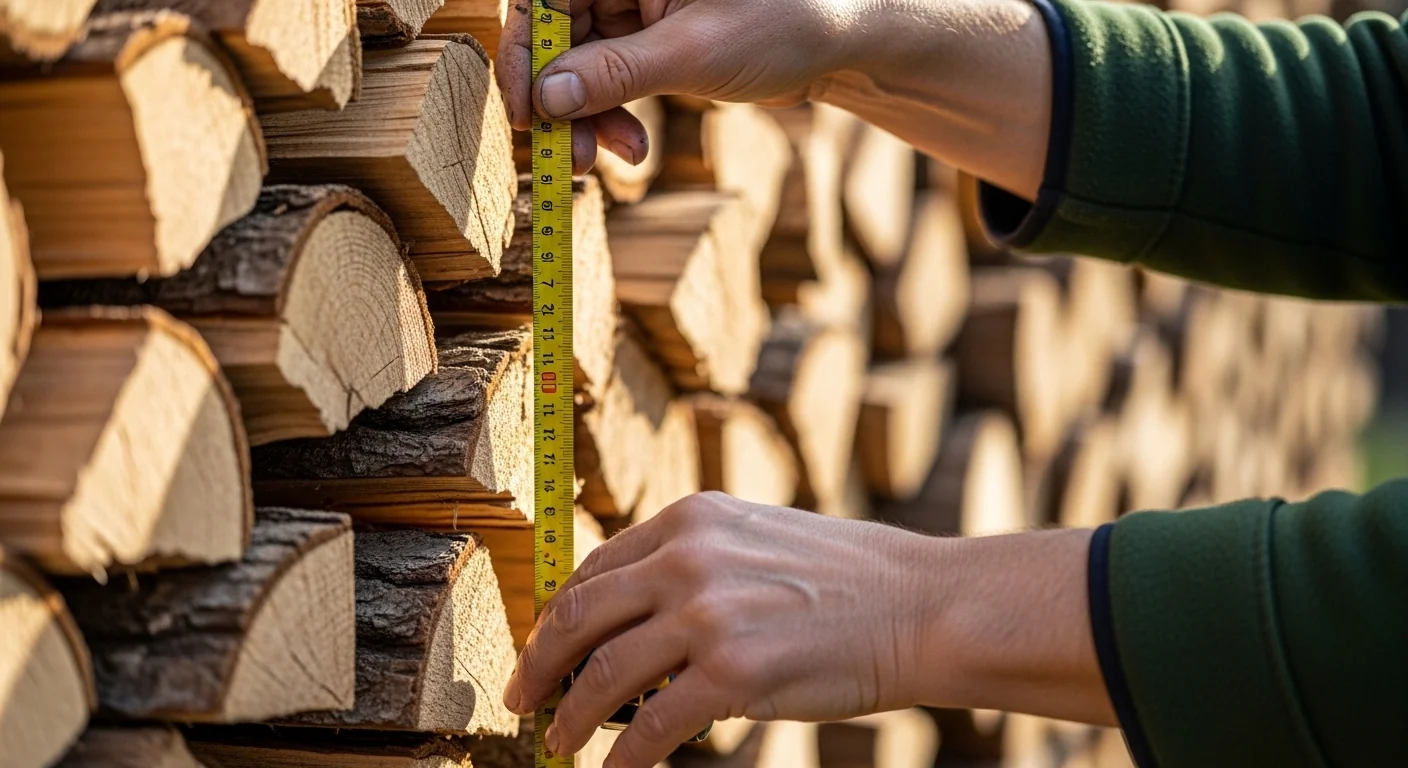
Hands measuring firewood stack dimensions with tape for cord calculator
Accurate on-site measurement with a tape is the essential first step that lets the calculator reveal whether you truly received a full cord.
  • Stack Length (ft): Measure the total horizontal run of the pile from one end to the other. A standard full-cord stack is 8 feet long. If your pile has gaps or irregular ends, measure only the wood, not the space.
  • Stack Width (ft): This is the log length, the depth of the stack from front to back. Standard firewood is cut to 16 inches (1.33 ft), 18 inches (1.5 ft), or 24 inches (2 ft). A full cord requires 4-foot-long logs to achieve 128 cubic feet in a single row. Entering this in inches by mistake is the most common input error.
  • Stack Height (ft): Measure from the ground to the consistent top of the stack. Do not measure the highest point of a rounded or uneven pile; use the average working height.
  • Wood Type: Select the species closest to what you have. If you have a mixed pile, choose the dominant species or the one with the lower BTU value to get a conservative estimate.
  • Units are always feet: Convert inches by dividing by 12. A 16-inch log length = 1.33 ft. A 42-inch height = 3.5 ft.
  • Do not round up: Enter actual measured values. A stack that measures 7 feet 9 inches is 7.75 ft, not 8 ft. That difference alone removes more than 16 cubic feet from a standard-depth stack.

Inputs and Outputs (What Each Field Means)

Every field in this calculator has a specific physical meaning. Confusing any one of them with a similar-sounding measurement produces a result that can be significantly wrong. If you also work with other bulk-stacked commodities on your property, the approach to measuring stacked volume is similar to what’s used in the silage bunker capacity calculator, where L x W x H is always the starting point before any packing factor adjustments.

Field Unit What It Means Common Mistake Safe Entry Guidance
Stack Length feet The horizontal length of the pile from end to end Measuring the space the pile occupies rather than the actual wood run Measure the actual wood face, not the ground footprint
Stack Width (Depth) feet The log cut length; how deep the stack is front-to-back Entering inches instead of feet (e.g., 16 instead of 1.33) Divide any inch measurement by 12 before entering
Stack Height feet Vertical height from ground level to the top of the usable pile Measuring the tallest piece rather than the consistent stacking height Use the height that the majority of the pile reaches; exclude outliers
Wood Type selection Species category used to estimate BTU heat output per cord Selecting hardwood when the pile is softwood, inflating heat estimates When species is unknown, select the lower-BTU softwood option for a conservative result
Cubic Feet (output) cu ft Gross stack volume: L x W x H Treating gross volume as usable wood volume (actual wood is less, due to air gaps) Use this figure to compare against the 128 cu ft cord standard
Full Cords (output) cords Cubic feet divided by 128; the legal unit for firewood sales in most U.S. states Confusing face cords with full cords when comparing supplier quotes Any value below 1.00 means you have less than a legal full cord
Face Cords (output) face cords Cubic feet divided by 42.6; also called a rick; one row of 16-inch logs stacked 4 ft high and 8 ft long Assuming a face cord is equivalent to a full cord when purchasing It takes approximately 3 face cords to equal 1 full cord
BTU Output (output) million BTU Estimated heat content based on full cord count and selected wood species Applying the BTU figure to green (unseasoned) wood, which delivers far less heat These values assume seasoned wood at roughly 20 percent moisture content

Worked Examples (Real Numbers)

  • 【QUICKLY CUT WOOD BLOCKS OF UNIFORM LENGTH】This is a quick, adjustable and telescopic firewood measuring tool. For quick…
  • 【STRONG MAGNETIC】The firewood measuring tool is made of a stronger magnet with a diameter of 2.2inch to prevents trouble…
  • 【HIGH VIS ORANGE AND MEASURED MARKS】The magnetic firewood measuring tool is designed in bright orange, which is not easy…

Example 1: A Textbook Full Cord

  • Mild, Balanced Smoke Flavor: oak delivers a clean, subtle smoke flavor that pairs well with a wide range of foods, espec…
  • Reliable Heat Source: Known for its strong heat output and consistent performance, oak burns hot and steady for long per…
  • Optimized for Popular Smokers: Each wood split is 8 inches long, carefully sized and split to fit perfectly in vertical …
  • Stack Length: 8 ft
  • Stack Width (log length): 4 ft
  • Stack Height: 4 ft
  • Wood Type: Oak (23.6 million BTU per cord)

Result: 128.0 cubic feet | 1.00 full cord | 3.00 face cords | 23.6 million BTU

This is the textbook definition of a legal cord: 4 ft x 4 ft x 8 ft = 128 cubic feet. Oak at 23.6 million BTU per cord is one of the highest heat-density hardwoods available. A single cord of seasoned oak can run a mid-efficiency wood stove for roughly 260 hours at continuous output, depending on the unit’s rated BTU/hr.

Example 2: A Common Short Delivery

  • Efficient and Easy to Use: Operating this Adjustable Firewood Measuring Tool is quick and straightforward, allowing you …
  • Versatile Length Adjustment: With an adjustable range from 16 inches to 26 inches, this Chainsaw Firewood Measuring Tool…
  • Simple Marking Functionality: This effective Firewood Attachment allows you to easily mark wood on the bark, ensuring th…
  • Stack Length: 8 ft
  • Stack Width (log length): 4 ft
  • Stack Height: 3 ft
  • Wood Type: Birch (17.5 million BTU per cord)

Result: 96.0 cubic feet | 0.75 full cords | 2.25 face cords | 13.1 million BTU

A stack that is only 3 feet tall instead of 4 feet loses a full quarter of a cord. This scenario is common with deliveries where the driver stacks loosely or loads to a visual impression of height rather than measuring. If you paid for a full cord at a going rate, you received only three-quarters of what you purchased. The Rip-Off Detector in the tool flags this as a below-full-cord result.

Example 3: One Face Cord (Rick)

  • 2 cubic ft of premium kiln dried 12″ piñon logs
  • Fatwood kindling
  • Premium firestarters
  • Stack Length: 8 ft
  • Stack Width (log length): 1.33 ft (16-inch logs)
  • Stack Height: 4 ft
  • Wood Type: Pine (11.0 million BTU per cord)

Result: 42.6 cubic feet | 0.33 full cords | 1.00 face cord | 3.63 million BTU

A single face cord of 16-inch pine is roughly one-third of a full cord and provides the lowest heat density among common firewood species. This is a realistic starting supply for shoulder-season heating or occasional fires, but it falls far short of what most homes need for a primary heat source through a full winter.

Reference Table (Fast Lookup)

  • Complete Package: you will receive 3 firewood bundle signs, each with its own ground stake, ready to meet your everyday …
  • Practical Size: these firewood yard signs measure about 16 x 12 inches; Their compact yet eye catching design ideal for …
  • Reliable Construction: crafted from plastic hollow plate and equipped with sturdy ground stakes, these firewood sign off…
Stack Configuration L x W x H (ft) Cubic Feet Full Cords Face Cords Estimated BTU (Oak, 23.6M/cord)
Standard Full Cord 8 x 4 x 4 128.0 1.00 3.00 23.6 million
Three-Quarter Cord 8 x 4 x 3 96.0 0.75 2.25 17.7 million
Half Cord 8 x 4 x 2 64.0 0.50 1.50 11.8 million
Quarter Cord 4 x 4 x 2 32.0 0.25 0.75 5.9 million
Face Cord (Rick) 8 x 1.33 x 4 42.6 0.33 1.00 7.8 million
Compact Pallet-Style Stack 4 x 4 x 4 64.0 0.50 1.50 11.8 million
Shallow Porch Stack 8 x 2 x 4 64.0 0.50 1.50 11.8 million
Double Full Cord 16 x 4 x 4 256.0 2.00 6.01 47.2 million
Large Winter Supply 16 x 4 x 6 384.0 3.00 9.01 70.8 million
Long Single Row 12 x 4 x 4 192.0 1.50 4.51 35.4 million

The BTU column is a derived estimate using Oak (23.6 million BTU per full cord) applied proportionally to each cubic footage. Substituting a different species changes the BTU output proportionally. A half cord of hickory (21.6 million BTU/cord) produces approximately 10.8 million BTU; the same half cord in pine (11.0 million BTU/cord) yields roughly 5.5 million BTU.

How the Calculation Works (Formula + Assumptions)
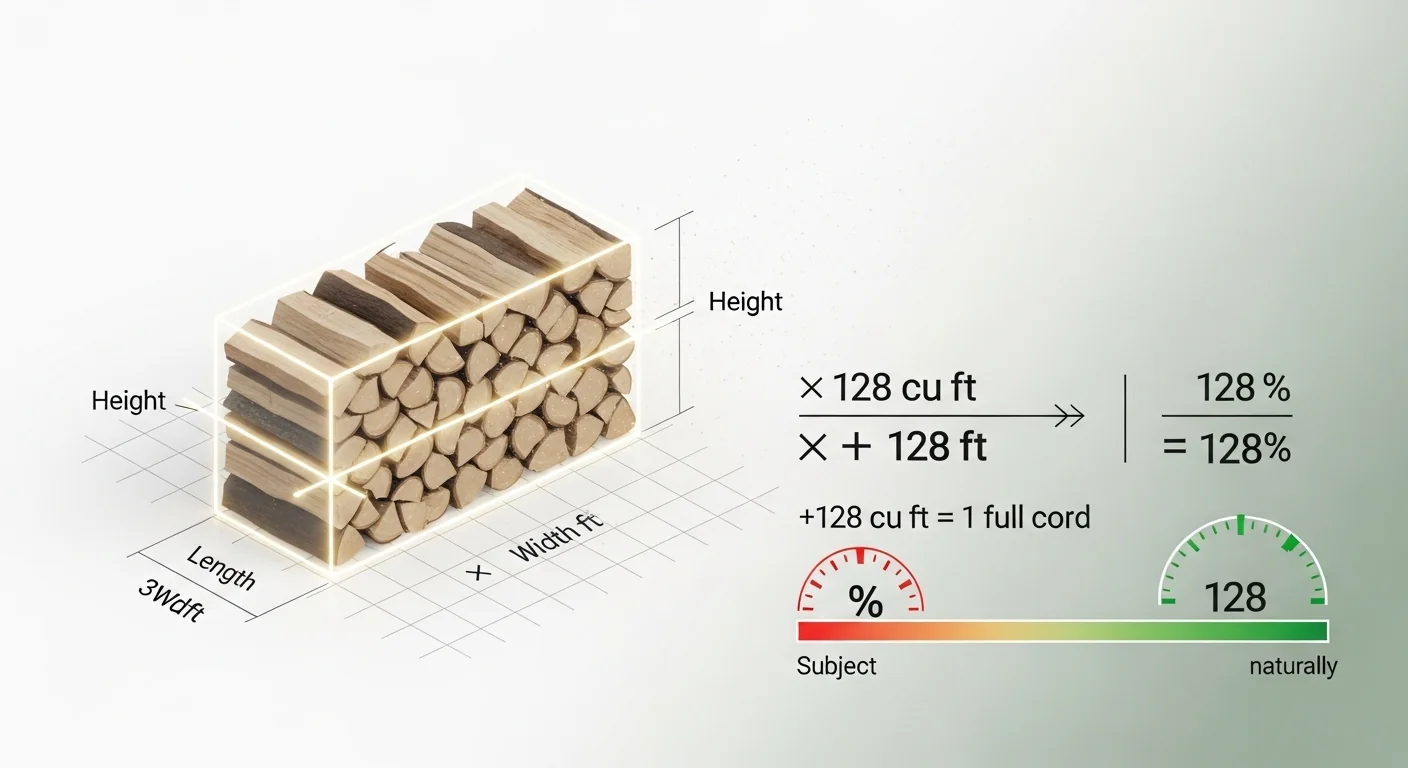
Firewood cord calculator logic showing length width height multiplication divided by 128 cubic feet
The core math converts your measured stack dimensions directly into the legal cord equivalent, making shortfalls immediately visible.
Show the calculation steps

Step-by-Step Formula

  • ACCURATE FIREWOOD MEASURING TOOL – Engineered for precision, the Mingo Marker eliminates measuring errors and delivers c…
  • COMPLETE FIREWOOD MARKING KIT – The ultimate chainsaw firewood measuring tool includes your mainframe unit plus 16″ mark…
  • ESSENTIAL LOGGING TOOLS AND EQUIPMENT – Built for serious woodsmen, the Mingo is the firewood cutting accessory that bel…

Step 1: Gross cubic feet
Cubic Feet = Stack Length (ft) x Stack Width (ft) x Stack Height (ft)
Example: 8 ft x 4 ft x 4 ft = 128.0 cu ft

Step 2: Full cords
Full Cords = Cubic Feet / 128
The value 128 is the legally defined volume of one full cord in the United States (4 ft x 4 ft x 8 ft). Division is straightforward; results are rounded to two decimal places.
Example: 128.0 / 128 = 1.00 cord

Step 3: Face cords
Face Cords = Cubic Feet / 42.6
A face cord (also called a rick) is one row of wood 4 feet high and 8 feet long, stacked one log deep at a 16-inch (approximately 1.33 ft) cut length: 4 x 8 x 1.33 = 42.56, rounded to 42.6 cu ft. Results are rounded to two decimal places.
Example: 128.0 / 42.6 = 3.00 face cords

Step 4: BTU estimate
Total BTU = Full Cords x BTU per cord for selected species
Each species has a published average BTU value per full cord, based on air-dried hardwood or softwood data. The result is displayed in millions of BTU for readability.
Example (Oak): 1.00 x 23,600,000 = 23,600,000 BTU = 23.6 million BTU

Assumptions and Limits

  • SOLVE ALL YOUR DIMENSIONAL MATH: Quickly and accurately with the award-winning CM Pro-Desktop construction calculator’s …
  • EFFORTLESS CONVERSION BETWEEN BUILDING FORMATS: Work in and convert between all common building dimension formats: feet-…
  • TIME-SAVING BUILT-IN FUNCTIONS: Right angles give you instant solutions for square-ups, rafters (hip, valley, jacks), ra…
  • Gross stack volume is always larger than actual wood volume. Air gaps between logs typically account for 15 to 20 percent of a stacked pile. This tool measures gross volume; the usable wood volume is somewhat less.
  • BTU values assume properly seasoned wood at approximately 20 percent moisture content. Green (freshly cut) wood can contain 45 to 50 percent moisture, reducing effective heat output substantially.
  • Log shape variation affects packing. Round logs with bark leave larger gaps than split, angular pieces. A pile of unsplit rounds may have significantly more air space than a tightly stacked pile of split wood at the same dimensions.
  • Face cord volume (42.6 cu ft) assumes exactly 16-inch cut lengths. Logs cut to 18 inches, 20 inches, or 24 inches produce a proportionally larger face cord volume and a different full-cord equivalent ratio.
  • The 128-cubic-foot cord standard is federal and applies in most U.S. states, but some states define the cord differently or regulate terms like “face cord” and “rick” separately. Local weights-and-measures regulations take precedence.
  • This calculator does not account for settling. A freshly stacked pile that dries and settles over weeks may lose measurable height. A stack measured immediately after delivery may read slightly larger than its settled volume.
  • All inputs are assumed to represent a single, roughly rectangular stack. Irregularly shaped piles or multiple separate stacks should be measured and calculated individually, then summed.

Standards, Safety Checks, and “Secret Sauce” Warnings

  • Comprehensive Care Instructions: Each card provides essential guidelines for crafting and using wax fire starters, ensur…
  • Safety Information: Each card includes important safety information, such as warning labels and heat safety tips, ensuri…
  • DIY Friendly: Designed for DIY enthusiasts, these cards provide information for anyone wanting to create their own wax f…

Critical Warnings

  • Size: 10 * 40 Cm/4×16 Inch, Made From High-Quality Tin Plate/Iron Metal
  • Easy To Install: Four Corners Are Pre-Drilled, You Can Not Only Hang, But Also Stick To The Wall. The Edges Of Each Tin …
  • Applicable Venue: Perfectly Smooth With High Resolution And Quality Graphics,Very Suitable For Indoor Or Outdoor, Garage…
  • A “cord” is a legal unit. In the U.S., the National Institute of Standards and Technology (NIST) Handbook 130 defines a cord as 128 cubic feet of stacked wood. Selling wood described as a “cord” when the actual measured volume is less is a violation of weights-and-measures law in most states. Measure before you stack, not after.
  • Face cord confusion is the leading cause of firewood overpayment. A face cord is approximately one-third of a full cord. If a supplier quotes a price “per cord” but delivers a face cord, you receive about one-third the wood you paid for. The terms “rick,” “rank,” “face cord,” and “fireplace cord” are not standardized and should always be converted to cubic feet before comparing prices.
  • BTU estimates degrade sharply with wet wood. The heat values in this tool assume seasoned firewood. Burning green wood does not just produce less heat; it also increases creosote buildup in flue systems, creating a fire hazard. A firewood thermometer or moisture meter is the only reliable way to confirm seasoning.
  • Stack height measurement errors compound fast. Because height is one of three multiplied dimensions, a one-foot undercount in a standard 8 x 4 stack removes 32 cubic feet, which is a quarter of a cord. Always measure, never estimate by eye.

Minimum Standards

  • A full cord must equal at least 128 cubic feet of stacked wood, verified by measuring length, width, and height in feet and multiplying.
  • Firewood sold by the “cord” must be accompanied by a receipt showing the quantity and unit of measure in most U.S. states. Request this documentation from any supplier before payment.
  • Seasoned firewood suitable for burning should test at or below 20 percent moisture content. Above that threshold, heat output drops and combustion byproducts increase.
Competitor Trap: Most firewood volume guides online simply show you the formula (L x W x H / 128) and move on. What they skip is the step that actually protects you: the comparison against the legal standard before you finish stacking. By the time a pile is fully stacked, you have lost leverage with your supplier. Calculate your cord count from the delivery measurements or from the truck bed dimensions before the wood leaves the vehicle. If you heat a barn or outbuilding in addition to your home, the barn ventilation calculator can help you size the airflow needs that directly affect how much wood you burn per heating season. Winter resource planning, whether it involves firewood, hay, or feed, benefits from working the numbers before the season starts rather than during it; the winter cattle feed calculator uses the same “calculate now, adjust early” logic for livestock operations.

Common Mistakes and Fixes

Mistake: Entering Log Length in Inches Instead of Feet

  • Handy Adjustable Firewood Measuring Tool: this firewood measuring tool can be adjusted for versatile use; It extends fro…
  • Sturdy Magnetic Attachment System: its built-in magnet provides secure attachment to your chainsaw bar; This magnetic lo…
  • Durable and Highly Visible Design: made from strong steel with a bright orange finish; This firewood marking tool is bui…

This is the single most frequent input error. A 16-inch log length entered as “16” in the width field instead of “1.33” inflates the cubic footage by a factor of twelve and produces a completely wrong cord count. The calculator expects all three dimensions in feet. Always divide inch measurements by 12 before entering.

Fix: Mentally confirm that your width entry is less than your stack height and stack length, since log depth is almost always the smallest dimension in a standard firewood stack.

Mistake: Measuring a Face Cord and Assuming It Equals a Full Cord

  • Sleek Cubic 3-way Design: Unlike traditional extension cord, the smart-looking white extension cord 6 feet features 3 gr…
  • Patented Right Angled Flat Wall Plug: The 0.33” low-profile plug fits easily in tight spaces and keeps furniture close t…
  • Well-made Flat Power Strip: ETL listed, made of top-grade UL94 V-0 flame-retardant PC & ABS materials and crafted with S…

A face cord stacked to 4 feet high, 8 feet long, and one log deep with 16-inch cuts contains roughly 42.6 cubic feet, which is about one-third of a full cord. Many buyers see a substantial-looking pile and assume it is a cord. The physical impression of volume is misleading, particularly when logs are large in diameter.

Fix: Always convert any purchase to cubic feet first. Multiply the three dimensions and divide by 128. The face cord output in this tool also shows directly how many face cords you have, which makes the comparison clear. Measuring bulk commodities by their stacked dimensions is a skill that transfers across other farm inputs; the same logic behind getting an accurate count applies whether you are measuring wood or assessing hay bale weight for a bulk order.

Mistake: Measuring the Stack Space Instead of the Stack

  • Strong Magnetic Base: The powerful magnet gives the chainsaw wood measuring tool excellent stability, allowing it to att…
  • Convenient: When not in use, hang the included hook on your belt to magnetically secure the firewood marking tool. Easy …
  • Increase efficiency: The standard measurement length for marking firewood is 16 inches. It also comes with a 6-inch exte…

Some buyers measure the area where the wood is stacked (the allocated space or the rack dimensions) rather than the actual wood pile dimensions. A rack built for a cord does not guarantee the rack is full. Gaps at the ends, uneven top layers, and partially filled sections all reduce the real volume below the rack’s designed capacity.

Fix: Measure the actual wood from its lowest point to its consistent height and from its interior end to the other interior end. Do not use the rack or storage frame dimensions as a proxy.

Mistake: Using Green-Wood BTU Values for Heating Season Planning

  • CSA CERTIFIED SAFETY YOU CAN TRUST — This gas valve kit is ANSI Z21.5 CSA Certified, meeting strict North American safet…
  • HIGH-CAPACITY 300,000 BTU SOLID BRASS BALL VALVE — Rated at 300,000 BTU with 3/4″ NPT fittings and 1/2 PSIG max pressure…
  • COMPLETE KIT — EVERYTHING INCLUDED — Kit includes a solid brass straight ball valve, flat black floor plate with 3″ univ…

Planning a heating season around the BTU figures from this tool assumes the wood is seasoned and dry. Buying green wood in spring with the intention of burning it in fall often results in wood that is still above optimal moisture content by November, particularly in humid climates. The heat output is lower and creosote accumulation is higher.

Fix: Treat the BTU values as a ceiling, not a guarantee. If you are burning wood that was cut within the last six months, reduce your effective BTU estimate accordingly. A moisture meter reading above 20 percent is a direct indicator that the real heat output will be lower than the calculator result.

Mistake: Averaging Measurements Across an Uneven Stack

  • Strong Magnetic Base: The powerful magnet gives the chainsaw wood measuring tool excellent stability, allowing it to att…
  • Convenient: When not in use, hang the included hook on your belt to magnetically secure the firewood marking tool. Easy …
  • Increase efficiency: The standard measurement length for marking firewood is 16 inches. It also comes with a 6-inch exte…

A pile that is 5 feet high in the middle and 3 feet high at the ends is not a 4-foot-high stack. Using the peak height rather than a representative consistent height overstates the volume, sometimes by a significant margin in loosely stacked or wind-shifted piles.

Fix: Measure height at three or four points along the length of the stack and use the lowest consistent measurement. This approach ensures the cord count is not overstated and reflects what you can actually expect from the pile.

Next Steps in Your Workflow

Bestseller #1
  • 【Heavy-Duty & Durable Construction】Built to last, this camping stove features a robust carbon steel frame and reinforced…
  • 【Versatile 3-in-1 Cooking Surface】Designed for all your camping cookware, this wood stove features a convertible dual-ri…
  • 【Efficient Ash Removal System】Enjoy a cleaner campsite with our innovative pull-out ash drawer. Unlike traditional campi…
Bestseller #2
  • ✔ 【PERFECT DESIGN】–We have been carefully designed to expertly split natural premium pine fire sticks wood into 3.5-inc…
  • ✔ 【KILN DRIED WOOD】–Our premium product is kiln-dried small pine firewood, which has a moisture content of less than 6%…
  • ✔ 【SMOKE REDUCTION】–Our kiln-dried kindling fire logs has the lowest sap and resin content compared to traditional fat …
Bestseller #3
  • Made from 100% kiln-dried hardwood sawdust with an ultra-low moisture content.
  • No additives, binders, or toxins — pure compressed sawdust.
  • Eco-friendly & carbon neutral positioning.

Once you have confirmed your cord count and heat estimate, the practical next step is comparing that figure against your actual heating requirement for the season. A typical well-insulated home in a cold climate uses one to three cords of hardwood per winter season for primary wood heat; a drafty older structure or large outbuilding can use considerably more. Your cord count from this tool gives you a concrete supply number to work with. From there, the question becomes cost per cord versus available alternatives. The hay cost calculator uses the same unit-cost logic for another bulk commodity that many homesteads manage alongside wood, and the approach to cost-per-unit comparison translates directly.

If you manage livestock in addition to heating your home, wood and feed purchasing often compete for the same fall budget window. Running the numbers on both before committing to suppliers gives you a clearer picture of total input costs. The feed cost calculator covers the livestock side of that planning and can be worked in parallel with your firewood procurement decisions. Order early, confirm volume in cubic feet before the wood leaves the truck, and keep your receipts with the cord measurement documented.

FAQ

What is the exact legal definition of a cord of firewood?

A full cord is defined as a stack of wood measuring 4 feet high, 4 feet wide (the log length or depth), and 8 feet long, yielding exactly 128 cubic feet of gross stacked volume. This definition is established by the National Institute of Standards and Technology (NIST) Handbook 130 and is adopted by most U.S. state weights-and-measures programs. Any sale of firewood described as a “cord” that does not meet this volume standard may be subject to regulatory action.

How many face cords make a full cord?

It takes approximately 3 face cords to equal 1 full cord, assuming all three use the same 16-inch log length and the same stacking height and length. The face cord formula (42.6 cubic feet) divides into 128 cubic feet approximately 3 times. If a face cord uses a different log length, such as 18 or 24 inches, the ratio changes and 3 face cords will no longer equal exactly 1 full cord.

Why do BTU values vary so much between wood species?

BTU output per cord is primarily driven by wood density. Dense hardwoods like oak and hickory pack more combustible material into the same cubic volume as lighter softwoods like pine or aspen. A cord of oak can contain nearly three times the heat energy of a cord of aspen. Moisture content at the time of burning is equally important; even high-density wood delivers dramatically less heat when it is not properly seasoned.

Does this calculator account for air gaps between logs?

No. This tool calculates gross stack volume from the three entered dimensions. The actual solid wood in any stack is always less than the gross volume because of the air space between logs. Published estimates suggest actual wood occupies roughly 80 to 85 percent of gross stacked volume, but this varies with log shape, split versus round, and stacking practice. The gross cubic footage is the standard used for legal cord measurement and for comparing supplier deliveries.

Is a “rick” the same as a face cord?

In common use, yes. A rick and a face cord both describe one layer of logs stacked to a given height and length, with the depth equal to one log length. The term “rick” is regional and informal, while “face cord” is more widely used in firewood commerce. Neither term is legally standardized at the federal level, which means a rick sold by one supplier may not be the same volume as a rick sold by another. Always convert to cubic feet for any comparison.

Can I use this calculator for a round, uneven, or tarped pile?

The calculator is designed for a roughly rectangular stacked pile. For irregular, round, or cone-shaped piles, the L x W x H formula will overstate the volume. In those cases, measure the largest consistent rectangular section of the pile and calculate that portion, then estimate the remainder separately. A covered or tarped pile should be measured underneath the tarp, not at the tarp’s outer dimensions.

Conclusion

The most consequential mistake remains confusing face cords with full cords, and the most consequential habit is making firewood quantity decisions by eye. Use the numbers. Measure your stack, confirm your cord count, and know exactly what you have before winter arrives.

Related articles

[tyg_related]
Umer Hayiat, founder of THE Yield Grid, standing in a greenhouse holding a small potted seedling.

Umer Hayiat

Gardening Expert

Hi, I’m Umer. I got tired of vague gardening advice, so I started building tools instead. I turn verified agricultural data into free calculators for your soil, spacing, and yields. Skip the guesswork and get the exact math.

Umer Hayiat

My personal favorites

TheYieldGrid is a participant in the Amazon Services LLC Associates Program, an affiliate advertising program designed to provide a means for sites to earn advertising fees by advertising and linking to Amazon.com. As an Amazon Associate, we earn from qualifying purchases.