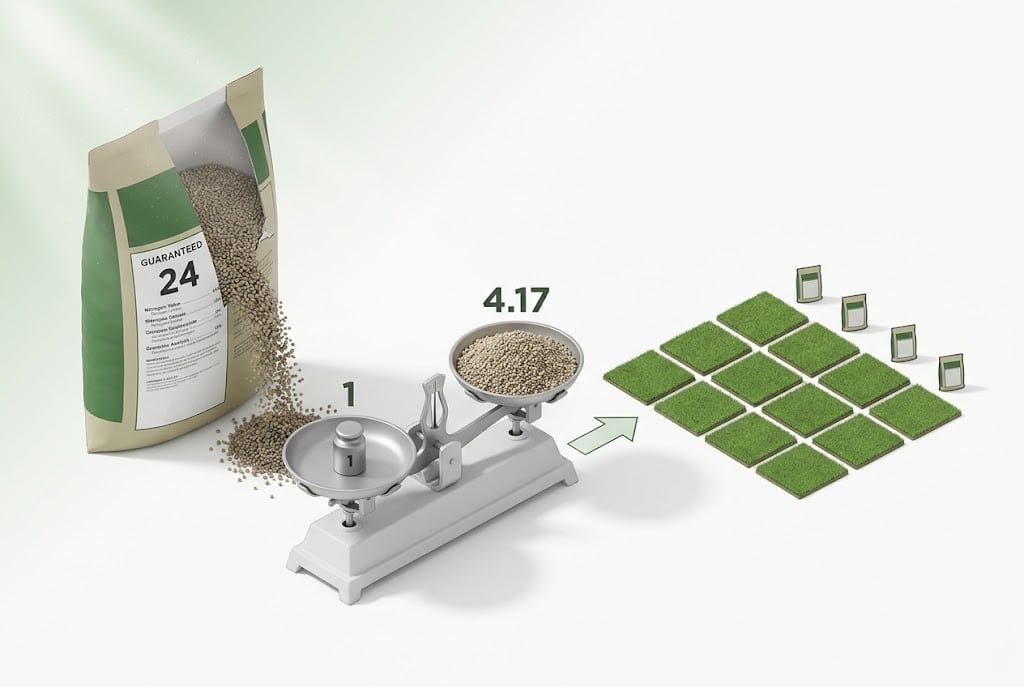
Fertilizer labels list three numbers that most homeowners treat as a brand name rather than a formula. That 24-0-6 on the bag is not decoration; it tells you exactly how diluted the nitrogen is inside the product. Every extra step between knowing your lawn’s size and buying the right number of bags runs through a single conversion called the N-Factor, and skipping it is the most common reason lawns either stay yellow or get burned.
This calculator takes your lawn size, the bag’s N-P-K ratio, the bag weight, your target nitrogen application rate, and an optional bag price, then returns the exact pounds of product required and the minimum number of whole bags to buy. It does not predict turf color, soil test outcomes, or fertilizer performance across different soil types. Those variables sit outside what a quantity calculator can determine from label data alone.
Bottom line: After running the numbers, you will know precisely how many bags to add to your cart and what this application will cost, before you leave for the store.
Use the Tool
Before opening the calculator, pull out the fertilizer bag you plan to use (or look it up online) and measure your lawn area in square feet. You will need the three-number N-P-K formula printed on the bag, the net bag weight in pounds, and your target nitrogen rate. The standard starting rate for most grasses is 1 pound of actual nitrogen per 1,000 square feet; adjust only if your soil test or extension recommendation specifies otherwise.
Lawn Fertilizer Calculator
Know exactly how many bags you need — no guesswork, no waste.
Fill in your lawn details above and click Calculate.
| Step | Formula | Value |
|---|
| Lawn Size | Lbs Product | Bags (40 lb) |
|---|
How This Calculator Works
N-Factor — How many pounds of product you need per pound of actual nitrogen. Calculated as: N-Factor = 1 ÷ (N% ÷ 100). Example: a 24-0-6 bag has 24% N, so N-Factor = 1 ÷ 0.24 = 4.17 lbs product per lb N.
Lbs of Product Needed — Multiply how many 1,000 sq ft units your lawn has by the N-Factor, then by your target rate. Lbs = (Lawn Size ÷ 1,000) × Target Rate × N-Factor.
Bags Required — Divide total lbs needed by the bag weight, then round up to the nearest whole bag. Bags = ⌈ Lbs Needed ÷ Bag Weight ⌉.
Total Cost (optional) — If a bag price is provided: Cost = Bags × Price per Bag.
Assumptions & Limits
- Nitrogen percentage (N) must be at least 1% — this calculator does not apply to zero-nitrogen products.
- The standard application rate of 1 lb actual N per 1,000 sq ft is suitable for most cool and warm-season grasses during active growth. Always verify local extension recommendations.
- Bag weight assumed to be the net product weight (not gross). Always check the label.
- This calculator assumes even spreader coverage. Irregular lawn shapes or missed passes will affect actual coverage.
- Slow-release vs. fast-release formulations may call for different rates — consult the bag label first.
- Results are for a single application. Annual nitrogen programs require multiple applications.
- Lawn size range: 100 – 500,000 sq ft. Target rate range: 0.25 – 4 lbs N per 1,000 sq ft.
If you are unsure how to interpret the three numbers on a fertilizer bag, the NPK Calculator breaks down what each macro-nutrient fraction means and how they interact in a blended product.
Quick Start (60 Seconds)
- Lawn Size (sq ft): Enter the total turf area you plan to fertilize, not the full lot. Subtract driveways, beds, and structures. For irregular shapes, break the area into rectangles and add the results.
- Bag Weight (lbs): Use the net weight printed on the bag label, which is the weight of the fertilizer itself. Do not confuse with shipping weight or pallet weight on bulk orders.
- N-P-K (Nitrogen field): Enter only the first number from the three-number ratio. For a 24-0-6 product, enter 24. This is the only value the formula requires; P and K fields are for reference tracking only.
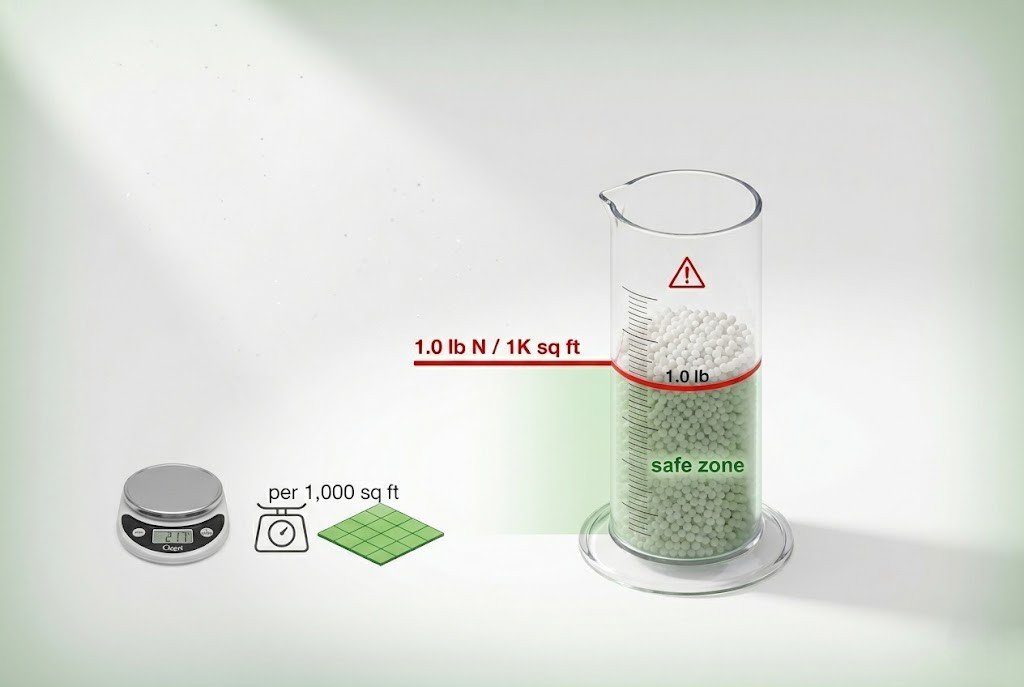
- Target Rate: Default is 1 lb of actual nitrogen per 1,000 square feet, which is the widely cited standard for a single application on most cool-season and warm-season grasses. Do not exceed 1.5 without a specific agronomic reason.
- Bag Cost (optional): Enter the price per bag to see your total application cost alongside the quantity result. Leave blank if cost is not relevant.
- Click Calculate: The tool runs only when all required fields are filled. Inline error messages appear next to any field that is empty, non-numeric, or out of range.
- Reset: Clears all inputs and results so you can run a quick comparison between two different fertilizer products.
Inputs and Outputs (What Each Field Means)
| Field | Unit | What It Means | Common Mistake | Safe Entry Guidance |
|---|---|---|---|---|
| Lawn Size | sq ft | Total turf area receiving fertilizer in this application | Including non-turf areas like garden beds, which inflates the quantity | 100 to 500,000 sq ft; most residential lawns fall between 1,000 and 20,000 |
| Bag Weight | lbs | Net weight of fertilizer product in one bag | Using gross or shipping weight instead of the net product weight on the label | 1 to 200 lbs; typical consumer bags run 20 to 50 lbs |
| N (Nitrogen %) | % (no symbol needed; enter the number only) | First number in the N-P-K ratio; represents the fraction of actual nitrogen by weight | Entering the full ratio string (e.g., “24”) instead of just the N value; this field is already correct for single-number entry | 1 to 99; most lawn fertilizers fall between 15 and 46 |
| P (Phosphorus %) | % | Second number in the N-P-K ratio; tracked for reference, not used in quantity calculation | Leaving blank when the value is 0, which is valid for many nitrogen-only products | 0 is acceptable; enter 0 for phosphorus-free formulas |
| K (Potassium %) | % | Third number in the N-P-K ratio; tracked for reference only | Confusing K (potassium oxide, K2O equivalent) with elemental potassium | 0 to 99; most lawn products with potassium range from 2 to 12 |
| Target Rate | lbs N per 1,000 sq ft | How much actual nitrogen you want to apply per 1,000 square feet of turf | Entering the product rate from the bag (lbs of product per 1,000 sq ft) instead of the nitrogen rate | 0.25 to 4; the default of 1 is the standard for most single-application programs |
| Bag Cost | $ per bag | Retail price of one bag; used to compute total application cost | Forgetting to update this when comparing sale versus regular-price products | Optional; leave blank to skip cost output |
| Lbs of Fertilizer Needed | lbs | Exact product weight required to hit your nitrogen target across the full area | Rounding this down and buying too few bags | Output only; used as the basis for bag count |
| Bags Needed | whole bags | Minimum number of bags to purchase; always rounded up to avoid coming up short mid-application | Assuming partial bags are always available at the store | Output only; always buy this many bags even if the last bag will not be fully used |
| N-Factor | lbs product per lb N | How many pounds of fertilizer product you must apply to deliver one pound of actual nitrogen | Not understanding this value; it is the core conversion that makes the calculation valid | Output only; lower N% means a higher N-Factor and more product required |
| Total Cost | $ | Estimated application cost based on bags purchased times bag price | Treating this as a precise cost without accounting for taxes, shipping, or delivery fees | Output only; appears when a bag cost is entered |
For a broader view of how fertilizer nutrient fractions interact across blended products, the NPK Fertilizer Calculator lets you compare nutrient delivery across multiple formulations side by side.
Worked Examples (Real Numbers)
Example 1: Small Suburban Lawn, Standard Rate
- Lawn size: 2,500 sq ft
- N-P-K: 24-0-6
- Bag weight: 40 lbs
- Target rate: 1 lb actual N per 1,000 sq ft
- Bag price: $48
Calculation:
- N-Factor = 1 / (24 / 100) = 4.17 lbs product per lb N
- Lbs needed = (2,500 / 1,000) x 1 x 4.17 = 10.42 lbs
- Bags = ceil(10.42 / 40) = 1 bag
- Cost = 1 x $48.00 = $48.00
Result: 10.42 lbs of product needed; 1 bag required; application cost $48.00.
One 40 lb bag is more than sufficient. You will have approximately 29.58 lbs remaining, enough to treat the same area twice more before restocking.
Example 2: Mid-Size Lawn, Common 28% Nitrogen Product
- Lawn size: 7,500 sq ft
- N-P-K: 28-0-4
- Bag weight: 50 lbs
- Target rate: 1 lb actual N per 1,000 sq ft
- Bag price: $55
Calculation:
- N-Factor = 1 / (28 / 100) = 3.57 lbs product per lb N
- Lbs needed = (7,500 / 1,000) x 1 x 3.57 = 26.79 lbs
- Bags = ceil(26.79 / 50) = 1 bag
- Cost = 1 x $55.00 = $55.00
Result: 26.79 lbs of product needed; 1 bag required; application cost $55.00.
The higher nitrogen concentration in a 28% product means you apply less product by weight for the same nitrogen delivery. A single 50 lb bag covers the full 7,500 sq ft with 23.21 lbs left over for future applications.
Example 3: Large Property at an Elevated Application Rate
- Lawn size: 15,000 sq ft
- N-P-K: 32-0-10
- Bag weight: 45 lbs
- Target rate: 1.5 lbs actual N per 1,000 sq ft
- Bag price: not entered
Calculation:
- N-Factor = 1 / (32 / 100) = 3.13 lbs product per lb N
- Lbs needed = (15,000 / 1,000) x 1.5 x 3.13 = 70.31 lbs
- Bags = ceil(70.31 / 45) = 2 bags
Result: 70.31 lbs of product needed; 2 bags required.
At 1.5 lbs N per 1,000 sq ft on a large property, the bag count jumps significantly relative to a standard 1 lb rate. The 19.69 lbs of product remaining after the second bag should be stored properly and used on the next scheduled application. Rates above 1.5 lbs N per 1,000 sq ft carry a meaningful burn risk and should be split across two visits.
Reference Table (Fast Lookup)
All values below assume a target rate of 1 lb actual nitrogen per 1,000 sq ft. Two common bag weights are shown to compare purchasing scenarios. The “Lbs Needed” column is the computed output; bag counts are always rounded up.
| Lawn Size (sq ft) | N% (First Number) | N-Factor (lbs product / lb N) | Lbs Needed | Bags (40 lb bag) | Bags (50 lb bag) |
|---|---|---|---|---|---|
| 1,000 | 15 | 6.67 | 6.67 | 1 | 1 |
| 1,000 | 24 | 4.17 | 4.17 | 1 | 1 |
| 2,500 | 15 | 6.67 | 16.67 | 1 | 1 |
| 2,500 | 24 | 4.17 | 10.42 | 1 | 1 |
| 5,000 | 15 | 6.67 | 33.33 | 1 | 1 |
| 5,000 | 24 | 4.17 | 20.83 | 1 | 1 |
| 5,000 | 32 | 3.13 | 15.63 | 1 | 1 |
| 10,000 | 15 | 6.67 | 66.67 | 2 | 2 |
| 10,000 | 24 | 4.17 | 41.67 | 2 | 1 |
| 10,000 | 32 | 3.13 | 31.25 | 1 | 1 |
| 15,000 | 24 | 4.17 | 62.50 | 2 | 2 |
| 20,000 | 24 | 4.17 | 83.33 | 3 | 2 |
Notice the 10,000 sq ft / 24% row: a 40 lb bag falls short (requires 2 bags) while a 50 lb bag is sufficient with a single purchase. Choosing the larger bag size at that lawn size produces a meaningful cost and trip difference.
How the Calculation Works (Formula + Assumptions)
Show the calculation steps
Step 1: Compute the N-Factor
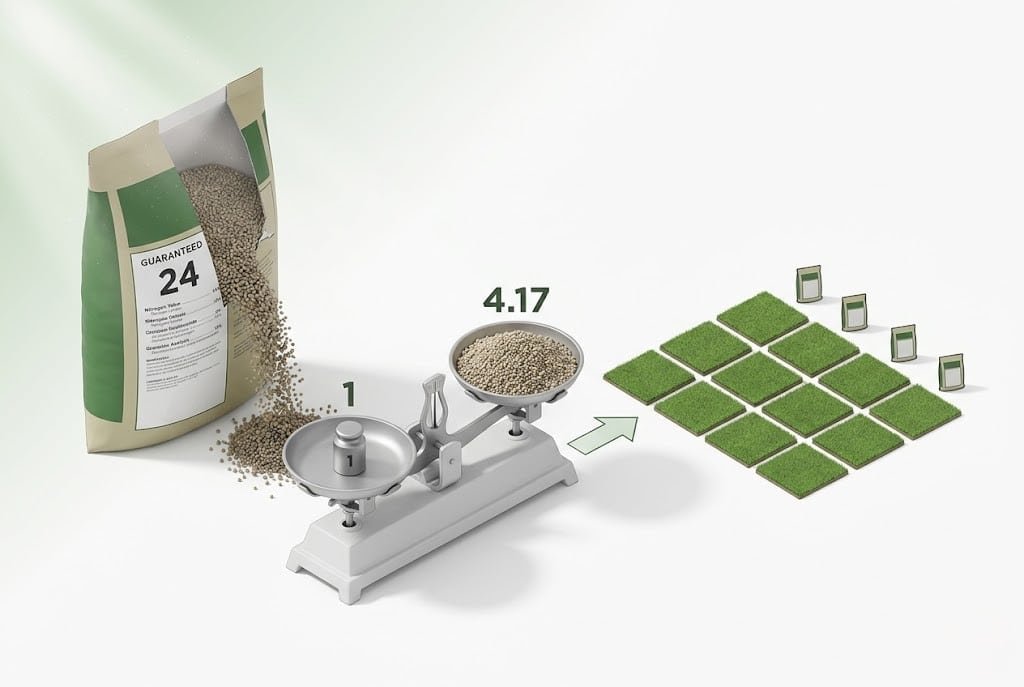
The N-Factor converts the N percentage on the label into a multiplier. It answers the question: how many pounds of product do you need to deliver one pound of actual nitrogen?
Formula: N-Factor = 1 / (N% / 100)
Example: A 24% nitrogen product gives N-Factor = 1 / 0.24 = 4.167. That means every 4.167 lbs of product contains 1 lb of actual nitrogen.
Step 2: Compute Pounds of Product Needed
Scale the N-Factor to your lawn area and target rate:
Lbs Needed = (Lawn Size / 1,000) x Target Rate x N-Factor
The division by 1,000 converts square feet to units of 1,000 sq ft, which is the standard expression for lawn application rates.
Step 3: Compute Bags Required
Divide pounds needed by the bag weight, then apply ceiling rounding (always round up, never down):
Bags = ceiling(Lbs Needed / Bag Weight)
Ceiling rounding is non-negotiable; buying the mathematically precise fractional bag is not possible at retail.
Step 4: Compute Total Cost (optional)
If a bag price is entered: Total Cost = Bags (rounded up) x Price Per Bag
Cost is based on bags purchased, not on exact product weight used, since you must buy whole bags.
Assumptions and Limits
- The N-Factor formula assumes the nitrogen percentage on the label is accurate and represents actual nitrogen, not nitrogen equivalent or slow-release fraction only. Always use the guaranteed analysis panel, not the marketing description.
- The standard rate of 1 lb actual N per 1,000 sq ft is a widely cited single-application guideline for actively growing turf. It does not account for soil test results, existing organic nitrogen in the soil, or seasonal accumulation from prior applications.
- Bag weight in this calculator is assumed to be net product weight. Some retail packaging shows a gross or shipping weight that includes the bag itself; use the label’s guaranteed net weight.
- This calculator assumes perfectly even spreader coverage. Missed passes, overlapping swaths, or irregular lawn shapes will produce uneven application and invalidate the computed outcome.
- Slow-release formulations may specify different application intervals and rates than quick-release products of the same N percentage. The formula is identical, but rate recommendations differ; consult the bag label for slow-release products.
- This tool calculates quantity for a single application. Multi-application annual programs require repeating this calculation for each event with the appropriate rate for that timing.
- The lawn size range accepted by this tool is 100 to 500,000 sq ft. Entries outside this range are flagged as invalid. Very large commercial properties may have site-specific application requirements beyond the scope of this tool.
Standards, Safety Checks, and “Secret Sauce” Warnings
Critical Warnings
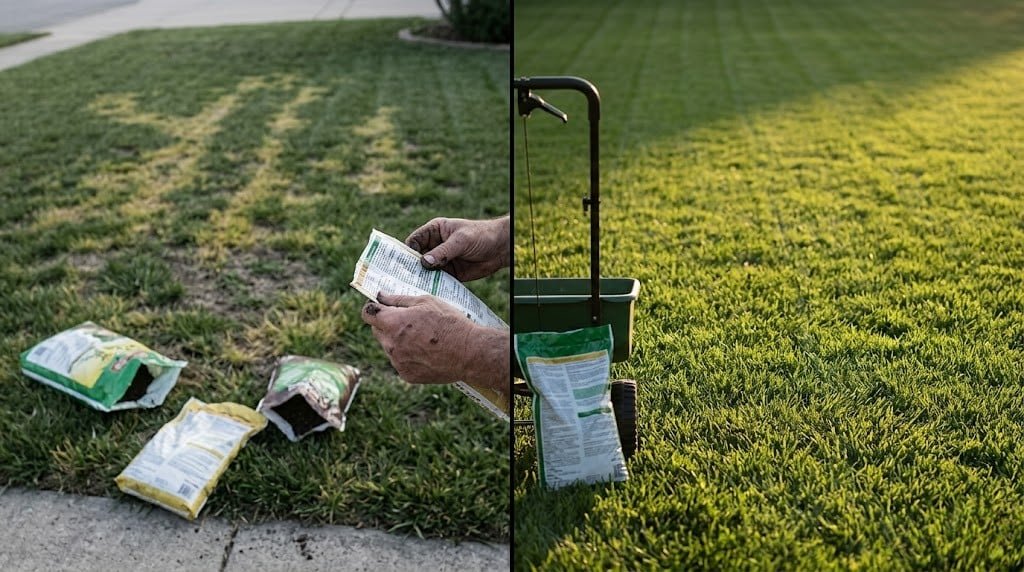
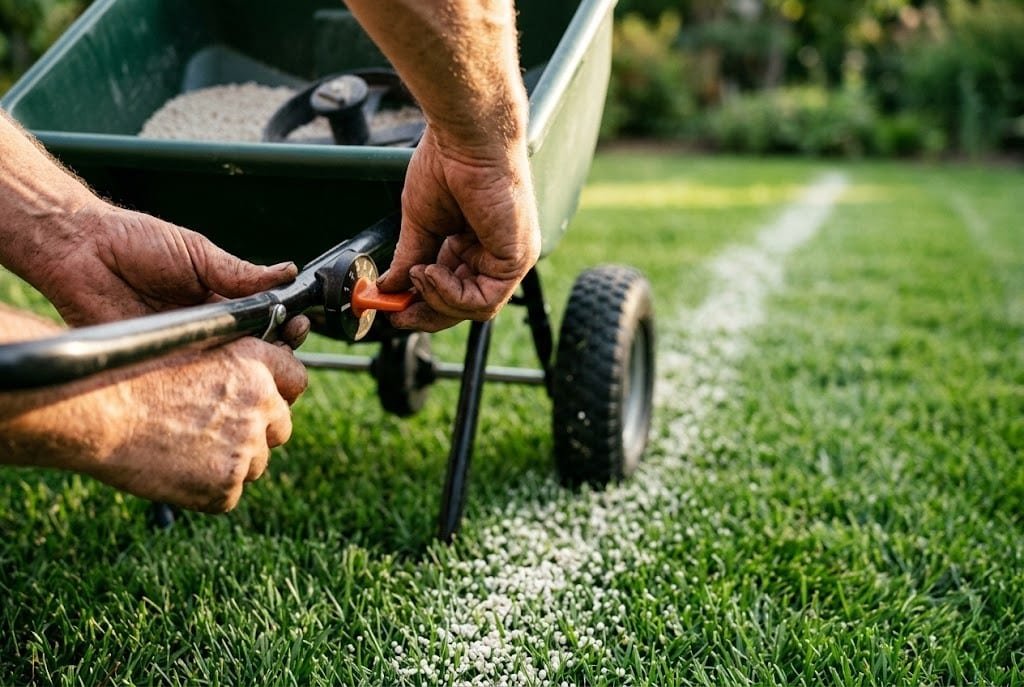
- Spreader setting: always start at the lowest recommended setting. The bag label provides a spreader setting range for major spreader brands. Begin at the lowest end and make a test pass on a small section before committing to the full lawn. Over-application is not recoverable the same season; fertilizer burn from excess nitrogen is a real and documented outcome at excessive rates.
- Application rates above 1.5 lbs actual nitrogen per 1,000 sq ft in a single event carry meaningful burn risk. Sandy soils, turf under heat stress, or recently seeded areas are especially vulnerable. If your situation requires a higher total seasonal rate, split the applications into multiple events spaced at least 2 to 4 weeks apart.
- Never apply fertilizer to wet turf or immediately before rain. Granular nitrogen on wet blades or in advance of heavy rain increases runoff and volatilization losses and reduces actual delivery to the root zone.
- Leftover product in a partially used bag must be sealed and stored dry. Moisture absorption will cause granules to clump and potentially become unusable, or will alter the spreader calibration needed for the next application.
Minimum Standards
- Always verify the spreader is calibrated before a full-lawn application. A miscalibrated spreader can under- or over-apply by a wide margin even when the bag count is correct. The Fertilizer Spreader Calibration Calculator provides a structured way to confirm output rate before you start.
- Use a soil test result from your county extension service or a private lab at least once every 2 to 3 years to determine whether your phosphorus and potassium levels actually require supplementation. Many residential lawns in the mid-Atlantic and Pacific Northwest have elevated phosphorus from decades of complete fertilizer use.
- For nitrogen rate guidance specific to your grass species, growth stage, and region, confirm against your state’s cooperative extension recommendations rather than relying solely on bag marketing copy.
Nitrogen Rate Context
For comparing nitrogen delivery across liquid and granular products, or for calculating how much nitrogen your current program delivers on an annual basis, the Nitrogen Calculator provides a complementary view of nitrogen totals across multiple application events.
Competitor Trap: Many fertilizer quantity guides online instruct readers to “just follow the bag directions” and apply the product rate listed on the label for a given square footage. That guidance skips the actual nitrogen delivery calculation entirely. The bag-recommended product rate is calibrated for a specific nitrogen outcome, but if you switch brands, bag sizes, or products mid-program, the product rate changes while the actual nitrogen target stays the same. Using this calculator with the N-Factor approach ensures your nitrogen delivery is consistent regardless of which product you buy.
Common Mistakes and Fixes
Mistake: Measuring the Full Lot Instead of the Turf Area
Property records and real estate listings report total lot size, which includes the house footprint, driveway, walkways, planting beds, and any hardscape. Fertilizing to the full lot size can mean buying 30% to 50% more bags than the turf actually needs. The overage costs money and leads to excess product in storage.
Fix: Use a measuring wheel, GPS measurement app, or satellite measurement tool to trace only the grass area, then enter that number into the Lawn Size field.
Mistake: Entering the Product Application Rate Instead of the Nitrogen Rate
Fertilizer bags often state the recommended product rate in lbs per 1,000 sq ft (for example, “apply 4 lbs per 1,000 sq ft”). This is the product rate, not the nitrogen rate. The Target Rate field in this calculator asks for lbs of actual nitrogen per 1,000 sq ft, which is a smaller number derived from the N-Factor formula. Entering the product rate as the nitrogen rate will produce a wildly inflated result.
Fix: Leave the Target Rate at the default of 1 lb N per 1,000 sq ft unless a soil test, turfgrass specialist, or extension publication specifically recommends a different nitrogen rate for your situation.
Mistake: Confusing N% with the Full NPK Ratio
Some users read “24-0-6” and enter 24 into all three N-P-K fields, or enter 240 thinking the three digits form a single number. The N field accepts only the first number in the ratio, which is the nitrogen percentage by weight.
Fix: Enter each number from the N-P-K label separately into its own field: 24, then 0, then 6 for a 24-0-6 product.
Mistake: Buying the Exact Mathematically Required Amount Without Rounding Up
A calculation that returns 41.67 lbs of product does not mean one 40 lb bag is enough. Partial bags cannot be purchased at most retail stores, and running short mid-application means an uneven result where half the lawn received product and half did not.
Fix: Always buy the ceiling number of bags shown in the result. For 41.67 lbs needed from a 40 lb bag, purchase 2 bags. Store the remainder properly for the next application.
Mistake: Using the Same Spreader Setting Across Different Products
Granule size, density, and coating vary significantly between fertilizer brands and formulations. A spreader calibrated for one 24% nitrogen product will not deliver the same rate per pass when loaded with a different product of the same nominal N%. The physical flow characteristics differ at the spreader plate level.
Fix: Look up the spreader setting on the new bag for your specific spreader model. If the bag does not list your spreader brand, start at the lowest provided setting and run a catch test to verify output rate before beginning the full application.
Related Tools and Next Steps
Once you know your bag count, confirming your spreader delivers the right output rate per pass is the logical next step before applying. The Fertilizer Spreader Calibration Calculator walks through a catch-weight test to verify actual delivery against your target.
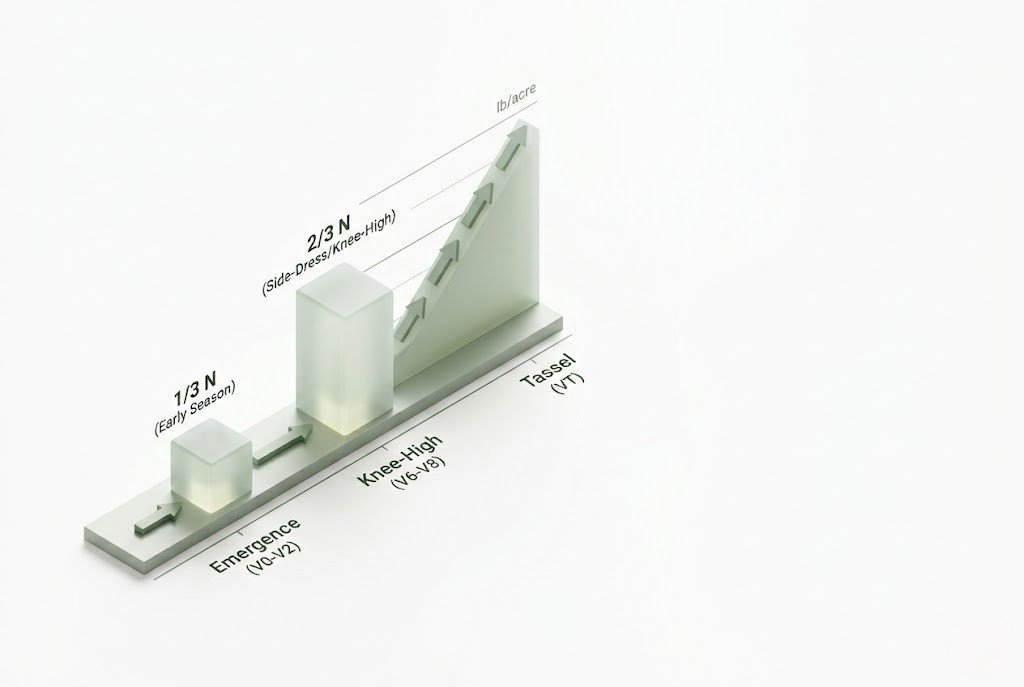
Nitrogen is the primary driver of turf response, but comparing nitrogen delivery across multiple products or seasonal plans requires a dedicated tool. The Nitrogen Calculator lets you sum nitrogen inputs across different products and applications throughout the season.
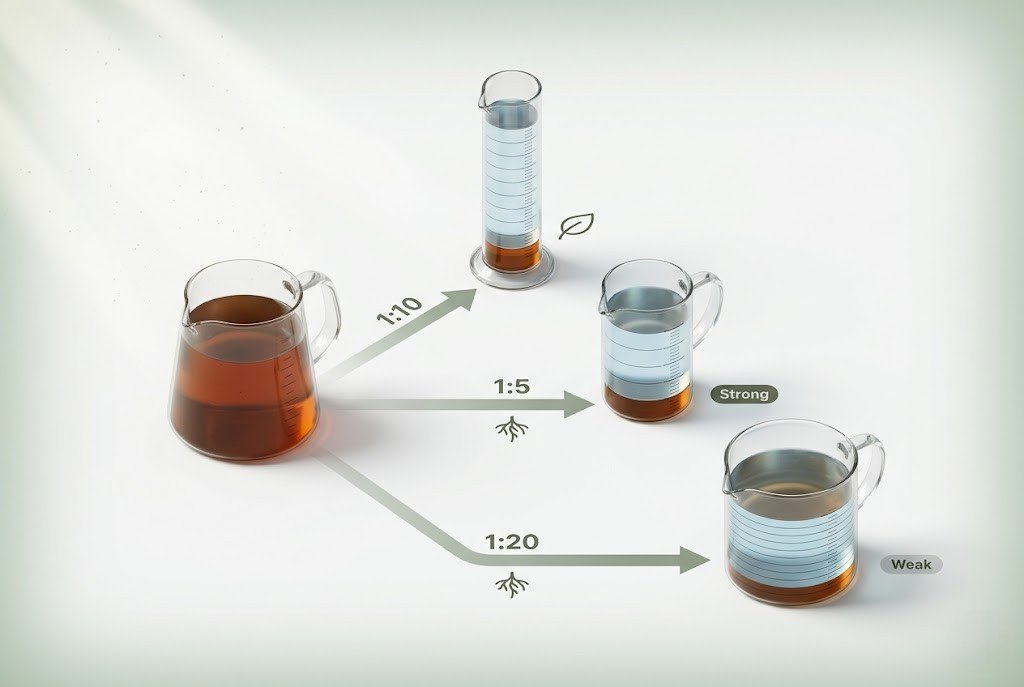
Granular fertilizer coverage is different from liquid. If you are considering a liquid fertilizer program or foliar feeding, the Fertilizer Dilution Calculator handles concentration and dilution math for liquid products.
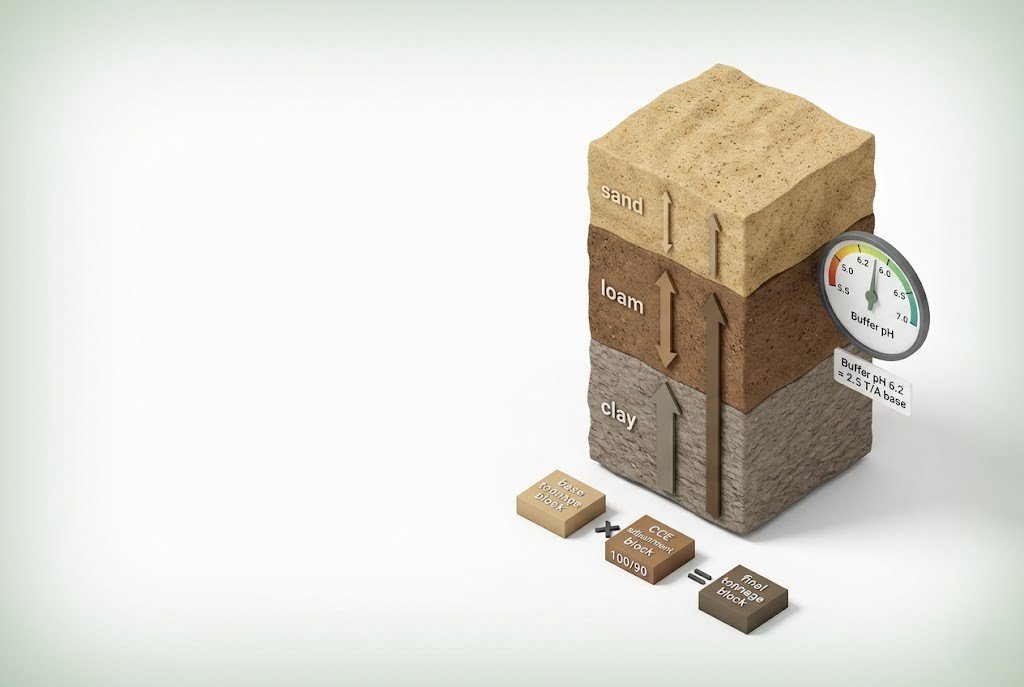
Soil pH affects how efficiently turf can access nitrogen and other nutrients. If your grass is not responding as expected even after correct fertilizer application, check whether pH is limiting nutrient uptake. The Soil pH Lime Calculator estimates how much agricultural lime is needed to raise pH to the target range.
Adding organic matter to the soil affects the long-term nitrogen cycle in your lawn. The Compost Calculator helps size a topdressing application if you are building organic matter alongside your fertilizer program.
NPK products vary widely in how they deliver each nutrient. The NPK Calculator breaks down the actual nutrient content per bag for any label ratio, useful for comparing multiple product options before purchasing.
If you are working with animal manures or organic nitrogen sources as part of a nutrient program, the Manure Nitrogen Availability Calculator estimates how much of the organic nitrogen fraction will become plant-available in the current season.
FAQ
What is the N-Factor and why does it matter for calculating fertilizer bags?
The N-Factor is the multiplier that converts your actual nitrogen target into an equivalent weight of fertilizer product. It equals 1 divided by the nitrogen percentage expressed as a decimal. A product with 24% nitrogen has an N-Factor of 4.17, meaning you need 4.17 lbs of product to deliver 1 lb of actual nitrogen. Without this conversion, bag counts are meaningless.
How do I find the N-P-K ratio on a fertilizer bag?
The N-P-K ratio is printed on the front of every fertilizer bag as three numbers separated by hyphens, such as 24-0-6. This appears in the guaranteed analysis panel on the label. The first number is nitrogen, the second is phosphate (P2O5 equivalent), and the third is potash (K2O equivalent). Enter only the first number into the N field of this calculator.
Is 1 lb of nitrogen per 1,000 sq ft always the right rate?
It is the standard single-application rate cited by most university extension programs for actively growing turf, but it is not universal. Warm-season grasses during peak summer growth may tolerate higher rates applied in split doses. Cool-season grasses in fall or spring programs sometimes use 0.5 lb rates. Soil test results and local extension recommendations should take priority over any generic number.
Can I use this calculator for liquid fertilizers?
The current calculator is designed for granular fertilizers where the input unit is bag weight in pounds. Liquid fertilizers are measured in gallons or fluid ounces, and concentration is typically expressed in oz per gallon rather than N-P-K label weight fractions. A different dilution calculation applies to liquid products.
What happens if I have leftover fertilizer from the last bag?
Store remaining product in the original sealed bag in a cool, dry location away from moisture and direct sunlight. Granule degradation and clumping reduce spreader accuracy on future applications. Most dry granular fertilizers remain usable for one to two seasons if stored properly. Discard any product that has absorbed significant moisture or solidified.
Why does the calculator always round up the bag count instead of rounding to the nearest whole number?
Rounding to the nearest whole bag would sometimes produce a result below the required product weight, meaning your lawn would receive less nitrogen than your target rate. Because bags cannot be split at purchase, the only safe rounding direction is up. The extra product in the partially used bag is stored and applied in the next scheduled feeding, which is the correct agronomic practice.
Conclusion
Fertilizer math is not complicated once you recognize that the bag label’s N-P-K numbers are a dilution ratio, not a dosage. The N-Factor converts that ratio into something actionable: how many pounds of product you must buy and apply to hit a specific nitrogen delivery target across a specific area. Running this calculation before purchasing eliminates both the under-buying that forces a mid-application store run and the over-buying that leaves expensive product sitting in a garage.
The single most consequential mistake in residential fertilization is using a spreader setting from a previous product without recalibrating for the new one. Buying the right number of bags solves the quantity problem; calibrating the spreader correctly solves the distribution problem. Both steps together are what the label math is actually designed to support. If you are scaling up to larger properties or working with variable application rates across zones, the Active Ingredient Per Acre Calculator extends the same logic to acre-scale application planning.

Lead Data Architect
Umer Hayiat
Founder & Lead Data Architect at TheYieldGrid. I bridge the gap between complex agronomic data and practical growing, transforming verified agricultural science into accessible, mathematically precise tools and guides for serious growers.
View all tools & guides by Umer Hayiat →