

Every popular list of bright indirect light plants skips the part that actually determines success: which bright indirect light you have. A south-facing window filtered by a sheer curtain, an east-facing windowsill that catches two hours of morning sun, and a bright north-facing room 8 feet from the glass all qualify as “bright indirect light” on a plant tag. But they are not the same condition, and a Calathea that thrives in one may crisp up in another.
This guide sorts plants by the light niche they actually match: early morning tolerance, high ambient intensity, or reflective supplemented light. Every plant below is assigned to one of three decision branches built around window direction, distance from glass, and the shadow test, a practical method for assessing light without a meter.
You will leave with a clear map: which plants belong where in your specific room, how far from which window, and what the non-negotiable watering shift is when light changes. No generic “place in bright indirect light” advice repeated twelve times.
Bottom line: Match the plant to your specific bright-indirect-light niche, not to the label on the tag.
The Yield Grid Decision Grid
Before browsing a plant list, identify which of these three branches describes your actual growing spot. All three fall under “bright indirect light,” but the plants that succeed in each are different. For a deeper explanation of what these categories mean and how to test them, see how to define indirect light in any room.
Branch 1: East-Facing or Filtered Morning Sun. The spot receives up to 2 hours of gentle direct morning sunlight (before 10 a.m.) and bright indirect light for the remaining daylight hours. Shadow test: sharp but softened shadow edges. Window distance: 0 to 3 feet from east-facing glass. Plants here must tolerate brief direct rays without scorching.
Recommended: Items 2, 5, and 6 below.
Branch 2: South/West, Set Back or Diffused. High ambient brightness all day but zero direct sun hits the leaves. Achieved by placing plants 3 to 6 feet back from south- or west-facing windows, or by using a sheer curtain. Shadow test: distinct, crisp shadow. This is the brightest niche and supports plants with the highest light appetites.
Recommended: Items 1, 3, 4, 7, and 8 below.
Branch 3: North-Facing or Supplemented Rooms. A north-facing room with large windows, or any room where natural brightness is adequate but marginal. Shadow test: soft shadow, barely defined. This niche often requires grow-light backup from October to March in northern latitudes. Plants here must tolerate or adapt to lower intensity without etiolating.
Recommended: Items 9 and 10 below.
Quick Comparison Table
| Option | Key mechanism | Best for | Decision Grid Branch | Effort Score (1-5) |
|---|---|---|---|---|
| 1. Monstera deliciosa | Large leaf surface area; high photosynthetic demand | Brightest indirect spot in the home | Branch 2 | 3 |
| 2. Phalaenopsis Orchid | Epiphytic; light triggers bloom spike initiation | East windowsill; gentle morning exposure | Branch 1 | 4 |
| 3. Calathea orbifolia | Thin leaf cuticle; high transpiration; no direct sun tolerance | Filtered south or bright east, no direct rays | Branch 2 | 4 |
| 4. Fiddle-Leaf Fig | High light threshold for internode spacing control | South-facing room, set back 4-6 ft | Branch 2 | 3 |
| 5. African Violet | Rosette form; light drives flowering cycle | East window, no afternoon sun | Branch 1 | 4 |
| 6. Hoya carnosa | CAM photosynthesis lite; tolerates light fluctuation | East or filtered west; blooms triggered by bright periods | Branch 2 | 3 |
| 7. Alocasia amazonica | Large thin leaves; high humidity-light coupling | Bright filtered south; needs consistent moisture | Branch 2 | 5 |
| 8. Rubber Plant (Ficus elastica) | Thick cuticle; moderate light tolerance range | South/west set back; tolerates some variation | Branch 2 | 2 |
| 9. Cast Iron Plant | Extremely low light compensation point | North room; deep interior; low-light backup | Branch 3 | 1 |
| 10. Peperomia obtusifolia | Succulent-like leaf water storage; low transpiration | North window or supplemented interior | Branch 3 | 2 |
1. Monstera deliciosa

Best for: Branch 2 (South/West, Set Back or Diffused)
Blueprint: What, For, Steps, Mistake.
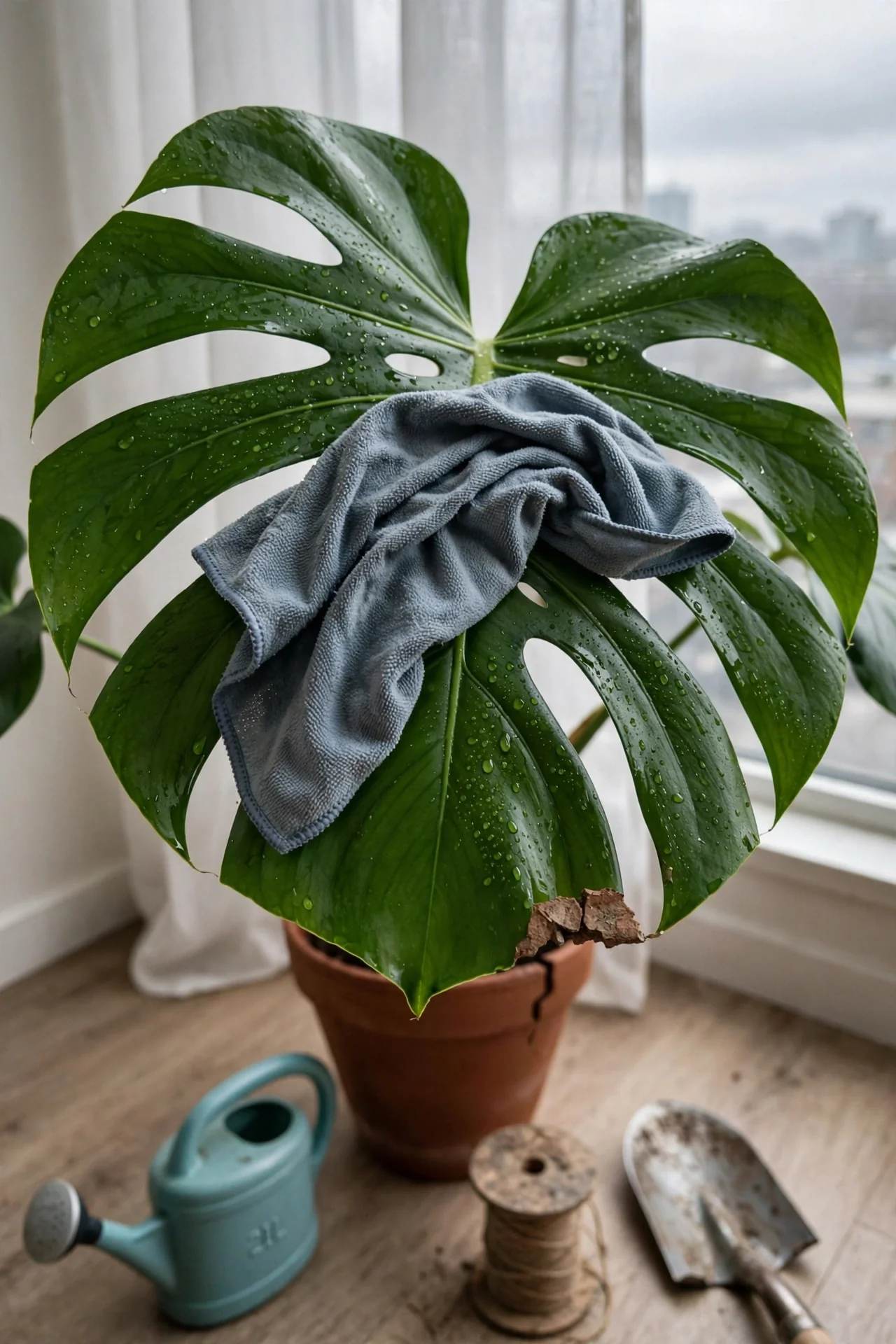
What: A large-leafed aroid that uses its broad surface area to capture high ambient light under a rainforest canopy. In the home, this translates to the brightest indirect spot you can offer without direct sun striking the leaves.
For: South- or west-facing rooms where the plant sits 3 to 6 feet from the glass, or behind a sheer curtain. East-facing windows are acceptable but will produce slower growth and smaller leaves.
Steps: (1) Position the plant where a handheld shadow test produces a crisp, distinct outline at midday. (2) Rotate the pot one-quarter turn every watering to prevent the stem from leaning toward the light source. (3) If the newest leaf is smaller than the previous one, the plant is receiving insufficient light: move it closer to the window by 1 to 2 feet.
Common mistake: Placing a Monstera directly against a south-facing window glass. Even in winter, midday rays through untinted glass can produce leaf burn on the thin sections between fenestrations. A sheer curtain or a 3-foot setback eliminates this risk. For a deeper breakdown of Monstera-specific light thresholds, see how Monstera light needs shift with window placement.
2. Phalaenopsis Orchid
Best for: Branch 1 (East-Facing or Filtered Morning Sun)
Use vs. Skip.
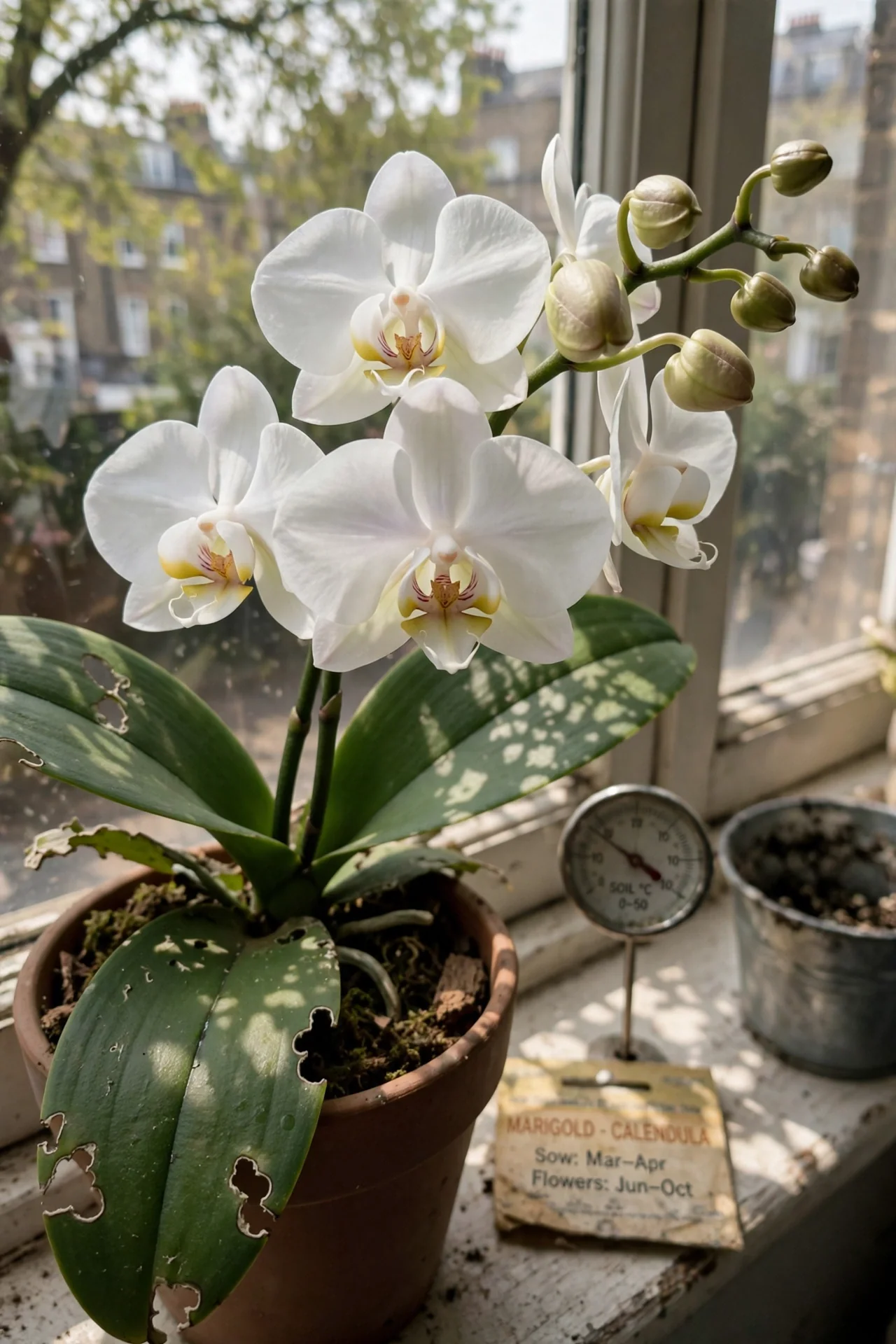
Use if: You have an east-facing windowsill where the plant receives up to 2 hours of gentle morning sun before 10 a.m., then bright indirect light the rest of the day. This light pattern is the primary trigger for annual bloom spike initiation. The leaves should feel warm to the touch but never hot.
Skip if: Your only available spot is a south- or west-facing windowsill without a sheer curtain. Direct afternoon rays will cause visible leaf scorch within a single exposure, producing a bleached, papery patch that does not recover. A sheer curtain or a 2-foot setback is the minimum fix.
3. Calathea orbifolia
Best for: Branch 2 (South/West, Set Back or Diffused)
Threshold rule: numbers that matter.
Calathea leaves have an extremely thin cuticle compared to most tropical houseplants, which means they lose water rapidly through transpiration and cannot tolerate direct sun on the leaf surface, even for 30 minutes. The usable light window is narrower than for most plants on this list.
Key numbers: Position the plant at a distance where it receives 200 to 400 foot-candles for at least 6 hours daily. Below 150 foot-candles, new leaves will emerge noticeably smaller and the characteristic silver banding will fade. Above 500 foot-candles without diffusion, leaf edges will begin to crisp. The adjustment signal: if leaf margins curl inward by midday, the plant is losing water faster than roots can supply it. Move it 1 foot farther from the light source or increase ambient humidity to 50 to 60 percent relative humidity per a hygrometer reading.
4. Fiddle-Leaf Fig (Ficus lyrata)
Best for: Branch 2 (South/West, Set Back or Diffused)
Blueprint: What, For, Steps, Mistake.
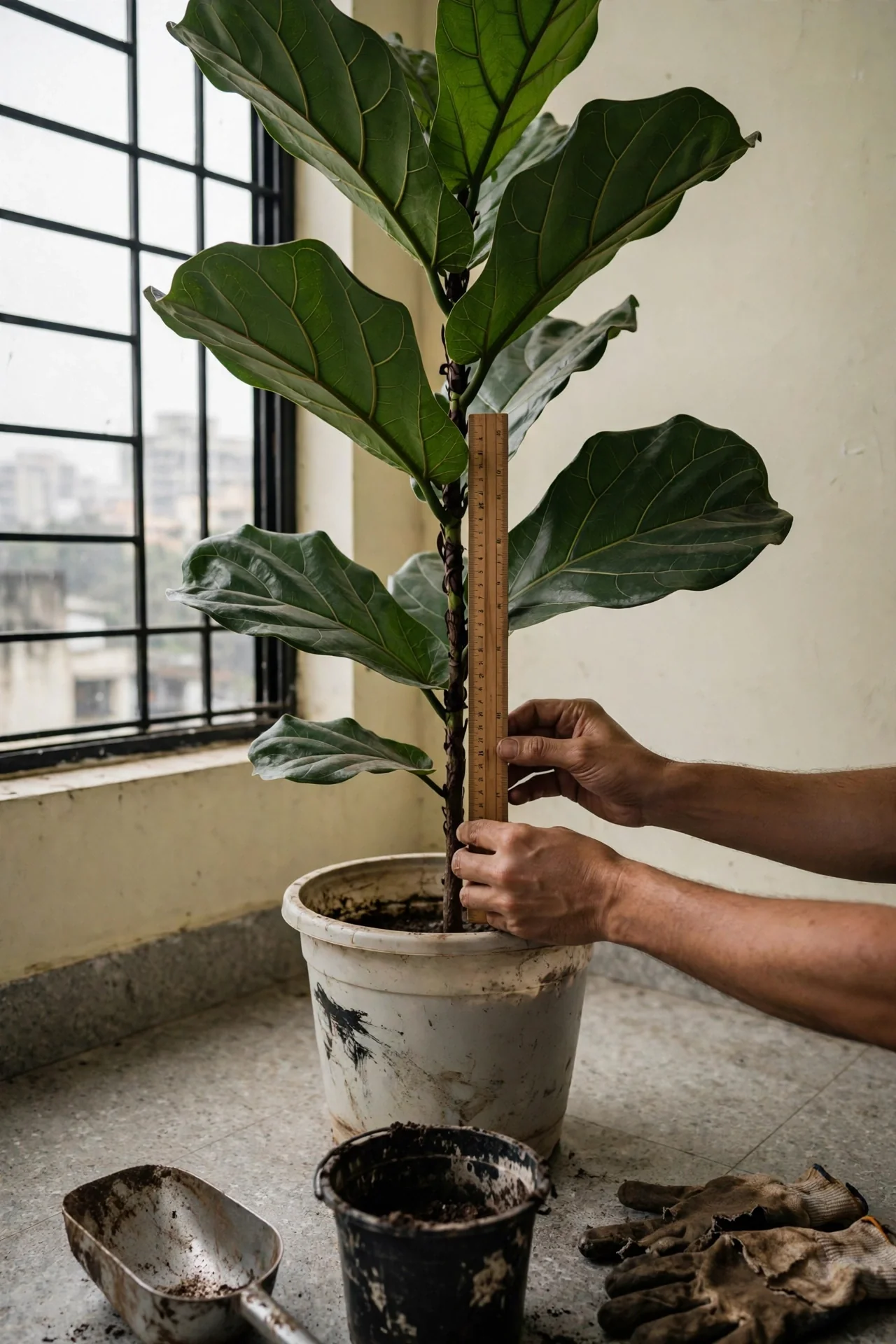
What: A high-light-demand tree that uses light intensity to regulate internode spacing, the distance between successive leaves along the stem. In adequate light, leaves emerge every 2 to 4 inches along the stem. In insufficient light, internodes stretch to 8 to 12 inches, producing a leggy, unstable structure.
For: A south-facing room where the plant sits 4 to 6 feet from the glass, or 3 to 4 feet from a west-facing window with a sheer curtain. Direct sun on the leaves for more than 1 hour will produce reddish-brown burn spots, particularly on young leaves.
Steps: (1) Place the plant in the brightest indirect spot in the room and leave it there; fiddle-leaf figs shed leaves when repositioned frequently. (2) Measure the distance between the newest two leaves. If it exceeds 6 inches, move the plant 1 foot closer to the light source and wait 4 weeks before measuring again. (3) Every 2 months, wipe both sides of each leaf with a damp cloth to remove dust, which can reduce light absorption by enough to simulate a drop in ambient brightness.
Common mistake: Compensating for low light by watering more. A fiddle-leaf fig in dim conditions uses water more slowly, not faster. Soggy soil in low light is the shortest path to root rot. For a detailed breakdown by window direction, see fiddle-leaf fig light requirements explained.
5. African Violet (Saintpaulia)
Best for: Branch 1 (East-Facing or Filtered Morning Sun)
Use vs. Skip.
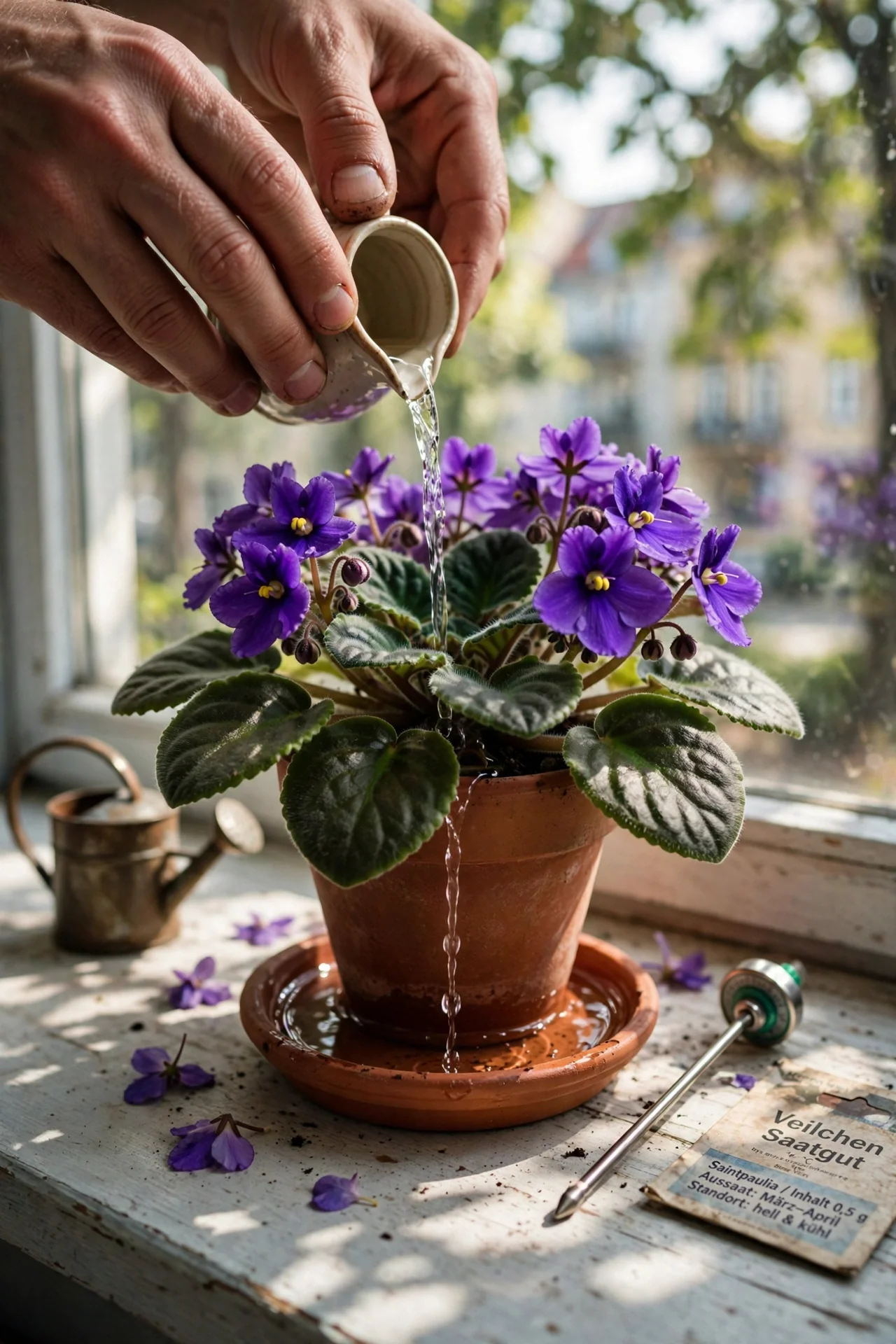
Use if: You want a flowering plant for an east-facing windowsill, the one spot where African violets bloom reliably without supplemental lighting. The rosette growth form means leaves self-shade the crown, so the plant needs bright ambient light from the side, not overhead. Water from below or use a self-watering planter designed for indoor use to avoid wetting the leaves, which causes spotting and crown rot.
Skip if: Your east window is shaded by a building, tree, or awning. Without at least 150 foot-candles for 8 hours daily, the plant will produce healthy leaves but no flowers. The difference between a blooming and a non-blooming African violet is often just 2 feet of distance from the glass.
6. Hoya carnosa (Wax Plant)
Best for: Branch 2 (South/West, Set Back or Diffused)
Threshold rule: numbers that matter.
Hoya carnosa uses a modified form of crassulacean acid metabolism (CAM) that makes it more forgiving of light fluctuation than most tropical foliage plants. It will survive in medium indirect light but requires bright periods to bloom.
Key numbers: For flowering, provide a minimum of 300 to 500 foot-candles for at least 4 hours daily, ideally in the morning or early afternoon. The peduncle, the short spur from which flowers emerge, will only form on stems receiving direct bright light exposure. Once formed, do not remove it; the same peduncle reblooms year after year. Watering cadence: allow the top 2 inches of soil to dry completely between waterings. In bright indirect light, this typically translates to watering every 10 to 14 days during the growing season.
7. Alocasia amazonica (Amazonian Elephant Ear)
Best for: Branch 2 (South/West, Set Back or Diffused)
10-Minute Workflow: Steps and Upgrade.
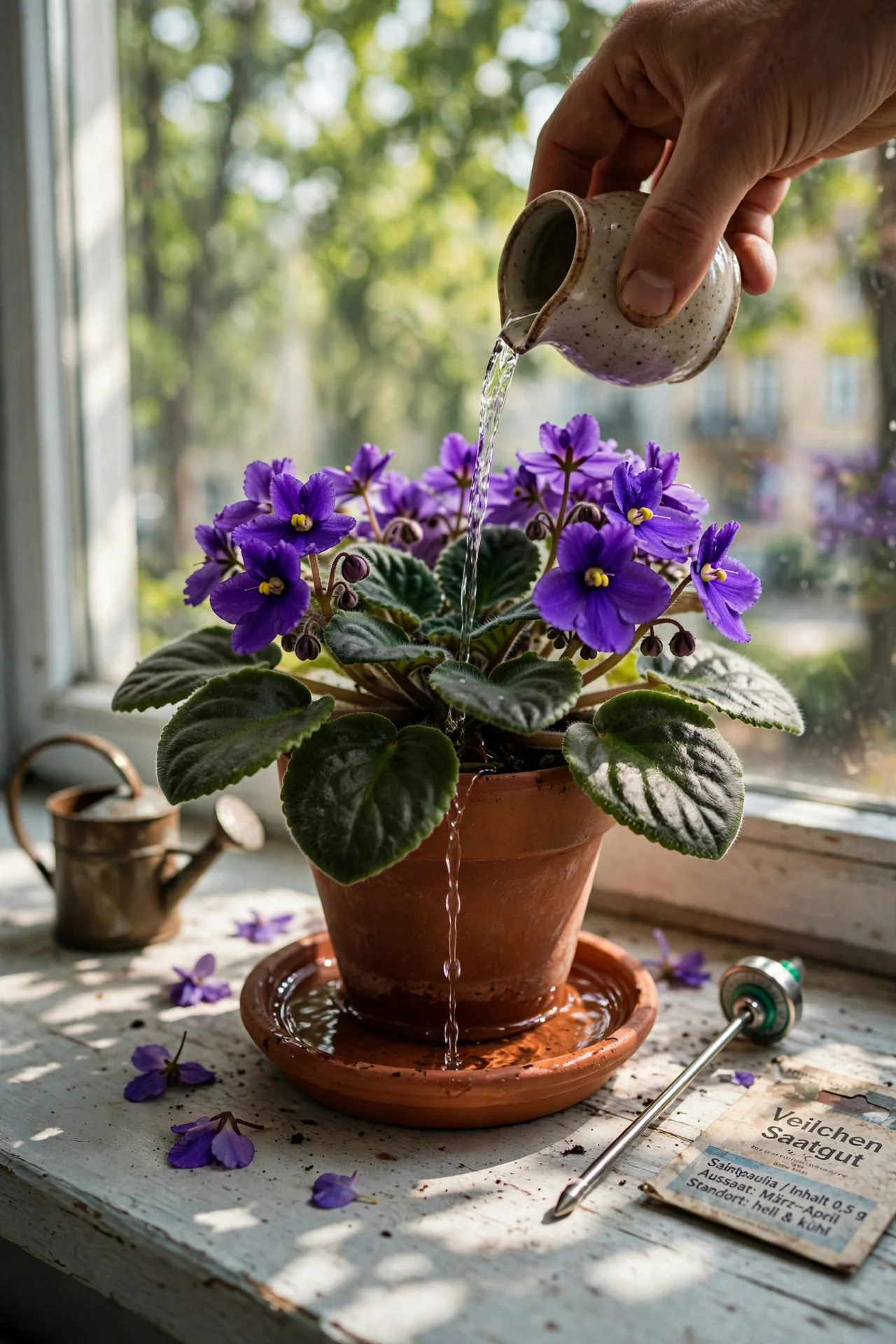
Steps: (1) Position the plant in a south-facing room, 3 to 5 feet from the window or behind a sheer curtain. (2) Check that the shadow test produces a distinct but slightly softened shadow at noon. (3) Water when the top 1 inch of soil feels dry; in bright indirect light, this is typically every 5 to 7 days during summer. (4) Mist the leaves every morning or place a humidity tray beneath the pot; Alocasia leaves lose turgor rapidly below 50 percent relative humidity. (5) Inspect the leaf undersides weekly for spider mites, which proliferate on stressed Alocasias in dry air.
Upgrade option: If your room cannot provide sufficient natural brightness, particularly from November through February, add a full-spectrum LED grow light positioned 12 to 18 inches above the plant, running 10 to 12 hours daily. See grow lights for houseplants: choosing and positioning for setup details.
8. Rubber Plant (Ficus elastica)
Best for: Branch 2 (South/West, Set Back or Diffused)
Use vs. Skip.
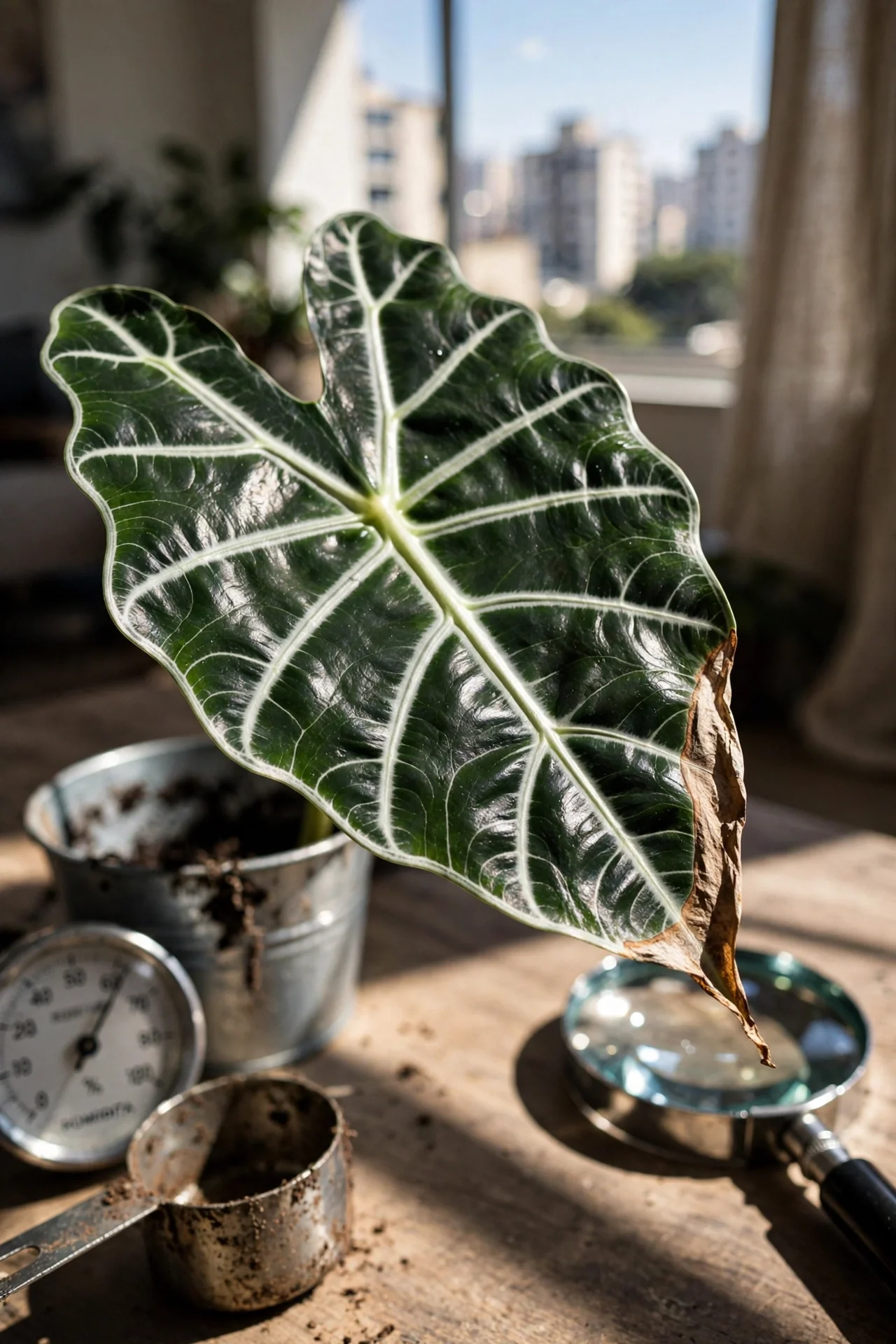
Use if: You want a tall, vertical foliage plant that tolerates a wider light range than most Ficus. Rubber plants with dark green leaves will maintain steady growth in 200 to 500 foot-candles. Variegated cultivars (Tineke, Ruby, Belize) need the higher end of that range, at least 350 foot-candles, to preserve their cream or pink leaf margins; in dimmer conditions, new leaves revert to solid green.
Skip if: Your space drops below 150 foot-candles for more than 3 months of the year. The plant will survive but will drop its lower leaves and produce increasingly smaller new growth, a slow decline that is often mistaken for a watering problem.
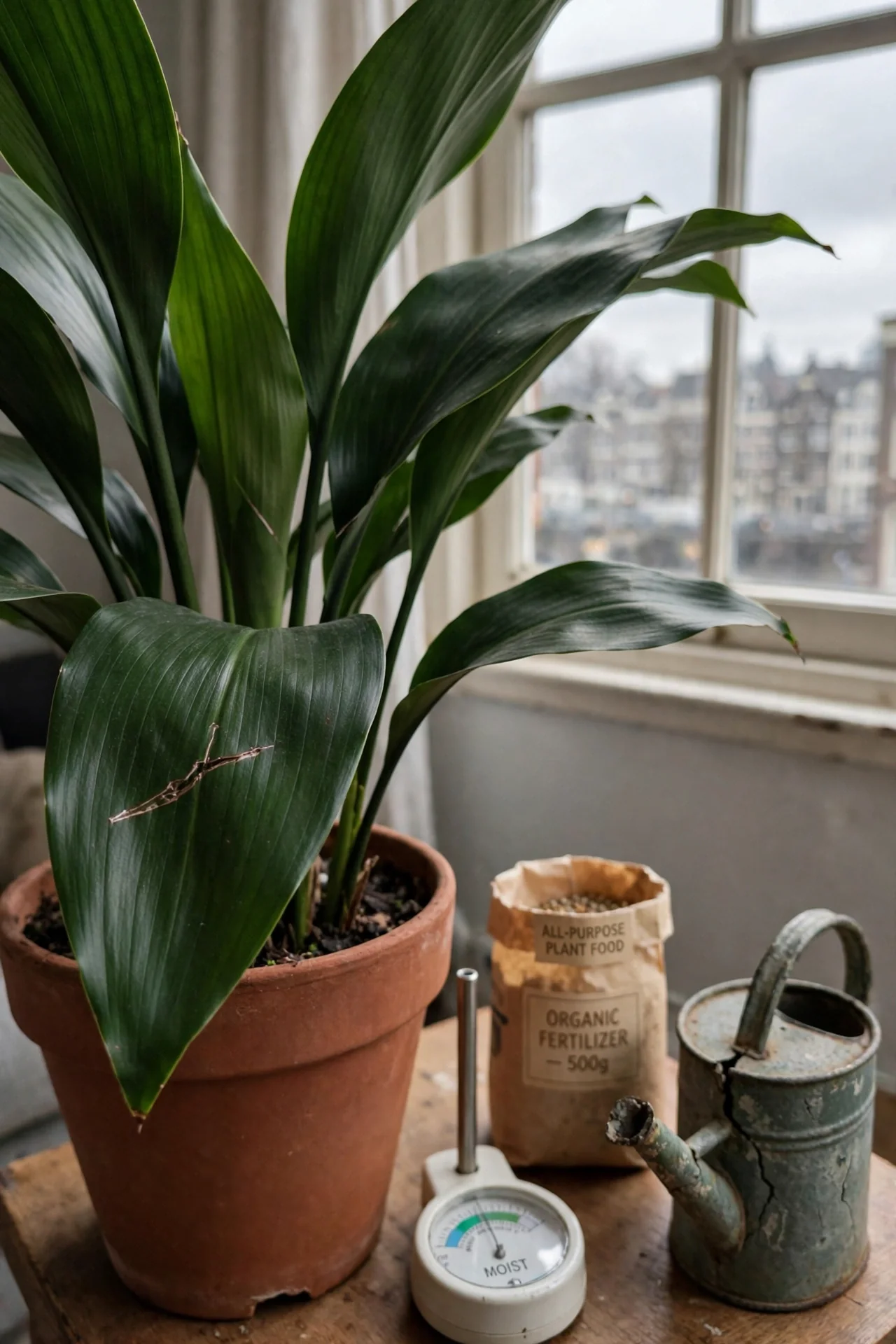
9. Cast Iron Plant (Aspidistra elatior)
Best for: Branch 3 (North-Facing or Supplemented Rooms)
Threshold rule: numbers that matter.
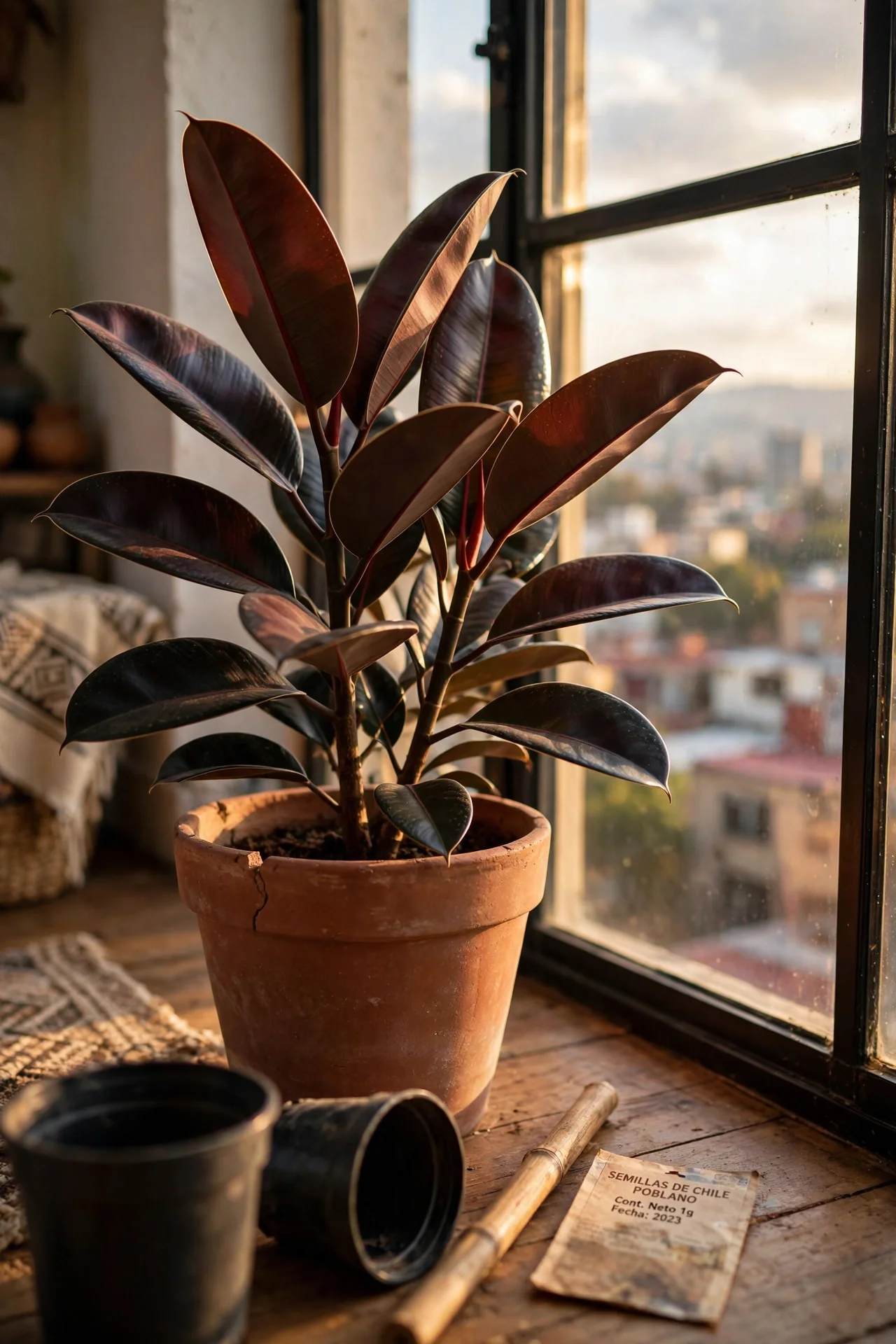
The cast iron plant has the lowest light compensation point on this list, the minimum light level at which photosynthesis balances respiration. It can sustain itself at 25 to 50 foot-candles, which is roughly the brightness of a room lit by a single north-facing window on an overcast day. This makes it one of the few plants that genuinely tolerates deep interior placement.
Key numbers: In north-facing rooms, position within 4 feet of the window glass. Beyond 6 feet, even a cast iron plant will gradually decline. Watering in Branch 3 conditions: because transpiration is low, allow the soil to dry completely through the top 3 inches before watering, which may mean watering only once every 3 to 4 weeks in winter. Variegated cultivars need more light than solid green types to maintain their striping. For other plants that tolerate genuinely low light, see best low-light houseplants that actually survive.
10. Peperomia obtusifolia (Baby Rubber Plant)
Best for: Branch 3 (North-Facing or Supplemented Rooms)
10-Minute Workflow: Steps and Upgrade.
Steps: (1) Place the plant on a north-facing windowsill or within 2 feet of the glass; Peperomia obtusifolia performs well at 100 to 250 foot-candles. (2) Check soil moisture before watering by inserting a finger to the second knuckle (roughly 2 inches). If any moisture is felt, wait. (3) In winter, when daylight hours shorten and indoor humidity drops, reduce watering frequency by roughly half relative to the summer schedule. (4) If stems begin to elongate and leaves space farther apart, the plant is etiolating; move it 1 foot closer to the window or add a small LED grow lamp.
Upgrade option: Use a moisture meter for plants to remove the guesswork from the watering check. Peperomia obtusifolia stores water in its thick leaves, and its roots are fine and shallow. Overwatering in Branch 3 conditions, where evaporation is slowest, is the leading cause of failure with this species.
Starter Stack (What to Choose First)
Branch 1 Starter: East Window Pair
Start with a Phalaenopsis Orchid (Item 2) on the windowsill and an African Violet (Item 5) on a small stand directly beside it. Together they use the same light niche, gentle morning sun followed by bright indirect afternoon, but occupy different vertical space and have different watering cadences. The orchid dries out between waterings on a 7-to-10-day cycle; the African violet prefers consistently moist but never wet soil. Estimated initial cost: $25 to $45 for both plants in 4-inch pots. Combined weekly care time: 10 to 15 minutes.
Branch 2 Starter: High-Impact Focal Point
Begin with a Monstera deliciosa (Item 1) as your floor plant and a Rubber Plant (Item 8) as a vertical accent. Both thrive in the same set-back south- or west-facing room position. The Monstera provides horizontal spread and fenestrated visual interest; the Rubber Plant adds height with minimal width. Together they use the room’s brightest indirect zone efficiently. Estimated initial cost: $35 to $70 for a 6-inch Monstera and a 4-foot rubber plant. Combined weekly care time: 15 to 20 minutes, mostly for leaf dusting and rotation.
Branch 3 Starter: Low-Light Confidence Builders
Start with a Cast Iron Plant (Item 9) and a Peperomia obtusifolia (Item 10). This pair is the most forgiving entry point on the list. Both tolerate the widest light range and the longest intervals between watering. Place the cast iron plant on the floor 3 to 4 feet from a north window; place the Peperomia on the sill itself. Estimated initial cost: $20 to $35 for both. Combined weekly care time: under 10 minutes, mostly a quick soil check.
When This Won’t Work
Failure condition 1: Window glass that blocks too much light. Modern low-E coated windows can reduce visible light transmission by 30 to 40 percent compared to clear glass. If your windows have a noticeable tint or were installed after 2010 as energy-efficient upgrades, the “bright indirect light” you perceive by eye may be significantly dimmer at the plant level than expected. The fix: measure with a light meter app at plant height at noon on a clear day. If readings fall below 150 foot-candles in what you thought was a bright spot, you will need to move plants closer to the glass or supplement with a grow light. For help positioning plants in offices with tinted windows, refer to office plant light: matching species to corporate window conditions.
Failure condition 2: Seasonal light drop in winter. In latitudes above 40 degrees north (roughly New York City, Madrid, Beijing, and northward), December daylight hours are roughly half of June daylight hours, and the sun angle is lower, reducing intensity at the window by a substantial margin. Plants that thrived in a spot from March through September may stop growing or begin dropping leaves from November through February, even though the location has not changed. The alternative: move Branch 2 plants 1 to 2 feet closer to the glass during the low-light months, or run a full-spectrum grow light for 4 to 6 hours to extend the effective day length. Branch 3 plants may need temporary relocation to a brighter window or supplemental lighting through winter.
Choosing the Right Option for Your Situation
Budget Threshold
If your total plant budget is under $30, start with Branch 3: Cast Iron Plant (Item 9) and Peperomia obtusifolia (Item 10). These are widely available in 4-inch pots for $8 to $15 each, require no additional equipment, and will not need a grow light or humidity tray. The cost of failure is low, and both plants tolerate a learning curve on watering.
Time Threshold
If you can commit 10 minutes or fewer per week to plant care, avoid Alocasia amazonica (Item 7, Effort Score 5) and Calathea orbifolia (Item 3, Effort Score 4). Both need weekly humidity monitoring and more frequent watering checks. Stick to items with an Effort Score of 1 to 3: Cast Iron Plant, Rubber Plant, Peperomia obtusifolia, Monstera deliciosa, and Hoya carnosa.
Technical Constraint: Hard Water Sensitivity
If your tap water has a high mineral content (total dissolved solids above 200 ppm, which you can check with an inexpensive TDS meter), avoid Calathea orbifolia and Phalaenopsis Orchid as starter plants. Both are sensitive to salt buildup at the root zone and will develop brown leaf tips within 2 to 3 months of watering with hard tap water. Use rainwater, distilled water, or filtered water for these species, or select a plant that tolerates harder water, such as Cast Iron Plant or Rubber Plant.
Yes/No Checklist:
– Can you identify whether your target spot gets morning, afternoon, or no direct sun?
– Do you know the direction your windows face?
– Are you willing to measure light once with a free phone app?
– Can you commit to the Effort Score of the plant you are considering?
Expert Q&A
How do I know if my “bright indirect light” spot is actually bright enough?
Use the shadow test at midday: hold your hand 12 inches above a white sheet of paper in the spot. A crisp, well-defined shadow indicates high ambient light suitable for Branch 2 plants. A soft, blurry shadow suggests Branch 3 conditions. If you cannot see any shadow, the spot is low light, not bright indirect. For a precise reading, a free light meter app will display foot-candles; aim for at least 150 fc for Branch 3 plants and 300 fc or more for Branch 2 plants.
What is the difference between bright indirect light and medium light?
Bright indirect light measures roughly 300 to 1,000 foot-candles at plant height and produces a distinct shadow. Medium light falls between 100 and 300 foot-candles, with a softer, less defined shadow. Many plants sold as “bright indirect” will survive in medium light but will grow noticeably slower and may not flower. The practical distinction: bright indirect sits within 1.5 meters of an unobstructed east, south, or west window; medium light is typically 1.5 to 3 meters from the glass or in a north-facing room with a small window.
Can I use a grow light instead of natural bright indirect light?
Yes, and in some situations you should. A full-spectrum LED grow light positioned 12 to 18 inches above the plant, running 10 to 12 hours daily, can replicate bright indirect conditions for most species on this list. The advantage is consistency: grow lights do not shift with weather, season, or time of day. The disadvantage is that they require an electrical outlet and a timer for reliable results. Use a grow light as a supplement for Branch 1 and Branch 2 spots during winter, or as the primary light source for Branch 3 plants in windowless rooms.
Why are my bright indirect light plants dropping leaves even though the spot hasn’t changed?
Leaf drop in a stable location is most often a response to seasonal light reduction, not a watering or feeding issue. As days shorten in autumn, the same window receives fewer hours of usable light and lower peak intensity. The plant sheds leaves it can no longer support. Other causes include cold drafts from the window glass (temperatures below 55 degrees Fahrenheit at the leaf surface) and accumulated salts in the soil from months of tap-water watering, which are more visible in lower-evaporation winter conditions.
How does watering change when a plant is moved from low light to bright indirect light?
A plant moved into brighter conditions will increase its transpiration rate and use soil moisture faster. If you previously watered every 14 days in low light, expect to water every 7 to 10 days in bright indirect light, but always check the soil rather than following a calendar. The reverse move, from bright indirect to lower light, requires reducing watering frequency to avoid root rot. The soil surface drying test (top 1 to 2 inches) remains the most reliable indicator across light levels.
Conclusion
The most common mistake with bright indirect light plants is treating the phrase “bright indirect light” as a single location type rather than a spectrum of three distinct niches. A Monstera pushed against south-facing glass, a Calathea in a dim north room, and an orchid on a shaded west sill all suffer from the same root cause: the plant was matched to a label, not to a measured spot.
Your next step: test one window in your home using the shadow test described in Branch 1 above. Once you know whether you are working with morning-tolerant, high-ambient, or supplemented conditions, choose your first plant from the matching branch. For plants that demand even more light than the species covered here, see bright light houseplants: species for direct and near-direct conditions.