
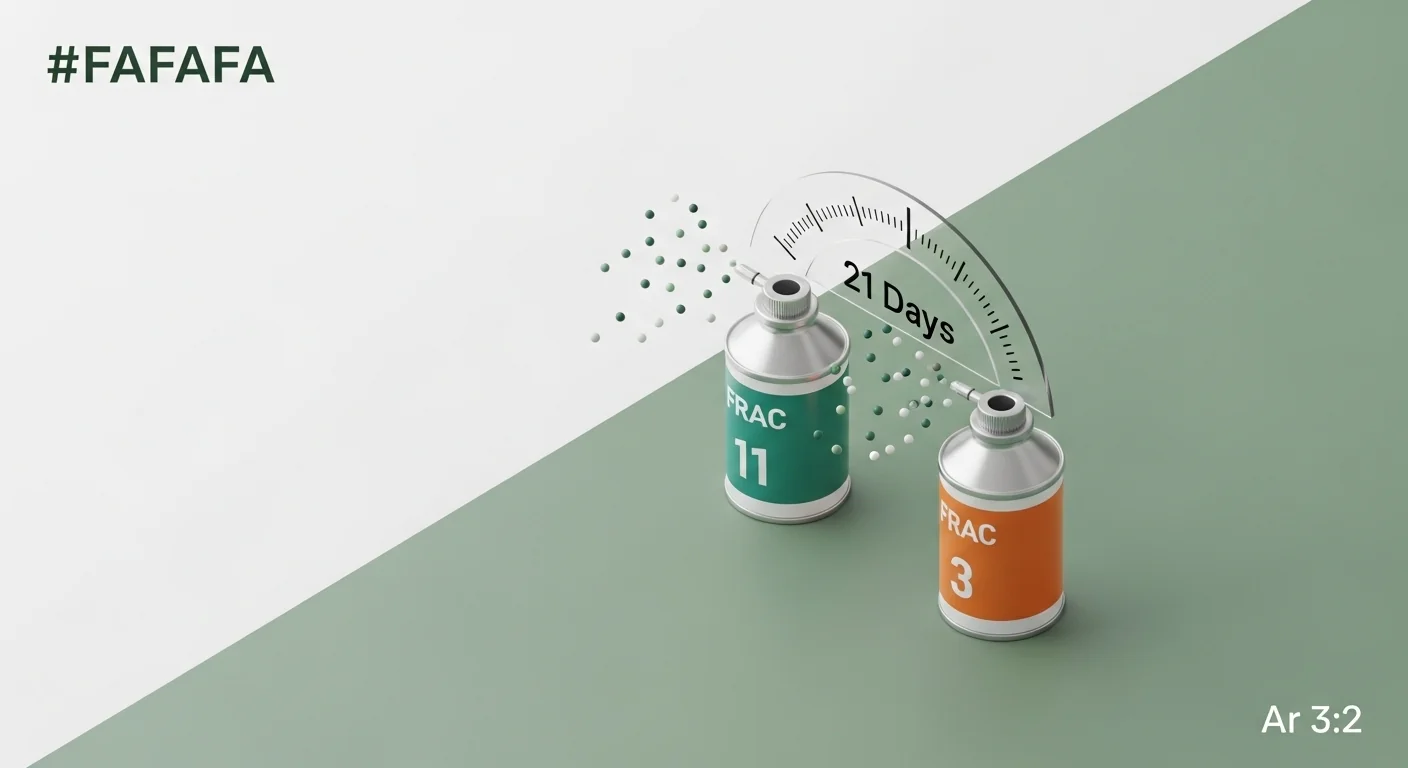

Turf disease failures do not always come from applying the wrong fungicide. They come from applying the right fungicide too many times in a row. Every single-site inhibitor works by targeting one specific enzyme in the fungal cell. That precision is the source of its power, and the exact mechanism that allows pathogen populations to evolve complete resistance through a single point mutation. The spray that worked perfectly in June can become useless by August, not because the product changed, but because the surviving mutants were the only ones left to reproduce.
This fungicide FRAC code calculator identifies the resistance risk created by your last application, flags when that risk crosses into dangerous territory, and generates a rotation strategy based on the FRAC code you used. It does not predict disease severity, account for weather conditions, or substitute for a licensed agronomist interpreting field-specific pathogen data. For mixing ratios when transitioning to oil-based protective sprays as part of an integrated disease management approach, the neem oil mixing ratio calculator covers dilution guidance for contact-mode treatments.
After running this calculator, you will know whether your next fungicide application must use a different FRAC code, which specific active ingredients represent the lowest-risk rotation options, and whether your current spray interval has already triggered selection pressure requiring immediate program correction.
Use the Tool

Fungicide FRAC Code Rotation & Resistance Blocker
Prevent chemical resistance by rotating fungicide modes of action — powered by The Yield Grid
Fungicide FRAC Code Calculator| FRAC Code | Mode of Action | Example A.I. | Resistance Risk | Site Specificity |
|---|---|---|---|---|
| FRAC 11 | QoI — Strobilurins | Azoxystrobin, Pyraclostrobin | HIGH | Single-site |
| FRAC 7 | SDHI — Succinate Dehydrogenase | Boscalid, Fluopyram | HIGH | Single-site |
| FRAC 3 | DMI — Triazoles/Sterol Biosyn. | Propiconazole, Tebuconazole | MEDIUM | Single-site |
| FRAC 1 | MBC — Benzimidazoles | Thiophanate-methyl | HIGH | Single-site |
| FRAC 4 | PA — Phenylamides | Metalaxyl / Mefenoxam | HIGH | Single-site (Pythium only) |
| FRAC M3 | Multi-site — Dithiocarbamates | Mancozeb, Thiram | LOW | Multi-site |
| FRAC M5 | Multi-site — Chloronitriles | Chlorothalonil (Daconil) | LOW | Multi-site |
| FRAC 2 | Dicarboximides | Iprodione | MEDIUM | Single-site |
How This Calculator Works — Formula & Assumptions
Step 1 — Identify the FRAC Code of the Last Applied Fungicide
Each active ingredient maps to a FRAC code based on its mode of action (MOA). The tool uses a deterministic lookup table aligned with the FRAC Code List (Fungicide Resistance Action Committee).
Step 2 — Assess Resistance Risk
Single-site inhibitors (FRAC 11, 7, 3, 1, 4) carry HIGH–MEDIUM resistance risk because a single gene mutation can confer full resistance. Multi-site inhibitors (FRAC M3, M5) require many simultaneous mutations — resistance is extremely rare.
Step 3 — Application Interval Check
Back-to-back applications of the same FRAC code within a single season create selection pressure. The tool flags applications of the same MOA used within a 28-day window as a resistance concern. Short intervals compound selection pressure.
Step 4 — Rotation Recommendation Engine
The tool mandates switching to a different FRAC group — ideally to a multi-site inhibitor (FRAC M) every 2nd or 3rd application, or to a different single-site FRAC group.
Step 5 — Application Rate
Rate guidance is based on standard turf label rates. Always consult the product label — rates vary by formulation, application equipment, and disease pressure. All rates shown are per 1,000 sq ft unless noted.
Assumptions & Limitations
- This tool provides advisory guidance only — always read and follow product labels.
- Resistance status of local pathogen populations may vary by geography and history of use.
- Weather, temperature, and disease pressure may override rotation timing guidance.
- Some disease/fungicide combinations are off-label — consult an agronomist or licensed applicator.
- FRAC codes shown reflect FRAC 2024 publication; verify current listing for new products.
- Multi-site fungicides (FRAC M) are generally tank-mixed — standalone efficacy may be lower on some diseases.
FRAC Science — Understanding the Super-Fungus Risk
What is a FRAC Code?
FRAC (Fungicide Resistance Action Committee) assigns codes to group fungicides by their biochemical mode of action. Fungicides with the same FRAC code attack the same molecular target in the fungal cell. Rotating FRAC codes is the single most important practice for preventing resistance.
Why Single-Site Inhibitors Are Dangerous
Single-site inhibitors (Strobilurins, SDHIs, Triazoles) work by blocking ONE specific enzyme or protein in the fungal cell. This precision is what makes them so effective — but also what makes them vulnerable. A single point mutation in the fungal genome can change the shape of that target protein, making the fungicide unable to bind. The fungus survives. Its offspring all carry that mutation. Within 2–5 seasons of selection pressure, your entire pathogen population may be resistant.
The Selection Pressure Math
Any fungal population contains rare resistant individuals — perhaps 1 in 1,000,000 spores. When you apply a single-site fungicide:
- 999,999 susceptible fungi are killed
- The 1 resistant individual survives and reproduces
- Next application: 1 in 100,000 are resistant
- Third application: 1 in 1,000 — and efficacy drops noticeably
- By season’s end: full population shift, complete resistance
Multi-site inhibitors (FRAC M) require simultaneous mutations at many different sites — statistically impossible — which is why resistance to chlorothalonil or mancozeb has never been documented in turfgrass pathogens.
Best Practice Rotation Programs
Professional programs follow a 2-1-2 or 3-1 structure: 2 applications of a single-site FRAC, followed by 1 multi-site FRAC M application, then rotate to a different single-site FRAC group.
Before running the calculator, have the following information ready: the name of the turf disease you are targeting, the active ingredient (not just the brand name) from your most recent fungicide application, and the number of days elapsed since that application. Active ingredients appear on the product label under "Active Ingredients" and are distinct from trade names. Disease outbreak timing correlates strongly with temperature accumulation thresholds; pairing this tool with the growing degree days calculator helps time applications against biological pressure windows rather than calendar intervals alone.
Quick Start (60 Seconds)
- Target Disease: Select from the dropdown. The tool adjusts disease-specific context notes based on your selection. If you are treating multiple diseases simultaneously, run the calculator once for each pathogen.
- Last Applied Active Ingredient: Choose the active ingredient, not the brand. Azoxystrobin and Heritage are the same FRAC 11 compound. Selecting the correct active ingredient is the most important step for accurate risk detection.
- FRAC Code Auto-Detection: Once you select an active ingredient, the FRAC code field populates automatically. Verify it matches the FRAC code listed on your product label under "Group" or "FRAC Code."
- Days Since Last Application: Enter a whole number between 1 and 365. Be precise. The 21-day threshold is the boundary between an acceptable reapplication window and confirmed resistance selection pressure for high-risk FRAC codes.
- All fields are required: The Calculate button will not fire until every field is complete. Inline error messages will appear next to any missing field.
- Review the Rotation Strategy output: The recommended next active ingredients are specific alternatives in a different FRAC group. Do not substitute a different brand within the same FRAC code and expect a different resistance outcome.
- Check the Reference Table: The FRAC reference table at the bottom of the results panel shows all eight major FRAC groups with resistance risk ratings, useful for planning a multi-application rotation sequence before purchasing product.
Inputs and Outputs (What Each Field Means)
| Field Name | Type / Unit | What It Represents | Common Mistake | Safe Entry Guidance |
|---|---|---|---|---|
| Target Disease | Select (categorical) | The turf disease being chemically managed; determines contextual pressure notes and disease-specific resistance history | Selecting a disease based on suspected symptoms without confirmation; misdiagnosis leads to off-target chemistry | Confirm visually or via lab test before selecting. Brown Patch and Dollar Spot are the two most commonly misidentified turf diseases. |
| Last Applied Active Ingredient | Select (categorical) | The chemical active ingredient in your most recent fungicide application; maps to a specific FRAC code and resistance risk class | Entering a brand name rather than the active ingredient; multiple brands share the same active ingredient and FRAC code | Read the "Active Ingredients" line on the product label. Products like Heritage (Azoxystrobin) and Compass (Trifloxystrobin) are both FRAC 11 despite different brand identities. |
| FRAC Code (Auto-Detected) | Display / Hidden (text) | The Fungicide Resistance Action Committee code indicating the mode of action; auto-populated from the active ingredient selection | Assuming different brands equal different FRAC codes; two products with different names but the same FRAC code provide zero resistance diversification | Always verify the auto-detected FRAC code against the group listed on the product label. Discrepancies indicate a formulation not yet in the database. |
| Days Since Last Application | Integer (days, 1 to 365) | The calendar interval since the most recent application of the active ingredient listed; determines whether the spray interval falls within the resistance selection pressure window | Entering the interval since the last application of any fungicide rather than the specific active ingredient being assessed | Track each active ingredient separately. If Azoxystrobin was used 10 days ago and Propiconazole was used 5 days ago, enter 10 days when assessing FRAC 11 risk. |
| Resistance Risk Level (Output) | Output (categorical: Low / Moderate / Critical) | The calculated resistance selection pressure based on FRAC risk class, site specificity, and spray interval | Treating "Moderate" as safe; Moderate risk means rotation is advised, not optional | Treat any result other than "Low Risk" as requiring a program change before the next application. |
| Rotation Strategy (Output) | Output (list of active ingredients) | Recommended active ingredients in a different FRAC group suitable for your next application | Selecting the recommended active ingredient but purchasing a formulation that contains both the old and new active ingredient as a combination product, inadvertently continuing the old FRAC code | Check combination product labels. Some pre-mixed products combine two FRAC codes. Confirm the new active ingredient is the sole or primary mode of action. |
| Application Rate (Output) | Output (volume per 1,000 sq ft) | Standard turf label rate range for the last applied active ingredient; shown as advisory guidance only | Using the displayed rate for final calibration without consulting the product label; rates vary by formulation type, concentration, and disease pressure | The displayed rates are typical ranges. Always confirm against the current product label for the specific formulation in your possession. |
Worked Examples (Real Numbers)
Example 1: Golf Course Green With Repeated Strobilurin Applications
- Target Disease: Brown Patch
- Last Applied Active Ingredient: Azoxystrobin (Heritage) [FRAC 11, HIGH risk, Single-site]
- Days Since Last Application: 10
Result: CRITICAL: Resistance Alert. Gauge at 95/100. Traffic light: Resistance Warning. Super-Fungus alert triggered.
FRAC 11 is a single-site QoI inhibitor applied within 10 days of the previous FRAC 11 application. The tool identifies this as maximum selection pressure: susceptible individuals in the pathogen population were killed by the first application, and the surviving population now skews heavily toward the resistant minority. A third FRAC 11 application will not control Brown Patch. The required action is an immediate switch to FRAC 3 (DMI triazole) or FRAC M5 (Chlorothalonil) before the next spray cycle.
Example 2: Fairway Dollar Spot Program Using Triazoles
- Target Disease: Dollar Spot
- Last Applied Active Ingredient: Propiconazole (Banner Maxx) [FRAC 3, MEDIUM risk, Single-site]
- Days Since Last Application: 21
Result: Moderate: Rotation Advised. Gauge at 50/100. Traffic light: Rotation Advised.
FRAC 3 carries documented resistance history in Dollar Spot populations, particularly in turf with multi-year DMI-heavy programs. At exactly 21 days, the interval sits at the boundary of the resistance pressure window. The tool recommends rotating to FRAC 11 (Azoxystrobin), FRAC 7 (Boscalid), or FRAC M5 (Chlorothalonil) for the next application. Staying with FRAC 3 at this interval is not catastrophic but represents unnecessary compounding of resistance risk given that alternatives are available.
Example 3: Home Turf Pythium Protection With Multi-Site Chemistry
- Target Disease: Pythium Blight
- Last Applied Active Ingredient: Chlorothalonil (Daconil) [FRAC M5, LOW risk, Multi-site]
- Days Since Last Application: 14
Result: Low Risk: Rotation Optional. Gauge at 20/100. Traffic light: Safe.
Multi-site inhibitors require simultaneous mutations at numerous biochemical targets to confer resistance. No confirmed resistance to Chlorothalonil has been documented in turfgrass oomycetes or fungi under field conditions. At 14 days, a repeat FRAC M5 application is acceptable from a resistance standpoint. The tool suggests rotating to a single-site FRAC code (FRAC 11 or FRAC 3) on the next application for improved efficacy against active infection, reserving FRAC M5 for the protective slots in the rotation program.
Reference Table (Fast Lookup)
| FRAC Code | Mode of Action Group | Example Active Ingredients | Resistance Risk | Site Specificity | Max Consecutive Apps (Best Practice) | Ideal Rotation Partner |
|---|---|---|---|---|---|---|
| FRAC 11 | QoI Strobilurin | Azoxystrobin, Pyraclostrobin, Trifloxystrobin | HIGH | Single-site (bc1 complex) | 2 consecutive maximum | FRAC 3 or FRAC M5 |
| FRAC 7 | SDHI (Succinate Dehydrogenase) | Boscalid, Fluopyram, Fluxapyroxad, Penthiopyrad | HIGH | Single-site (SdhB/C/D subunits) | 2 consecutive maximum | FRAC 3 or FRAC M5 |
| FRAC 3 | DMI Triazole (Sterol Biosynthesis Inhibitor) | Propiconazole, Tebuconazole, Myclobutanil, Metconazole | MEDIUM | Single-site (CYP51) | 2 consecutive, 3 with caution | FRAC 11 or FRAC M5 |
| FRAC 1 | MBC Benzimidazole | Thiophanate-methyl (Cleary 3336) | HIGH | Single-site (beta-tubulin) | 1 consecutive; resistance widespread | FRAC 3 or FRAC M5 |
| FRAC 4 | Phenylamide (PA) | Metalaxyl, Mefenoxam (Subdue MAXX) | HIGH | Single-site (RNA pol I); oomycetes only | 1 consecutive; always tank-mix with FRAC M | FRAC M5 (Chlorothalonil) |
| FRAC 2 | Dicarboximide | Iprodione (Chipco 26GT) | MEDIUM | Single-site (osmotic signal transduction) | 2 consecutive, then insert FRAC M | FRAC 11 or FRAC M5 |
| FRAC M5 | Chloronitrile (Multi-site) | Chlorothalonil (Daconil) | LOW | Multi-site (glutathione, SH-groups) | No restriction; use to reset rotation | Any single-site FRAC for efficacy boost |
| FRAC M3 | Dithiocarbamate (Multi-site) | Mancozeb (Fore), Thiram | LOW | Multi-site (multiple enzyme sites) | No restriction; protectant use only | Any single-site FRAC for curative activity |
| FRAC 11 + 7 combo | QoI + SDHI Pre-mix | Lexicon (Fluxapyroxad + Pyraclostrobin) | HIGH (both components) | Dual single-site | 1 consecutive; both FRAC codes count as used | FRAC 3 + FRAC M tank mix |
How the Calculation Works (Formula + Assumptions)
Show the calculation steps
Step 1: Active Ingredient to FRAC Code Lookup
The calculator maintains a deterministic lookup table of active ingredients mapped to their FRAC code, mode of action group, site specificity class (single-site vs. multi-site), and baseline resistance risk class (HIGH / MEDIUM / LOW). When you select an active ingredient, the FRAC code and associated risk parameters are retrieved from this table. No interpolation occurs; the lookup is categorical.
Step 2: Risk Class Assignment
Risk class is assigned at the FRAC code level, not the product level:
- FRAC 11, 7, 1, 4: HIGH (single-site; one mutation sufficient to confer resistance)
- FRAC 3, 2: MEDIUM (single-site but polygenic resistance mechanisms; gradual population shift)
- FRAC M3, M5: LOW (multi-site; simultaneous mutations required across many targets)
Step 3: Interval Threshold Logic
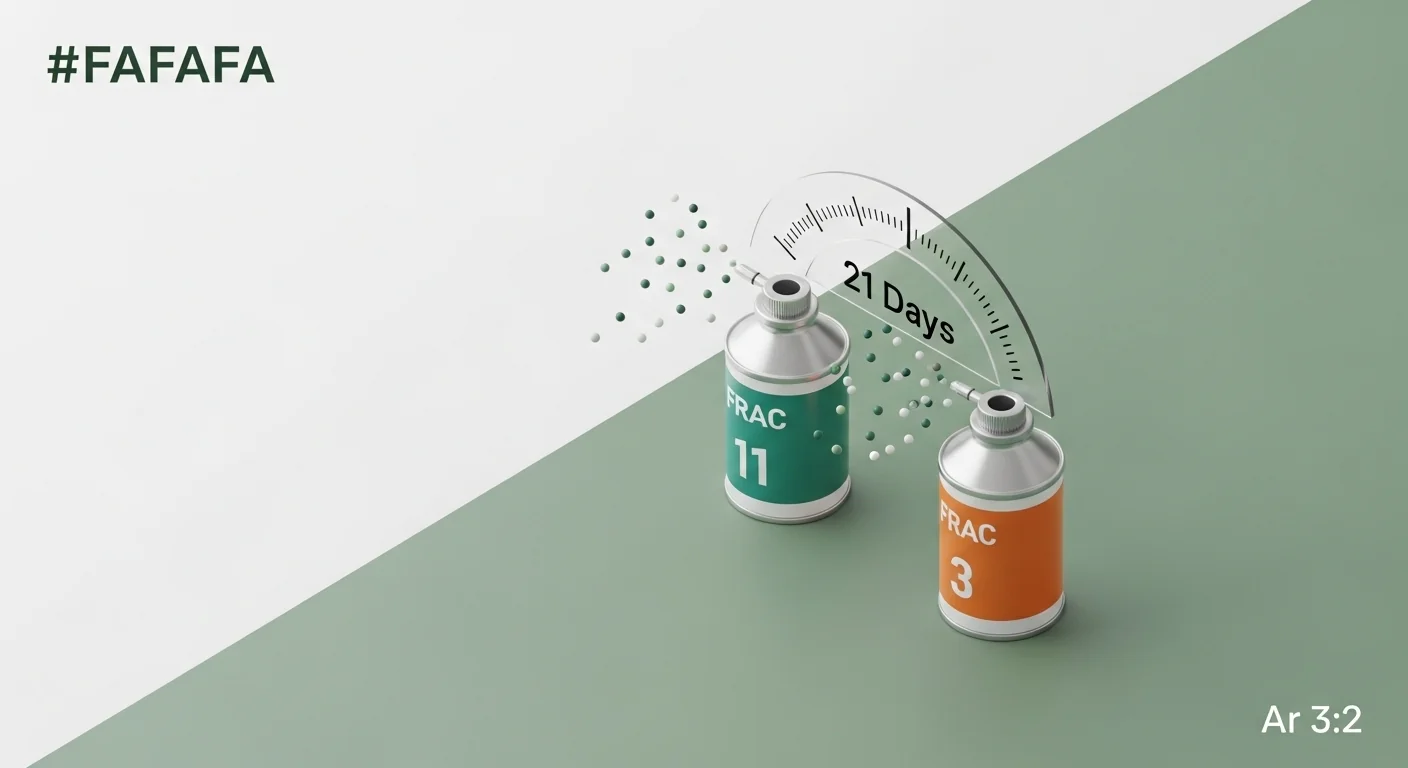
The spray interval is compared against a 21-day resistance pressure threshold for HIGH-risk FRAC codes:
- HIGH risk + interval 14 days or less: Critical resistance alert, gauge score 95/100
- HIGH risk + interval 15 to 21 days: Critical resistance alert, gauge score 80/100
- HIGH risk + interval greater than 21 days: Moderate risk, gauge score 55/100, rotation still advised
- MEDIUM risk + interval 21 days or less: Moderate risk, gauge score 50/100
- LOW risk at any interval, or MEDIUM risk beyond 21 days: Low risk, gauge score 20/100
Step 4: Rotation Recommendation Lookup
The rotation map assigns pre-validated alternative FRAC codes for each FRAC group. For example, FRAC 11 maps to FRAC 3, FRAC 7, FRAC M5, and FRAC M3 as rotation partners. The first two alternatives listed are single-site options for curative efficacy; the last two are multi-site options for resistance reset. The recommendation always leads with a curative option first.
Rounding and Display Rules
Gauge percentage is an integer. Rate guidance is shown as a range without rounding, sourced from standard label ranges. Interval input accepts whole days only; the calculator does not process decimal values.
Assumptions and Limits
- Resistance risk is modeled at the population level. Individual plants may show disease symptoms even with a "Low Risk" result if pathogen pressure is extreme or if application coverage was incomplete.
- The 21-day threshold is a broadly accepted practical guideline, not an absolute regulatory standard. Some disease programs and specific pathogen populations may require shorter rotation windows.
- The tool does not account for tank-mix chemistry. If your last application included two active ingredients from different FRAC codes, enter the higher-risk FRAC code as the primary input.
- Application rate guidance represents typical turf label ranges per 1,000 square feet. Rates for other use areas, ornamentals, or high-pressure disease situations require independent label verification.
- The calculator uses 2024 FRAC code assignments. Products registered after this date or reformulations with new active ingredients may not appear in the active ingredient dropdown.
- Weather, canopy moisture, and nitrogen fertility all affect actual disease pressure and fungicide efficacy. This tool models chemistry risk only, not agronomic field conditions.
- Resistance status of local pathogen populations is not factored in. In regions with confirmed FRAC 11-resistant Brown Patch or FRAC 3-resistant Dollar Spot populations, the critical threshold should apply to any repeat application of that FRAC code regardless of interval.
Standards, Safety Checks, and "Secret Sauce" Warnings
Critical Warnings
- The two-application trap: Applying the same single-site FRAC code twice within one season appears safe and effective through the first cycle. The disease is suppressed, results look good, and the same product is purchased again. By the third application, the surviving pathogen population has been selectively enriched with resistant genotypes. The disease outbreak after the third application is not a product failure. It is a manufactured resistance event that began with the second application.
- Brand rotation is not FRAC rotation: Switching from Heritage to Compass, or from Banner Maxx to Eagle 20EW, appears to be a program change. Both Heritage and Compass are FRAC 11. Both Banner Maxx and Eagle 20EW are FRAC 3. The pathogen population does not register brand identity; it registers the mode of action. Switching brands within the same FRAC code provides no resistance management benefit.
- FRAC 3 resistance in Dollar Spot is not theoretical: Multi-year DMI-heavy programs on golf courses in the United States have produced populations with documented reduced DMI sensitivity. FRAC 3 moderate risk classification means resistance develops more slowly, not that it cannot develop.
- Combination products consume two FRAC codes simultaneously: Products like Lexicon (FRAC 11 + FRAC 7) are highly effective but use up two FRAC codes in a single spray. After using a combination product, both constituent FRAC codes must be rotated away from. Using a straight FRAC 11 product after a FRAC 11 + FRAC 7 pre-mix does not constitute rotation for FRAC 11.
Minimum Standards
- Never apply the same single-site FRAC code more than two consecutive applications without inserting at least one multi-site FRAC M application.
- Programs targeting Dollar Spot should include FRAC M5 (Chlorothalonil) or FRAC M3 (Mancozeb) in every third application slot, regardless of current resistance status, as a structural program deposit against future selection pressure.
- Any program showing confirmed disease breakthrough on a product with a previously clean efficacy history should be treated as a resistance event, not an application error, until proven otherwise. Rotate to a different FRAC group immediately and document the incident.
Competitor Trap: Most fungicide resistance guides list FRAC codes in a table and advise "rotating modes of action." They stop there. What those guides omit is the specific mechanism by which rotation timing matters as much as rotation itself. A grower who switches FRAC codes every 60 days but repeatedly uses a high-risk single-site code for back-to-back applications within each rotation block is still building resistance. The rotation chart looks correct on paper while the pathogen population continues to shift. This calculator measures the interval-specific pressure, not just whether a theoretical rotation plan exists on paper. Following a structured rotation schedule mirrors the logic behind organized crop sequencing: the succession planting chart illustrates how temporal diversity prevents biological monoculture vulnerabilities, a principle equally applicable to fungicide programs.
Common Mistakes and Fixes
Mistake: Tracking Spray Dates by Brand Rather Than Active Ingredient
A spray log that records "Heritage applied June 3" and "Compass applied June 17" looks like a two-product rotation to any reviewer. Both are FRAC 11 Strobilurins. The pathogen population experienced 14 consecutive days between two identical modes of action. Any FRAC 11-sensitive genotypes remaining after June 3 were eliminated by June 17, and the surviving resistant individuals were handed an uncontested reproductive window. Fix: restructure spray logs to record the FRAC code alongside the product name, and flag any FRAC code repetition within a 21-day window as a program error requiring correction before the next purchase.
Mistake: Treating FRAC M Applications as Filler Sprays
Multi-site fungicides carry lower efficacy ratings against active infection than single-site chemistries. As a result, many programs push FRAC M applications into the schedule only when nothing better is available, or reduce rates to save cost. This misunderstands their strategic role: FRAC M applications are resistance insurance. Applying them at full label rates on a scheduled basis keeps the resistant fraction of the pathogen population from accumulating faster than the rotation cycle can counteract. Fix: schedule FRAC M applications as mandatory program slots, not optional fill-ins, and apply at the upper end of the label rate range for protective programs.
Mistake: Applying Calendar-Only Spray Intervals Without Adjusting for Disease Pressure
A standard 14-day spray interval makes sense in mild conditions but creates compounded selection pressure during periods of intense disease activity, when the pathogen is reproducing rapidly and the number of spore cycles per interval is higher than baseline. More rapid reproduction means more mutation events per unit time and faster population shift toward resistance. Timing sprays against environmental triggers rather than calendar dates reduces the total number of high-pressure applications required. The logic of threshold-based timing applies across many planning decisions; the harvest date calculator demonstrates how to structure timing decisions around biological thresholds rather than fixed calendar dates. Fix: define spray triggers based on temperature and humidity thresholds, not calendar dates alone.
Mistake: Using FRAC 11 as the Default Starting Point for Every Disease
Strobilurins became dominant on golf courses and athletic fields because they are highly effective, rain-fast, and systemic. Over many seasons they became the default first product applied at disease onset. The consequence is that FRAC 11 resistance is now documented in Brown Patch populations in multiple US regions, reducing the reliable efficacy window. Starting a program with a FRAC M protective application, or with a FRAC 3 DMI, preserves FRAC 11 as a high-impact option for confirmed disease events where curative activity is needed. Fix: reserve FRAC 11 for confirmed disease events rather than using it as routine preventive chemistry in every program cycle.
Mistake: Ignoring Resistance Warnings in Low-Pressure Seasons
When disease pressure is naturally low, even a resistant pathogen population may not produce visible symptoms, creating the illusion that a repeated FRAC code is still working. The population shift continues regardless of symptom expression. When a high-pressure season arrives, the resistant population is already dominant and efficacy failure appears sudden and unexplained. Fix: enforce FRAC rotation discipline in low-pressure seasons precisely because the cost of doing so is minimal. Program integrity during easy conditions is what protects performance during difficult ones.
Next Steps in Your Workflow
Once the resistance risk level and rotation recommendation are in hand, the immediate practical step is updating your spray program documentation before purchasing product for the next application cycle. If the result is Moderate or Critical, the active ingredient for the next slot is already identified by the rotation output. Purchase that product rather than restocking the previous one. If your application falls within a Critical resistance window and a spray is already scheduled within the next 48 hours, substitute the recommended FRAC group immediately and document the change in your spray log with the reason: "FRAC code rotation required per resistance management protocol."
Over the medium term, a three-application rotation plan built around the output of this tool creates a defensible program structure: Slot 1 uses your current FRAC code, Slot 2 deploys the recommended rotation partner, and Slot 3 inserts a FRAC M multi-site reset. For broader plant health management, disease pressure in dense plantings is directly affected by canopy airflow and plant spacing; the plant spacing calculator can inform density decisions that reduce the humid microclimate conditions that drive fungal disease cycles. Tracking seasonal spray expenditures and output against expected yield or turf quality benchmarks is covered by the vegetable yield calculator for production settings where chemical inputs need to be evaluated against measurable output.
FAQ
What does the FRAC code actually represent?
FRAC stands for Fungicide Resistance Action Committee. The code groups fungicides by their biochemical mode of action, meaning which specific process or enzyme they disrupt inside the fungal cell. Two products with the same FRAC code attack the same biological target, even if they carry different trade names, active ingredient names, or label claims. Resistance that develops to one product in a FRAC group effectively reduces the efficacy of all products in that group.
How is FRAC 11 different from FRAC 3 in terms of resistance risk?
FRAC 11 (Strobilurin) inhibits a single protein in the mitochondrial electron transport chain. A single point mutation at one position in the cytochrome b gene is sufficient to confer near-complete resistance. FRAC 3 (DMI triazole) inhibits the CYP51 enzyme, but resistance typically involves multiple mechanisms acting together, including target site modification and enhanced efflux. FRAC 3 resistance develops more gradually than FRAC 11, which is why the calculator assigns it a MEDIUM rather than HIGH risk rating.
Can resistance reverse if I stop using a FRAC code for a season?
Partially. Resistant genotypes often carry a fitness cost compared to susceptible individuals when selection pressure is absent. Over multiple seasons without a specific FRAC code, the resistant fraction of the population may decline. However, resistance does not disappear, and the speed of reversion is highly variable by pathogen species, local population structure, and competition dynamics. Programs should not count on resistance reversal as a strategy; active rotation is always preferable to reversal reliance.
Does the calculator work for ornamentals and vegetables, or only turf?
The FRAC code logic and resistance risk classifications are universal across all plant pathology applications. The disease list in the dropdown is oriented toward turfgrass diseases, and the application rate guidance reflects turf label rates. For ornamental or vegetable disease programs, the same FRAC rotation principles apply, but application rates and labeled uses must be confirmed against product labels specific to those crops and use sites.
What should I do if my disease does not appear in the dropdown?
Select the disease closest to the pathogen class you are managing. The resistance risk classification for your active ingredient does not change based on disease selection; that output depends on the active ingredient and spray interval, which function identically regardless of disease choice. The disease field affects only the contextual pressure notes displayed alongside the rotation recommendation.
Is chlorothalonil truly safe to repeat without rotation concerns?
Under current field conditions, yes. No confirmed resistance to chlorothalonil has been documented in turfgrass fungal pathogens after decades of commercial use. Multi-site inhibitors require simultaneous mutations across many different biochemical targets, a statistically near-impossible event. That said, chlorothalonil has curative limitations against established infections and has faced regulatory review in some jurisdictions. Its primary role is as a protectant and rotation reset tool, not a standalone curative chemistry for active outbreaks.
Conclusion
The fungicide FRAC code calculator converts a commonly misunderstood resistance mechanism into a specific, actionable spray program decision. The single most critical failure this tool prevents is the error that looks like success: a second application of the same single-site FRAC code on a disease that appeared fully controlled after the first. That apparent success is selection pressure working exactly as intended, eliminating every susceptible individual and leaving the resistant population to reproduce unopposed. The calculator flags that window before a third application turns it into a confirmed program failure with no remaining chemistry to fall back on.
Running this check before every fungicide purchase takes under 60 seconds and produces a defensible rotation recommendation grounded in FRAC science rather than brand marketing. The number-one mistake to avoid going forward is tracking chemical programs by product name instead of FRAC code. Once spray logs record FRAC codes alongside active ingredients, resistance management stops being an abstract best practice and becomes a measurable, enforceable standard built into every purchasing decision. Disease prevention is ultimately one component of a broader plant health system; understanding how environmental timing, spacing, and application chemistry interact is the foundation of a durable management program.