
Most grow-light decisions are made from fixture spec sheets. Spec sheets measure output at the emitter, not at the canopy, and they ignore the one variable that determines whether a plant thrives or suffers irreversible damage: how many moles of photons actually accumulate on the leaf surface every day. Daily Light Integral (DLI) answers that question with a single, auditable number that spec-sheet marketing never gives you.
This DLI calculator takes canopy-level PPFD (in micromoles per square meter per second), your photoperiod, your target crop, and your CO2 status, then computes DLI in mol/m2/day. It cross-checks the result against crop-specific thresholds and flags two failure modes that most growers discover only after the damage is done: phototoxicity bleaching above 45 DLI without CO2, and permanent chlorophyll degradation above 65 DLI regardless of enrichment. The tool does not predict yield, model spectrum quality, or account for supplemental daylight in greenhouse settings. Light intensity and vapor pressure deficit interact closely; if you are dialing in a full environment, the VPD calculator belongs in the same workflow.
Once you have your DLI, you can decide with confidence whether to lower your fixture, shorten your photoperiod, add CO2 enrichment, or leave the schedule exactly as it is.
Use the Tool
DLI & PPFD Photoperiod Calculator
Calculate Daily Light Integral from grow light output — detect bleaching & chlorophyll breakdown risks
Crop DLI Reference — Computed Values
| Crop | Min DLI | Optimal DLI | Max DLI (no CO₂) | Status |
|---|
Assumptions & Limits of this Calculator
What this tool assumes
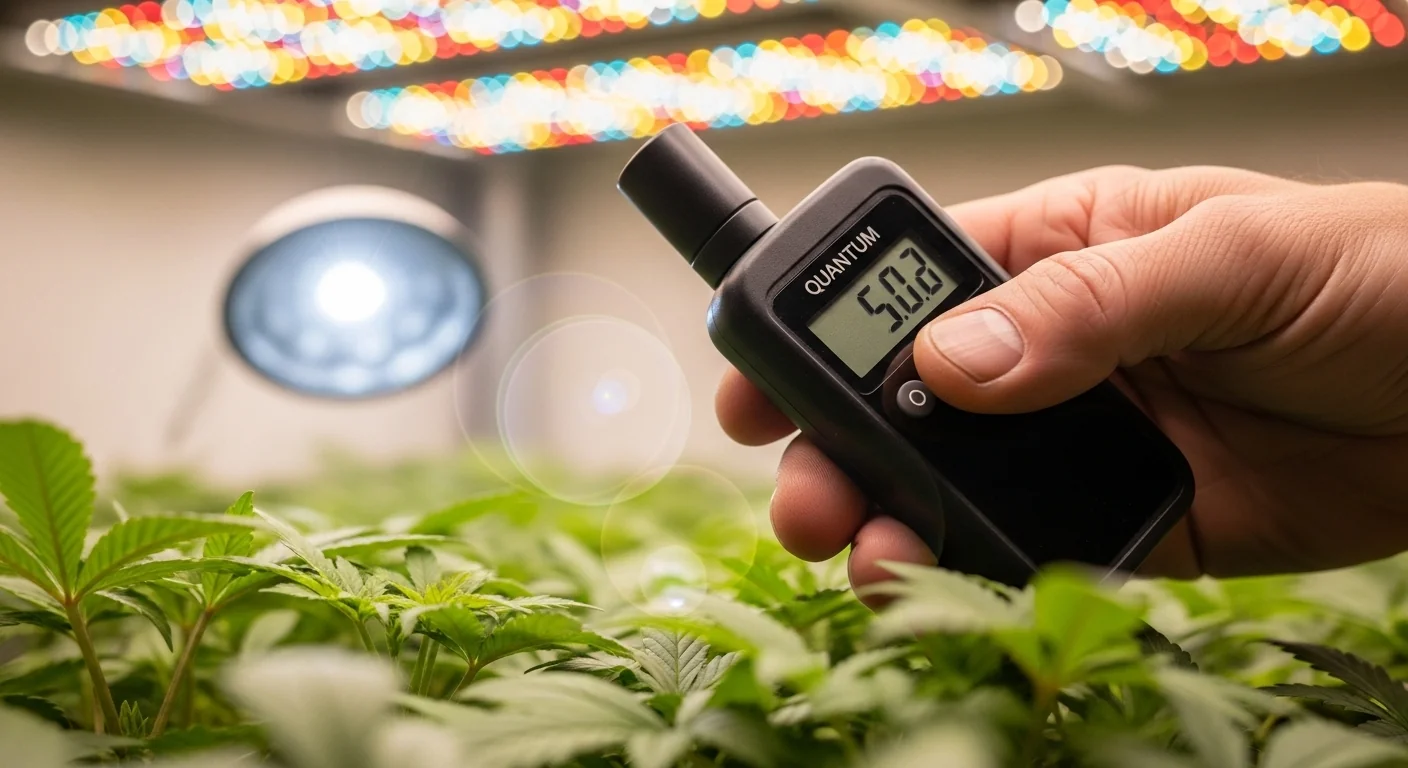
- PPFD entered is measured at the canopy level, not at the light fixture. Use a quantum PAR meter (e.g. Apogee MQ-500) for accurate readings.
- Light output is uniform across the entire canopy — real grow lights have hot spots and edge fall-off (typically 10–30% less at edges).
- CO₂ supplementation threshold is set at ≥1,200 PPM ambient concentration. Below this, standard thresholds apply.
- DLI targets assume healthy root zone, correct VPD, and balanced nutrition. Light stress symptoms appear faster under any other deficiency.
- The phototoxicity threshold of 65 mol/m²/day is a conservative estimate; actual chlorophyll breakdown depends on cultivar, temperature, and spectrum quality.
Formula used
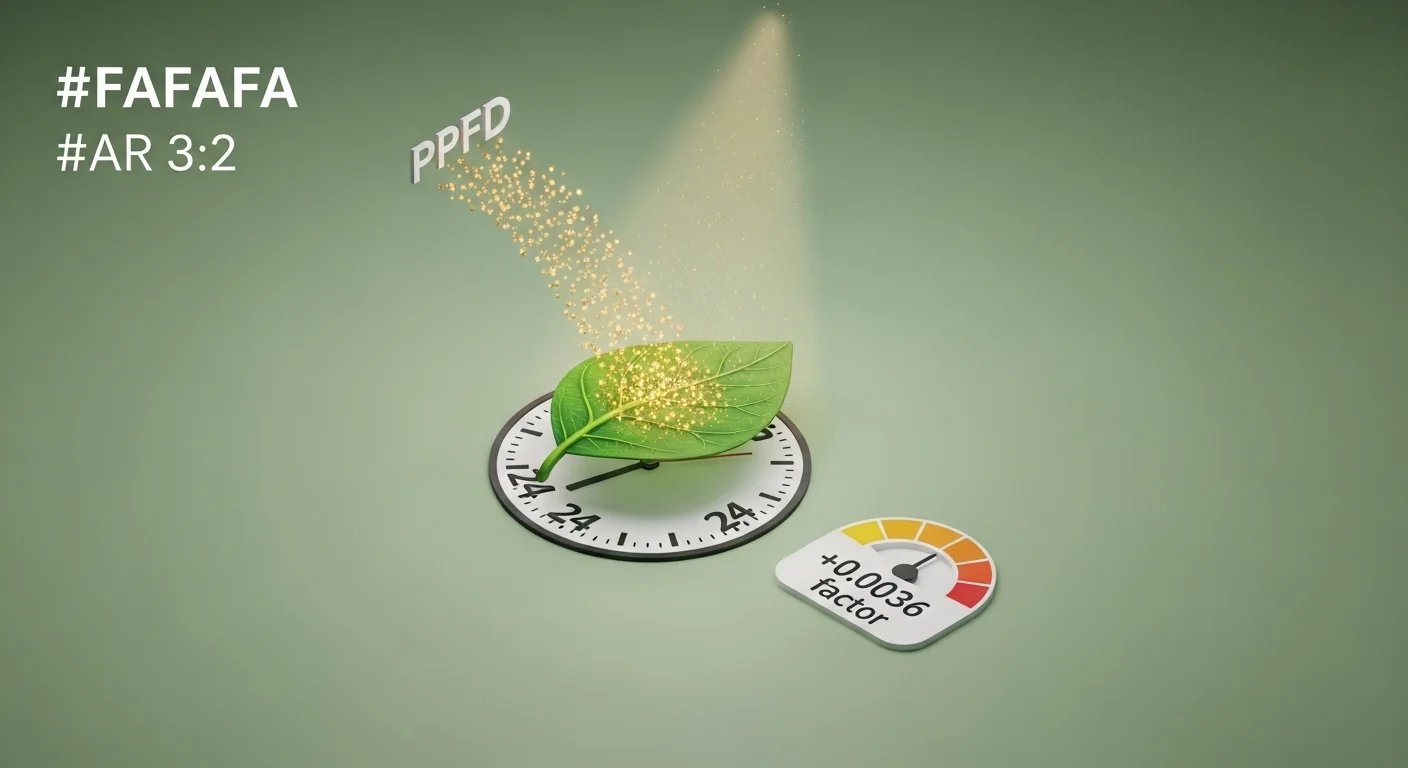
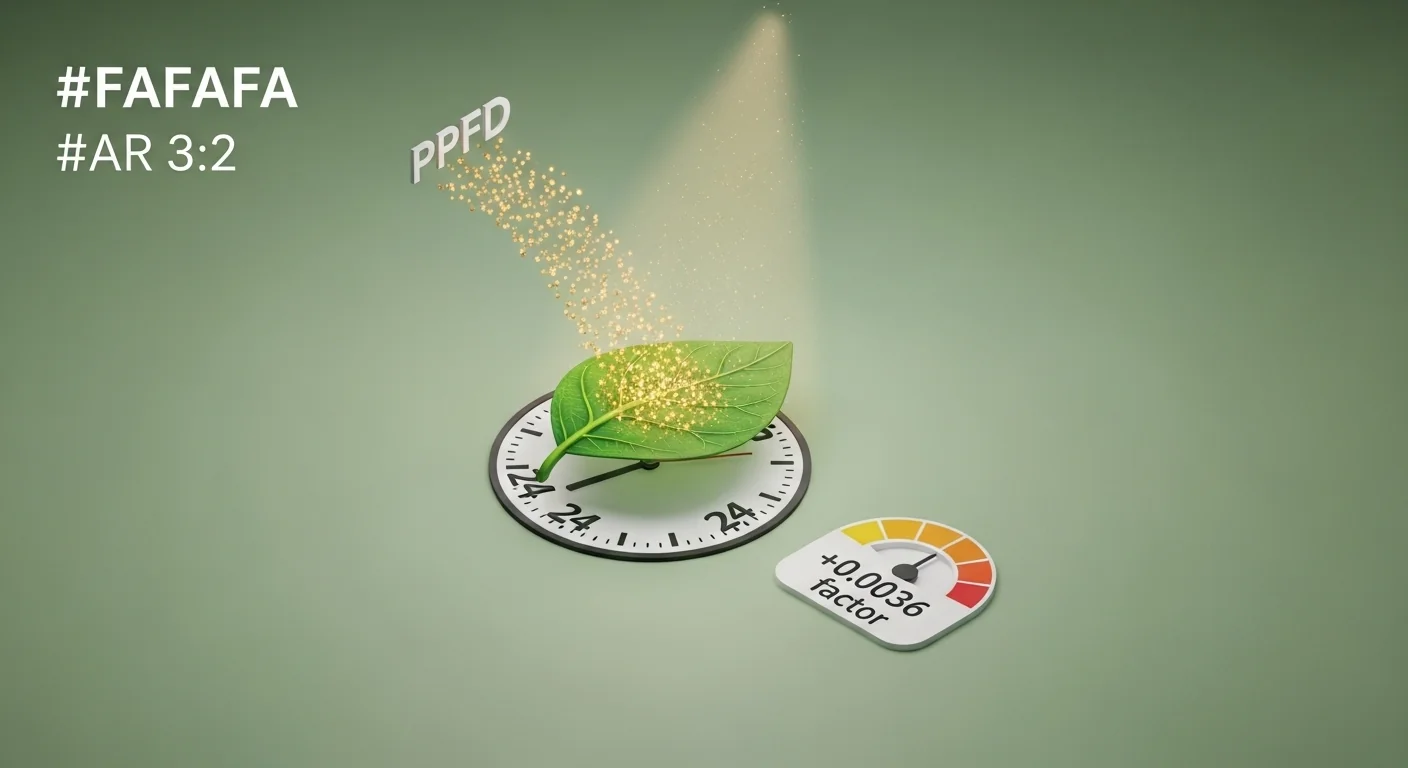
Where 0.0036 = conversion factor (3,600 seconds per hour ÷ 1,000,000 μmol per mol).
This calculates how many moles of photons (PAR) reach 1 m² of canopy over one full day.
Limitations
- Does not account for supplemental sunlight in greenhouse environments.
- Does not calculate heat load or VPD interactions — high-intensity lights also raise canopy temperature.
- Commercial LED efficacy claims (μmol/J) differ from actual canopy PPFD — always measure with a PAR meter.
- Maximum DLI values with CO₂ are theoretical; most cultivars plateau around 80–90 mol/m²/day even with full CO₂ enrichment.
How this DLI calculator works
Step 1 — Enter PPFD (μmol/m²/s)
PPFD measures the number of photosynthetically active photons hitting your canopy each second. This is what your PAR meter reads. Typical values: seedlings 200–400, veg 400–800, flower 600–1,200+.
Step 2 — Set photoperiod (hours/day)
How many hours per day are your lights on? Common schedules: 24/0 (clones), 20/4 or 18/6 (veg), 12/12 (flower trigger).
Step 3 — Apply the DLI formula
Example: 800 PPFD × 18 hrs × 0.0036 = 51.8 mol/m²/day
Step 4 — Check thresholds
Each crop has a known optimal DLI range backed by controlled environment agriculture research. When DLI exceeds safe thresholds — especially without CO₂ enrichment — chloroplasts become photoinhibited and the plant’s photoprotection mechanisms trigger bleaching and tissue death.
The Phototoxicity Mechanism
At very high DLI (>65 mol/m²/day), excess photon energy cannot be consumed through photosynthesis or dissipated as heat fast enough. Reactive oxygen species (ROS) damage chlorophyll pigments, causing the characteristic snow-white bleaching of the uppermost canopy leaves. This damage is permanent — affected tissue does not recover.
Supplemental CO₂ (≥1,200 PPM) raises the plant’s light saturation point by accelerating the Calvin cycle, allowing it to process substantially more photon energy before entering photoinhibition.
Before entering values, have your quantum PAR meter reading at canopy height ready, not the fixture's rated output. You will also need the exact number of hours your lights are on per day and a clear sense of whether you are running supplemental CO2 above roughly 1,200 PPM. If you are evaluating the operating cost of the light that produced those PPFD readings, the grow light cost calculator pairs directly with this one. Fill in all four fields before clicking Calculate; the tool will not run on partial input.
Quick Start (60 Seconds)
- PPFD field: Enter your canopy-level reading in micromoles per square meter per second (written as μmol/m2/s). Valid range is 1 to 3,000. Do not use the manufacturer's rated output or the PPFD measured at a point other than canopy height.
- Photoperiod field: Enter the number of hours per day your lights are actually on, not the hours the timer is set for. Half-hour increments are accepted (e.g., 18.5). Valid range is 1 to 24.
- Crop selector: Choose the crop and growth stage that best matches your current situation. Cannabis vegetative and Cannabis flowering have different optimal DLI bands and different bleaching thresholds, so selecting the wrong stage will produce a misleading safety assessment.
- CO2 toggle: Select "Yes" only if you are actively maintaining ambient CO2 at or above 1,200 PPM across the entire canopy. A CO2 bag or a small burner running intermittently does not meet this threshold.
- Calculate button: The results panel will not appear until all four inputs are filled and valid. If any field shows a red error, fix it before proceeding.
- Gauge bar: The marker on the color gradient shows where your DLI falls relative to the deficient, optimal, high, and danger zones for the chosen crop. Use it as a quick visual sanity check, not as a replacement for reading the full warnings box.
- Reset button: Clears all inputs and collapses the results panel so you can start a fresh calculation for a different room or light schedule.
Inputs and Outputs (What Each Field Means)
| Field | Unit | What It Represents | Common Mistake | Safe Entry Guidance |
|---|---|---|---|---|
| LED Grow Light Output (PPFD) | μmol/m2/s | The instantaneous flux of photosynthetically active photons arriving at the canopy surface each second | Using the fixture's maximum rated PPFD at 18 inches instead of a measured reading at actual canopy distance | Measure at three to five canopy points and use the average; edges typically read lower than center |
| Light Cycle / Photoperiod | hours/day | The number of hours per 24-hour period that the lights are actually on and delivering rated output | Including ramp-up and ramp-down time from dimmable drivers, which inflates the effective photoperiod | Use only the hours at full or target intensity; dimming periods are not equivalent to rated PPFD hours |
| Target Crop | category | The plant species and growth stage, which determines the correct optimal DLI band and bleach threshold | Selecting "Cannabis (Veg)" for a plant in early flower transition, which applies the wrong maximum DLI threshold | When in doubt between two stages, use the more conservative (lower-maximum) option |
| CO2 Supplementation | Yes / No | Whether ambient CO2 concentration is maintained at or above 1,200 PPM throughout the canopy | Selecting "Yes" based on a CO2 burner that cycles off and on, leaving average concentration well below 1,200 PPM | Only select "Yes" if a controller is actively holding ambient CO2 at 1,200 PPM or higher during the entire photoperiod |
| Daily Light Integral (DLI) | mol/m2/day | The total moles of PAR photons delivered to one square meter of canopy over a full 24-hour period | Confusing DLI with PPFD; DLI is cumulative while PPFD is instantaneous | Compare the calculated DLI against the reference table for the selected crop before making any intensity changes |
Worked Examples (Real Numbers)
Example 1: Lettuce in a Vertical Farm Under Budget LEDs
- PPFD (canopy): 250 μmol/m2/s
- Photoperiod: 18 hours/day
- Crop: Lettuce / Leafy Greens
- CO2: No
Result: DLI = 250 × 18 × 0.0036 = 16.2 mol/m2/day
The optimal band for lettuce is 12 to 17 mol/m2/day. At 16.2, this setup sits comfortably inside the range. Extending the photoperiod to 20 hours would push DLI to 18.0, which begins to exceed the recommended maximum and risks tipburn acceleration in sensitive varieties.
Example 2: Cannabis Vegetative, Mid-Range LED, No CO2
- PPFD (canopy): 700 μmol/m2/s
- Photoperiod: 18 hours/day
- Crop: Cannabis (Vegetative)
- CO2: No
Result: DLI = 700 × 18 × 0.0036 = 45.4 mol/m2/day
The cannabis vegetative maximum without CO2 is 45 mol/m2/day. At 45.4 this is effectively at the limit. A small increase in PPFD or a minor photoperiod extension would cross into phototoxicity territory. Running CO2 at 1,200 PPM would raise the ceiling to 65 mol/m2/day, providing meaningful headroom for more intense light.
Example 3: Commercial 1,000W LED at Full Power, No CO2 (The Bleach Scenario)
- PPFD (canopy): 1,500 μmol/m2/s
- Photoperiod: 18 hours/day
- Crop: Cannabis (Vegetative)
- CO2: No
Result: DLI = 1,500 × 18 × 0.0036 = 97.2 mol/m2/day
This result is 52 mol/m2/day above the safe maximum for cannabis without CO2, and 32.2 above the absolute chlorophyll degradation threshold of 65. The plant physically cannot process this volume of photon energy through photosynthesis or thermal dissipation. Reactive oxygen species accumulate, chlorophyll pigments are oxidized, and the upper canopy turns white permanently. Reducing either fixture intensity or photoperiod is the only corrective path.
Reference Table (Fast Lookup)
| Crop | Min DLI (mol/m2/day) | Optimal DLI Range | Max DLI Without CO2 | Max DLI With CO2 | PPFD to Hit Optimal Midpoint at 18 hrs |
|---|---|---|---|---|---|
| Cannabis (Vegetative) | 35 | 35 to 45 | 45 | 65 | 556 μmol/m2/s |
| Cannabis (Flowering) | 45 | 45 to 65 | 65 | 90 | 694 μmol/m2/s |
| Tomatoes | 20 | 20 to 30 | 30 | 40 | 347 μmol/m2/s |
| Lettuce / Leafy Greens | 12 | 12 to 17 | 17 | 20 | 201 μmol/m2/s |
| Culinary Herbs | 10 | 10 to 15 | 15 | 18 | 174 μmol/m2/s |
| Cucumbers / Peppers | 20 | 20 to 30 | 30 | 40 | 347 μmol/m2/s |
| Strawberries | 12 | 12 to 20 | 20 | 26 | 222 μmol/m2/s |
| Seedlings / Clones | 5 | 5 to 15 | 15 | 18 | 139 μmol/m2/s |
The PPFD column in the final column is derived: Optimal Midpoint DLI ÷ (18 hours × 0.0036). These are canopy-level targets, not fixture ratings.
How the Calculation Works (Formula and Assumptions)
Show the calculation steps
The Formula
DLI = PPFD × Photoperiodhrs × 0.0036
The constant 0.0036 is a unit conversion factor. One hour contains 3,600 seconds. One mole of photons equals 1,000,000 micromoles. Dividing 3,600 by 1,000,000 gives 0.0036. Multiplying PPFD (micromoles per square meter per second) by hours and by 0.0036 yields moles per square meter per day.
Step-by-Step Walkthrough
- Measure canopy-level PPFD in μmol/m2/s using a quantum PAR meter.
- Record the number of hours per day the lights run at that intensity.
- Multiply PPFD by photoperiod hours. The result is in μmol/m2/day expressed in hours.
- Multiply that product by 0.0036 to convert to mol/m2/day.
- Round to one decimal place for practical use.
Rounding Rule
The tool rounds the final DLI to two decimal places internally and displays one decimal place in the primary result. For decision-making purposes, rounding to the nearest whole number is sufficient for most crops, but for threshold comparisons (especially near the 45 and 65 DLI boundaries), use the one-decimal value to avoid false safety signals.
Assumptions and Limits
- PPFD is assumed to be constant and uniform across the entire canopy for the full photoperiod. Real fixtures produce a hot spot at center and deliver lower flux at edges, often 10 to 30 units lower depending on fixture design and hang height.
- CO2 supplementation is treated as a binary condition. The threshold assumed is 1,200 PPM sustained throughout the photoperiod. Partial enrichment or intermittent delivery is not modeled.
- Ramp-up and ramp-down time from dimmable LED drivers is not accounted for. If a driver takes 30 minutes to reach full intensity, effective PPFD for those 30 minutes is lower than the entered value.
- The chlorophyll degradation threshold of 65 mol/m2/day is a conservative ceiling based on controlled environment agriculture research. Actual onset varies by cultivar, ambient temperature, and spectrum quality (particularly UV ratio).
- Supplemental solar radiation in greenhouse settings is not included in the calculation. Growers in glass or polycarbonate houses must add measured solar DLI to their artificial DLI to avoid underestimating total photon load.
- The tool assumes healthy root zone, appropriate VPD, and nutritionally complete fertigation. Plants under other stressors can show photoinhibition symptoms at lower DLI values than the thresholds stated here.
- Maximum DLI values with CO2 enrichment are theoretical ceilings. Most cultivars plateau in photosynthetic response at 80 to 90 mol/m2/day even under full CO2 enrichment.
Standards, Safety Checks, and Secret Sauce Warnings
Critical Warnings
- Phototoxicity bleach threshold: Any DLI above 45 mol/m2/day without sustained CO2 enrichment exceeds the plant's photoprotection capacity for cannabis in vegetative growth. Chloroplasts cannot safely dissipate excess photon energy as heat fast enough. The result is reactive oxygen species damage to chlorophyll pigments, producing the characteristic snow-white discoloration of the upper canopy. This damage is permanent. Affected leaves do not recover chlorophyll function.
- Chlorophyll degradation zone: Above 65 mol/m2/day, irreversible chlorophyll breakdown occurs regardless of CO2 supplementation status for most cannabis cultivars. At this DLI level the Calvin cycle operates at saturation; additional photons produce no additional photosynthesis and generate cellular oxidative stress instead.
- CO2 advisory for low-DLI environments: Supplemental CO2 provides negligible benefit when DLI is below 30 mol/m2/day. Light is the limiting factor at that intensity, not carbon availability. Running CO2 enrichment at low DLI wastes consumable resources without improving photosynthetic output. Use the CO2 calculator to size enrichment only after confirming DLI is in the range where enrichment produces a measurable response.
- Greenhouse supplemental lighting interaction: Growers adding artificial light in glass or film greenhouses must account for solar DLI contributions. Failing to do so leads to over-lighting during high-irradiance days. Tools for planning greenhouse supplemental lighting account for seasonal solar DLI variation that this calculator does not include.
Minimum Standards
- Cannabis vegetative growth requires a minimum of 35 mol/m2/day for productive lateral branching and internode development. Values below this threshold produce stretched, low-density plants regardless of nutrient regime.
- Seedlings and clones should not exceed 15 mol/m2/day without CO2. Propagation stages have low light saturation points; excessive DLI during propagation stresses roots that have not yet developed sufficient capacity to support high photosynthetic demand.
- Leafy greens and herbs rarely benefit from DLI above 17 to 20 mol/m2/day. Pushing higher does not accelerate marketable yield in most varieties and risks tipburn from accelerated transpiration without a corresponding increase in root water uptake.
Competitor Trap: The vast majority of DLI calculators on grow-light brand websites use a single slider input for PPFD and a single slider for photoperiod, then output a number with no safety context. They do not differentiate between CO2-enriched and ambient-CO2 environments. A grower running a 1,500 PPFD fixture on an 18-hour cycle gets back a number like "97.2 DLI" with no warning that this value is more than double the safe ceiling without supplemental CO2. The phototoxicity failure is invisible in the output, and growers discover the problem only after the canopy bleaches.
Common Mistakes and Fixes
Mistake: Using Manufacturer PPFD Specs Instead of Measured Canopy Readings
Fixture manufacturers publish peak PPFD at a specific distance from a bare sensor, often under ideal laboratory conditions. Canopy readings at the actual hang height in a real grow room are consistently lower due to light fall-off, reflection losses, and the diffuse scattering of nearby surfaces. Entering the spec-sheet number produces a DLI that is higher than what the plant actually receives, making the environment appear more dangerous than it is or masking actual deficiency.
Fix: Always measure PPFD at canopy level with a calibrated quantum PAR meter before entering any value into this tool.
Mistake: Treating CO2 Supplementation as Binary When Delivery Is Inconsistent
A CO2 burner or generator that cycles on and off based on a basic timer or temperature sensor does not maintain 1,200 PPM throughout the photoperiod. Growers who select "Yes" for CO2 when their actual average concentration is closer to 600 to 800 PPM are applying the wrong safety threshold. The bleach and degradation limits used in the CO2-enriched mode are calibrated for sustained enrichment, not intermittent delivery.
Fix: Use a CO2 controller with a continuous sensor and set the setpoint to 1,200 PPM before selecting "Yes" in this tool.
Mistake: Calculating DLI Once and Never Updating After Canopy Height Changes
As plants grow taller, the canopy moves closer to the fixture, and PPFD at the canopy surface increases. A DLI calculation performed when the canopy was 12 inches from the fixture is not valid when the canopy is 6 inches away. This is especially critical during late vegetative stretch in cannabis, where canopy-to-fixture distance can halve in two weeks.
Fix: Recalculate DLI every time you raise or lower your fixture or any time the canopy grows more than 4 inches toward the light source.
Mistake: Reducing Photoperiod to Control DLI Without Checking Crop Photoperiodism
Shortening a cannabis photoperiod below 18 hours of light in the vegetative stage to reduce DLI risks initiating the flowering response in some strains, particularly auto-flowering phenotypes that respond to any change in light cycle. Growers who reduce an 18-hour schedule to 14 hours to lower DLI inadvertently trigger pre-mature flower formation. Referencing the shade cloth percentage calculator offers an alternative approach: reduce PPFD intensity with shade cloth while maintaining the photoperiod, which preserves light cycle integrity without triggering photoperiodism responses.
Fix: Reduce intensity through dimming or fixture height before reducing photoperiod for vegetative cannabis.
Mistake: Ignoring Crop Steering Implications of DLI Changes
DLI is not an isolated variable. Changes to photoperiod or PPFD affect the water-to-light ratio, which in turn influences whether plants are in generative or vegetative steering mode. Growers focused on DLI optimization without tracking the water-use and irrigation-timing implications may inadvertently push plants into unintended steering states. The crop steering calculator should be consulted after any significant DLI adjustment to verify that irrigation timing and volumes remain appropriate for the new light environment.
Fix: After adjusting DLI, review your irrigation frequency and dry-back targets to confirm they match the new light intensity and photoperiod.
Next Steps in Your Workflow
Once you have a confirmed DLI in the optimal range for your crop, the next variable to verify is air management. High-intensity lighting generates substantial radiant heat at the canopy surface, and without adequate airflow, leaf temperature rises independently of ambient air temperature. This creates a thermal microclimate that elevates vapor pressure deficit at the leaf boundary layer even when your sensor reads a safe ambient VPD. Checking your air movement setup using the grow tent fan sizing tool ensures that the light intensity your DLI calculation confirms is matched by adequate air exchange to prevent localized heat stress.
If your DLI result signals that CO2 enrichment would allow you to run more light productively, the next step is sizing the enrichment system correctly rather than guessing. Running CO2 without accounting for room volume, canopy area, and air exchange rate produces either under-delivery (no benefit) or over-delivery (waste and potential safety hazard). The greenhouse CO2 calculator walks through the volume and delivery math that turns a "Yes to CO2" decision into an actionable equipment specification.
FAQ
What is a good DLI for cannabis in vegetative growth?
The established optimal range for cannabis in the vegetative stage is 35 to 45 mol/m2/day. Below 35, growth rate and branching density typically suffer. Above 45 without supplemental CO2 held at 1,200 PPM or higher, phototoxicity becomes a realistic risk. With consistent CO2 enrichment, the ceiling extends to approximately 65 mol/m2/day.
What is the difference between PPFD and DLI?
PPFD is an instantaneous measurement: how many micromoles of PAR photons hit one square meter of canopy every second at a specific moment in time. DLI is cumulative: the total moles of PAR photons delivered to that same square meter over a full 24-hour period. PPFD is like a speedometer reading, while DLI is the total miles driven in a day.
How does CO2 supplementation change the safe DLI limit?
Elevated CO2 accelerates the Calvin cycle, which is the biochemical process that converts the energy captured from photons into sugar. Faster carbon fixation allows chloroplasts to process a greater volume of photons before becoming saturated. At 1,200 PPM CO2, the light saturation point rises substantially, shifting the safe DLI ceiling from 45 to approximately 65 mol/m2/day for cannabis in vegetative growth.
Can I use DLI to compare natural sunlight with grow lights?
Yes, DLI is the standard unit used for this comparison in controlled environment agriculture and greenhouse science. Outdoor mid-latitude summer solar DLI typically reaches 40 to 60 mol/m2/day on clear days. Indoor LED setups can replicate or exceed these values, which is why phototoxicity thresholds matter: achieving solar-equivalent or super-solar DLI indoors without CO2 enrichment produces conditions most plants did not evolve to handle under static, diffused, point-source light.
What causes light bleaching and can the plant recover?
Light bleaching results from photoinhibition at the chloroplast level. When photon flux exceeds the plant's combined capacity for photosynthesis and thermal dissipation, reactive oxygen species accumulate and oxidize chlorophyll pigments irreversibly. Affected tissue turns white or yellow-white. Bleached leaves do not recover photosynthetic function; the plant may produce new growth from unaffected meristems, but the bleached canopy tissue is permanently damaged.
How accurate is the DLI formula, and what can make it wrong?
The formula itself (PPFD × hours × 0.0036) is mathematically exact given its inputs. Inaccuracy enters through measurement quality. Using fixture-rated PPFD instead of canopy-measured PPFD, measuring PPFD at the wrong canopy height, or entering the wrong photoperiod (including ramp time at reduced intensity) are the most common sources of a calculated DLI that diverges from the actual photon load the plant receives.
Conclusion
The DLI calculator shifts grow-light decision-making from specification theater to a single auditable number that reflects what the plant actually receives. Its real differentiator is the CO2-aware threshold system: separating the phototoxicity limit at 45 mol/m2/day from the chlorophyll degradation ceiling at 65 means growers operating high-intensity fixtures without enrichment get an explicit warning rather than a neutral output. That warning is what high-output LED marketing never provides.
The single most preventable mistake in high-intensity indoor growing is entering the wrong PPFD: a number from a spec sheet rather than a canopy-level PAR meter reading. Every threshold in this tool assumes measured input. If the PPFD value is wrong, the DLI is wrong, and the safety assessment is wrong. Invest in a quantum PAR meter before investing in more light. For growers operating in glass or film greenhouses where solar contribution is significant, the leaf area index calculator offers a complementary lens on how efficiently your canopy is actually intercepting the combined photon load you are delivering.