
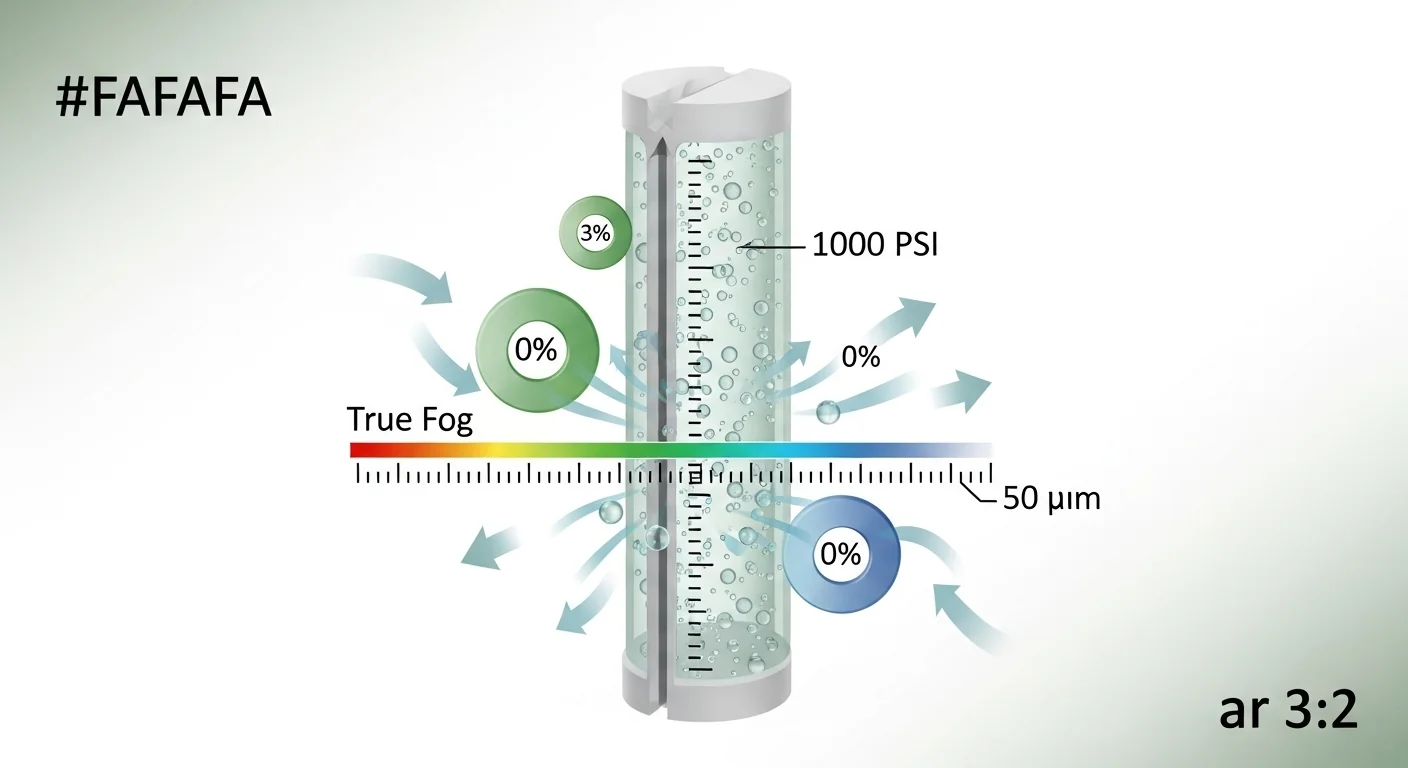
Greenhouse Misting System VPD Cooling Sizer
Calculate required misting flow rate, evaporative cooling potential, and droplet safety — powered by The Yield Grid
—
| Pump PSI | Droplet Size (µm) | Droplet Type | Fungal Risk |
|---|---|---|---|
| 40 | ~200 | Mist (heavy) | CRITICAL |
| 100 | ~130 | Mist (medium) | HIGH |
| 250 | ~80 | Fine Mist | MODERATE |
| 500 | ~55 | Fine Mist | LOW-MOD |
| 1000 | ~25 | True Fog | SAFE |
| 1200 | ~18 | Ultra-Fine Fog | SAFE |
How This Greenhouse Misting Calculator Works
Step 1 — Saturation Vapor Pressure (SVP) via Magnus Formula
SVP(T) = 0.6108 × exp(17.27 × T_C / (T_C + 237.3))   [kPa]
T_C = (T_F − 32) × 5/9   [convert °F to °C]
The Magnus formula gives SVP at any temperature. Used at both ambient and canopy temperatures.
Step 2 — Current VPD (ambient air)
VPD_ambient = SVP(T_ambient) × (1 − RH_ext / 100) [kPa]
Step 3 — Required Target Humidity at Canopy
SVP_canopy = SVP(T_canopy)
RH_target = (1 − VPD_target / SVP_canopy) × 100   [%]
Step 4 — Wet Bulb Temperature & Depression
T_wb ≈ T_amb × atan(0.151977 × (RH + 8.313659)^0.5)
       + atan(T_amb + RH) − atan(RH − 1.676331)
       + 0.00391838 × RH^1.5 × atan(0.023101 × RH) − 4.686035
WBD (Wet Bulb Depression) = T_amb − T_wb   [°F]
Wet Bulb Depression quantifies available evaporative cooling potential. Larger WBD = drier air = more cooling possible.
Step 5 — Humidity Ratio (grains of water per lb of dry air)
HumRatio(T, RH) = 0.62198 × (SVP(T) × RH/100) / (101.325 − SVP(T) × RH/100)
                     [kg/kg dry air]
ΔHumRatio = HumRatio(T_ambient, RH_target) − HumRatio(T_ambient, RH_ext)
SpecificVolume ≈ 0.287 × (T_amb_C + 273.15) / 101.325   [m³/kg]
Step 6 — Required Misting Flow Rate (GPH)
CFM_SI = CFM × 0.000471947   [m³/s]
Required GPH = max(0, ΔHumRatio / SpecificVolume × CFM_SI × 3600 × 264.172)
This converts the humidity deficit at the ventilation rate into gallons per hour of water the misting system must evaporate.
Step 7 — Droplet Size Estimation
If PSI ≥ 1000  → Droplet ≈ 25 µm  (True Fog — evaporates in air)
If PSI ≥ 800   → Droplet ≈ 35 µm  (Near-fog)
If PSI ≥ 500   → Droplet ≈ 55 µm  (Fine Mist — marginal)
If PSI ≥ 250   → Droplet ≈ 80 µm  (Fine Mist — risky)
If PSI ≥ 100   → Droplet ≈ 130 µm (Heavy Mist — HIGH RISK)
If PSI  < 100  → Droplet ≈ 200 µm (Very Heavy — CRITICAL)
The Fungal Rain Threshold is 50 µm. Droplets above 50 µm are too heavy to evaporate in air; they fall on leaf surfaces and create the ideal environment for Botrytis (bud rot) and Powdery Mildew.
Assumptions & Limits
- Temperature inputs accepted in °F (32–130 °F). Internally converted to °C for psychrometric calculations.
- Assumes sea-level atmospheric pressure (101.325 kPa). High-altitude operations will require ~3–5% higher GPH to achieve the same evaporation rate.
- Humidity ratio formula uses standard dry air molecular weight ratio (0.62198).
- Wet bulb approximation uses the Stull (2011) empirical formula — accurate within ±0.3°C for RH 5–99% and temp 0–55°C.
- Droplet size model is a tiered approximation; actual droplet size depends on nozzle orifice diameter and flow rate in addition to pressure.
- GPH result assumes 100% evaporation efficiency in ideal conditions. In practice, target 15–25% safety margin above the calculated GPH.
- Canopy temperature assumed constant; actual leaf temperature may fluctuate with radiation load.
- Does not account for infiltration losses or doors being open.
- Target RH values above 95% or below 20% are flagged as impractical.
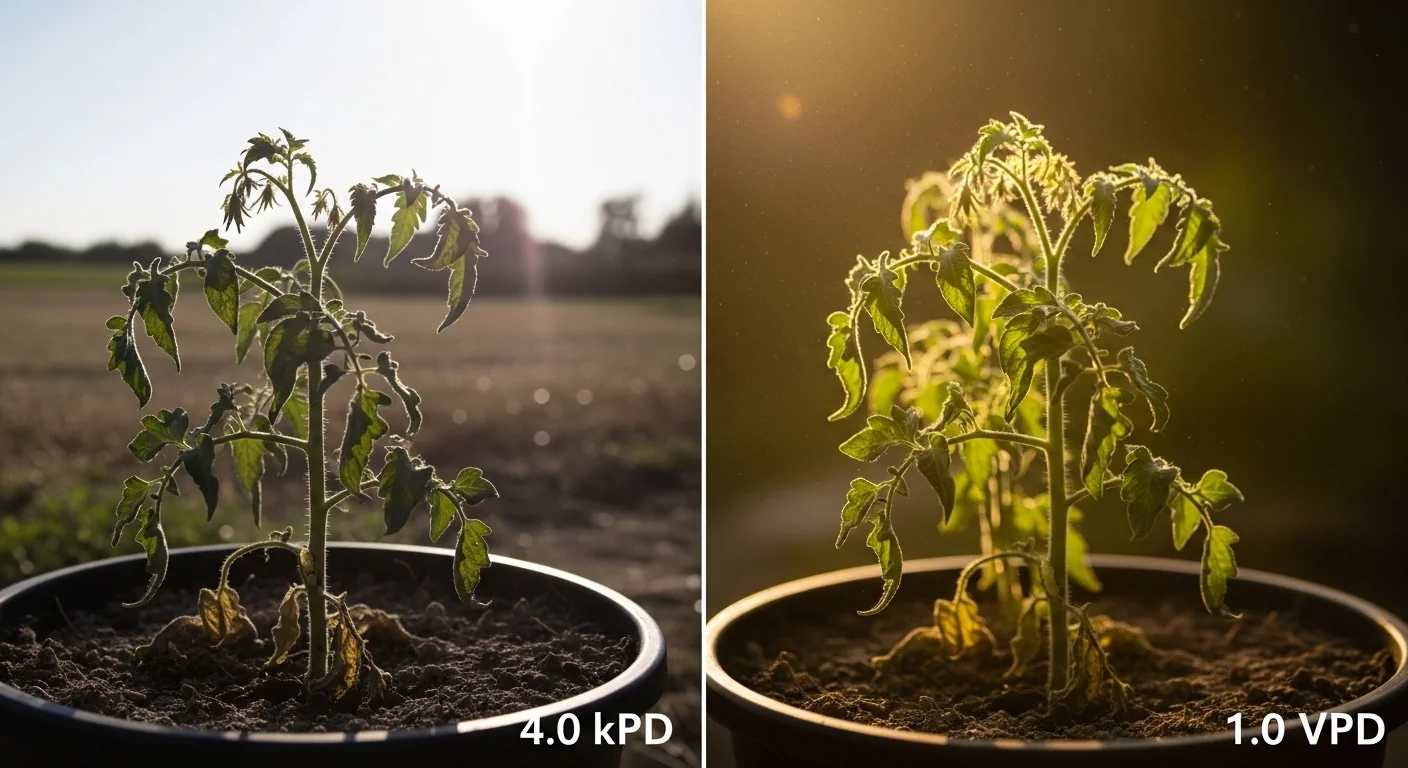
Every greenhouse cooling problem starts the same way: the air is too hot, the vapor pressure deficit (VPD) is too high, and plants are shutting down their stomata. Operators reach for a misting system, which is the correct instinct. But the fatal error happens before a single nozzle is installed, at the pump selection stage, because VPD control requires fog, and most misting hardware sold to hobbyists and small commercial growers produces something closer to drizzle. This calculator forces you to confront that distinction before your crop pays the price.
The tool calculates required gallons per hour (GPH) of water your misting system must evaporate to shift your greenhouse from its current ambient conditions to your target VPD, using the Magnus saturation vapor pressure formula, a wet bulb depression estimate, and a humidity ratio mass balance. It also estimates the droplet size produced by your pump pressure and flags whether those droplets are capable of evaporating in the air column or will fall on plant surfaces. What the tool does not do: it does not account for infiltration from open vents, it does not model radiation load on the canopy, and it assumes sea-level atmospheric pressure throughout.
After running this calculator, you will know exactly whether your current or planned pump PSI is in the true fog zone (under 50 microns) or the crop-destroying fungal rain zone, and you will have the GPH target needed to size pump capacity, nozzle count, and timer intervals correctly.
Use the Tool
Before entering values, gather your greenhouse interior dimensions (not exterior), a current weather reading for ambient temperature and relative humidity, your ventilation fan's rated CFM, and the pressure rating printed on your misting pump or listed in its spec sheet. Canopy temperature can be measured with an infrared thermometer pointed at the top of your plant canopy, or estimated at 4 to 6 degrees Fahrenheit below ambient air temperature. If you need to size your ventilation system first, the greenhouse fan calculator will give you a CFM baseline to plug in here.
Quick Start (60 Seconds)
- Length, Width, Height: Measure interior floor dimensions and peak wall/ridge height in feet. Do not use exterior dimensions or roofline slope lengths.
- External Ambient Temperature: Use current outdoor air temperature in degrees Fahrenheit, not the temperature inside the greenhouse. Range accepted: 32 to 130 F.
- External Relative Humidity: Enter as a whole number (1 to 99). Common input mistake: entering 0.45 instead of 45 for 45% RH.
- Target VPD: Enter in kilopascals (kPa). Vegetative stage: 0.8 to 1.2 kPa. Flowering or fruiting: 1.0 to 1.5 kPa. Do not enter values above 2.0 kPa as a target; you will never achieve them by misting alone.
- Air Exchange Rate (CFM): Use your fan's rated capacity. If you have multiple fans, add their CFM totals. A common mistake is using nominal horsepower instead of actual airflow spec.
- Misting Pump Pressure (PSI): Check your pump's nameplate or product listing. Standard garden misters run 40 to 60 PSI. High-pressure systems designed for evaporative cooling run 800 to 1200 PSI.
- Canopy Temperature: Must be at or below ambient air temperature. If you do not have an infrared measurement, subtract 4 F from your ambient reading as a conservative default.
Inputs and Outputs (What Each Field Means)
| Field | Unit | What It Represents | Common Mistake | Safe Entry Guidance |
|---|---|---|---|---|
| Greenhouse Length | ft | Interior floor length | Using exterior dimensions including wall thickness | Measure inside wall to inside wall |
| Greenhouse Width | ft | Interior floor width | Using peak-to-peak gutter span on gothic arch designs | Measure interior ground-level span |
| Greenhouse Height | ft | Average interior height (eave or peak for gutter-connected) | Entering peak ridge height instead of eave height | Use eave height for Venlo-style; use 2/3 of peak for gothic arch as approximation |
| External Ambient Temperature | °F | Outdoor dry-bulb air temperature | Entering greenhouse interior temp, which is already elevated | Pull from a shaded outdoor sensor or current weather reading |
| External Relative Humidity | % | Outdoor relative humidity as a percentage (1 to 99) | Entering decimal (0.35 instead of 35) | Whole number between 1 and 99 |
| Target VPD | kPa | Desired vapor pressure deficit at the leaf surface | Entering a target that is achievable only at 100% RH, which enables disease | Stay in the range 0.4 to 1.8 kPa depending on crop stage |
| Air Exchange Rate | CFM | Total ventilation fan airflow capacity in cubic feet per minute | Using installed motor HP rather than rated airflow output | Sum all fan CFM ratings; use 80% of rated if fans are older than 5 years |
| Misting Pump Pressure | PSI | Operating pressure at the pump outlet | Entering line supply pressure instead of pump outlet pressure | Read from pump nameplate or spec sheet; garden supply lines are typically 40 to 80 PSI |
| Canopy / Leaf Temperature | °F | Leaf surface temperature used to compute stomatal VPD | Using air temperature, which overestimates SVP at the leaf | Infrared thermometer reading; must be below ambient air temp |
| Required Misting Rate (OUTPUT) | GPH | Gallons per hour the system must evaporate to meet VPD target | Treating this as total water flow rather than evaporation rate | Add a 15 to 25% safety margin when selecting pump capacity |
| Droplet Size Estimate (OUTPUT) | µm | Approximate droplet diameter at the entered pump PSI | Assuming high PSI alone guarantees small droplets without checking nozzle orifice size | Verify nozzle orifice diameter is 0.10 to 0.20 mm for high-pressure systems |
| Wet Bulb Depression (OUTPUT) | °F | Difference between dry-bulb and wet-bulb temperature; indicates evaporative cooling potential | Expecting large cooling when WBD is small (already humid air) | Values below 5 F indicate limited evaporative cooling available regardless of pump size |
Wet bulb depression is closely related to dew point depression. If you need the dew point of your ambient air for cross-referencing sensor readings, the dew point calculator uses the same ambient temperature and RH inputs.
Worked Examples (Real Numbers)
Scenario 1: Small Desert Hobby Greenhouse in a Heat Event
- Dimensions: 30 ft long, 12 ft wide, 10 ft tall (3,600 ft³)
- Ambient temperature: 98 F, Ambient RH: 25%
- Canopy temperature: 92 F
- Target VPD: 1.2 kPa
- Air exchange rate: 360 CFM
- Pump pressure: 1000 PSI
Result: Required misting rate approximately 3.8 GPH. Ambient VPD 4.6 kPa (extreme stress). Estimated droplet size 25 µm (true fog, fungal risk eliminated). Required canopy RH to hit target VPD: approximately 77%. ACH: 6.
Desert summer conditions produce extreme VPD even at moderate temperatures. A 360 CFM fan in this volume creates 6 air changes per hour, giving the misting system frequent fresh, dry air to absorb fog. At 1000 PSI, the 3.8 GPH evaporation requirement stays well within typical 2-nozzle high-pressure station capacity.
Scenario 2: Commercial Tomato Greenhouse with a Low-Pressure Garden Mister
- Dimensions: 200 ft long, 40 ft wide, 16 ft tall (128,000 ft³)
- Ambient temperature: 88 F, Ambient RH: 45%
- Canopy temperature: 84 F
- Target VPD: 1.0 kPa
- Air exchange rate: 8,000 CFM
- Pump pressure: 60 PSI (standard garden mister)
Result: Required misting rate approximately 36.6 GPH. Ambient VPD 2.5 kPa (high stress). Estimated droplet size 200 µm. Fungal Rain Warning active: droplets will not evaporate and will wet foliage continuously.
This is the scenario the Secret Sauce was built to expose. The 36.6 GPH flow rate looks manageable, and the system would reduce VPD on paper, but every gallon per hour lands on leaf surfaces as rainfall at 60 PSI. Botrytis spore germination begins within hours of continuous leaf wetness at temperatures above 65 F.
Scenario 3: Cannabis Flower Room in a Glass Greenhouse
- Dimensions: 60 ft long, 30 ft wide, 14 ft tall (25,200 ft³)
- Ambient temperature: 82 F, Ambient RH: 55%
- Canopy temperature: 78 F
- Target VPD: 1.2 kPa
- Air exchange rate: 1,800 CFM
- Pump pressure: 1000 PSI
Result: Required misting rate approximately 1.9 GPH. Ambient VPD 1.68 kPa (slightly elevated). Estimated droplet size 25 µm (true fog). Required canopy RH to hit target: approximately 63%. ACH: 4.3.
When ambient humidity is already moderate, the delta humidity ratio is small and the required GPH is low. This is a maintenance misting scenario rather than a crisis cooling scenario. A single-pump high-pressure station running on a humidistat cycle is sufficient. The real risk here is growers over-misting based on intuition, pushing RH above 70% and creating the Botrytis conditions the high-pressure system was supposed to prevent.
Reference Table (Fast Lookup)
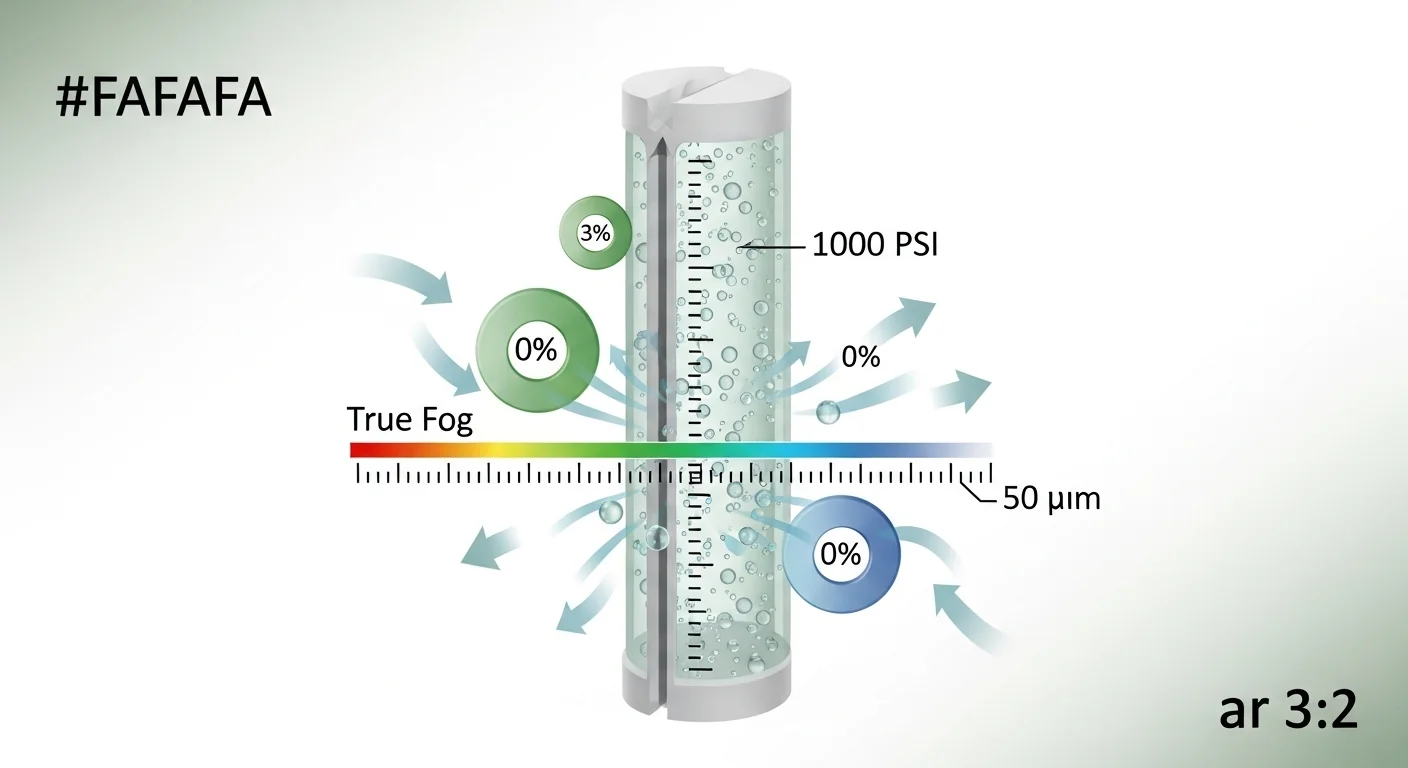
The table below shows how pump pressure determines droplet size and evaporation outcome. The "Evaporation in Air" column is the derived result: whether a droplet of that diameter can fully evaporate before reaching plant surfaces under typical greenhouse air speed (0.5 to 1.0 m/s). Values at the 50 µm threshold are the regulatory line between cooling fog and pathogen-delivering rain.
| Pump PSI | Droplet Size (µm) | Classification | Evaporates in Air | Fungal Rain Risk | Typical Application |
|---|---|---|---|---|---|
| 40 to 60 | ~200 | Heavy Mist | No | Critical | Dust suppression, livestock cooling only |
| 100 | ~130 | Medium Mist | No | High | Outdoor patios, not suitable for enclosed plant canopies |
| 250 | ~80 | Fine Mist | Partial | Moderate | Open-sided shade structures; marginal for enclosed greenhouses |
| 500 | ~55 | Fine Mist | Partial to marginal | Low to Moderate | Borderline; nozzle type and air speed determine outcome |
| 800 | ~35 | Near-Fog | Yes, under typical greenhouse airflow | Low | Acceptable for lower-canopy crops with adequate airflow |
| 1000 | ~25 | True Fog | Yes | Eliminated | Standard for enclosed commercial greenhouse evaporative cooling |
| 1200 | ~18 | Ultra-Fine Fog | Yes | Eliminated | High-density cannabis and propagation environments |
| 1500+ | ~12 to 15 | Aerosol-Class Fog | Yes | Eliminated | Sterile propagation, tissue culture rooms |
The 50 µm threshold is the non-negotiable line. Below it, droplets behave like fog and evaporate within the air column. Above it, they behave like rain and deposit directly on plant tissue, no matter how briefly the system runs.
How the Calculation Works (Formula + Assumptions)
Show the calculation steps
Step 1: Saturation Vapor Pressure (SVP)
The Magnus approximation converts temperature to saturation vapor pressure in kilopascals. All temperatures are converted from Fahrenheit to Celsius internally before this formula is applied: T_C = (T_F minus 32) times 5/9. Then SVP = 0.6108 times exp(17.27 times T_C divided by (T_C plus 237.3)). This runs separately for ambient air temperature and for canopy temperature.
Step 2: Ambient VPD
Current VPD in kPa = SVP(ambient) times (1 minus RH_external divided by 100). This tells you the actual moisture deficit the plant is experiencing before any misting.
Step 3: Target Relative Humidity at the Canopy
To hit the user-specified target VPD, the required RH at canopy temperature is: RH_target = (1 minus VPD_target divided by SVP(canopy)) times 100. This value is clamped between 20 and 99 to exclude physically impractical targets.
Step 4: Wet Bulb Temperature and Depression
The Stull (2011) empirical formula estimates wet bulb temperature in Celsius from ambient temperature and RH. Wet Bulb Depression (WBD) = ambient dry-bulb minus wet-bulb temperature, converted to Fahrenheit. A larger WBD means drier air and greater evaporative cooling potential. WBD values below 5 F indicate that the air is already near saturation and misting will have limited cooling effect.
Step 5: Humidity Ratio and Delta
Humidity ratio converts relative humidity into kilograms of water per kilogram of dry air: HR = 0.62198 times (SVP times RH/100) divided by (101.325 minus SVP times RH/100). The delta humidity ratio (ΔHR) is the difference between the humidity ratio at the target RH and the current ambient RH. This delta, multiplied by the mass flow of dry air through the greenhouse, gives the water mass the misting system must add per second.
Step 6: Required GPH
CFM is converted to SI units (m³/s = CFM times 0.000471947). Specific volume of moist air at ambient temperature is estimated as 0.287 times (T_C plus 273.15) divided by 101.325 (m³/kg). Required GPH = (ΔHR divided by specific volume) times CFM_SI times 3600 (seconds per hour) times 264.172 (gallons per m³) divided by 1000 (kg water per m³). If ΔHR is zero or negative, no misting is needed and the result displays as 0 GPH.
Step 7: Droplet Size
Droplet size is a tiered lookup based on pump PSI: 1000+ PSI maps to approximately 25 µm, 800+ to 35 µm, 500+ to 55 µm, 250+ to 80 µm, 100+ to 130 µm, and below 100 PSI to approximately 200 µm. The Fungal Rain threshold is 50 µm.
Assumptions and Limits
- Sea-level atmospheric pressure (101.325 kPa) is assumed throughout. Facilities above 2,000 ft elevation will need higher GPH to compensate for lower air density.
- The Stull (2011) wet bulb approximation is accurate within approximately 0.3 degrees Celsius for RH between 5 and 99% and temperatures between 0 and 55 degrees Celsius.
- Droplet size values are tiered approximations. Actual droplet diameter depends on nozzle orifice size (0.10 to 0.20 mm for high-pressure systems) as well as pressure.
- Required GPH assumes 100% evaporation efficiency. Real-world efficiency depends on air speed, humidity, and nozzle distribution pattern. Add 15 to 25% capacity margin when sizing equipment.
- The tool does not model infiltration from open vents, doors, or wall gaps. Buildings with poor sealing will require proportionally higher GPH than calculated.
- Canopy temperature is treated as constant. In practice it fluctuates with solar radiation load and can spike 8 to 15 F above ambient under direct sun in a glass greenhouse.
- The formula computes a steady-state requirement. Systems run on timed cycles rather than continuously, and actual cycle duration must account for the duty cycle efficiency.
- Target RH values above 95% are physically impractical to maintain and create high-humidity disease risk. The tool clamps RH_target at 99%.
Standards, Safety Checks, and "Secret Sauce" Warnings
Critical Warnings
- The 50 Micron Fungal Rain Line: Any misting system operating below 1000 PSI with standard 0.20 mm or larger orifice nozzles will produce droplets larger than 50 µm. These droplets do not evaporate in the air column under typical greenhouse airflow speeds. They fall directly onto plant tissue. Continuous leaf wetness at temperatures above 60 F triggers Botrytis cinerea (bud rot) spore germination and Powdery Mildew colony establishment, often within 12 to 24 hours of the first wet event.
- VPD Does Not Validate Droplet Safety: A low-pressure misting system can technically reduce measured RH and VPD readings at a sensor. The sensor does not know whether that humidity came from evaporated fog or from rain that fell on every leaf in the house. VPD instrument readings and crop health are two different things when droplet size is wrong.
- Pump Pressure Drops Along the Line: A pump rated at 1000 PSI delivers that pressure at the pump outlet. Pressure drops along the supply line due to friction. A 200-foot nylon run with 30 nozzles may arrive at the last nozzle at 750 PSI, pushing droplets back into the 35 to 40 µm range. Size lines and nozzle counts to maintain at least 900 PSI at the farthest nozzle.
- Over-Misting to Compensate for Heat: When WBD is low (ambient RH above 80%), evaporative cooling capacity is physically limited regardless of GPH or pump size. Running a misting system harder than the WBD supports does not increase cooling; it deposits liquid water. Monitor WBD as a real-time cap on what misting can achieve.
Minimum Standards
- Pump pressure: 1000 PSI minimum for enclosed greenhouse evaporative cooling applications where plant canopy is present.
- Nozzle orifice: 0.10 to 0.15 mm stainless steel anti-drip nozzles required at 1000 PSI to produce sub-50 µm droplets and prevent drip-on at shutdown.
- GPH safety margin: Size pump capacity to deliver at least 120% of the calculated required GPH to account for efficiency losses and line pressure drop.
- Environmental controller: A VPD-based humidistat controller with adjustable setpoints is the minimum acceptable automation for production greenhouses. Timed cycles alone cannot respond to ambient condition changes and will over-mist during low-WBD periods.
The Competitor Trap: Most articles and product listings for greenhouse misting systems lead with flow rate (GPH or liters per hour) and nozzle count as the primary sizing criteria. Flow rate is the output variable, not the design variable. The design variable is pump pressure, because pressure determines whether water becomes fog or becomes rain. A 10-GPH system at 60 PSI will destroy a crop. A 10-GPH system at 1000 PSI will protect it. Specifying a system by GPH without specifying minimum operating PSI is like specifying a ventilation system by cubic feet without specifying whether the air moves or sits still.
Humidity control in greenhouses does not stop with misting. During cooler periods, high ambient humidity becomes a problem in the opposite direction. The grow room dehumidifier calculator handles the removal side of that equation, and the two tools work as paired bookends for year-round climate management. Winter heating introduces another humidity complication: heated air carries lower absolute humidity and will spike VPD sharply, which is covered in detail by the greenhouse heater sizing guide.
Common Mistakes and Fixes
Mistake: Using Line Pressure Instead of Pump Pressure for PSI Input
Municipal or well supply lines in most regions deliver 40 to 80 PSI. Operators plug this number in and see "low pressure warning" and assume there is a data entry error. There is not. The supply line feeds the pump; the pump multiplies pressure. A 1000 PSI pump fed by a 60 PSI line outputs 1000 PSI at the manifold. Enter the pump outlet pressure, not the water supply inlet pressure.
Fix: Check the pump's nameplate or product page for rated operating pressure (PSI) and enter that value.
Mistake: Ignoring Wet Bulb Depression as a Cooling Limit
On a humid summer afternoon when ambient RH is already 80%, operators run their misting system at full duty cycle expecting a 10-degree temperature drop. The physics do not support it. When WBD is 3 F, the maximum achievable evaporative cooling is roughly 2 to 3 F regardless of nozzle count or flow rate. The remaining water has nowhere to go but onto the plants.
Fix: Check the WBD output before operating your system. If WBD falls below 5 F, consider reducing misting duty cycle and relying on ventilation until ambient RH drops.
Mistake: Sizing by Floor Area Instead of Volume
Many reference guides suggest 1 nozzle per 100 to 150 square feet of floor area. This rule of thumb ignores ceiling height, which directly determines air volume and therefore the humidity ratio delta the system must overcome. A 10-foot ceiling and a 16-foot ceiling over the same floor footprint require materially different GPH to achieve the same VPD shift.
Fix: Always size from volume (L times W times H) and actual CFM, as this calculator requires. Nozzle distribution patterns should follow manufacturer spacing guidelines for the specific pump pressure being used.
Mistake: Setting a VPD Target That Requires Near-Saturation RH
A target VPD of 0.2 kPa at a canopy temperature of 75 F requires RH above 94%. At that humidity level, disease pressure becomes severe and the cure is worse than the problem. Operators chasing ultra-low VPD targets often end up with Powdery Mildew outbreaks indistinguishable from those caused by fungal rain from a low-pressure system.
Fix: Keep target VPD in the 0.6 to 1.5 kPa range for most crops. If your crop stage genuinely requires lower VPD, pair high humidity operation with enhanced air circulation to displace the stagnant humid boundary layer from leaf surfaces.
Mistake: Treating Calculated GPH as a Flow Rate Rather Than an Evaporation Rate
The tool outputs required evaporation in GPH. If your pump delivers 5 GPH through nozzles but the air can only absorb 2 GPH of evaporation given the current WBD, the remaining 3 GPH falls as rain. Required GPH is a maximum ceiling set by atmospheric capacity, not a target to hit with hardware volume alone.
Fix: Treat the calculated GPH as a rate the atmosphere can receive, and use a humidistat or VPD controller to modulate actual run time rather than running the system continuously at rated flow.
Next Steps in Your Workflow
After confirming your required GPH and verifying your pump PSI puts you in the true fog zone, the next layer of optimization is integrating your misting system into a broader environmental control strategy. VPD is not just a humidity number; it reflects the interaction between temperature, humidity, and plant physiology across the entire growth cycle. If you are dialing in specific vegetative and flower targets, the crop steering calculator maps out how VPD targets shift across stages and how misting schedule adjustments interact with irrigation timing to steer plant development.
Climate control in a greenhouse is a system of coupled variables, not a collection of isolated knobs. After misting is dialed in, CO2 enrichment becomes the next constraint on photosynthetic rate. Stomata that are operating at the correct VPD open further when CO2 is available, amplifying the return on your misting investment. The greenhouse CO2 calculator handles the enrichment side of that equation and accounts for the ventilation rate you already calculated here.
FAQ
What GPH should a greenhouse misting system produce?
Required GPH depends on your greenhouse volume, ventilation rate, ambient temperature, ambient relative humidity, and your target VPD. There is no universal number. A small hobby greenhouse in a dry desert climate may need 3 to 6 GPH. A large commercial house in a humid subtropical climate during a heat event may require 30 to 80 GPH. This calculator produces the exact figure for your specific conditions.
What PSI do I need for a greenhouse misting system?
A minimum of 1000 PSI at the pump outlet is the standard for enclosed greenhouse evaporative cooling where plant canopy is present. Systems below 1000 PSI produce droplets larger than 50 µm that do not evaporate in the air column and create continuous leaf wetness, which is the primary trigger for Botrytis and Powdery Mildew outbreaks.
How does VPD relate to greenhouse misting?
VPD (Vapor Pressure Deficit) measures the difference between the amount of moisture the air can hold and the amount it actually holds. High VPD means dry air that stresses plants by forcing excessive transpiration. Misting adds water vapor to the air, reducing VPD toward a target. The correct amount of misting is determined by the humidity ratio delta between current and target conditions at your ventilation rate.
What is the "Fungal Rain" problem in greenhouse misting?
Fungal rain is the condition where a misting system produces droplets large enough (above 50 µm) to fall onto leaf surfaces rather than evaporate in the air. The result is continuous foliage wetting, which creates ideal germination conditions for Botrytis cinerea (bud rot) and Powdery Mildew. It is caused by operating a misting system at low pressure (below 800 PSI) and is the most commonly overlooked failure mode in greenhouse climate design.
Can I use a standard garden mister for greenhouse cooling?
Standard garden misters operate at 40 to 80 PSI and produce droplets in the 130 to 200 µm range. These droplets cannot evaporate in enclosed greenhouse air before reaching plant surfaces. For humidity control and evaporative cooling in an enclosed greenhouse with a plant canopy, a dedicated high-pressure pump station rated at 1000 PSI or above with 0.10 to 0.15 mm anti-drip stainless steel nozzles is required.
What is wet bulb depression and why does it matter for misting?
Wet bulb depression (WBD) is the difference between the dry-bulb (standard) temperature and the wet-bulb temperature of the air. It quantifies how much evaporative cooling is physically possible given the current humidity. A large WBD (10 or more degrees Fahrenheit) indicates dry air with significant cooling potential. A small WBD (below 5 degrees Fahrenheit) means the air is already near saturation and misting will have minimal cooling effect while adding disease risk.
Conclusion
The greenhouse misting calculator reframes evaporative cooling design around a variable most system vendors never mention: pump pressure as a determinant of droplet size, and droplet size as a binary switch between cooling fog and crop-destroying rain. Getting the GPH right matters. Getting the PSI right matters more. A correctly sized high-pressure system running at the right duty cycle based on real VPD feedback is the difference between a plant environment that performs and one that breeds pathogens on a tight schedule.
The single most avoidable mistake in this entire workflow is selecting a misting system based on flow rate alone without verifying pump pressure. If the spec sheet for your planned system does not list a minimum operating PSI of 800 or above, the product is not designed for enclosed plant environments regardless of what its marketing copy says. Run this calculator first, confirm your droplet size is in the safe zone, and size your pump capacity to deliver at least 20% above the calculated GPH. For further context on shading as a complementary temperature reduction strategy that reduces the misting load during peak radiation hours, the shade cloth percentage calculator pairs directly with this tool for summer climate planning.