
Pesticide application rate errors are not a measurement inconvenience. They are a federal compliance failure. The number that matters to regulators is not how many bags or ounces you applied. It is the mass of active ingredient delivered per acre of treated ground, because that is the figure tied to groundwater exposure limits, ecological risk thresholds, and EPA label law. When applicators skip this calculation, they often do not know they exceeded the legal limit until enforcement creates consequences that are difficult to reverse.
This calculator takes the product label inputs you already have and converts them into the active ingredient load figure the law cares about: lbs A.I. per acre. It flags whether that figure is within the federal annual limit printed on the label, flags the proximity to the compliance threshold, and returns a recommended split-application rate so seasonal allowances stay intact. It does not predict drift, model groundwater movement, or substitute for a certified applicator’s judgment in commercial contexts. For dilution ratio work separate from A.I. load, the pesticide dilution calculator handles tank-mix concentration math independently.
After running this tool, you will know whether your planned product rate is legally compliant, how much headroom remains in your seasonal A.I. allowance, and at what application rate the federal ceiling becomes a real constraint for your specific product concentration.
Use the Tool
Active Ingredient per Acre Legal Limit Sizer
Calculate your A.I. load and check against EPA federal limits before application
Before entering values, pull the physical product label. You will need the full product name, the active ingredient percentage printed on the front panel, the per-acre product rate from the directions for use, and the annual A.I. limit from the environmental hazards or application restrictions section. Area can be entered in acres or converted from square footage using the unit selector. If you routinely calculate application volumes before mixing, the fertilizer dilution calculator covers the parallel math for nutrient products mixed in liquid systems.
Quick Start (60 Seconds)
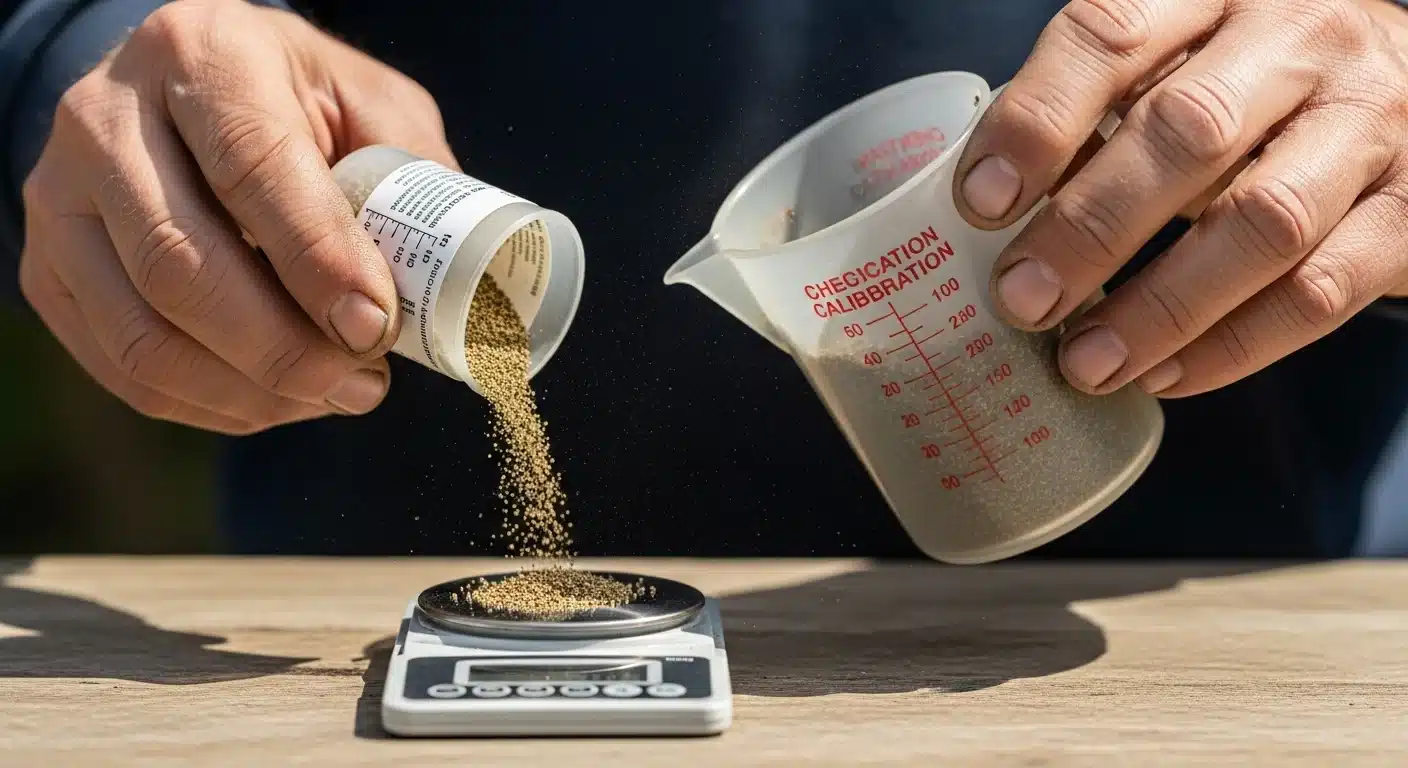
- Chemical / Product Label Name: Enter the full product name exactly as printed. This field is for your own records and does not affect the math, but accurate labeling matters if you save results for compliance documentation.
- Target Area: Use the actual treated area, not the property size. Select "Acres" or "1,000 sq ft" from the dropdown. The calculator converts 1,000 sq ft units to acres using the standard 43,560 sq ft per acre factor.
- Product Concentration (% A.I.): This is the active ingredient percentage on the front of the product label. For Prodiamine 65 WDG, this is 65. Do not enter the decimal form (0.65); enter the percentage figure directly.
- Lbs of Product per Acre: Enter the product application rate from your label's directions-for-use table, not the A.I. rate. This is the physical product weight, before the concentration math is applied.
- Federal Max Yearly A.I. Limit: Find this in the label's "Application Restrictions" or "Environmental Hazards" section. It is expressed as lbs A.I. per acre per year. If the label states a seasonal limit, that is the number to enter here.
- Unit check: All weight values must be in pounds. If your label gives rates in ounces, divide by 16 before entering.
- Multiple applications: If this is not your first application of the season, the limit entered should reflect remaining headroom, not the full annual ceiling. The calculator does not track cumulative seasonal applications automatically.
Inputs and Outputs (What Each Field Means)
| Field | Unit | What It Means | Common Mistake | Safe Entry Guidance |
|---|---|---|---|---|
| Chemical / Product Label Name | Text | Product identifier for documentation; not used in calculation | Leaving blank or entering a nickname instead of full label name | Copy exactly from the product bag or container |
| Target Area | Acres or 1,000 sq ft | Total area receiving this application | Using property size instead of actual treated footprint | Measure or confirm with a site plan; select the correct unit from the dropdown |
| Product Concentration (% A.I.) | Percent (%) | Mass of active ingredient as a fraction of total product mass | Entering the decimal (0.65) instead of the percentage (65) | Read from the Guaranteed Analysis or Active Ingredient panel on the front label |
| Lbs of Product per Acre | lbs / Acre | Physical product mass applied per unit of treated area | Confusing the product rate with the A.I. rate listed separately on some labels | Use the rate from the Directions for Use table; check ounces vs. pounds |
| Federal Max Yearly A.I. Limit | lbs A.I. / Acre / Year | EPA-enforced annual ceiling for this active ingredient on this site | Using a per-application rate instead of the annual cumulative limit | Look specifically for "do not apply more than X lbs A.I. per acre per year" language |
| A.I. per Acre (output) | lbs A.I. / Acre | Active ingredient mass delivered per treated acre this application | Treating this as the full seasonal picture when multiple applications are planned | Compare to the Max Yearly Limit; remember this is per-event, not cumulative |
| Total A.I. Applied (output) | lbs A.I. | Total active ingredient across the entire treated area | Ignoring this figure when thinking about site-wide ecological load | Useful for record-keeping and reporting; not the compliance figure per se |
| Remaining Legal Headroom (output) | lbs A.I. / Acre | How much A.I. per acre remains usable before hitting the annual limit | Assuming headroom means a second full-rate application is automatically safe | Use to plan split applications; a second application must stay within this remaining margin |
| Split Application Rate (output) | lbs A.I. / Acre | Recommended per-application A.I. load when dividing the annual budget into two events | Applying at the full annual limit in round one, then wondering why there is no room for round two | Use as the target ceiling for each application event when pre-emergent timing requires two passes |
Worked Examples (Real Numbers)
Scenario 1: Prodiamine 65 WDG at a Rate Just Under the Legal Limit
- Product: Prodiamine 65 WDG
- Target Area: 2 acres
- Concentration: 65% A.I.
- Product Rate: 3.5 lbs / Acre
- Federal Max Yearly Limit: 2.3 lbs A.I. / Acre
Result: A.I. per Acre = 3.5 x (65 / 100) = 2.275 lbs A.I./Acre. Total A.I. applied across 2 acres = 4.55 lbs. Limit usage = 98.9% of the annual ceiling. Remaining headroom = 0.025 lbs A.I./Acre.
This application is technically within the federal limit, but with only 0.025 lbs A.I./Acre remaining, any second application at the same rate would push the seasonal total past 2.3 lbs. The traffic-light indicator returns yellow (caution), not green. A second treatment would need to stay below 0.025 lbs A.I./Acre, meaning a product rate of approximately 0.038 lbs/Acre at 65% concentration, which is not a practical application rate. In effect, this rate consumes the entire annual budget in one pass.
Scenario 2: 50% Concentration Product Applied at a Rate That Triggers a Violation
- Product: Generic 50% A.I. herbicide (WG formulation)
- Target Area: 1 acre
- Concentration: 50% A.I.
- Product Rate: 5 lbs / Acre
- Federal Max Yearly Limit: 2.3 lbs A.I. / Acre
Result: A.I. per Acre = 5 x (50 / 100) = 2.5 lbs A.I./Acre. Limit exceeded by 0.2 lbs A.I./Acre. Limit usage = 108.7% of annual ceiling. Remaining headroom = negative (violation).
This scenario illustrates the calculation failure that creates real EPA exposure. Five pounds of a 50% product feels conservative in volume terms, but the A.I. load crosses the legal threshold. The tool returns a red compliance flag and calculates the maximum safe product rate at this concentration: 4.6 lbs/Acre (2.3 / 0.50). Reducing the product rate to 4.6 lbs/Acre brings the A.I. load exactly to the limit.
Scenario 3: Compliant Low-Rate Application With Room for a Split Second Pass
- Product: Pre-emergent granular, 65% A.I.
- Target Area: 0.5 acres (approximately 21,780 sq ft)
- Concentration: 65% A.I.
- Product Rate: 2 lbs / Acre
- Federal Max Yearly Limit: 2.3 lbs A.I. / Acre
Result: A.I. per Acre = 2 x (65 / 100) = 1.3 lbs A.I./Acre. Total A.I. on 0.5 acres = 0.65 lbs. Limit usage = 56.5%. Remaining headroom = 1.0 lbs A.I./Acre. Recommended split rate = 1.15 lbs A.I./Acre per application.
At this rate, a second application of the same product at the same rate would bring the seasonal total to 2.6 lbs A.I./Acre, which exceeds the limit. However, reducing the second application's product rate to approximately 1.54 lbs/Acre (1.0 / 0.65) keeps the combined seasonal load at exactly 2.3 lbs A.I./Acre. The headroom figure from the output gives the ceiling for that follow-up pass directly.
Reference Table (Fast Lookup)
Values below assume a product with 65% active ingredient concentration and a federal annual limit of 2.3 lbs A.I./Acre. Adjust proportionally for other concentrations.
| Product Rate (lbs/Acre) | A.I. per Acre (lbs) | % of 2.3 lb Annual Limit | Remaining Headroom (lbs A.I./Acre) | Second Application Feasible at Same Rate? | Compliance Status |
|---|---|---|---|---|---|
| 1.0 | 0.650 | 28.3% | 1.650 | Yes | SAFE |
| 1.5 | 0.975 | 42.4% | 1.325 | Yes | SAFE |
| 2.0 | 1.300 | 56.5% | 1.000 | No (would total 2.6) | SAFE |
| 2.5 | 1.625 | 70.7% | 0.675 | No (would total 3.25) | SAFE |
| 3.0 | 1.950 | 84.8% | 0.350 | No | CAUTION |
| 3.2 | 2.080 | 90.4% | 0.220 | No | CAUTION |
| 3.5 | 2.275 | 98.9% | 0.025 | No | CAUTION |
| 3.55 | 2.308 | 100.3% | -0.008 | No | VIOLATION |
| 4.0 | 2.600 | 113.0% | -0.300 | No | VIOLATION |
| 5.0 | 3.250 | 141.3% | -0.950 | No | VIOLATION |
How the Calculation Works (Formula and Assumptions)
Show the calculation steps
Step 1: Convert area to acres (if using 1,000 sq ft units)
Acres = (Area in 1,000 sq ft x 1,000) / 43,560
Example: 5 units of 1,000 sq ft = 5,000 sq ft / 43,560 = 0.1148 acres
If you enter area directly in acres, this step is skipped.
Step 2: Calculate active ingredient per acre
A.I. per Acre (lbs) = Product Rate (lbs/Acre) x (Concentration / 100)
Example: 3.5 lbs/Acre x (65 / 100) = 2.275 lbs A.I./Acre
Rounding: results are displayed to 4 decimal places to preserve precision near legal thresholds where small differences matter.
Step 3: Calculate total product and total A.I. across the full treated area
Total Product (lbs) = Product Rate (lbs/Acre) x Area (Acres)
Total A.I. (lbs) = A.I. per Acre x Area (Acres)
Step 4: Compliance check
If A.I. per Acre is greater than Federal Max Limit: violation flag is triggered.
If A.I. per Acre is between 80% and 100% of the limit: caution flag is triggered.
If A.I. per Acre is at or below 80% of the limit: compliant status is returned.
Step 5: Split application rate
Split Rate (lbs A.I./Acre) = Federal Max Yearly Limit / 2
This is a conservative planning rate for two-application programs. Each application targeting this rate keeps the combined seasonal total at the full legal ceiling.
Assumptions and Limits
- The tool assumes the product concentration and annual A.I. limit entered are taken directly from the current registered product label. Registration limits change; always use the most recent label revision.
- This calculator treats each calculation as a single-event snapshot. It does not store or accumulate previous application records across sessions. Users with multiple seasonal applications must manually track cumulative A.I. load against remaining headroom.
- The 80% caution threshold is a planning convention used in this tool; it is not a regulatory boundary. The actual federal legal ceiling is 100% of the stated annual limit.
- Area conversion from 1,000 sq ft uses the standard 43,560 sq ft per acre. For non-rectangular sites, area measurement error upstream of this calculator directly affects output accuracy.
- The split application rate returned (Max Limit / 2) assumes two equal applications. Programs with unequal split timing may warrant a different distribution; consult the product label for split-rate guidance if provided.
- This tool covers active ingredient per acre math only. It does not model buffer zone requirements, aerial vs. ground application differences, application timing restrictions, or soil mobility risk for specific active ingredients.
- Commercial and licensed applicators operating under a certified pesticide applicator license may be subject to additional state-level restrictions that set lower per-acre limits than the federal label ceiling.
Standards, Safety Checks, and "Secret Sauce" Warnings
Critical Warnings
- Volume is the wrong unit of measurement. Mixing decisions based on appearance (color, turbidity, "how it feels") produce no legal protection. EPA compliance is calculated in lbs of active ingredient per acre, not in ounces of product per gallon of water or bags per square foot. The label math is the only defensible record.
- Seasonal limits are cumulative, not per-application. An application within the legal limit in April does not reset the counter. If the annual ceiling is 2.3 lbs A.I./Acre and the first application deposited 2.0 lbs, the remaining legal budget for the entire season is 0.3 lbs A.I./Acre, regardless of how many months remain.
- Exceeding the label rate is a federal violation, not a recommendation. Under FIFRA (the Federal Insecticide, Fungicide, and Rodenticide Act), applying a pesticide in a manner inconsistent with its label is unlawful. This applies to exceeding per-acre rates, annual limits, and site-type restrictions.
- Residue carryover compounds the problem. Active ingredients with soil persistence, particularly pre-emergent herbicides applied at or near the annual ceiling, may carry residual activity into the following season. The herbicide carryover calculator can help estimate how much A.I. may remain active in the soil before the next planned application window.
Minimum Standards
- Always source the annual A.I. limit directly from the current registered label, not from a third-party rate guide or prior-season documentation.
- Document application date, product name, lot number, rate applied per acre, total area treated, and calculated A.I. load as a minimum compliance record set.
- When planning a two-application program, run this calculator for both applications before executing either. Confirm the combined A.I. load stays within the annual limit at the planned rates.
- For applications near sensitive areas (water bodies, groundwater recharge zones, organic buffer fields), consult state extension resources in addition to the federal label. Some state registrations impose tighter per-acre A.I. limits than the federal ceiling. The soil pH sulfur calculator is an adjacent example of how soil chemistry context affects product behavior; the same site-specific thinking applies to herbicide selection and rate decisions.
The Competitor Trap: Most guides explain how to dilute a product or how many ounces per gallon to mix. Very few explain that none of those volume calculations are what the EPA measures during an enforcement review. A bag of 65% WDG diluted into 100 gallons and applied at 3.5 lbs product per acre delivers 2.275 lbs A.I. per acre to the field, regardless of what the tank mix looks like visually. Applicators who rely on visual calibration and skip the A.I. per acre step are not cutting corners; they are doing a fundamentally different and legally insufficient calculation.
Common Mistakes and Fixes
Mistake: Entering the A.I. Rate Instead of the Product Rate
Some product labels list both the product application rate and the resulting A.I. rate in separate columns of the use directions table. Entering the A.I. rate into the "Lbs of Product per Acre" field causes the calculator to apply the concentration multiplier twice, producing an output that is far below the actual A.I. load. This error always makes compliance look better than it is.
Fix: Enter the physical product weight per acre. Use the A.I. rate from the label only to cross-check the calculator's output, not as an input.
Mistake: Using a Single Application Rate to Check Annual Compliance When Multiple Applications Are Planned
Running the calculator once and seeing a compliant result does not confirm that the full-season program is compliant. Each subsequent application at the same rate stacks against the same annual ceiling. Two applications at 1.9 lbs A.I./Acre exceed a 2.3 lb annual limit even though each individual application passes the check in isolation.
Fix: Run the calculator for each planned application event. Subtract each result from the remaining headroom before planning the next event. The "Remaining Legal Headroom" output from the first run becomes the effective limit ceiling for the second.
Mistake: Ignoring the Unit Selector When the Area Is Measured in Square Feet
Entering 10,000 (meaning 10,000 sq ft) with the unit selector set to "Acres" tells the calculator you are treating 10,000 acres. The area conversion is automatic and correct only when the unit selector matches how the number was measured. This is most common for residential or commercial turf applications measured in square feet.
Fix: Switch the dropdown to "1,000 sq ft" and enter the area in those units. A 10,000 sq ft property is entered as 10 in "1,000 sq ft" mode.
Mistake: Confusing Product Concentration With Tank-Mix Concentration
The product concentration entered should be the labeled formulation percentage, not the final concentration in the spray tank after dilution. A 65% WDG product diluted into 50 gallons of water per acre does not become a 65% solution; the active ingredient per acre is still determined by the lbs of product applied, not by the gallons mixed. For tank-mix chemistry affecting spray behavior, the non-ionic surfactant ratio calculator handles adjuvant rate decisions separately from A.I. load compliance.
Fix: Use the concentration from the product label's "Active Ingredients" panel. Ignore dilution when filling this field.
Mistake: Assuming the Federal Label Limit Is the Only Regulatory Constraint
The federal label represents the national registration floor. Individual states may have more restrictive application limits, site-type restrictions (e.g., near schools or water bodies), or requirements for certified applicator oversight at certain rate levels that supersede the federal label text. Passing this calculator's compliance check satisfies the federal label math, but not necessarily state law.
Fix: Cross-reference the application plan against the state pesticide regulatory agency's guidance and, for commercial applications, confirm against the applicable certified applicator license requirements in the jurisdiction of application.
Next Steps in Your Workflow
Once you have confirmed that the planned A.I. per acre is within the federal limit and reviewed headroom for subsequent applications, the next practical step is documenting the calculation alongside the application record. Many state pesticide enforcement programs require applicators to maintain records that include the product name, EPA registration number, rate applied, target site, and date. Keeping the A.I. per acre figure in that record makes it simple to demonstrate compliance during a records inspection without having to reconstruct the math retroactively.
If the treated area is part of a broader soil and crop management plan, the A.I. calculation is typically one step within a larger fertility and protection workflow. After completing your herbicide application planning, running the NPK calculator alongside the treated area data helps integrate herbicide timing with fertility applications that may follow. For turf management contexts where pre-emergent herbicide timing aligns with fertilizer programs, the lawn fertilizer calculator helps coordinate application windows without overloading treatment schedules.
FAQ
What is active ingredient per acre, and why does the EPA use it instead of product volume?
Active ingredient per acre is the mass of the biologically active compound in a pesticide formulation delivered to each acre of treated ground. The EPA regulates this figure because the same A.I. load can be delivered in very different product volumes depending on formulation concentration. Volume is a container measurement; active ingredient per acre is the ecotoxicological exposure measurement that matters for environmental risk assessment.
Where do I find the federal maximum yearly A.I. limit on a product label?
Look in the "Application Restrictions," "Directions for Use," or "Environmental Hazards" section of the product label. The language typically reads: "Do not apply more than [X] lbs of active ingredient per acre per year." It may also appear in a rate table footnote. If the label does not state an annual limit, check the product's EPA registration documents or contact the registrant directly.
What happens if I accidentally exceed the EPA annual A.I. limit per acre?
Applying a pesticide in a manner inconsistent with its label is a federal violation under FIFRA. Consequences range from warning letters for first-time non-commercial applicators to civil penalties and license suspension for certified applicators. Environmental consequences may include groundwater contamination findings, crop injury claims in adjacent fields, and mandatory remediation if the exceedance is documented during an inspection.
Is the 80% caution threshold used in this calculator a regulatory standard?
No. The 80% threshold is a planning buffer built into this tool to flag applications that are technically compliant but leave very little room for a follow-up application within the same season. The actual regulatory ceiling is 100% of the labeled annual limit. The caution zone is a practical signal, not a legal boundary. Some applicator training programs suggest a similar safety margin for exactly this reason, but it is not codified in EPA regulations.
How does the split application rate recommendation work?
The split rate is calculated as half the annual A.I. limit (Max Limit / 2). It represents a conservative target for each of two equal application events within a season. Applying at or below this rate in round one ensures that a second application at the same rate keeps the combined seasonal total at exactly the legal ceiling, providing a clean two-pass program without exceeding the annual budget.
Can I use this calculator for liquid pesticide formulations as well as dry granular products?
Yes, as long as inputs are converted to pounds. Liquid formulations are often labeled in fluid ounces per acre or gallons per acre. Convert the product rate to lbs/Acre using the product's specific weight (lbs per gallon, available on the label's physical properties section). Once all values are in pounds, the A.I. per acre formula applies identically across granular, wettable granule, and liquid formulations.
Conclusion
The active ingredient per acre calculation is the legal unit of measurement for pesticide compliance, and the arithmetic is simple enough that there is no practical excuse for skipping it. The gap between a compliant application and a federal violation can be a fraction of a pound of A.I. per acre. At 65% concentration, the difference between 3.5 lbs product per acre and 3.6 lbs product per acre is the difference between 2.275 and 2.34 lbs A.I./Acre, which, at a 2.3 lb limit, is the line between caution and violation. The margin is thin, and it narrows further with every additional application in the same season.
The single most common avoidable error is relying on product volume rather than A.I. load as the application standard, and it is common precisely because volume is observable and A.I. load requires a calculation that many applicators skip. This tool exists to eliminate that gap. For soil amendment planning that works alongside your herbicide program, the soil pH lime calculator handles lime rate decisions using a similar input-from-the-label workflow, keeping field math consistent across inputs.