
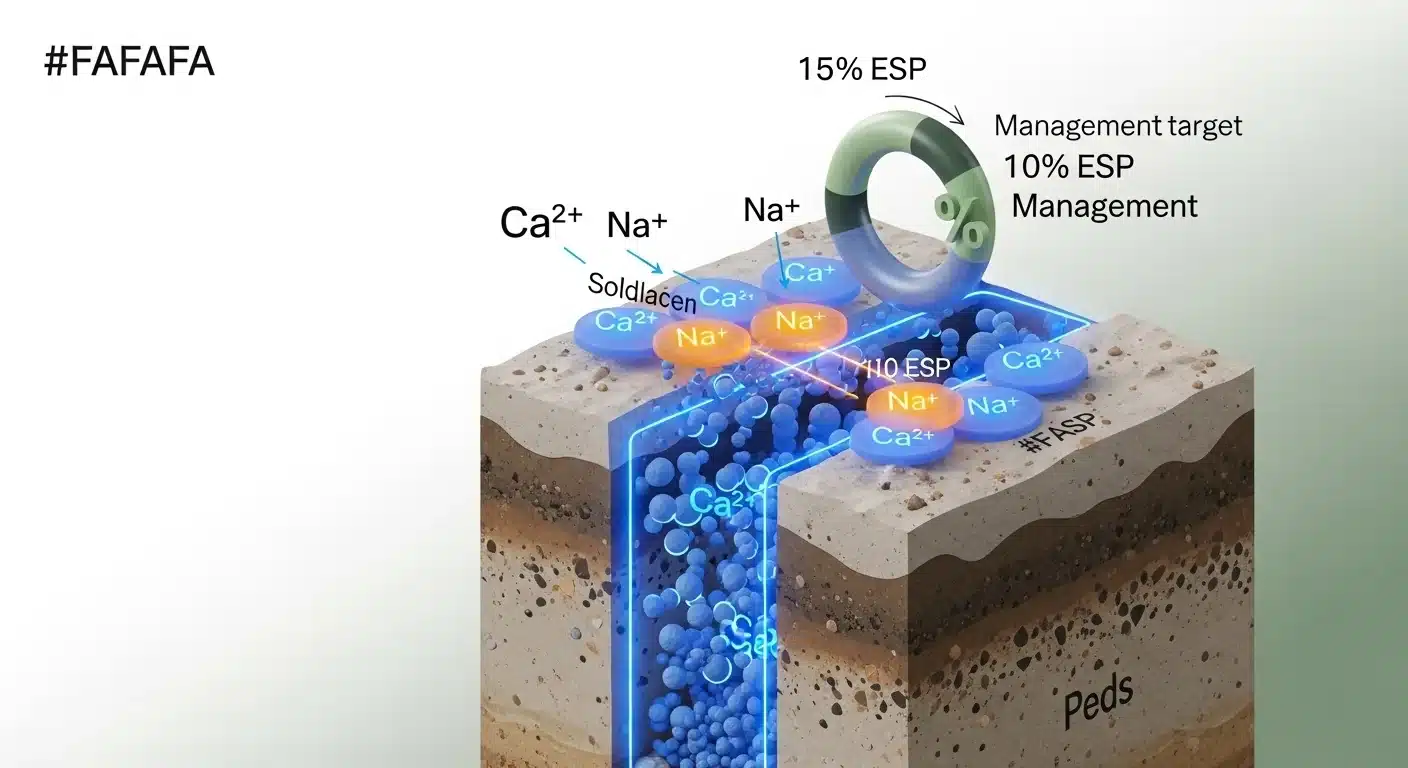
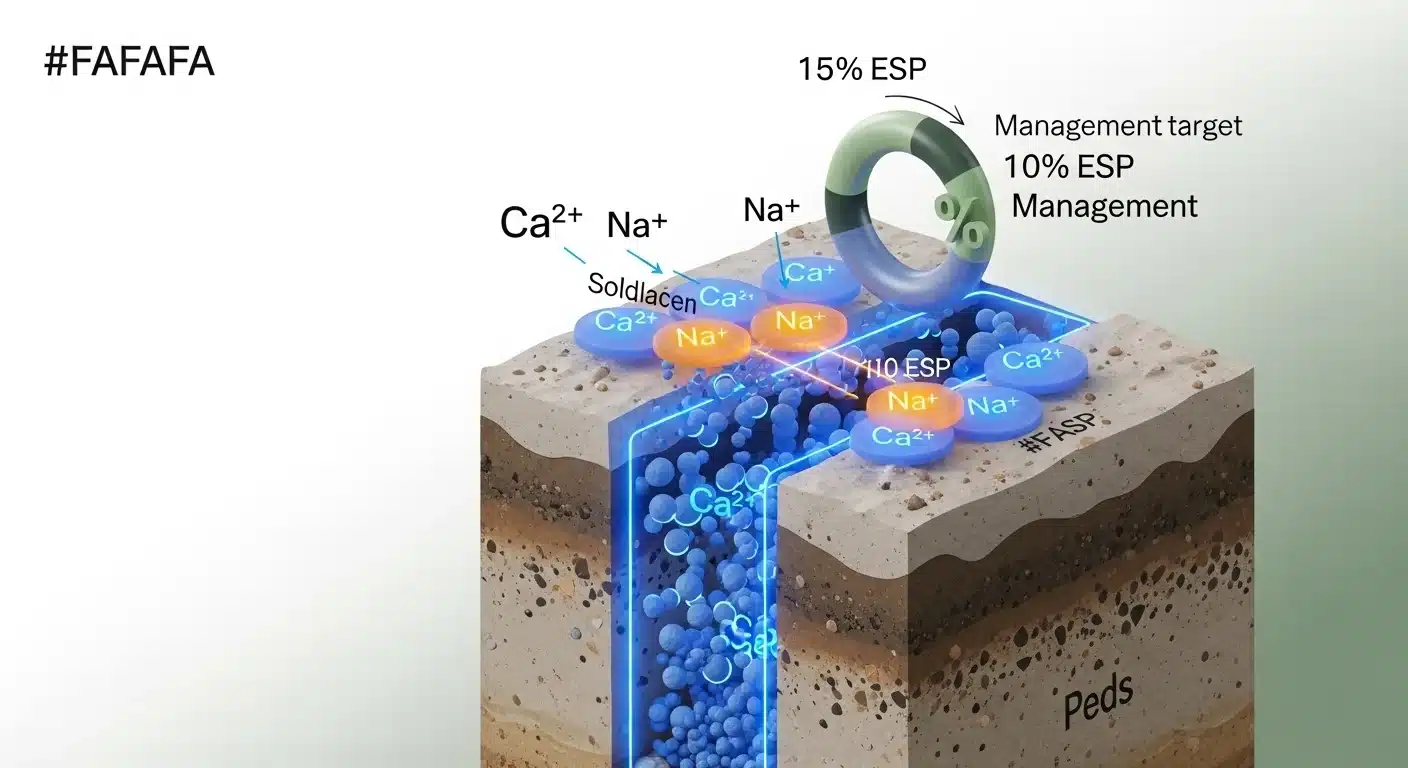
Sodium in irrigation water or native soil can quietly displace calcium and magnesium on clay exchange sites. When the ratio tips too far, clay platelets lose their natural grouping and the entire soil structure collapses. The soil SAR calculator instantly quantifies this risk using only four lab values and returns the exact gypsum tonnage needed to restore flocculation before drainage fails completely.
This tool calculates the sodium adsorption ratio directly from soil test sodium, calcium, and magnesium in mEq/L plus cation exchange capacity. It then derives exchangeable sodium percentage and the gypsum application rate in both English and metric units. The calculator does not replace a full salinity analysis, irrigation water testing, or site-specific leaching trials; it gives the immediate diagnostic number that drives the remediation decision.
after one calculation you know whether your soil is still safe or already sodic and exactly how many pounds of agricultural gypsum per acre will mathematically displace the excess sodium.
Use the Tool
| SAR Range | Classification | ESP (approx) | Gypsum Need | Risk |
|---|
How This Calculator Works ▾
Step 1 — Sodium Adsorption Ratio (SAR)
The SAR quantifies the relative concentration of sodium compared to calcium and magnesium. A high SAR means sodium dominates the soil solution, which displaces Ca²⁺ and Mg²⁺ from exchange sites.
Step 2 — Exchangeable Sodium Percentage (ESP)
Step 3 — Gypsum Requirement
If ESP_initial ≤ ESP_target, gypsum is not required (result = 0).
Sodic Soil Warning Trigger
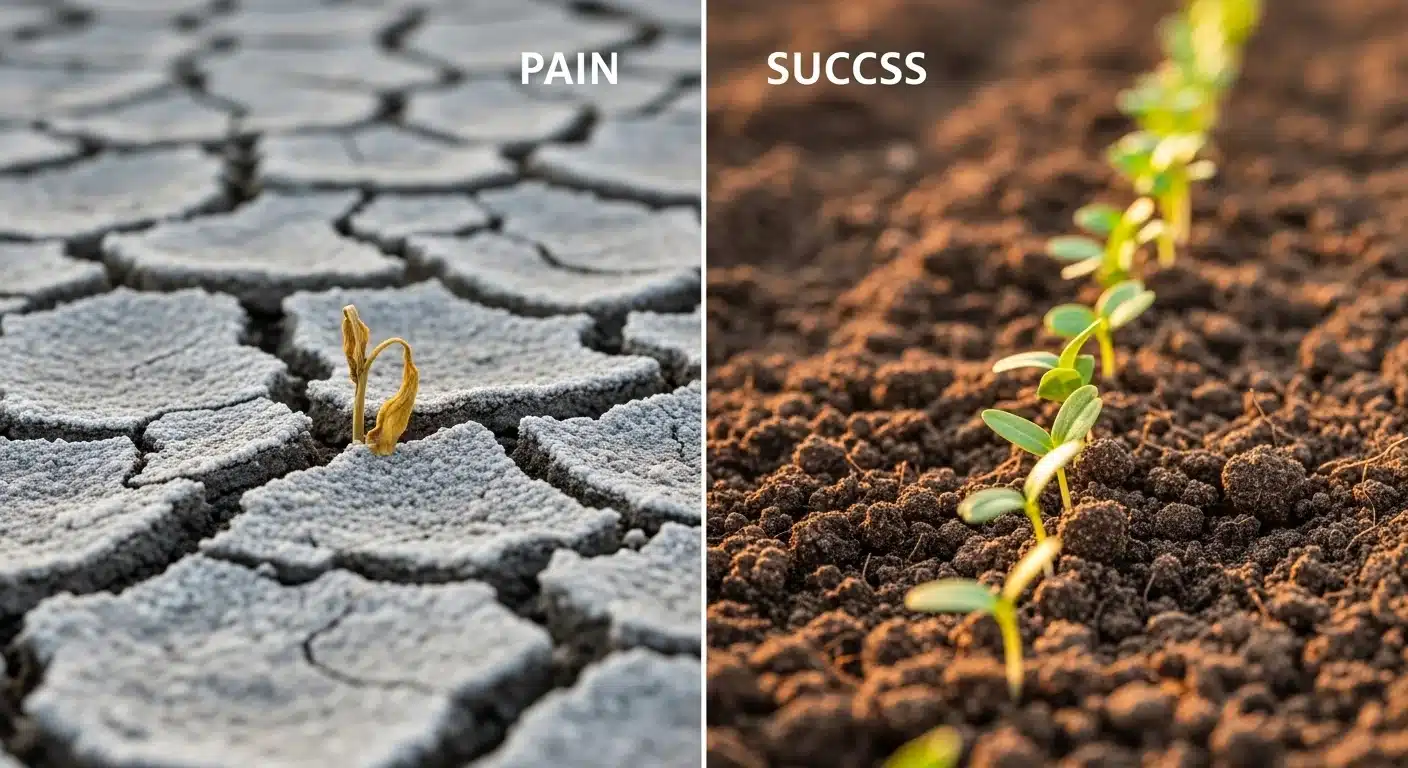
SAR > 13 triggers a critical sodic-soil warning. At these levels, sodium chemically disperses clay platelets, collapsing soil structure into an impermeable layer. This is the “concrete trap” — water pools, roots suffocate, and yields crash without gypsum intervention.
Assumptions & Limits ▾
- All ion concentrations must be entered in mEq/L (milliequivalents per liter). If your lab reports in mg/L (ppm), convert: Na ÷ 23, Ca ÷ 20, Mg ÷ 12.15.
- CEC is in meq/100g soil (also written cmolc/kg), as reported by standard cation exchange capacity tests.
- Gypsum calculation assumes a standard tillage depth of 6 inches (15 cm) and a soil bulk density of ~1.3 g/cm³.
- ESP target is set at 10% — the commonly recommended agronomic safe level for most crops.
- This tool uses the USSL (U.S. Salinity Laboratory) SAR classification thresholds.
- Results are estimates. Always verify with a certified agronomist before applying large quantities of gypsum.
- SAR > 13: Sodic soil — mandates gypsum application per USSL standards.
- This tool does not account for leaching fraction, irrigation water SAR (SARw), or long-term salinity accumulation.
Have your recent soil test report open. Enter the four values exactly as reported by the lab. The calculator runs only when every field contains a valid number and instantly updates the SAR, ESP, gypsum requirement, and risk gauge.
For best results pair this with a current CEC soil calculator run on the same sample so the numbers stay consistent across tools.
Quick Start (60 Seconds)
- Sodium (Na⁺): enter the mEq/L value from the cation column of your soil test; typical range 0.1–50.
- Calcium (Ca²⁺): enter the mEq/L value; most agricultural soils report 0.1–80.
- Magnesium (Mg²⁺): enter the mEq/L value; typical range 0.1–40.
- Cation Exchange Capacity (CEC): enter the meq/100 g value; most cropped soils fall between 5 and 50.
- Click Calculate SAR & Gypsum Requirement; the gauge and all outputs appear immediately.
- Use the Reset button before changing units or starting a new sample.
- If any field shows a red border the calculation is blocked until the error is fixed.
Inputs and Outputs (What Each Field Means)
| Field | Unit | What it measures | Common mistake | Safe entry guidance |
|---|---|---|---|---|
| Sodium (Na⁺) | mEq/L | Soluble sodium concentration in the soil solution | Entering ppm instead of mEq/L | 0.01–200; use lab-reported mEq/L value |
| Calcium (Ca²⁺) | mEq/L | Soluble calcium concentration | Confusing meq/100 g with mEq/L | 0.01–500; direct from saturation extract |
| Magnesium (Mg²⁺) | mEq/L | Soluble magnesium concentration | Omitting magnesium entirely | 0.01–200; required for accurate SAR |
| Cation Exchange Capacity (CEC) | meq/100 g | Soil’s total capacity to hold cations | Using meq/L instead of meq/100 g | 1–200; standard units from soil test |
| Outputs: SAR value (unitless), ESP (%), Gypsum (lbs/acre and kg/ha), Ca+Mg combined (mEq/L), risk classification, and live gauge position. | ||||
Worked Examples (Real Numbers)
Example 1: Healthy soil profile
- Sodium (Na⁺) = 2.0 mEq/L
- Calcium (Ca²⁺) = 22.0 mEq/L
- Magnesium (Mg²⁺) = 9.0 mEq/L
- CEC = 28 meq/100 g
Result: SAR = 0.51, ESP = 7.1 %, Gypsum required = 0 lbs/acre (0 kg/ha).
The soil shows no sodium hazard; structure remains stable and no amendment is needed at this time.
Example 2: Moderate sodium hazard
- Sodium (Na⁺) = 9.0 mEq/L
- Calcium (Ca²⁺) = 14.0 mEq/L
- Magnesium (Mg²⁺) = 6.0 mEq/L
- CEC = 20 meq/100 g
Result: SAR = 2.85, ESP = 45 %, Gypsum required = 12040 lbs/acre (13497 kg/ha).
Sodium is beginning to occupy exchange sites; a preventive gypsum application will keep ESP safely below the 10 % target.
Example 3: Severe sodic condition
- Sodium (Na⁺) = 25.0 mEq/L
- Calcium (Ca²⁺) = 5.0 mEq/L
- Magnesium (Mg²⁺) = 2.0 mEq/L
- CEC = 18 meq/100 g
Result: SAR = 13.36, ESP = 138.9 %, Gypsum required = 35913 lbs/acre (40259 kg/ha).
The soil has crossed the sodic threshold; immediate heavy gypsum application plus leaching irrigation is required to restore permeability.
Reference Table (Fast Lookup)
| SAR Range | Classification | ESP (approx. at CEC=20) | Gypsum (lbs/acre at CEC=20) | Action |
|---|---|---|---|---|
| 0–3 | Low | <5 % | 0 | Monitor annually |
| 3–6 | Low-Medium | 5–8 % | 0 | Re-test after next irrigation |
| 6–9 | Medium | 8–12 % | 0–1800 | Consider light gypsum |
| 9–13 | High | 12–18 % | 1800–5500 | Apply preventive gypsum |
| 13–18 | Very High | 18–25 % | 5500–11000 | Mandatory gypsum + leach |
| 18–26 | Severe | 25–35 % | 11000–22000 | Heavy gypsum program |
| >26 | Extreme | >35 % | >22000 | Intensive remediation |
| >13 | Sodic threshold | >15 % | Variable by ESP delta | USSL standard triggers action |
How the Calculation Works (Formula + Assumptions)
Show the calculation steps
The sodium adsorption ratio is computed as SAR = Na⁺ / √((Ca²⁺ + Mg²⁺) / 2). All four inputs are used in milliequivalents per liter or meq/100 g exactly as reported by the laboratory.
Exchangeable sodium percentage is calculated as ESP (%) = (100 × Na⁺) / CEC. If ESP exceeds the 10 % management target the difference is converted to the quantity of sodium that must be replaced.
Gypsum requirement is then derived as ΔNa (meq/100 g) × CEC × 86 = lbs gypsum per acre (6-inch depth). The metric equivalent multiplies the English value by 1.121 to give kg per hectare. Results are rounded to two decimal places for SAR and whole numbers for gypsum tonnage.
Assumptions & Limits
- All concentrations must be in mEq/L; ppm values must be converted before entry.
- CEC is assumed to be in standard meq/100 g units from a routine soil test.
- Gypsum math assumes a 6-inch tillage depth and average soil bulk density of 1.3 g/cm³.
- The 10 % ESP target is the default safe level for most field crops.
- The tool uses USSL classification thresholds for SAR interpretation.
- Results are estimates only; the calculator cannot account for irrigation water SAR, existing gypsum in the soil, or long-term salt accumulation.
- If lab reports use different extraction methods the numbers may need adjustment before entry.
Standards, Safety Checks, and “Secret Sauce” Warnings
The calculator applies two hard-coded safety thresholds derived directly from the underlying chemistry.
- SAR greater than 13 triggers the sodic soil alert and displays the mandatory gypsum rate.
- ESP greater than 15 % is flagged as exceeding the classic sodic threshold used by the U.S. Salinity Laboratory.
- When sodium dominates the soil solution the calculator automatically shows the clay dispersion warning and recommends gypsum to restore structure.
- Gypsum rates are never shown as zero when ESP exceeds the 10 % target.
Minimum Standards
- Gypsum must be agricultural-grade calcium sulfate to supply the exact calcium needed for cation exchange.
- Application should be followed by sufficient irrigation to move displaced sodium below the root zone.
- Retest SAR and ESP four to six weeks after treatment to confirm improvement.
The most common competitor trap is telling growers that poor drainage is always a physical problem solved by deep tillage. The real issue is often chemical: excess sodium has already dispersed the clay into an impermeable concrete-like layer. Tillage alone cannot fix dispersed clay; only the correct gypsum rate can.
For related salinity management see the soil leaching requirement calculator.
Common Mistakes and Fixes
Mistake: Entering ppm values instead of mEq/L
The calculator expects milliequivalents per liter. Using raw ppm numbers inflates the sodium term and produces falsely high SAR values. Fix: divide reported ppm by the ion’s equivalent weight (Na ÷ 23, Ca ÷ 20, Mg ÷ 12.15) before entry.
Mistake: Ignoring magnesium in the calculation
Some simplified spreadsheets omit magnesium, which underestimates the denominator and overstates the SAR. The full formula requires both calcium and magnesium. Fix: always include the lab-reported magnesium value.
Mistake: Assuming tillage will fix surface crusting
Crusting caused by dispersed clay will re-form after tillage unless sodium is displaced. Fix: run the calculator first; apply the indicated gypsum rate before any mechanical work.
Mistake: Using the wrong depth assumption for gypsum rates
The formula is calibrated for a 6-inch depth. Deeper incorporation requires proportional scaling. Fix: adjust tonnage upward if your tillage plan exceeds 6 inches.
Mistake: Applying gypsum without a follow-up leaching irrigation
Gypsum displaces sodium but the displaced ions must be moved out of the root zone. Fix: schedule a leaching irrigation immediately after spreading.
Next Steps in Your Workflow
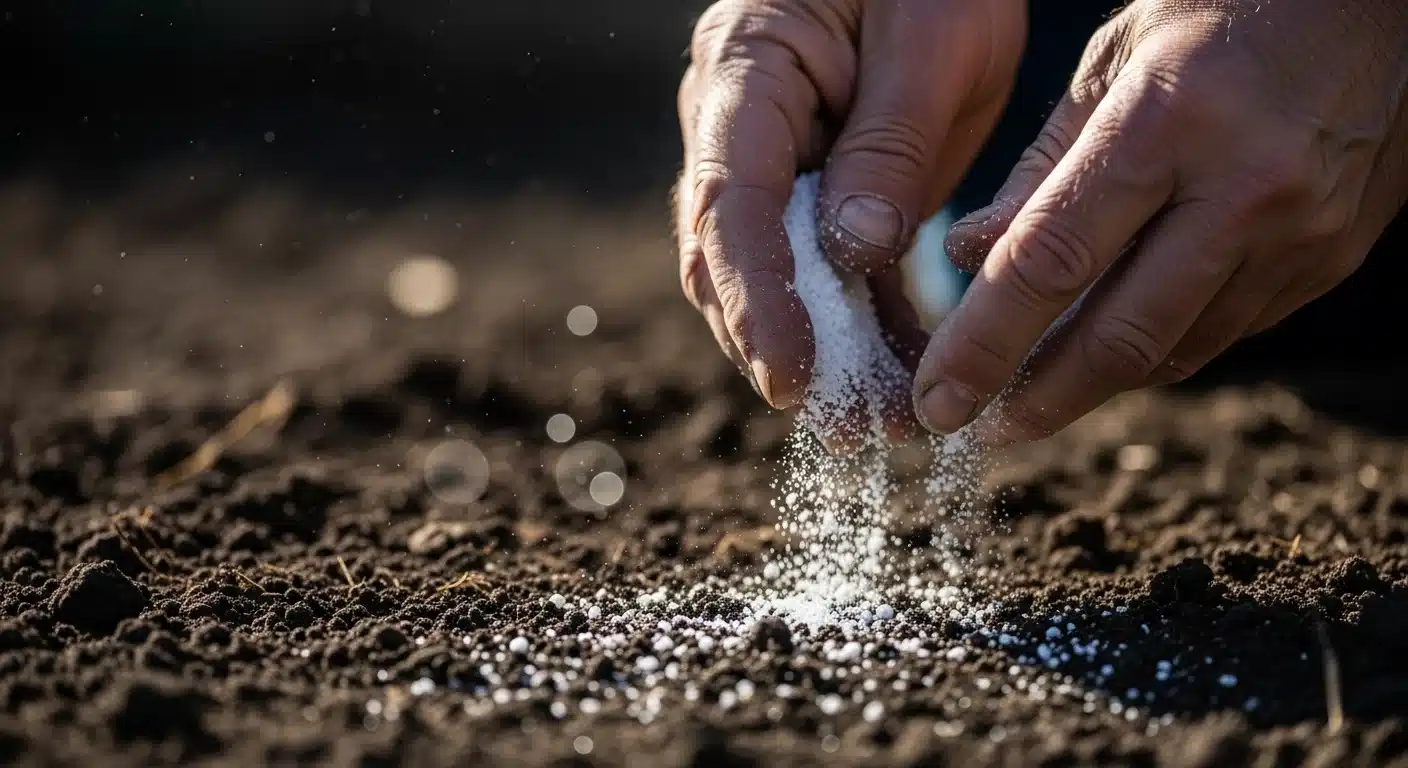
Once the calculator returns your SAR and gypsum rate the immediate action is to order the calculated tonnage of pelletized gypsum and schedule the application before the next irrigation cycle. Pair the treatment with a leaching event to flush the displaced sodium. For fields that also show pH issues consider coordinating the gypsum application with lime or sulfur programs using the soil pH lime calculator or sulfur calculator on the same sample date.
After treatment re-sample the top 6 inches in four to six weeks and re-run the soil SAR calculator to verify that both SAR and ESP have moved into the safe zone. Track salt index of any subsequent fertilizers with the fertilizer salt index calculator to avoid adding further sodium load.
FAQ
What is the sodium adsorption ratio formula?
The sodium adsorption ratio formula is SAR = Na⁺ / √((Ca²⁺ + Mg²⁺) / 2). All ions are expressed in mEq/L. The result is a unitless number that predicts the likelihood of clay dispersion when sodium dominates the soil solution.
How do you calculate gypsum application rate for sodic soil?
First compute ESP as (100 × Na⁺) / CEC. Subtract the 10 % target to find the excess sodium. Convert the excess to gypsum tonnage using the factor 86 lbs per meq per acre (6-inch depth). The calculator performs the entire sequence automatically and returns both lbs/acre and kg/ha.
What does a high exchangeable sodium percentage ESP mean?
ESP above 15 % indicates that sodium occupies enough exchange sites to cause clay dispersion, reduced permeability, and surface crusting. The soil SAR calculator flags any ESP over 10 % as requiring corrective gypsum.
When is soil considered sodic?
Soil is considered sodic when SAR exceeds 13 or ESP exceeds 15 %. At these levels the calculator displays the critical warning and the exact gypsum tonnage needed to restore soil structure.
How does gypsum fix soil crusting?
Gypsum supplies soluble calcium that displaces sodium from clay exchange sites. Once sodium is removed the clay platelets re-flocculate, permeability returns, and surface crusting disappears. The calculator gives the precise rate required for this cation exchange reaction.
What units are required for the soil SAR calculator?
The tool requires sodium, calcium, and magnesium in mEq/L and CEC in meq/100 g. These are the standard units reported by routine soil saturation extract and ammonium acetate tests used across North America.
Conclusion
The soil SAR calculator translates four laboratory numbers into an immediate, actionable diagnosis of sodium-related structural collapse. It removes guesswork from sodic soil remediation by calculating the exact gypsum rate required to reverse clay dispersion before drainage and root health are lost.
The single most costly mistake is treating visible crusting or poor infiltration as a purely physical problem. Run the calculator first, apply the indicated gypsum, then leach. For supporting measurements see the soil bulk density calculator when scaling rates to actual field volume.