
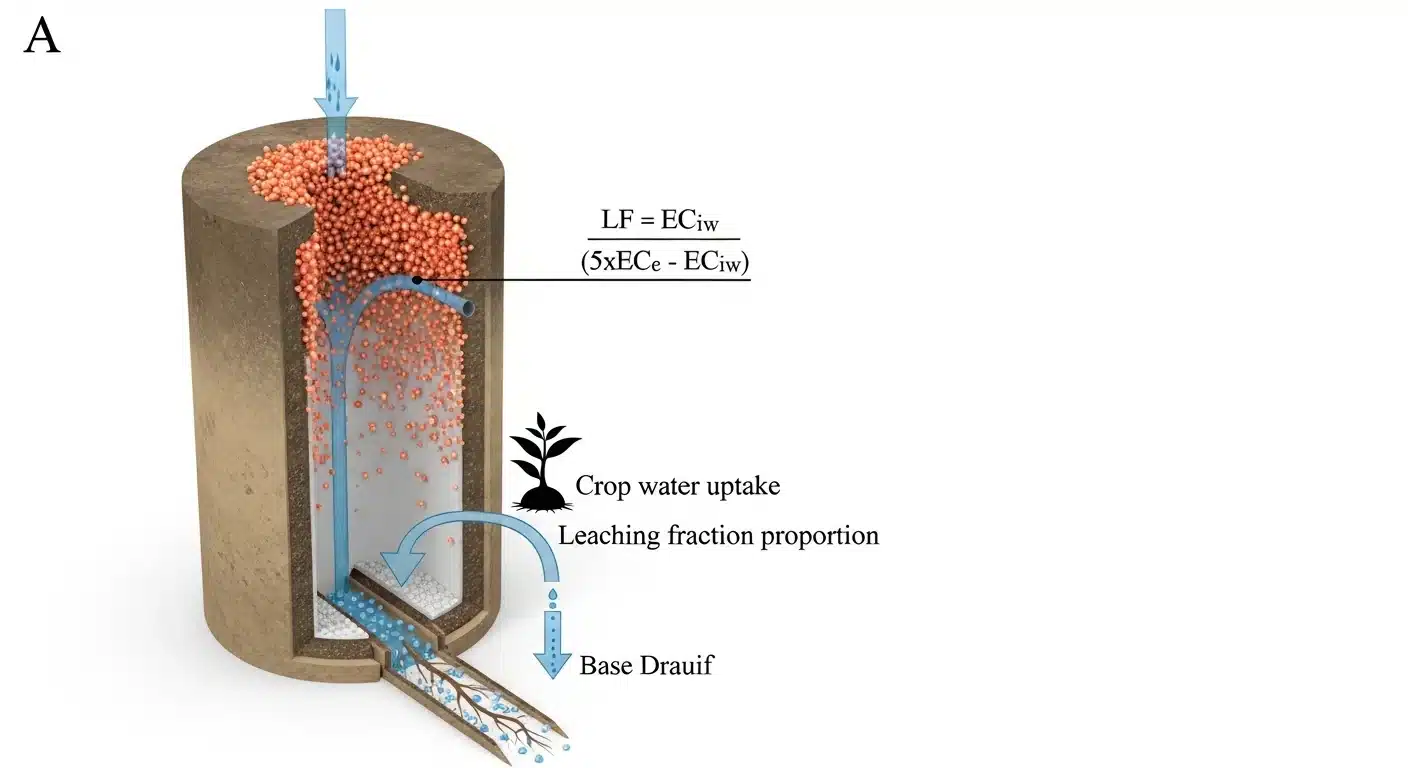
Every drop of irrigation water carries dissolved salts into the root zone. The water itself evaporates or gets absorbed by the plant, but the salt stays behind. Over successive watering cycles, this process concentrates salts to levels that flip osmotic pressure in reverse: instead of the plant drawing water in from the soil, the saltier soil begins pulling water molecules back out of the roots. A plant sitting in wet soil can die of osmotic dehydration. This is not a rare edge case. It is the default outcome for any irrigated system without a deliberate leaching strategy. Irrigation water quality, measured as electrical conductivity (ECiw in dS/m), determines how aggressively salt loads accumulate and how much extra water is required to flush them before crop damage occurs.
This soil leaching requirement calculator applies the FAO-29 steady-state leaching fraction formula (Rhoades, 1974) to determine two specific numbers: the leaching fraction (LF), which is the proportion of applied irrigation that must exit as drainage rather than crop uptake, and the total weekly water volume you need to apply to meet both the crop requirement and the leaching target simultaneously. The tool does not model soil moisture dynamics, predict exact salinity timelines, or account for rainfall. It outputs a starting irrigation target based on your water quality and crop tolerance, not a guarantee of field performance.
After using this calculator, you can set a defensible total irrigation volume that prevents root-zone salt accumulation, then verify it by checking that your drainage runoff EC is roughly two to three times your applied water EC.
Use the Tool
Soil Salinity & Leaching Fraction Calculator
Calculate how much extra irrigation water your crops need to flush root-zone salt buildup
How This Calculator Works
The Osmotic Salt Lockout Problem
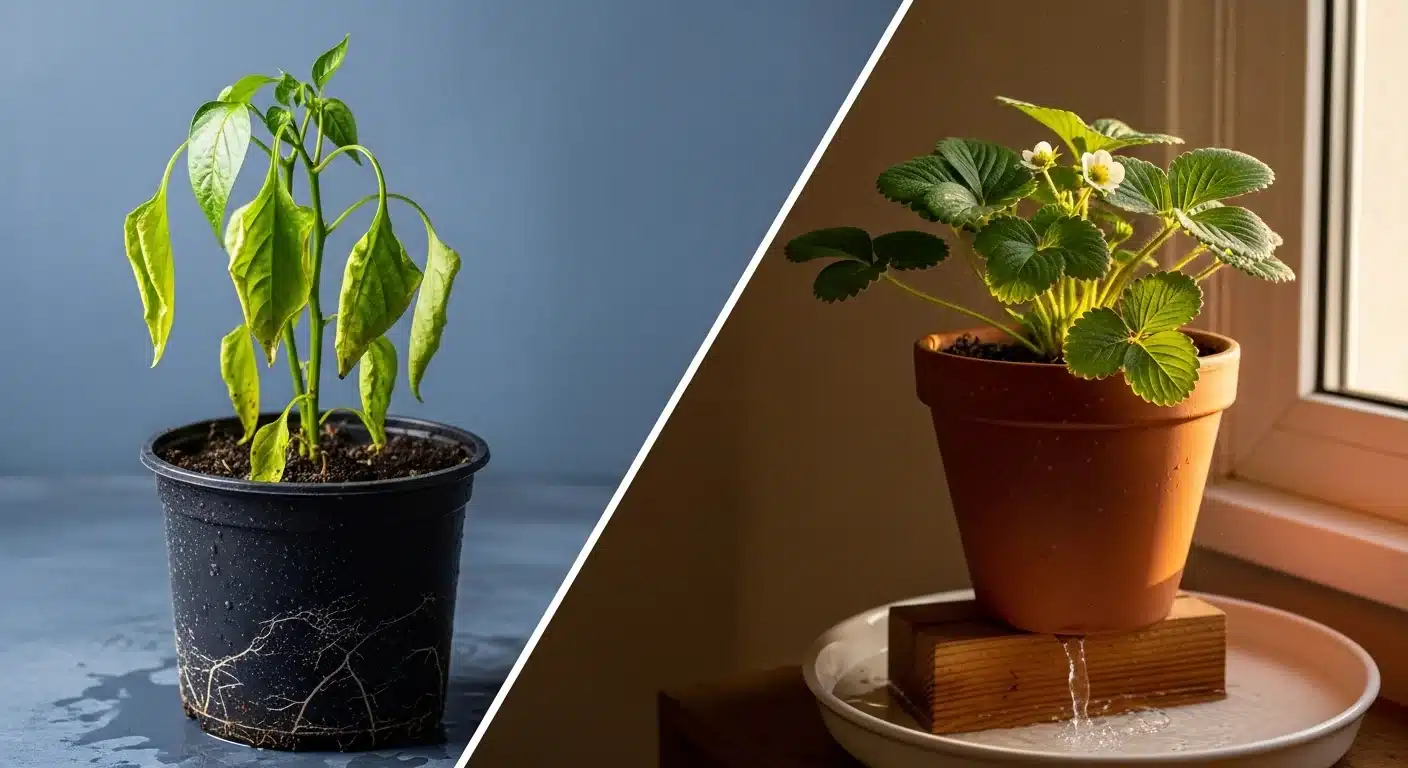
Water evaporates from soil, but dissolved salts stay behind. Without intentional leaching (flushing excess irrigation water through the root zone to carry salts out with drainage), salts accumulate with each watering cycle. Once soil EC (ECe) exceeds your crop’s tolerance threshold, osmotic pressure reverses — the now-saltier soil actually pulls water molecules out of plant roots. The plant wilts and dies even while sitting in wet soil. This is “Osmotic Salt Lockout.”
Step 1 — Leaching Fraction Formula
This gives the fraction of applied irrigation water that must pass beyond the root zone as drainage to prevent salt accumulation. Derived from the FAO-29 mass-balance method (Rhoades, 1974).
- ECiw = electrical conductivity of your irrigation water (dS/m)
- ECe = maximum soil EC your crop can tolerate (dS/m)
- A result of 0.10 = 10% of all water applied must drain past the roots
Step 2 — Total Applied Water
If your crop needs 2 inches and LF = 0.20, you must apply 2 ÷ 0.80 = 2.5 inches total. The extra 0.5 inches (20%) carries salt out through drainage.
Step 3 — Danger Check
When your irrigation water is already saltier than what your crop can survive in the soil, no amount of leaching can fix the problem. The math breaks down (LF becomes negative or >1). You must reduce your water’s EC via reverse osmosis, blending, or switching sources.
Assumptions & Limitations
- Uses the FAO steady-state leaching fraction formula (Rhoades, 1974). Assumes uniform irrigation application and adequate drainage.
- Does not account for rainfall contribution to leaching — subtract rainfall before entering crop water requirement.
- Assumes the crop grows in a single soil layer with uniform salinity. Layered soils or hardpan may require field measurement.
- Soil texture affects drainage speed: sandy soils drain faster, clay soils need lower application rates over more time.
- ECe thresholds are 50% yield-loss values. For premium crops, target 25% yield-loss threshold (lower ECe value).
- Does not account for precipitation of sparingly soluble salts (e.g., calcium carbonate). Actual salt behavior may vary.
Before running the calculation, have three pieces of information ready: the electrical conductivity of your irrigation source (request a water quality report from your utility or test with an EC meter), the published crop salinity threshold for your specific crop (commonly expressed as ECe in dS/m, available from USDA and FAO crop salt-tolerance tables), and your average weekly crop water requirement in either inches or gallons. If your soil is dense or poorly structured, it may restrict drainage even when the leaching fraction math is correct. A soil bulk density calculation can help you identify whether compaction is limiting the drainage your leaching plan depends on.
Quick Start (60 Seconds)
- ECiw field: Enter your irrigation water EC in dS/m. Typical city tap water runs 0.3 to 1.0 dS/m. Well water varies widely; always test before assuming. Do not enter TDS (ppm) directly: divide ppm by approximately 640 to convert to dS/m.
- ECe field: Enter your crop’s saturated paste extract threshold, not the irrigation water EC. Strawberry is approximately 1.5 dS/m, tomato approximately 4.0 dS/m, pepper approximately 1.5 dS/m, corn approximately 1.7 dS/m. Use the 50% yield-loss value unless you need more conservative protection.
- Crop Water Requirement: Enter the volume your crop actually needs for growth alone, before any leaching buffer is added. The calculator adds the leaching water on top of this figure.
- Unit toggle: Switch between inches and gallons before entering the crop water requirement. The leaching volume and total water output will use the same unit you select.
- Check the danger alert first: If your ECiw equals or exceeds your ECe, the calculator will flag “Crop Death Imminent” rather than returning a leaching fraction. This is the correct result: no leaching math can protect a crop being irrigated with water that already exceeds the crop’s soil EC threshold.
- Read the traffic-light gauge: The needle shows leaching fraction severity. Values below 10% are low-overhead situations. Values above 25% indicate a water quality or crop selection problem that leaching alone cannot efficiently solve.
- Cross-check your result: After applying the calculated total water volume in the field, measure the EC of your drainage runoff. It should be noticeably higher than your applied water EC, confirming that salts are being displaced, not trapped.
Inputs and Outputs (What Each Field Means)
| Field | Unit | What It Means | Common Mistake | Safe Entry Guidance |
|---|---|---|---|---|
| ECiw (Irrigation Water EC) | dS/m | Total dissolved salt load in your irrigation source, measured as electrical conductivity | Entering TDS in ppm without converting; using a generic “city water” assumption without testing | Test your actual source. Divide ppm by ~640 if converting from TDS. Range: 0 to 20 dS/m. |
| ECe (Crop Salinity Limit) | dS/m | The maximum root-zone soil EC (saturated paste extract) your crop can tolerate before yield loss begins at the 50% threshold | Confusing ECe (soil extract) with ECiw (water EC); using tomato thresholds for a more sensitive crop | Look up the specific variety in FAO or USDA salt-tolerance tables. Premium crops may warrant using the 25% yield-loss value instead. |
| Crop Water Requirement | in or gal/week | Water the plant consumes through evapotranspiration each week, not including any leaching buffer | Including existing over-watering in the baseline figure, which inflates the leaching volume output | Use evapotranspiration data or your measured crop uptake. Subtract rainfall from the figure before entering it. |
| Leaching Fraction (LF) [Output] | % | The portion of total applied irrigation water that must exit the root zone as drainage to prevent salt accumulation | Interpreting LF as the amount of extra water to add separately, rather than as a fraction of the total applied volume | LF is already built into the Total Water figure. Do not add the leaching volume on top of Total Water. |
| Total Water to Apply [Output] | in or gal/week | The combined volume covering both crop water requirement and leaching fraction in a single irrigation event | Applying this volume to a container or bed without confirming that drainage can actually exit the root zone | Confirm drainage pathways are clear before applying the calculated total. Blocked drainage invalidates the result. |
| Leaching Volume [Output] | in or gal/week | The portion of Total Water that exits as drainage, carrying dissolved salts out of the root zone | Assuming that any drainage observed equals the target leaching volume; actual drainage can be delayed by slow-draining media | Measure actual runoff volume to confirm it matches the calculated leaching target. |
| Water Efficiency [Output] | % | The fraction of total applied water that goes to crop uptake, equal to (1 – LF) expressed as a percentage | Treating a low efficiency figure as acceptable when water costs or disposal restrictions make high-LF irrigation economically impractical | If efficiency falls below 75%, evaluate water treatment options such as partial RO blending before accepting the overhead. |
Worked Examples (Real Numbers)
Scenario 1: Strawberry in a Greenhouse with City Water
- ECiw = 0.8 dS/m (filtered city supply)
- ECe = 1.5 dS/m (strawberry 50% yield-loss threshold)
- Crop Water Requirement = 2.00 inches per week
LF = 0.8 / (5 x 1.5 – 0.8) = 0.8 / 6.7 = 0.119, or 11.9%
Total Water = 2.00 / (1 – 0.119) = 2.00 / 0.881 = 2.27 inches per week
Result: Apply 2.27 inches per week total; 0.27 inches (about 12% of the applied volume) exits as drainage carrying displaced salts.
This is a manageable leaching overhead for drip systems. The key risk here is intermittent irrigation schedules that allow the soil surface to dry between events, which concentrates salts faster between flushes. Maintaining consistent moisture while still reaching the drainage target is the operational challenge.
Scenario 2: Processing Tomato with Hard Well Water
- ECiw = 2.0 dS/m (high-mineral well water)
- ECe = 4.0 dS/m (tomato 50% yield-loss threshold)
- Crop Water Requirement = 3.00 inches per week
LF = 2.0 / (5 x 4.0 – 2.0) = 2.0 / 18.0 = 0.111, or 11.1%
Total Water = 3.00 / (1 – 0.111) = 3.00 / 0.889 = 3.37 inches per week
Result: Apply 3.37 inches per week; 0.37 inches exits as drainage.
Although the ECiw is relatively high at 2.0 dS/m, tomato’s higher salt tolerance keeps the leaching fraction below 12%. This scenario illustrates why crop selection matters enormously in high-EC water regions: the same 2.0 dS/m water applied to strawberry would immediately exceed the crop’s ECe threshold and trigger the danger condition.
Scenario 3: Bell Pepper with Moderately Hard Water (Elevated Risk)
- ECiw = 1.2 dS/m (municipal blend with mineral content)
- ECe = 1.5 dS/m (pepper 50% yield-loss threshold)
- Crop Water Requirement = 1.50 inches per week
LF = 1.2 / (5 x 1.5 – 1.2) = 1.2 / 6.3 = 0.190, or 19.0%
Total Water = 1.50 / (1 – 0.190) = 1.50 / 0.810 = 1.85 inches per week
Result: Apply 1.85 inches per week; 0.35 inches exits as drainage, representing 19% of total applied volume.
At an ECiw of 1.2 dS/m against a crop threshold of 1.5 dS/m, the margin is thin. A single week where the drainage pathway becomes partially blocked could allow the root-zone EC to approach the danger zone. This scenario calls for weekly EC monitoring of both irrigation water and drainage runoff, and consideration of partial RO blending to reduce the water EC to below 0.8 dS/m.
Reference Table (Fast Lookup)
Leaching fractions below are computed directly from the FAO-29 formula for three representative crop salinity thresholds. Values marked “DANGER” indicate the irrigation water EC already exceeds the crop limit; no leaching fraction is mathematically valid in those cases.
| ECiw (dS/m) | LF at ECe = 1.5 (Sensitive: Strawberry, Pepper) | LF at ECe = 2.5 (Moderate: Lettuce, Onion) | LF at ECe = 4.0 (Tolerant: Tomato, Corn) | Risk Level (at ECe = 1.5) |
|---|---|---|---|---|
| 0.3 | 4.2% | 2.5% | 1.5% | Very Low |
| 0.5 | 7.1% | 4.2% | 2.6% | Low |
| 0.8 | 11.9% | 6.8% | 4.2% | Moderate |
| 1.0 | 15.4% | 8.7% | 5.3% | Moderate |
| 1.5 | DANGER | 13.6% | 8.1% | Crop Death (ECe = 1.5) |
| 2.0 | DANGER | 19.0% | 11.1% | Crop Death (ECe = 1.5) |
| 2.5 | DANGER | DANGER | 14.3% | Crop Death (ECe = 1.5 and 2.5) |
| 3.0 | DANGER | DANGER | 17.6% | Crop Death (ECe = 1.5 and 2.5) |
How the Calculation Works (Formula + Assumptions)
Show the calculation steps
Step 1: Compute Leaching Fraction
The formula is derived from a steady-state mass balance of salt inputs and outputs in the root zone:
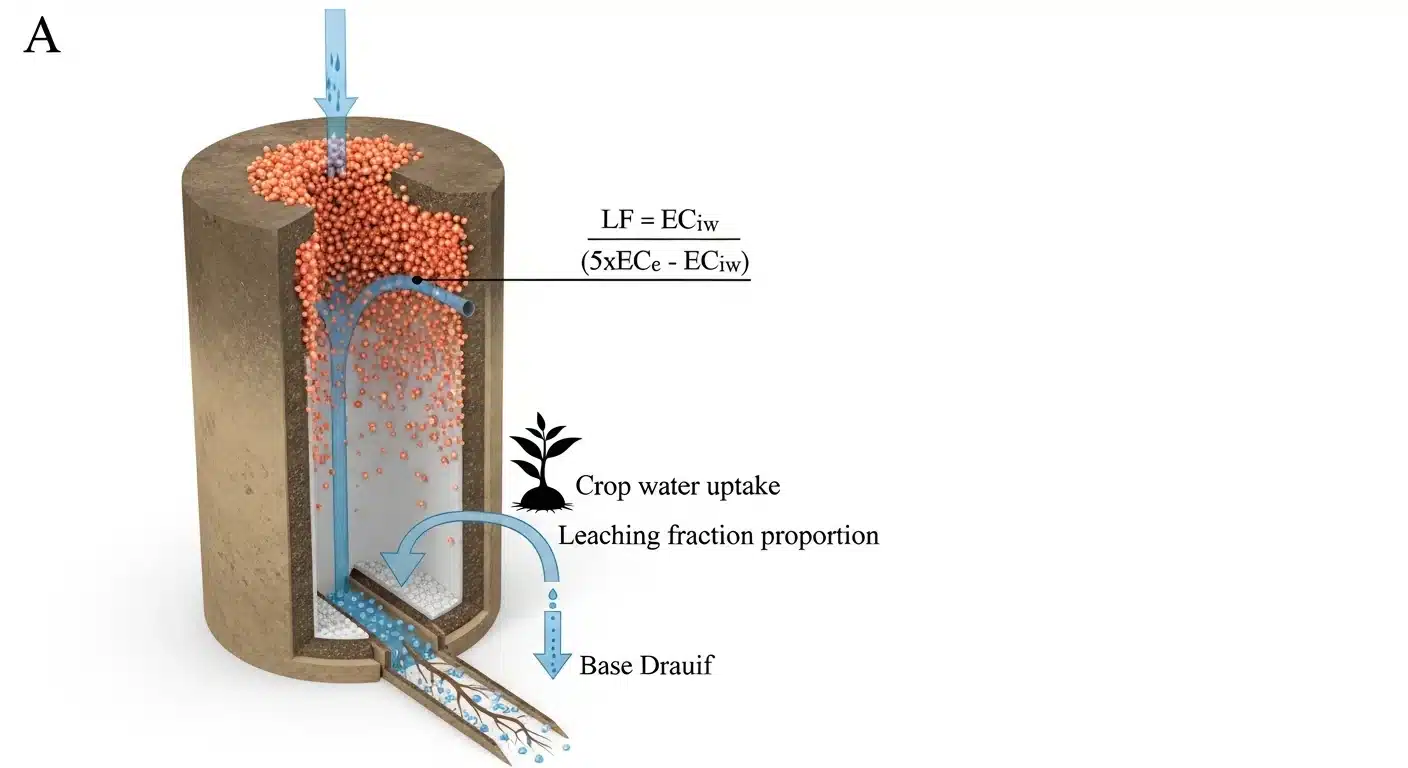
LF = ECiw / (5 x ECe – ECiw)
The denominator term (5 x ECe) reflects the relationship between average root-zone EC and the saturated paste extract (ECe): the root zone averages approximately 5 times higher in conductivity than the applied water EC at equilibrium under steady-state conditions. Subtracting ECiw accounts for the salt contributed by the water itself.
Rounding rule: express LF as a percentage rounded to one decimal place for practical irrigation scheduling.
Step 2: Compute Total Applied Water
Total Water = Crop Water Requirement / (1 – LF)
This formula inflates the crop requirement by the inverse of the non-leaching fraction. If LF = 0.20, then (1 – LF) = 0.80, meaning 80% of what you apply goes to the crop and 20% exits as drainage. Dividing the crop requirement by 0.80 gives the total that satisfies both needs in a single application.
Units carry through unchanged: if the crop requirement is entered in gallons, the total water and leaching volume are returned in gallons.
Step 3: Danger Condition Check
IF ECiw >= ECe: Leaching fraction is undefined (negative or invalid)
When the EC of the irrigation water already exceeds the soil EC threshold the crop can survive, no steady-state leaching scheme is mathematically valid. The formula produces a zero or negative denominator, and the physical meaning collapses: you cannot dilute a root zone below the salt concentration of the water you’re using to dilute it. Source water treatment is the only path forward in this condition.
Assumptions and Limits
- The FAO-29 formula assumes steady-state conditions: salt inputs equal salt outputs over time. In practice, soil is rarely at true steady state, so the LF is a design target, not a precision measurement.
- Uniform irrigation application is assumed across the root zone. Channeling, preferential flow paths, or dry spots cause localized salt accumulation that the formula cannot predict.
- Adequate drainage capacity is required. If soil or container media cannot transmit the calculated leaching volume within the irrigation interval, salts will concentrate between events regardless of the formula result.
- Rainfall is not included. Subtract effective rainfall from your weekly crop water requirement before entering it into the calculator.
- ECe thresholds in this calculator are 50% yield-loss values from FAO and USDA salt-tolerance tables. For high-value or sensitive crops, use the 25% yield-loss ECe value, which is lower and will produce a higher (more conservative) leaching fraction.
- The formula does not account for precipitation of sparingly soluble salts such as calcium carbonate. In alkaline soils, calcite precipitation can reduce actual leaching efficiency below the calculated value.
- Soil layering (e.g., a clay lens below a sandy surface horizon) can trap drainage above the restrictive layer, locally spiking EC despite correct surface application.
Standards, Safety Checks, and “Secret Sauce” Warnings
Critical Warnings
- Osmotic Salt Lockout in wet soil: Plants visually wilting while the substrate is thoroughly moist is a diagnostic symptom of osmotic lockout, not drought. Salt-saturated media creates a solute concentration gradient that forces water molecules out of root cells. Increasing irrigation frequency in this situation accelerates root damage. The correct response is a corrective flush with low-EC water, followed by a recalculated leaching schedule.
- Blocked drainage invalidates the formula entirely: A leaching fraction calculation is only valid if the drainage pathway is open. Compressed or compacted growing media, waterlogged container bases, or clogged drain holes mean the “leaching” water simply accumulates below the root zone rather than carrying salts out. Before implementing any leaching schedule, verify that drainage flow is unobstructed. The fertilizer salt index calculator can help identify whether fertilizer-contributed salts are compounding water-EC-driven accumulation in your system.
- No leaching formula is valid when ECiw exceeds ECe: This is mathematically and physically absolute, not a conservative precaution. Continuing to irrigate with ECiw greater than or equal to ECe without source water treatment guarantees progressive root-zone salt enrichment regardless of drainage volume.
- High sodium content requires separate analysis: Electrical conductivity measures total ion concentration, not sodium specifically. A water source with moderate overall EC but high sodium may cause structural damage to clay soils that reduces drainage capacity over time, undermining the leaching fraction assumptions. The sodium adsorption ratio (SAR) calculator addresses this dimension and should be run alongside ECiw evaluation for well water or recycled irrigation sources.
Minimum Standards
- Leaching fractions above 25% indicate a water quality problem that leaching alone addresses inefficiently. At this level, water treatment such as partial reverse osmosis blending is typically more cost-effective than accepting the ongoing water and nutrient waste.
- Drainage runoff EC should be monitored periodically. A runoff EC that is 2 to 3 times your applied water EC confirms active salt displacement. Runoff EC below 1.5 times applied water EC suggests insufficient leaching is occurring despite the application volume.
- The cation exchange capacity of your growing medium affects how quickly salts accumulate and how effectively leaching flushes them. Low-CEC media (sand, perlite, rockwool) respond faster to leaching schedules than high-CEC organic soils. The CEC soil calculator provides context for interpreting how your medium type interacts with your calculated leaching fraction.
Competitor Trap: Most salt management guides tell growers to “add 10 to 20% extra water as a leaching fraction.” This generic range ignores the critical interaction between actual water EC and crop-specific salt tolerance. A 10% leaching fraction applied with 2.0 dS/m water to a strawberry crop (ECe = 1.5 dS/m) is useless: the water itself exceeds the crop’s threshold. Conversely, a 20% leaching fraction with 0.3 dS/m rainwater collected in a cistern is wasteful overkill. The formula-derived result from your actual inputs is not interchangeable with a blanket percentage recommendation.
Common Mistakes and Fixes
Mistake: Using EC Thresholds for the Wrong Growth Stage
Published crop ECe thresholds are typically measured under full vegetative growth conditions. Seedlings and transplants in early establishment often have lower salt tolerance than mature plants of the same species. Applying the adult-stage threshold to a seedling crop results in a leaching fraction that is too low for the actual risk.
Fix: During germination and early establishment, target a root-zone EC at least 25 to 30% below the published adult threshold and recalculate your leaching fraction accordingly.
Mistake: Treating the Leaching Volume as an Extra Application on Top of Total Water
A recurring error in irrigation scheduling is to calculate the crop water requirement, add it to the separately calculated leaching volume, and apply both as additive quantities. This double-counts the leaching water and over-applies by a significant margin. The formula already builds the leaching fraction into the Total Water figure by dividing by (1 – LF).
Fix: Apply the Total Water figure as a single scheduled irrigation volume. The leaching fraction is the portion of that total that exits as drainage, not an additional amount applied after the crop requirement is met.
Mistake: Ignoring Fertilizer EC Contributions to Root-Zone Salinity
The leaching fraction calculation accounts for salts entering through irrigation water. But fertilizer applications, especially high-rate soluble nutrient programs, also contribute salt load to the root zone. The combined EC of water plus dissolved fertilizer can significantly exceed the ECiw measured from the tap, raising the effective salt input above what the calculated leaching fraction was designed to manage. Highly soluble fertilizers each carry a measurable salt index that compounds over time, making soil EC monitoring especially critical in fertigation programs.
Fix: Monitor actual root-zone EC with a soil EC probe or slurry test between irrigation cycles. If root-zone EC is climbing despite applying the calculated total water, reduce fertilizer salt load or increase the leaching fraction temporarily. The CEC of your growing medium determines how much buffering capacity exists before EC spikes become acute.
Mistake: Conflating TDS (ppm) with EC (dS/m) Without Converting
Water quality reports from utilities and lab services often express dissolved solids in ppm or mg/L rather than dS/m. Entering a TDS ppm value directly into the ECiw field without conversion produces a leaching fraction that is roughly 640 times too aggressive, generating absurd total water outputs. This error is common when growers switch between meter types or lab report formats.
Fix: Divide ppm by approximately 640 to convert to dS/m before entering the value. Verify by cross-checking against a direct EC measurement from a calibrated meter if available.
Mistake: Applying a Single Annual Leaching Event Instead of Per-Irrigation Leaching
Field-scale agriculture sometimes uses an annual heavy leaching irrigation at season start or end to reset soil EC. This approach is valid for certain systems but does not substitute for per-irrigation steady-state leaching in intensive production systems or container growing. Between leaching events, salts continue to accumulate with every irrigation, potentially reaching damaging levels before the next scheduled flush.
Fix: In high-frequency drip or container systems, the calculated leaching fraction should be applied at every irrigation event, not reserved for periodic large-volume flushes. This matches the FAO-29 steady-state design assumption the formula was built on.
Next Steps in Your Workflow

Once you have your leaching fraction and total water figure, the immediate next step is to verify drainage capacity in your specific system. In container growing, this means confirming that drainage holes are open and that the volume of runoff collected after irrigation matches the calculated leaching volume. In field settings, it means checking that the soil profile can transmit the applied volume within the irrigation interval. If your soil is heavy or prone to compaction, reviewing its texture profile is practical before committing to a leaching-based irrigation schedule. The soil texture calculator can help identify whether sand, silt, or clay proportions are likely to create drainage bottlenecks that the leaching formula does not model.
The second area to address is fertilizer EC contribution. If you are running a fertigation program, the EC of your irrigation water is not the only salt input to manage. Nutrient solution EC adds directly to root-zone salt accumulation between leaching events. Dialing in your nutrient concentrate dilution so that the combined feed EC stays at a known level is part of closing the salt management loop. The fertilizer dilution calculator can help you back-calculate the injection ratio needed to reach a target feed EC from a concentrated stock solution.
FAQ
What is a leaching fraction in irrigation?
The leaching fraction (LF) is the proportion of total applied irrigation water that must drain through and below the root zone, rather than being used by the plant. Its purpose is to carry dissolved salts out of the root zone before they accumulate to levels that reduce crop yield or cause osmotic stress. A leaching fraction of 0.15 means 15% of every irrigation event exits as salt-laden drainage.
How do I find the ECe threshold for my crop?
ECe thresholds are published in the FAO Irrigation and Drainage Paper No. 29 (Rhoades, 1974, updated 1985) and in USDA Agricultural Handbooks. The ECe value represents the saturated paste extract conductivity at which 50% yield loss occurs. Values for the 10% and 25% yield-loss points are also available for higher-value crops where a more conservative threshold is warranted.
What happens if my ECiw is higher than my crop’s ECe?
The leaching fraction formula breaks down mathematically because the denominator approaches zero or goes negative. More importantly, the physical outcome is irreversible: you cannot reduce the root-zone salt concentration below the salt concentration of the water you’re applying. The tool flags this as “Crop Death Imminent.” Source water treatment (reverse osmosis, blending with low-EC water, or sourcing an alternative supply) is the only corrective path.
Does rainfall count toward my leaching fraction?
Rainfall contributes to leaching if it is sufficient to create drainage flow through the root zone, and its EC is typically very low (near zero), making it highly effective for salt displacement. However, light rainfall that only wets the surface without generating drainage can temporarily dissolve salts into a shallow layer and then evaporate, concentrating them again. Subtract effective leaching rainfall from your crop water requirement before entering it into the calculator.
How often should I check the actual root-zone EC in practice?
The frequency depends on leaching fraction magnitude and salt-load variability. For systems running a leaching fraction below 10% with stable water quality, bi-weekly monitoring is a common baseline. Systems operating above 15% LF, using variable water sources, or running intensive fertigation programs benefit from weekly measurement. Immediately after any change to irrigation source, fertilizer program, or system configuration, take a baseline reading before resuming the regular schedule.
Can I reduce my leaching fraction by switching to RO-filtered water?
Yes, directly and proportionally. RO filtration reduces ECiw, which is the numerator in the leaching fraction formula. Lower ECiw produces a lower LF and, therefore, a lower Total Water requirement. Partial RO blending (mixing RO permeate with source water) is often more practical and cost-effective than full RO treatment, and it allows fine-tuning of the feed EC to a specific target. The appropriate blend ratio depends on both source and permeate EC measurements.
Conclusion
Salt accumulation in the root zone is not a slow-moving background problem. In closed or semi-closed growing systems, a few cycles of under-leaching can concentrate EC to damaging levels within days. What makes salt lockout deceptive is that it mimics drought stress visually: wilting plants in wet soil trigger more irrigation, which adds more salt, accelerating the damage. Using a calculated leaching fraction rather than a gut-feeling watering schedule is the specific intervention that breaks this loop.
The single most common failure mode is applying the right leaching fraction to a system where drainage cannot actually exit. The formula assumes water moves freely through the root zone and carries salts out. Blockages, compaction, or slow-draining media all violate this assumption and render the calculation moot. Verify your drainage pathway before trusting the result, and revisit the calculation whenever your irrigation source, fertilizer program, or growing medium changes. If you are also managing soil pH as part of your nutrient program, the soil pH sulfur calculator addresses the intersection of acidification and salt dynamics in amended soils.