
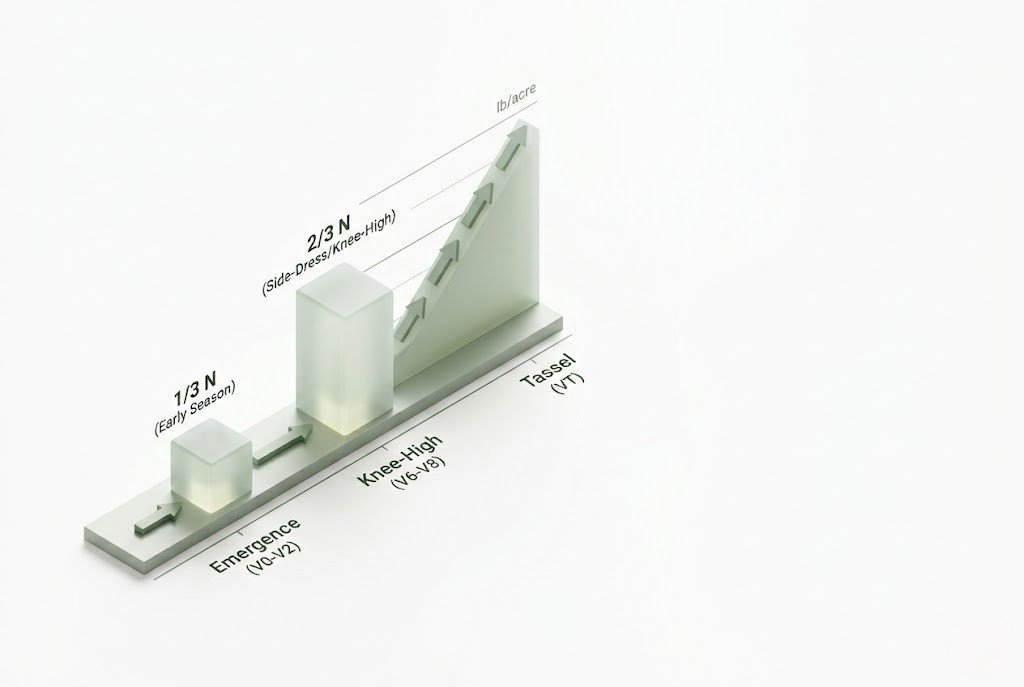
Nitrogen timing separates a good corn crop from a mediocre one. Apply too much at planting and you risk root burn, leaching losses, and wasted fertilizer dollars. Apply too little at side-dress and your ears will show it at harvest. The challenge is knowing exactly how many pounds of nitrogen your specific field area requires at each growth stage.
This corn nitrogen calculator computes total nitrogen requirements based on your row length, row count, and current growth stage. It outputs a split-application breakdown showing how much to apply now versus how much to reserve for side-dressing. The calculator does NOT account for soil test nitrogen credits, previous crop residue, or manure applications. Those adjustments require additional calculations using tools like the manure nitrogen availability calculator.
After using this calculator, you will know the exact pounds of nitrogen to apply today and the exact amount to hold back for knee-high side-dressing, preventing both early-season burn and late-season deficiency.
Use the Tool
Corn Nitrogen Calculator
Calculate nitrogen requirements for your corn field
Results
| Parameter | Value |
|---|---|
| Total Area | — |
| N Rate per 100 sq ft | 0.2 lbs |
| Total N Required | — |
| Apply Now | — |
| Side Dress Later | — |
Split Application: Corn is a heavy feeder. Apply 1/3 now and 2/3 when knee-high for optimal uptake.
Burn Warning: Do not let granules touch the corn stalk. Apply in a band 4-6 inches away from plants.
Quick Reference: N Requirements by Area
| Area (sq ft) | N Required (lbs) | Apply Now | Side Dress |
|---|---|---|---|
| 500 | 1.00 | 0.33 | 0.67 |
| 1,000 | 2.00 | 0.67 | 1.33 |
| 2,500 | 5.00 | 1.67 | 3.33 |
| 5,000 | 10.00 | 3.33 | 6.67 |
| 10,000 | 20.00 | 6.67 | 13.33 |
How this calculator works
Formula Steps:
- Step 1 – Calculate Area: Rows × Row Length × Row Width (3 ft standard)
- Step 2 – Calculate N Requirement: Area ÷ 100 × 0.2 lbs N per stage
- Step 3 – Split Application: Total N ÷ 3 = Apply Now; Total N × 2/3 = Side Dress
Assumptions & Limits:
- Row width assumed at 3 feet (standard corn spacing)
- N rate of 0.2 lbs per 100 sq ft is typical for sweet corn
- Actual needs may vary based on soil test, variety, and yield goal
- Maximum recommended single application: 50 lbs N per 1,000 sq ft
- For fields > 1 acre, consider professional soil testing
The Yield Grid
Before calculating, measure your actual row length in feet using a tape measure or wheel. Count total planted rows. Select the growth stage that matches your current field conditions: Pre-Plant (before or at planting), Knee High (V6-V8, plants approximately 18-24 inches tall), or Tassel (VT, tassels emerging). If your corn falls between stages, select the earlier stage to avoid over-application.

For comprehensive nitrogen planning across your entire operation, the NPK calculator provides broader nutrient ratio guidance.
Quick Start (60 Seconds)
- Row Length (ft): Enter the length of one corn row measured in feet. Range: 1 to 5,000 feet. Common mistake: entering plot width instead of row length.
- Number of Rows: Enter the total count of planted rows as a whole number. Range: 1 to 1,000. Do not include skipped rows or wheel tracks.
- Corn Stage: Select from Pre-Plant, Knee High, or Tassel. This determines the timing message but not the nitrogen rate calculation.
- Unit consistency: All length measurements must be in feet. Convert meters by multiplying by 3.28.
- Row width assumption: The calculator uses 3-foot row spacing. If your rows are 30-inch spacing, results remain accurate. For 36-inch or wider rows, nitrogen per linear foot increases proportionally.
- Decimal entries: Row length accepts decimal values (e.g., 87.5 feet). Number of rows must be a whole number.
Inputs and Outputs (What Each Field Means)
| Field Name | Type | Unit | What It Means | Common Mistake |
|---|---|---|---|---|
| Row Length | Input | feet | Linear distance of one planted row from end to end | Measuring the diagonal instead of the actual row path |
| Number of Rows | Input | integer | Total count of parallel planted rows | Including headland turnaround areas in the count |
| Corn Stage | Select | category | Current growth phase determining application guidance | Selecting Tassel when plants are still at V10-V12 |
| Total Area | Output | sq ft | Calculated growing area: Rows x Length x 3 ft width | N/A |
| Total N Required | Output | lbs | Full-season nitrogen need for the calculated area | N/A |
| Apply Now | Output | lbs | One-third of total nitrogen for immediate application | N/A |
| Side Dress Later | Output | lbs | Two-thirds of total nitrogen reserved for knee-high stage | N/A |
Worked Examples (Real Numbers)
Example 1: Small Garden Plot at Pre-Plant
- Row Length: 50 feet
- Number of Rows: 8
- Corn Stage: Pre-Plant
Result: Total area = 8 x 50 x 3 = 1,200 sq ft. Total N = (1,200 / 100) x 0.2 = 2.40 lbs nitrogen. Apply Now = 0.80 lbs. Side Dress = 1.60 lbs.
For this backyard plot, apply just under 1 pound of actual nitrogen at planting. One 10-pound bag of 10-10-10 fertilizer contains 1 pound of nitrogen, making this a straightforward single-bag application split across two timings.
Example 2: Quarter-Acre Field at Knee High
- Row Length: 200 feet
- Number of Rows: 18
- Corn Stage: Knee High
Result: Total area = 18 x 200 x 3 = 10,800 sq ft. Total N = (10,800 / 100) x 0.2 = 21.60 lbs nitrogen. Apply Now = 7.20 lbs (should have been applied at pre-plant). Side Dress = 14.40 lbs (apply now at knee-high).
At knee-high stage, the 14.40 lbs represents your current side-dress need. Using 46-0-0 urea, this equals approximately 31 pounds of product. Apply in bands 4-6 inches from stalks to prevent burn.
Example 3: Large Production Block at Pre-Plant
- Row Length: 660 feet (1/8 mile)
- Number of Rows: 48
- Corn Stage: Pre-Plant
Result: Total area = 48 x 660 x 3 = 95,040 sq ft (approximately 2.18 acres). Total N = (95,040 / 100) x 0.2 = 190.08 lbs nitrogen. Apply Now = 63.36 lbs. Side Dress = 126.72 lbs.
This field requires significant nitrogen split across two applications. The 63-pound pre-plant application and 127-pound side-dress application align with university extension recommendations of approximately 1 pound N per bushel of expected yield for 150-bushel corn.
Reference Table (Fast Lookup)
| Area (sq ft) | Total N (lbs) | Apply Now (lbs) | Side Dress (lbs) | Urea 46-0-0 (lbs total) | Ammonium Sulfate 21-0-0 (lbs total) |
|---|---|---|---|---|---|
| 500 | 1.00 | 0.33 | 0.67 | 2.2 | 4.8 |
| 1,000 | 2.00 | 0.67 | 1.33 | 4.3 | 9.5 |
| 2,500 | 5.00 | 1.67 | 3.33 | 10.9 | 23.8 |
| 5,000 | 10.00 | 3.33 | 6.67 | 21.7 | 47.6 |
| 10,000 | 20.00 | 6.67 | 13.33 | 43.5 | 95.2 |
| 21,780 (1/2 acre) | 43.56 | 14.52 | 29.04 | 94.7 | 207.4 |
| 43,560 (1 acre) | 87.12 | 29.04 | 58.08 | 189.4 | 414.9 |
| 87,120 (2 acres) | 174.24 | 58.08 | 116.16 | 378.8 | 829.7 |
Product columns calculated by dividing Total N by the nitrogen fraction (0.46 for urea, 0.21 for ammonium sulfate). Actual bag weights vary; round up to the nearest available package size.
How the Calculation Works (Formula + Assumptions)
Show the calculation steps
Step 1: Calculate Total Growing Area
Area (sq ft) = Number of Rows x Row Length (ft) x Row Width (ft)
Row width is fixed at 3 feet, representing standard 36-inch corn spacing.

Step 2: Calculate Total Nitrogen Requirement
Total N (lbs) = (Area / 100) x 0.2
The rate of 0.2 lbs nitrogen per 100 square feet derives from sweet corn and garden corn recommendations. Field corn at higher yield goals may require 0.25-0.30 lbs per 100 sq ft.
Step 3: Split Application Calculation
Apply Now = Total N / 3
Side Dress = Total N x (2/3)
The one-third / two-thirds split follows agronomic research showing corn uptakes minimal nitrogen before V6 but rapidly increases demand through tasseling.
Rounding: All outputs display to two decimal places. For practical application, round to the nearest quarter-pound for small plots or nearest pound for larger fields.
Assumptions and Limits
- Row width fixed at 3 feet; 30-inch rows produce slightly conservative estimates, 38-inch rows produce slightly aggressive estimates
- Nitrogen rate of 0.2 lbs per 100 sq ft assumes moderate yield goals (100-120 bushels per acre equivalent for field corn)
- Calculator does not subtract soil nitrogen credits from organic matter mineralization
- Calculator does not account for nitrogen from previous legume crops (soybeans, clover) which can contribute 40-80 lbs N per acre
- Irrigation and rainfall affect nitrogen availability; sandy soils with high rainfall may require higher rates due to leaching
- Hot, dry conditions reduce nitrogen uptake efficiency; consider foliar applications in drought stress
Standards, Safety Checks, and Secret Sauce Warnings
Critical Warnings:
- Burn prevention: Granular nitrogen fertilizers must never contact corn stalks directly. Maintain 4-6 inch placement bands on either side of the row. Contact causes tissue damage visible within 24-48 hours as brown streaking on lower leaves.
- Split application is mandatory for heavy feeders: Corn removes more nitrogen per acre than nearly any other grain crop. Single applications exceeding 80 lbs N per acre increase volatilization losses and groundwater contamination risk.
- Tassel-stage applications have limited uptake: After VT stage, nitrogen uptake efficiency drops significantly. Applications past early tassel may not translate to yield improvement.
- Wet soil caution: Applying nitrogen to saturated soils increases denitrification losses. Wait 24-48 hours after heavy rain before side-dressing.
Minimum Standards:
- Pre-plant application should not exceed 40 lbs actual N per acre to minimize early-season losses
- Side-dress timing window: V4 through V8 (approximately 12-24 inches tall) for maximum uptake efficiency
- Soil temperature above 50F at 4-inch depth for nitrification of ammonium-based fertilizers
Competitor Trap: Many online corn nitrogen calculators provide a single total nitrogen number without split-application guidance. This leads growers to apply full-season nitrogen at planting, where 30-50 lbs per acre can be lost to leaching, volatilization, or denitrification before the crop can use it. The economic loss compounds: wasted fertilizer dollars plus reduced yield from mid-season nitrogen deficiency. Always split your applications.
For understanding nitrogen loss mechanisms and stabilizer options, the urea volatilization calculator quantifies ammonia losses under various conditions.

Common Mistakes and Fixes
Mistake: Measuring Field Dimensions Incorrectly
Growers often estimate row length by pacing or eyeballing, leading to errors of 10-20 feet on shorter rows. This compounds across multiple rows, potentially under- or over-applying nitrogen by significant margins.
Fix: Use a measuring wheel or GPS distance function. For irregularly shaped fields, measure the longest row and shortest row, then average.
Mistake: Including Headlands in Row Count
Counting the total number of passes during planting includes turnaround areas that may not be planted to corn. This inflates the calculated area and nitrogen requirement.
Fix: Count only rows in the actual planted block. Exclude end rows if they serve as equipment turnaround areas with reduced plant population.
Mistake: Selecting Wrong Growth Stage
Choosing Tassel when corn is actually at V12-V14 (leaves fully emerged but no tassel visible) changes the timing guidance inappropriately. The stages in this calculator affect recommendations, not the underlying math.
Fix: Use the collar method to count visible leaf collars. Knee-high typically corresponds to V6-V8. Tassel selection should wait until actual tassel emergence.
Mistake: Ignoring Soil Test Credits
This calculator provides a baseline requirement and does not subtract nitrogen already present in soil. Fields with high organic matter, recent manure applications, or previous legume crops may need substantially less supplemental nitrogen.
Fix: Obtain a pre-sidedress nitrate test (PSNT) at V5-V6 stage. Subtract soil nitrate-N credits from the calculator output before determining actual fertilizer needs.
Mistake: Applying Full Rate as Urea Without Incorporation
Surface-applied urea without rainfall or mechanical incorporation within 48 hours can lose 20-40 lbs N per acre to ammonia volatilization, particularly on high-pH soils or crop residue.
Fix: Incorporate urea within 24 hours, apply before predicted rainfall, or use urease inhibitor products. The fertilizer spreader calibration calculator ensures accurate application rates.
Related Tools and Next Steps
Calculate balanced nutrient programs using the NPK fertilizer calculator to ensure phosphorus and potassium keep pace with your nitrogen applications.
If applying liquid nitrogen through irrigation, the fertilizer dilution calculator determines correct concentrate-to-water ratios for fertigation systems.
For fields receiving manure, the manure nitrogen availability calculator estimates plant-available N from organic sources so you can reduce synthetic fertilizer accordingly.
Growers dealing with high-pH soils losing nitrogen should check the urea volatilization calculator to quantify potential losses and evaluate stabilizer economics.
When soil tests indicate pH issues affecting nutrient availability, the soil pH lime calculator or lower soil pH calculator provides correction rates.
For precision application equipment setup, use the fertilizer spreader calibration calculator to verify your equipment delivers the calculated rate accurately.
FAQ
Why does the calculator recommend splitting nitrogen applications for corn?
Corn uptakes less than 10 lbs nitrogen per acre before the V6 growth stage. Applying full-season nitrogen at planting means that nitrogen sits in the soil for weeks, subject to leaching during rain events and volatilization losses. Split applications place nitrogen in the root zone when the plant can actually absorb it, typically between V8 and VT when uptake peaks at 4-5 lbs per acre per day.
What if my corn rows are 30 inches apart instead of 36 inches?
The calculator uses 3-foot row width as a standard assumption. With 30-inch (2.5-foot) rows, your actual growing area is approximately 17 percent less than calculated. You can either multiply your result by 0.83, or accept the slight over-application as a buffer for yield variability. For 38-inch rows, multiply by 1.06.
Can I apply all the nitrogen at side-dress if I missed pre-plant?
Yes, but with caution. Single applications exceeding 100 lbs actual nitrogen per acre increase salt damage risk and nitrogen loss. If the total requirement exceeds 80-100 lbs, consider two side-dress passes at V6 and V10 rather than one heavy application. Reduce rates on sandy soils to prevent leaching past the root zone.
How do I convert the nitrogen requirement to bags of fertilizer?
Divide the required nitrogen pounds by the nitrogen fraction of your fertilizer. For 46-0-0 urea, divide by 0.46. For 34-0-0 ammonium nitrate, divide by 0.34. For 21-0-0 ammonium sulfate, divide by 0.21. The result is pounds of product needed. Divide by your bag weight (typically 50 lbs) to determine bag count.
Does this calculator work for field corn and sweet corn?
The 0.2 lbs N per 100 sq ft rate aligns with garden-scale sweet corn recommendations. Field corn at production yield goals (150-200 bushels per acre) typically requires 1.0-1.2 lbs N per bushel of expected yield, which may exceed this calculator’s output. For field corn, consider this calculator’s result a minimum baseline.
Should I apply nitrogen before or after rain?
Light rainfall (0.25-0.5 inches) within 48 hours of surface application helps incorporate nitrogen into the soil and reduces volatilization losses. Heavy rainfall immediately after application can move nitrogen below the root zone, especially on sandy soils. Ideal timing places application 1-2 days before a predicted light rain event.
Conclusion
Nitrogen management for corn succeeds or fails on two factors: total rate accuracy and application timing. This calculator addresses both by computing area-specific nitrogen requirements and enforcing the split-application principle that prevents early-season waste and late-season deficiency. The one-third/two-thirds split captures how corn actually uptakes nitrogen across its growth cycle.
The single largest mistake in corn nitrogen management remains applying everything at planting. Growers who adopt split applications consistently report better standability, reduced lodging, and more complete ear fill. Use this calculator’s pre-plant and side-dress breakdown as your baseline, then adjust based on soil testing and seasonal conditions.