
The Yield Grid · Soil, Fertilizer & Amendments Math
Liquid Fertilizer Dilution Calculator
Calculate how much liquid fertilizer to mix for any water volume and dilution ratio.
| Water (gal) | Fert (fl oz) | Fert (tbsp) |
|---|
| Ratio | Use Case | Fert (fl oz) | Fert (tbsp) |
|---|---|---|---|
| 1:500 | Foliar / Seedlings | 0.26 | 0.51 |
| 1:200 | Mild fertigation | 0.64 | 1.28 |
| 1:100 | Standard garden | 1.28 | 2.56 |
| 1:50 | Heavy feeding | 2.56 | 5.12 |
| 1:20 | Concentrate mix | 6.40 | 12.80 |
| 1:10 | High-concentration | 12.80 | 25.60 |
How this calculator works
Formula used (Fertilizer Dilution Calculator):
- Start with your Water Volume in gallons (gal).
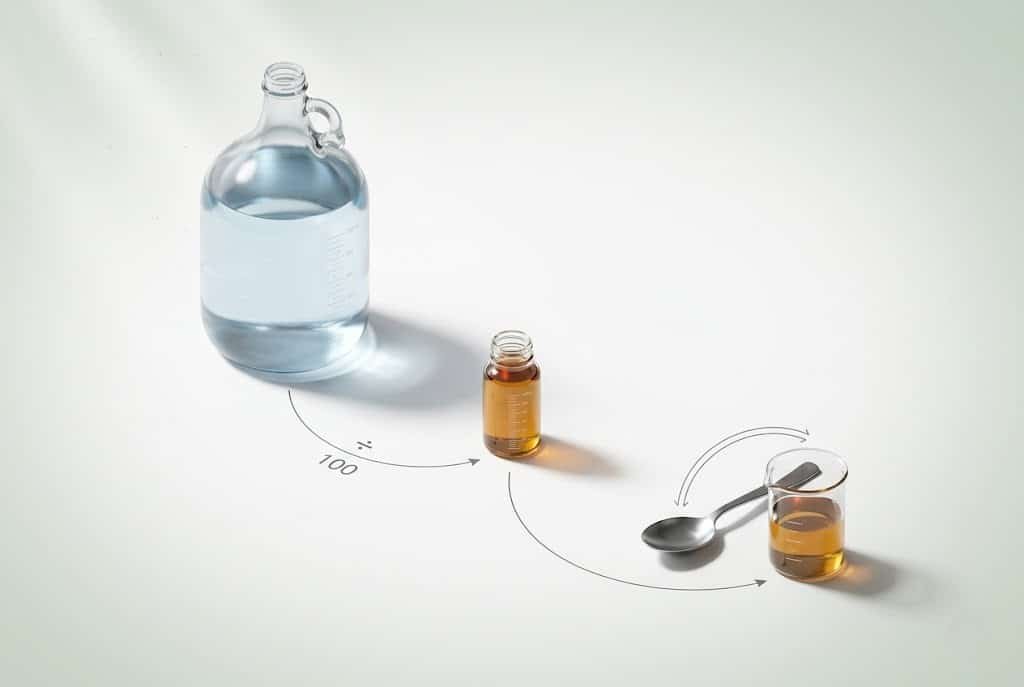
- Divide by the Ratio denominator (e.g. 100 for a 1:100 ratio):
Fert (gal) = Water (gal) ÷ Ratio - Convert gallons to fluid ounces: multiply by 128
Fert (fl oz) = Fert (gal) × 128 - Convert fluid ounces to tablespoons: multiply by 2
Fert (tbsp) = Fert (fl oz) × 2
Secret Sauce Check: 1 fl oz = 2 tbsp (US measurement). This calculator always verifies both outputs satisfy this relationship.
Assumptions & Limits:
- Assumes US fluid ounces (1 fl oz = 29.574 ml).
- Assumes US tablespoons (1 tbsp = 14.787 ml = ½ fl oz).
- Assumes liquid fertilizer has same density as water (for volume mixing).
- Water volume must be greater than 0 gallons.
- Ratio denominator must be at least 1 (i.e. pure concentrate = 1:1).
- Very high ratios (above 500) indicate very dilute solutions; typical garden ratios are 1:50–1:200.
- Always check your fertilizer label — manufacturer ratios override general guidelines.
Liquid fertilizer labels give a ratio. A watering can holds gallons. The gap between those two facts is where most application errors happen. Translating a 1:100 ratio into an actionable volume for a specific container is a unit-conversion chain, and a single wrong step compounds into either a nutrient-starved plant or a burned one. This page exists to close that gap with a deterministic calculation, not a guess.
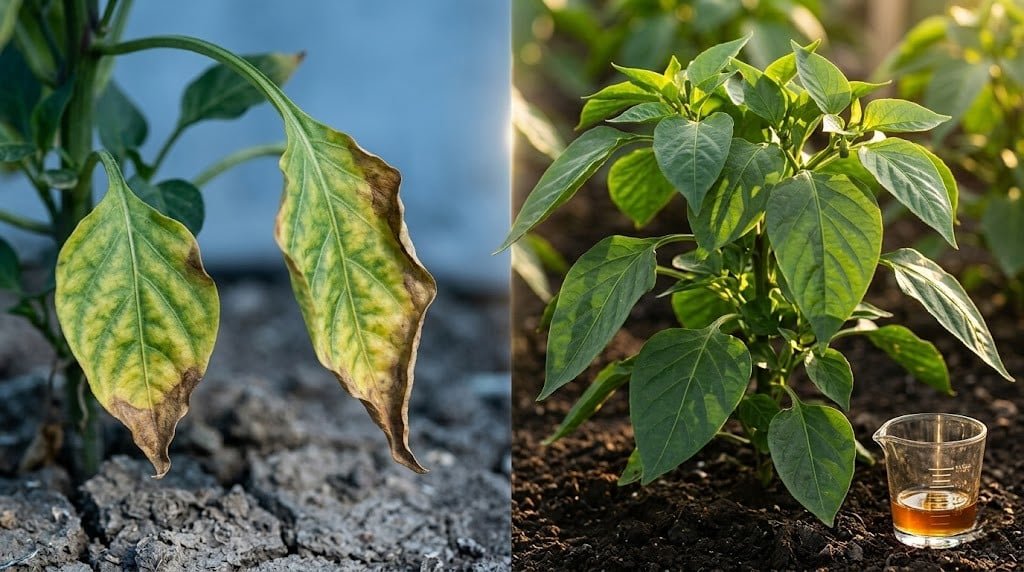
This fertilizer dilution calculator takes two inputs, water volume in gallons and the dilution ratio denominator, and returns the exact amount of liquid fertilizer needed in both fluid ounces and tablespoons. It does not account for fertilizer density, temperature-dependent solubility, or plant-specific uptake rates. Those variables live outside the scope of a dilution calculation and require a soil test or manufacturer consultation.
After using this tool, you will know precisely how many tablespoons or fluid ounces of liquid concentrate to add to your water volume for a given ratio, with both units cross-verified against the 1 oz = 2 tbsp standard so you can measure with whatever tool is in your hand.
Use the Tool
Before entering values, have your fertilizer label open so you can read the manufacturer’s recommended dilution ratio exactly. Know your container size in gallons (or convert liters to gallons: 1 liter = 0.264 gallons). If you are using a fertilizer injector system, confirm whether the ratio on the label refers to the injector ratio or the final solution ratio, since these are different numbers that produce very different mix volumes.
Quick Start (60 Seconds)
- Water Volume field: Enter the total water you are mixing into, in US gallons. A standard watering can is roughly 2 gallons; a 5-gallon bucket is 5. Do not enter liters here without converting first.
- Ratio (1:X) field: Enter only the denominator. For a 1:100 ratio, enter 100. For 1:50, enter 50. Do not enter the full ratio string or a colon.
- Check your fertilizer label twice. Some labels express ratio as mL per liter, not a true 1:X ratio. Convert before entering.
- Click Calculate only after both fields are filled. The tool will not run with empty or zero inputs.
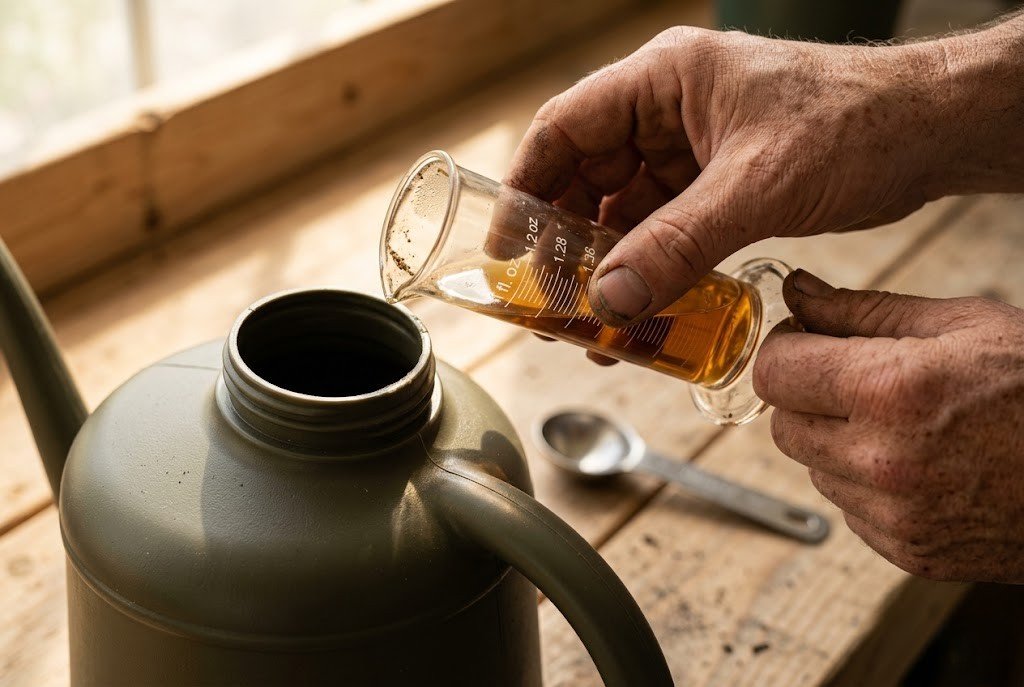
- Read the result in both tablespoons and fluid ounces. For small batches (under 1 gallon), tablespoons are the more practical measuring unit. For large batches, fluid ounces are easier to measure accurately with a graduated cylinder.
- Check the Warnings box below the result. If your ratio is below 1:30, a burn-risk notice will appear. Review your label before proceeding.
- Use the reference table to spot-check neighboring volumes at your ratio before mixing.
Inputs and Outputs (What Each Field Means)
| Field | Unit | What It Means | Common Mistake | Safe Entry Guidance |
|---|---|---|---|---|
| Water Volume | US gallons (gal) | The total water volume into which the concentrate is mixed | Entering liters without converting, or entering the final solution volume instead of the water-only volume | Must be greater than 0. Decimals are accepted (e.g., 0.5 for half a gallon). |
| Dilution Ratio (1:X) | Dimensionless integer or decimal | The denominator of the concentrate-to-water ratio. A ratio of 1:100 means 1 part fertilizer per 100 parts water. | Entering the full ratio as “1:100” instead of just “100,” or confusing the ratio with a parts-per-million value | Must be at least 1. Common garden values are 50 to 200. Values below 10 trigger a burn-risk warning. |
| Fertilizer Needed (fl oz) | US fluid ounces | Primary output: the volume of liquid concentrate to add to the stated water volume | Treating fluid ounces as weight ounces. These are not the same unit. | Read-only result. Use a measuring cup or graduated cylinder for accuracy. |
| Fertilizer Needed (tbsp) | US tablespoons | Secondary output: the same concentrate volume expressed in tablespoons for small-batch convenience | Using a metric tablespoon (15 mL) when the calculation assumes the US tablespoon (approximately 14.79 mL). The difference is small but measurable at larger volumes. | Read-only result. Verified against the fl oz result by the internal 1 oz = 2 tbsp check. |
Worked Examples (Real Numbers)
Example 1: Standard Backyard Garden Watering (5 Gallons, 1:100)
- Water Volume: 5 gallons
- Dilution Ratio: 1:100 (enter 100)
Result: 6.4 fl oz | 12.8 tbsp
This is a common general-purpose liquid feed scenario. At 1:100 with 5 gallons, the result lands in the safe zone. A standard measuring cup marked in fluid ounces handles this measurement easily without a graduated cylinder.
Example 2: Seedling Tray with Half a Gallon of Water (0.5 Gallons, 1:500)
- Water Volume: 0.5 gallons
- Dilution Ratio: 1:500 (enter 500)
Result: 0.128 fl oz | 0.256 tbsp
Seedlings and foliar applications require very dilute solutions. At sub-0.3 tablespoon volumes, a standard kitchen tablespoon becomes impractical. Use a 1 mL or 3 mL syringe for this level of precision. The fluid ounce figure (0.128) confirms the volume is just over one-eighth of a fluid ounce.
Example 3: Hydroponic Reservoir Top-Off (25 Gallons, 1:100)
- Water Volume: 25 gallons
- Dilution Ratio: 1:100 (enter 100)
Result: 32 fl oz | 64 tbsp
At this scale, fluid ounces are the practical unit. 32 fl oz equals exactly 1 quart, which aligns neatly with standard liquid fertilizer bottle sizes. Cross-checking with the tablespoon figure (64 tbsp = 4 cups = 1 quart) confirms the result is internally consistent. For hydroponic use, verify the resulting electrical conductivity with a meter after mixing.
Reference Table (Fast Lookup)
| Water (gal) | Ratio (1:X) | Fert (fl oz) | Fert (tbsp) | Fert (mL approx.) | Typical Use Case |
|---|---|---|---|---|---|
| 0.5 | 500 | 0.128 | 0.256 | 3.8 | Seedling / foliar spray |
| 1 | 200 | 0.64 | 1.28 | 18.9 | Mild fertigation, sensitive plants |
| 1 | 100 | 1.28 | 2.56 | 37.9 | Standard liquid feed, garden beds |
| 2 | 100 | 2.56 | 5.12 | 75.7 | Watering can standard fill |
| 5 | 100 | 6.40 | 12.80 | 189.3 | 5-gallon bucket, garden irrigation |
| 5 | 50 | 12.80 | 25.60 | 378.5 | Heavy feeder, established vegetables |
| 10 | 100 | 12.80 | 25.60 | 378.5 | Drip system reservoir, small plot |
| 25 | 100 | 32.00 | 64.00 | 946.4 | Hydroponic reservoir, 1-quart bottle |
| 25 | 200 | 16.00 | 32.00 | 473.2 | Mild fertigation, large volume |
| 50 | 100 | 64.00 | 128.00 | 1892.7 | Irrigation tank, small commercial |
The mL column is derived: 1 US fl oz = 29.5735 mL. This column is useful when measuring with a metric syringe or graduated cylinder.
How the Calculation Works (Formula + Assumptions)
Show the calculation steps
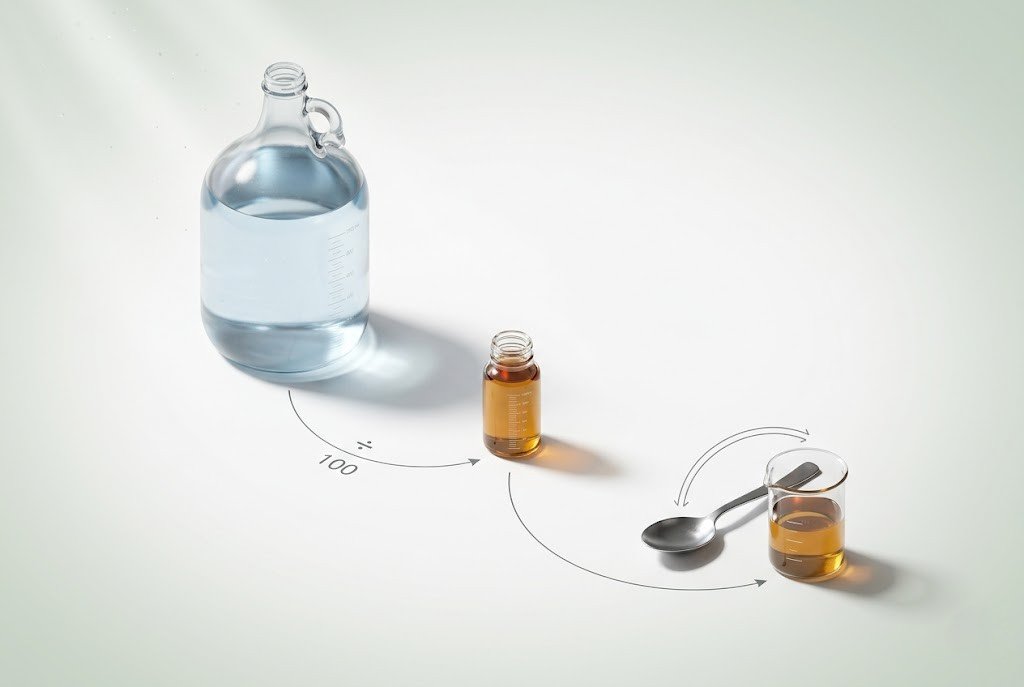
The liquid fertilizer mixing ratio formula follows a three-step unit conversion chain:
- Step 1 – Fertilizer volume in gallons: Divide the water volume by the ratio denominator.
Fert (gal) = Water (gal) ÷ Ratio - Step 2 – Convert to fluid ounces: Multiply by 128, since there are 128 US fluid ounces in one US gallon.
Fert (fl oz) = Fert (gal) × 128 - Step 3 – Convert to tablespoons: Multiply by 2, since there are 2 US tablespoons in one US fluid ounce.
Fert (tbsp) = Fert (fl oz) × 2
Rounding rule: Results above 10 round to 1 decimal place. Results between 1 and 10 round to 2 decimal places. Results below 1 round to 3 decimal places to preserve accuracy for small-batch mixing.
Internal verification: The tool divides the tablespoon result by 2 and compares it against the fluid ounce result. If these do not match within floating-point tolerance, a conversion error is flagged. This confirms the 1 oz = 2 tbsp relationship holds in every output.
Assumptions and Limits
- All calculations assume US customary units. 1 US fluid ounce = 29.5735 mL. 1 US tablespoon = 14.787 mL = 0.5 fl oz. Do not use Imperial fluid ounces (the UK system), which differ slightly.
- The formula assumes the dilution ratio provided is a volume-to-volume ratio (e.g., 1 part fertilizer to 100 parts water). Some product labels express concentration as grams per liter or mL per liter, which requires a different conversion before entry.
- The tool does not account for fertilizer density. Heavier concentrates (above 1.0 specific gravity) will deliver more fertilizer by weight per fluid ounce than the formula assumes. For weight-sensitive precision, convert using the liquid fertilizer weight per gallon calculator.
- The tool assumes the fertilizer is fully soluble in water at room temperature. High-concentration or cold-water mixing may result in undissolved particles that alter the effective dilution.
- Very high ratios (above 500:1 denominator) produce sub-0.2 fl oz results for 1-gallon batches. These volumes are below the resolution of most consumer measuring tools. A 1 mL syringe is recommended.
- Ratios below 1:10 are within the calculator’s accepted range but trigger a burn-risk warning. The calculator does not prevent you from computing a dangerous concentration; it flags the risk and defers to the user’s judgment and their product label.
- This tool calculates dilution volume only. It does not predict nutrient availability, soil pH impact, or fertilizer uptake efficiency. For NPK planning, pair this tool with the NPK calculator.
Standards, Safety Checks, and “Secret Sauce” Warnings
Critical Warnings
- Ratios below 1:30 carry a fertilizer burn risk. At these concentrations, root tissue and leaf surfaces can be damaged within hours of application. The calculator flags ratios below 1:30 in orange and ratios below 1:10 in red. If your label does not explicitly authorize these concentrations, do not proceed without a dilution-rate confirmation from the manufacturer.
- Fluid ounces and weight ounces are not interchangeable. A common and consequential mistake is measuring fertilizer by weight when the ratio specifies volume. A fluid ounce of a dense liquid fertilizer weighs more than one ounce by weight. Always use a volumetric measuring tool (graduated cylinder, fluid-ounce measuring cup) for liquid concentrate.
- The tablespoon figure must equal exactly twice the fluid ounce figure. If you manually verify your poured amounts and find a discrepancy larger than measurement tolerance, re-measure. The 1 oz = 2 tbsp standard (US) is exact, not approximate. A mismatch usually indicates a measuring-tool error, not a formula error.
- Foliar spray solutions should use ratios of 1:400 or weaker. Applying a standard 1:100 garden ratio directly to foliage, especially in warm weather, risks leaf scorch. The calculator’s concentration gauge bar visualizes this: positions toward the right (strong) should not be used for foliar applications.
Minimum Standards
- Always use the dilution ratio from the specific product label, not a generic online recommendation. Formulation strength varies significantly between brands and product lines.
- For new plants, apply a half-strength solution (double the ratio denominator) on the first two applications before moving to the full recommended rate.
- For drip irrigation or fertigation systems, verify that the calculated volume matches what your fertilizer injector is set to deliver, since injectors apply a concentrate-to-water ratio before the water reaches the plant, adding a second ratio stage to the calculation.
Competitor Trap: Many liquid fertilizer mixing ratio calculators output only one unit, typically fluid ounces. This creates a practical problem for home gardeners who measure with kitchen tablespoons and a decision problem for anyone who needs to cross-verify the result. The missing tablespoon output is not a cosmetic gap; it removes the ability to catch unit-conversion errors before mixing. A result of 6.4 fl oz should always produce 12.8 tbsp. If a calculator gives you one without the other, you have no internal check. Always verify both units before pouring.
For applications involving additional chemical inputs alongside fertilizer, the pesticide dilution calculator follows the same ratio structure and can be run in parallel to confirm combined tank-mix volumes are within tolerance.
Common Mistakes and Fixes
Mistake: Using Ratio Shorthand Backward
Some gardeners read “1:100” as “100 parts fertilizer to 1 part water” rather than the correct “1 part fertilizer to 100 parts water.” At typical volumes, this mistake produces a 10,000-fold overdose. The fix is simple but requires a mental reset: the first number is always the smaller quantity (the concentrate), and the second is always the larger quantity (the water).
Fix: Read the ratio out loud as “1 of this goes into 100 of that” before entering any values.
Mistake: Entering Liters as Gallons
A 10-liter watering can is approximately 2.64 gallons, not 10 gallons. Entering 10 when you mean 2.64 produces a result that is nearly four times higher than needed. This error is especially common when using European or metric-labeled containers in a US-unit workflow.
Fix: Convert liters to gallons first (divide liters by 3.785) and enter the result in the Water Volume field.
Mistake: Confusing mL-per-Liter Labels with 1:X Ratios
A product label reading “5 mL per liter” is not a 1:5 ratio. It is closer to a 1:200 ratio (since 5 mL in 1000 mL = 5/1000 = 0.005 = 1:200). Entering 5 into the ratio field instead of 200 will produce a severely over-concentrated mix.
Fix: Convert mL-per-liter to a ratio by dividing 1000 by the mL value. A “5 mL per liter” label becomes a 1:200 ratio. Enter 200 in the ratio field.
Mistake: Skipping the Tablespoon Cross-Check
Using only the fluid ounce result and ignoring the tablespoon output removes a built-in verification step. If you are measuring with a tablespoon and only read the fl oz number, a misread or unit confusion goes uncaught until the plant shows a response.
Fix: Always read both output fields. Confirm that the tablespoon number is exactly double the fluid ounce number before pouring.
Mistake: Applying Standard Garden Rates to Seedlings
Seedlings and recently-rooted cuttings are significantly more sensitive to fertilizer salt concentration than established plants. A 1:100 ratio appropriate for a mature tomato plant can cause root burn in a seedling tray within 24 hours. The calculator’s concentration bar and warnings are calibrated for general plants; seedling thresholds are more conservative.
Fix: For seedlings, multiply the recommended ratio denominator by 4 to 5 (e.g., change 1:100 to 1:400 or 1:500) and increase gradually over several weeks as the plant establishes.
Related Tools and Next Steps
Once you have your liquid fertilizer volume calculated, knowing the complete nutrient profile of what you are mixing helps avoid over-application of any single element. The NPK fertilizer calculator translates product labels into actual nitrogen, phosphorus, and potassium amounts applied per area.
Lawn applications have different dilution needs than garden beds because coverage area and application rate interact. Use the lawn fertilizer calculator to pair your dilution result with a square footage target.
If you are also preparing compost teas or liquid organic inputs, the compost tea recipe tool handles ratio-based preparation for liquid organic amendments with different mixing considerations than synthetic concentrates.
For applications where both fertilizer and a surfactant are being mixed together, the non-ionic surfactant ratio calculator provides the correct proportions for adjuvant addition without altering your fertilizer dilution.
Understanding how fertilizer salt index affects soil health at the concentrations you are applying is a useful next step after calculating mix volumes. The fertilizer salt index calculator quantifies the osmotic risk from your chosen product and rate combination.
Nitrogen availability from liquid sources changes based on formulation and application timing. The nitrogen calculator accounts for these variables when you want to move from a dilution calculation to a nutrient-budget calculation.
For soil pH management decisions that interact with fertilizer program choices, the soil pH lime calculator and the soil pH sulfur calculator help ensure your fertilizer applications are landing in a pH range where nutrient uptake is maximized.
FAQ
What does a 1:100 dilution ratio mean for liquid fertilizer?
A 1:100 dilution ratio means 1 part liquid fertilizer concentrate is mixed with 100 parts water. For every gallon of water, you add 1/100 of a gallon of fertilizer, which equals 1.28 fl oz or about 2.56 tablespoons. The first number is always the concentrate volume; the second is always the water volume.
How many tablespoons of liquid fertilizer per gallon of water?
The answer depends entirely on the dilution ratio. At 1:100, one gallon of water requires 2.56 tablespoons. At 1:50, that doubles to approximately 5.12 tablespoons. At 1:200, it drops to about 1.28 tablespoons. There is no single universal tablespoon-per-gallon value; always calculate from the specific product ratio.
Is fluid ounces the same as ounces for measuring fertilizer?
No. Fluid ounces measure volume; ounces (weight) measure mass. For liquid fertilizers, the label ratio is a volume-to-volume ratio, so you must use a fluid ounce measurement. A fluid ounce of a dense liquid fertilizer weighs more than one weight ounce, so using a kitchen scale set to ounces will deliver a different (and usually incorrect) quantity.
What is a safe fertilizer dilution ratio to avoid burning plants?
Most established garden plants tolerate ratios between 1:50 and 1:200 for soil applications. Ratios stronger than 1:30 carry a meaningful risk of root burn, and anything below 1:10 is high-risk unless the product label explicitly specifies that concentration. Seedlings and foliar applications should use ratios of 1:400 or weaker as a general baseline.
Can I use this calculator for hydroponic nutrient solutions?
Yes, with one additional step. This calculator gives you the volume of concentrate to add. For hydroponic systems, you must then measure the electrical conductivity of the resulting solution with an EC meter to confirm the nutrient concentration is within target range. Volume-based dilution and EC-based verification work together; neither replaces the other.
Why does my fertilizer label use mL per liter instead of a ratio?
Many product labels, especially European and metric-formulated products, express dosage as milliliters of concentrate per liter of water. To convert to a 1:X ratio, divide 1000 by the mL value. A label that reads “5 mL per liter” is equivalent to a 1:200 ratio. Enter 200 in the ratio field of this calculator to get the correct volume for your gallon-based container.
Conclusion
The single most common mistake this tool is designed to prevent is ratio inversion: treating the larger number in a 1:100 ratio as the concentrate quantity rather than the water quantity. Double-check every entry against your product label. If the result triggers a burn-risk warning, treat that as a signal to re-read the label before mixing, not a reason to override. Accurate dilution is the foundation that every other part of a fertilizer program builds on.