
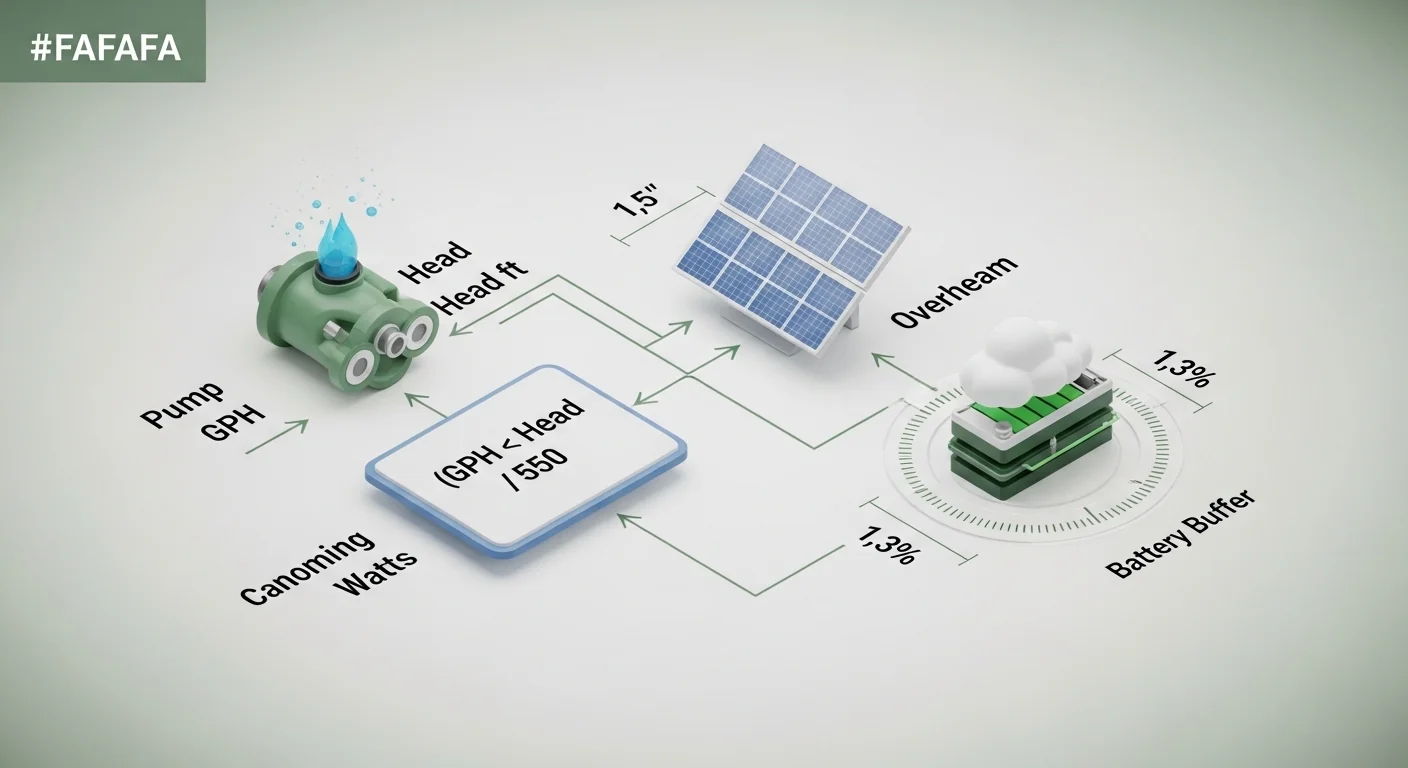
Choosing the wrong solar pump setup is rarely about picking a bad pump. It is almost always about under-sizing the panel or ignoring how dramatically flow drops as lift height increases. A pump rated at 500 GPH at zero head might deliver fewer than 300 GPH once it is pushing water four feet up to a spillway. The watt requirement changes with it, and so does the panel you need to sustain reliable daily operation.
| Component | Value |
|---|
| Flow (GPH) | Head (ft) | Watts | Panel (W) | Battery (Ah @12V, 8h) |
|---|
How This Calculator Works
Step 1 — Watts Required: Multiply your desired flow (GPH) by the pump head height (ft), then divide by a hydraulic constant of 550. Formula: Watts = (GPH × Head) / 550
Step 2 — Solar Panel Size: Multiply the required watts by 1.5 to account for real-world inefficiencies (panel angle, temperature, clouds). Formula: Panel Watts = Watts × 1.5
Step 3 — Battery Capacity: Multiply required watts by daily run hours, then divide by battery voltage (12V assumed). Formula: Battery Ah = (Watts × Hours) / 12
Assumptions: Hydraulic constant of 550 is an approximation for typical small DC pond pumps. Actual efficiency varies by pump model. Panel overhead of 50% covers average losses. Battery sizing assumes 100% depth of discharge — for lead-acid, double the Ah; for lithium, add 20%.
Assumptions & Limits
This calculator covers small to medium DC solar pond pumps (50–5000 GPH, up to 50 ft head). It does not account for pipe friction losses, fitting losses, or extreme temperatures. For long pipe runs (>25 ft horizontal), add 10–15% to your wattage estimate. Battery capacity assumes a standard 12V system. Results are estimates — always verify against the pump manufacturer’s performance curve.
This solar pump calculator computes three core outputs from your inputs: the minimum watt draw of the pump, the recommended solar panel size with overhead built in, and the battery capacity needed to run the system for your chosen daily hours. What it does not do is account for pipe friction losses from long horizontal runs, fitting bends, or pump efficiency curves from specific manufacturers. Those variables require the pump's published performance data and should be cross-checked before finalizing a purchase.
After using this tool, you will know the minimum solar panel wattage, the battery bank size in amp-hours at 12V, and whether your head height puts you in a zone where real-world flow will fall short of your design target.
Use the Tool

Before entering values, have two measurements ready: the vertical lift distance in feet from the water surface to the highest discharge point, and your target flow rate in gallons per hour. If you are designing a new feature rather than sizing an existing pump, start with the minimum flow the feature needs to look and function right. You may also want to have your intended daily run hours, since battery sizing scales directly with that number. Pond owners planning the full water feature setup can use the pond liner size calculator alongside this tool to complete the core specifications before ordering materials.
Quick Start (60 Seconds)
- Pump Head Height (ft): Measure the vertical distance from the water surface to the outlet, not the total pipe length. A pump sitting at the pond bottom pushing water 5 feet up to a waterfall crest has a 5 ft head. Enter a value between 0.5 and 50 ft.
- Desired Flow (GPH): Enter the gallons per hour you want at the outlet, not the pump's rated max. Manufacturer specs are almost always measured at zero head. Reduce your expectation for any meaningful lift.
- Run Time (Hours/Day): How many hours per day the pump needs to operate. This directly drives battery sizing. Short decorative run times (4 to 6 hours) allow for a significantly smaller battery than all-day filtration loops.
- Check units: Feet for head, GPH for flow. Do not mix in metric values. The formula is calibrated for imperial units only.
- Read the traffic light result: The green/yellow/red indicator reflects system size complexity, not safety. Yellow and red flag configurations where an MPPT charge controller and careful battery selection become more important, not optional.
- Review the cloudy-day buffer: The calculator generates a recommended battery size that is 30 percent above the minimum. Plan your purchase around that number, not the bare minimum Ah.
- Worked examples below: If you are unsure whether your inputs are reasonable, compare them against the three scenario walkthroughs in the Worked Examples section before finalizing.
Inputs and Outputs (What Each Field Means)
| Field | Unit | What It Means | Common Mistake | Safe Entry Guidance |
|---|---|---|---|---|
| Pump Head Height | ft | Vertical lift from water surface to discharge point | Using total pipe length instead of vertical rise only | Measure plumb vertical drop; ignore horizontal pipe runs for this field |
| Desired Flow | GPH | Target gallons per hour at the outlet under load | Entering the pump's zero-head rating without adjustment | Use a conservative flow target; actual delivery will be lower than rated max at any head above zero |
| Run Time | Hours/Day | Daily operating hours the system must sustain | Entering 24 hours for a decorative fountain, inflating battery size unnecessarily | Match to actual desired operation window; filtration loops typically require longer run times than aesthetic features |
| Watts Required | W | Minimum continuous watt draw for the pump at these specs | Treating this as the panel size rather than the pump draw | Use as the floor for pump selection, not the panel size; the panel must be larger to cover real-world losses |
| Solar Panel Size | W | Recommended panel wattage including a 1.5x overhead factor | Buying a panel equal to pump watts with no overhead margin | Purchase a panel at or above this wattage; go higher if installation angle is suboptimal or shading is a factor |
| Battery Capacity | Ah (at 12V) | Amp-hours at 12V needed to sustain the pump for the stated daily run hours | Selecting lead-acid batteries sized to the minimum Ah without accounting for depth-of-discharge limits | For lead-acid, double the displayed Ah; for lithium, add a 20 percent margin; use the cloudy-day buffer Ah figure as the baseline |
| Cloudy Day Battery | Ah (at 12V) | Battery size with a 30 percent reserve for partial solar days | Ignoring this figure entirely and buying minimum-spec batteries | Treat this number as your purchase target, not the bare minimum |
Worked Examples (Real Numbers)
Scenario 1: Small Decorative Fountain, Minimal Lift
- Pump Head Height: 4 ft
- Desired Flow: 500 GPH
- Run Time: 6 hours/day
Result: Watts Required = (500 x 4) / 550 = 3.6 W. Panel = 3.6 x 1.5 = 5.5 W. Battery = (3.6 x 6) / 12 = 1.8 Ah. Cloudy-day buffer = 2.3 Ah.
This is a small, clean system. A 10W panel is a practical real-world purchase since 5.5W panels are rarely sold individually. Battery requirements at this scale are minimal; a small sealed lead-acid unit handles this comfortably even with the cloudy-day buffer applied.
Scenario 2: Medium Garden Pond with Waterfall, Standard Run
- Pump Head Height: 8 ft
- Desired Flow: 1,000 GPH
- Run Time: 10 hours/day
Result: Watts Required = (1000 x 8) / 550 = 14.5 W. Panel = 14.5 x 1.5 = 21.8 W, round to 25W. Battery = (14.5 x 10) / 12 = 12.1 Ah. Cloudy-day buffer = 15.7 Ah.
The system sits in the medium range. The traffic-light indicator will read yellow, which means an MPPT charge controller provides a meaningful efficiency gain here. A 20Ah sealed battery covers the cloudy-day buffer. Head loss at 8 ft is a real concern: verify the chosen pump's flow-vs-head curve to confirm it delivers 1,000 GPH at 8 ft, not just at zero head.
Scenario 3: Large Koi Pond Filtration Loop, Extended Hours
- Pump Head Height: 15 ft
- Desired Flow: 2,000 GPH
- Run Time: 12 hours/day
Result: Watts Required = (2000 x 15) / 550 = 54.5 W. Panel = 54.5 x 1.5 = 81.8 W, round to 100W. Battery = (54.5 x 12) / 12 = 54.5 Ah. Cloudy-day buffer = 70.9 Ah.
This configuration triggers the red indicator. At 15 ft of head, the actual delivered flow from most pumps rated at 2,000 GPH zero-head will be substantially lower. Cross-referencing the pump manufacturer's performance curve before finalizing this design is not optional. A 100W panel with an 80Ah lithium battery is a realistic purchase pair for this load. Extended run times at this scale make lithium chemistry significantly more practical than lead-acid.
Reference Table (Fast Lookup)
| Flow (GPH) | Head (ft) | Watts Required | Panel Size (W) | Battery Min (Ah) | Cloudy Buffer (Ah) |
|---|---|---|---|---|---|
| 150 | 3 | 0.8 | 2 | 0.5 | 0.7 |
| 300 | 4 | 2.2 | 4 | 1.5 | 1.9 |
| 500 | 5 | 4.5 | 7 | 3.0 | 3.9 |
| 800 | 6 | 8.7 | 14 | 5.8 | 7.5 |
| 1,000 | 8 | 14.5 | 22 | 9.7 | 12.6 |
| 1,500 | 10 | 27.3 | 41 | 18.2 | 23.6 |
| 2,000 | 12 | 43.6 | 66 | 29.1 | 37.8 |
| 2,500 | 15 | 68.2 | 103 | 45.5 | 59.1 |
| 3,000 | 18 | 98.2 | 148 | 65.5 | 85.1 |
| 4,000 | 20 | 145.5 | 219 | 97.0 | 126.1 |
All Ah values assume 12V nominal voltage and 8 hours of daily run time. Battery column shows minimum draw only; apply the cloudy buffer column when purchasing. For lead-acid chemistry, double the cloudy buffer Ah to stay above a 50 percent depth of discharge.
How the Calculation Works (Formula + Assumptions)
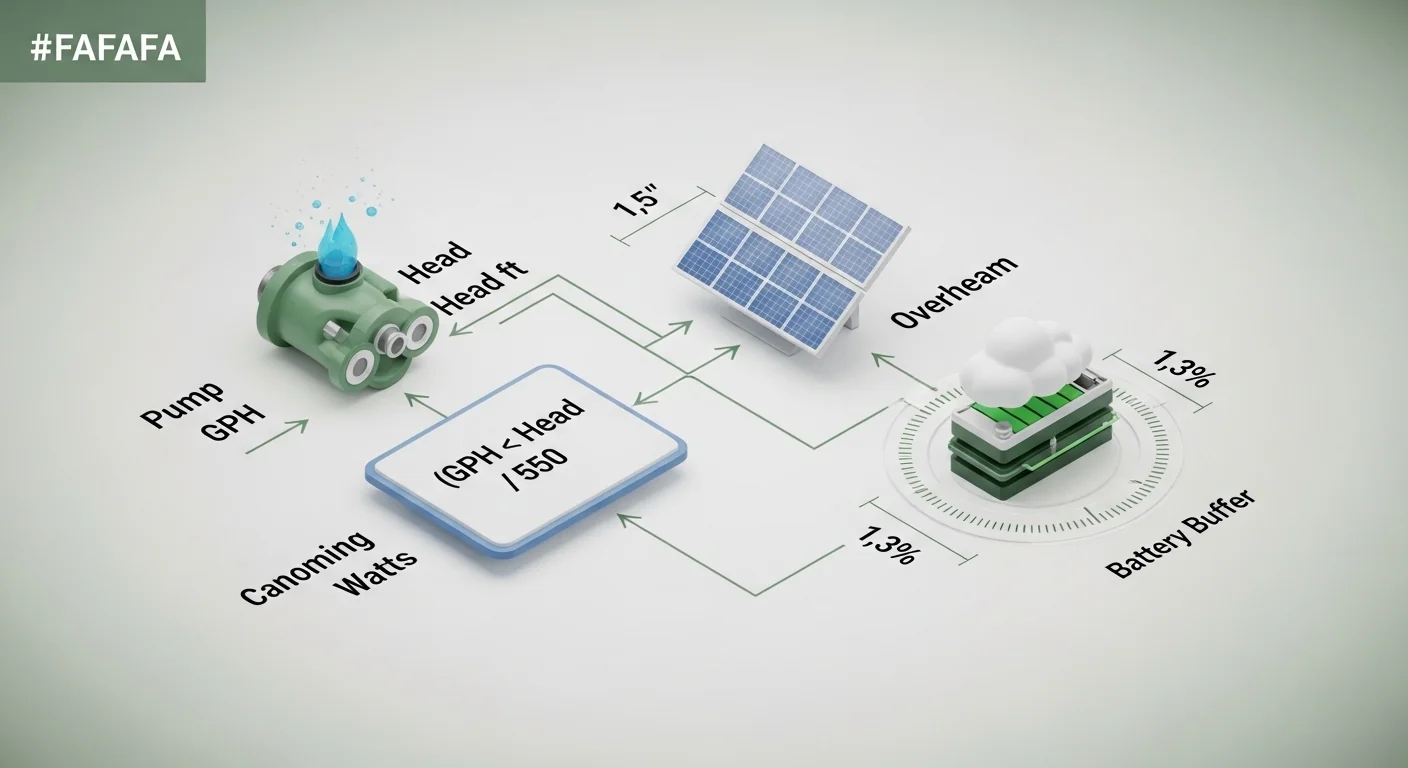
Show the calculation steps
Step 1 - Watts Required: Multiply your desired flow in GPH by the pump head height in feet. Divide that product by 550. This hydraulic constant approximates the relationship between volumetric flow, lift, and power draw in small DC pond pump systems operating in the typical range. Formula: Watts = (GPH x Head) / 550. Round to one decimal place.
Step 2 - Solar Panel Size: Multiply the watts result by 1.5. This 50 percent overhead accounts for panel derating due to real-world temperature, non-ideal tilt angles, partial shading, and inverter or controller conversion losses. Formula: Panel Watts = Watts x 1.5. Round up to the nearest whole watt when purchasing.
Step 3 - Battery Capacity: Multiply the watts result by the daily run time in hours. Divide by 12 (the assumed system voltage). Formula: Battery Ah = (Watts x Hours) / 12. Round to one decimal place. The cloudy-day buffer multiplies this by 1.3.
Step 4 - Daily Energy Usage: Watts multiplied by run hours gives watt-hours consumed per day. This figure is displayed in the breakdown table and is useful when cross-referencing battery datasheets that list capacity in watt-hours rather than amp-hours.
Assumptions and Limits
- The hydraulic constant of 550 is an approximation suitable for small DC solar pond pumps. High-efficiency or large commercial pumps will have lower constants; cheap submersible pumps may have higher effective constants due to lower efficiency.
- Battery voltage is assumed to be 12V nominal. 24V systems require halving the displayed Ah figures to get the equivalent 24V bank size.
- Panel overhead of 1.5x (50 percent) is a general derating factor. In high-heat environments or installations with significant shading, a 2x factor is more conservative.
- Pipe friction losses from horizontal runs are not included. For runs exceeding 25 feet of horizontal pipe, add 10 to 15 percent to the pump watt estimate manually before using this tool.
- The tool does not account for pump-specific efficiency curves. All pumps of the same rated GPH and head do not consume the same watts; a quality pump with high hydraulic efficiency will draw less than a low-cost equivalent.
- Cloudy-day buffer of 1.3x covers one partially overcast day. Multi-day cloud cover or seasonal low-sun periods require a larger battery reserve calculated separately.
- The calculator does not account for battery self-discharge rates, charge controller efficiency losses, or wiring resistance between components.
Standards, Safety Checks, and "Secret Sauce" Warnings
Critical Warnings
- Head loss is not optional to consider: Pump performance curves show flow declining steeply as head increases. A pump advertised at 1,000 GPH may deliver 600 GPH or less at 8 feet of head. Always check the manufacturer's performance chart at your specific head height before treating the desired flow number as achievable. Designers who skip this step end up with undersized water features regardless of how accurate the solar calculation is. The waterfall pump calculator handles flow-vs-head specifics for cascade and spillway features.
- Cloud-cover battery undersizing: The bare minimum battery Ah figure keeps the pump running at rated wattage for the stated hours under ideal solar conditions. A single overcast afternoon can exhaust a minimum-spec battery. The 30 percent buffer built into this tool's cloudy-day output is the real design target for reliable operation.
- Panel watts are not the same as pump watts: Running a pump that draws 15 watts from a 15W panel will result in a failed or sluggish system. The panel must be oversized relative to the pump draw to account for conversion losses, heat derating, and charge controller inefficiency.
- High-head configurations above 10 ft: At head heights above 10 feet, flow reduction from the rated GPH becomes severe enough to change the entire system design. The calculator flags this and warns accordingly, but the user must verify against the actual pump curve.
Minimum Standards
- Panel size should always be at or above 1.5x the pump's calculated watt draw. This is not a comfort margin; it is a functional requirement for reliable solar-powered operation.
- Battery capacity for lead-acid chemistry must be doubled from the displayed minimum Ah to avoid operating below 50 percent depth of discharge, which severely shortens battery lifespan.
- Systems exceeding 100 watts should use an MPPT charge controller rather than PWM. The efficiency gain at higher wattages justifies the cost difference and prevents panel output from being wasted during the charging cycle. This matters in the same way that voltage drop in landscape lighting runs must be managed to prevent underperformance.
Competitor Trap: Most solar pump sizing guides online tell you to simply match the pump's rated wattage to a same-wattage panel and call the job done. This leaves out the 1.5x overhead factor entirely, ignores the battery buffer for cloudy conditions, and never mentions that the GPH rating printed on the pump box is measured at zero head. Following that advice on a 10-foot-head installation will produce a pump that runs erratically during peak sun and shuts off entirely by mid-afternoon. The cloudy-day buffer and the head loss warning in this tool exist specifically because that shortcut produces predictably bad results.
Common Mistakes and Fixes
Mistake: Using the Pump's Box Rating as the Actual Flow
Manufacturers test and label pump flow at zero head, meaning the pump sits level with the discharge and lifts nothing. The moment any vertical rise is introduced, flow drops. At 6 feet of head, most submersible pumps deliver well under their rated GPH. Designing a pond or water feature around the box number without checking the performance curve at your actual head height produces a feature that underperforms on day one.
Fix: Find the pump's performance curve (usually in the product manual or manufacturer's website) and read the flow value at your actual head height before entering a GPH target in this calculator.
Mistake: Sizing the Solar Panel to Match Pump Watts Exactly
A 20W pump connected to a 20W panel operates at maximum stress with zero margin for panel derating, temperature loss, or suboptimal angle. Real-world panel output at noon in summer heat is already below the nameplate rating. The result is a pump that runs only during peak sun hours and underperforms or fails to start on any other part of the day.
Fix: Use the panel wattage this calculator outputs, which already includes the 1.5x factor. In shaded or high-temperature installations, move toward a 2x multiplier.
Mistake: Buying a Lead-Acid Battery Sized to the Minimum Ah
Lead-acid batteries degrade rapidly when regularly discharged below 50 percent of their rated capacity. Buying a battery sized to the exact minimum Ah the calculator shows means the battery is fully depleted every cycle, which cuts its usable lifespan dramatically. Pond owners often discover this after the first season when the battery can no longer hold a charge. The pond evaporation calculator is a useful companion tool for understanding water feature maintenance patterns that affect system run time decisions.
Fix: For lead-acid, buy a battery with at least double the minimum Ah shown. Use the cloudy-day buffer Ah as the starting point for lithium chemistry instead.
Mistake: Ignoring Horizontal Pipe Length When Estimating Head
The head height field in this calculator is for vertical lift only. However, long horizontal pipe runs and every 90-degree fitting in the system add equivalent friction resistance that behaves like additional head. A 40-foot horizontal run to a distant waterfall adds meaningful resistance that the bare vertical measurement misses.
Fix: For runs longer than 25 feet of horizontal pipe, add a 10 to 15 percent margin to your watt estimate manually. Alternatively, enter a slightly higher head value in the calculator to bake in the friction allowance.
Mistake: Setting Run Time to Maximum Without Considering System
Purpose
Entering 24 hours of run time for a decorative fountain that operates only during daylight hours inflates the battery requirement unnecessarily. Conversely, entering 6 hours for a koi pond biological filter that must run continuously to keep water oxygenated will undersize the battery. The run time field has a direct linear effect on battery sizing, so an accurate value matters.
Fix: Match run time to actual intended operation. Filtration and aeration systems often require 12 to 18 hours or continuous operation; aesthetic fountains rarely need more than 6 to 10 hours. If the pond also includes an ultraviolet clarifier, check the pond UV clarifier sizing tool to confirm that system's power draw is accounted for separately.
Next Steps in Your Workflow
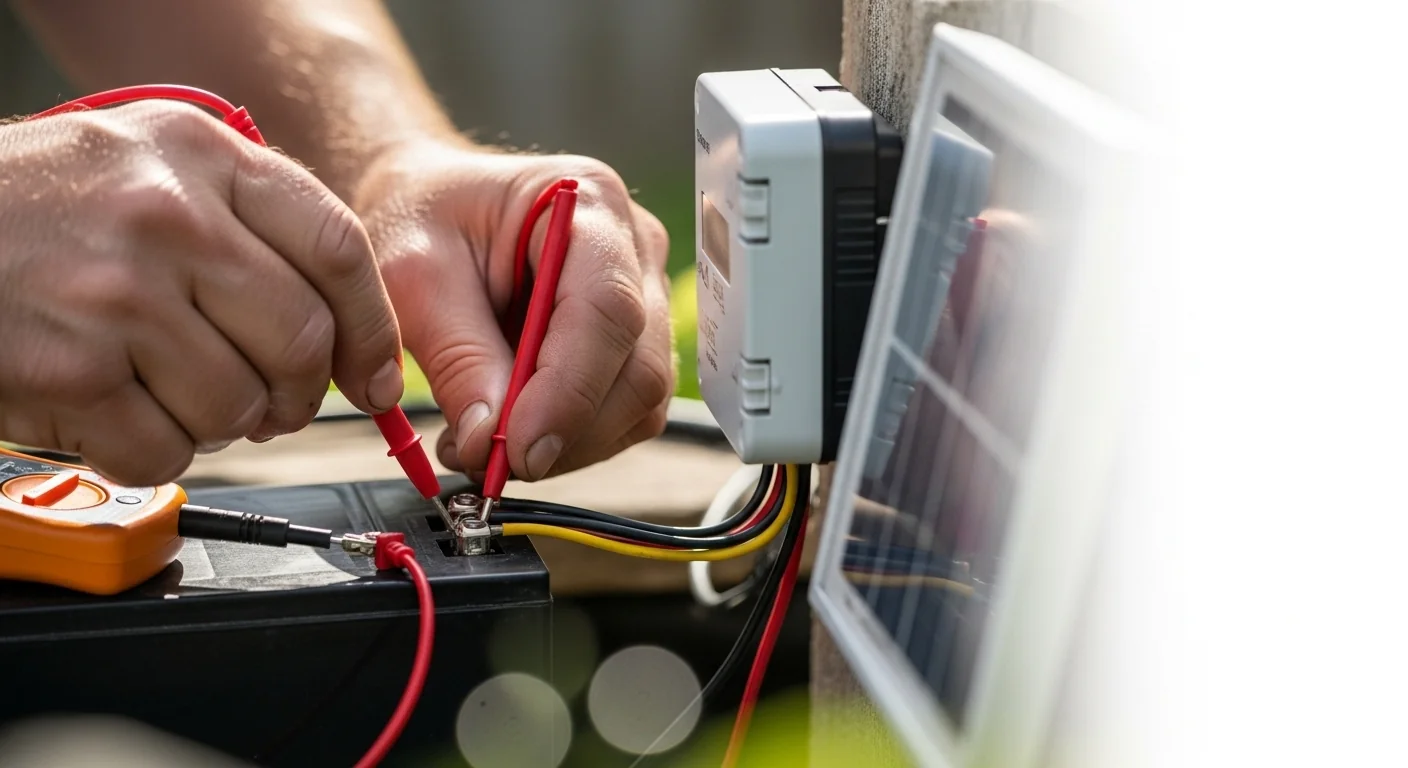
Once you have the watt, panel, and battery numbers from this calculator, the next practical step is cross-referencing the watts required against specific pump models. Pump manufacturers publish performance curves that show GPH at various head heights. Pull the curve for any pump you are considering and confirm it delivers at least your target GPH at your stated head. If it does not, either choose a higher-rated pump or reduce the head height by repositioning the outlet. Battery and panel purchases can happen in parallel once the watt requirement is locked in, since those figures do not depend on pump model selection.
For ponds that involve significant water feature planning beyond the pump itself, the pond liner calculator handles the volume and surface area side of the design, and the rain garden sizing calculator is useful if your water feature integrates with storm runoff management. Both pair well with the solar pump output when you are working through a full landscape water system from scratch.
FAQ
What does pump head height actually mean for a solar pond pump?
Pump head height is the vertical distance the water must travel from the source surface to the discharge point. It does not include horizontal pipe length. A pump at pond level pushing water up four feet to a waterfall lip has a 4 ft head. This measurement is the most important single variable in pump sizing because flow decreases sharply as head increases beyond the pump's efficient operating range.
Why is the solar panel recommendation larger than the pump's watt
draw?
Solar panels do not deliver their nameplate wattage under real-world conditions. Temperature, panel angle, partial cloud cover, and charge controller losses reduce effective output. A 1.5x overhead factor ensures the panel generates enough usable power to run the pump reliably rather than only during ideal noon conditions. Skipping this margin is the most common cause of intermittent solar pump operation.
What battery type is best for a solar pond pump system?
Lithium iron phosphate (LiFePO4) batteries outperform lead-acid in nearly every metric relevant to solar pond systems: depth of discharge, cycle life, weight, and maintenance. For lead-acid batteries, the usable capacity is limited to roughly 50 percent of the rated Ah, which means you need twice the displayed minimum. Lithium allows discharge to 80 to 90 percent, making the cloudy-day buffer figure a practical sizing target.
How does head loss affect the flow I actually get from my pond pump?
Every pump has a performance curve showing flow rate at increasing head heights. As head increases, flow decreases in a non-linear way that accelerates as you approach the pump's maximum head rating. A pump rated for 1,000 GPH at zero head might only deliver 500 GPH at 8 ft and near zero at 14 ft. This is why entering your design flow target rather than the pump's rated max is critical for accurate sizing.
Can I use this calculator for an AC pond pump connected to a solar
inverter?
This calculator is calibrated for DC solar pond pump systems running directly off a solar panel and battery at 12V nominal. AC pump systems powered through an inverter have additional efficiency losses from the DC-to-AC conversion stage, which typically runs between 85 and 92 percent efficiency. For AC-inverter setups, increase the watt estimate by dividing the result by the inverter's efficiency rating before sizing the panel and battery.
What is a cloudy-day battery buffer and how big should it be?
A cloudy-day buffer is extra battery capacity beyond the bare minimum needed to run the pump for the stated hours. When cloud cover reduces solar panel output, the battery carries the load. This calculator recommends a 30 percent buffer above the minimum as a practical baseline for most installations. Regions with frequent overcast weather or shading from trees should consider a larger reserve of 50 percent or more above the minimum Ah.
Conclusion
The most important mistake to avoid after running these numbers is treating the minimum battery Ah as the purchase target. The cloudy-day buffer figure is the real baseline for a system that holds through a partially overcast day without the pump cutting out. Size to that number, verify flow against the actual pump performance curve at your head height, and the rest of the component selection becomes straightforward. For ongoing pond feature planning, the waterfall pump calculator extends this work into flow-rate and spillway design with the same level of specificity.