
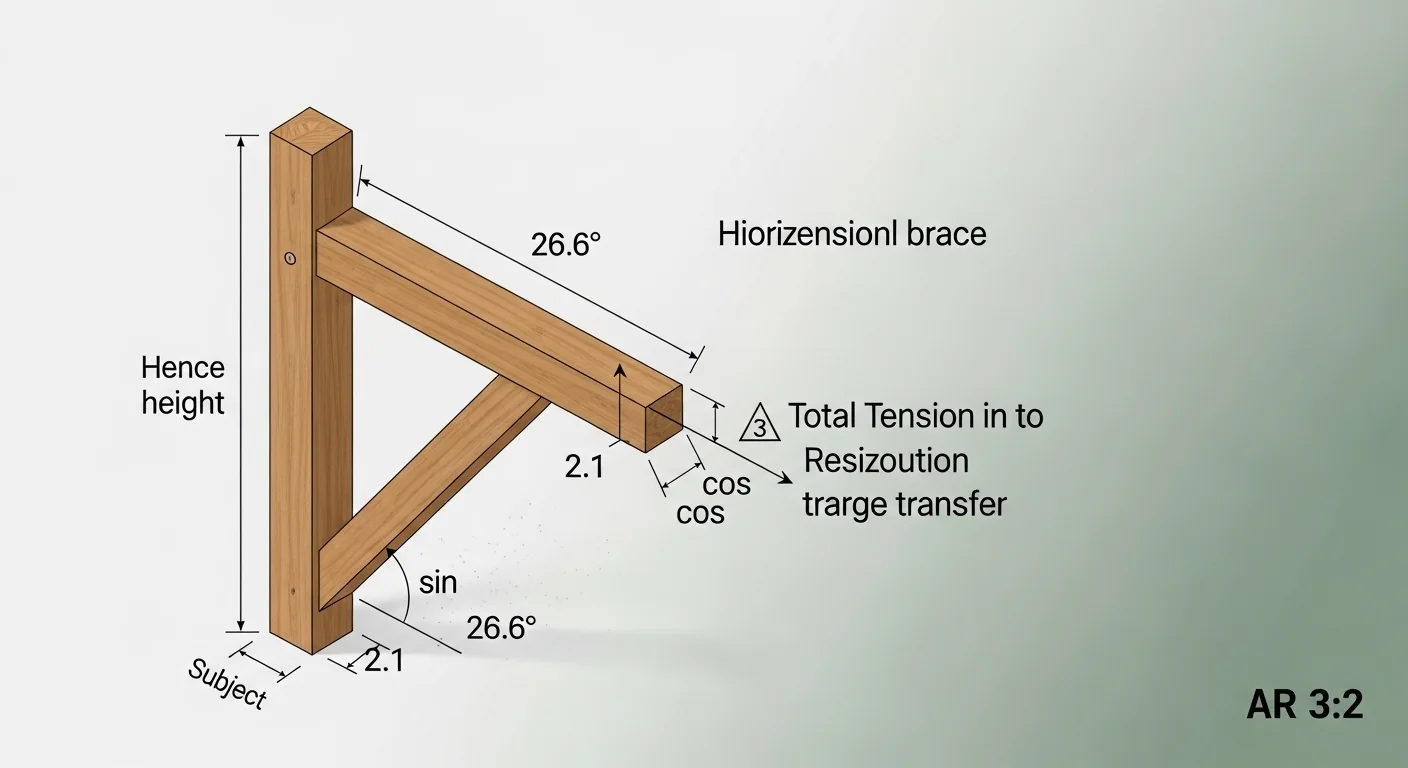
High-tensile fence bracing fails in a specific, predictable way. The corner post does not snap. The wire does not break. The diagonal brace member does not split. What happens instead is slower and harder to diagnose: the diagonal tension wire converts horizontal wire pull into an upward lever force, and that force, applied constantly over months, physically lifts the corner post out of the soil. The geometry determines whether your brace fights that force or amplifies it.
This h brace fence calculator takes four inputs from your specific fence design and returns the minimum safe horizontal brace length, the diagonal wire angle, the aggregate wire tension, the upward pull vector acting on your corner post, and the minimum post burial depth for your soil type. It does not replace a licensed agricultural engineer for unusual terrain, expansive clay soils, or commercial installations. It does apply the same lever-arm geometry those engineers use for standard single-span H-brace assemblies on residential and small-farm fence runs. If you are also routing energized wire through the same line, the electric fence calculator handles energizer and ground rod sizing as a separate calculation.
After running your numbers, you will know the exact horizontal brace length required for your fence height and wire load before you drive a single post, and whether your planned brace puts your corner post in the safe zone, the marginal zone, or directly into the Post-Popper Trap.
Use the Tool
H-Brace Fence Geometry Sizer
Calculate brace dimensions, diagonal wire angle & post pull-out risk for high-tensile fence
| Measurement | Value | Notes |
|---|
- Gripple Wire Tensioners & Joiners — fast, no-crimp splicing at rated tension
- Spinning Jenny Wire Dispenser — controls payout and prevents tangles on multi-strand runs
- 12.5 Gauge High-Tensile Wire Rolls — minimum spec for 200–250 lb strand tension
- Heavy-Duty Post-Hole Digger / Auger — achieve the burial depths shown above, especially in clay
| Fence Ht | Min Brace Len | 5-Wire Tension | Diagonal Angle | Post-Popper Risk |
|---|---|---|---|---|
| 4 ft | 8 ft | 1,250 lbs | 26.6° | ✔ Safe |
| 5 ft | 10 ft | 1,250 lbs | 26.6° | ✔ Safe |
| 5 ft | 5 ft (square) | 1,250 lbs | 45° | ✖ POST-POPPER |
| 6 ft | 12 ft | 1,250 lbs | 26.6° | ✔ Safe |
| 8 ft | 16 ft | 1,250 lbs | 26.6° | ✔ Safe |
| 8 ft | 8 ft (square) | 1,250 lbs | 45° | ✖ POST-POPPER |
| 5 ft | 7.5 ft (1.5×) | 1,250 lbs | 33.7° | ⚠ Marginal |
How This Calculator Works & Assumptions
Formula Steps:
Example: 5 wires × 250 lbs = 1,250 lbs of constant horizontal pull
This ensures the diagonal wire angle stays shallow enough to direct force downward into the ground, not upward.
Ideal target: ≤ 26.6° (2:1 ratio). Above 33.7° the upward pull vector rapidly increases.
Horizontal Transfer (lbs) = Total Tension × cos(Angle)
If the brace is shorter than 2× fence height, the upward vector can physically jack the corner post out of the ground over time.
Burial must resist the calculated upward pull vector.
Assumptions & Limits:
• Wire tension values are per-strand after initial stretching and settling (typically 1–3 months post-install).
• This tool assumes a single-span H-brace assembly. Double-span bracing (two H-braces) is recommended for runs > 660 ft (1/8 mile).
• Post sizing: minimum 6″ diameter treated post for corner; 4–5″ for the horizontal brace member.
• Soil classifications are simplified. Rock, expansive clay, or saturated soils require engineering consultation.
• This tool provides guidance only and is not a substitute for local agricultural extension recommendations or professional engineering advice.
• High-tensile wire is typically 12.5 gauge, 200,000 PSI break strength. Do not substitute with barbed wire of lower tensile rating.
Category: Homesteading & Livestock | Keyword: h brace fence calculator
Before you start, have the following ready: the finished fence height in feet (measured from ground surface to the top wire), the exact number of wire strands you are running, the target tension per strand in pounds (check your wire manufacturer’s spec sheet, typical range 200 to 250 lbs), and a practical assessment of your soil type where the corner post will be set. If you are between soil types, use the weaker classification to stay on the conservative side.
Quick Start (60 Seconds)
- Fence Height: Enter the height from ground to top wire in feet. Common livestock heights are 4 ft (cattle), 5 ft (horse or hog), and 8 ft (deer exclusion). Do not include the portion of the post buried underground.
- Number of Wires: Count every strand that runs through this span. Do not include stay wires or droppers, only the horizontal tensioned strands.
- Tension per Wire: Use the per-strand working tension, not the break strength. Most 12.5 gauge high-tensile wire is tensioned to 200 to 250 lbs during installation. If unsure, enter 200 lbs as a conservative default.
- Soil Type: Choose the soil where the corner post will be buried. When in doubt between Sand and Loam, choose Sand. Between Loam and Hard Clay, choose Loam. The tool adjusts minimum burial depth accordingly.
- Click Calculate: Results appear below the button. The gauge bar shows immediately whether your geometry falls in the safe zone.
- Check the warnings panel: If the Post-Popper alert fires, read it before you source any materials. The fix is a longer brace, not deeper posts alone.
- Use Reset: The reset button clears all fields and results so you can run a second scenario without leftover data.
Inputs and Outputs (What Each Field Means)
| Field | Unit | What It Means | Common Mistake | Safe Entry Guidance |
|---|---|---|---|---|
| Fence Height | feet | Vertical distance from soil surface to the top tensioned wire strand | Including the underground portion of the post in the measurement | Measure from grade to top wire only; 2 to 16 ft accepted |
| Number of Wires | count (strands) | Total horizontal high-tensile strands running through the span being braced | Forgetting to count the bottom wire or skipping the top wire in the tally | Count every tensioned horizontal strand; 1 to 20 accepted |
| Tension per Wire | lbs | Working tension applied to each individual wire strand after final tensioning | Using the wire break strength instead of working tension, inflating the calculation | Use 200 to 250 lbs for 12.5 gauge wire; 100 to 350 lbs accepted |
| Soil Type | category | Soil classification at the corner post burial location, affects minimum burial depth output | Selecting Hard Clay when the site has seasonal saturation or a thin clay layer over sand | Choose the weaker classification when soil is mixed or unknown |
| Min. Horizontal Brace Length (output) | feet | The shortest safe horizontal distance between the corner post and the in-line post | Treating this as a suggestion rather than a minimum threshold | Build to this length or longer; never shorter |
| Diagonal Wire Angle (output) | degrees | The angle the tension wire makes with the horizontal brace member | Assuming any angle below 45 degrees is acceptable | Target 26.6 degrees or less; above 33.7 degrees triggers a danger warning |
| Upward Pull Vector (output) | lbs | The vertical component of diagonal wire tension acting to lift the corner post upward | Ignoring this value because it seems small relative to total tension | This force acts continuously; it must be resisted by post burial and soil friction |
| Min. Post Burial Depth (output) | inches | Minimum depth the corner post must be buried to resist the calculated upward force in your soil type | Using a generic “one-third of post length” rule without adjusting for soil type | Bury to this depth at minimum; add 6 inches in sandy or seasonally wet soil |
Worked Examples (Real Numbers)
Example 1: Standard Cattle Fence in Loam (4 ft, 5 Wires)
- Fence Height: 4 ft
- Number of Wires: 5
- Tension per Wire: 250 lbs
- Soil Type: Loam
Result: Total tension = 5 x 250 = 1,250 lbs. Minimum brace length = 4 x 2 = 8 ft. Diagonal angle = arctan(4 / 8) = 26.6 degrees. Upward pull vector = 1,250 x sin(26.6 degrees) = 559 lbs. Horizontal transfer = 1,250 x cos(26.6 degrees) = 1,118 lbs. Minimum burial depth = 28 inches.
This is the benchmark setup for most cattle operations. The 8 ft brace keeps the angle at exactly 26.6 degrees, directing the majority of wire tension horizontally into the in-line post rather than upward into the corner post. The 28-inch burial in loam is more than adequate to resist 559 lbs of upward pull on a standard 6-inch round treated post.
Example 2: Hog Containment in Sandy Soil (4 ft, 8 Wires, Higher Strand Count)
- Fence Height: 4 ft
- Number of Wires: 8
- Tension per Wire: 200 lbs
- Soil Type: Sand
Result: Total tension = 8 x 200 = 1,600 lbs. Minimum brace length = 4 x 2 = 8 ft. Diagonal angle = arctan(4 / 8) = 26.6 degrees. Upward pull vector = 1,600 x sin(26.6 degrees) = 715 lbs. Horizontal transfer = 1,600 x cos(26.6 degrees) = 1,430 lbs. Minimum burial depth = 30 inches (sand). High tension warning triggers at 1,600 lbs.
Eight strands at 200 lbs each cross the 1,500 lb aggregate threshold where the tool flags elevated risk. In sandy soil, the 715 lb upward pull requires a minimum 30-inch burial depth. A concrete collar at grade level is worth considering here because sandy soil provides the lowest lateral resistance of the three soil categories.
Example 3: Deer Exclusion Fence in Hard Clay (8 ft, 7 Wires)
- Fence Height: 8 ft
- Number of Wires: 7
- Tension per Wire: 250 lbs
- Soil Type: Hard Clay
Result: Total tension = 7 x 250 = 1,750 lbs. Minimum brace length = 8 x 2 = 16 ft. Diagonal angle = arctan(8 / 16) = 26.6 degrees. Upward pull vector = 1,750 x sin(26.6 degrees) = 782 lbs. Horizontal transfer = 1,750 x cos(26.6 degrees) = 1,564 lbs. Minimum burial depth = 24 inches (hard clay).
At 8 ft fence height, the minimum 16 ft brace span is the most common place installers cut corners on deer exclusion projects, typically citing site constraints. Hard clay provides the strongest post retention at the lowest burial depth, but the 1,750 lb aggregate tension still warrants a double-span H-brace if the fence run exceeds 660 ft.
Reference Table (Fast Lookup)
Values below are computed using 5 wire strands at 250 lbs each (1,250 lbs aggregate) and the 2:1 brace ratio rule. The “Upward Pull at 2:1” column is the derived safety metric. The “Upward Pull at Square (1:1)” column shows what happens if the installer uses a square brace instead.
| Fence Height (ft) | Min Brace Length (ft) | Angle at 2:1 (deg) | Upward Pull at 2:1 (lbs) | Upward Pull at Square 1:1 (lbs) | Post-Popper Risk at 2:1 |
|---|---|---|---|---|---|
| 3 | 6 | 26.6 | 559 | 884 | Safe |
| 4 | 8 | 26.6 | 559 | 884 | Safe |
| 5 | 10 | 26.6 | 559 | 884 | Safe |
| 5 (marginal, 1.5:1 brace) | 7.5 | 33.7 | 693 | 884 | Marginal |
| 5 (square brace) | 5 | 45.0 | 884 | 884 | DANGER |
| 6 | 12 | 26.6 | 559 | 884 | Safe |
| 7 | 14 | 26.6 | 559 | 884 | Safe |
| 8 | 16 | 26.6 | 559 | 884 | Safe |
| 8 (square brace) | 8 | 45.0 | 884 | 884 | DANGER |
Note: the upward pull at 2:1 remains constant at 559 lbs regardless of fence height because the ratio is held at exactly 2:1 (arctan 0.5 = 26.6 degrees, sin 26.6 degrees = 0.4472, and 1,250 x 0.4472 = 559 lbs). Increasing fence height increases the required brace length proportionally, not the angle. The angle only worsens when the brace length fails to scale with fence height.
How the Calculation Works (Formula + Assumptions)
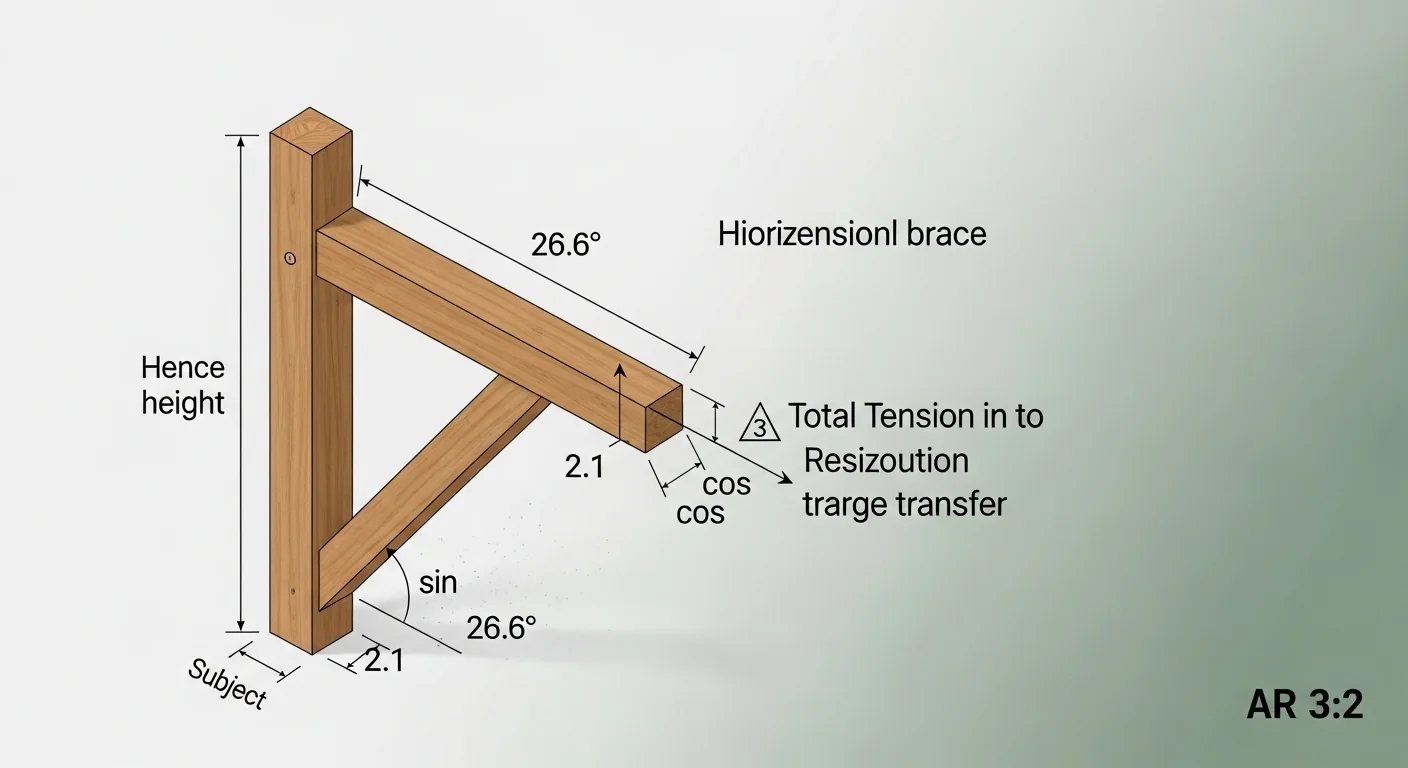
Show the calculation steps
Step 1 – Total Wire Tension (lbs)
Multiply the number of wire strands by the tension applied per strand.
Formula: Total Tension = Wires x Tension per Wire
Example: 5 strands x 250 lbs = 1,250 lbs of continuous horizontal pull on the corner post assembly.
Step 2 – Minimum Horizontal Brace Length (ft)
The horizontal brace must be at least twice the fence height. This ratio ensures the diagonal wire angle stays at or below 26.6 degrees.
Formula: Min Brace Length = Fence Height x 2
Rounding: the tool reports to one decimal place. Always round up when sourcing lumber or setting posts.
Step 3 – Diagonal Wire Angle (degrees)
The diagonal tension wire runs from the base of the in-line post to the top of the corner post. The angle is calculated from opposite (fence height) over adjacent (brace length).
Formula: Angle = arctan(Fence Height / Brace Length)
At 2:1 ratio: arctan(1/2) = 26.57 degrees, displayed as 26.6 degrees.
Step 4 – Upward Pull Vector and Horizontal Transfer (lbs)
The diagonal wire does not pull purely horizontally. It resolves into two components using trigonometry.
Upward Pull = Total Tension x sin(Angle)
Horizontal Transfer = Total Tension x cos(Angle)
At 26.6 degrees with 1,250 lbs: Upward = 559 lbs, Horizontal = 1,118 lbs. The goal is to maximize horizontal transfer and minimize upward pull, which is why the 2:1 ratio is the geometric minimum.
Step 5 – Minimum Post Burial Depth
Burial depth is assigned by soil type based on standard agricultural fencing practice:
Sand: 30 inches minimum. Loam: 28 inches minimum. Hard Clay: 24 inches minimum.
These depths are not calculated dynamically from the pull vector; they are established minimums for the respective soil class. Higher upward pull vectors may require deeper burial or supplemental anchoring beyond these minimums.
Assumptions and Limits
- The tool models a single-span H-brace. Double-span bracing (two H-brace assemblies in series) is the standard recommendation for fence runs exceeding 660 ft (one-eighth mile) and is not modeled here.
- Wire tension values are per-strand working tension after initial wire creep and settling, which typically occurs over 1 to 3 months post-installation. Freshly tensioned wire may be slightly above or below the entered value during this settling period.
- Post size is assumed to be a minimum 6-inch diameter treated round post for the corner and a 4 to 5 inch member for the horizontal brace. Smaller posts reduce the soil bearing area and require correspondingly deeper burial.
- Soil classifications are simplified three-category approximations. Rock, expansive clay, saturated or seasonally flooded soils, and soils with a shallow hardpan layer require site-specific engineering assessment.
- The burial depth outputs are minimums based on soil type category alone. Post diameter, post treatment class, and the calculated upward pull vector all affect actual required depth and are not combined into a single dynamic output in this version of the tool.
- This tool does not model bracing for corner angles less than 180 degrees (angled corners) or end posts with a wrap-around brace configuration. It applies only to standard in-line H-brace assemblies with a horizontal member and a single diagonal tension wire.
- Temperature-driven changes in wire tension are not included in this calculator. Wire tension increases as temperature drops and decreases as temperature rises. For that analysis, the fence tension temperature calculator handles seasonal tension adjustment as a standalone calculation.
Standards, Safety Checks, and “Secret Sauce” Warnings
Critical Warnings
- The Post-Popper Threshold is a hard minimum, not a guideline. Any horizontal brace shorter than twice the fence height produces an upward pull vector in the diagonal wire. At a 1:1 (square) ratio with 1,250 lbs of aggregate tension, the upward force reaches 884 lbs. This force acts 24 hours a day, 365 days a year. A correctly buried post will not resist it indefinitely in most soil types.
- Aggregate tension compounds the risk. Adding wire strands increases total tension linearly. Five strands at 250 lbs = 1,250 lbs. Ten strands at 250 lbs = 2,500 lbs. At a sub-optimal brace ratio, every additional strand added to the fence multiplies the post-lifting force proportionally. The brace geometry must be correct before wire count is finalized, not after.
- Wire tension changes with temperature. High-tensile wire contracts in cold weather, increasing strand tension beyond the installation value. A fence tensioned to 250 lbs in summer may see 300 lbs or more per strand in deep winter in northern climates. Check seasonal tension adjustment using the fence tension temperature calculator linked above.
- Sandy soil magnifies every geometry error. Poor brace ratio plus sandy soil plus high wire count is the combination most likely to produce post pull-out within the first growing season. If any two of those three factors are present, build to 2.5:1 ratio or greater.
Minimum Standards
- Horizontal brace length: at minimum 2 times the fence height. Target 2.5 times for runs with more than 8 wire strands or in sandy soil.
- Diagonal wire angle: 26.6 degrees at 2:1 ratio is the practical target. The tool flags a warning above 33.7 degrees (1.5:1 ratio) and a danger condition above 45 degrees (1:1 ratio).
- Corner post size: 6-inch diameter minimum for treated round posts. For square timber, 6×6 minimum. Smaller cross-sections reduce the soil bearing contact area and require greater burial depth to compensate.
- 12.5 gauge high-tensile wire for the diagonal brace member and for the fence strands. Lower gauge wire (13 or 14 gauge) has a lower break strength and should not be used at 250 lb working tension.
Competitor Trap: The most common competing advice on h brace fence geometry is the visual test, “if the brace looks like a square, it’s too short.” This heuristic correctly identifies a 1:1 ratio as dangerous but provides no actionable guidance for the zone between square and correct. A brace at 1.5:1 (fence height of 5 ft, brace length of 7.5 ft) does not look obviously wrong. It does, however, direct 693 lbs of the 1,250 lb aggregate load upward into the corner post rather than horizontally to the in-line post. The visual test catches only the most extreme failures. The formula catches all of them.
Common Mistakes and Fixes
Mistake: Building a Square H-Brace Because It Looks Proportional
A square brace where the horizontal member equals the fence height is the single most common installation error in high-tensile fence bracing. It looks balanced, it is easy to cut from standard lumber lengths, and it is geometrically wrong. At a 45-degree diagonal angle, the tension wire directs as much force upward into the corner post as it does horizontally into the in-line post. The corner post begins to lift. If you are working with woven wire instead of high-tensile and want to compare bracing requirements for that fence type, the woven wire fence calculator uses different tension specs.
Fix: Always set horizontal brace length to at least 2 times the fence height before installing diagonal wire.
Mistake: Using Post Depth as the Primary Safety Variable Instead of Brace Length
After learning about the upward pull vector, some installers respond by simply digging the corner post deeper. A deeper post in the same soil does add pull-out resistance, but it does not reduce the upward force itself. The geometry of the brace determines the force. The burial depth only determines how much resistance is available to counter it. Chasing burial depth while leaving a bad brace ratio in place is like adding a larger anchor to a boat with a hole in the hull.
Fix: Correct brace length first. Verify burial depth second.
Mistake: Ignoring Aggregate Tension When Adding Wire Strands Late in the Design
Fence designs often evolve during planning. A cattle fence becomes a dual-purpose cattle-and-hog fence and gains three extra strands. The brace was sized for five strands. It now carries eight. The 60-lb per-strand increase at 250 lbs working tension adds 750 lbs to the aggregate load and increases the upward pull vector by the same trigonometric proportion. Brace geometry and wire strand count are not independent decisions.
Fix: Re-run the calculator whenever the wire strand count changes during design, before sourcing posts or lumber.
Mistake: Applying the Same Brace Length to Both End Posts and Corner Posts
End posts at the termination of a fence run carry the full cumulative tension of all strands in one direction only. Corner posts carry tension from two directions simultaneously. This tool calculates single-direction load (one fence run). At a true 90-degree corner, the resultant force on the corner post is approximately 1.41 times the single-run tension. A separate brace assembly is required for each run meeting at the corner, not a single shared brace.
Fix: Install independent H-brace assemblies on each fence run that terminates at or meets a corner post.
Mistake: Tensioning Wire Before the Diagonal Brace Wire Is Properly Installed
The H-brace only functions as a system. The corner post, horizontal brace member, and diagonal tension wire must all be fully installed and the diagonal wire properly tensioned before the fence strands are tensioned. Tensioning the fence wire into a brace that lacks its diagonal wire turns the horizontal member into a lever with no counterforce, and the corner post can deflect immediately under the first passes of tensioning.
Fix: Complete the full H-brace assembly, including diagonal wire tensioning, before running and tensioning any fence strands.
Next Steps in Your Workflow
Once you have the minimum brace length and post burial depth from the calculator, the practical next step is sourcing materials before staking out the fence line. The horizontal brace member should be treated wood rated for ground contact (UC4B or UC4C treatment class), and the post should be sized at 6-inch diameter minimum for the corner. Post length should be the burial depth plus the fence height plus at least 6 additional inches for variation in grade. Cutting posts on-site from a longer stock length is more reliable than ordering to exact dimension.
After the brace assembly is complete and the fence strands are tensioned, the next decisions are about the paddock system the fence defines. The pasture stocking rate calculator helps you determine whether the acreage the fence encloses supports the animal load you are planning, and the cattle handling facility design calculator is useful if your layout includes a working area or loading chute within the fenced perimeter.
FAQ
What is the minimum horizontal brace length for a 5-foot high-tensile fence?
The minimum is 10 feet, derived from the 2:1 rule: brace length must equal at least twice the fence height. A 5-foot fence with a 10-foot horizontal brace produces a 26.6-degree diagonal wire angle. At any shorter brace length, the diagonal wire begins directing an increasing proportion of wire tension upward into the corner post rather than horizontally toward the in-line post.
How deep should a high-tensile fence corner post be buried?
Minimum burial depth depends on soil type. In hard clay, 24 inches is the baseline. In loam, 28 inches. In sand, 30 inches. These are minimums for standard single-span H-brace assemblies. Posts in sandy soil with high aggregate wire tension (above 1,500 lbs) benefit from deeper burial or a concrete collar at grade level for additional pull-out resistance.
What happens if the diagonal wire angle is too steep?
Steep angles above 33.7 degrees shift a disproportionate share of wire tension into the vertical (upward) component. At 45 degrees (square brace), the upward and horizontal components are equal. This upward force acts on the corner post continuously and will slowly jack the post out of the ground, a failure mode sometimes called the Post-Popper Trap. The fence looks intact until the post visibly tilts or pulls free.
When should I use a double-span H-brace instead of a single-span?
Double-span bracing, two H-brace assemblies installed in series, is the standard recommendation when the fence run exceeds 660 feet (one-eighth of a mile), when aggregate wire tension is unusually high, or when soil conditions are marginal. Single-span bracing is adequate for most residential and small-farm applications with runs under 660 feet and standard wire strand counts.
Does soil type change the required brace length?
Soil type does not change the required brace length. Brace length is determined entirely by fence height through the 2:1 ratio rule. Soil type affects the minimum burial depth of the corner post, which is the variable that changes between sand, loam, and hard clay. The geometry of the brace is independent of soil conditions; the post anchoring depth is not.
Can this calculator be used for woven wire or barbed wire fence?
The brace geometry formulas apply to any tensioned fence system, but the tension-per-wire input values differ significantly. Woven wire and barbed wire are installed at much lower tension than high-tensile wire. Entering working tension values appropriate to the actual wire type will produce valid outputs. Do not use 250 lbs per strand as an input for woven wire or barbed wire, as those products are not designed for and cannot hold high-tensile working tension.
Conclusion
The h brace fence calculator enforces one principle that the majority of fence installation guides bury in passing: brace length is not a matter of preference or available lumber, it is the output of a lever-arm calculation, and the wrong length transfers hundreds of pounds of upward force into a post that was only buried to resist downward loads. The 2:1 rule is not conservative. It is the geometric minimum. Any brace shorter than twice the fence height is operating in failure mode from the first day wire tension is applied.
The single most avoidable mistake in high-tensile fence bracing is building a square H-brace because it looks right. The geometry does not care how it looks. Run the calculator for your specific fence height and wire configuration, verify the burial depth against your soil type, and set the brace before tensioning a single strand. For fence systems that also include electrical components, the electric fence joule calculator helps size the energizer for the fence perimeter and wire count once the physical structure is correctly built.