
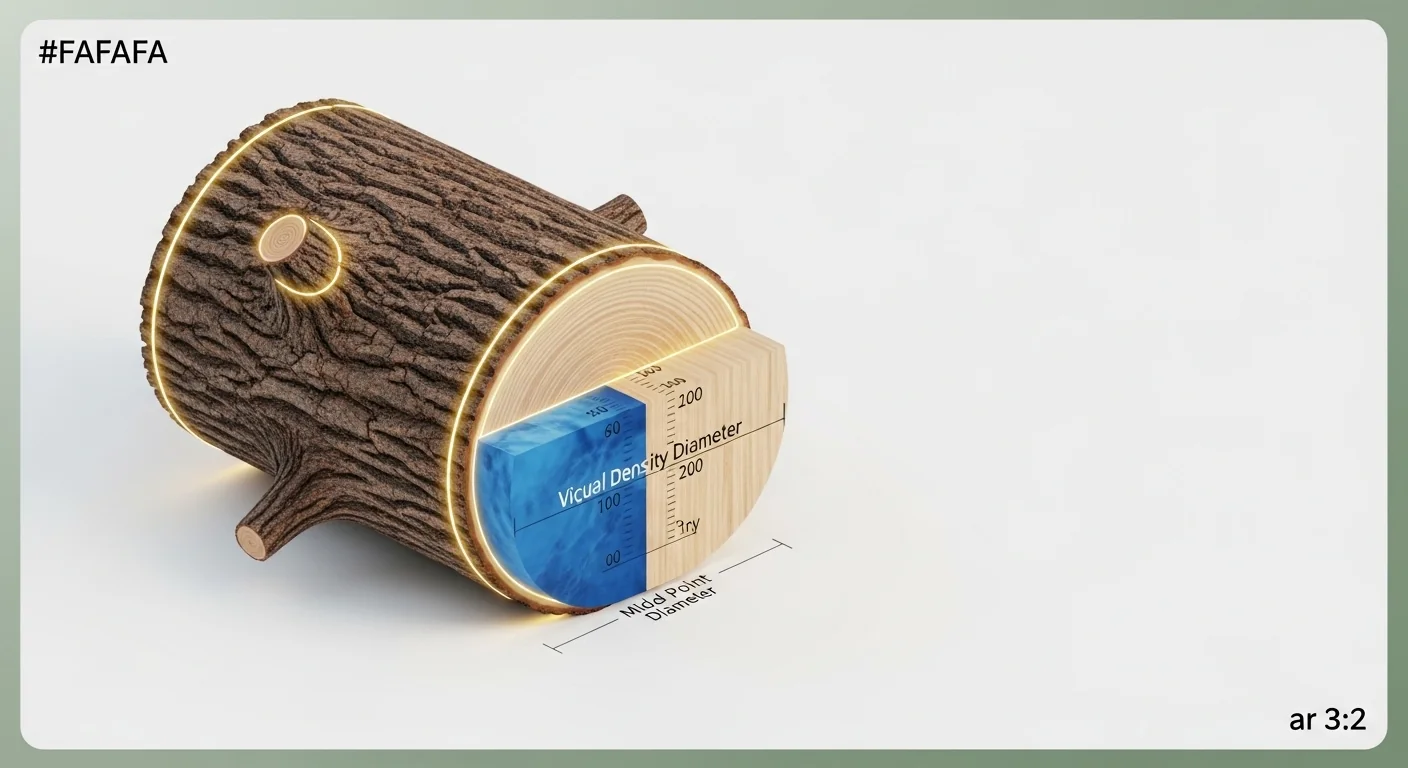
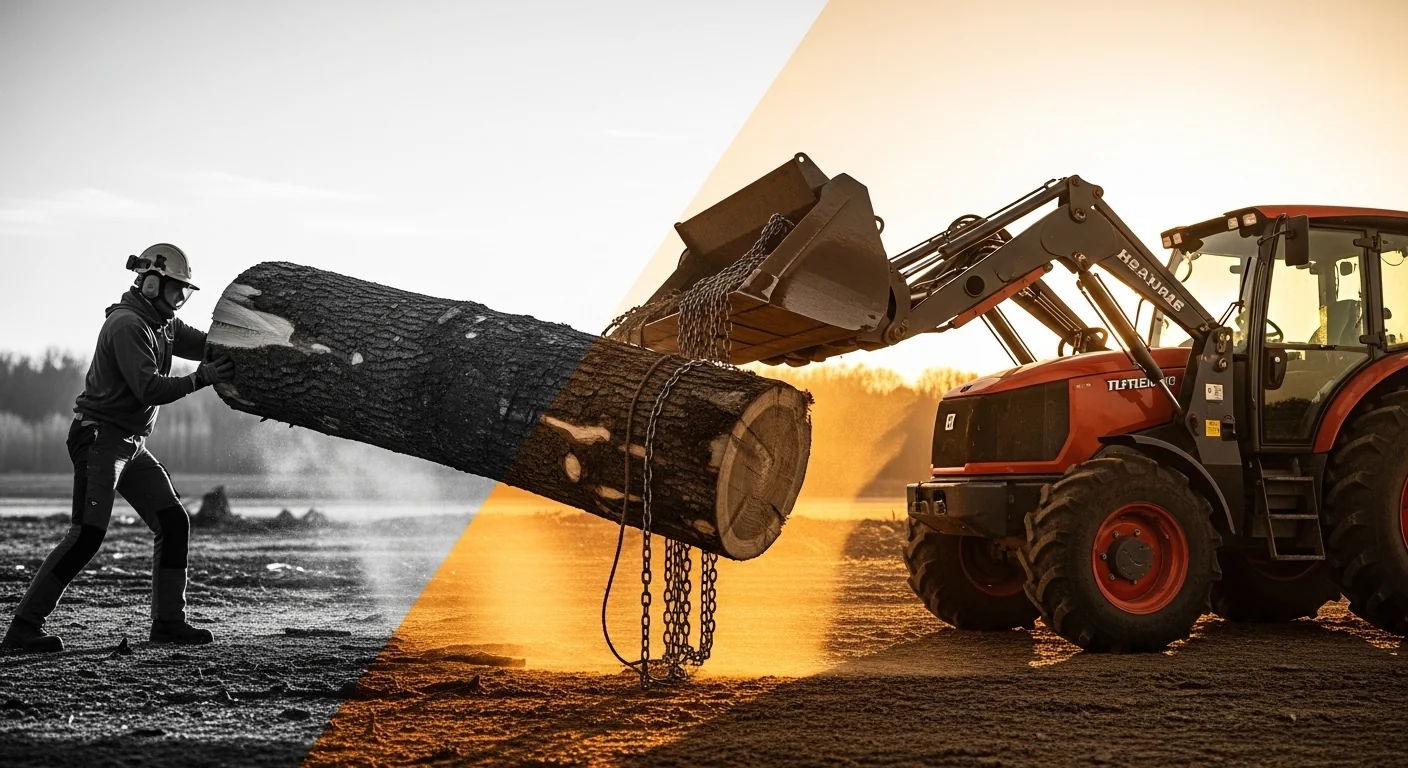
A log that looks manageable sitting on the ground can be a different problem entirely once you factor in species, moisture state, and length. Green oak behaves nothing like seasoned pine of the same diameter, and the difference is not cosmetic — it determines whether you need a handcart, a two-person team, a tractor loader, or a dedicated logging machine. Weight estimation is the first decision gate in any log-moving workflow, and it is consistently underestimated on homesteads of every size.
This calculator uses the standard cylinder volume formula (pi times radius squared times length) combined with a species-specific density table that distinguishes between green (fresh-cut) and seasoned (air-dried) wood. It produces estimated weight in pounds and kilograms, log volume in cubic feet, and a deterministic lifting safety check against two thresholds: the 50 lb solo lift guideline and the 2,000 lb rated capacity typical of sub-compact utility tractors. What it does not do is account for log taper, bark weight, or partial drying — those variables require field measurement and are covered in the Assumptions section below. If you are also working through cord volumes for heating or firewood storage, the firewood cord calculator covers that side of the equation independently.
After running this calculator, you will know whether your specific log requires solo handling, two people, or a piece of equipment — and approximately what capacity that equipment needs to be rated for.
Use the Tool
Log Weight Calculator
Estimate green or seasoned wood weight by species — The Yield Grid
1-person lift 2,000 lbs
small tractor 5,000+
| Species | Condition | Density (lbs/cu ft) | Est. Weight (lbs) |
|---|
How this calculator works
Step 1 — Calculate the log’s volume in cubic feet:
Step 2 — Multiply volume by wood density:
Density varies by species and moisture state. Green (freshly felled) wood carries significant moisture weight — often 40–80% heavier than the same piece when seasoned. The density values are industry-standard averages from forestry references.
Lifting safety thresholds:
Assumptions & Limits
- The log is modeled as a perfect cylinder — real logs taper, which can reduce actual volume by 10–30%.
- Density values are mid-range averages. Actual density varies with grow conditions, age, and local climate.
- Green density assumes full saturation (freshly cut); actual moisture at cutting varies.
- Seasoned assumes 12+ months of air drying under cover; partially dried wood will weigh more than the dry estimate.
- Lifting thresholds are safe-handling guidelines, not absolute limits — fatigue, terrain, grip, and technique all affect safe working loads.
- Tractor limits are estimates for sub-compact utility tractors. Check your equipment’s rated lift capacity.
- Formula valid for logs 0.1–200 ft long and 0.5–300 in diameter.
Before you start, have two measurements ready: the log’s total length in feet and its average diameter in inches measured at the middle of the log, not at the fat butt end. Select the closest species from the dropdown and choose between green (freshly felled, within roughly the past few weeks) and seasoned (air-dried for six months or more). If you are working from a lumber yard or have pre-cut firewood bolts, the seasoned option is almost always correct. For a broader look at wood-to-heat value once the weight question is settled, the firewood calculator is a useful companion tool in the same workflow.
Quick Start (60 Seconds)
- Log Length (feet): Measure end to end along the long axis. Round to the nearest tenth of a foot. Do not convert from inches inside your head — enter feet only.
- Average Diameter (inches): Measure at the midpoint of the log, not at the base. Real logs taper; the midpoint diameter is the single best approximation for a cylinder model.
- Wood Species: Pick the closest match. If you have a species not listed, choose the closest density equivalent — hickory behaves like high-density hardwood; cedar and pine are on the lighter softwood end.
- Wood Condition: “Green” means freshly cut, carrying full moisture. “Seasoned” means air-dried for at least six to twelve months under cover. Partially dried wood will fall somewhere between the two estimates.
- Click Calculate Weight: Results appear below the button. The gauge bar color shifts from green (safe solo range) to orange (mechanical assistance zone) to red (exceeds small tractor capacity).
- Check the warnings panel: The safety determination is computed automatically — read it before planning your move.
- Reset if needed: The Reset button clears all fields so you can run multiple scenarios back to back.
Inputs and Outputs (What Each Field Means)
| Field | Unit | What It Represents | Common Mistake | Entry Guidance |
|---|---|---|---|---|
| Log Length | Feet (ft) | Total end-to-end measurement of the log segment | Entering inches instead of feet (e.g., entering 96 when the log is 8 ft) | Accepted range: 0.1 to 200 ft. Decimals supported. |
| Average Diameter | Inches (in) | Cross-section measurement at the midpoint of the log | Measuring at the base butt, which is always wider and inflates the estimate | Accepted range: 0.5 to 300 in. Use the midpoint of the log. |
| Wood Species | Selection | Determines the density value used in the weight formula | Selecting a different species because it “looks similar” — density varies widely | 8 species available: Oak, Maple, Ash, Hickory, Elm, Pine, Douglas Fir, Cedar |
| Wood Condition | Selection | Green = fresh cut with full moisture; Seasoned = 6-12+ months air-dried | Calling wood “dry” when it was only cut a month ago — it is still green | When in doubt, choose Green. It produces the conservative (heavier) estimate. |
| Weight (lbs) | Pounds (lbs) | Primary output: estimated log weight using density times volume | Treating the result as exact rather than an estimate with a cylindrical assumption | Displayed prominently. Use this for equipment and handling decisions. |
| Weight (kg) | Kilograms (kg) | Metric equivalent of the primary weight output | Mixing up units when comparing to equipment rated in metric tons | 1 metric ton = 1,000 kg. Shown alongside lbs for reference. |
| Volume (cu ft) | Cubic feet (cu ft) | Intermediate output: the log’s cylindrical volume used in the formula | Confusing cubic feet of volume with board-feet of lumber — they are different | Useful for comparing to cord-wood volumes or timber board-foot estimates. |
| Density Used | lbs/cu ft | The species-and-condition density value pulled from the built-in table | Not cross-checking this value against your known species — it confirms the lookup worked | Shown alongside the species label so you can verify the correct row was applied. |
If you regularly estimate the weight of baled material alongside log work, the hay bale weight calculator applies a similar volume-times-density approach to hay, which can be useful context for cross-referencing weight estimates across your operation.
Worked Examples (Real Numbers)
Example 1: Short Green Pine Log for Campfire or Kindling Rounds
- Length: 4 ft
- Diameter: 6 in
- Species: Pine
- Condition: Green (fresh cut)
Radius in feet = (6 / 2) / 12 = 0.25 ft
Volume = pi x 0.25 x 0.25 x 4 = 0.785 cu ft
Density (green pine) = 40 lbs/cu ft
Weight = 0.785 x 40 = 31.4 lbs
Result: 31.4 lbs — safe for solo handling.
A freshly cut 4-foot pine section at 6 inches across falls just under the 50 lb solo lift guideline. One person can manage this with proper lifting technique, though repeated lifts of this size over a work session add up quickly. Batch them and take breaks.
Example 2: Standard Green Oak Utility Log (Fence Post Replacement or Firewood Block)
- Length: 8 ft
- Diameter: 10 in
- Species: Oak
- Condition: Green (fresh cut)
Radius in feet = (10 / 2) / 12 = 0.4167 ft
Volume = pi x 0.4167 x 0.4167 x 8 = 4.363 cu ft
Density (green oak) = 62 lbs/cu ft
Weight = 4.363 x 62 = 270.5 lbs
Result: ~271 lbs — mechanical assistance required.
This is a typical homestead utility log: long enough for rough lumber or gate post use, heavy enough to make manual handling genuinely dangerous for a single person. A tractor loader, log arch, or even a simple cant hook with a helper is the minimum safe approach. The tractor capacity threshold of 2,000 lbs is not a concern here — a standard sub-compact loader handles this easily.
Example 3: Large Seasoned Maple Sawmill or Milling Log
- Length: 12 ft
- Diameter: 18 in
- Species: Maple
- Condition: Seasoned (air-dried)
Radius in feet = (18 / 2) / 12 = 0.75 ft
Volume = pi x 0.75 x 0.75 x 12 = 21.206 cu ft
Density (seasoned maple) = 44 lbs/cu ft
Weight = 21.206 x 44 = 933.1 lbs
Result: ~933 lbs — within typical tractor rated capacity, but verify before lifting.
This log is well within the 2,000 lb threshold for a sub-compact utility tractor, but it is close enough to the working load range that checking your specific machine’s rated front-loader capacity matters. If this same log were green maple (58 lbs/cu ft), the estimated weight would climb to approximately 1,230 lbs — still under 2,000, but the margin narrows considerably.
Reference Table (Fast Lookup)
All weights below are estimated for a log that is 4 feet long with an 8-inch diameter (volume = 1.396 cu ft). This size represents a common firewood round or short utility section. The Lift Category column applies the 50 lb solo threshold as the breakpoint between categories.
| Species | Condition | Density (lbs/cu ft) | Est. Weight at 4 ft x 8 in (lbs) | Lift Category |
|---|---|---|---|---|
| Hickory | Green | 63 | 87.9 | Two-person / equipment |
| Oak | Green | 62 | 86.6 | Two-person / equipment |
| Maple | Green | 58 | 81.0 | Two-person / equipment |
| Ash | Green | 55 | 76.8 | Two-person / equipment |
| Elm | Green | 54 | 75.4 | Two-person / equipment |
| Hickory | Seasoned | 50 | 69.8 | Two-person / equipment |
| Oak | Seasoned | 47 | 65.6 | Two-person / equipment |
| Maple | Seasoned | 44 | 61.4 | Two-person / equipment |
| Ash | Seasoned | 42 | 58.6 | Two-person / equipment |
| Pine | Green | 40 | 55.8 | Two-person / equipment |
| Elm | Seasoned | 40 | 55.8 | Two-person / equipment |
| Douglas Fir | Green | 38 | 53.0 | Two-person / equipment |
| Cedar | Green | 34 | 47.5 | Solo lift (under 50 lbs) |
| Douglas Fir | Seasoned | 30 | 41.9 | Solo lift (under 50 lbs) |
| Pine | Seasoned | 28 | 39.1 | Solo lift (under 50 lbs) |
| Cedar | Seasoned | 23 | 32.1 | Solo lift (under 50 lbs) |
Notice that even a modest 4-foot section of green hardwood exceeds the solo lift threshold. This table also illustrates why species and condition together determine more of the outcome than log geometry alone — hickory green versus cedar seasoned at the same dimensions is a 55 lb difference.
How the Calculation Works (Formula and Assumptions)
Show the calculation steps
Step 1 — Convert diameter to radius in feet.
The diameter input is in inches. The formula requires radius in feet to keep units consistent with the length input.
Radius (ft) = (Diameter in inches / 2) / 12
Step 2 — Calculate log volume using the cylinder formula.
Volume (cubic feet) = pi x Radius (ft) x Radius (ft) x Length (ft)
This is the standard formula for a perfect cylinder. Rounding is applied to 3 decimal places for volume display. The underlying multiplication uses full floating-point precision.
Step 3 — Multiply volume by species density.
Weight (lbs) = Volume (cu ft) x Density (lbs/cu ft)
Density values are drawn from a built-in lookup table keyed to species and condition. The table contains industry-standard average values from forestry references. Final weight is displayed rounded to one decimal place.
Step 4 — Convert to kilograms.
Weight (kg) = Weight (lbs) x 0.453592
Step 5 — Apply lifting safety thresholds.
The result is compared against two thresholds: 50 lbs (solo lift guideline) and 2,000 lbs (typical sub-compact utility tractor rated capacity). The gauge bar fills proportionally up to a 5,000 lb scale and changes color at these breakpoints.
Assumptions and Limits
- The log is modeled as a perfect cylinder. Real logs taper from butt to tip, which means the cylindrical model consistently overestimates volume. Taper can reduce actual volume by roughly 10 to 30 percent depending on tree species and age. If your log tapers visibly, the true weight will be lighter than the estimate.
- Density values are mid-range averages. Wood density varies with regional growing conditions, soil type, age, and how the specific tree grew. The values in this tool are representative, not exact for any single log.
- The green condition assumes full moisture saturation typical of freshly felled wood within a few weeks of cutting. Wood cut several months ago but not yet fully seasoned will have a moisture content between green and dry, and its actual weight will fall between the two estimates.
- The seasoned condition targets wood air-dried for approximately 6 to 12 months or longer under cover. Kiln-dried wood may be slightly lighter than the dry estimate, depending on the target moisture content of the drying process.
- Bark weight is not separately accounted for. Bark adds a small but non-trivial amount to total weight, particularly on large-diameter logs. De-barked logs will weigh slightly less than this estimate.
- The 2,000 lb tractor threshold is a typical rated capacity for sub-compact utility tractors. Actual lift capacity varies by machine, loader model, tire configuration, and attachment geometry. Always consult your equipment’s operator manual before relying on this figure.
- The 50 lb solo lift guideline is derived from NIOSH ergonomic recommendations. Actual safe lift weights vary by individual fitness, posture, lift frequency, and environmental conditions.
Standards, Safety Checks, and Secret Sauce Warnings
Critical Warnings
- Green wood is significantly heavier than seasoned wood of the same species and size. The weight difference between a freshly cut green oak log and the same log after a year of seasoning is not trivial — it routinely changes the lift category from one tier to the next. Assuming “dry” when wood is freshly cut is one of the most common planning errors in homestead log handling, and it has caused equipment overloads.
- The tractor threshold applies to the rated lift capacity of the machine, not its rough capability. A tractor can often physically pick up more than its rated capacity — but operating above the rated load risks tipping, hydraulic failure, or structural damage. Rated capacity exists as a safety margin; treat it as the ceiling, not a guideline.
- Tapered logs weigh less than the cylindrical estimate suggests. If you are using this tool to plan lifting equipment for a large log and the estimate falls near a threshold (for example, 1,800 lbs against a 2,000 lb rated capacity), account for taper — the actual weight may be well under the estimate. Conversely, if the log is unusually round and straight, the estimate is more accurate.
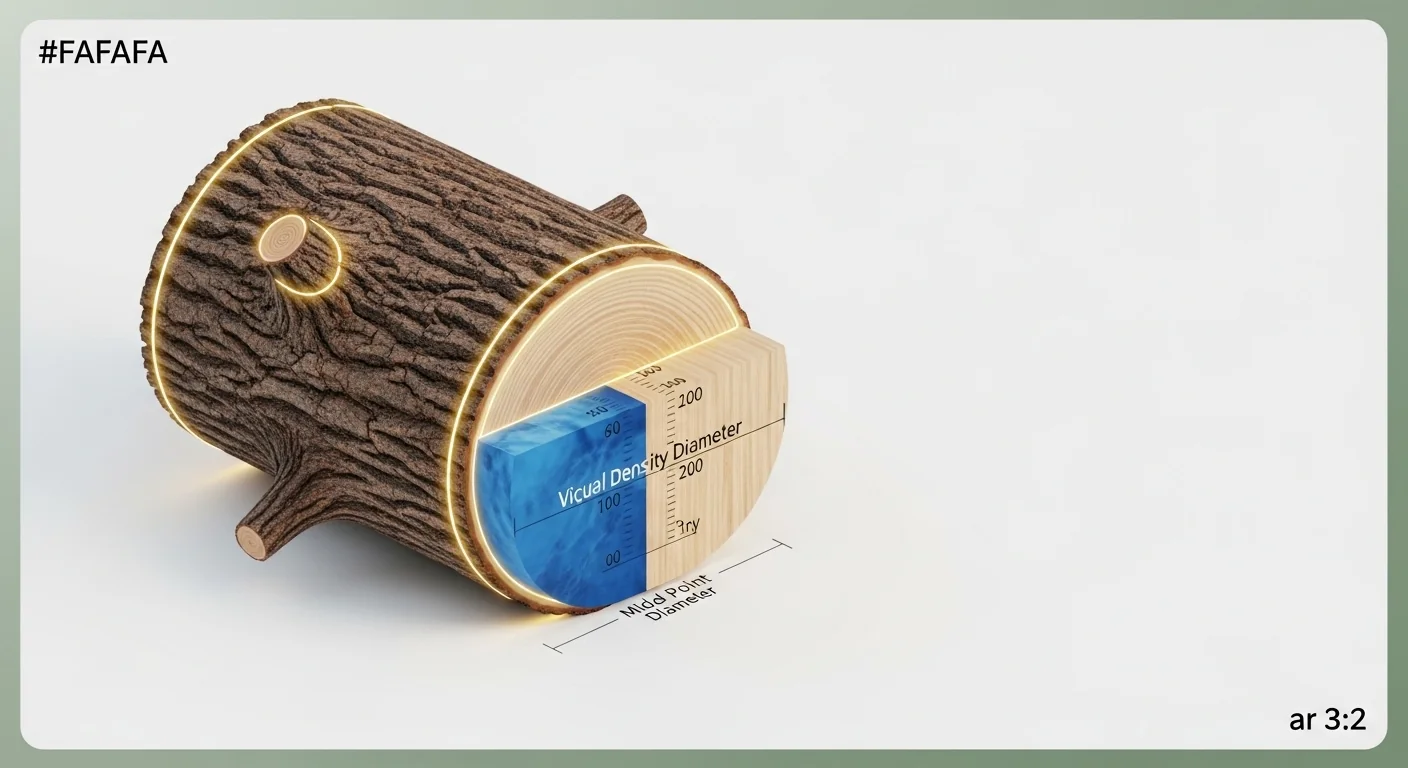
- Midpoint diameter is the correct measurement input. Using the butt diameter inflates the estimate. Using the tip diameter deflates it. For a tapered log, the midpoint is the standard single-point measurement in the cylinder model.
Minimum Standards
- Solo manual lift: do not exceed 50 lbs per NIOSH ergonomic guidelines for repetitive lifting tasks.
- Two-person manual lift: generally appropriate for loads between 50 and 150 lbs with proper coordination and positioning.
- Mechanical assistance (cant hook, log arch, skidder, loader): required for loads above 150 lbs in most practical homestead scenarios.
- Verify tractor front-loader rated capacity before attempting to lift logs that approach your machine’s stated limit. The rating is in your equipment’s operator manual and is specific to the loader attachment, not just the tractor.
Competitor Trap: Many log weight estimation resources online provide a single density number per species without distinguishing between green and dry states. Using a dry density value for a freshly cut log systematically underestimates the actual weight — sometimes by 30 to 50 lbs per cubic foot. On a large green oak log with 10 or more cubic feet of volume, this mistake can add several hundred pounds of invisible error to your planning. The species density table in this tool separates green and seasoned values explicitly for this reason.
If tractor safety on your land is a broader concern, the tractor side slope limit calculator addresses stability thresholds on sloped terrain — a related risk factor when moving heavy logs across uneven ground. For fence-line work where you may be moving log material for post support, the H-brace fence calculator provides structural sizing guidance that intersects with log-weight planning.
Common Mistakes and Fixes
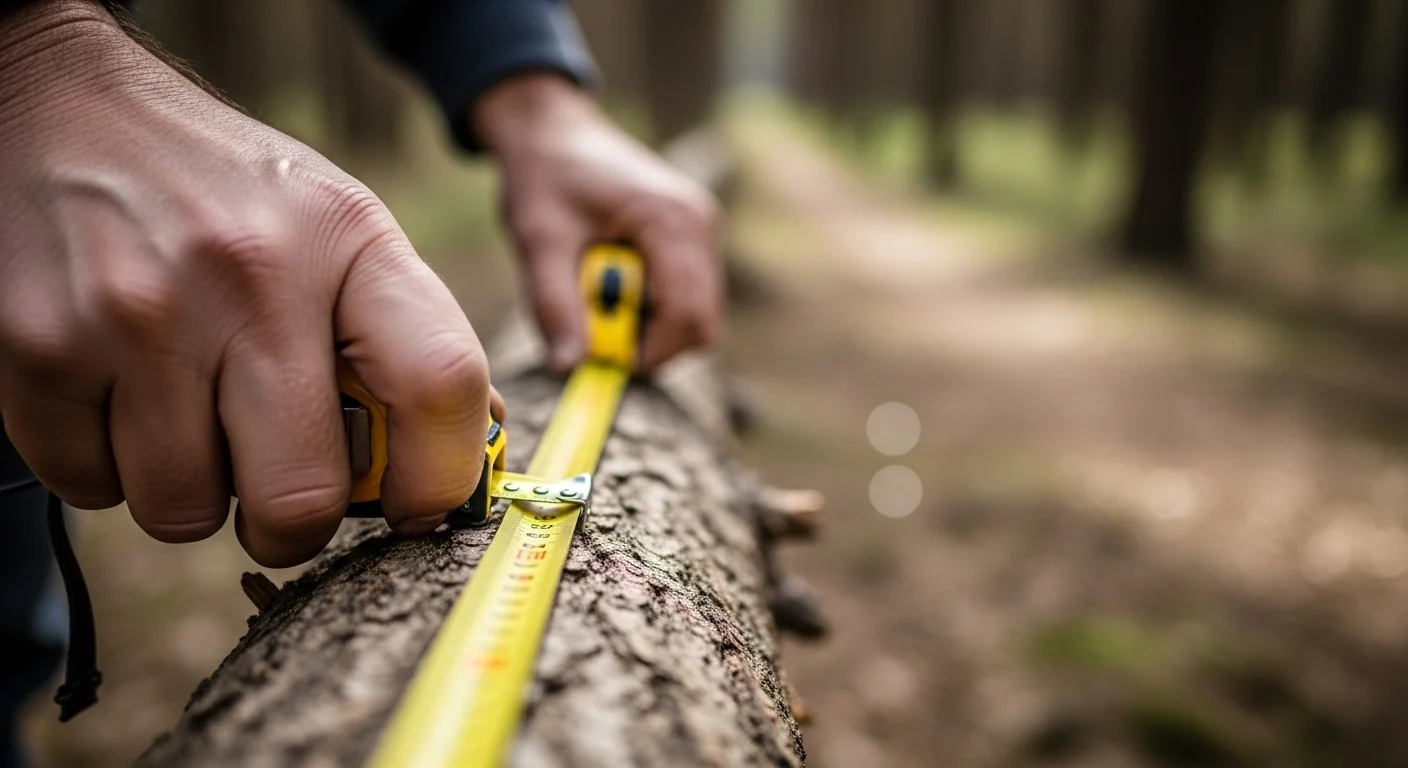
Mistake: Measuring Diameter at the Fat End Instead of the Midpoint
The butt of a log is its widest point, and it is usually the most convenient place to measure because that is where the log is sitting on the ground. Using butt diameter inflates the cylindrical volume estimate, sometimes substantially on tapered logs. The cylinder formula assumes consistent cross-section along the entire length, so the midpoint measurement is the correct single-point proxy for the taper average.
Fix: Measure at the longitudinal center of the log, even if it requires estimating or repositioning.
Mistake: Calling Partially Dried Wood “Seasoned”
Wood cut four to six weeks ago is not seasoned. The drying process is slow and non-linear — moisture content drops faster in the first few months and then slows as the exterior reaches equilibrium. Calling month-old wood “dry” and entering seasoned density underestimates the true weight, which can put you in a dangerous planning position when moving the log.
Fix: When in doubt, enter “Green.” The green estimate is always the conservative, heavier figure. It is better to overestimate weight for equipment planning than to underestimate it.
Mistake: Treating the Calculator Result as the Exact Weight
The cylinder model is an approximation. Real logs have taper, bark weight, irregular cross-section, and variable moisture through the wood. The output of this calculator is a planning estimate, not a certified load weight. Engineers and logging operations use more precise methods (weight scales, adjusted taper formulas) when exact loads are required.
Fix: Use the result to determine handling category and equipment class. Add a safety buffer for equipment planning — particularly if the estimated weight falls within 20 to 30 percent of a tractor’s rated limit. If you are also hauling logs, the livestock trailer weight calculator is useful for checking combined load estimates before towing.
Mistake: Confusing Log Volume in Cubic Feet with Cord Volume or Board Feet
Cubic feet of cylindrical log volume is a raw geometric measurement. A cord of firewood is a stacked volume that includes air gaps between pieces. Board feet are a lumber measure that accounts for thickness, width, and length in a completely different way. These three units are not interchangeable, and mixing them up leads to significant under-ordering or over-ordering of wood.
Fix: Use the volume output from this tool as a single-log weight input only. Use dedicated firewood or lumber calculators for cord and board-foot planning.
Mistake: Ignoring the Tractor Capacity Warning When the Log Falls Near the Threshold
A result of 1,750 lbs against a 2,000 lb tractor rating might look like safe territory on paper. But that 250 lb buffer can disappear quickly once you add the weight of the lifting chain, the angle of approach on a slope, or a second log segment the operator decides to grab at the same time. The rated capacity is stated for level ground and clean load geometry — real conditions reduce the actual safe working load.
Fix: Treat any result above 1,500 lbs as requiring explicit capacity verification against your specific machine’s operator manual, especially if you are working on anything other than level ground.
Next Steps in Your Workflow
Once you have an estimated weight and a handling category, the practical next step is cross-referencing that number against your actual equipment. If you own a tractor with a front loader, locate the operator manual entry for the loader’s rated lift capacity — it is typically different from the tractor’s own hydraulic capacity and is specified at a given load distance from the pivot. If you are renting equipment for a one-time log move, knowing the approximate weight in advance lets you specify the right machine class rather than guessing. For ongoing winter firewood operations, feeding the volume output into your heating fuel planning is a logical next step, and pairing log weight estimates with winter cattle feed calculations can help you sequence barn access and tractor scheduling more efficiently across the season.
For larger land operations where log movement intersects with other infrastructure work — clearing fence lines, managing barn access routes, or prepping timber for a building project — weight estimation is just one variable in a broader equipment workflow. Barn airflow requirements, for instance, change significantly when you are stacking large volumes of green wood inside a structure, and the barn ventilation calculator addresses that side of the equation. Plan your log handling in sequence rather than in isolation: weight first, then equipment, then access route, then storage or processing destination.
FAQ
Why does green wood weigh so much more than seasoned wood?
Fresh-cut wood carries substantial moisture content throughout its cellular structure. Depending on species, that moisture can account for a large portion of the total log weight. As wood dries over months, that water evaporates, significantly reducing weight. This is why a freshly felled oak log and a well-seasoned oak log of identical dimensions can differ by hundreds of pounds on large sections.
How accurate is a cylinder-based log weight estimate?
It is accurate enough for equipment planning and handling decisions, but it is not a precision measurement. The cylinder model overestimates volume on tapered logs and does not account for bark, irregular cross-section, or moisture variation through the wood. For most homestead decisions, the estimate is adequate. For certified load weights, a calibrated scale is required.
What does “average diameter” mean for a tapered log?
It is the diameter measured at the longitudinal midpoint of the log — halfway between the butt and the tip. Because real logs taper continuously, the midpoint measurement is the single-point best approximation for a cylindrical model. Measuring at the butt overestimates; measuring at the tip underestimates. Some forestry formulas use both end measurements and the midpoint together, but for practical planning, midpoint alone is standard.
Can I use this tool for lumber or milled timber?
The calculator estimates weight for round logs, not milled lumber. Milling removes material, and the resulting dimensional lumber has a different cross-section than a cylinder. For milled timber, use the actual cross-sectional dimensions (width times height) rather than a diameter. The density values in this tool apply to the same species in milled form, but the volume formula would need to be recalculated as a rectangle rather than a cylinder.
What if my species is not in the list?
Choose the species with the closest density profile. In general: high-density hardwoods (locust, beech, hornbeam) are closest to hickory or oak. Mid-density hardwoods (birch, cherry, walnut) sit near maple or ash. Light hardwoods and mixed softwoods are closest to elm or pine. If you know the specific density of your species from a forestry reference, you can back-calculate expected weight directly from the volume output shown by the calculator.
Does the 50 lb solo lift limit apply to rolling or dragging, not just lifting?
The 50 lb threshold in this tool specifically references the NIOSH guideline for vertical lifting tasks. Rolling, skidding, or dragging a log with a cant hook involves different muscle groups and lower peak force, which is why those methods are used to move logs that exceed manual carry limits. That said, dragging large logs across uneven terrain creates its own injury risks through slipping, sudden movement, and repetitive strain. The lift threshold is a planning minimum, not a complete safety standard for all handling methods.
Conclusion
The fundamental differentiator in this calculator — and the information that most competing resources skip — is the explicit separation of green and seasoned density values by species. Planning a log move based on dry density when the wood was cut last week is a systematic planning error, and on large hardwood logs, the weight difference between those two states is not a rounding issue. It can shift the result from “manageable with a tractor” to “exceeds rated capacity.” The tool is direct about this through the species density table and the warning panel, which is designed to make the safe handling decision before any equipment is started.
The most important mistake to avoid is measuring diameter at the butt and calling the wood dry when it is not. Both errors inflate the volume estimate and underestimate the weight simultaneously — pushing your result in opposite directions in ways that compound, rather than cancel. Run the calculator twice if you are uncertain about condition: once for green, once for seasoned. The spread between those two numbers tells you the uncertainty range you are working with. For fence-line and land clearing work where log weight connects directly to post material and structural loads, the H-brace fence calculator is a practical next stop in that planning sequence.