A compost pile fails in predictable ways. Too much nitrogen and it turns into a wet, ammonia-smelling mass that repels beneficial microorganisms.
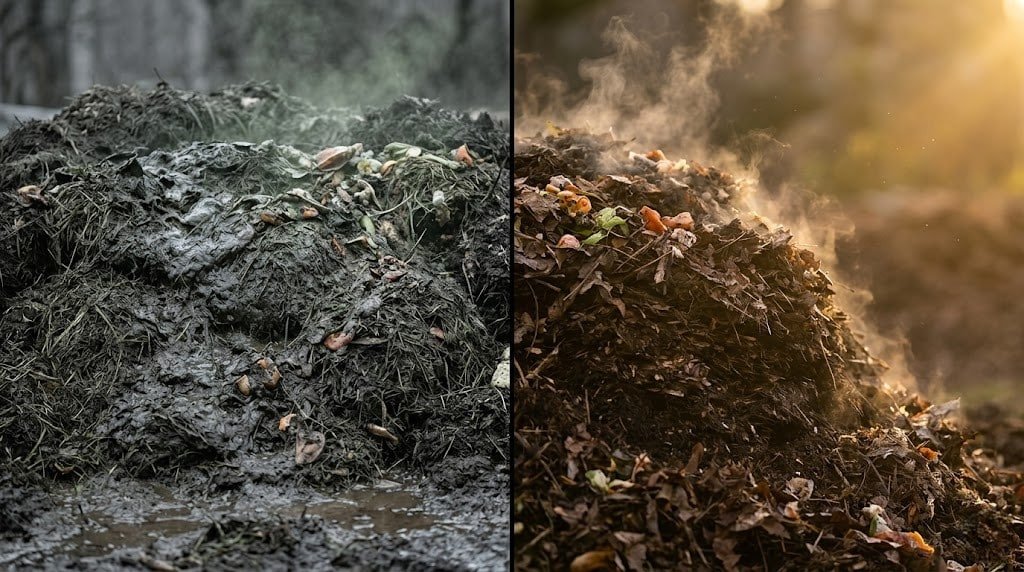
Too much carbon and decomposition slows to near-zero, leaving you with a dry pile that looks the same in six months as it did the day you built it. Neither failure is obvious from the outside until you dig in, and by then you have already lost weeks. The carbon to nitrogen ratio, expressed as C:N, is the single number that separates efficient composting from frustrating stagnation.
This compost ratio calculator uses a weighted average formula to compute the C:N ratio across any combination of ingredients by weight. It does not estimate compost maturity timelines, predict pile temperature, or account for moisture content variations. What it does, accurately and immediately, is tell you where your mix sits on the C:N spectrum and whether you need to correct it before you build the pile.
Bottom line: After running your ingredients through the calculator, you will know whether to add browns (high-carbon materials), add greens (high-nitrogen materials), or proceed with your current mix to hit the 25:1 to 30:1 ideal range that supports rapid, odor-controlled decomposition.
Use the Tool
Compost C:N Ratio Calculator
The Yield Grid — Soil, Fertilizer & Amendments Math
Fill in your ingredients above and click Calculate Compost Ratio to see your results.
| Ingredient | Type | C:N Ratio | Notes |
|---|---|---|---|
| Dry Leaves | Browns | 40–80:1 | Ideal carbon source |
| Straw | Browns | 40–100:1 | Low nutrients, slow break down |
| Cardboard | Browns | 350–500:1 | Shred first; very high carbon |
| Wood chips | Browns | 100–500:1 | Use sparingly as carbon source |
| Grass clippings | Greens | 15–25:1 | High nitrogen; mix well |
| Food scraps | Greens | 10–20:1 | High moisture content |
| Coffee grounds | Greens | 20:1 | Excellent nitrogen booster |
| Manure (cow) | Greens | 10–20:1 | Great activator |
How This Calculator Works
Formula
This calculator uses a weighted average C:N ratio based on the weight and C:N ratio of each ingredient:
Step-by-Step
- For each ingredient, multiply its weight (lbs) by its C:N ratio value.
- Sum all those products across all ingredients.
- Divide by the total combined weight of all ingredients.
- The result is your compost pile’s weighted average C:N ratio.
Target & Standards (Secret Sauce)
- Ideal range: 25:1 to 30:1 — microorganisms thrive and break down material efficiently.
- Too low (< 25:1): Too much nitrogen → smelly, slimy pile. Add browns (dry leaves, straw, cardboard).
- Too high (> 30:1): Too much carbon → slow decomposition. Add greens (grass clippings, food scraps, manure).
- C:N defaults used: Browns average ~60:1 (blend of leaves, straw, wood); Greens average ~15:1 (blend of grass, food scraps, manure).
Assumptions & Limits
- C:N values are averages — actual ratios vary by material age, moisture, and source.
- Weight entered should be dry weight for most accuracy; fresh-weight inputs may skew results.
- Calculator supports up to 10 ingredients at a time.
- Minimum weight per ingredient: 0.1 lbs.
- This tool is for educational estimation; test your actual pile for best results.
Before entering your ingredients, gather the dry weights of each material you plan to add. Wet weight from fresh grass clippings or food scraps will skew the result because water weight carries no carbon or nitrogen. If you are working from a batch already assembled, use estimated dry weight by accounting for obvious moisture. Each ingredient needs two data points: the material type (selected from the dropdown) and the weight in pounds.
The tool supports up to 10 ingredients in a single calculation. Add as many rows as your pile requires, then click Calculate. For a broader look at how much finished compost a pile will produce from your raw volume, the compost volume calculator is a natural companion to this tool.
Quick Start (60 Seconds)
- Select ingredient type first. The dropdown groups materials into Browns (high carbon) and Greens (high nitrogen). Each option shows the C:N ratio in parentheses so you can see the range before committing to a weight.
- Enter weight in pounds, not volume. A cubic yard of dry leaves and a cubic yard of wood chips weigh very different amounts. Pounds is the only unit this calculator accepts, and the result depends entirely on the ratio of weights, not bulk volumes.
- Use dry weight only. Fresh grass clippings are roughly 75 to 85 percent water by weight. If you weigh them wet, you will underestimate the nitrogen load and the calculator will show a higher C:N ratio than your pile will actually have.
- Add at least two ingredients. A single-material pile rarely hits the 25:1 to 30:1 target, and the calculator only becomes useful for decision-making when it reflects your actual blend.
- Use the Add Another Ingredient button for complex mixes. If you are layering four or five materials, enter each one separately rather than trying to estimate an average. The formula weights each input proportionally.
- Check the gauge, not just the number. The visual gauge shows where your ratio falls relative to the ideal 25:1 to 30:1 zone. A ratio of 31:1 and a ratio of 60:1 both read "Too High," but the corrective action required is very different in scale.
- Reset before starting a new batch. The Reset button clears all fields and returns the form to the two-row default. Do not add a new calculation on top of a previous one.
Inputs and Outputs (What Each Field Means)
| Field | Unit | What It Means | Common Mistake | Safe Entry Guidance |
|---|---|---|---|---|
| Ingredient Type | N/A (dropdown) | The material being added to the pile; each type carries a fixed representative C:N ratio used in the weighted average formula | Selecting "Grass Clippings" for dried, brown grass, which has a much higher C:N than fresh clippings | Match the material to its actual condition; dried grass behaves like a brown, not a green |
| Weight (lbs) | Pounds (lbs) | The mass of that ingredient contributed to the pile, used as the proportional weight in the C:N average | Entering fresh weight instead of dry weight, especially for food scraps, manure, and grass | Enter values between 0.1 and 100,000 lbs; use consistent dry-weight estimates across all ingredients |
| C:N Ratio (output) | Ratio :1 | The weighted average carbon to nitrogen ratio of the full pile blend | Treating the output as a precise lab measurement rather than a planning estimate | Use the result to guide proportional adjustments; a difference of 2 to 3 points is within normal material variability |
| Status (output) | Category label | Traffic-light classification: Too Low, Slightly Low, Ideal, Slightly High, or Too High, based on fixed thresholds | Ignoring the status and acting only on the raw number without reading the specific recommendation | Read the full warning box text; it specifies which material type to add and why |
| Browns Weight (output) | Pounds (lbs) | Total weight of all high-carbon ingredients entered, shown alongside a proportion of total pile weight | Assuming the browns/greens split by volume matches the split by weight | Use this as a sanity check: if your browns proportion looks wrong, recheck your individual entries |
| Greens Weight (output) | Pounds (lbs) | Total weight of all high-nitrogen ingredients entered | Treating manure as a brown because it looks brown; manure is classified as a green due to its low C:N ratio | Classify by C:N ratio, not appearance; any material with a C:N below roughly 30:1 functions as a nitrogen source |
Worked Examples (Real Numbers)
Example 1: Carbon-Heavy Backyard Pile
- Dry Leaves: 50 lbs (C:N 60:1)
- Grass Clippings: 25 lbs (C:N 20:1)
Calculation: (50 × 60 + 25 × 20) ÷ (50 + 25) = (3,000 + 500) ÷ 75 = 3,500 ÷ 75 = 46.7:1
Result: 46.7:1 (Too High)
The pile leans heavily on leaves and does not have enough nitrogen to sustain active microbial decomposition. Adding another 30 to 40 lbs of grass clippings or 20 lbs of manure would bring the ratio closer to the 25:1 to 30:1 target.
Example 2: Multi-Material Mix Near Ideal
- Dry Leaves: 30 lbs (C:N 60:1)
- Straw: 15 lbs (C:N 70:1)
- Food Scraps (vegetable): 25 lbs (C:N 15:1)
- Grass Clippings: 30 lbs (C:N 20:1)
Calculation: (30 × 60 + 15 × 70 + 25 × 15 + 30 × 20) ÷ (30 + 15 + 25 + 30) = (1,800 + 1,050 + 375 + 600) ÷ 100 = 3,825 ÷ 100 = 38.3:1
Result: 38.3:1 (Slightly High)
A common four-material mix that still runs above the ideal band. Replacing 10 lbs of straw with 10 lbs of coffee grounds or adding another 15 lbs of food scraps would pull this into the acceptable range without a major reformulation.
Example 3: Nitrogen-Heavy Manure and Kitchen Waste Pile
- Dry Leaves: 10 lbs (C:N 60:1)
- Manure (cow): 40 lbs (C:N 15:1)
- Food Scraps (vegetable): 30 lbs (C:N 15:1)
Calculation: (10 × 60 + 40 × 15 + 30 × 15) ÷ (10 + 40 + 30) = (600 + 600 + 450) ÷ 80 = 1,650 ÷ 80 = 20.6:1
Result: 20.6:1 (Slightly Low)
A pile dominated by nitrogen sources with a minimal carbon base. At 20.6:1, this mix is near the boundary where ammonia odor becomes noticeable. Adding 20 to 25 lbs of shredded cardboard or dry leaves would raise the ratio into the 25:1 to 30:1 band.
Reference Table (Fast Lookup)
| Ingredient | Type | C:N Ratio Used | Ratio Range (Actual) | Lbs Needed to Raise 10-lb Green Pile by 5 C:N Points | Composting Role |
|---|---|---|---|---|---|
| Dry Leaves | Browns | 60:1 | 40 to 80:1 | ~1.7 lbs | Primary carbon source; widely available in autumn |
| Straw | Browns | 70:1 | 40 to 100:1 | ~1.5 lbs | Bulking agent; improves aeration in dense piles |
| Cardboard (shredded) | Browns | 400:1 | 350 to 500:1 | ~0.3 lbs | Very high carbon; use in small amounts as a ratio corrector |
| Wood Chips | Browns | 250:1 | 100 to 500:1 | ~0.5 lbs | Long-lasting carbon source; slows decomposition if overused |
| Sawdust | Browns | 500:1 | 200 to 750:1 | ~0.25 lbs | Extreme carbon; small additions make large ratio corrections |
| Newspaper (shredded) | Browns | 170:1 | 150 to 200:1 | ~0.7 lbs | Useful for layering; can mat if not torn finely |
| Grass Clippings | Greens | 20:1 | 15 to 25:1 | Reduces ratio; use to lower an excess-carbon pile | Fast-acting nitrogen; high moisture content aids microbial startup |
| Food Scraps (vegetable) | Greens | 15:1 | 10 to 20:1 | Reduces ratio; strong nitrogen source | Nutrient-dense; balance with browns to prevent odor |
| Coffee Grounds | Greens | 20:1 | 19 to 24:1 | Reduces ratio; also improves pile texture | Consistent nitrogen input; widely available from households |
| Manure (cow) | Greens | 15:1 | 10 to 20:1 | Reduces ratio; also adds microbial inoculant | Strong activator; introduces native decomposer populations |
| Manure (chicken) | Greens | 10:1 | 6 to 15:1 | Reduces ratio rapidly; use in small quantities | Highest-nitrogen manure; can cause ammonia burn if overdone |
| Alfalfa | Greens | 12:1 | 10 to 15:1 | Reduces ratio; fast breakdown rate | High-nitrogen activator; often used to jumpstart cold piles |
The "Lbs Needed" column is derived from the weighted average formula, assuming a baseline 10-lb all-green pile at 15:1 and a target shift of 5 C:N points upward. Actual correction amounts depend on the full weight of your pile.
How the Calculation Works (Formula + Assumptions)
Show the calculation steps
The compost ratio calculator uses a weighted average formula.
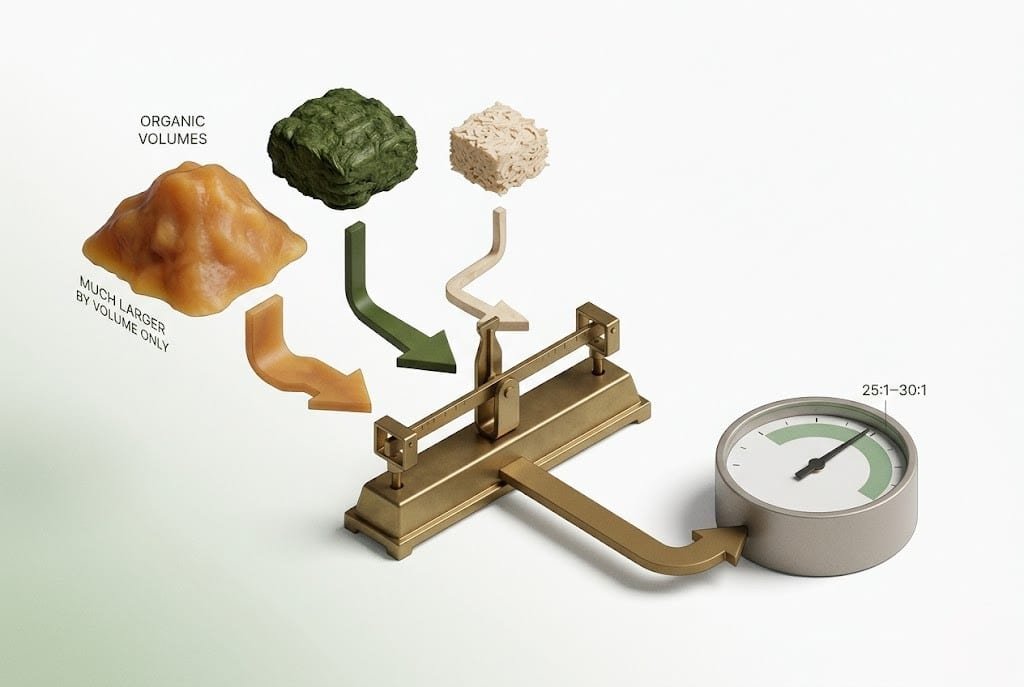
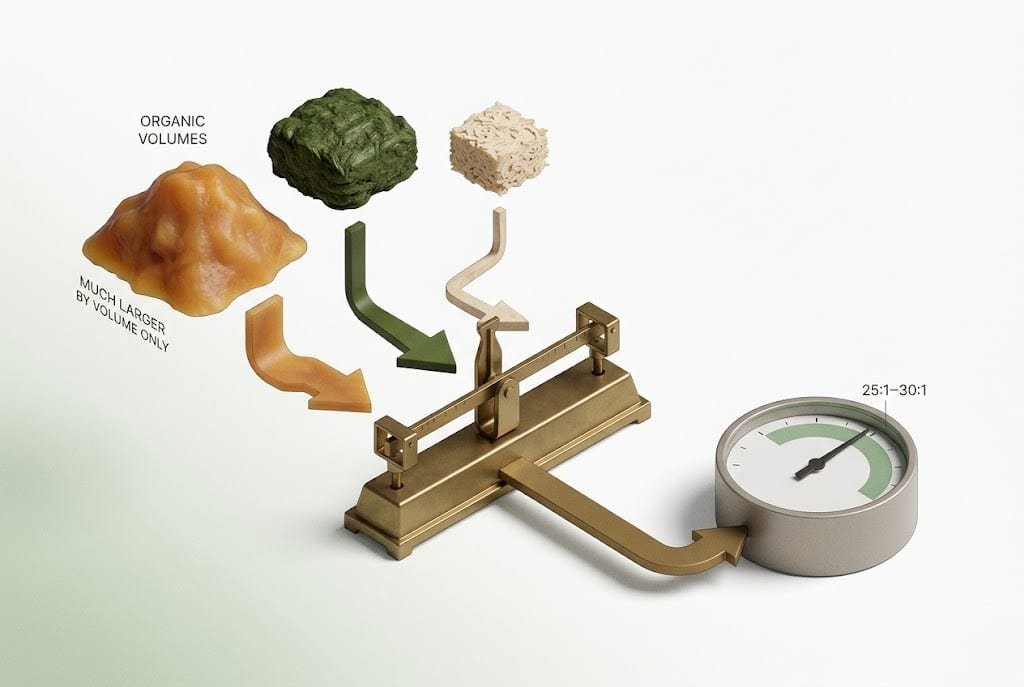
Each ingredient contributes to the final C:N ratio in proportion to its weight relative to the total pile weight.
- Step 1 - Assign C:N values. Each ingredient type carries a fixed representative C:N ratio (for example, Dry Leaves = 60:1, Grass Clippings = 20:1). These values represent the midpoint of the published range for each material.
- Step 2 - Multiply weight by C:N ratio. For each ingredient: Weight (lbs) × C:N value. This produces a weighted carbon score for that material.
- Step 3 - Sum the weighted scores. Add all individual (Weight × C:N) products together.
- Step 4 - Divide by total weight. Divide the sum from Step 3 by the total weight of all ingredients combined.
- Step 5 - Round to one decimal place. The result is displayed as XX.X:1.
Formula: Weighted C:N = Σ(Weighti × CNi) ÷ Σ(Weighti)
No unit conversion is required as long as all weights are entered in the same unit (pounds). If you prefer kilograms, the ratio calculation will produce the same result provided all inputs use kilograms consistently, because the weights cancel in the division step.
Assumptions and Limits
- C:N values in the dropdown are fixed representative averages, not lab measurements. The actual C:N of your material may differ by 20 to 50 points depending on species, maturity, and decomposition stage.
- The formula assumes dry weight inputs. Wet or fresh materials will overstate their proportion relative to their actual carbon and nitrogen content.
- A maximum of 10 ingredients can be entered in a single calculation. Piles with more distinct materials require grouping similar items.
- The calculator does not account for moisture content, aeration, particle size, or temperature, all of which affect real-world decomposition rate alongside C:N ratio.
- Materials classified as browns and greens in the dropdown follow the functional C:N definition (below or above roughly 30:1), not color or appearance. Dried manure, for example, remains a "green" regardless of how it looks.
- The 25:1 to 30:1 target range is the standard cited in composting science literature for thermophilic aerobic decomposition. Cold composting and vermicomposting operate differently and may tolerate wider ranges.
- Cardboard and sawdust have extremely high C:N ratios (350:1 to 500:1+). Small additions by weight produce large ratio corrections. A few pounds of shredded cardboard can shift a 100-lb pile substantially.
Standards, Safety Checks, and Warnings
Target range: 25:1 to 30:1 (carbon to nitrogen) for aerobic, thermophilic composting.
Critical Warnings
- Ratio below 20:1 triggers anaerobic decomposition risk. At this level, nitrogen exceeds what aerobic microbes can consume efficiently. The pile often becomes waterlogged, produces ammonia gas, and develops a persistent sulfur or sewage odor. The fix is immediate addition of high-carbon browns, particularly dry leaves or shredded cardboard.
- Ratio above 40:1 stalls decomposition for extended periods. Microbes are carbon-limited at this level and cannot generate the metabolic heat needed for rapid breakdown. A pile at 60:1 or higher may show almost no change over a 3 to 6 month window. Nitrogen-rich greens such as manure, alfalfa, or food scraps are the corrective material.
- Chicken manure at high volumes can crash the ratio below 10:1. At C:N values of 6:1 to 10:1, ammonia volatilization becomes a significant problem. If chicken manure is a primary ingredient, the calculator will show a "Too Low" status requiring a substantial browns addition.
- Wet weight entries produce systematically false results. If a user enters the weighed fresh weight of grass clippings (roughly 80 percent water), the nitrogen load appears lower than it actually is and the ratio reads higher. Actual pile behavior will be more nitrogen-heavy than the calculator suggests.
Minimum Standards
- The 25:1 to 30:1 C:N target applies to aerobic thermophilic composting aimed at pathogen destruction and rapid turnaround. This is the standard used by most home and municipal composting programs.
- No single ingredient should constitute more than 70 to 80 lbs of a 100-lb pile unless it is a mid-range material (C:N between 20:1 and 40:1). Extreme-ratio materials like sawdust or chicken manure require careful balancing against other inputs.
- At minimum, include one carbon source and one nitrogen source to give the calculator meaningful data. A single-ingredient pile produces a result equal to that ingredient's C:N value, which has limited decision value.
Competitor Trap: Many compost ratio guides online classify materials as "browns" and "greens" by appearance and assign a single blanket ratio to each category (such as "browns = 30:1, greens = 15:1"). This is a two-point approximation that can produce errors of 15 to 20+ ratio points for common materials like cardboard, sawdust, or chicken manure. This calculator uses ingredient-specific C:N values and a weighted average formula so that the material composition of each ingredient, not just its color category, drives the result.
For context on how nitrogen availability changes after organic matter enters the soil, the soil organic matter nitrogen release calculator addresses what happens after finished compost is applied. If manure is a major ingredient in your pile, the manure nitrogen availability calculator provides complementary analysis of its plant-available nitrogen fraction.
Common Mistakes and Fixes
Mistake: Treating Volume as a Proxy for Weight
Compost guides often describe pile ratios in terms of "3 parts browns to 1 part greens by volume."

Volume and weight do not scale together consistently. A cubic foot of dry leaves weighs a fraction of a cubic foot of wet food scraps. Entering volume-based estimates as if they were weights will produce a C:N result that does not reflect the pile's actual chemistry.
Fix: Weigh your ingredients on a basic postal or kitchen scale, or use a bucket of known volume with estimated density for each material type.
Mistake: Using Fresh Grass Clipping Weight
Freshly cut grass can be 75 to 85 percent water by weight. Entering 50 lbs of fresh clippings into the calculator effectively assigns 50 lbs of C:N 20:1 material to the pile, but the dry fraction representing actual carbon and nitrogen is far smaller. The calculated ratio will appear higher (more carbon-heavy) than the pile will actually behave as moisture redistributes.
Fix: Either use dry weight or account for moisture by reducing fresh-weight inputs to roughly 20 percent of their stated value when estimating grass, food scraps, or fresh manure.
Mistake: Ignoring Cardboard and Sawdust Leverage
Cardboard has a C:N ratio in the 350:1 to 500:1 range. Because the weighted average formula scales proportionally by weight, even 5 lbs of shredded cardboard added to a 100-lb pile can shift the C:N ratio by 15 to 20 points. Users who add cardboard as a bulk layer without weighing it often overcorrect, pushing a slightly-low pile well into "Too High" territory.
Fix: Weigh cardboard and sawdust additions carefully. Enter each addition into the calculator before physically adding it to the pile to preview the ratio shift.
Mistake: Classifying Dried Manure as a Brown
Manure turns brown and crumbly when dried, leading many composters to treat it as a carbon source. Cow manure at 10:1 to 20:1 is a nitrogen-rich green regardless of its color or texture. Entering it under a brown category, or skipping it from the calculator entirely because it "doesn't seem like a green," systematically underestimates the nitrogen load and produces a false high C:N reading.
Fix: Classify any material with a C:N ratio below approximately 30:1 as a green. The calculator's dropdown handles this automatically if you select the correct ingredient type.
Mistake: Calculating Ratio Once and Not Rechecking After Corrections
Adding 20 lbs of leaves to a 200-lb pile will change the ratio, but the new ratio is not simply the old ratio plus the leaves' C:N value. The weighted average formula recalculates across the new total weight. A correction that looked adequate on a 100-lb pile produces a smaller ratio shift on a 300-lb pile.
Fix: Every time you add corrective material, re-enter the full ingredient list into the calculator with updated weights. The tool resets cleanly, so recalculating the full mix after each adjustment takes under a minute.
Related Tools and Next Steps
Once your C:N ratio is confirmed in the ideal range, you may want to estimate finished compost yield from your raw inputs: the compost calculator helps size your pile and estimate output volume.
Compost is ultimately incorporated into soil, and understanding the resulting nitrogen released from organic matter guides fertilizer decisions: see the soil organic matter nitrogen release tool for post-application planning.
If your pile relies heavily on manure and you want to understand the plant-available nitrogen fraction once it is composted and applied, the manure nitrogen availability calculator fills that gap.
For gardeners building raised beds with finished compost as a component of the growing mix, the raised bed soil calculator helps determine the right volume and ratio of compost to other amendments.
Once compost is applied and soil nutrient levels are assessed, the NPK calculator can help match supplemental fertilizer applications to crop nitrogen, phosphorus, and potassium requirements.
For understanding nitrogen-specific supplemental applications beyond compost, the nitrogen calculator covers common nitrogen sources and application rates.
If your composting goals connect to a full soil amendment program, the soil mix calculator provides a framework for calculating amendment volumes across a garden or growing area.
FAQ
What is the ideal C:N ratio for compost?
The standard target for aerobic thermophilic composting is 25:1 to 30:1 (carbon to nitrogen by weight). This range supports efficient microbial activity, sufficient heat generation to neutralize pathogens, and a controlled decomposition pace without significant odor. Ratios outside this range do not prevent composting entirely but increase time, odor risk, or both.
What happens if the C:N ratio is too low?
A C:N ratio below 20:1 means there is more nitrogen than aerobic microbes can efficiently process. Excess nitrogen is released as ammonia gas, producing a strong odor. The pile can also become waterlogged and anaerobic. The corrective action is adding high-carbon browns such as dry leaves, straw, or shredded cardboard to raise the ratio toward the 25:1 to 30:1 zone.
What happens if the C:N ratio is too high?
Above 40:1, microbial populations are limited by nitrogen scarcity. They can consume carbon for energy but lack sufficient nitrogen to reproduce and sustain active decomposition. The result is a dry, slow pile that may show little change for months. Adding nitrogen-rich greens (grass clippings, manure, food scraps, or alfalfa) corrects the imbalance.
Why does the calculator use dry weight and not fresh weight?
Carbon and nitrogen are present in the dry fraction of organic material, not the water. Fresh grass clippings are mostly water, so their fresh weight significantly overstates how much dry matter they contribute. Entering fresh weights into a dry-weight-based calculator produces a C:N result that is higher (more carbon-heavy) than what the pile will actually exhibit once moisture equilibrates.
Can I use this calculator for vermicomposting or cold composting?
The 25:1 to 30:1 target is calibrated for hot aerobic composting. Vermicomposting worms tolerate a wider C:N range, roughly 20:1 to 40:1, and cold composting (passive piles) is less sensitive to ratio because decomposition speed is already limited by temperature. The calculator results still provide useful directional guidance, but the thresholds for "Ideal" may be interpreted more loosely in those systems.
How accurate are the C:N values in the dropdown?
Each value is a representative average derived from composting literature. Actual C:N ratios vary by source region, plant species, material age, and storage method. Dry leaves, for example, range from 40:1 to 80:1 depending on species and how long they have been on the ground. The calculator uses midpoint values to provide a reliable planning estimate, not a lab-accurate measurement.
Conclusion
The carbon to nitrogen ratio is not a vague guideline. It is the core input that determines whether a compost pile reaches thermophilic temperatures, breaks down efficiently, and finishes odor-free. The weighted average formula this calculator uses means every ingredient contributes proportionally to the result, which is why a small addition of sawdust or cardboard can shift a ratio dramatically while the same weight of leaves makes a smaller correction. That mathematical reality is what separates a planned pile from a guessed pile.
The single most common error is entering fresh weights for high-moisture materials like grass clippings and food scraps, which inflates the apparent C:N ratio and leads to under-correction. Weigh inputs dry, or apply the appropriate dry-matter estimate, and the calculator will give you an actionable starting point every time. For growers who want to close the loop from compost production to soil application, the NPK fertilizer calculator helps quantify the remaining nutrient gap after compost has been incorporated.

Lead Data Architect
Umer Hayiat
Founder & Lead Data Architect at TheYieldGrid. I bridge the gap between complex agronomic data and practical growing, transforming verified agricultural science into accessible, mathematically precise tools and guides for serious growers.
View all tools & guides by Umer Hayiat →