
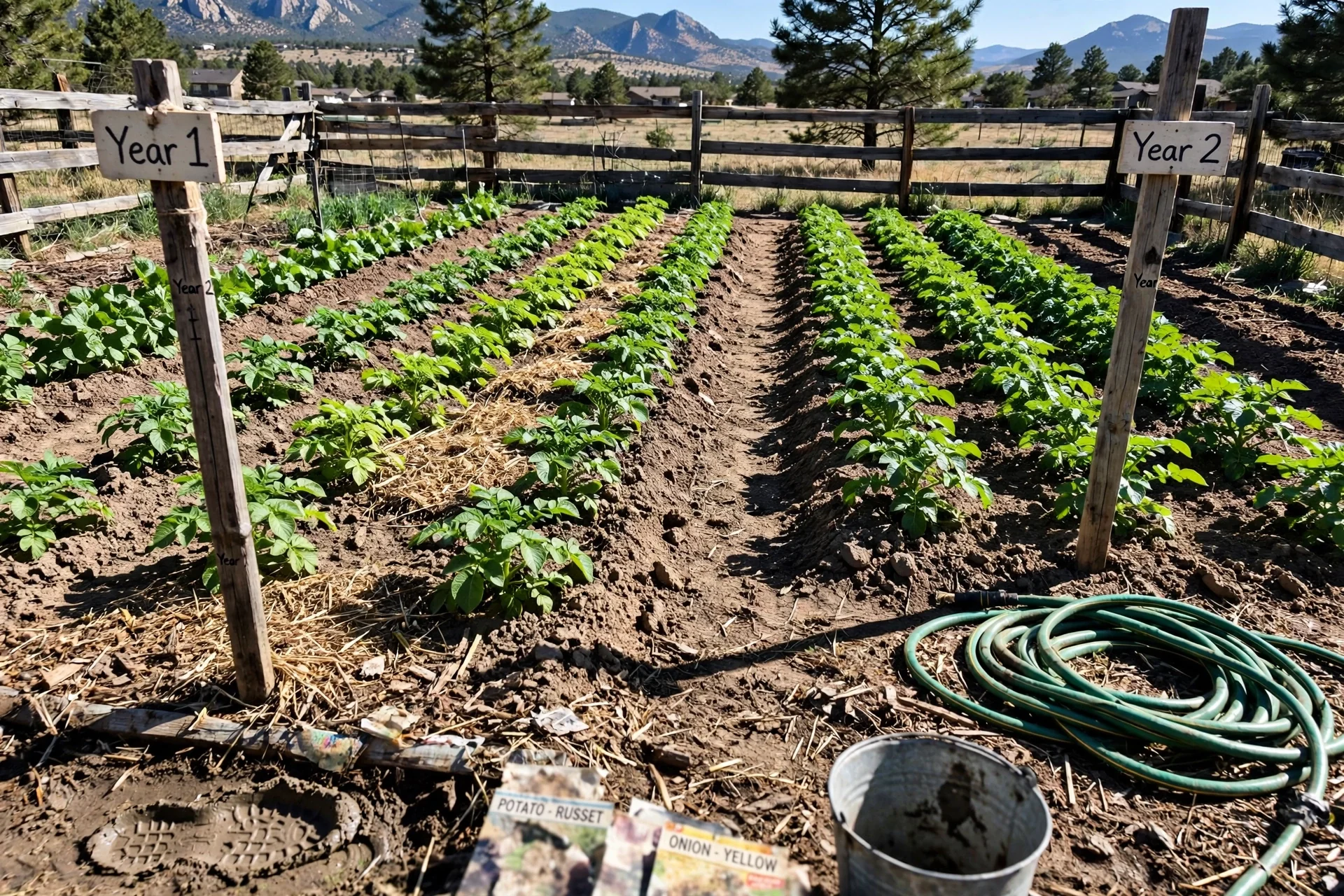
Most Colorado potato beetle advice treats every control method as equally durable. They are not. The beetle has documented resistance to over 50 active ingredients across all major insecticide classes, and populations in organic systems are now showing reduced susceptibility to spinosad, the go-to biorational option. The real question is not which method works. It is which methods will keep working three seasons from now.
This guide covers the full decision space: cultural prevention that stops beetles before they arrive, biorational sprays that target the most vulnerable life stage, and physical removal tactics that sidestep resistance entirely. What is excluded: systemic neonicotinoid seed treatments (not available to home gardeners in most regions), broad-spectrum synthetic pyrethroids as a first choice (resistance is widespread), and unregistered homemade concoctions with no replicated efficacy data.
By the end, you will know which methods match your garden size, your tolerance for reapplication, and your region’s resistance profile. You will also see which pairs of methods create a multi-year rotation sequence, which is the only approach that preserves the usefulness of every tool on this list.
Bottom line: If you use the same mode of action on consecutive CPB generations, you are selecting for resistance; rotate between at least two unrelated control categories every season.
The Yield Grid Decision Grid
Branch 1: Prevention-First (No Beetles Present)
You are planting potatoes in a new location or have not yet seen adults this season. Your priority is keeping colonizing beetles from establishing. Use this branch if your soil temperature at 10 cm depth is still below 12°C (the threshold at which overwintered adults begin emerging) or if you are willing to install barriers before emergence. Recommended: Items 1, 2, 3, 5 below.
Branch 2: Early Intervention (Eggs or Small Larvae Detected)
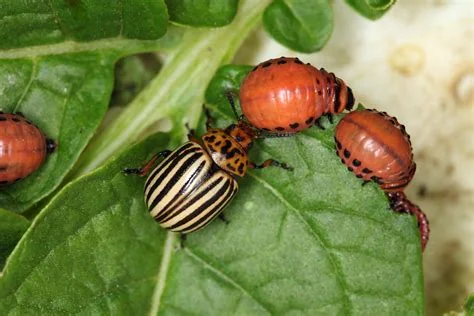
You have scouted and found orange-yellow egg masses on leaf undersides, or first- and second-instar larvae (under 5 mm, dark red with black head). This is the narrow window where biorational sprays actually penetrate the soft cuticle. If larvae have reached third instar or larger, most biological products lose significant efficacy. Recommended: Items 4, 6, 8, 9 below.
Branch 3: Active Infestation (Large Larvae or Adults, Defoliation Visible)
You have fourth-instar larvae (up to 12 mm), adult beetles feeding openly, or defoliation approaching the 20% threshold on potatoes. You need methods that work regardless of life stage and do not contribute to resistance. This branch prioritizes physical removal and barrier tactics that have zero chemical selection pressure. Recommended: Items 7, 10, 11, 12 below.
For a deeper understanding of the predator complex that can supplement any of these branches, see our guide on attracting and conserving beneficial insects in the garden.
Quick Comparison Table
| Option | Key Mechanism | Best For | Decision Grid Branch | Effort Score (1-5) |
|---|---|---|---|---|
| Crop Rotation | Distance-based disruption of spring colonization | Gardeners with space to move plots | Branch 1 | 1 |
| Straw Mulch Barrier | Physical obstruction of soil-to-plant movement | Small to medium plots | Branch 1 | 2 |
| Floating Row Covers | Exclusion barrier preventing adult access | Small gardens, early season | Branch 1 | 2 |
| Bt tenebrionis Spray | Ingested bacterial toxin targeting larval gut | Gardeners who scout and time sprays | Branch 2 | 4 |
| Trap Cropping | Perimeter planting to concentrate and remove beetles | Medium to large gardens | Branch 1 | 3 |
| Neem/Azadirachtin Spray | Antifeedant and growth regulator disruption | Organic gardens, early instar timing | Branch 2 | 4 |
| Handpicking and Vacuum | Direct physical removal of all life stages | Small gardens, zero-chemical preference | Branch 3 | 5 |
| Spinosad Targeted Spray | Nerve and muscle disruption via ingestion and contact | Organic and conventional gardens | Branch 2 | 3 |
| Beneficial Insect Release | Predation of eggs and small larvae | Gardeners committed to biological control | Branch 2 | 4 |
| Diatomaceous Earth | Cuticle abrasion causing desiccation | Dry conditions, larval stage focus | Branch 3 | 4 |
| Kaolin Clay Barrier | Particle film repellent and oviposition deterrent | Hot, dry regions; organic certification | Branch 3 | 3 |
| Mulch Plus Bt Integration | Combined physical barrier and microbial control | Gardeners wanting layered non-chemical defense | Branch 3 | 3 |
1. Crop Rotation With Verified Distance Thresholds
Best for: Branch 1 (Prevention-First)
Format: Threshold Rule
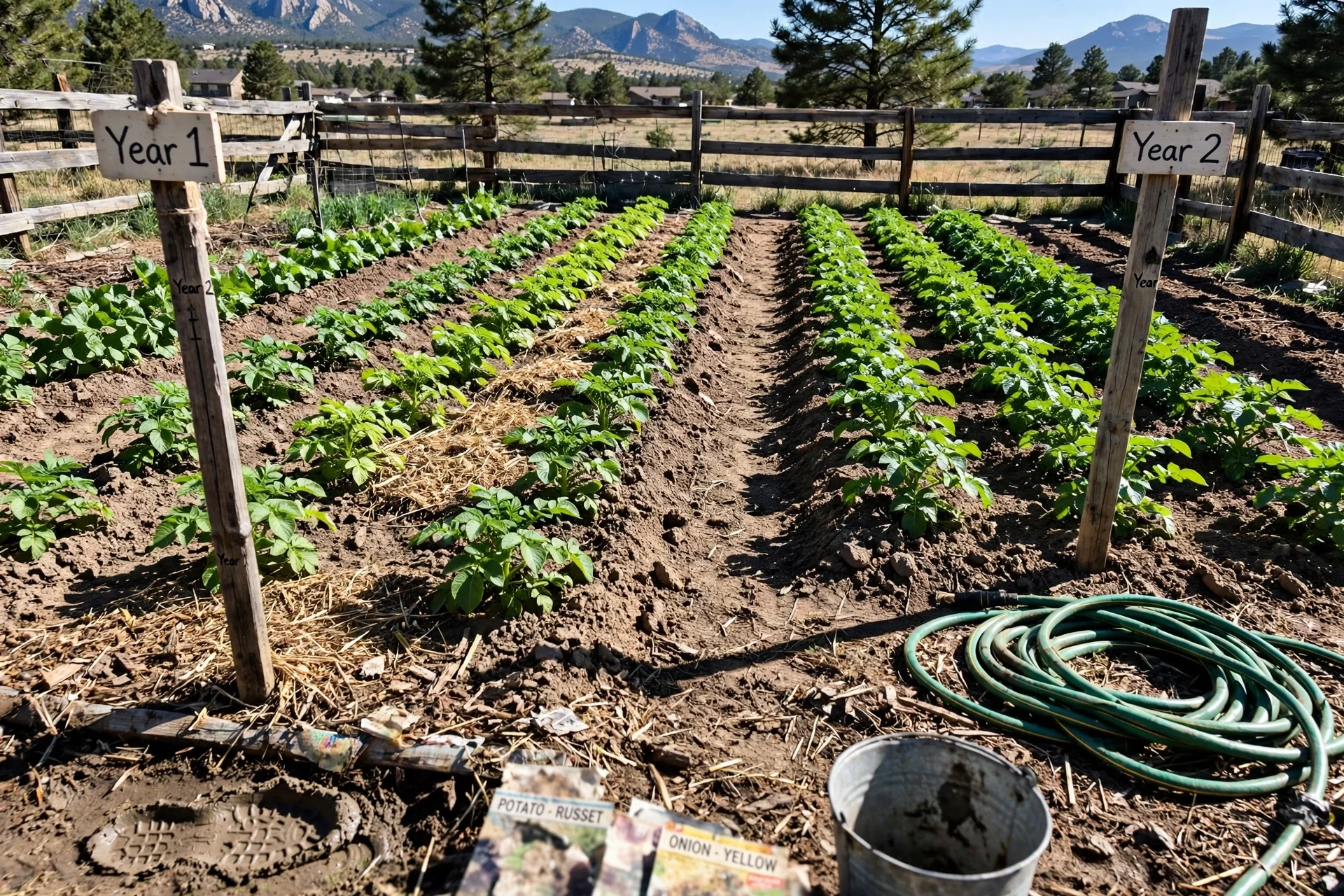
The single most effective cultural control for Colorado potato beetle is also the most underutilized by home gardeners. Overwintered adults emerging from soil in spring rarely fly initially. They walk to find host plants. Research consistently shows that rotational distances of 400 meters or more between this year’s potato plot and last year’s significantly limit spring colonization. Shorter rotations of 100 meters still provide measurable reduction in beetle density compared to planting in the same location. The minimum distance that provides any benefit is approximately 100 meters, and the prevention threshold where colonization is largely blocked is roughly 1.5 km.
Adjustment for small gardens: If you cannot achieve even 100 meters of separation, rotate to the farthest possible corner and insert a non-solanaceous barrier crop (corn, sunflowers, or a physical barrier like a fence line) between the old and new planting sites. Also delay planting by 10 to 14 days after your region’s typical emergence window. Overwintered beetles that emerge and find no host plants will either starve or disperse. The emergence window can be estimated by tracking soil temperature at 10 cm depth; adults begin emerging when it reaches roughly 12°C.
Common mistake: Rotating potatoes with tomatoes or eggplant, which are also solanaceous hosts. This accomplishes nothing because the beetles feed and reproduce on all three. True rotation requires a non-host crop between solanaceous plantings. For more companion planting strategies that support pest management, see our guide on companion planting for pest control.
2. Straw Mulch Barrier at Planting
Best for: Branch 1 (Prevention-First)
Format: Blueprint
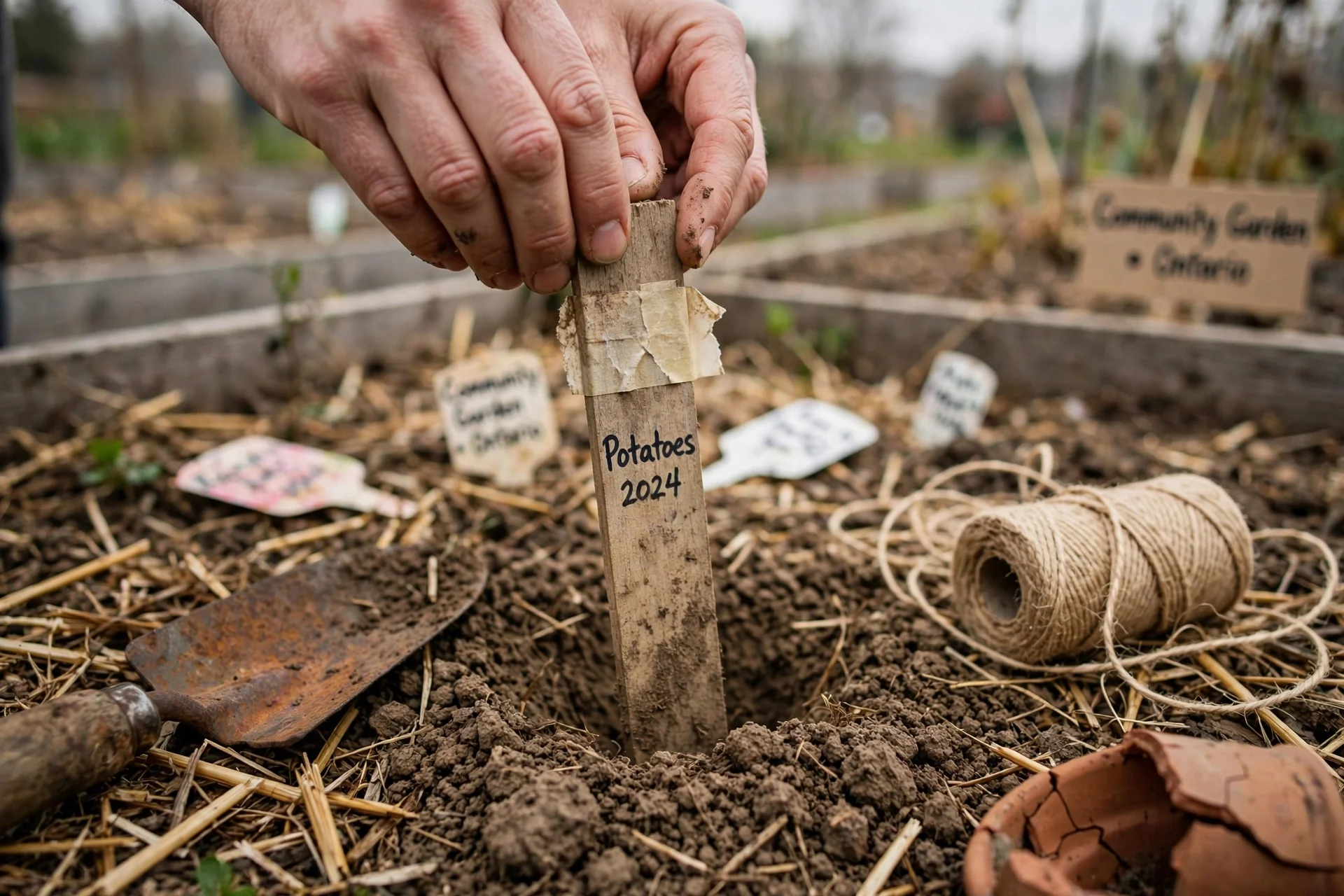
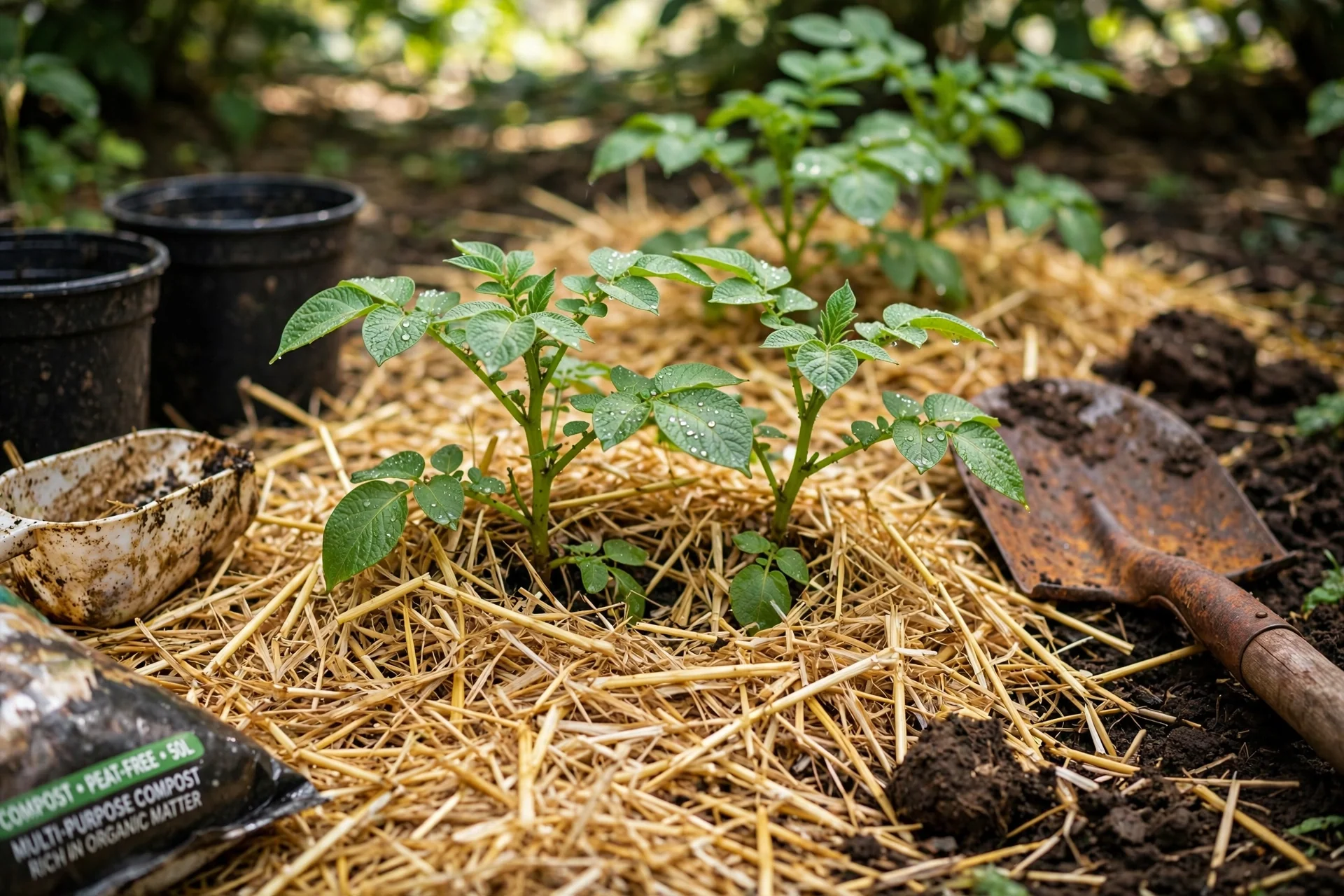
What it is: A layer of cereal straw, 10 to 15 cm (4 to 6 inches) deep, applied immediately after potato plants emerge. The mulch physically obstructs emerging adult beetles from locating stems and makes it harder for larvae that drop from plants to successfully pupate in the soil below. Field research confirms organic mulching reduces CPB damage even at commercial scale. The additional benefit is moisture retention and weed suppression, which improves potato vigor independently of pest pressure. Use clean straw free of herbicide residues.
3. Floating Row Covers Installed at Planting
Best for: Branch 1 (Prevention-First)
Format: Use vs. Skip
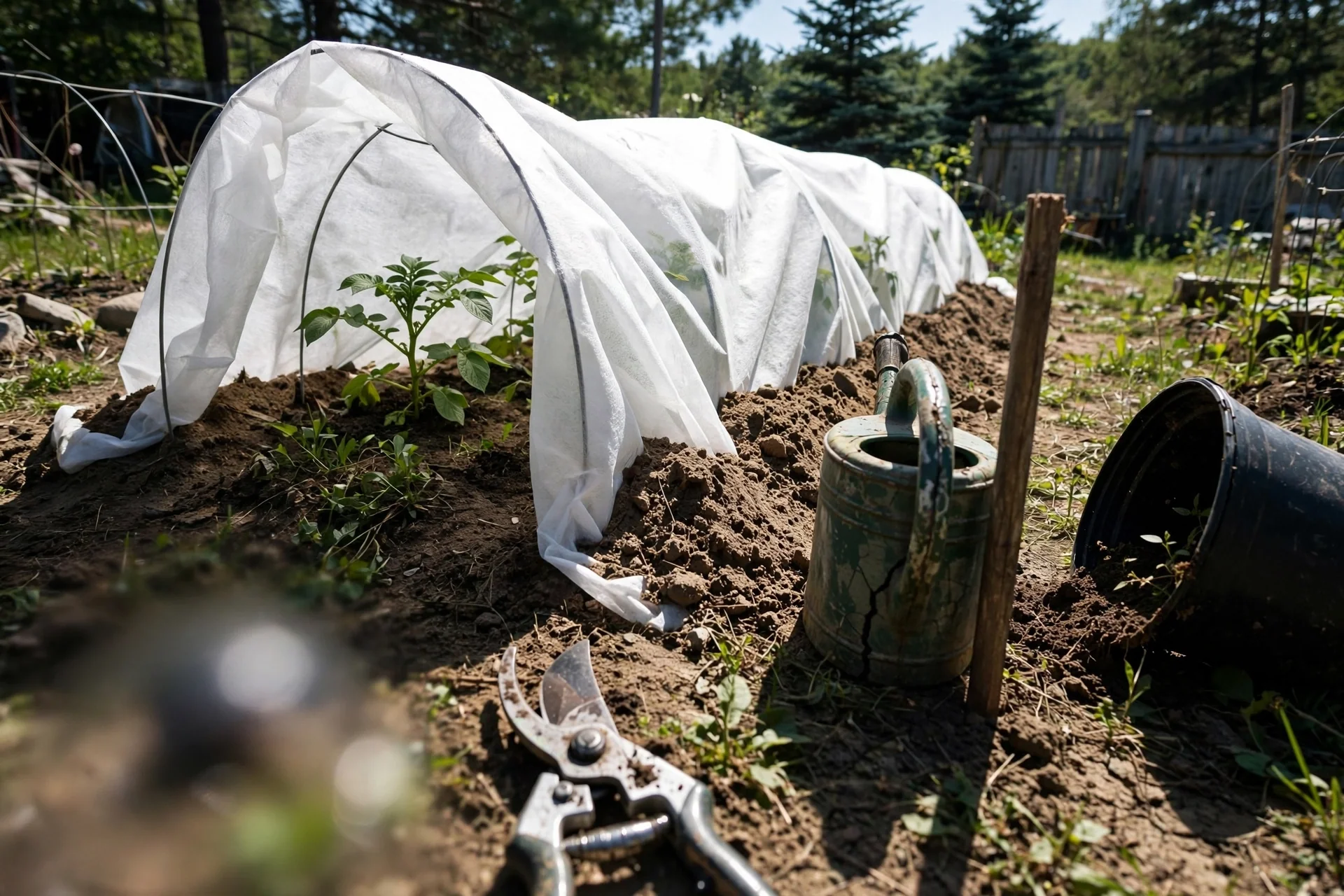
Floating row covers create a physical exclusion barrier that prevents adult beetles from ever reaching potato foliage. They must be installed immediately after planting and secured at all edges with soil, pins, or weights. The critical constraint is that potatoes are not insect-pollinated, so covers can remain in place for the entire growing season without affecting yield. However, covers must be removed temporarily for weeding, and any gap in the seal becomes an entry point. In warm climates, heat buildup under the fabric can stress plants once ambient temperatures exceed 29°C (85°F). Skip this method if you garden in consistently hot summer regions and cannot provide shade.
4. Bacillus thuringiensis tenebrionis: Timing the Spray Window
Best for: Branch 2 (Early Intervention)
Format: Threshold Rule
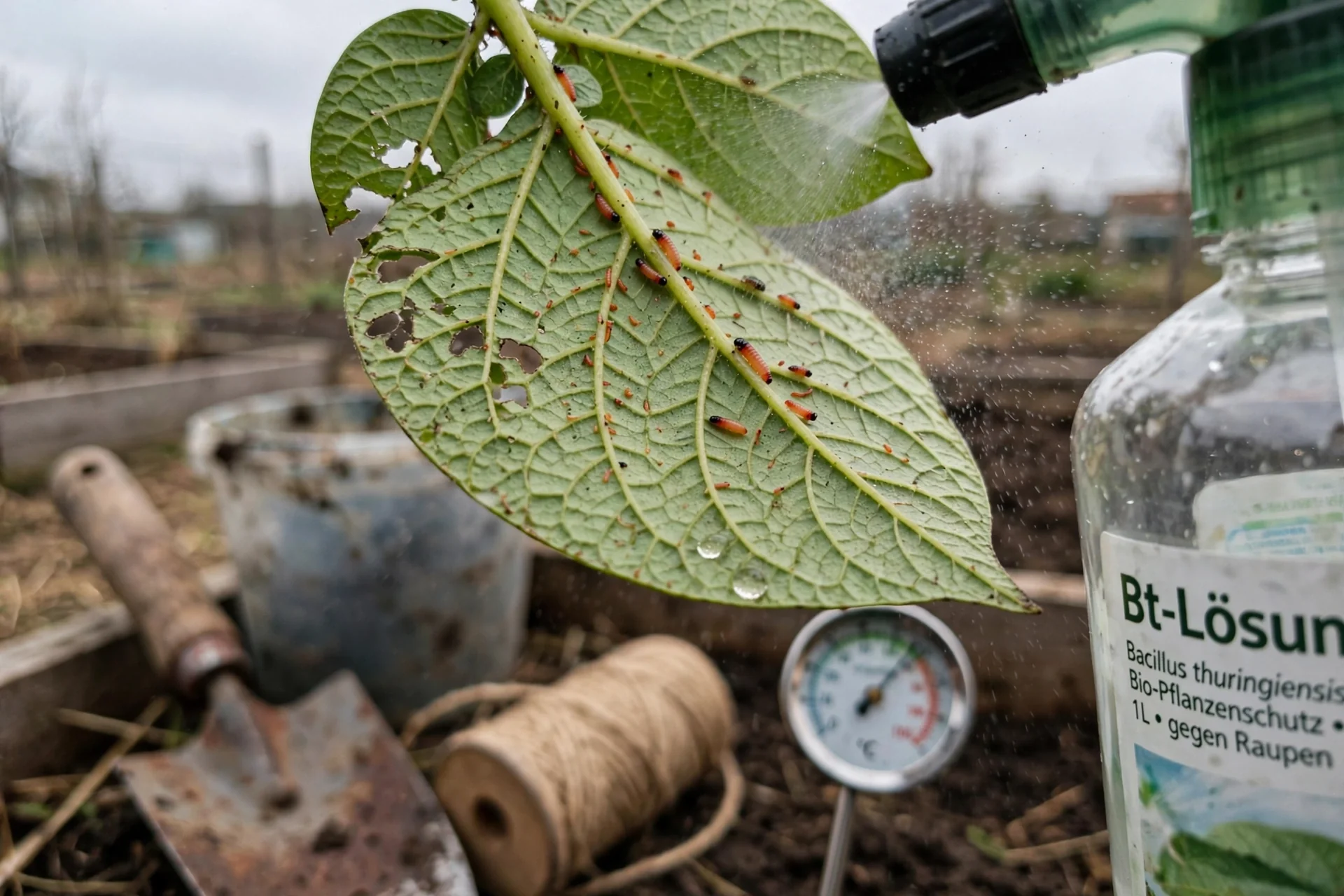
Bt tenebrionis (Bt-t) is a bacterial insecticide that produces a crystalline protein toxic only to CPB larvae after ingestion. It has zero effect on adults. The operational challenge is that the spray window is narrow and unforgiving. Research from field trials shows that effective CPB control is achieved when the initial Bt application occurs between the point when an average of 1 to 30% of marked egg masses have hatched, and no later than 4 days after 30% egg hatch of the first generation flush. Delaying until 6 days after 30% hatch results in significantly more defoliation and lower yield.
To use this threshold, flag 10 to 15 egg masses with colored tape when you first detect them. Check flagged masses daily. When roughly 3 out of 10 flagged masses show hatched larvae, you are inside the window. Apply Bt-t immediately at the label rate (commonly 3 to 6 quarts per acre equivalent; scale down for garden use). Larvae stop feeding within hours and die within 2 to 4 days. A second application 5 to 7 days later is typically needed to cover staggered hatch. For more on Bt-based pest control across different caterpillar and beetle pests, see our guide on using Bt for caterpillar and beetle larvae.
5. Trap Cropping With Perimeter Planting
Best for: Branch 1 (Prevention-First)
Format: 10-Minute Workflow
Step 1: Plant 4 to 5 potato plants along the garden perimeter 10 to 14 days before your main crop goes in. Step 2: As soon as these trap plants emerge, scout them daily for adult beetles. Step 3: Remove beetles by hand into a bucket of soapy water, or use a cordless handheld vacuum for faster collection. Step 4: Once your main crop emerges, continue scouting the trap crop first; beetles will concentrate there. Step 5: Upgrade option: for larger plots, plant an entire perimeter row of an early-maturing potato variety like Superior, then flame or vacuum the trap row when beetle density peaks, before the main crop is attractive.
6. Neem/Azadirachtin Sprays With Stage-Specific Timing
Best for: Branch 2 (Early Intervention)
Format: Use vs. Skip
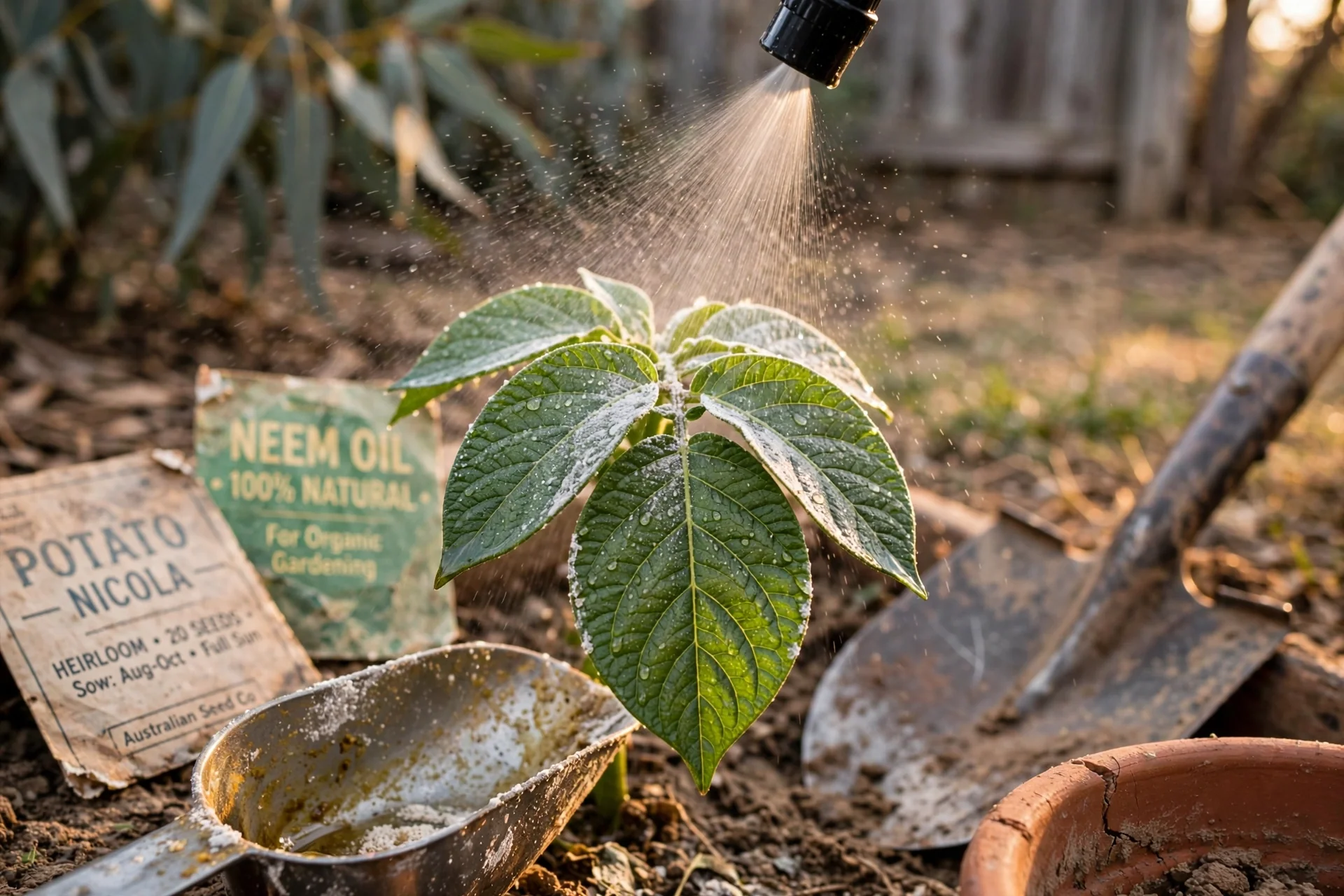
Azadirachtin, the primary active compound in neem oil formulations, acts as both an antifeedant and an insect growth regulator on CPB larvae. It disrupts molting, preventing larvae from progressing between instars. The key constraint is that efficacy drops sharply against third- and fourth-instar larvae, and it provides minimal control of adults. Field trials show moderate efficacy overall, and one limitation is the short residual period: azadirachtin has a half-life of roughly 48 minutes to 4 hours in water and approximately 2 days on leaf surfaces. This means reapplication every 5 to 7 days is required during peak larval activity. Skip this method if you cannot commit to that reapplication frequency or if larvae have already exceeded the second instar. For a broader look at neem applications across pest types, see our guide on using neem oil for insect control.
7. Handpicking and Vacuum Removal at Scale
Best for: Branch 3 (Active Infestation)
Format: Blueprint
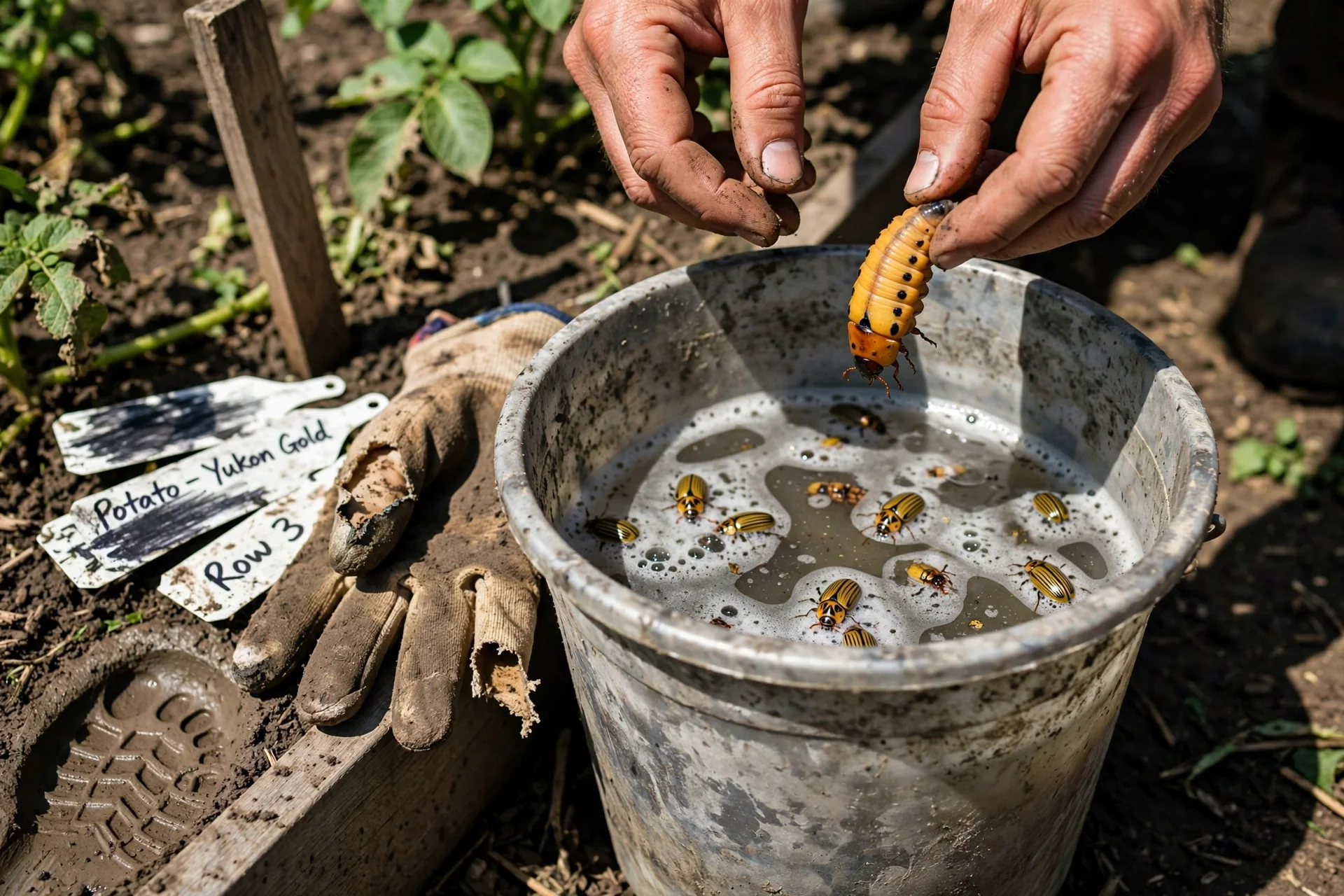
What it is: Physical removal of adult beetles, larvae, and egg masses by hand or with a cordless handheld vacuum. For whom: gardeners with fewer than roughly 100 row-feet of potatoes who can commit to daily scouting during the peak activity window (typically 3 to 4 weeks in early to mid-summer). Steps: Scout in early morning when beetles are sluggish and less likely to drop from plants. Hold a container of soapy water beneath the leaf before disturbing the beetle to catch those that drop reflexively. Check the underside of every leaf for orange-yellow egg masses (each containing 20 to 45 eggs standing on end like tiny sausages) and crush them between thumb and forefinger or scrape them into the soapy water.
Key detail that matters: A SARE-funded farmer trial found that cordless handheld vacuums were surprisingly effective at removing both adults and larvae, matching the efficacy of guinea fowl predation in side-by-side trials. The vacuum method eliminates the “drop and hide” escape behavior that makes handpicking frustrating. The primary mistake gardeners make is stopping after removing adults while leaving egg masses intact. Each missed egg mass produces 30 to 35 larvae, and the fourth instar alone does the majority of feeding damage. Remove egg masses first, then target adults and visible larvae.
8. Spinosad Targeted Application
Best for: Branch 2 (Early Intervention)
Format: Threshold Rule
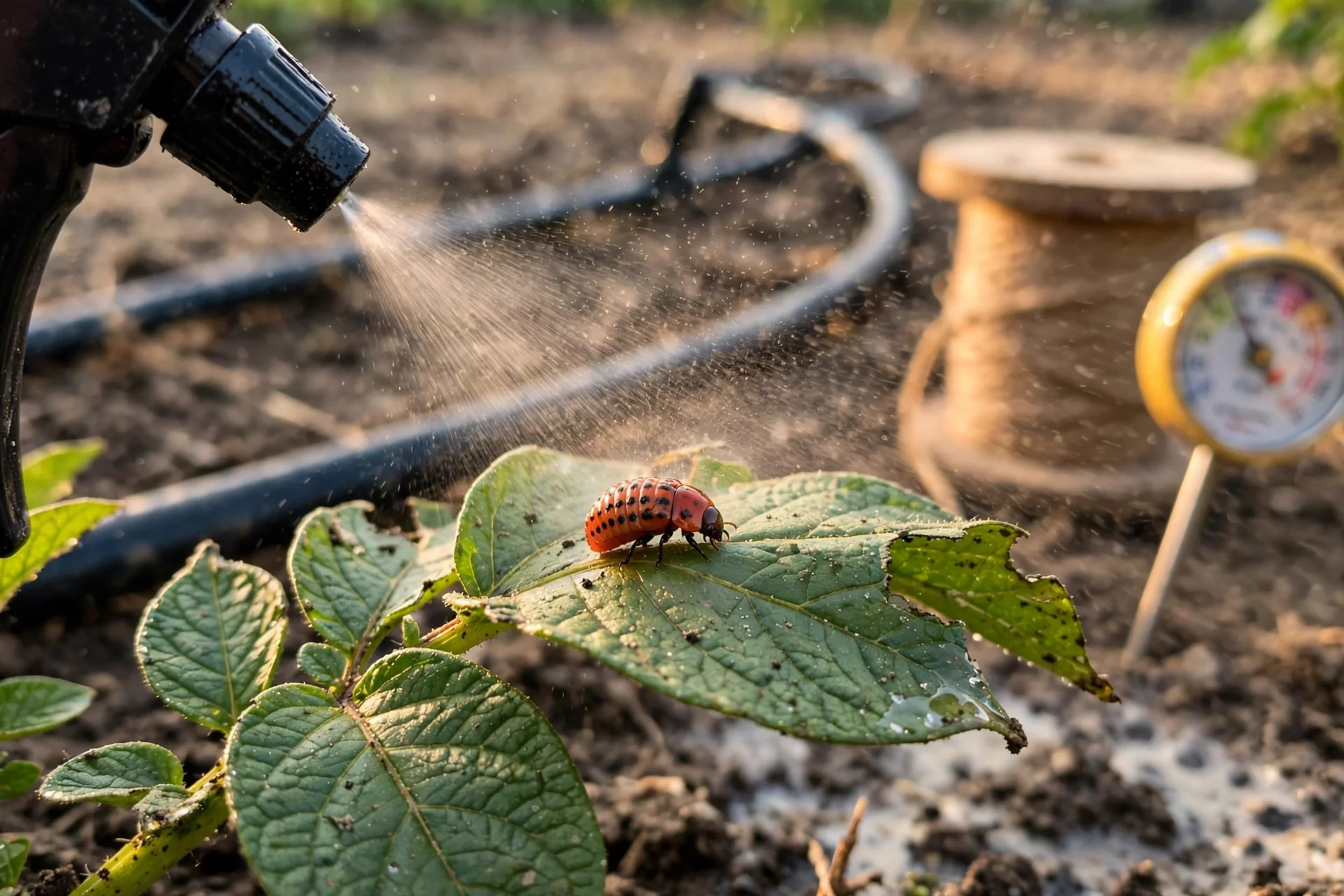
Spinosad is a fermentation-derived insecticide that acts on the insect nervous system via ingestion and contact. It is approved for organic production in many countries including the US, Canada, and EU member states. The threshold for application is 4 small larvae per plant or 1.5 large larvae per plant, based on scouting 50 plants. Apply at 30% egg hatch when larvae are still in the first or second instar. Rotate spinosad with products from different IRAC groups between generations; documented resistance exists in CPB populations from regions with heavy organic potato production, particularly in Quebec and the northeastern US.
9. Beneficial Insect Release and Conservation
Best for: Branch 2 (Early Intervention)
Format: Use vs. Skip
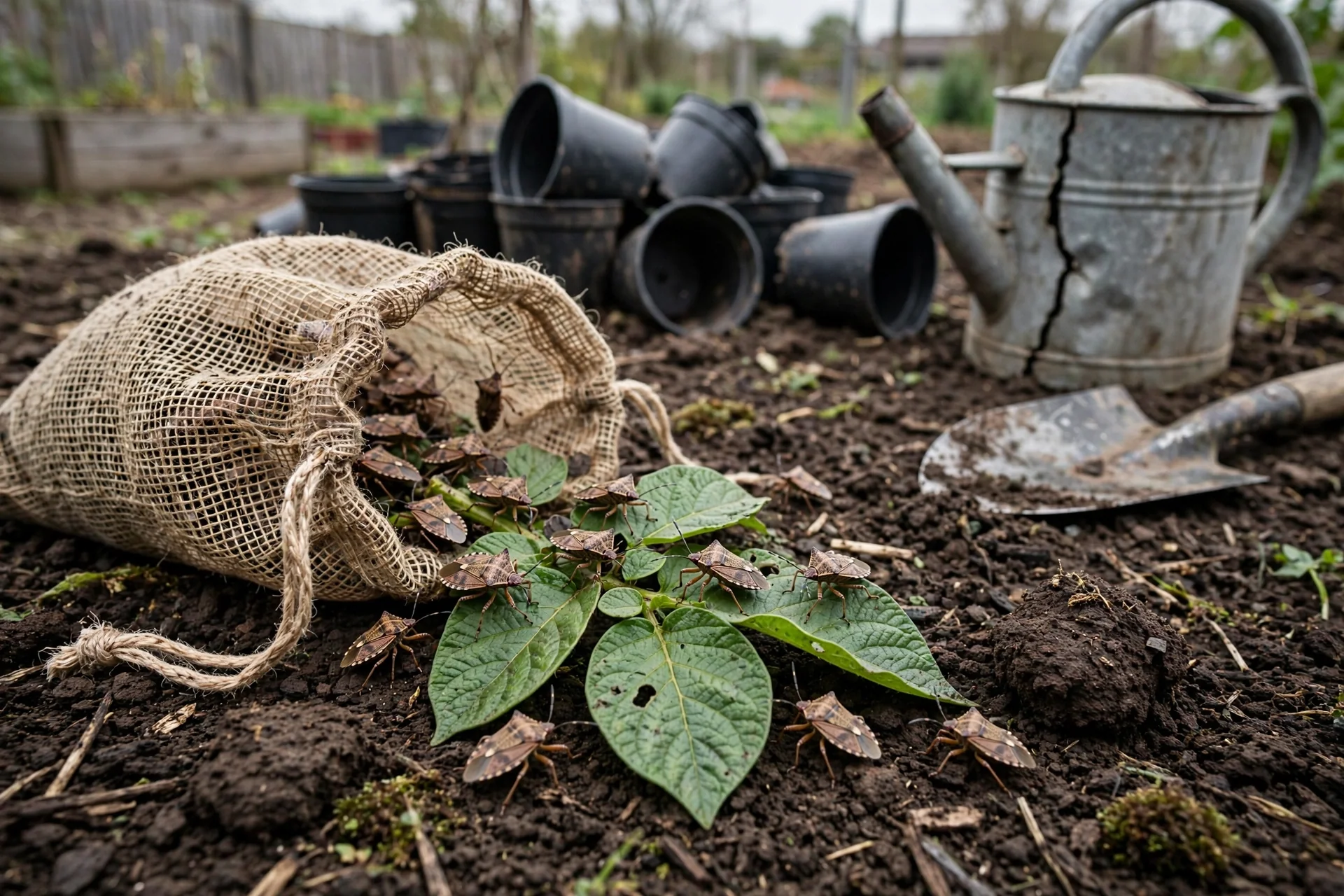
Predatory stink bugs (Perillus bioculatus and Podisus maculiventris) are specialist predators of CPB eggs and larvae. The spined soldier bug (Podisus) is commercially available for release. Lady beetles, particularly Coleomegilla maculata, also consume CPB eggs. Ground beetles (Lebia grandis) prey exclusively on CPB eggs and larvae and are active at night. The constraint is that natural enemy populations rarely suppress CPB below economic thresholds on their own, and broad-spectrum insecticide use eliminates them. Use this approach if you are committed to zero-spray management and can accept some defoliation. Skip if you need rapid knockdown of an established large infestation. To learn more about building a predator-friendly garden ecosystem, read our guide on beneficial insects for natural pest control.
10. Diatomaceous Earth: Conditions Required for Efficacy
Best for: Branch 3 (Active Infestation)
Format: Threshold Rule
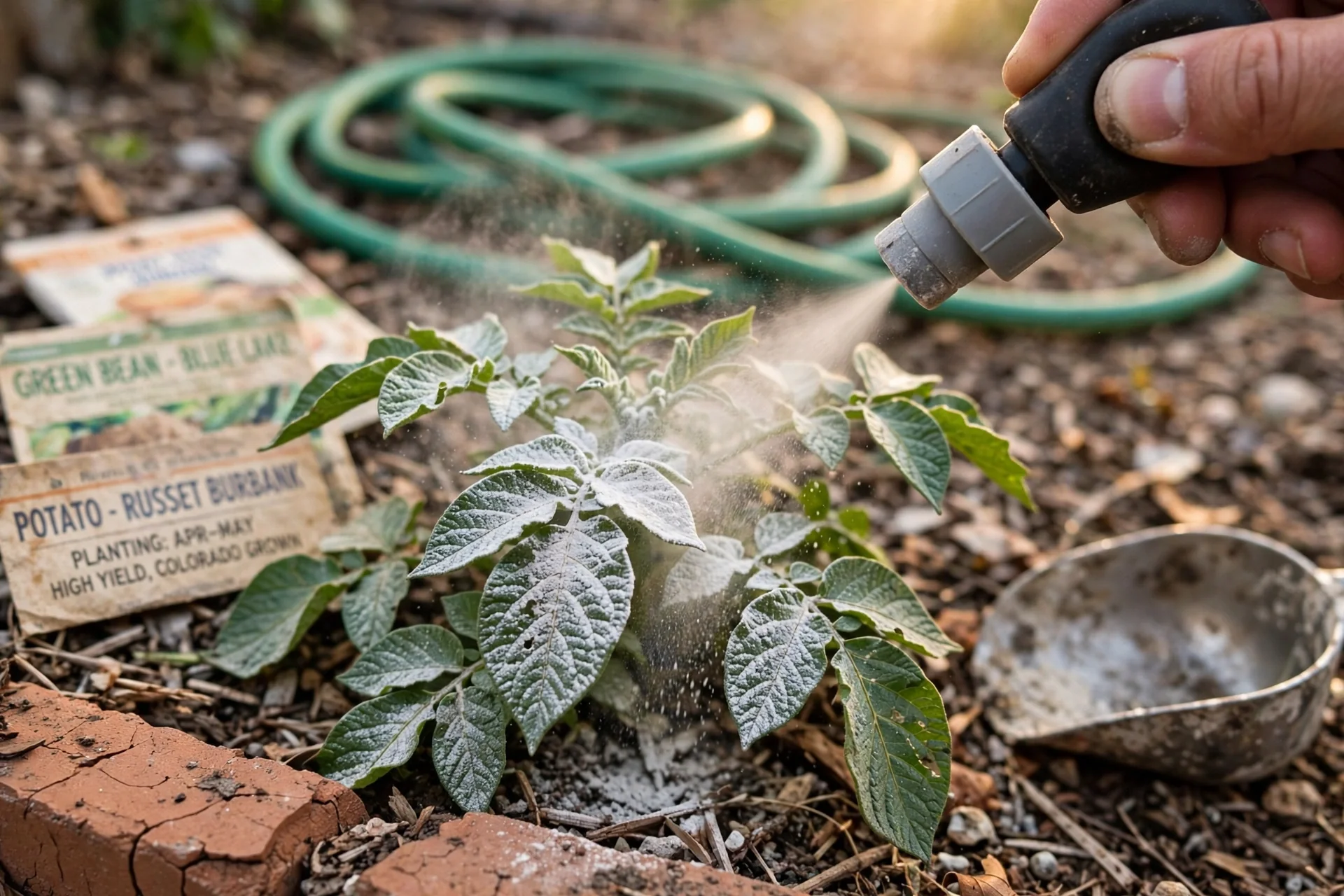
Diatomaceous earth (DE) kills CPB larvae by abrading the cuticle, causing death through desiccation. It has no effect on eggs and limited effect on adult beetles with hardened exoskeletons. The critical threshold that determines success or failure is moisture. DE must remain dry to work. A single rainfall, heavy dew, or overhead irrigation renders it inert until reapplied. Laboratory trials confirm that among inert dusts tested against CPB, diatomaceous earth and wood ash showed limited control compared to chemical standards, and the key variable was environmental persistence.
For best results, apply DE in the early morning when leaves are dry but larvae are still active on upper leaf surfaces. Dust upward from the ground, covering all stems and both leaf surfaces, especially the undersides where larvae congregate. Reapply after every rain event and at minimum every 5 to 7 days during active feeding. In humid climates or during rainy periods, this method becomes impractical due to the reapplication burden. Gardeners in arid regions will get more consistent results. Do not apply DE to flowering plants where pollinators are active, as the dust is non-selective and will harm bees on contact. For more on DE application techniques and safety, see our guide on using diatomaceous earth in the garden.
11. Kaolin Clay Particle Film
Best for: Branch 3 (Active Infestation)
Format: 10-Minute Workflow
Step 1: Mix kaolin clay (Surround WP or equivalent) at a rate of 3 cups per gallon of water. Step 2: Add a small amount of vegetable oil as a spreader-sticker. Step 3: Spray to thoroughly coat all leaf surfaces until the white film is visible. Step 4: Reapply every 7 to 10 days and after heavy rain. Step 5: Upgrade: combine with spinosad for a two-mode defense (clay repels adults and deters egg-laying, spinosad kills larvae that hatch from eggs that are laid despite the clay barrier). Kaolin is OMRI-listed and leaves no toxic residue.
12. Integrated Mulch Plus Bt Approach
Best for: Branch 3 (Active Infestation)
Format: Blueprint
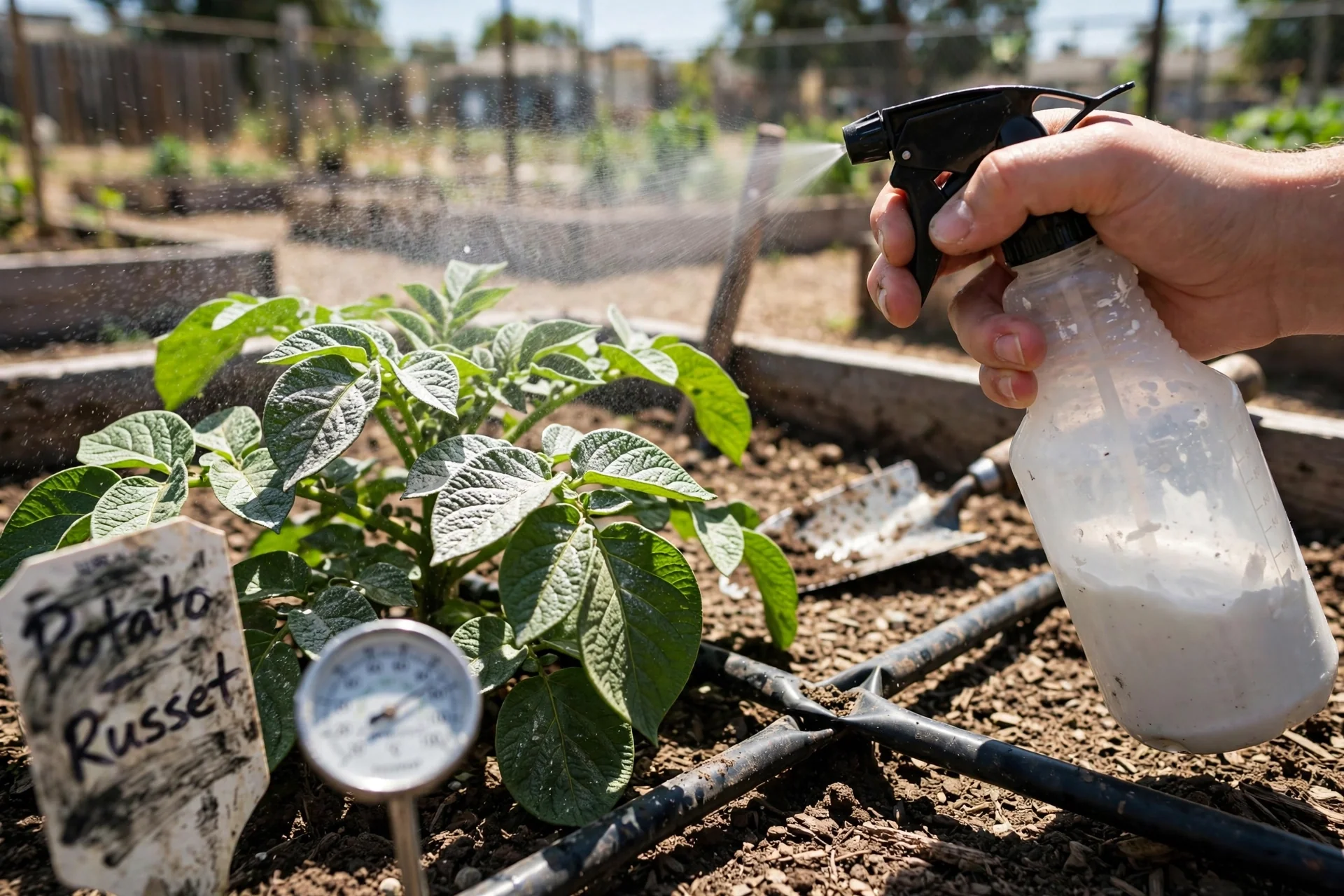
What it is: A two-layer strategy combining a 10 cm straw mulch applied at potato emergence with Bt tenebrionis sprays timed to egg hatch. The mulch reduces the number of larvae that successfully drop and pupate in soil, while Bt kills feeding larvae before they reach the damaging fourth instar. For whom: gardeners who have experienced CPB pressure in previous seasons and want a chemical-free, resistance-proof approach. Steps: Apply mulch immediately after plants emerge. Flag egg masses and monitor for hatch. Apply Bt when 30% of flagged masses show hatched larvae. Reapply Bt at 5- to 7-day intervals through the first-generation larval period. The synergy is that fewer larvae survive to pupate, reducing the second-generation adult population without selecting for resistance to either component.
Starter Stack (What to Choose First)
Branch 1: Prevention-First Starter Kit
Combine Item 1 (Crop Rotation) with Item 2 (Straw Mulch). Crop rotation at 100-plus meters keeps overwintered beetles from walking directly into your potato patch. The straw mulch then catches any beetles that do arrive, making it harder for them to locate stems and for larvae to pupate. Together, these two methods require no spraying and no daily labor. Estimated cost: $15 to $30 for straw bales (one bale covers roughly 30 to 40 row-feet at 10 cm depth). Time investment: 2 to 3 hours once at planting.
Branch 2: Early Intervention Starter Kit
Combine Item 4 (Bt tenebrionis) with Item 8 (Spinosad), used in strict rotation. Apply Bt-t against the first generation of larvae. Switch to spinosad for the second generation, or vice versa in alternating years. This rotates between IRAC Group 11 (Bt microbial disruptors) and Group 5 (spinosyns), which have entirely different modes of action. Estimated cost: $25 to $40 for both products, enough for one season on a garden up to 500 square feet. Time investment: 15 to 30 minutes per application, 3 to 4 applications per season.
Branch 3: Active Infestation Starter Kit
Combine Item 7 (Handpicking and Vacuum) with Item 10 (Diatomaceous Earth). Use the vacuum or handpicking to remove adults and large larvae immediately. Follow up with DE dusting to kill small larvae that hatch from undetected egg masses. The vacuum handles the escape-artist adults; the DE provides residual protection against the next wave. Estimated cost: $30 to $60 for a cordless handheld vacuum plus $10 to $20 for food-grade DE. Time investment: 15 to 30 minutes daily during peak beetle activity (typically 3 to 4 consecutive weeks).
When This Won’t Work
Failure condition 1: Nearby non-rotated potato fields. If a neighbor, community garden plot, or commercial field within roughly 400 meters grows potatoes in the same location year after year, your rotation and barrier methods will be overwhelmed by immigrating adults from that source population. Second-generation adults are strong fliers and will colonize rotated fields 1 to 4 weeks later than non-rotated fields, but they will still arrive. In this scenario, preventive methods alone are insufficient. You must add a scouting and intervention protocol (Branch 2 or 3 items) to handle the inevitable influx.
Failure condition 2: Initiating control after fourth-instar larvae dominate. If you first notice CPB when large larvae (8 to 12 mm, humpbacked, reddish-orange) are already stripping foliage, biorational sprays (Bt-t, neem, spinosad) will perform poorly because the larval cuticle thickens with each instar. The fourth instar consumes roughly 85% of the total foliage a larva will eat in its lifetime. At this stage, the only effective options are physical removal (handpicking or vacuuming) or synthetic insecticides. If defoliation has already exceeded 30%, the potato plant’s ability to bulk tubers is compromised regardless of subsequent control. The alternative action is to harvest early if tubers are of usable size, then destroy the remaining foliage to deny the beetle population a food source for building the overwintering generation.
For comparison, the principles here align with management strategies for other persistent beetle pests. See our guide on cucumber beetle control for a related pest that also benefits from rotation and early intervention.
Choosing the Right Option for Your Situation
Budget Threshold
If your annual pest control budget for the potato patch is under $25, focus entirely on Branch 1 and Branch 3 methods. Crop rotation costs nothing. Straw mulch is the cheapest barrier. Handpicking requires only a bucket and soap. Skip commercial beneficial insect releases (which can run $40 to $80 per shipment) and skip spinosad unless you already own it. Bt-t and neem are the most cost-effective spray options at roughly $12 to $18 per concentrate bottle that lasts multiple seasons in a small garden.
Time Threshold
If you can commit fewer than 30 minutes per week to CPB management, rely on Branch 1 methods exclusively. Crop rotation plus straw mulch plus floating row covers create a system that works passively once installed. The trade-off is that if beetles breach these defenses, you will have no rapid-response option. If you can commit 15 to 30 minutes daily during the 3- to 4-week peak window, add handpicking or vacuuming as insurance.
Technical Constraint: Resistance History in Your Region
CPB resistance profiles vary by geography. If you garden in the northeastern US, Quebec, Ontario, or the upper Midwest where intensive potato production occurs, assume that local populations carry resistance to at least one insecticide class. Contact your provincial or state extension service to determine which modes of action still test effective in your area. In regions with documented spinosad resistance (confirmed in several organic potato-producing areas), rotate Bt-t with physical removal rather than relying on spinosad as a backup.
Yes/No Checklist
1. Can you move your potato planting at least 30 meters from last year’s location? If NO, you must use Branch 2 or 3 methods.
2. Are you willing to scout undersides of leaves twice weekly during June and July? If NO, rely on Branch 1 barriers only.
3. Have you used the same spray product on CPB for two consecutive seasons? If YES, switch to a different mode of action this year.
4. Is your garden within 400 meters of a known potato field? If YES, do not rely on prevention alone; add an intervention method.
Expert Q&A
What temperature kills Colorado potato beetle eggs?
CPB eggs are not killed by typical summer temperatures. Egg hatch accelerates at warmer temperatures: eggs can hatch in as little as 3 to 4 days at 29°C (84°F), while at cooler temperatures around 15°C (59°F), hatch takes up to 16 days. Sustained temperatures above 38°C (100°F) may reduce egg viability, but this is not reliable as a control strategy. The practical implication is that in hot weather, the egg-to-larva transition happens faster, shortening your scouting and treatment window.
Can chickens or ducks control Colorado potato beetles?
Yes, but with significant trade-offs. Ducks and chickens readily consume adult beetles and larvae when allowed to forage in potato rows. Guinea fowl have been documented in on-farm trials as equally effective as handheld vacuum removal for CPB control. However, poultry also damage potato plants by knocking down foliage, scratching up tubers, and depositing manure directly on edible crops. This method works best in a rotational system where birds are deployed after harvest to clean up remaining beetles before they overwinter.
Why are Colorado potato beetles so hard to kill with insecticides?
CPB possesses a uniquely fast metabolic detoxification system. Cytochrome P450 enzymes and glutathione S-transferases in the beetle rapidly break down insecticide molecules before they reach lethal concentrations. Additionally, adult beetles have a thick, hard cuticle that contact-only products struggle to penetrate. Compounding these innate defenses, CPB has evolved target-site resistance to nearly every insecticide class used against it, including organochlorines, organophosphates, carbamates, pyrethroids, and neonicotinoids. This is why rotation between unrelated modes of action is non-negotiable.
How do I distinguish Colorado potato beetle eggs from lady beetle eggs?
CPB eggs are bright orange-yellow, elongated oval, and laid upright in tight clusters of 20 to 45 eggs that resemble small sausages standing on end. They are almost always on the undersides of potato, eggplant, or tomato leaves. Lady beetle eggs are also orange-yellow but are more spindle-shaped, slightly smaller, and laid in smaller, looser clusters of 5 to 30. If you see eggs on plants that are not in the Solanaceae family, they are almost certainly not CPB. When uncertain, leave the egg mass and check the plant again in 4 to 5 days; CPB larvae have black heads and reddish bodies, while lady beetle larvae look like tiny alligators with orange and black markings.
Is the Colorado potato beetle a quarantine pest in the UK?
Yes. The Colorado potato beetle is classified as a Great Britain quarantine pest and is not established in the UK. Import and movement restrictions apply to susceptible host material including potato plants and tubers. When outbreaks occur, as confirmed in Kent in 2023 and Hampshire previously, official containment and eradication measures are triggered, including removal and destruction of infested plants and pesticide spray programs. Gardeners in the UK who suspect CPB should report it to the Animal and Plant Health Agency rather than attempting control independently.
Conclusion
Controlling Colorado potato beetle is not about finding the single best product. It is about sequencing methods so that no single selection pressure operates for long enough to produce resistance. The number one mistake gardeners make is finding one spray that works and using it every year until it stops. By then, the local beetle population carries resistance and that tool is lost, often permanently.
The most durable sequence for a home garden is crop rotation plus straw mulch as your baseline every year, with Bt-t and handpicking rotated through the growing season as needed. If you do nothing else, move your potatoes. For additional strategies that protect pollinators while managing pests, see our guide on bee-safe pest control methods.