
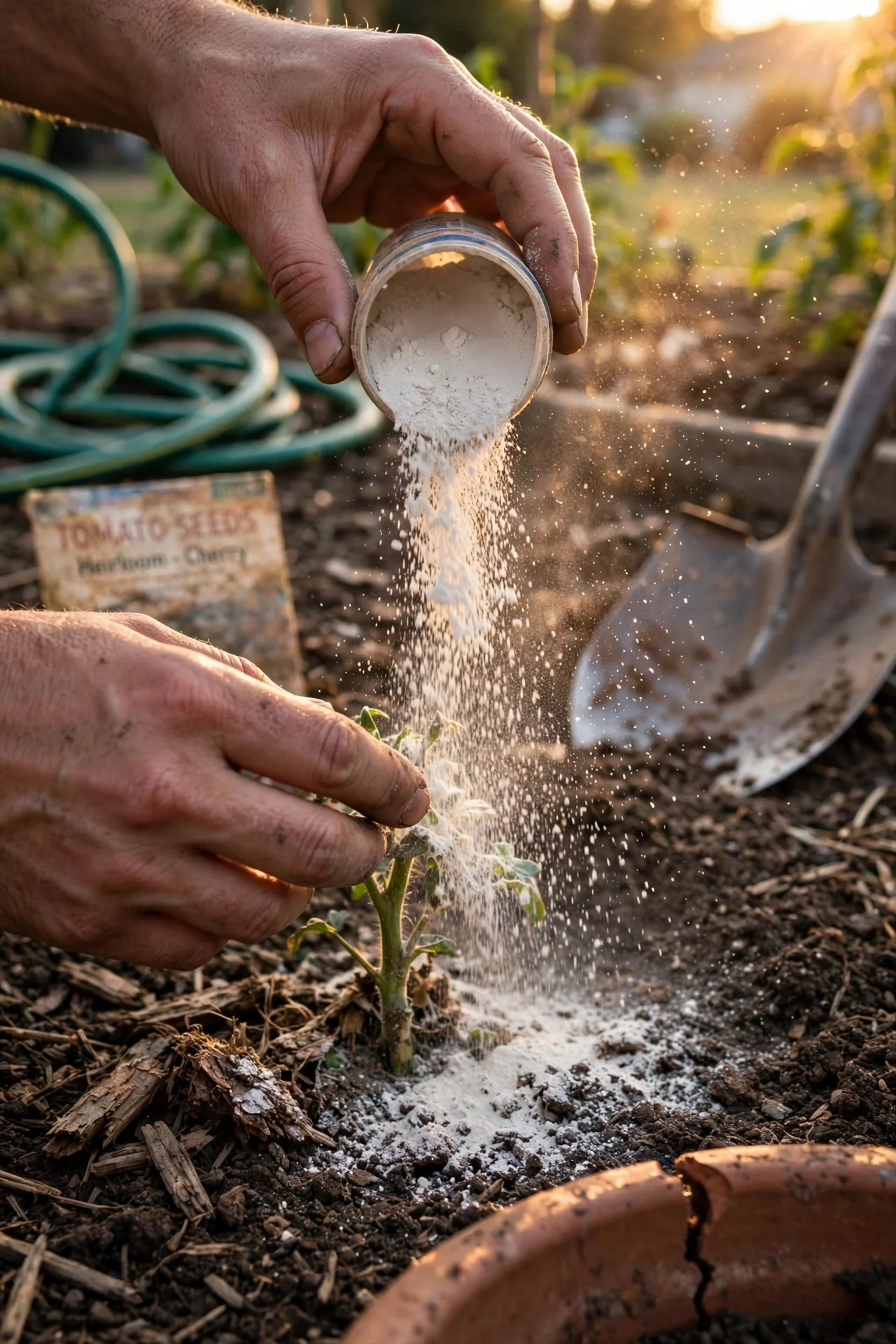
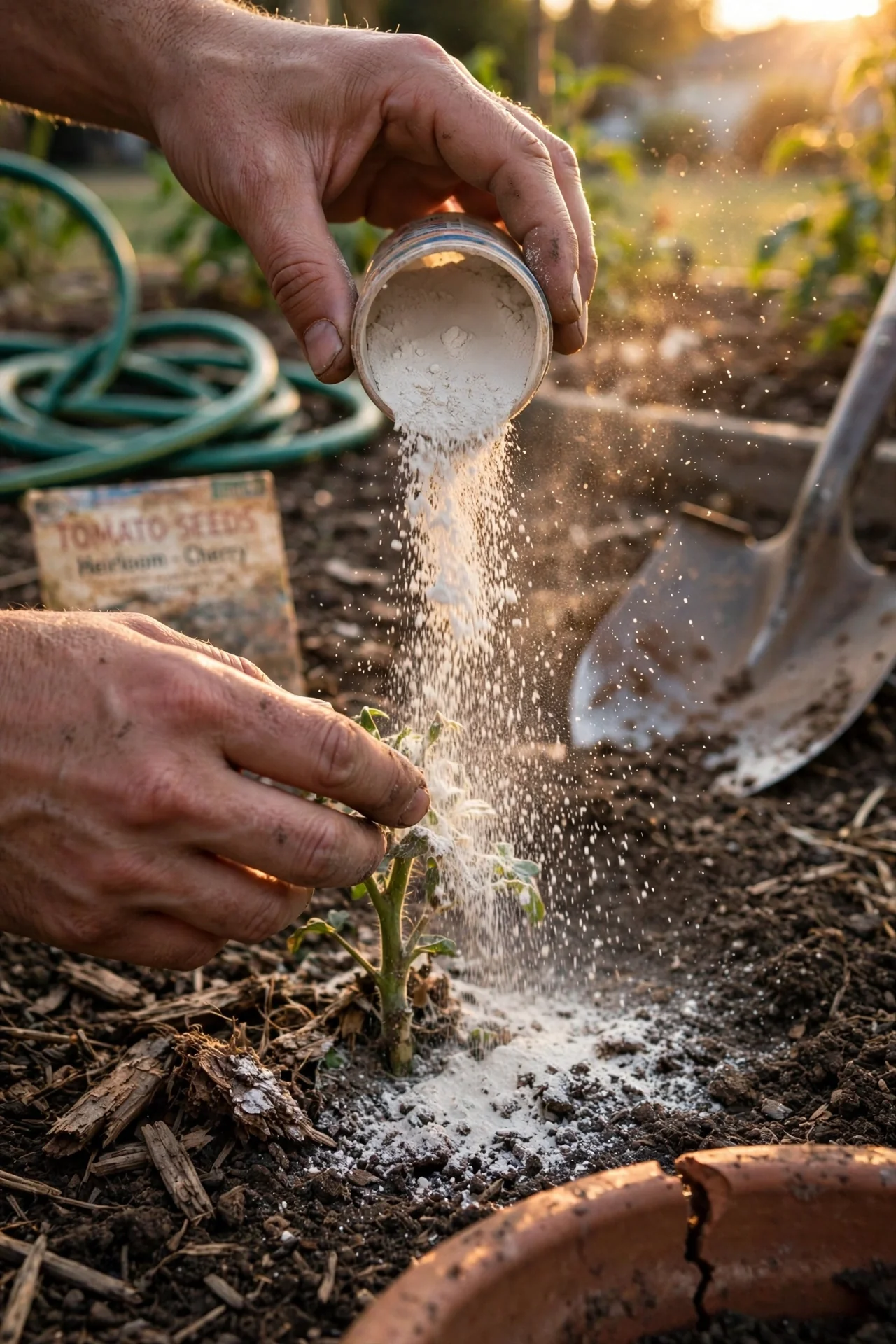
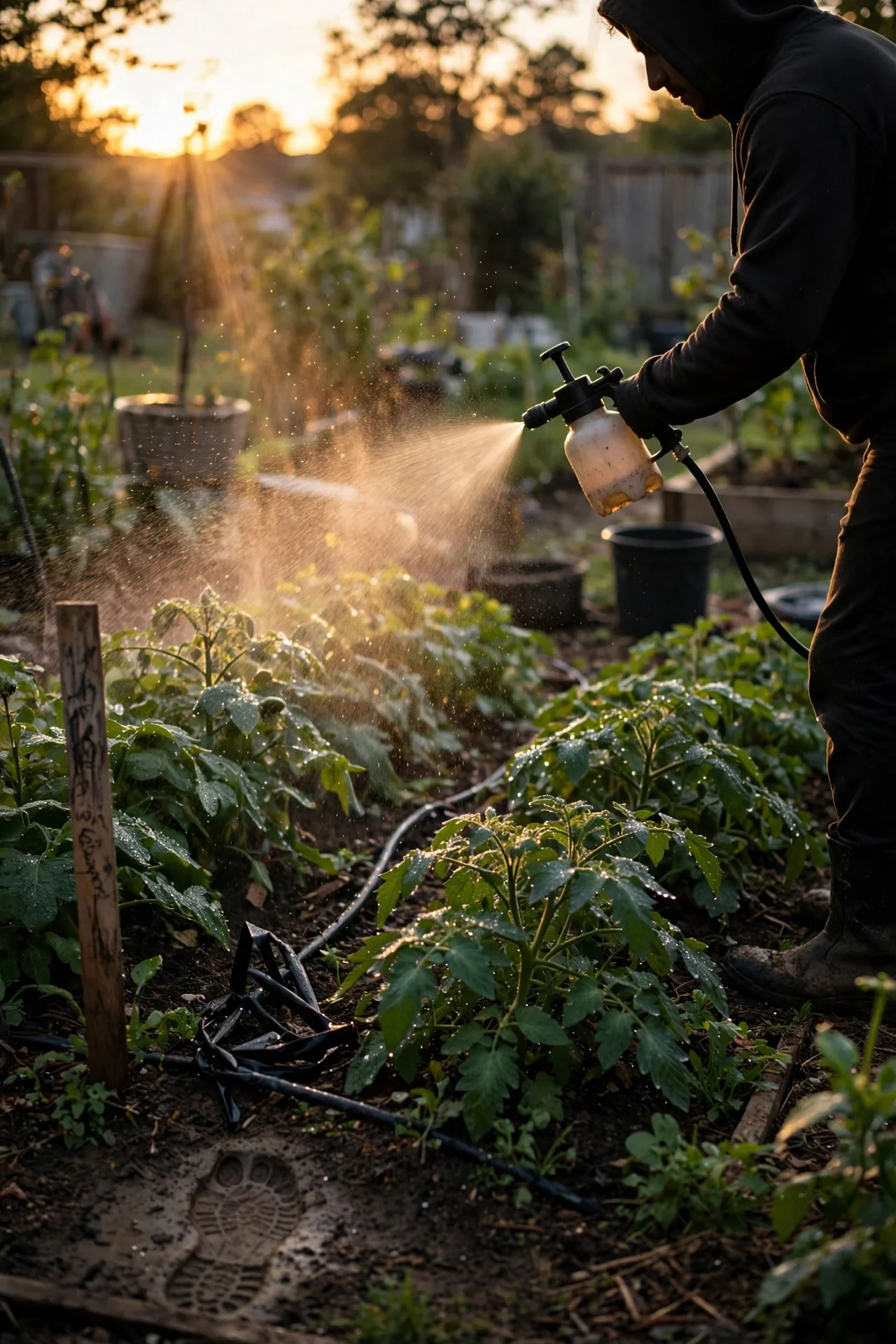
Most bee safe pest control advice puts product choice first. Look for the bee icon on the label, they say. Use neem instead of synthetics, they say. But research and field observation point to an uncomfortable truth: timing is the real safety mechanism. A product deemed bee safe when dry can be lethal when sprayed directly onto a foraging bee at 11 a.m. on a blooming plant. Conversely, even a moderately toxic substance applied after sunset when bees are inside the hive may pose negligible real-world risk. This article flips the conventional hierarchy: when you apply matters more than what you apply, and how you apply matters more than both for certain formulations.
This guide covers pest control methods suitable for outdoor gardens, orchards, and landscape plantings where bees actively forage. It excludes structural pest control (carpenter bees in house siding, wasp nest removal), large-scale agricultural protocols, and any method that involves killing bees themselves. The focus is exclusively on managing plant pests while preserving pollinator health.
By the end, you will be able to identify which branch of the decision grid matches your garden situation, compare options on a consistent effort scale, and select a starter combination that fits your available time and budget. Every recommendation is anchored to measurable conditions: temperature thresholds, dilution ratios, application windows, and reapplication intervals.
Bottom line: If you remember one rule from this article, make it this: never spray anything, bee safe or otherwise, onto open blooms between 9 a.m. and 3 p.m. during the growing season.
The Yield Grid Decision Grid
Answer yes to the first question that fits your situation. Each branch leads to a recommended set of items below.
Branch 1: Are you willing to accept some pest damage as part of a balanced garden ecosystem?
You prioritize prevention over intervention. Your strategy leans on cultural controls, habitat manipulation, and natural enemy conservation. You accept that a few chewed leaves are the price of a living garden. If yes, go to Branch 1.
Recommended: Items 1, 2, 3 below. Start with companion planting for pest management as your foundation strategy.
Branch 2: Do you have 15 to 30 minutes per week for hands-on monitoring and targeted physical interventions?
You are willing to inspect plants regularly and act with precision. You prefer methods that leave no residue and require no mixing or spraying. Your tolerance for pest damage is moderate. If yes, go to Branch 2.
Recommended: Items 4, 5, 6 below.
Branch 3: Do you need a spray-based solution and can commit to applying it only during the evening or pre-dawn window?
Your pest pressure is high enough that cultural and physical methods alone are insufficient. You accept that any spray, however benign, carries some residual risk and must be timed precisely. If yes, go to Branch 3.
Recommended: Items 7, 8, 9, 10, 11, 12 below.
Quick Comparison Table
| Option | Key Mechanism | Best For | Decision Grid Branch | Effort Score (1-5) |
|---|---|---|---|---|
| Beneficial Insects | Predation and parasitism by released natural enemies | Aphids, mites, caterpillars, scale | Branch 1 | 2 |
| Companion Planting | Repellent volatiles, trap cropping, nectar for beneficials | Generalist pests, nematodes | Branch 1 | 1 |
| Physical Barriers | Exclusion by fabric or mesh | Cabbage worms, beetles, squash bugs | Branch 1 | 2 |
| Diatomaceous Earth | Abrasion of insect cuticle causing dehydration | Slugs, ants, crawling beetles | Branch 2 | 3 |
| Hand-Picking | Manual removal and disposal | Tomato hornworms, Japanese beetles | Branch 2 | 4 |
| Sticky Traps | Visual or pheromone attraction to adhesive surface | Whiteflies, thrips, fungus gnats | Branch 2 | 2 |
| Horticultural Oil | Suffocation of eggs and soft-bodied insects | Scale, mites, aphids, psyllids | Branch 3 | 3 |
| Insecticidal Soap | Cell membrane disruption on contact | Aphids, whiteflies, mites, mealybugs | Branch 3 | 4 |
| Neem Oil | Antifeedant, growth regulator, repellent | Chewing and sucking insects, fungal pathogens | Branch 3 | 4 |
| Bacillus thuringiensis | Gut toxin specific to caterpillar larvae | Cabbage worms, hornworms, loopers | Branch 3 | 3 |
| Kaolin Clay | Particle film barrier and irritant | Flea beetles, leafhoppers, thrips | Branch 3 | 3 |
| Sulfur Spray | Multi-site contact fungicide and mild insect suppressant | Powdery mildew, rust, mites | Branch 3 | 3 |
1. Beneficial Insects
Best for: Branch 1
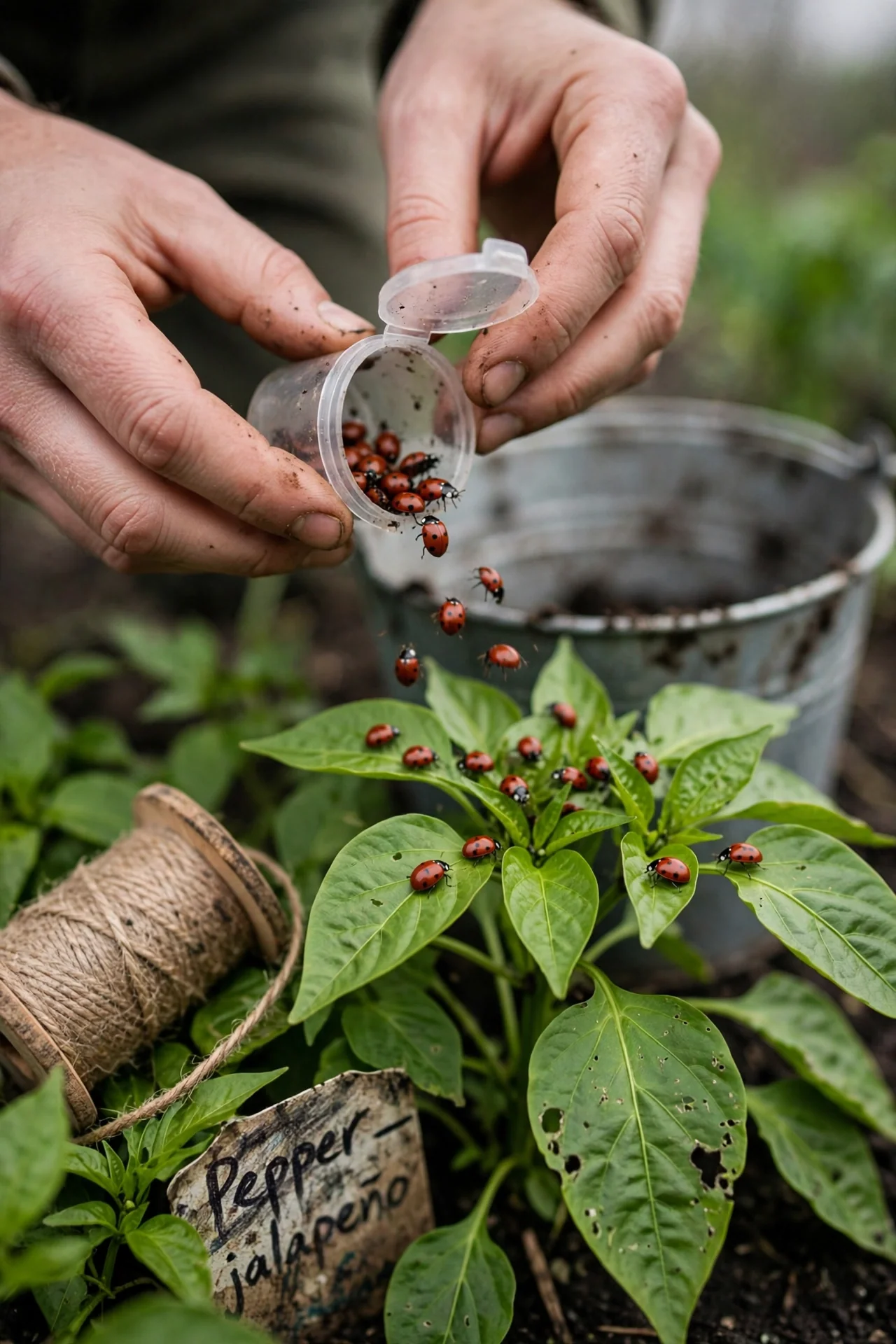
What it is: The deliberate release of predatory or parasitic insects that naturally suppress pest populations. Lady beetles (Hippodamia convergens) target aphids. Green lacewing larvae (Chrysoperla carnea) consume aphids, mealybugs, thrips, and small caterpillars. Predatory mites (Phytoseiulus persimilis) specialize on spider mites.
Why it is bee safe: This method introduces no chemical residue whatsoever. Beneficial insects are host-specific or guild-specific; they hunt pest species, not pollinators. Bees and predatory insects coexist in the same garden without conflict.
Application steps: Order from an insectary that ships overnight with cold packs. Release at dusk to reduce dispersal loss. For lacewing eggs, sprinkle near aphid colonies. For lady beetles, refrigerate for 24 hours before release (this reduces flight response) and mist the release area first. A common mistake is releasing onto plants with no prey; beneficials will simply leave. Ensure pest populations are present before ordering. Learn more about integrating released predators into your garden with our guide on beneficial insects for natural pest suppression.
2. Companion Planting
Best for: Branch 1
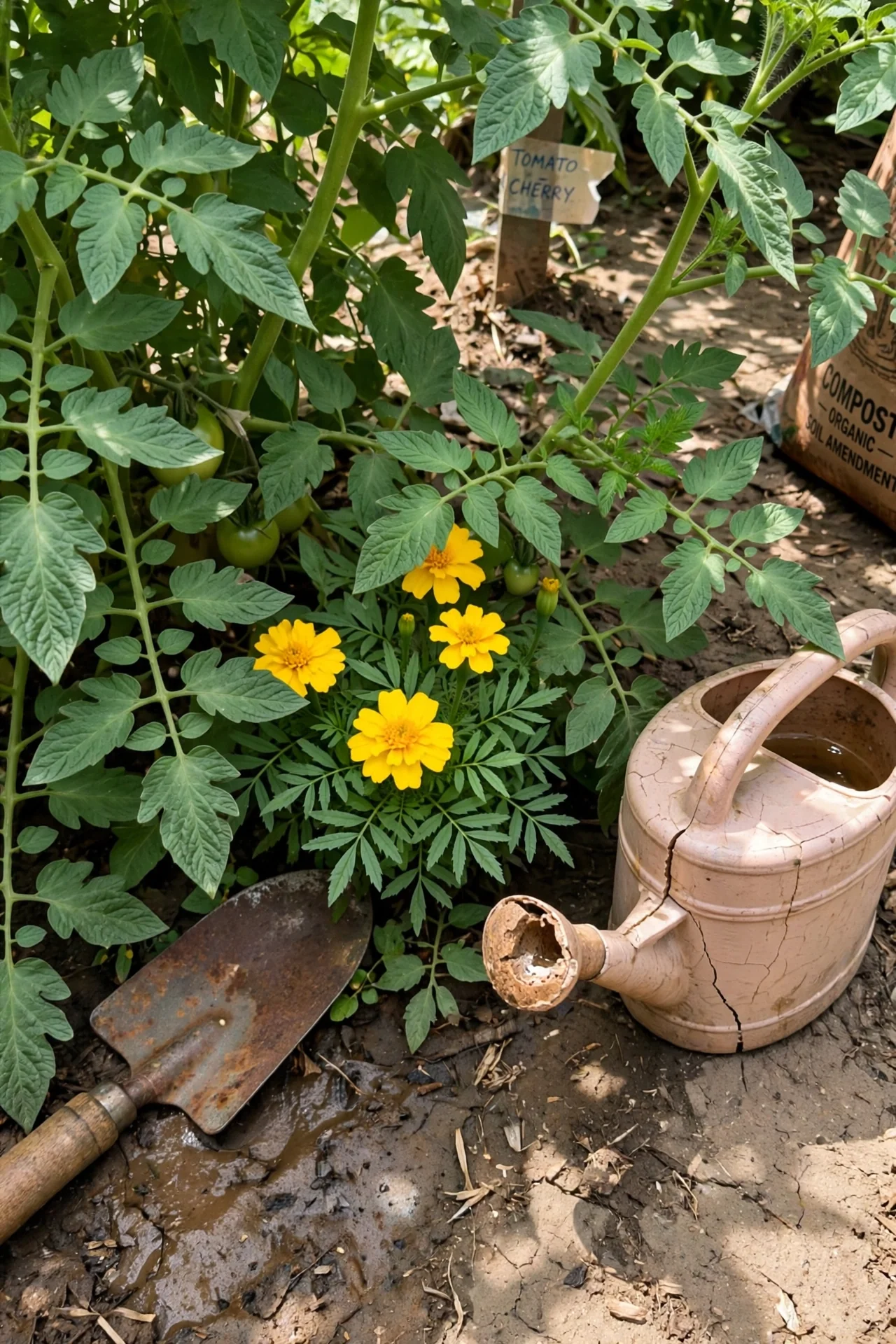
Use it when: You are designing or renovating planting beds and want a low-effort, season-long deterrent layer. French marigolds (Tagetes patula) suppress root-knot nematodes through root exudates. Sweet alyssum (Lobularia maritima) attracts hoverflies whose larvae consume aphids.
Skip it when: Pest pressure is already severe. Companion planting is preventive, not curative. A cabbage already infested with loopers needs intervention, not a marigold planted next to it.
Edge case: Some companion plants, like fennel and dill, attract both beneficials and pest species. Use them as trap crops at the garden perimeter, not interplanted with your main crop.
3. Physical Barriers and Row Covers
Best for: Branch 1
What they are: Lightweight spun-bonded polyester or polypropylene fabrics (commonly sold as floating row cover) placed over crops to physically exclude insects. They work by creating a mechanical barrier that pests cannot penetrate.
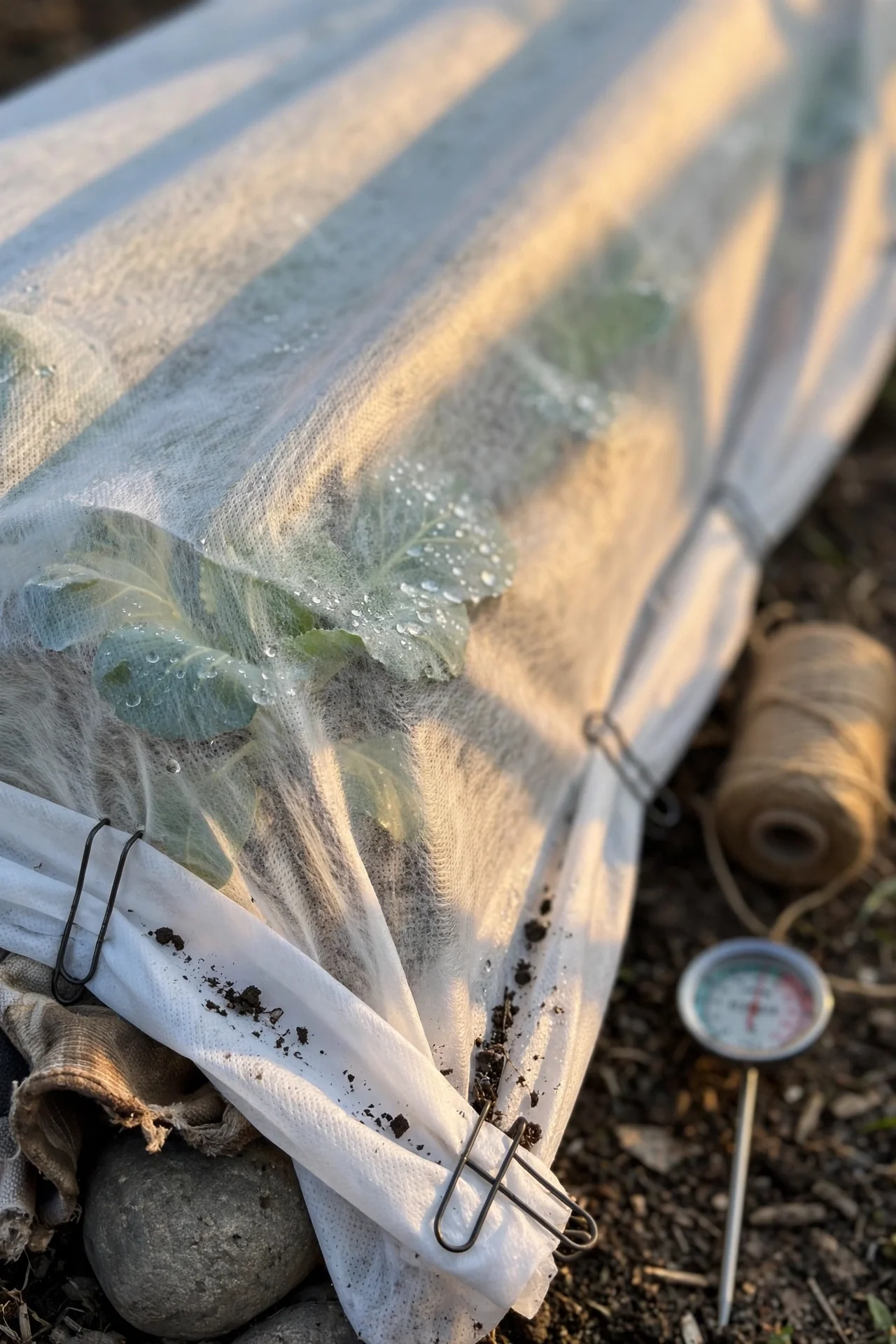
The pollination problem: Row covers also exclude bees. This creates a critical timing constraint. Install covers immediately after transplanting or seeding, before pest insects arrive. Remove them when the first female flowers open and pollination is needed. For crops like squash, cucumbers, and melons that require insect pollination, this means covers stay on roughly 3 to 5 weeks depending on variety and temperature. Crops that do not require pollination (leafy greens, root vegetables, potatoes) can remain covered all season.
Mistake to avoid: Leaving covers on past bloom onset for fruiting crops. The plant will produce flowers that abort without pollination, reducing yield despite healthy foliage.
4. Diatomaceous Earth
Best for: Branch 2
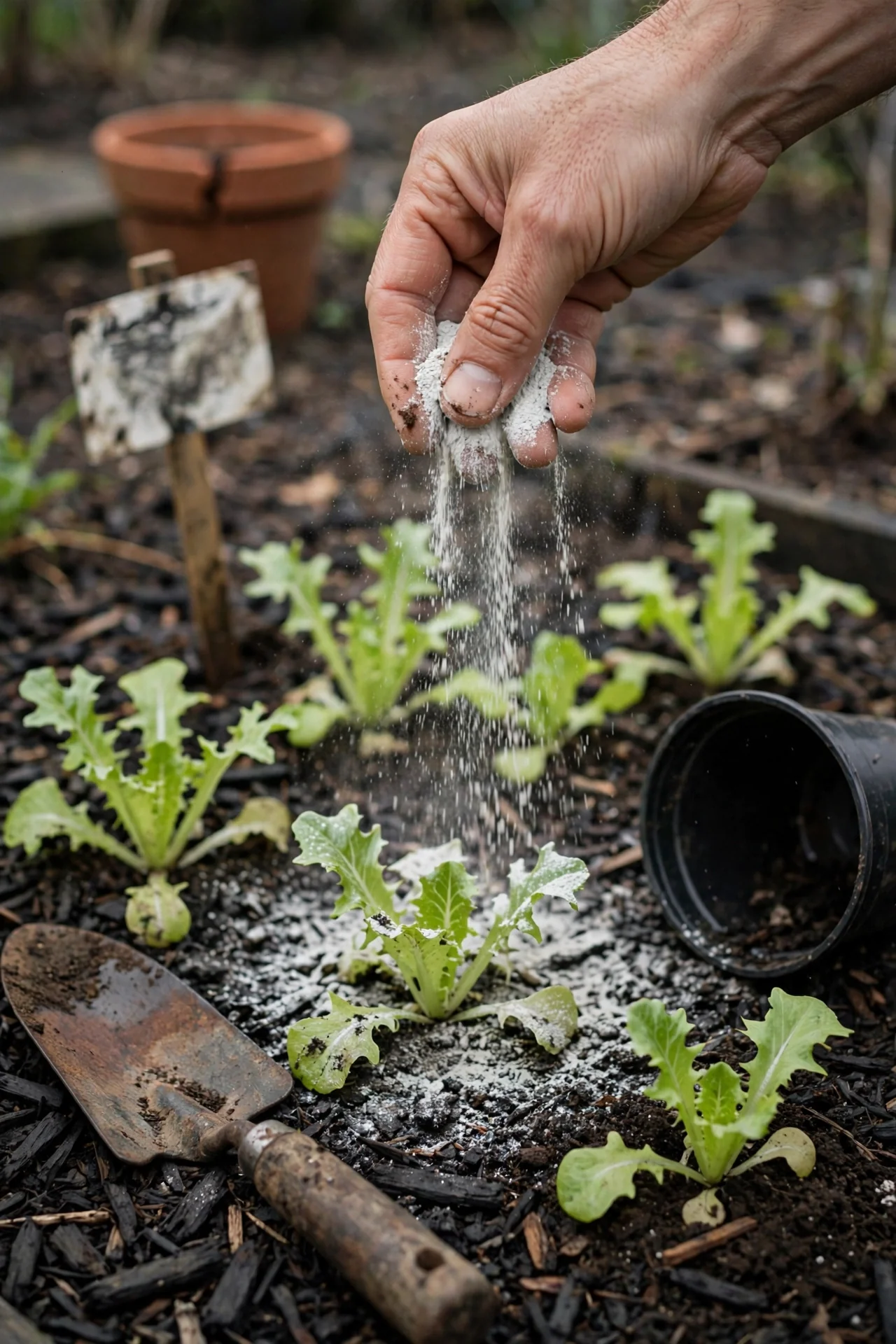
Mechanism: Diatomaceous earth (DE) consists of fossilized diatom skeletons composed of silica. The microscopic sharp edges abrade the waxy cuticle of insects, causing them to lose moisture and die from desiccation. It works only on insects that crawl through it or have direct body contact with the dust.
Bee safety considerations: DE is non-selective and can harm any insect that contacts it, including bees if they land on treated surfaces. The key constraint is application location, not timing. Apply DE only to soil surfaces, stem bases, and non-blooming foliage. Never dust open flowers. Bees primarily visit flowers, not soil or stems, so targeted ground-level application sharply limits exposure. Apply when air is still; wind drift carries DE particles onto blooms.
Reapplication rule: DE loses effectiveness when wet. Reapply after rain, overhead irrigation, or heavy dew. In dry conditions, a single application may remain effective for 7 to 10 days. For complete guidance on safe application techniques, see our detailed article on using diatomaceous earth in the garden.
5. Hand-Picking and Water Blasting
Best for: Branch 2
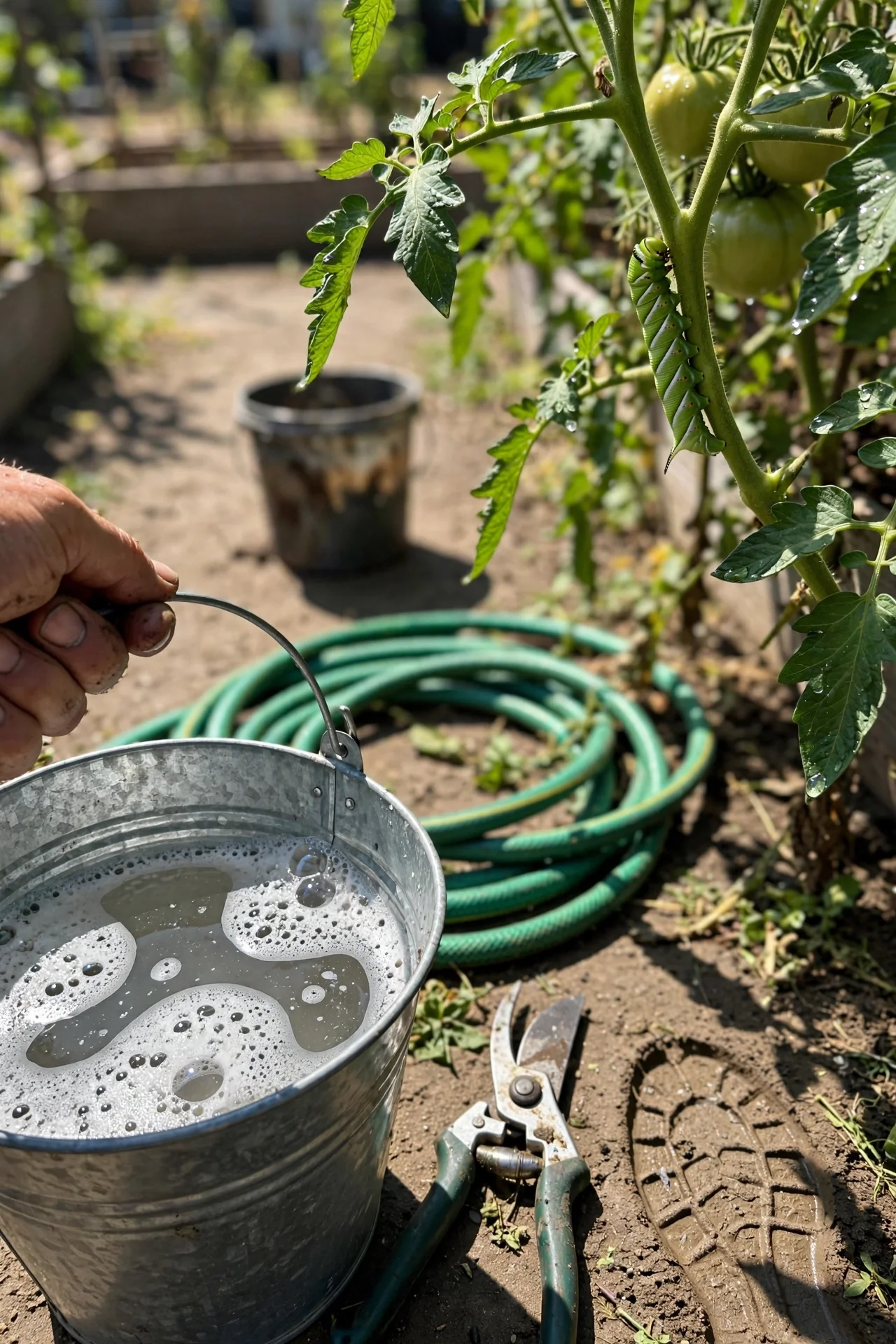
Hand-picking: Walk your garden in early morning when insects are sluggish. Knock Japanese beetles into a bucket of soapy water. Pluck tomato hornworms off by hand (they are large and easy to spot). Dispose in sealed bags. Requires consistency: skip 3 days and a hornworm can defoliate a tomato plant.
Water blasting: A strong jet of water from a hose nozzle dislodges aphids, spider mites, and whiteflies from stems and leaf undersides. The insects are knocked to the ground where most do not reclimb. This method is entirely residue-free and bee safe at any time of day, though morning application allows foliage to dry before evening, reducing disease risk.
6. Sticky Traps and Lures
Best for: Branch 2
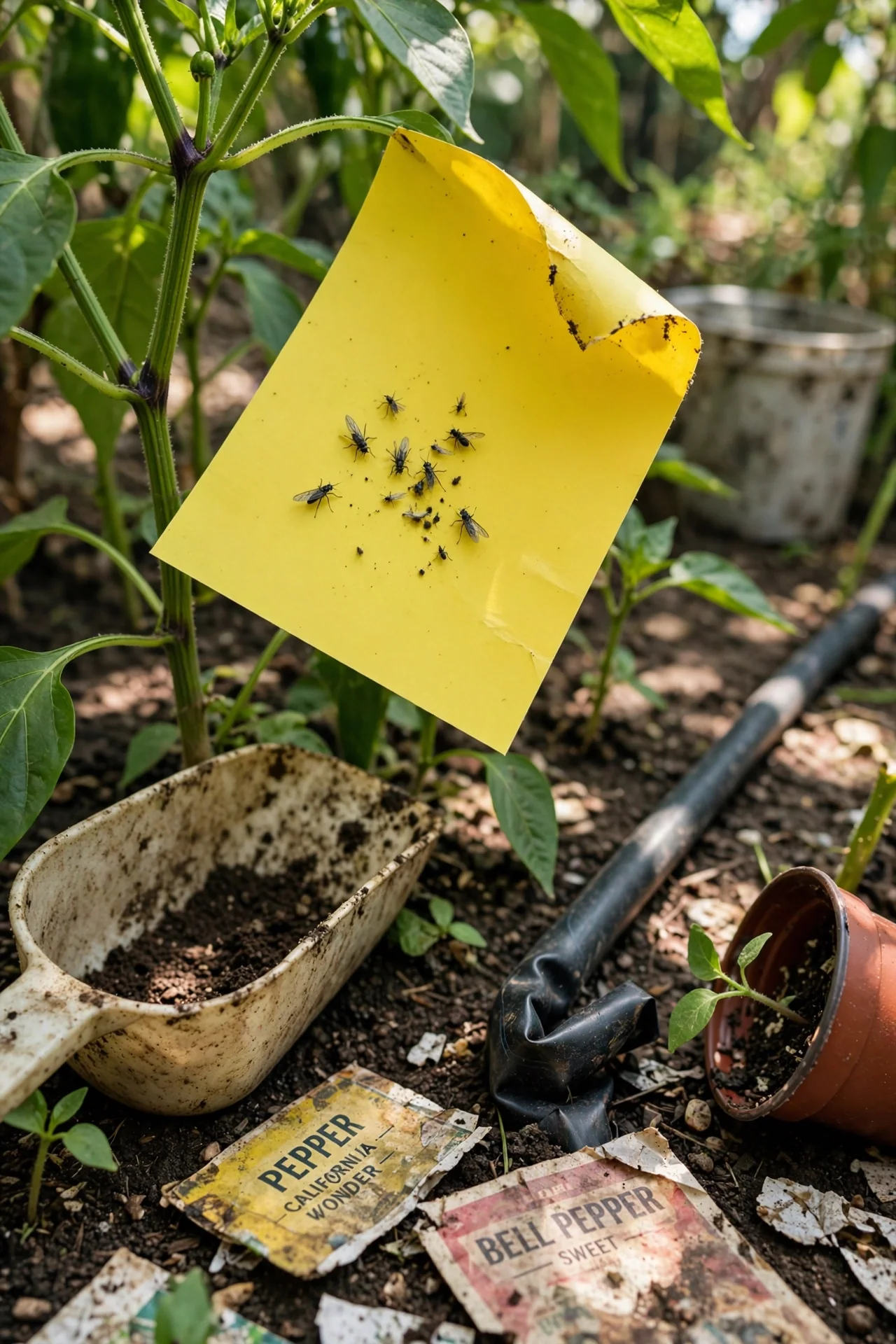
How they work: Yellow or blue sticky cards exploit the visual attraction of certain insects to specific wavelengths. Yellow traps target whiteflies, fungus gnats, and winged aphids. Blue traps target thrips. Pheromone lures added to sticky traps increase specificity for pests like codling moth or cucumber beetle.
Bee safety constraint: Sticky traps are non-selective by design. Bees can and do become trapped if cards are placed near blooming plants. The mitigation is placement: position traps at least 3 meters (10 feet) from flowering plants and at crop canopy height, not above it where foraging bees fly. Remove traps during peak bloom periods in nearby crops.
Use traps for monitoring first: Before purchasing lures, deploy plain sticky cards for one week. If trap counts are low, you may not need to escalate to pheromone-based trapping at all.
7. Horticultural Oil
Best for: Branch 3
What it is: Highly refined petroleum oil or plant-derived oil (mineral oil, paraffinic oil) that smothers insect eggs, larvae, and soft-bodied adults by coating their breathing pores (spiracles). It works on contact only; there is no residual toxicity once the spray dries.
Application window: Apply only in the dormant season or during the growing season when temperatures stay between 4 degrees C and 29 degrees C (40 degrees F and 85 degrees F). Above 32 degrees C (90 degrees F), horticultural oil can cause phytotoxicity, burning leaf tissue regardless of whether bees are present. Below 4 degrees C, the emulsion breaks down and coverage becomes uneven. Apply in late evening or pre-dawn, and never when rain is forecast within 24 hours.
Dilution: Dormant applications typically use a 2 to 4 percent solution (5 to 10 tablespoons per gallon of water). Growing-season applications use a lighter 1 to 2 percent solution (2.5 to 5 tablespoons per gallon). Always verify against the specific product label; oil concentrations vary by manufacturer and crop. For a complete breakdown of seasonal use, read our guide on horticultural oil application and timing.
8. Insecticidal Soap
Best for: Branch 3
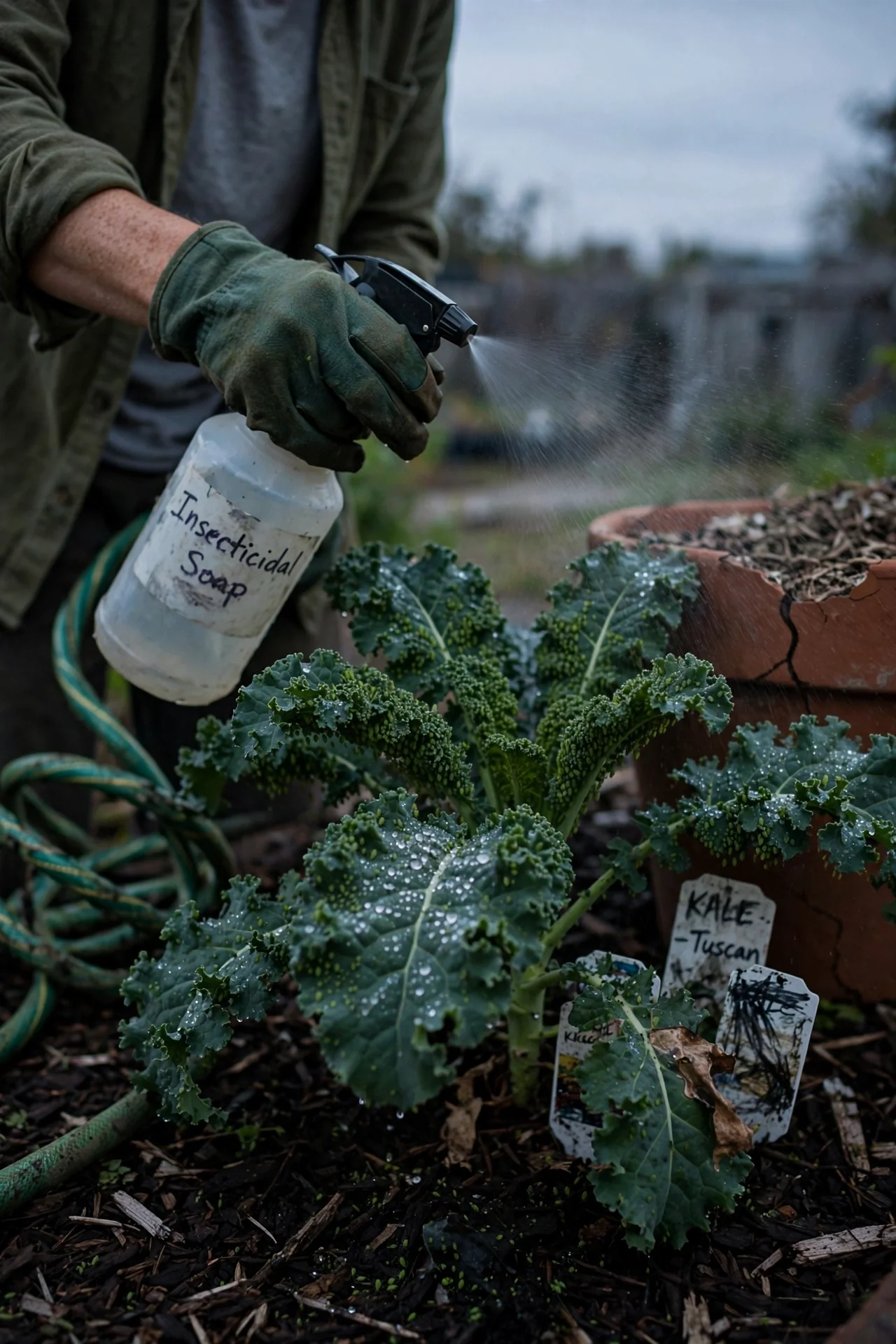
Active ingredient: Potassium salts of fatty acids, typically at 1 to 2 percent concentration in ready-to-use formulations or 47 to 50 percent in concentrates requiring dilution. It disrupts cell membranes of soft-bodied insects on contact. Once dry on the leaf surface, it has no insecticidal activity. This is the single most important bee safety feature: toxicity exists only while the spray is wet. Apply after sunset, and by the time bees resume foraging the following morning, the residue is inert.
Key constraint: Insecticidal soap kills only what it contacts directly. It provides zero residual protection. If a new wave of aphids arrives 48 hours after spraying, they will be unaffected. This is why reapplication every 5 to 7 days is often necessary during active infestations. See our complete guide on using insecticidal soap for garden pests.
9. Neem Oil
Best for: Branch 3
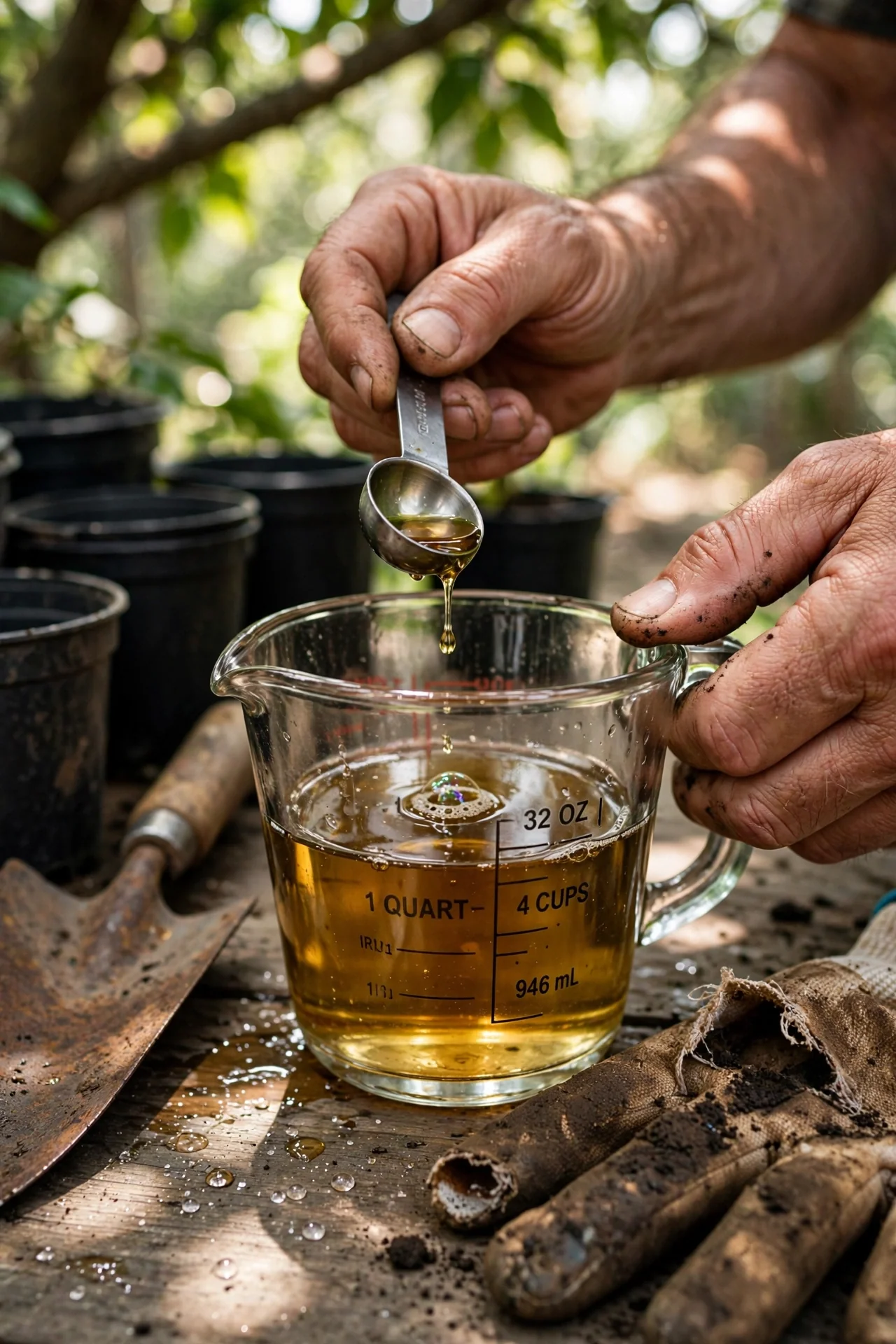
Dual action: Cold-pressed neem oil contains azadirachtin, which acts as an antifeedant (pests stop eating) and a growth regulator (larvae fail to molt). Clarified hydrophobic extract of neem oil works primarily as a contact suffocant, similar to horticultural oil. Both forms degrade rapidly under UV light, with a half-life on leaf surfaces of roughly 1 to 2.5 days.
Timing rule: Neem oil is classified as moderately toxic to bees by the University of California IPM program when wet. Apply only during late evening, night, or early morning when bees are not foraging, and avoid spraying open blooms entirely. A standard dilution for foliar application is 1 to 2 teaspoons of neem oil per quart of water (roughly 5 to 10 mL per liter), emulsified with a few drops of mild liquid soap. For complete mixing instructions and pest-specific guidance, see our article on neem oil for insect control.
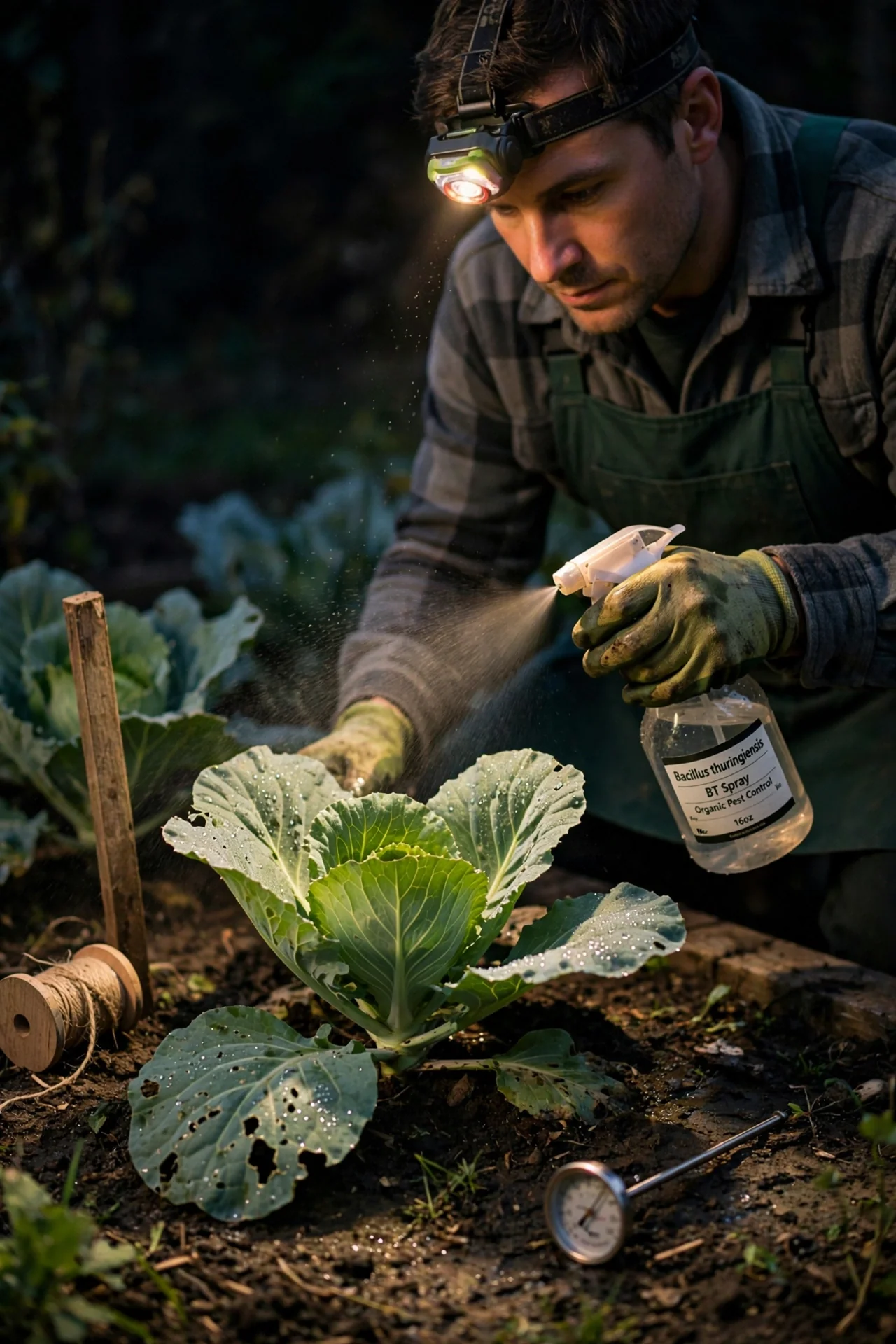
10. Bacillus thuringiensis (Bt)
Best for: Branch 3
What makes it uniquely bee safe: Bacillus thuringiensis subspecies kurstaki (Btk) produces a crystalline protein toxin that is activated only in the alkaline gut environment of Lepidoptera (moth and butterfly) larvae. Bees have acidic guts, so the toxin never activates. Btk is harmless to bees at any concentration and any time of day. It is one of the few insecticides approved for application during bloom by organic certification programs.
What it controls: Cabbage worms (imported cabbageworm, cabbage looper, diamondback moth), tomato hornworms, tent caterpillars, gypsy moth larvae, and other leaf-eating caterpillars. It does not control sawfly larvae (which are not Lepidoptera), beetle larvae, or any sucking insects.
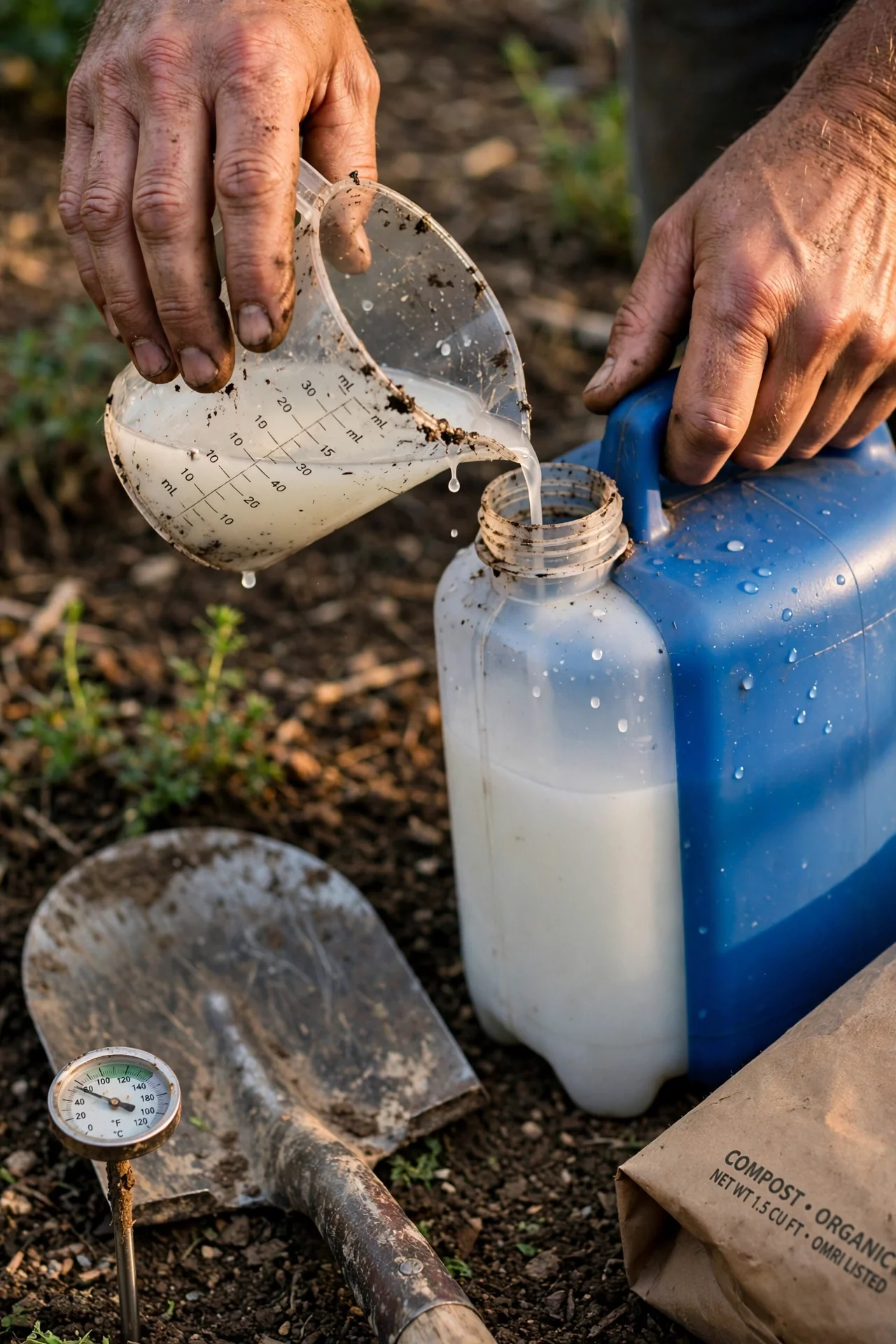
Application precision: Bt degrades in sunlight within 1 to 3 days. Apply in late afternoon or evening so larvae ingest it during their peak feeding period (dusk and night for many species). Mix at a rate of 1 to 2 teaspoons per gallon of water depending on formulation. Thorough coverage of leaf undersides is essential because caterpillars often feed there. For everything you need to know about timing and target pests, read our dedicated guide on using Bt for caterpillar control.
11. Kaolin Clay Spray
Best for: Branch 3
How it works: Kaolin clay (sold as Surround WP and similar products) forms a white mineral particle film on leaves and fruit. Insects cannot recognize the coated plant as a host, and those that land become irritated by the particles and leave. It is a repellent and physical barrier, not a toxin.
Application rate: Mix 0.25 to 0.5 pounds per gallon of water (roughly 30 to 60 grams per liter). Apply as a slurry using a pump sprayer with continuous agitation to prevent settling. Reapply every 7 to 21 days depending on rain and new growth. Do not apply during bloom; the white film can interfere with bee navigation and flower recognition.
12. Sulfur Spray
Best for: Branch 3
Primary use: Sulfur is predominantly a fungicide for powdery mildew, rust, and certain leaf spots, but it also suppresses mite populations. Its insecticidal effect is mild and primarily through vapor action (sulfur volatilizes at temperatures above roughly 21 degrees C or 70 degrees F).
Bee safety profile: Sulfur has low acute toxicity to bees. However, older research indicates that flowers of sulfur can repel bees from treated areas for up to 48 hours after application. For this reason, apply sulfur only when plants are not in bloom and never when temperatures exceed 27 degrees C (80 degrees F), as phytotoxicity risk rises sharply above this threshold. Avoid applying within 2 weeks of a horticultural oil spray; the combination can damage foliage.
Edge case: Lime sulfur (calcium polysulfide) is a different product with higher bee toxicity. Do not assume all sulfur formulations are equivalent. Check the label for the specific active ingredient.
Starter Stack (What to Choose First)
Branch 1 Starter: Prevention Ecosystem
Pair companion planting with beneficial insects. Establish French marigolds, sweet alyssum, and dill as permanent habitat strips along bed edges. Two weeks after flowering begins, release a mixed batch of lacewing eggs and lady beetles. The flowering plants provide nectar to sustain adult beneficials; the released larvae handle active pest colonies. Estimated cost: $25 to $45 for seeds and beneficial insect shipment. Time investment: 30 minutes for initial planting, 10 minutes for insect release, then virtually hands-off for the remainder of the season. This stack works best for gardens of 100 square feet or larger where a permanent beneficial habitat is feasible.
Branch 2 Starter: Physical Intervention Duo
Pair diatomaceous earth with sticky traps. Apply a light dusting of DE around the base of all susceptible plants and on soil surfaces. Place one yellow sticky trap per 50 square feet at canopy height, positioned away from any blooming plants. The DE handles crawling pests; the traps capture flying pests and provide ongoing monitoring data so you know if pest pressure is building. Estimated cost: $15 to $25 for a 4-pound bag of DE and a pack of 10 sticky traps. Time investment: 15 minutes for initial setup, then 5 minutes twice weekly to check traps and reapply DE after rain. Expect to replenish DE two to three times per month during wet periods.
Branch 3 Starter: Evening Spray Trio
Pair insecticidal soap with Bacillus thuringiensis, backed by horticultural oil for dormant-season use. During the growing season, identify your pest: if you see soft-bodied insects (aphids, whiteflies, mites), use insecticidal soap. If you see caterpillars or leaf-rolling damage, switch to Bt. Do not tank-mix them; separate applications 48 hours apart prevent any interaction. In late winter before bud break, apply horticultural oil as a single dormant spray to smother overwintering eggs. Estimated cost: $35 to $55 for all three products. Time investment: 20 minutes per application session, with sessions needed every 5 to 10 days during peak pest season. The non-negotiable rule: all spraying must finish before sunrise or begin after sunset.
When This Won’t Work
Failure condition 1: Systemic infestations in large, dense plants. When squash bugs or vine borers have penetrated deep into thick stems, or when a large tomato plant is hosting dozens of hidden hornworms, surface-level interventions lose effectiveness. Contact sprays cannot reach insects inside stems, and hand-picking becomes impractical when pest density exceeds roughly one insect per leaf. The signal is wilting despite adequate water: the pest is feeding internally. At this stage, you may need to remove and bag the infested plant entirely rather than escalate to a stronger chemical. Composting infested material risks spreading the pest; dispose of it in sealed bags through municipal waste.
Failure condition 2: You cannot commit to the application window. Every spray-based method in this guide depends on evening or pre-dawn application. If your schedule does not permit this, for reasons of work, travel, or physical limitation, the safety margin evaporates. Spraying insecticidal soap at 2 p.m. on a sunny day not only risks bee exposure but also increases the likelihood of leaf burn. In this scenario, revert to Branch 1 or Branch 2 methods exclusively. Physical barriers, hand-picking, and beneficial insects require no timing precision relative to bee activity.
Choosing the Right Option for Your Situation
Budget threshold
If your total pest control budget for the season is under $20, focus on Branch 1 and Branch 2 options. Companion planting seeds, one bag of diatomaceous earth, and a pack of sticky traps can all be acquired within this range. Branch 3 spray products cost more upfront but last multiple seasons if stored correctly (cool, dry, out of direct sunlight). Concentrates almost always cost less per application than ready-to-use spray bottles.
Time threshold
If you can dedicate more than 30 minutes per week to pest management, Branch 2 hand-picking and monitoring will yield the most precision. If you can spare 15 minutes per week, Branch 3 evening spraying is viable. If you realistically will visit the garden only on weekends, choose Branch 1 methods; they tolerate neglect better than any spray schedule.
Technical constraint: water quality
Hard water (high calcium and magnesium content) reduces the effectiveness of insecticidal soap and can cause neem oil emulsions to break down. If your water source is hard, use distilled water for mixing sprays, or add a water conditioner. You can test your water hardness with an inexpensive aquarium test strip; readings above 150 ppm (moderately hard) warrant using distilled water for spray mixing.
Yes/No Checklist
Can you apply sprays exclusively after sunset or before sunrise? Yes / No
Are you willing to tolerate some cosmetic leaf damage as part of a balanced ecosystem? Yes / No
Is your water hardness below 150 ppm, or can you access distilled water for mixing? Yes / No
Do you have at least 15 minutes per week to monitor plants for pest activity? Yes / No
Expert Q&A
Does neem oil kill bees on contact?
Neem oil can kill bees if sprayed directly onto them while wet. The risk drops sharply once the spray dries on foliage, which typically takes 30 minutes to 2 hours depending on temperature and humidity. The University of California classifies neem oil as moderately toxic to bees and recommends application only during late evening, night, or early morning when bees are not foraging.
What time of day are bees least active in the garden?
Honey bee foraging activity peaks between roughly 9 a.m. and 3 p.m. when temperatures are above 13 degrees C (55 degrees F). Bees are inside the hive at night and during heavy rain. The safest application window is after sunset and before sunrise. Early morning (pre-7 a.m.) is a secondary window but carries more risk because some bees begin foraging at first light.
Can insecticidal soap harm bees if it drifts onto flowers?
Insecticidal soap is toxic to bees only while wet. Once it dries on the leaf surface, which occurs within 30 minutes to 3 hours depending on conditions, it becomes inert. If you spray in the evening after bees have returned to the hive, the residue is dry and harmless by morning. The primary risk is direct contact with wet spray, not dried residue.
Are homemade soap sprays safer for bees than commercial insecticidal soap?
No. Homemade soap sprays using dish detergent often contain degreasers, fragrances, and surfactants not tested on plants or insects. They can be more phytotoxic (leaf-burning) and their effect on bees is unpredictable. Commercial insecticidal soaps use potassium salts of fatty acids at known concentrations, and their bee toxicity profile is documented. Commercial formulations are the safer choice for both plants and pollinators.
How soon after spraying Bt can bees safely visit treated plants?
Immediately. Bacillus thuringiensis subspecies kurstaki is harmless to bees at any time, wet or dry. The protein toxin it produces requires an alkaline gut environment found only in Lepidoptera larvae. Bee guts are acidic, so the toxin never activates. Bt is approved for use during bloom by organic certification programs, making it the strongest candidate for caterpillar control when plants are flowering.
Conclusion
The single factor that separates bee safe pest control from bee harmful pest control is not the product on the shelf. It is the clock on the wall. Every method in this guide can be made safer or more dangerous by when and where you apply it. The number one mistake gardeners make is reaching for a spray first and thinking about timing second.
If you take one action after reading this, make it an evening walk through your garden with a flashlight. Identify which pests are actually present, on which plants, and at what density. Then choose the lowest-effort option that matches your situation. For a ready-to-use spray option that integrates well with the timing principles in this guide, see our article on organic aphid spray formulations and application.