
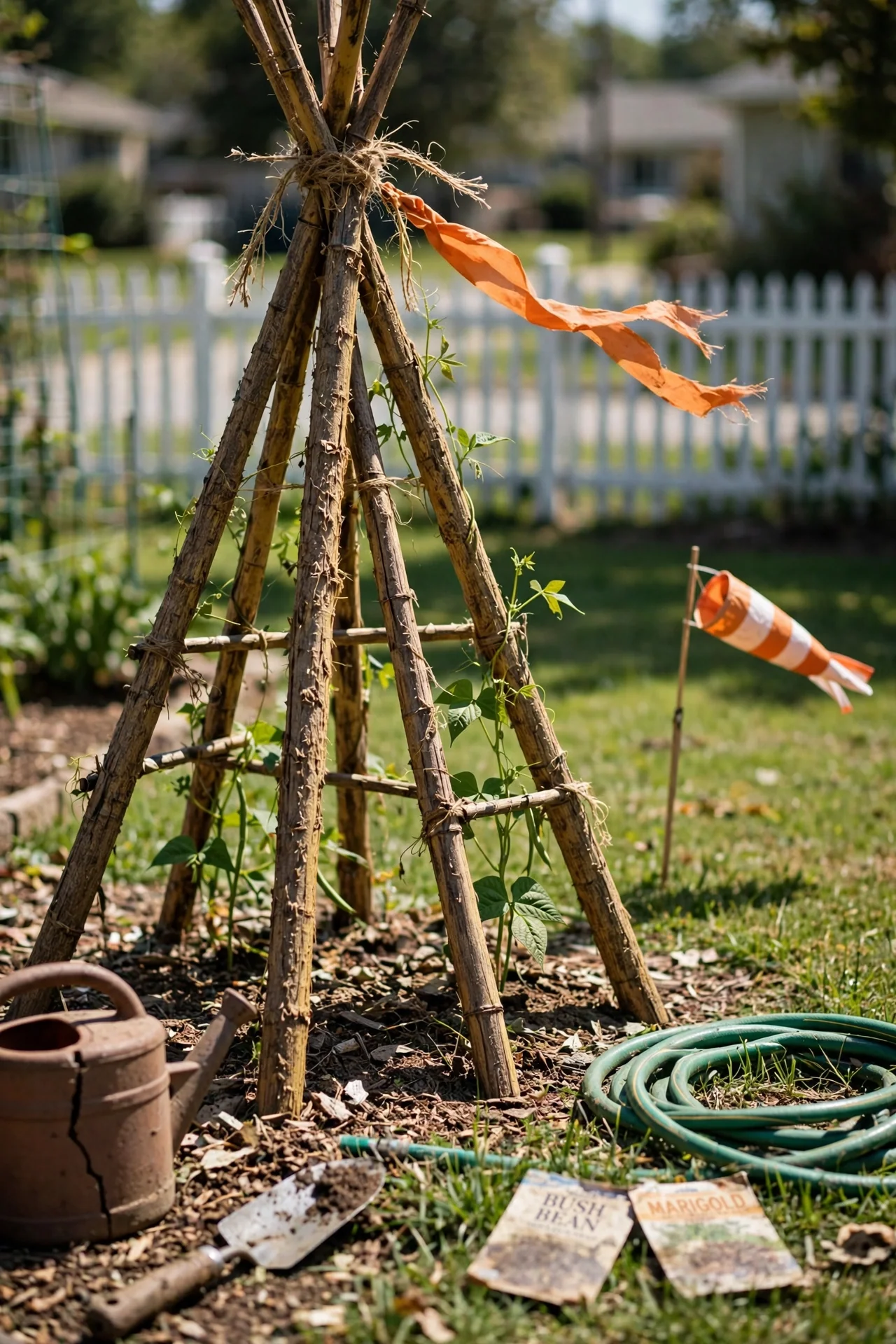
A bean teepee trellis is often presented as a one-size-fits-all project: grab some poles, tie them at the top, plant, and wait. The reality is more nuanced. A teepee that thrives in a sheltered urban courtyard can collapse in a windy suburban plot. One that supports lightweight snap beans beautifully will buckle under a heavy crop of runner beans. The variable most guides omit is your specific site conditions: wind exposure, soil type, and the mature weight of the bean variety you are growing.
This guide approaches the bean teepee not as a single DIY project but as a category of structures. It includes freestanding teepees, reinforced high-wind designs, container-adapted builds, and material variations from bamboo to metal. It excludes flat panel trellises and arch tunnels except where they inform a teepee decision. Each option is matched to a set of measurable growing conditions so you can choose with confidence.
By the end, you will know exactly which teepee configuration suits your space, how much ongoing effort the structure demands, and what backup options exist if your first choice is a mismatch. The framework is built around wind speed, soil anchoring depth, and the climbing habit of your beans, rather than generic material lists.
Bottom line: The best bean teepee trellis is the one engineered for your wind exposure, soil type, and bean variety, and this guide will help you find it.
The Yield Grid Decision Grid
Choose your branch based on the three factors that most determine teepee longevity: wind exposure, soil anchoring potential, and bean variety weight.
Branch 1: Sheltered Zone, Loose or Sandy Soil, Lightweight Beans
You garden in a courtyard, balcony, or fenced yard. Wind gusts rarely exceed 15 mph, and your soil drains quickly but needs help holding poles. You grow snap beans or filet beans that mature under 6 feet. Your priority is portability and minimal soil disturbance.
Recommended: Items 1, 3, 4 below.
Branch 2: Moderate Exposure, Loam or Clay, Midweight Beans
You have occasional wind gusts up to 25 mph and soil that holds poles well when dug deep enough. Your beans reach 7 to 8 feet and include varieties like Kentucky Wonder or Blue Lake. You need a balance of stability and accessibility for harvesting.
Recommended: Items 2, 5, 8, 9 below.
Branch 3: High Wind, Compacted or Rocky Soil, Heavy Runner Beans
You garden on a hilltop, open allotment, or rooftop with gusts exceeding 25 mph. Soil is dense or rocky, making digging labor-intensive. Your beans are aggressive climbers that produce heavy biomass (runner beans, yardlong beans). Your structure must resist both overturning and snapping at the base.
Recommended: Items 6, 7, 10, 11 below.
For a broader look at vertical growing systems that work alongside teepees, see our vertical vegetable garden planning guide.
Quick Comparison Table
| Option | Key Mechanism | Best For | Decision Grid Branch | Effort Score (1–5) |
|---|---|---|---|---|
| 1. Classic Bamboo Teepee | 6–8 canes, twine-lashed apex | Sheltered containers and raised beds | Branch 1 | 2 |
| 2. Jute-Wrapped Hybrid | Bamboo frame with continuous jute spirals | Visual focal points, kid-friendly spaces | Branch 1, 2 | 3 |
| 3. Center-Post Reinforced Teepee | Central vertical pole reduces splay | Loose soil, snap beans | Branch 1 | 2 |
| 4. Container-Optimized Teepee | Shortened poles (4–5 ft), weighted base | Balconies, patios, renters | Branch 1 | 1 |
| 5. Three-Pole Minimalist | Triangular base with guy lines | Tight spaces, fast-growing bush beans | Branch 2 | 2 |
| 6. Concrete-Bucket Anchored Teepee | Posts set in poured concrete in buckets | Rooftops, hard surfaces, high wind | Branch 3 | 1 |
| 7. Steel Conduit Teepee | Galvanized pipes, threaded couplings | Heavy runner beans, long-term set-ups | Branch 3 | 2 |
| 8. A-Frame-Teepee Hybrid | Two angled planes joined at ridge | Wider beds, double-row planting | Branch 2 | 2 |
| 9. Adjustable-Height Modular Teepee | Interlocking pole segments with pins | Gardeners testing varieties, shared plots | Branch 2 | 3 |
| 10. Guy-Line Triangulated Teepee | 3 external anchors with ratchet tensioners | Exposed allotments, hilltops | Branch 3 | 4 |
| 11. Heavy-Duty Timber Teepee | 4×4 posts, through-bolted apex | Perennial setups, heavy crops | Branch 3 | 1 |
| 12. Living Willow Teepee | Fresh willow rods that root in place | Long-term beds, educational gardens | Branch 3 | 2 |
1. Classic Bamboo Teepee
Best for: Branch 1
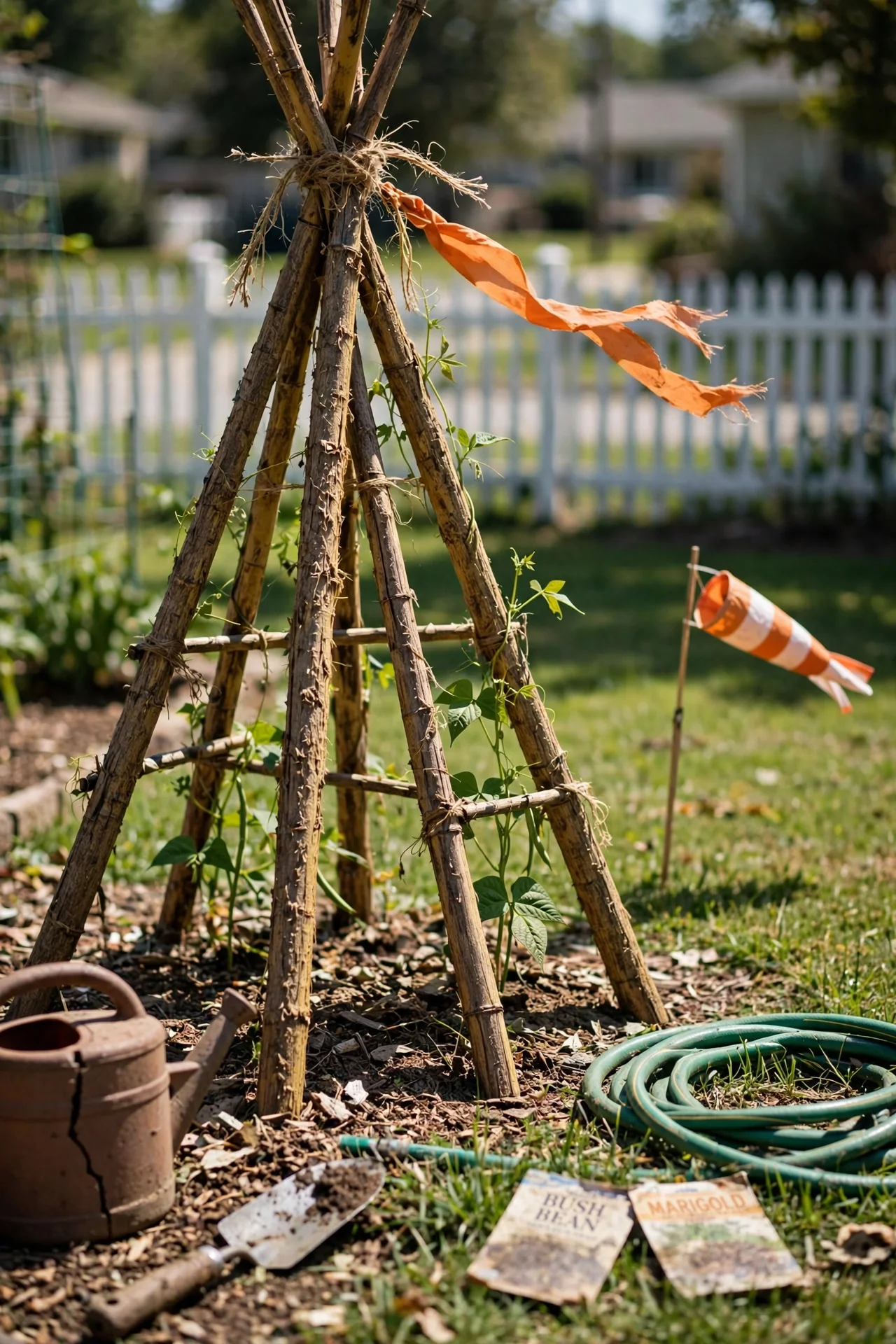
The bamboo teepee is the default for good reason. Six to eight canes, each 7 to 8 feet long, are pushed 6 to 8 inches into prepared soil and lashed together at the apex with weather-resistant twine. The geometry distributes load evenly across the circle, and the conical shape sheds moderate wind rather than resisting it face-on. What many guides omit is the anchor depth requirement: in sandy or loose soil, 6 inches is insufficient. You need 10 to 12 inches to prevent the poles from working loose during wet-dry cycles, which cause soil expansion and contraction around the smooth bamboo surface.
A subtle but important detail is cane selection. Choose canes with diameters between 1 and 1.5 inches at the base. Thinner canes flex too much under load, while thicker ones are harder to lash securely and can crack when force is applied at the apex tie. If you have access to a DIY pallet vertical garden, you can repurpose sturdy pallet slats as temporary stakes to brace the teepee during the first few weeks of growth. The biggest mistake with this design is tying the apex too low, which creates a narrow cone that funnels wind downward and loosens the anchors rather than shedding it.
2. Jute-Wrapped Hybrid
Best for: Branches 1 and 2
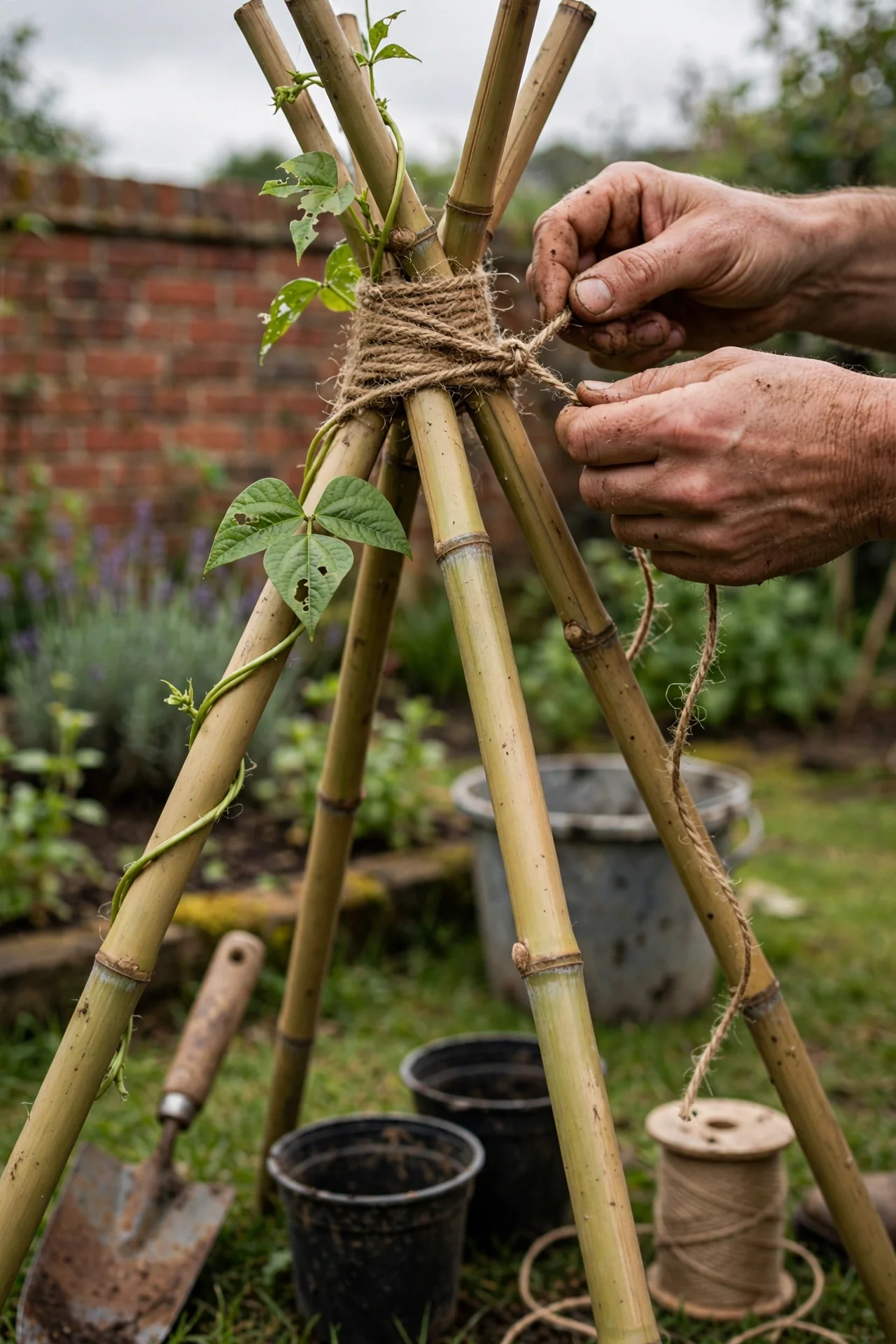
This variant adds continuous spirals of jute or sisal twine wrapped around the bamboo frame from base to apex. The horizontal wrapping provides climbing nodes for tendrils that might otherwise slip on smooth bamboo. The trade-off is that jute degrades over a single season in wet climates, requiring a mid-season rewrap in zones with more than 30 inches of annual rainfall. Use this when you want a denser visual screen or are growing beans that need extra grip, such as yardlong beans.
3. Center-Post Reinforced Teepee
Best for: Branch 1
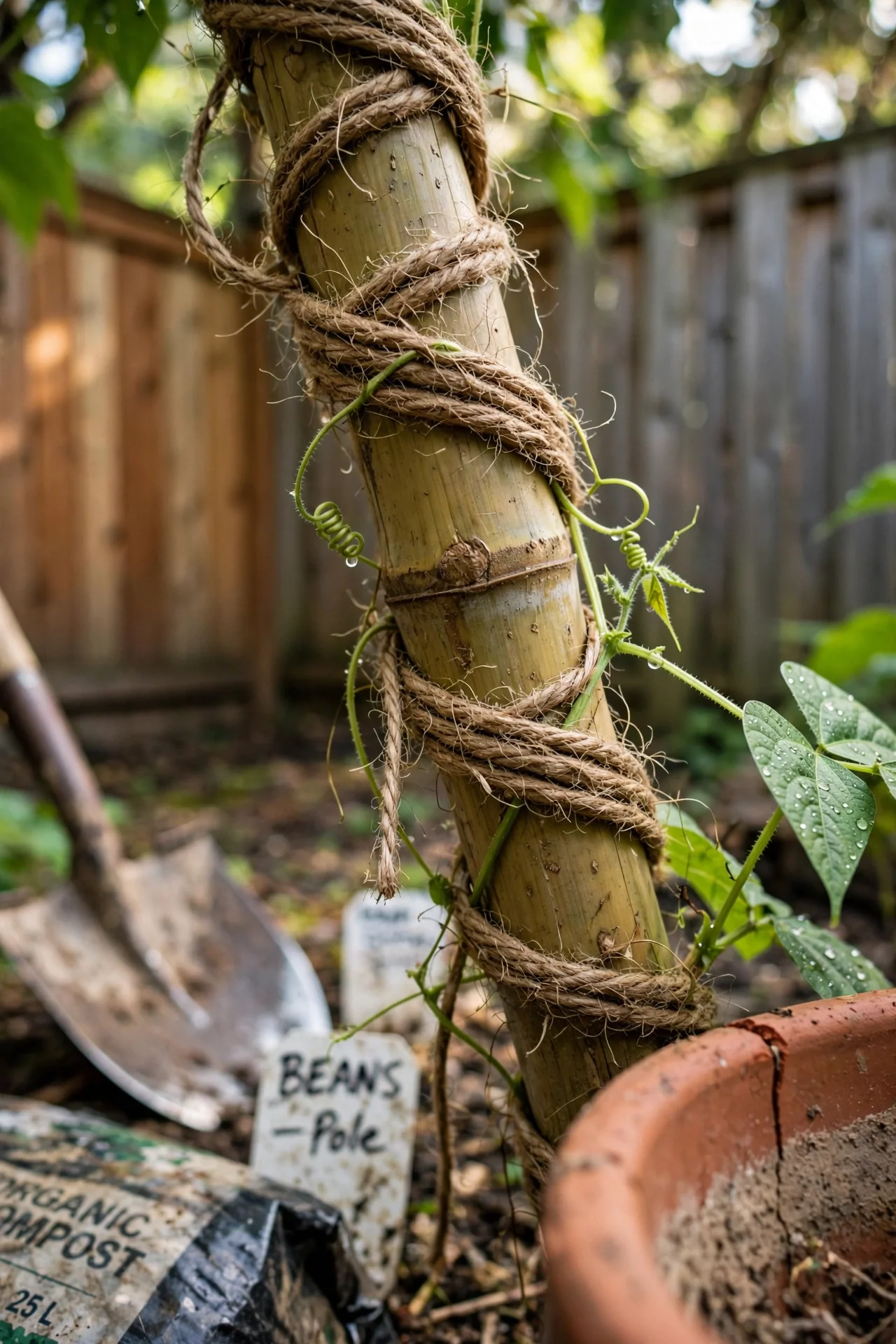
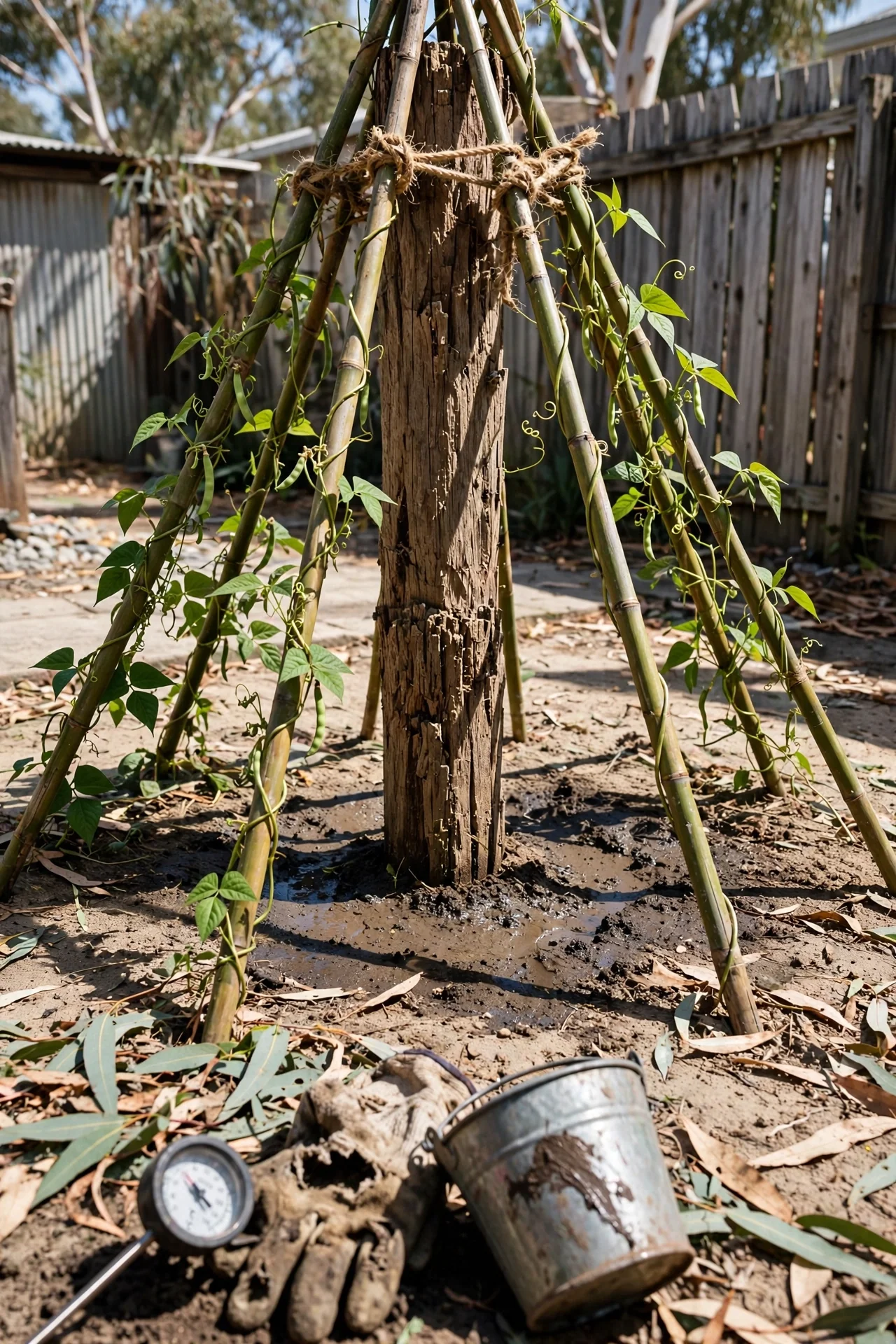
A single vertical post driven into the center of the teepee circle provides a rigid spine that reduces the outward splay force on the outer poles. When beans climb and load weight asymmetrically (which they always do: the sun-facing side grows faster), the outer canes want to pull inward. The center post resists this. This design is particularly effective for loose or sandy soils where outer poles are harder to anchor deeply. Drive the center post 18 to 24 inches deep, and lash each outer cane to it at two points: once at the apex and once at about 4 feet from the ground. This triangulation technique is borrowed from pea trellis construction, where lateral stability is critical for tall, narrow frames.
4. Container-Optimized Teepee
Best for: Branch 1
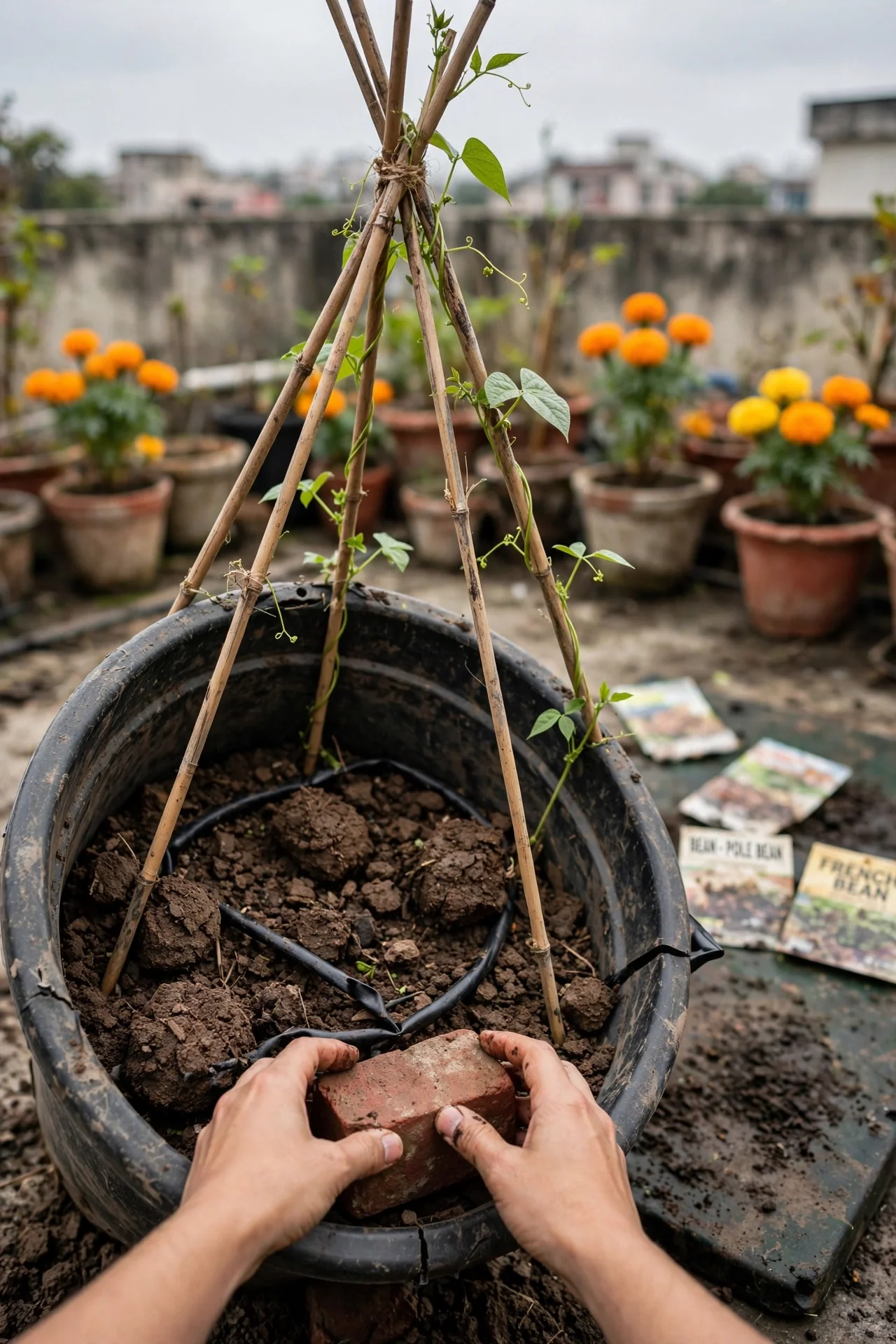
When you are gardening on a balcony, patio, or rental property, you need a teepee that fits a container and can be moved. Use 4- to 5-foot bamboo or fiberglass poles set inside a pot at least 16 inches in diameter and 14 inches deep. The weight of the potting mix anchors the poles, but you must also place a brick or concrete paver at the bottom of the pot below the soil to lower the center of gravity. Without ballast, a top-heavy teepee in a plastic pot will tip in anything stronger than a mild breeze. This design pairs well with a vertical herb garden at the base, creating a multi-layer container growing system that maximizes limited square footage.
5. Three-Pole Minimalist
Best for: Branch 2
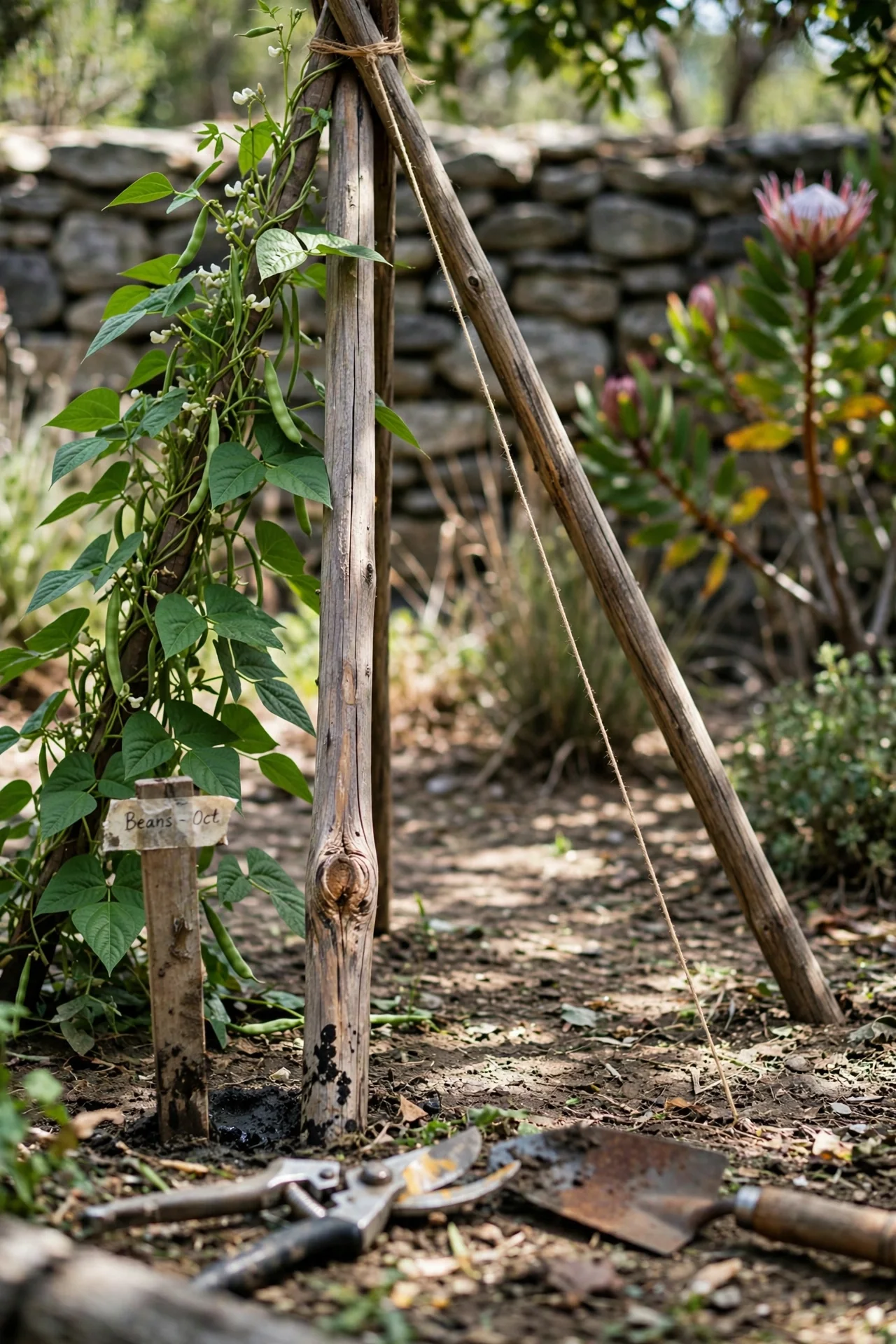
A three-pole teepee uses the fewest materials and takes up the smallest footprint, making it ideal for tight beds or intercropping. The triangular base is inherently stable, but the reduced number of climbing surfaces means you can plant only one or two bean plants per pole before they compete for space. Add guy lines from the apex to ground stakes if the site gets any wind at all; three points of contact at ground level are not enough to resist twisting forces.
6. Concrete-Bucket Anchored Teepee
Best for: Branch 3
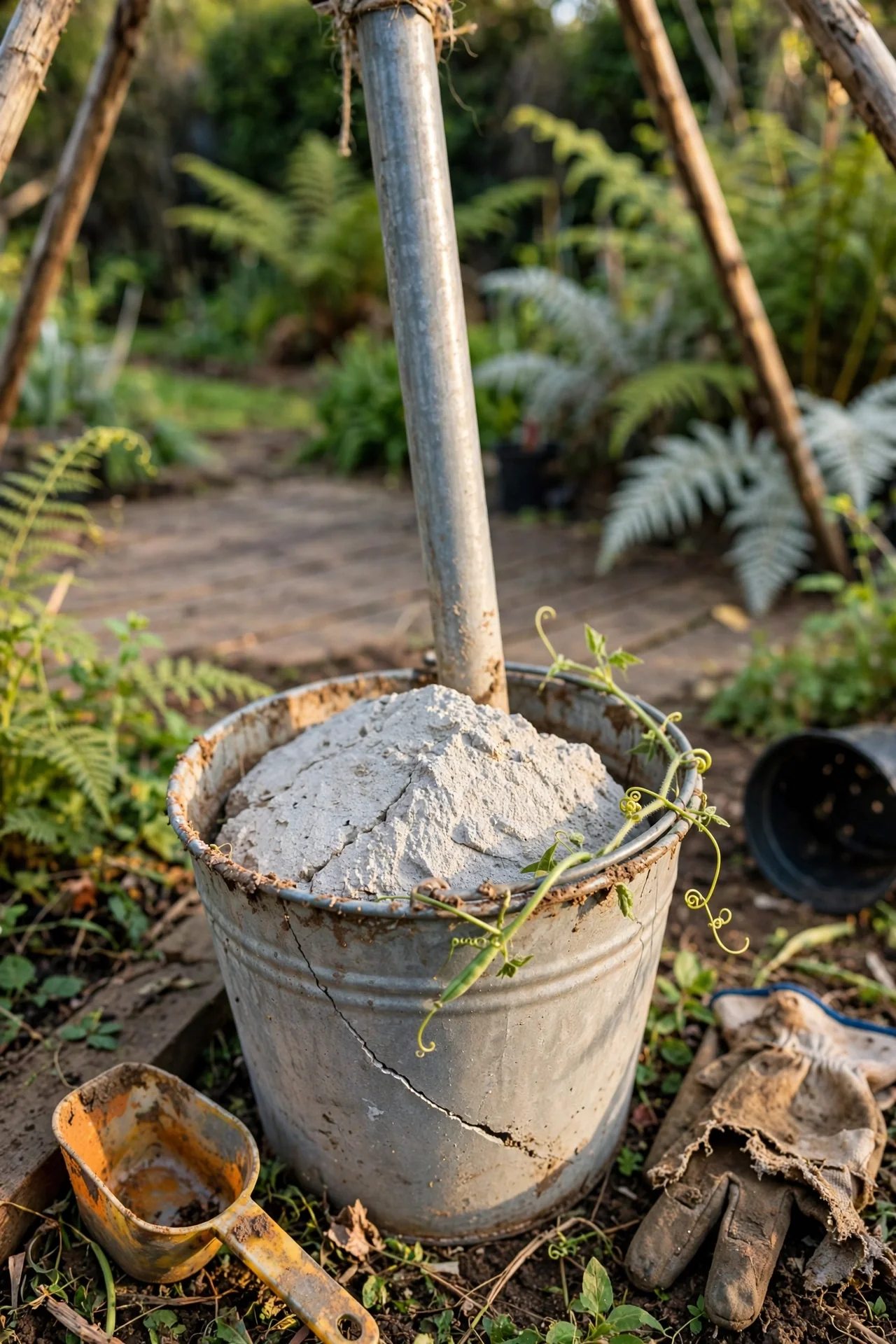
For rooftops, paved courtyards, and exposed balconies where digging is impossible and wind is relentless, this design sets each pole in a 5-gallon bucket filled with concrete or sand. The resulting base weighs approximately 60 to 80 pounds per bucket when using concrete, providing ballast that wind cannot overcome. The poles themselves can be bamboo, but metal conduit is better because the concrete-bamboo interface can trap moisture and accelerate rot. Drill drainage holes 2 inches above the bottom of each bucket so water does not pool around the pole base. This method is the only teepee style that can survive hurricane-force gusts without permanent ground anchoring, and it shares principles with vertical strawberry tower construction, where weighted bases solve the same stability problem.
7. Steel Conduit Teepee
Best for: Branch 3
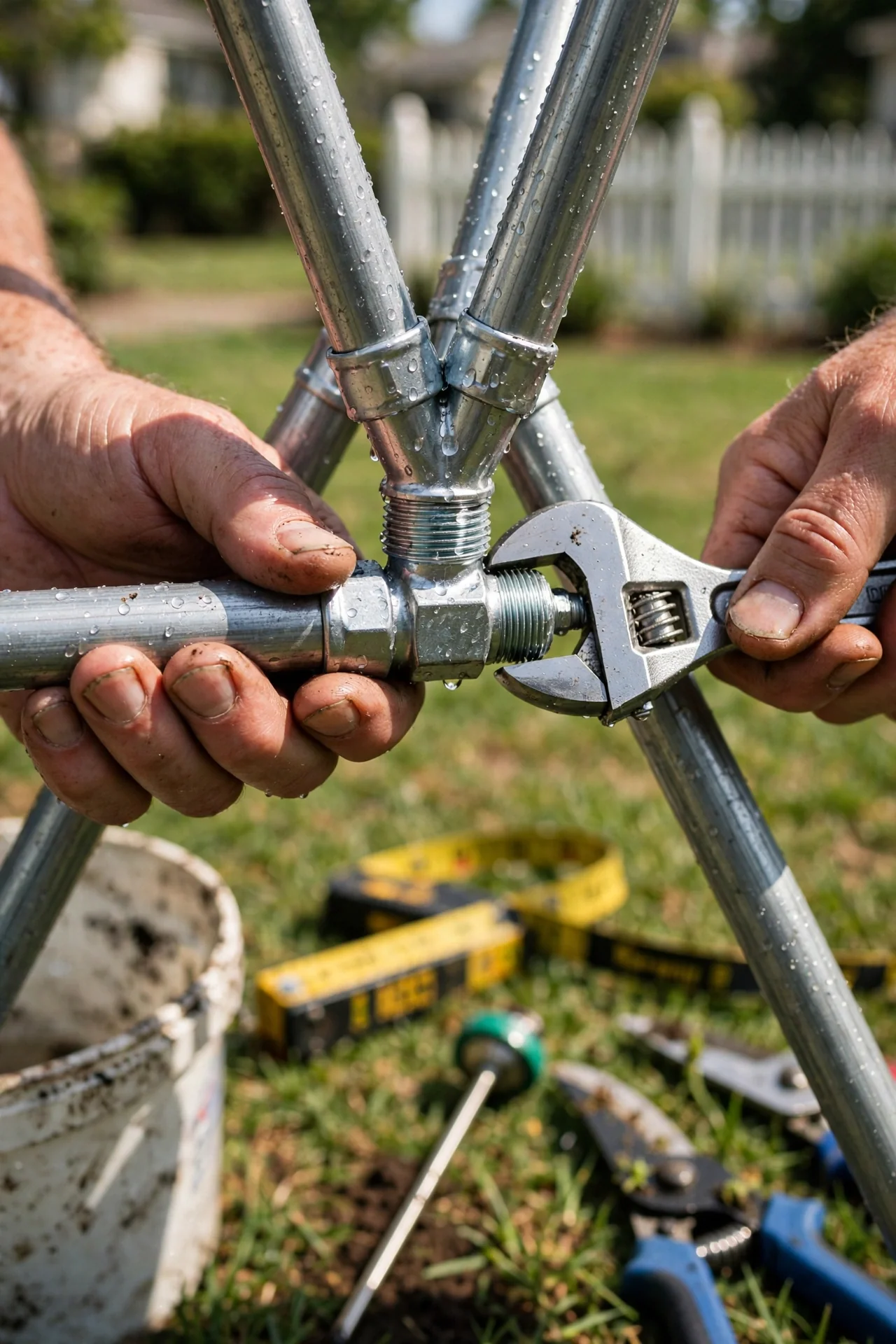
Galvanized steel conduit (3/4-inch or 1-inch diameter) assembles into a virtually indestructible teepee that handles the heaviest runner bean crops without flex, rot, or degradation. Threaded connectors at the apex eliminate the weak point of traditional lashing. The downside is heat: steel absorbs and radiates sunlight, and in temperatures above 90°F, the metal can scorch tender bean tendrils. Mitigate this by painting the conduit white or wrapping the lower 3 feet with jute. Use this design when you want to build once and reuse indefinitely, and combine it with a nearby hydroponic vertical garden if you are creating a permanent, high-productivity vertical growing zone.
8. A-Frame-Teepee Hybrid
Best for: Branch 2
This hybrid combines the conical shape of a teepee with the double-row planting capacity of an A-frame. Two rows of canes lean inward and meet at a shared horizontal ridge pole. The result is a structure that resembles a long tent, providing climbing surfaces on both sides while maintaining the wind-shedding properties of a rounded top. It requires a bed at least 4 feet wide and rewards the extra space with significantly more linear planting footage. Lash the ridge pole securely: it carries disproportionate load and is the most common failure point when the structure is overloaded.
9. Adjustable-Height Modular Teepee
Best for: Branch 2
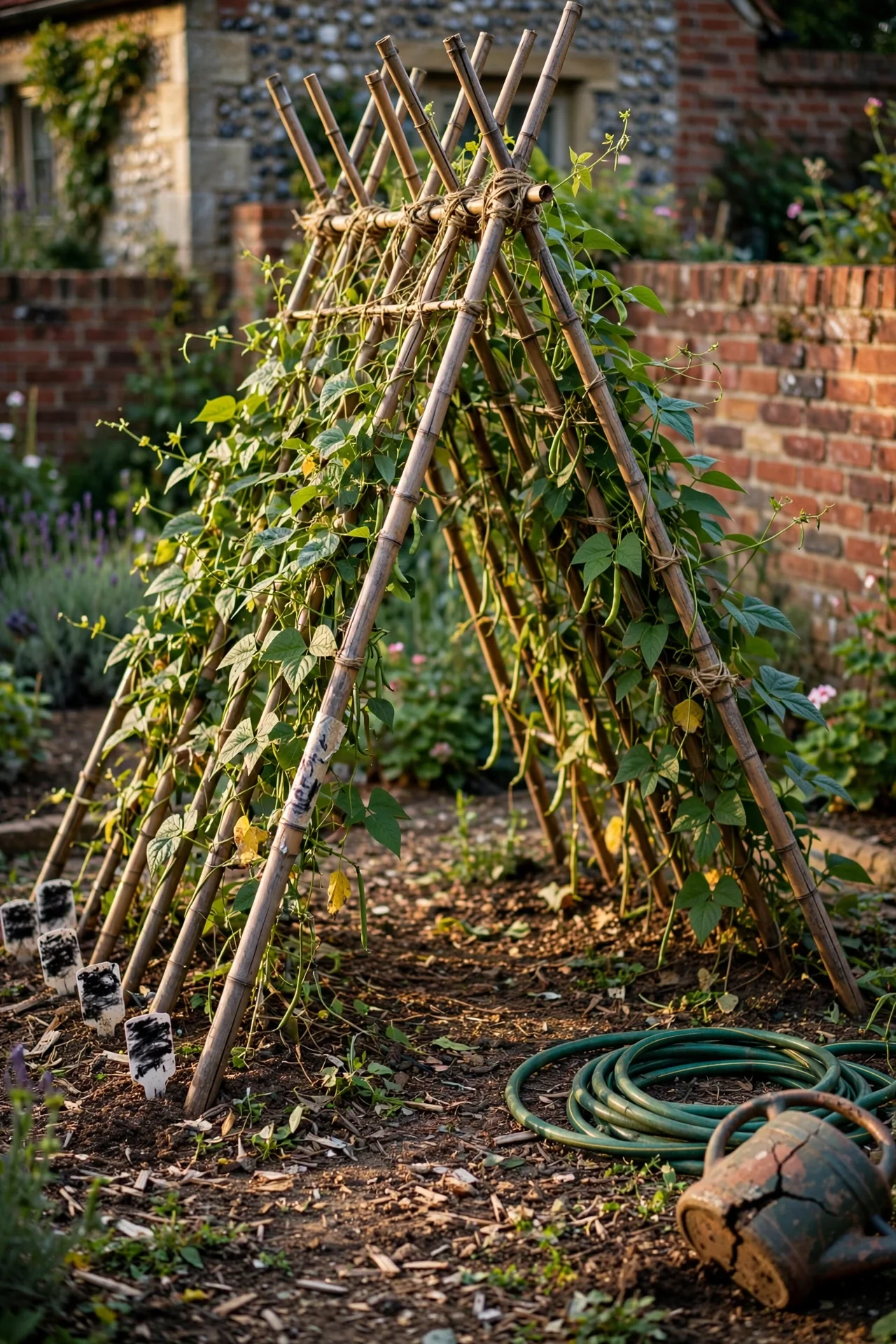
Modular poles that connect with internal pins or external sleeves allow you to change the teepee height from 5 feet to 8 feet between seasons. This matters when you are experimenting with different bean varieties or transitioning a single structure between crops. The joint is a structural vulnerability, so inspect connectors monthly during the growing season and avoid this design in Branch 3 wind conditions. The modular approach also simplifies winter storage, and the segmented poles can be repurposed for gutter garden support frames during the off-season.
10. Guy-Line Triangulated Teepee
Best for: Branch 3
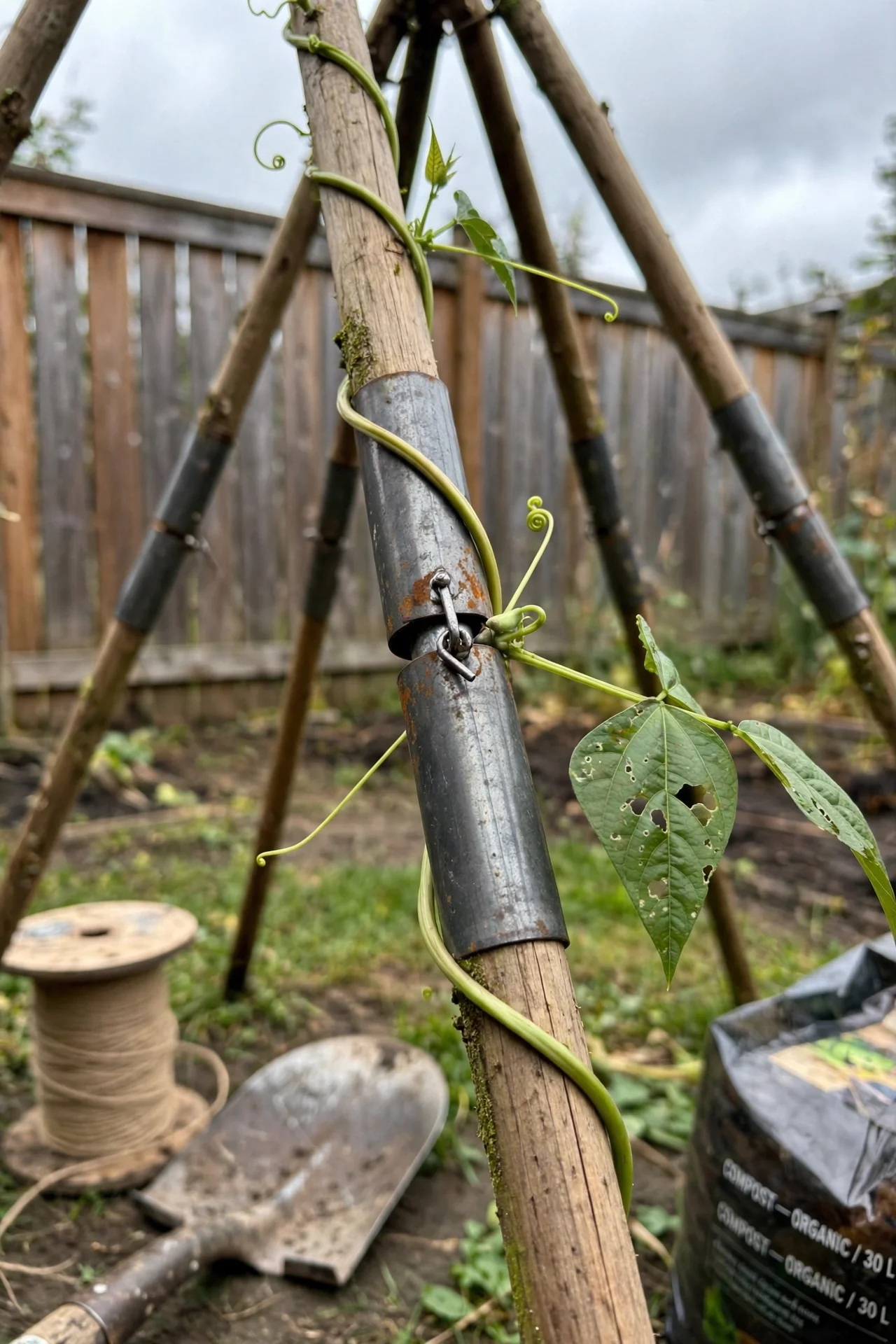
This is the standard teepee with a critical addition: three external guy lines anchored to ground stakes at 120-degree intervals around the structure, tensioned with small ratchet mechanisms. The lines oppose wind forces from any direction, converting what would be a lifting or overturning force into a compressive force that pushes the poles deeper into the soil. Tension must be checked weekly during the growing season because soil softens after rain and stakes can loosen. This is the highest-maintenance teepee on the list, reflected in its Effort Score of 4, and it is the only configuration that can reliably survive a full season on an exposed allotment without concrete.
11. Heavy-Duty Timber Teepee
Best for: Branch 3
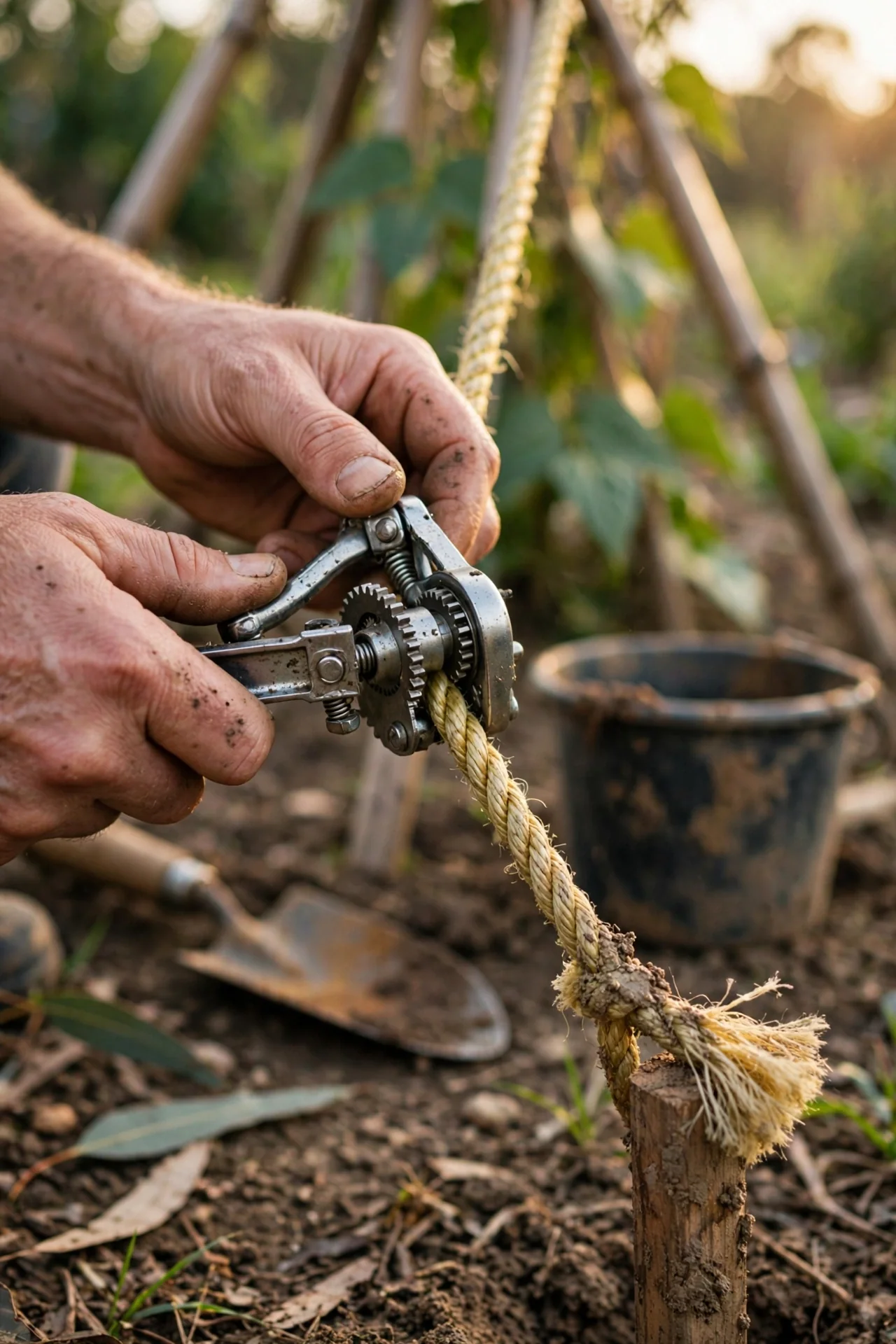
When you want a permanent landscape feature, use pressure-treated 4×4 posts set 2 to 3 feet deep in post holes, with the apex through-bolted with galvanized hardware. This structure can support not just beans but heavier climbers like gourds or small melons. The trade-off is permanence: once installed, it is difficult to move or adjust. The melon trellis principles of load distribution apply directly here, as the weight of a fully loaded timber teepee approaches that of a small fruit trellis, and the foundation must be designed accordingly.
12. Living Willow Teepee
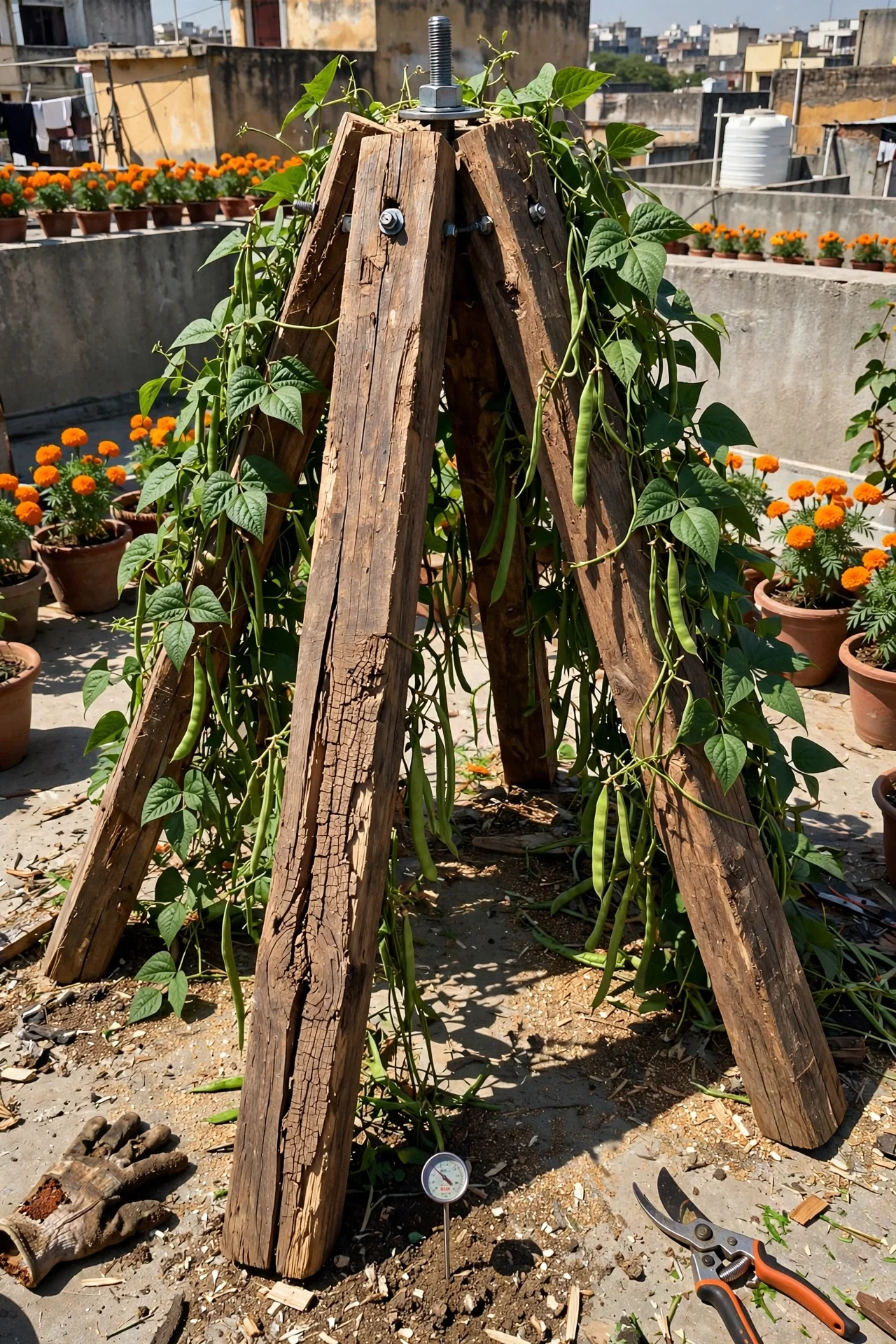
Best for: Branch 3
Fresh willow rods, harvested in late winter and pushed 12 inches into moist soil, will root and grow into a living structure. This teepee requires patience: the willow establishes in the first year, while beans can be planted in year two. Once rooted, the structure is self-repairing and strengthens annually. The constraint is that willow roots aggressively seek water, so avoid placing this teepee within 10 feet of underground pipes or building foundations. This design is a long-term investment that aligns with the seasonal planning approach described in our vertical garden maintenance guide.
Starter Stack (What to Choose First)
Branch 1: Sheltered & Small-Space Gardeners
Start with Item 1 (Classic Bamboo Teepee) plus Item 4 (Container-Optimized Teepee). The bamboo teepee gives you the standard experience and teaches you the lashing and anchoring mechanics. The container version lets you experiment with placement before committing to an in-ground location. Together, you can test two sites simultaneously with a total materials cost of approximately $25 to $45 and an assembly time of roughly 2 to 3 hours. The container teepee also serves as a backup if your in-ground anchor depth proves insufficient after the first heavy rain.
Branch 2: Moderate Exposure, Standard Beds
Start with Item 5 (Three-Pole Minimalist) plus Item 8 (A-Frame-Teepee Hybrid). The three-pole teepee is fast to build and teaches you the importance of guy-line tensioning, while the A-frame hybrid scales up your growing capacity if the site proves suitable. This pair lets you compare single-row versus double-row planting in a single season, with a total materials investment of roughly $30 to $55. If the three-pole structure fails in a wind event, you have gained a clear signal that you need to upgrade to Branch 3 reinforcements for the following year.
Branch 3: High Wind, Heavy Crops
Start with Item 7 (Steel Conduit Teepee) plus Item 10 (Guy-Line Triangulated Teepee). The steel conduit teepee provides an indestructible core structure, while the guy-line triangulation method can be retrofitted to any teepee style. Build the conduit teepee first, then install the guy lines when plants reach about 3 feet tall and begin to catch wind. The combined materials cost ranges from approximately $60 to $100, and the construction time is roughly 4 to 6 hours due to the conduit cutting and threading. This is a one-time investment for a structure that should last a decade or longer.
When This Won’t Work
A bean teepee trellis, in any configuration, is a poor choice when the available sunlight at ground level is less than 5 hours of direct sun per day. The teepee shape creates shade on its north-facing side (in the Northern Hemisphere), and beans planted there will struggle to photosynthesize enough to produce pods. If your site has marginal light, a flat vertical trellis oriented east-west will capture more usable sunlight across all planting positions. Flat panel designs are covered in our cucumber trellis ideas guide, many of which adapt well to beans.
The second failure condition is soil that cannot hold an anchor at depth. If you hit bedrock, a high water table, or a utility line at less than 12 inches below grade, standard pole anchoring is impossible. In these cases, you must switch to a surface-weighted system like Item 6 (Concrete-Bucket Anchored Teepee) or abandon the teepee form entirely in favor of a wall-mounted trellis or a container-based flat panel.
Choosing the Right Option for Your Situation
Budget Threshold
If your total materials budget is under $20, limit your options to Items 1, 2, 4, and 5. Bamboo and jute are the least expensive materials, and you can often source bamboo canes for free from garden-sharing groups. Container-optimized versions (Item 4) can use any existing pot, removing the cost of a new container. Avoid steel conduit (Item 7) and heavy timber (Item 11) at this budget tier, as the metal and hardware alone will exceed the threshold.
Time Threshold
If you have less than 2 hours to build and install, choose Items 1, 4, or 5. These three designs require no concrete mixing, no conduit cutting, and minimal lashing. The three-pole minimalist (Item 5) is the fastest: under 45 minutes from material gathering to planting. If you have a full day available, Items 7, 10, and 11 open up as viable options that reward the extra labor with multi-year durability.
Technical Constraint: Pole Diameter and Wind Load
The single most overlooked technical variable is the relationship between pole diameter, teepee height, and wind resistance. A teepee with 8-foot poles that are only 3/4 inch in diameter will sway noticeably in winds above 15 mph, and swaying loosens soil around the anchors. For every additional foot of height beyond 6 feet, increase pole diameter by roughly 1/4 inch. So an 8-foot teepee needs poles at least 1.25 inches thick at the base. Ignore this rule and the structure may stand perfectly still for weeks, then fail catastrophically during the first summer thunderstorm when the bean canopy acts as a sail.
Yes/No Checklist:
- Does your site receive at least 5 hours of direct sun at the planned teepee location?
- Can you dig or weight-anchor to a depth of at least 12 inches without hitting an obstruction?
- Have you measured the mature height of your bean variety and confirmed your poles are at least 1 foot taller?
- If your site experiences regular wind above 20 mph, have you selected a Branch 3 design or added guy lines?
Expert Q&A
Can I use the same bean teepee for peas and beans in the same season?
In most climates, yes, but succession timing matters. Peas prefer soil temperatures between 45°F and 70°F, while beans germinate best above 60°F. Plant peas at the base in early spring and let them climb. Once pea harvest winds down in early summer, cut them at soil level, leaving the roots to decompose, and plant beans in the same spots. The nitrogen fixed by pea roots benefits the beans that follow. Do not try to grow both simultaneously on the same teepee, as they will compete for climbing space and light.
What is the minimum number of poles for a functional bean teepee?
Three poles is the absolute structural minimum, creating a tripod that is inherently stable. However, three poles provide only three climbing surfaces, which limits you to roughly 6 to 9 bean plants total. For most gardeners, five to six poles is the practical minimum because it creates enough climbing surface area for a meaningful harvest while still being easy to lash at the apex. More than eight poles becomes unwieldy to assemble and creates a crowded center that traps humidity and encourages fungal disease.
Do I need to replace the twine lashing every season?
Natural fiber twines like jute and sisal typically degrade within one growing season when exposed to sun and rain. Inspect the lashing at the apex, which bears the most tension, every few weeks. If you see fraying or mold, replace it immediately. Synthetic twines like polypropylene or nylon last multiple seasons but can stretch under load, requiring retightening mid-season. For a set-and-forget approach, use UV-resistant zip ties or stainless steel wire for the apex connection, then wrap with twine for a natural appearance.
How do I store a bamboo teepee over winter to extend its life?
Untie the apex lashing and pull the poles from the ground. Clean off soil and let them dry completely in a covered area for three to four days. Store them horizontally on a rack, not leaned against a wall, which can cause warping. If you must store them outside, cover with a tarp that allows airflow underneath. Bamboo left in contact with wet soil over winter will develop fungal rot and become brittle. With proper storage, bamboo canes can last three to five seasons before needing replacement.
Can a bean teepee work on a sloped site?
Yes, but you must adjust the pole lengths so the apex is level. On a slope, the downhill poles need to be longer than the uphill poles by the vertical drop across the teepee footprint. For example, on a slope with a 12-inch drop across a 3-foot circle, cut the downhill poles approximately 12 inches longer than the uphill ones. Alternatively, dig the uphill pole holes deeper to level the base circle, but this reduces anchor depth on the uphill side, which is already the most vulnerable to overturning.
Conclusion
The bean teepee is deceptively simple: it looks like a few poles and some string, but its performance depends entirely on how well it is matched to your wind, soil, and crop. The single most common mistake is underestimating wind load on a fully leafed-out structure. A teepee that feels sturdy in May can act like a sail by July, and the failure is always sudden rather than gradual.
If you take one next step, build the classic bamboo teepee (Item 1) first, but anchor the poles 10 to 12 inches deep regardless of what a basic tutorial suggests. For alternative climbing plant support systems that use different structural principles, explore our clematis trellis design guide, where the focus shifts to decorative, long-term perennial support that shares surprisingly little engineering with annual bean structures.