
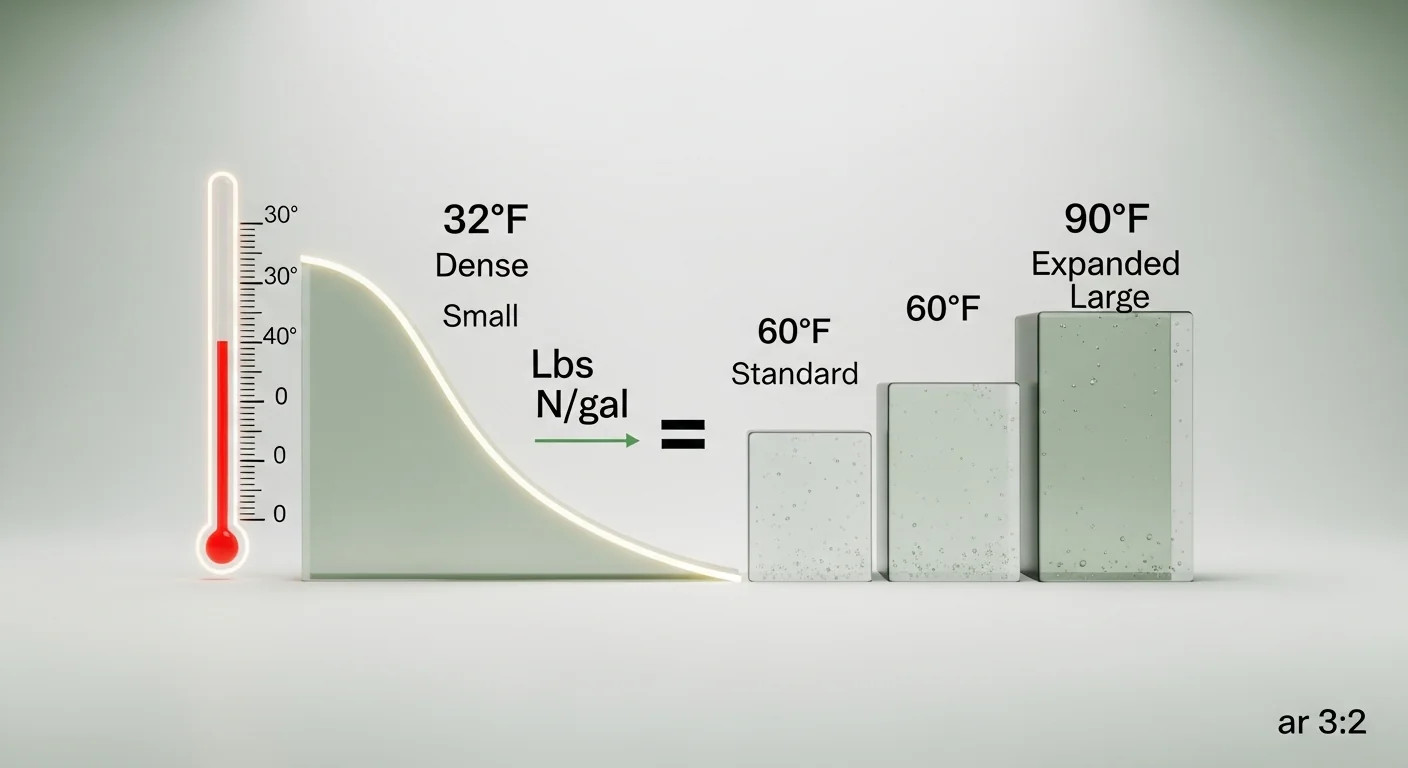
Liquid fertilizer weight per gallon is not a fixed number. Every product has a different density, and that density shifts with temperature. UAN 32% at 60°F weighs 11.06 lbs/gal. At 80°F it weighs 10.98. Below 32°F it stops being a liquid at all and becomes a solid crystal slurry that can seize pump impellers. Using the wrong density figure in your application math produces the wrong N rate, not by a rounding error, but by a meaningful percentage of the total nitrogen you intended to apply.
This calculator uses a temperature-corrected density lookup derived from published Fertilizer Institute reference data to determine the exact density of your liquid fertilizer at your current ambient temperature, then computes the gallons per acre needed to hit a target nitrogen rate. It does not calculate boom output, travel speed, or nozzle sizing; those variables belong in a separate equipment calibration workflow. If you are working upstream on total nitrogen budget across sources, the nitrogen calculator is the appropriate companion tool.
After using this calculator you will know exactly how many gallons of your chosen liquid fertilizer to apply per acre, whether your current storage temperature puts you inside the safe operating zone, and whether your transfer pump is at risk of crystalline damage before you ever open a valve.
Use the Tool
Liquid Fertilizer Density & Salting-Out Calculator
Accurate density lookup, N rate math, and freeze-safety warnings for UAN and liquid fertilizers
The Yield Grid| Fertilizer | N% | lbs/gal @ 60°F | Salt-Out Temp |
|---|---|---|---|
| UAN 32% (32-0-0) | 32% | 11.06 | 32°F ⚠ |
| UAN 28% (28-0-0) | 28% | 10.66 | 0°F |
| 10-34-0 Starter | 10% | 11.65 | N/A (slurry) |
| AMS Solution 8-0-0-9S | 8% | 10.30 | 18°F |
| Urea Solution 46-0-0 | 46% | 9.72 | 34°F ⚠ |
| Temp (°F) | Density (lbs/gal) | Lbs N/gal | Status |
|---|
How This Calculator Works
Step 1 — Density lookup by fertilizer type & temperature:
Each liquid fertilizer has a known density profile. Density changes slightly with temperature — cooler liquid is slightly denser. Values are interpolated from published IPNI/Fertilizer Institute tables.
Step 2 — Calculate pounds of N per gallon:
e.g. UAN 32% at 60°F: 11.06 × 0.32 = 3.54 lbs N/gal
Step 3 — Calculate gallons needed per acre:
e.g. 100 lbs N target ÷ 3.54 lbs N/gal = 28.25 gal/acre
Step 4 — Salting-out (freeze) safety check:
UAN 32% salts out at 32°F — urea and ammonium nitrate crystallize, clogging lines and destroying pump impellers. UAN 28% is stable to 0°F. Always check before operating transfer equipment in cold weather.
Assumptions & Limits
- Density values based on standard commercial-grade solutions; actual product may vary ±0.5% by manufacturer.
- Temperature range modeled: –40°F to 120°F. Outside this range, results are extrapolated and less reliable.
- 10-34-0 starter is a suspension/slurry — agitation required; density is approximate and does not have a clean salting-out point.
- This tool calculates application rate math only — equipment capacity, boom output, and travel speed are not included.
- Salting-out temperatures are industry standard thresholds; always verify with your supplier before cold-weather application.
- N rate targets should be confirmed with a certified agronomist for your soil type, crop, and local regulations.
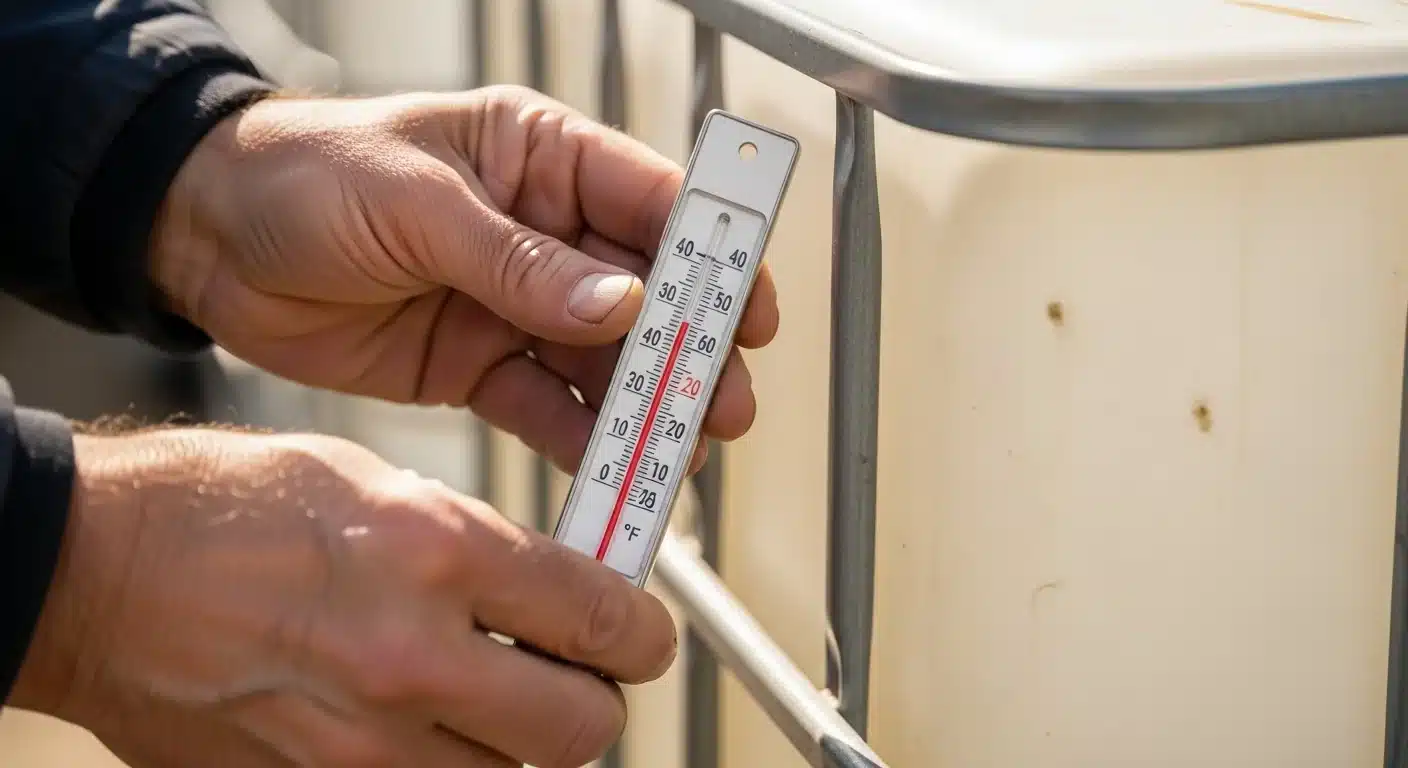
Before you calculate, have three pieces of information ready: the specific product in your tank or tote (UAN 32%, UAN 28%, 10-34-0 starter, AMS solution, or urea solution), a current thermometer reading at the storage location in degrees Fahrenheit, and your target nitrogen application rate in pounds of actual N per acre from your fertility plan. The thermometer reading at the tank matters more than the forecast; a barn-stored IBC tote at 35°F behaves very differently from one sitting on a concrete pad after a cold front.
Quick Start (60 Seconds)
- Select your fertilizer type first. UAN 32% and UAN 28% are the most common, but their density and freeze behavior differ substantially. Choosing the wrong product will cascade through every output.
- Enter the temperature at the storage or field location, not the weather app. Use a physical thermometer at the tank. Input in degrees Fahrenheit, range accepted: -40 to 120°F.
- Enter your target in pounds of actual nitrogen per acre. This is elemental N, not product pounds. A 100 lb/ac N goal is not 100 lbs of UAN 32%.
- Read the density output before acting on gallons-per-acre. If the density field shows “FROZEN,” stop. The product has salted out and the gallons-per-acre figure cannot be computed.
- Check the gauge bar color. Red or orange means you are at or near the salting-out threshold. The marker position shows where your temperature sits on the safety spectrum.
- Use the computed reference table in the results panel to see how density shifts across temperatures for your selected product before you finalize a nurse tank fill calculation.
- N rates above 150 lbs/ac in a single pass should be cross-checked against your agronomist’s split-application recommendation before entering them here.
Inputs and Outputs (What Each Field Means)
| Field | Unit | What It Means | Common Mistake | Safe Entry Guidance |
|---|---|---|---|---|
| Liquid Fertilizer Type | Selection | Determines N concentration and the density lookup table used for all calculations | Selecting UAN 32% when the tank actually holds UAN 28%, or vice versa | Confirm product from the delivery ticket or IBC label before selecting |
| Ambient Temperature | °F | The actual temperature at the point of storage or application; drives density interpolation and freeze-risk evaluation | Using the air temperature from a phone weather app instead of a thermometer reading at the tank | Read a thermometer placed at or on the storage container; indoor storage can be 20°F warmer than outdoor readings |
| Target N Rate | Lbs N / acre | Pounds of elemental nitrogen you want to deliver per acre (not pounds of product) | Entering product pounds instead of nitrogen pounds (e.g., entering 200 when the target is 200 lbs of UAN, not 200 lbs of N) | Pull the elemental N figure from your soil test recommendation or crop removal guide |
| Density (output) | Lbs / gal | The calculated weight of one gallon of the selected fertilizer at the entered temperature | Assuming the value on the product datasheet (typically at 60°F) applies at all temperatures | If the output reads FROZEN, do not proceed to application math; the product is outside its safe fluid range |
| Gallons Needed / Acre (output) | Gal / acre | Volume of liquid fertilizer to apply per acre to deliver the target N rate at the computed density | Using this number for whole-farm fill calculations without multiplying by field acreage separately | Multiply by field acres to get total nurse tank volume; cross-check against your spreader’s tank capacity |
| Lbs N per Gallon (output) | Lbs N / gal | Actual elemental nitrogen content per gallon at the current temperature-corrected density | Using the label N% without correcting for temperature-shifted density | This value should be your rate-setting reference, not the label percentage alone |
| Tons per Acre Applied (output) | Tons / acre | Total product weight applied per acre; useful for comparing with dry equivalent rates or load limits | Ignoring this figure when applying near road or field weight restrictions | Verify against field road weight limits if applying with a loaded tender truck or floater |
| Gal per 100 Acres (output) | Gal / 100 ac | Total volume for a 100-acre block at the calculated rate; aids nurse tank logistics | Forgetting to account for dead band, hose purge volume, and pump priming when filling tanks | Add 3-5% buffer volume to account for transfer losses when ordering product |
When planning multi-product applications, the fertilizer spreader calibration calculator covers the equipment-side variables this tool intentionally excludes.
Worked Examples (Real Numbers)
Example 1: Standard UAN 32% Pre-Plant at 60°F
- Fertilizer: UAN 32%
- Temperature: 60°F
- Target N rate: 100 lbs N/acre
Density at 60°F = 11.06 lbs/gal
Lbs N/gal = 11.06 x 0.32 = 3.539 lbs N/gal
Gallons needed = 100 / 3.539 = 28.26 gal/acre
Result: 28.26 gallons of UAN 32% per acre delivers 100 lbs of elemental nitrogen at standard storage temperature.
This is the baseline scenario most agronomists use when planning pre-season volumes. Temperature is neutral; no freeze risk applies.
Example 2: UAN 28% Applied During a Cold Snap at 40°F
- Fertilizer: UAN 28%
- Temperature: 40°F
- Target N rate: 80 lbs N/acre
Density at 40°F = 10.66 lbs/gal
Lbs N/gal = 10.66 x 0.28 = 2.985 lbs N/gal
Gallons needed = 80 / 2.985 = 26.80 gal/acre
Result: 26.80 gallons of UAN 28% per acre delivers 80 lbs N at 40°F. Salting-out threshold for UAN 28% is 0°F; no freeze risk at this temperature.
UAN 28% provides a useful cold-weather operating margin compared to UAN 32%, accepting temperatures down to 0°F before crystallization risk enters the picture.
Example 3: UAN 32% Stored in an Unheated Building at 28°F
- Fertilizer: UAN 32%
- Temperature: 28°F
- Target N rate: 120 lbs N/acre
Density at 28°F: CRYSTALLIZED. UAN 32% salts out at 32°F. At 28°F the solution has already converted partially or fully into solid urea and ammonium nitrate crystals.
Result: Application math cannot be completed. The product is outside its fluid operating range and must be warmed above 32°F before any transfer or application.
Running a transfer pump against crystallized product is the single most expensive field mistake in liquid nitrogen management. A $500 poly impeller pump can be destroyed in seconds by solid crystal material drawn into the intake.
Reference Table (Fast Lookup)
| Fertilizer | Temp (°F) | Density (lbs/gal) | N% | Lbs N/gal | Gal/acre for 80 lbs N | Gal/acre for 120 lbs N | Freeze Status |
|---|---|---|---|---|---|---|---|
| UAN 32% | 28°F | CRYSTALLIZED | 32% | — | — | — | SALT-OUT / DO NOT PUMP |
| UAN 32% | 32°F | 11.14 | 32% | 3.565 | 22.44 | 33.66 | AT THRESHOLD |
| UAN 32% | 50°F | 11.09 | 32% | 3.549 | 22.54 | 33.81 | Safe |
| UAN 32% | 60°F | 11.06 | 32% | 3.539 | 22.60 | 33.90 | Safe |
| UAN 32% | 80°F | 10.98 | 32% | 3.514 | 22.77 | 34.15 | Safe |
| UAN 28% | 0°F | 10.71 | 28% | 2.999 | 26.68 | 40.01 | AT THRESHOLD |
| UAN 28% | 32°F | 10.67 | 28% | 2.988 | 26.77 | 40.16 | Safe |
| UAN 28% | 60°F | 10.66 | 28% | 2.985 | 26.80 | 40.20 | Safe |
| 10-34-0 Starter | 60°F | 11.65 | 10% | 1.165 | 68.67 | 103.00 | Safe (agitate) |
| AMS Solution 8-0-0-9S | 60°F | 10.30 | 8% | 0.824 | 97.09 | 145.63 | Safe above 18°F |
| Urea Solution 46-0-0 | 60°F | 9.72 | 46% | 4.471 | 17.89 | 26.84 | Safe above 34°F |
| Urea Solution 46-0-0 | 34°F | 9.75 | 46% | 4.485 | 17.84 | 26.75 | AT THRESHOLD |
The derived “Lbs N/gal” and gallons-per-acre columns are computed values, not product label figures. They reflect the temperature-corrected density applied to the product’s nitrogen concentration. Use the at-threshold rows as hard stops in your pre-application checklist.
How the Calculation Works (Formula + Assumptions)
Show the calculation steps
Step 1: Density lookup by fertilizer type and temperature
Each fertilizer type has a density profile across temperatures, based on published reference values from the Fertilizer Institute. The tool interpolates linearly between the two nearest reference temperature points to arrive at density at the exact entered temperature. If the entered temperature is at or below the salting-out threshold, the density is returned as null and calculation stops.
Step 2: Lbs N per gallon
Lbs_N_per_gal = Density (lbs/gal) x (N% / 100)
Example: UAN 32% at 60°F: 11.06 x 0.32 = 3.539 lbs N/gal
Step 3: Gallons needed per acre
Gallons_per_acre = Target_Lbs_N / Lbs_N_per_gal
Example: 100 lbs N target / 3.539 = 28.26 gal/acre
Step 4: Salting-out freeze check
IF Temperature <= Salt-Out_Temp THEN output = CRYSTALLIZED
Thresholds: UAN 32% at 32°F, UAN 28% at 0°F, AMS solution at 18°F, Urea solution at 34°F, 10-34-0 has no defined salt-out point but viscosity increases sharply below 32°F.
Rounding: Density is displayed to 2 decimal places. Lbs N/gal is displayed to 3 decimal places. Gallons/acre is displayed to 2 decimal places. No rounding occurs inside the intermediate calculation chain; rounding is applied to display values only.
Unit conversions: Tons/acre = (Gallons/acre x Density) / 2000. Gallons per 100 acres = Gallons/acre x 100.
Assumptions and Limits
- Density reference values are based on standard commercial-grade fertilizer solutions. Actual product density can vary up to plus or minus 0.5% depending on manufacturer and batch concentration.
- The temperature range modeled is -40°F to 120°F. Values at the extremes of this range involve greater interpolation distance between reference points and carry slightly more uncertainty.
- 10-34-0 is a suspension fertilizer, not a true solution. The density values are approximate, agitation is required before and during application, and no single salting-out temperature applies. Viscosity changes below 32°F can impair flow even if the material does not crystallize completely.
- Salting-out thresholds are industry-standard reference values. Actual crystallization onset can vary by a few degrees depending on product purity and storage history. Verify with your supplier if applying near the boundary.
- This tool calculates application volume math only. Boom output rate, flow meter calibration, nozzle pressure, and travel speed are outside its scope.
- N rate inputs are treated as elemental nitrogen targets. The tool does not account for denitrification, volatilization losses, or soil immobilization. Worked Example 3 above uses a temperature of 28°F as an assumption to illustrate the salting-out failure mode; the tool does not produce a gallons-per-acre figure in that scenario because no fluid density exists at that temperature for UAN 32%.
- AMS solution and urea solution density profiles are based on representative commercial formulations. High-analysis variants may differ slightly from the values used here.
Standards, Safety Checks, and Warnings
Critical Warnings
- UAN 32% crystallizes at exactly 32°F. The urea and ammonium nitrate in solution precipitate back into solid form at the freezing point of water. This is not a viscosity change; it is a phase transition. A transfer pump run against crystallized UAN 32% can have its impellers destroyed within seconds. The damage is not repairable by thawing the pump.
- Near-threshold conditions (within 10°F of salt-out temperature) are an active risk zone. A tank that reads 42°F at 9 a.m. after a cold night may have product that partially crystallized and re-melted near the bottom. Nighttime low forecasts should be checked against the salt-out temperature of your product before planning morning pump-outs.
- Urea solution (46-0-0) has a higher salt-out temperature (34°F) than the freezing point of water. This surprises many operators who expect liquid fertilizer to behave like water. Urea solution can crystallize in conditions where a water-based assumption would call it safe.
- AMS solution salts out at 18°F, which gives more cold-weather operating margin than the urea-based products, but late fall and early spring overnight lows in northern production regions can still breach that threshold.
Minimum Standards
- Always confirm storage temperature with a physical thermometer at the tank before beginning a pump transfer in ambient temperatures below 50°F.
- For UAN 32% stored outdoors in fall and winter, the industry-standard mitigation is either product replacement with UAN 28% or installation of an IBC tote wrap heater maintaining tank temperature above 40°F.
- Transfer pumps used for UAN should be rated for crystalline-risk service. Poly centrifugal pumps (Banjo-style) are the standard recommendation; cast iron impellers are inappropriate for UAN service where freeze risk exists.
Competitor Trap: Most published “liquid fertilizer weight per gallon” reference pages list a single density number per product with no temperature context. A farmer who looks up “UAN 32% weight per gallon,” finds 11.06 lbs, uses that for winter planning, and then fills nurse tanks from an outdoor IBC at 30°F may find the tank line will not prime at all, not because of a pump failure, but because the product has already solidified. The density figure is useless without the temperature it applies to. This calculator pairs both inputs together by design.
The fertilizer salt index calculator is useful for evaluating placement risk when applying high-analysis liquid fertilizers near seed; the salt index concept is distinct from the salting-out threshold discussed here, but both matter in a complete fertility placement decision. For precise active ingredient load math across field applications, the active ingredient per acre calculator handles multi-product blending scenarios.
Common Mistakes and Fixes
Mistake: Using the Datasheet Density at 60°F for All Seasons
Product datasheets nearly always report density at 60°F because that is the industry reference temperature. A February pre-plant application at 45°F will use product that is measurably denser. Applying the 60°F density figure will under-calculate gallons per acre needed, resulting in a slightly higher-than-intended N rate delivered. In practice the difference is small but compounding across large acreages.
Fix: Enter the actual storage temperature into the calculator to get the temperature-corrected density for every application event.
Mistake: Confusing Product Pounds with Elemental Nitrogen Pounds
A target of 100 lbs N/acre is not the same as 100 lbs of UAN 32% per acre. UAN 32% at 60°F delivers only 3.54 lbs of elemental nitrogen per gallon. Entering 100 into the target field expecting 100 lbs of product is a fundamental unit confusion that leads to serious over-application of nitrogen.
Fix: Confirm that your input is elemental N from a soil test recommendation, not a product volume or product weight figure.
Mistake: Treating 10-34-0 Like a True Solution
10-34-0 is a polyphosphate suspension, not a clear solution. It requires continuous agitation to maintain its density and N+P distribution. An un-agitated 10-34-0 load will stratify, meaning the product drawn from the bottom of the tank has a different composition than the top. Density figures for 10-34-0 assume a fully agitated, uniform suspension.
Fix: Verify tank agitation is active before sampling product for density measurement or calibration. The urea volatilization calculator addresses a different N loss pathway but is a useful reminder that liquid N applications have multiple failure points beyond just density errors.
Mistake: Skipping the Freeze Check When Temperatures Are Near Threshold
A common field assumption is that a product only becomes dangerous when it is visibly frozen solid. UAN 32% can begin crystallizing at exactly 32°F, and an IBC tote that spent the previous night at 29°F may appear fluid at the surface while containing significant crystal mass in the lower half. Operating a pump against partially crystallized product causes the same impeller damage as fully solidified product.
Fix: Use the temperature entered in this calculator as a go/no-go gate. If the gauge bar shows orange or red, inspect the product physically and warm before pumping.
Mistake: Ignoring the Tons-per-Acre Output When Planning Loads
Farmers focused on N rate math often overlook the total weight of product being applied per acre. At higher N rates using heavier solutions like 10-34-0, the tons-per-acre figure can constrain load planning on soft or restricted roads. Mismatching nurse tank fill volume against field road weight limits creates logistics problems that the gallons-per-acre figure alone does not reveal.
Fix: Review the tons-per-acre output alongside the gallons-per-acre result when planning loads on fields with access road weight restrictions.
Next Steps in Your Workflow
Once you have your gallons-per-acre figure from this tool, the next decision point is calibrating delivery equipment to hit that volume consistently. Boom rate, nozzle output, travel speed, and flow meter readings all determine whether the calculated volume actually reaches the ground at the right rate. The fertilizer injector calculator handles injection-rate math for fertigation and toolbar injection systems where liquid N is metered inline rather than applied by a dedicated floater or sprayer.
If your fertility plan includes multiple nitrogen sources (liquid UAN plus dry urea, or UAN plus anhydrous credits), the total N budget needs to be reconciled across all inputs before the per-acre gallons target entered here is meaningful. The NPK fertilizer calculator supports blended and multi-source nutrient planning so that the figure you bring to this density calculator reflects a complete fertility program rather than a single-source starting point.
FAQ
Why does UAN 32% weigh more per gallon than UAN 28%?
Higher nitrogen concentration means more dissolved solute per volume of solution. UAN 32% contains more dissolved urea and ammonium nitrate than UAN 28% in the same gallon of water, which increases total mass per unit volume. At 60°F, UAN 32% weighs approximately 11.06 lbs/gal versus 10.66 lbs/gal for UAN 28%. The difference is real and matters when calculating N delivery per gallon.
What actually happens to UAN 32% when it “salts out” at 32°F?
Salting out is a crystallization event. The urea and ammonium nitrate that are dissolved in the solution precipitate back into solid form when temperature drops to the threshold. The product shifts from a pumpable liquid to a slurry or solid mass. It is not frozen water; it is a phase change in the dissolved salts. Warming the product back above 32°F will re-dissolve the crystals if no physical damage has occurred.
Can UAN 28% be safely used in cold weather when UAN 32% cannot?
Yes, within limits. UAN 28% remains fluid to 0°F compared to UAN 32%’s 32°F threshold. In northern regions where fall and winter application windows include temperatures between 0°F and 32°F, UAN 28% provides meaningful operating flexibility. The tradeoff is that delivering the same pounds of N per acre requires approximately 6-7% more gallons of UAN 28% than UAN 32%.
How much does temperature actually change the gallons-per-acre calculation?
For UAN 32% specifically, the density difference between 32°F (11.14 lbs/gal) and 80°F (10.98 lbs/gal) produces a difference of roughly 0.3 gallons per acre for a 100 lb N/acre target. Over 1,000 acres that is approximately 300 gallons of product. For large operations, the temperature correction is financially meaningful, not just academic.
Does 10-34-0 starter fertilizer have a salting-out temperature?
Not in the same defined sense as UAN products. 10-34-0 is a polyphosphate suspension rather than a true solution, so it does not undergo the sharp crystallization transition that UAN products do. However, viscosity increases significantly below 32°F, which can impair pump performance and distribution uniformity. Keeping 10-34-0 above freezing is strongly recommended even without a precise salt-out threshold.
Is the density figure from this calculator the same as what I would get weighing a jug?
Closely, but not necessarily exactly. This calculator uses published reference density values interpolated by temperature. Field product from a given supplier can vary slightly in concentration. Weighing a known volume (a calibrated one-gallon container on a postal or platform scale) at your current temperature is the most accurate verification method and takes about two minutes to complete.
Conclusion

Liquid fertilizer weight per gallon is the number that connects your nitrogen target to the actual volume of product in the tank, and it is temperature-dependent in ways that static reference tables never capture. The difference between applying UAN 32% safely at 50°F and attempting the same application at 30°F is not a matter of efficiency; it is a hard operational boundary where equipment damage becomes a near-certainty if the freeze check is skipped. The calculator on this page treats that check as a primary output, not a footnote.
The single most costly mistake in liquid nitrogen management is operating a transfer pump against crystallized product. It is also the most preventable. A two-minute temperature check and one calculation before every cold-weather pump-out is all that separates a routine application from a destroyed impeller and a delayed planting window. If your fertility plan involves nitrogen from multiple sources, including organic inputs, the manure nitrogen availability calculator can help credit existing soil nitrogen before you size a liquid N purchase.