
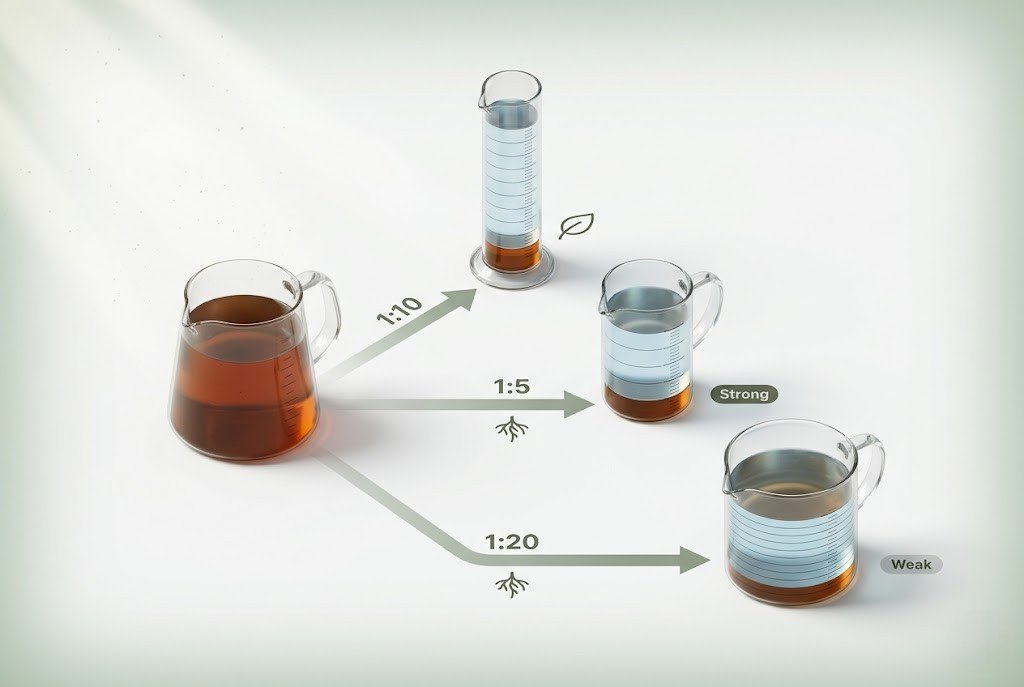
Aerated compost tea (AACT) delivers billions of beneficial microorganisms to plant roots and leaf surfaces, but those microbes die within minutes of contact with chlorinated water or incorrect dilution. The difference between a thriving soil food web and an expensive bucket of dead bacteria comes down to two numbers: your dilution ratio and your water preparation time.
This calculator determines the exact water volume needed for your compost tea concentrate based on three inputs: your tea volume, concentrate strength, and application method. It does not estimate microbial counts, guarantee plant outcomes, or replace soil testing. The calculator assumes you have already brewed aerated compost tea using standard methods (24-36 hour brew with continuous aeration).
After using this tool, you will know precisely how many gallons of dechlorinated water to mix with your tea concentrate and whether your dilution is appropriate for foliar application or root drenching.
Use the Tool
Compost Tea Dilution Calculator
Calculate the perfect water-to-tea ratio for foliar sprays & root drenches
| Component | Amount |
|---|
Quick Reference Table
| Tea Vol | Foliar (1:10) | Root Weak (1:20) | Root Strong (1:5) |
|---|---|---|---|
| 1 gal | 10 gal | 20 gal | 5 gal |
| 2 gal | 20 gal | 40 gal | 10 gal |
| 3 gal | 30 gal | 60 gal | 15 gal |
| 5 gal | 50 gal | 100 gal | 25 gal |
| 10 gal | 100 gal | 200 gal | 50 gal |
How This Calculator Works
Formula: Water Needed = Tea Volume × Dilution Ratio
Dilution Ratios:
- Foliar Spray: 1:10 (1 part tea to 10 parts water) – gentler for leaf absorption
- Root Drench (Strong Concentrate): 1:5 – more potent for established plants
- Root Drench (Weak Concentrate): 1:20 – safer dilution for seedlings or weaker brews
Assumptions & Limits:
- Assumes aerated compost tea (AACT) brewed for 12-36 hours
- Tea should be used within 4-6 hours of brewing for maximum microbial activity
- Water must be dechlorinated (let tap water sit 24+ hours or use rainwater)
- Molasses: 1-2 tbsp per gallon during brewing feeds beneficial microbes
- Kelp: 1 tsp per gallon adds trace minerals and growth hormones
Before calculating, have these ready: the volume of finished compost tea concentrate (measured in gallons), whether your brew is strong (24+ hours with active bubbling) or weak (12-18 hours or reduced aeration), and your intended application method. If you are unsure whether to use foliar spray or root drench, root drenching is generally safer for beginners since it tolerates wider dilution ranges.
For mixing and applying fertilizer solutions at precise concentrations, the fertilizer dilution calculator uses similar ratio-based math that complements compost tea preparation.
Quick Start (60 Seconds)
- Tea Volume field: Enter the gallons of concentrate you brewed. Measure from your brewing vessel, not the final mixed volume. Accepts values from 0.1 to 1000 gallons.
- Concentrate Strength: Select “Strong” if your tea brewed for 24+ hours with vigorous aeration and visible foam. Select “Weak” for shorter brews (12-18 hours) or if aeration was intermittent.
- Application Method – Foliar Spray: Choose this for leaf application. Uses a 1:10 ratio (gentler concentration to avoid leaf burn).
- Application Method – Root Drench: Choose this for soil application. Strong concentrates use 1:5 ratio; weak concentrates use 1:20 ratio for safety.
- Calculate button: Click only after all three fields are completed. The tool will not run with missing inputs.
- Results panel: Shows water needed, total mix volume, visual ratio bar, and additive recommendations (molasses and kelp per gallon).
- Common input mistake: Entering your desired final volume instead of your concentrate volume. The calculator adds water to your concentrate, not the reverse.
Inputs and Outputs (What Each Field Means)
| Field Name | Type | Unit | What It Means | Common Mistake | Safe Entry Guidance |
|---|---|---|---|---|---|
| Tea Volume | Input (number) | Gallons | The volume of finished compost tea concentrate before dilution | Entering desired final volume instead of concentrate amount | Measure directly from your brew bucket after removing the aerator |
| Concentrate Strength | Input (select) | N/A | Indicates brew duration and aeration quality, which affects microbial density | Selecting “Strong” for a brew that lost aeration mid-cycle | Choose “Weak” if unsure; the higher dilution ratio provides a safety margin |
| Application Method | Input (radio) | N/A | Determines the dilution ratio: foliar needs more dilution than root drench | Using root drench ratios for foliar spray, causing leaf damage | Default to foliar (1:10) if applying to both leaves and soil |
| Water Needed | Output | Gallons | The volume of dechlorinated water to add to your concentrate | Using chlorinated tap water directly | Prepare water 24+ hours ahead or use collected rainwater |
| Total Mix | Output | Gallons | Final volume after combining tea and water | Expecting this number to match your original tea volume | Total mix = tea volume + water needed |
| Molasses (Additive) | Output | Tablespoons | Recommended unsulfured molasses to feed microbes during brewing | Adding molasses after dilution instead of during brewing | Add during the brew, not at dilution time |
| Kelp (Additive) | Output | Teaspoons | Recommended kelp meal or extract for trace minerals | Using kelp fertilizer instead of kelp meal/extract | Use kelp extract or finely ground kelp meal only |
Worked Examples (Real Numbers)
Scenario 1: Small Garden Foliar Spray
- Tea Volume: 2 gallons
- Concentrate Strength: Strong (24+ hour brew)
- Application Method: Foliar Spray
Result: 20 gallons of water needed. Total mix: 22 gallons at 1:10 dilution.
This volume covers approximately 2,000-3,000 square feet of leaf surface when applied with a pump sprayer until leaves glisten but do not drip.

Apply in early morning or late evening to prevent rapid evaporation.
Scenario 2: Raised Bed Root Drench with Strong Concentrate
- Tea Volume: 5 gallons
- Concentrate Strength: Strong
- Application Method: Root Drench
Result: 25 gallons of water needed. Total mix: 30 gallons at 1:5 dilution.
The 1:5 ratio delivers a potent microbial dose suitable for established plants. Apply 1-2 gallons of diluted tea per 10 square feet of soil surface. For help calculating soil volumes in raised beds, see the raised bed soil calculator.
Scenario 3: Seedling Application with Weak Concentrate
- Tea Volume: 1 gallon
- Concentrate Strength: Weak (14 hour brew)
- Application Method: Root Drench
Result: 20 gallons of water needed. Total mix: 21 gallons at 1:20 dilution.
The 1:20 ratio protects tender seedling roots from potential nutrient or microbial overload. This conservative dilution is appropriate when brew quality is uncertain or when treating young transplants.
Reference Table (Fast Lookup)
| Tea Concentrate (gal) | Foliar 1:10 Water (gal) | Root Strong 1:5 Water (gal) | Root Weak 1:20 Water (gal) | Foliar Total Mix (gal) | Root Strong Total (gal) | Root Weak Total (gal) |
|---|---|---|---|---|---|---|
| 0.5 | 5 | 2.5 | 10 | 5.5 | 3 | 10.5 |
| 1 | 10 | 5 | 20 | 11 | 6 | 21 |
| 2 | 20 | 10 | 40 | 22 | 12 | 42 |
| 3 | 30 | 15 | 60 | 33 | 18 | 63 |
| 5 | 50 | 25 | 100 | 55 | 30 | 105 |
| 10 | 100 | 50 | 200 | 110 | 60 | 210 |
| 15 | 150 | 75 | 300 | 165 | 90 | 315 |
| 20 | 200 | 100 | 400 | 220 | 120 | 420 |
How the Calculation Works (Formula + Assumptions)
Show the calculation steps
Step 1: Determine the dilution ratio based on inputs
- Foliar spray (any strength): Ratio = 1:10
- Root drench + Strong concentrate: Ratio = 1:5
- Root drench + Weak concentrate: Ratio = 1:20
Step 2: Calculate water needed
Water Needed = Tea Volume x Ratio Number
Example: 5 gallons tea x 10 (for foliar) = 50 gallons water

Step 3: Calculate total mix volume
Total Mix = Tea Volume + Water Needed
Example: 5 + 50 = 55 gallons total
Step 4: Calculate additive recommendations
Molasses = Tea Volume x 2 tablespoons per gallon
Kelp = Tea Volume x 1 teaspoon per gallon
Rounding: All outputs display one decimal place. Gallons are not converted to other units.
Assumptions and Limits
- The calculator assumes you have brewed aerated compost tea (AACT) using the standard method: compost in a mesh bag, submerged in water, with continuous air bubbling for 12-36 hours.
- Ratios are based on commonly cited AACT application guidelines, not laboratory-verified microbial counts for your specific tea.
- The tool does not account for tea age. Compost tea should be used within 4-6 hours of stopping aeration; microbial populations decline rapidly after that.
- Water temperature is not factored in. Ideal brewing and mixing temperatures range from 55-75 degrees F; cold water slows microbial activity, hot water kills microbes.
- Additive amounts (molasses, kelp) are recommendations for the brewing phase, not for post-dilution addition.
- The calculator assumes static brewing conditions. Variables like compost source quality, aeration rate, and ambient temperature significantly affect actual microbial density.
- Results apply to liquid application only. This tool does not calculate compost tea for soil injection or drip irrigation systems that may require different concentrations.
- For adjusting soil chemistry before application, the soil pH lime calculator or soil pH sulfur calculator can help establish optimal growing conditions.
Standards, Safety Checks, and Critical Warnings
Critical Warnings:
- Chlorine destroys compost tea. Municipal tap water contains chlorine or chloramine that kills beneficial microbes on contact. Let tap water sit uncovered for 24+ hours to allow chlorine to off-gas, or use collected rainwater, well water, or dechlorinated water from an aquarium supply.
- Do not store diluted tea. Use the entire batch within 4-6 hours of mixing. Diluted tea without aeration becomes anaerobic and can harbor harmful pathogens.
- Foliar application on edibles requires timing. Stop foliar spraying at least 2 weeks before harvest to allow microbial residue to dissipate.
- Over-concentration causes damage. Using ratios stronger than 1:5 can overwhelm plant roots or cause foliar burn. When in doubt, dilute more.
Minimum Standards:
- Brew time minimum: 12 hours with active aeration (visible bubbling throughout)
- Aeration requirement: Continuous air supply producing at least 0.05 CFM per gallon of tea
- Compost-to-water ratio for brewing: Approximately 1:5 to 1:10 (compost to water by volume)
- Application frequency: No more than once per week for most plants; biweekly for sensitive species
Competitor Trap: Many compost tea guides omit the critical distinction between strong and weak concentrates when recommending root drench ratios. A 1:5 dilution applied to a weak tea delivers insufficient microbes, while a 1:20 dilution applied to a strong tea wastes potency. This calculator adjusts the ratio based on your actual brew strength, preventing both under-application and resource waste.
Common Mistakes and Fixes
Mistake: Using Chlorinated Water Directly from the Tap
Chlorine and chloramine are added to municipal water specifically to kill microorganisms.

Mixing fresh tap water with compost tea defeats the entire purpose of brewing: you are adding billions of beneficial microbes and then immediately killing them.
Fix: Fill your mixing container with tap water at least 24 hours before you plan to dilute. Aerate the water if possible to speed chlorine off-gassing.
Mistake: Entering Desired Final Volume Instead of Concentrate Volume
If you want 50 gallons of diluted tea and enter “50” in the tea volume field, the calculator will tell you to add 500 gallons of water (at 1:10 ratio). The tea volume field requires your actual concentrate amount, not your target output.
Fix: Measure your brewed concentrate first. If you need a specific final volume, work backward: divide your target by (ratio + 1) to find the concentrate needed.
Mistake: Applying Strong Root Drench Concentration to Seedlings
The 1:5 ratio is designed for established plants with developed root systems. Young seedlings, cuttings, and recently transplanted plants can experience root shock from concentrated microbial applications.
Fix: Always select “Weak” concentrate setting when treating plants less than 4 weeks old, regardless of your actual brew strength. The 1:20 ratio provides a safe introduction.
Mistake: Storing Diluted Tea for Later Use
Unlike concentrated tea under active aeration, diluted tea has no oxygen supply. Beneficial aerobic microbes die within hours, and anaerobic bacteria begin producing compounds that harm plants and may contain pathogens.
Fix: Calculate only the volume you can apply within 4-6 hours. If you have excess concentrate, continue aerating it until you are ready for the next application.
Mistake: Spraying Foliar Tea in Direct Midday Sun
Water droplets on leaves act as magnifying lenses, intensifying sunlight and causing leaf burn. The heat also accelerates microbial death before absorption can occur.
Fix: Apply foliar spray in early morning (before 9 AM) or late evening (after 6 PM) when temperatures are cooler and sunlight is indirect.
Related Tools and Next Steps
Calculate the base compost volume needed before brewing tea with the compost calculator for general composting needs.
Optimize your carbon-to-nitrogen ratio for faster compost breakdown using the compost C:N ratio calculator.
Determine proper NPK fertilizer rates to complement compost tea applications with the NPK calculator.
For container gardening, calculate exact potting soil volumes before adding compost tea to the mix using the potting soil calculator.
Ensure your lawn receives balanced nutrition alongside microbial inoculants with the lawn fertilizer calculator.
When diluting concentrated pesticides for integrated pest management, the pesticide dilution calculator follows similar ratio principles.
FAQ
Can I use compost tea on all plants?
Compost tea benefits most garden plants, vegetables, fruit trees, and ornamentals. However, some plants adapted to low-nutrient soils (like many native wildflowers and succulents) may not need microbial supplementation. Avoid applying to plants showing signs of fungal disease, as the added moisture and organic material can worsen certain conditions.
How often should I apply compost tea?
For most garden applications, once every 1-2 weeks during the growing season provides consistent microbial support. High-demand crops like tomatoes and peppers can receive weekly applications. Reduce frequency for established perennials and native plantings that have developed their own soil ecosystems.
What if my compost tea smells bad?
Healthy compost tea should smell earthy and slightly sweet, similar to forest soil after rain. A foul, sulfurous, or ammonia odor indicates anaerobic conditions from inadequate aeration. Discard bad-smelling tea immediately and do not apply it to plants. Check your aerator and increase bubbling for the next batch.
Does water temperature matter when diluting?
Yes. Use water between 55-75 degrees F for optimal microbial survival. Cold water (below 50 degrees F) slows microbe activity and reduces effectiveness. Hot water (above 85 degrees F) can kill beneficial organisms. Room temperature dechlorinated water is ideal for most applications.
Can I add other fertilizers to diluted compost tea?
Adding synthetic fertilizers, especially those containing salts, can harm the beneficial microorganisms in compost tea. If you want to boost nutrition, add organic amendments like fish emulsion or seaweed extract during brewing, not after dilution. Keep synthetic fertilizers as a separate application.
Is compost tea the same as compost extract?
No. Compost tea is actively brewed with aeration to multiply beneficial microorganisms. Compost extract is simply compost soaked in water without aeration, which releases nutrients but does not significantly increase microbial populations. This calculator is designed for aerated compost tea only.
Conclusion
The biggest mistake to avoid is not the math itself but the water source. Twenty-four hours of off-gassing time costs nothing and determines whether your diluted tea delivers living microbes or expensive dead water. Plan your water preparation before you start brewing, and your soil biology will thank you.