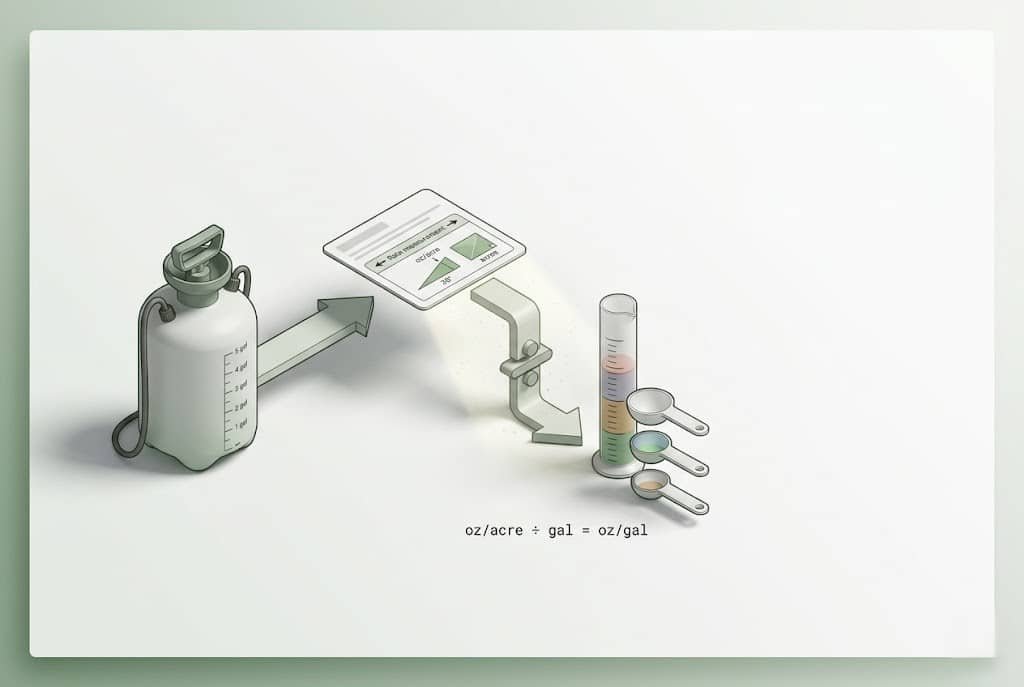
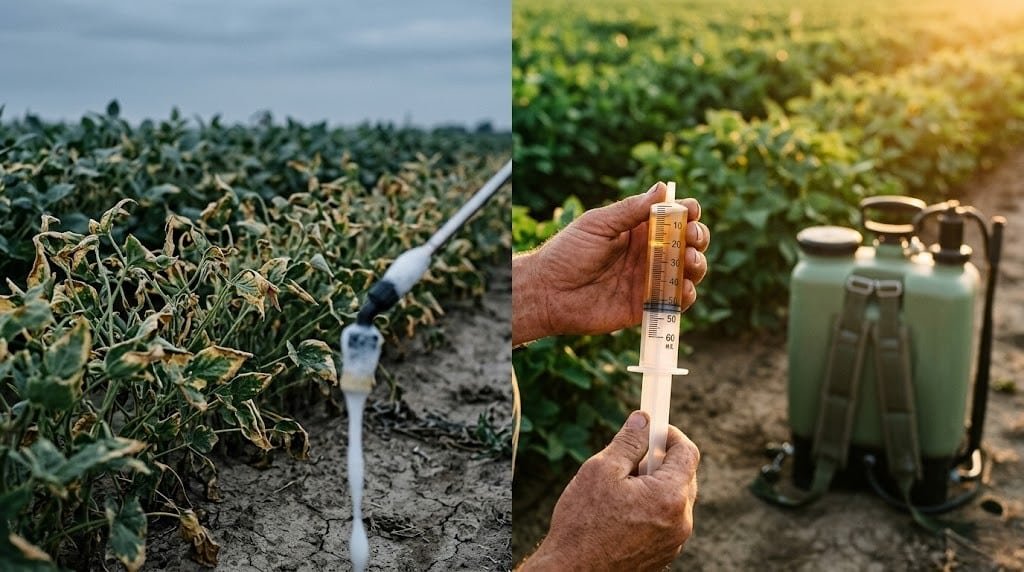
Mixing pesticide concentrate into a sprayer tank is a two-variable math problem with hard consequences if either number is wrong. Too little active ingredient and the application fails. Too much and you risk crop injury, label violations, or illegal residue levels. The math itself is straightforward, but unit mismatches between product labels and sprayer settings create the errors that lead to both outcomes.
This pesticide dilution calculator takes your tank size and your label rate, expressed as either ounces per gallon or ounces per acre, and outputs the precise volume of concentrate to measure out. It also converts that result into tablespoons and teaspoons for small-tank applications where fluid-ounce precision is difficult to achieve with standard measuring tools. What it does not do: it does not account for sprayer output calibration, boom overlap, or evaporation losses. It calculates concentrate volume only.
After using this tool, you will know exactly how many fluid ounces (or tablespoons, or teaspoons) of concentrate to add to your tank for a compliant, on-label mix. That single number is what separates a legal, effective application from one that fails agronomically or regulatorily.
Use the Tool
Before opening the calculator, have three things ready: (1) your sprayer tank capacity in gallons, (2) the application rate from the product label in ounces per gallon or ounces per acre, and (3) the acreage you plan to cover if your label rate is expressed per acre. If you are working from an oz/acre rate, you also need to know that your tank will cover the full area in one fill, or that you plan to scale the calculation accordingly.
Pesticide Safety Dilution Calculator
Calculate how much pesticide concentrate to add to your sprayer tank
| Tank (gal) | Pesticide Needed (oz) | Tbsp | Tsp |
|---|
How This Calculator Works
This Pesticide Dilution Calculator computes exactly how much pesticide concentrate you need to add to your sprayer tank.
Formula:
When your label rate is oz/acre, the rate is first converted to oz/gal using your tank size and coverage area:
Results are also expressed in tablespoons (1 oz = 2 tbsp) and teaspoons (1 oz = 6 tsp) for small-tank convenience.
Assumptions & Limits:
- Assumes one full tank covers the entire spray area uniformly.
- Results are for liquid concentrates measured in fluid ounces.
- Tank size must be between 0.1 and 10,000 gallons.
- Rate must be between 0.001 and 256 oz (per gallon or per acre).
- Area (when using oz/acre) must be between 0.001 and 100,000 acres.
- Does not account for spray overlap, drift, or dilution losses.
- Always verify results against the official product label.
If your application involves a liquid fertilizer or nutrient solution mixed alongside the pesticide, the fertilizer dilution calculator handles that side of the tank fill separately so you can verify both concentrations independently.
Quick Start (60 Seconds)
- Tank Size (gallons): Enter your sprayer’s actual usable capacity, not the rated maximum. A 25-gallon tank often fills to 22-23 gallons. Use the number you actually fill to.
- Application Rate: Read this directly from the pesticide label. Do not guess, round, or use a neighbor’s rate for a different product. Copy the number exactly.
- Rate Unit: Select oz/gallon if the label expresses rate per gallon of water; select oz/acre if the label expresses rate per acre of coverage. Mixing these up is the single most common input error.
- Area (acres) – oz/acre only: This field activates only when you select oz/acre. Enter the total area one tank will cover. If one tank covers half an acre, enter 0.5.
- Read the result in your preferred unit: The calculator shows fluid ounces as the primary result, with tablespoon and teaspoon conversions shown below for small-volume work.
- Check the safety traffic light: The color indicator shows whether your computed rate falls in a low, moderate, or high concentration zone based on oz/gallon of water.
- Cross-check against the label maximum: The calculator cannot read your label. If your computed amount exceeds the label’s stated maximum, use the label maximum and adjust your coverage area instead.
Inputs and Outputs (What Each Field Means)
| Field | Unit | What It Means | Common Mistake | Safe Entry Guidance |
|---|---|---|---|---|
| Tank Size | Gallons (US) | The actual water volume loaded into the sprayer before adding concentrate | Using the rated tank maximum instead of the actual fill volume | Fill and measure with water first; accept values from 0.1 to 10,000 gal |
| Application Rate | oz/gal or oz/acre | The product concentration specified on the pesticide label for your target pest or crop | Pulling a rate from a different product, different pest, or a previous season’s label | Read the current label; accept values from 0.001 to 256 oz |
| Rate Unit | Select | Whether the label rate is expressed per gallon of water or per acre of coverage area | Selecting oz/gallon when the label says oz/acre, producing a massively over-concentrated mix | Match exactly to the label wording before entering the rate number |
| Area to Spray | Acres | The total land area one full tank will treat (only relevant when rate is oz/acre) | Entering total farm acreage instead of one-tank coverage area | Calibrate sprayer output per acre first; accept values from 0.001 to 100,000 ac |
| Amount (primary result) | fl oz, tbsp, or tsp | Volume of liquid concentrate to measure and add to the tank | Reading the tbsp display as oz, or vice versa | Use the fl oz figure for all quantities above 1 oz; use tsp for sub-1 oz amounts |
| Concentration (oz/gal) | oz/gal water | The effective mixing ratio used to drive the safety traffic light | Assuming a “green” light means the rate is agronomically optimal | The traffic light reflects concentration zones only, not label compliance |
Worked Examples (Real Numbers)
Example 1: Backpack Sprayer for Garden Pest Control (oz/gal Rate)
- Tank size: 4 gallons
- Label rate: 1.5 oz per gallon of water
- Rate unit: oz/gallon
Result: 4 gal × 1.5 oz/gal = 6 fl oz of concentrate (12 tablespoons)
A 4-gallon backpack sits comfortably in the “low concentration” zone at 1.5 oz/gal. Six fluid ounces is easy to measure with a standard graduated cylinder. At this volume, measuring in tablespoons (12 tbsp) is also reliable if a liquid measuring cup is the only tool available.
Example 2: Field Sprayer for Herbicide Application (oz/acre Rate)
- Tank size: 100 gallons
- Label rate: 8 oz per acre
- Area per tank: 10 acres
- Rate unit: oz/acre
Result: Effective rate = (8 oz/acre × 10 acres) ÷ 100 gal = 0.8 oz/gal. Amount = 100 gal × 0.8 oz/gal = 80 fl oz of concentrate.
Eighty fluid ounces is 5 US cups of concentrate. This is a manageable quantity to measure with a calibrated jug. The effective tank concentration of 0.8 oz/gal falls in the “low” safety zone, meaning the dilution ratio is high relative to a standard pesticide mixing benchmark of 1 oz/gal.
Example 3: Greenhouse or Indoor Sprayer (Very Small Tank, oz/gal Rate)
- Tank size: 1 gallon
- Label rate: 0.5 oz per gallon of water
- Rate unit: oz/gallon
Result: 1 gal × 0.5 oz/gal = 0.5 fl oz = 1 tablespoon = 3 teaspoons
Half a fluid ounce is where measurement precision becomes critical. A standard kitchen tablespoon holds exactly 0.5 fl oz, making tablespoon measurement accurate here. For sub-0.5 oz amounts, use a dedicated laboratory syringe or graduated dropper rather than kitchen spoons, which carry ±10-15% volume error.
Reference Table (Fast Lookup)
Values below are computed directly from the formula: Amount (oz) = Tank (gal) × Rate (oz/gal). The “Safety Zone” column is derived from the effective oz/gal concentration using the same thresholds as the calculator widget.
| Tank Size (gal) | Rate (oz/gal) | Concentrate Needed (fl oz) | Tablespoons | Teaspoons | Safety Zone |
|---|---|---|---|---|---|
| 1 | 0.5 | 0.5 oz | 1 tbsp | 3 tsp | Low (<1 oz/gal) |
| 1 | 2.0 | 2.0 oz | 4 tbsp | 12 tsp | Moderate (1-4 oz/gal) |
| 4 | 1.0 | 4.0 oz | 8 tbsp | 24 tsp | Low |
| 4 | 2.0 | 8.0 oz | 16 tbsp | 48 tsp | Moderate |
| 15 | 1.0 | 15.0 oz | 30 tbsp | 90 tsp | Low |
| 25 | 1.5 | 37.5 oz | 75 tbsp | 225 tsp | Moderate |
| 50 | 1.0 | 50.0 oz | 100 tbsp | 300 tsp | Low |
| 100 | 2.0 | 200.0 oz | 400 tbsp | 1,200 tsp | Moderate |
| 100 | 4.5 | 450.0 oz | 900 tbsp | 2,700 tsp | High (>4 oz/gal) |
| 300 | 1.0 | 300.0 oz | 600 tbsp | 1,800 tsp | Low |
How the Calculation Works (Formula + Assumptions)
Show the calculation steps
When your label rate is oz per gallon of water:
Amount (fl oz) = Tank Size (gal) × Rate (oz/gal)
This is a direct multiplication. A 25-gallon tank at 2 oz/gal requires 50 fl oz of concentrate. No intermediate conversion is needed.
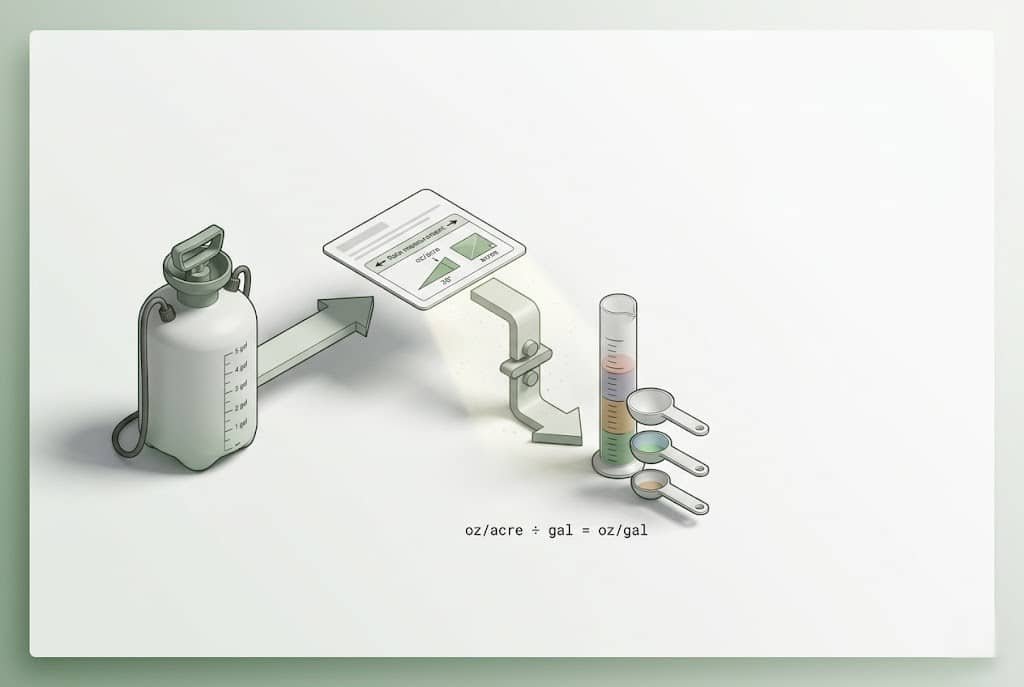
When your label rate is oz per acre:
Step 1: Convert to an effective oz/gal rate.
Effective Rate (oz/gal) = [Label Rate (oz/acre) × Area (acres)] ÷ Tank Size (gal)
Step 2: Multiply by tank size.
Amount (fl oz) = Tank Size (gal) × Effective Rate (oz/gal)
These two steps simplify to: Amount (fl oz) = Label Rate (oz/acre) × Area (acres). The tank size cancels out in this path. The formula still requires tank size to compute the safety concentration displayed by the traffic light.
Unit conversions applied to the result:
- 1 fl oz = 2 tablespoons (exactly)
- 1 fl oz = 6 teaspoons (exactly)
- 1 fl oz = 0.125 US cups (exactly)
The calculator selects the most readable unit automatically: fl oz for amounts ≥1 oz, tablespoons for amounts ≥0.5 oz but below 1 oz, and teaspoons for amounts below 0.5 oz. All unit displays are computed to two decimal places and then shown with trailing zeros removed.
Assumptions and Limits
- The formula assumes the entire tank volume is used to cover the stated area with no leftover mix.
- It assumes the concentrate is a liquid measured in fluid ounces, not a wettable powder measured by weight.
- It does not account for sprayer calibration error, nozzle wear, boom pressure variation, or application speed changes.
- It does not adjust for temperature effects on liquid volume (thermal expansion at high ambient temperatures can alter actual delivered volume by a small margin).
- It does not know the label maximum rate. If the computed amount exceeds the maximum rate stated on the label, use the label maximum and accept reduced coverage area.
- Tank size input range: 0.1 to 10,000 gallons. Rate input range: 0.001 to 256 oz. Area input range: 0.001 to 100,000 acres.
- All fluid ounce values are US fluid ounces (not imperial). One US fl oz = 29.5735 mL.
Standards, Safety Checks, and “Secret Sauce” Warnings
Critical Warnings
- Read the label before any calculation. In the United States, pesticide label language is federal law under FIFRA. Using a pesticide at a rate, timing, or crop/site combination not listed on the label is a federal violation, regardless of what any calculator outputs.
- Sub-1-oz results demand calibrated measuring tools. When the calculator outputs less than 1 fl oz (6 teaspoons or fewer), standard kitchen tools introduce unacceptable error margins. Use a graduated syringe, pipette, or laboratory measuring cylinder accurate to 0.1 mL or better.
- High-zone results (>4 oz/gal) require label verification before mixing. If the safety traffic light turns red, that does not automatically mean the rate is wrong. Some products have legitimate high-rate applications. But it does mean you should re-read the label section for your specific use case before proceeding.
- PPE is not optional at any concentration. Even low-zone results represent a chemical hazard. Wear label-specified personal protective equipment (gloves, eye protection, respiratory protection where indicated) during measuring and mixing, not just during application.
Minimum Standards
- Always compute from the current label, not a memorized rate from a previous season. Rates and re-entry intervals are revised between label versions.
- Measure concentrate into water, not the reverse. Fill the tank partially with water first, add concentrate, then complete filling. This reduces foaming and improves mixing uniformity.
- For oz/acre applications, calibrate your sprayer output per acre before relying on any volume calculation. An uncalibrated sprayer delivering 12 gallons per acre when you assumed 10 gallons per acre alters the effective concentration delivered to the crop.
For applications where active ingredient delivery per acre matters as a compliance metric, the active ingredient per acre calculator works in parallel with this tool to verify delivered AI load. If your application involves a non-ionic surfactant added to the tank, the non-ionic surfactant ratio calculator handles that additive separately.
Competitor Trap: Most pesticide mixing calculators online output a single number with no unit-conversion layer and no concentration safety check. The result is a raw fl oz figure that means nothing to a user with a 1-gallon handheld sprayer who has no way to measure 0.33 fl oz accurately. The tbsp/tsp conversion layer in this calculator is not a cosmetic feature. It is the difference between a usable result and a number that gets eyeballed by the user, producing a mix that is 30-50% off from label rate at small volumes.
Common Mistakes and Fixes
Mistake: Using the oz/acre Rate Directly in an oz/gal Field
If your label says “8 oz/acre” and you enter 8 in the rate field with oz/gal selected, the calculator will output a concentration that is orders of magnitude higher than intended. A 25-gallon tank would call for 200 fl oz of concentrate, roughly 1.56 gallons, which would mean your tank is nearly full of concentrate before water is even added.
Fix: Select the rate unit before entering the rate number. The field label and unit selector must match the label wording exactly.
Mistake: Entering Total Farm Acreage Instead of One-Tank Coverage
When using the oz/acre mode, the acreage field must represent the area one full tank covers, not the entire field or farm. If a 50-gallon tank covers 5 acres per fill and the field is 20 acres, enter 5, not 20. Entering 20 produces a concentrate amount that will treat the entire field but still fills one tank, creating a 4x over-concentration.
Fix: Know your sprayer’s gallons-per-acre output before using the oz/acre rate mode. Use a measured test strip to confirm output, or reference the spreader calibration calculator as a process reference for calibration methodology.
Mistake: Measuring Small Amounts with Kitchen Spoons
Kitchen tablespoons and teaspoons are nominal units. Actual volume varies by spoon design, fill level, and whether the liquid is leveled. At amounts below 2 tablespoons, this variability translates directly into concentration error that can exceed 15-20%.
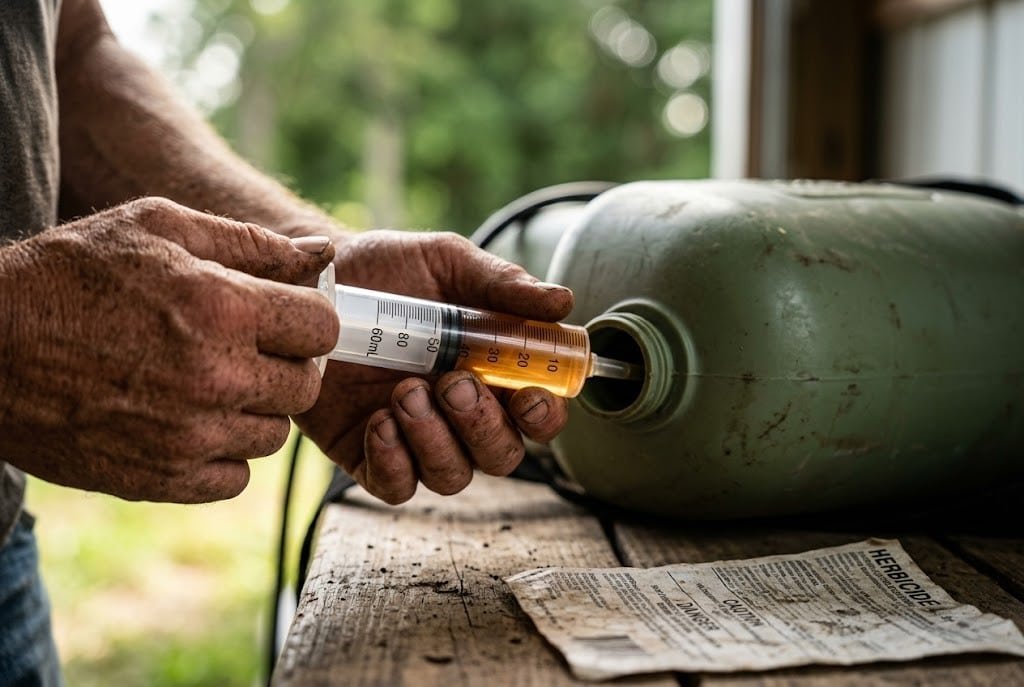
Fix: For any amount below 2 fl oz (4 tablespoons), use a graduated syringe or liquid measuring cylinder with marked increments of 1 mL or finer.
Mistake: Assuming the Calculator Validates Against the Label Maximum
The pesticide dilution calculator takes any rate you enter and computes the result. It does not know the label maximum for your specific product, pest, crop, or application timing. It will compute and display a result for a rate that exceeds the label without warning.
Fix: Before entering a rate, note the label’s stated minimum and maximum rates for your application scenario. Verify your computed amount does not exceed the maximum before mixing.
Mistake: Ignoring Residual Tank Volume from a Previous Mix
Sprayers are rarely completely empty at the start of a fill. Residual water or previously mixed product in the tank means the actual water volume available for dilution is less than the full tank capacity. This concentrates the new mix beyond the intended rate.
Fix: Either fully empty and rinse the tank before each fresh mix, or subtract the residual volume from the tank size entry. A tank with 2 gallons of residual water should be entered as (total capacity minus 2) gallons, not at full capacity.
Related Tools and Next Steps
After confirming your pesticide mix volume, check whether herbicide residues from a previous application could affect the next crop rotation using the herbicide carryover calculator.
If your spray program includes foliar or soil-applied fertilizers in the same pass, calculate nutrient concentrations separately with the NPK calculator to avoid tank-mix antagonism issues.
Liquid fertilizer injectors used alongside pesticide programs require their own dilution math. The fertilizer injector calculator handles proportioner and venturi-type systems used in greenhouse and nursery operations.
Lawn care pesticide applications often pair with fertilizer programs. The lawn fertilizer calculator covers the nutrient side of that combination pass.
If your pesticide application follows a soil pH amendment program, understanding current soil lime requirements helps sequence applications correctly. The soil pH lime calculator handles the amendment rate math.
Nitrogen timing is often coordinated with pesticide applications in row crop programs. The nitrogen calculator helps size nitrogen applications independently of the spray volume math.
FAQ
What is the formula used by this pesticide dilution calculator?
The core formula is: Amount (fl oz) = Tank Size (gal) × Rate (oz/gal). When the label rate is in oz/acre, the calculator first converts it to oz/gal using: Effective Rate = (oz/acre × Acres) ÷ Tank Size (gal), then applies the same multiplication. Both paths are shown in the “How the Calculation Works” section above.
How do I convert ounces per acre to ounces per gallon?
Multiply the oz/acre rate by the number of acres one tank covers, then divide by the tank size in gallons. For example, 8 oz/acre over 5 acres in a 25-gallon tank: (8 × 5) ÷ 25 = 1.6 oz/gal. This effective concentration is what drives the mix ratio and the safety zone indicator in the calculator.
Why does the calculator show tablespoons and teaspoons?
Product labels list rates in fluid ounces, but sub-1-oz amounts are impractical to measure in fl oz without laboratory equipment. One tablespoon equals exactly 0.5 fl oz; one teaspoon equals exactly one-sixth of a fluid ounce. Displaying these conversions allows small-tank users to use standard kitchen or garden measuring tools without doing separate conversion math.
What does the safety traffic light indicator mean?
The traffic light reflects the effective concentration of the mix in oz per gallon of water. Green (low) means below 1 oz/gal; yellow (moderate) means 1 to 4 oz/gal; red (high) means above 4 oz/gal. These zones are informational thresholds, not label compliance indicators. A red result does not mean the rate is wrong; it means the rate warrants extra label verification before mixing.
Can I use this calculator for herbicides, fungicides, and insecticides?
Yes. The formula applies to any liquid pesticide concentrate where the label rate is expressed in fluid ounces per gallon of water or fluid ounces per acre. This includes herbicides, contact and systemic fungicides, and insecticides. Wettable powders and water-dispersible granules measured by weight rather than volume are outside the scope of this tool.
What if my computed amount exceeds the label maximum rate?
Reduce the rate to the label maximum and recalculate. Do not use the computed amount if it places you above the label ceiling. Instead, accept that one tank will cover less than the full intended area at label maximum rate, or use fewer gallons of water per acre to bring the effective oz/gal back within the label range.
Conclusion
The pesticide dilution calculator removes the arithmetic from tank mixing, but it does not remove the responsibility to read the label. Every number this tool outputs is only as accurate as the inputs you provide, and the label rate is the one input that must come directly from the product documentation, not from memory, habit, or a rate used for a different product. The unit mismatch between oz/acre and oz/gal is the single most common calculation error in pesticide mixing, and it produces results that are catastrophically wrong in one direction or the other.
For small-tank applications below 5 gallons, the tablespoon and teaspoon conversions are not a convenience feature. They are a precision requirement. A result of 0.33 fl oz measured with a kitchen teaspoon introduces more error than the same amount measured with a graduated syringe. Use the right tool for the right scale. Start with the label. Verify the unit. Then mix. For soil amendment and nutrient applications that run alongside your pest management program, the compost calculator provides the same approach to amendment math: formula-driven, assumption-transparent, and built around what the label or soil test actually specifies.

Lead Data Architect
Umer Hayiat
Founder & Lead Data Architect at TheYieldGrid. I bridge the gap between complex agronomic data and practical growing, transforming verified agricultural science into accessible, mathematically precise tools and guides for serious growers.
View all tools & guides by Umer Hayiat →