
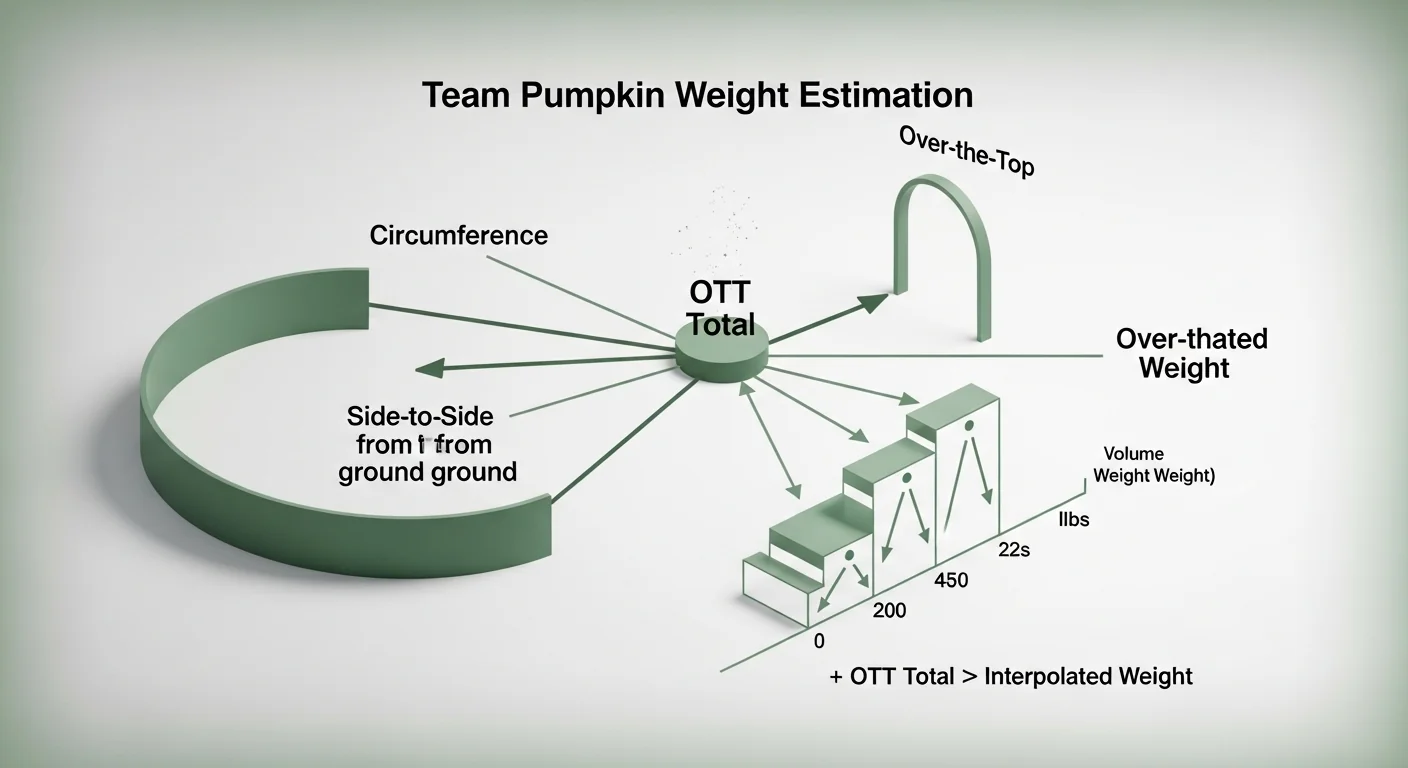
Three tape measurements taken from the soil up and across a giant pumpkin encode a surprisingly accurate weight estimate, but only when those numbers feed the correct formula. The Team Pumpkin lookup table, built by competitive growers over decades, maps Over-the-Top total distance to interpolated weight far more reliably than simple cubic approximations that circulate online. The difference between those two approaches can exceed 200 lb at competitive weights, which is the margin between winning a state fair and finishing outside the ribbon.
This calculator takes Circumference, Side-to-Side, and Over-the-Top measurements in inches, adds them into an OTT Total, and returns an estimated weight in pounds and kilograms using the Team Pumpkin standard lookup table with linear interpolation between data points. It does not predict final harvest weight, account for water loss after picking, or adjust for abnormal pumpkin geometry. It gives you the weight estimate that weigh-off organizers and experienced growers use when reading a pumpkin in the field. If you also track plant productivity per square foot of garden space, the vegetable yield calculator on this site covers that side of the grow.
After using this tool, you will know whether your pumpkin is tracking toward a competitive entry, a county fair ribbon, or a record-territory weigh-off, and exactly how many pounds separate it from the current world record.
Use the Tool

Giant Pumpkin Weight Estimator
Team Pumpkin formula — estimate weight from circumference & OTT measurements
How This Calculator Works
- Add up your three measurements:
OTT Total = Circumference + Side-to-Side + Over-the-Top - Look up estimated weight using the Team Pumpkin standard formula table — a precomputed weight-per-OTT mapping developed by the competitive giant pumpkin community.
- Metric approximation: For rough estimates,
Weight (lb) ≈ (OTT)³ × factor, where the factor is calibrated to the lookup table near typical competitive weights. - State record comparison: Checks your result against a US state record baseline (2,000 lb) used here as a reference threshold.
Before entering numbers, have a fabric measuring tape ready and take all three measurements while the pumpkin is still on the vine. Measurements shift after harvest as the pumpkin loses moisture and settles. Enter each value in inches as a decimal (for example, 58.5 not 58 1/2). The calculator accepts values to one decimal place and will flag any entry that falls outside the valid range. For timing your measurements relative to your expected harvest window, the harvest date calculator can help you plan measurement sessions alongside ripeness milestones.
Quick Start (60 Seconds)
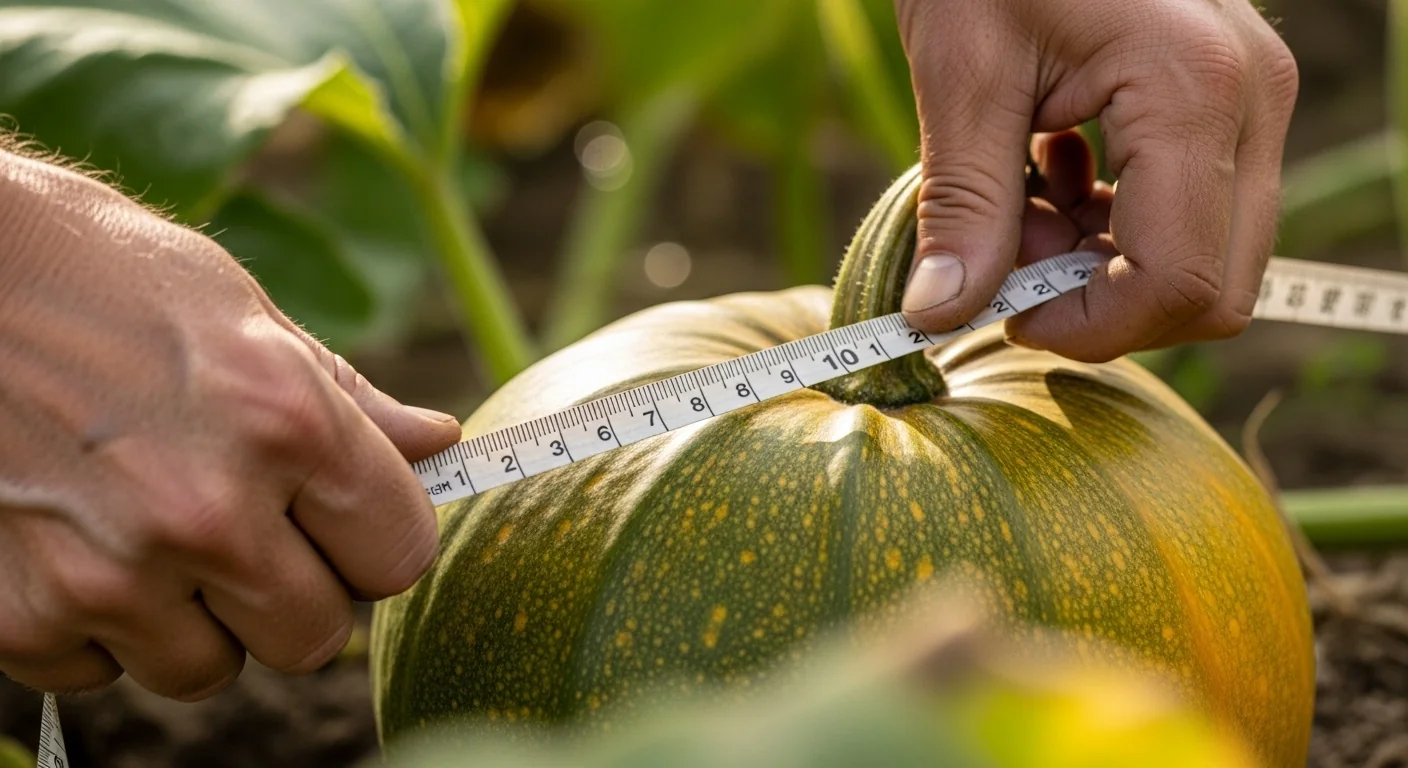
- Circumference: Wrap the tape around the widest horizontal equator of the pumpkin, parallel to the ground. This is not the belly measurement taken under the pumpkin. Valid range: 1 to 700 inches.
- Side-to-Side: Measure the straight-line width from the widest point on one side to the widest point on the other side, without the tape following the curve of the pumpkin. Valid range: 1 to 300 inches.
- Over-the-Top: Place the tape at the ground on one side, run it up and over the top center of the pumpkin, and bring it back down to the ground on the opposite side. Valid range: 1 to 300 inches.
- OTT Total: The calculator adds these three numbers automatically. The meaningful competitive range begins around 175 inches total.
- Units: All inputs must be in inches. Metric measurements need to be converted before entry (1 cm = 0.3937 in).
- Decimal entry: Enter fractional inches as decimals. Half an inch is 0.5, a quarter inch is 0.25.
- Timing matters: Giant pumpkins can gain several inches of OTT per day during peak growth. A measurement from three days ago may already be meaningfully out of date.
Inputs and Outputs (What Each Field Means)
| Field | Unit | What It Measures | Common Mistake | Safe Entry Guidance |
|---|---|---|---|---|
| Circumference | Inches | Horizontal distance around the pumpkin at its widest equatorial point | Measuring the belly (underside arc) instead of the true equator | Keep tape parallel to the ground; do not dip it under the pumpkin |
| Side-to-Side | Inches | Straight-line width at the widest lateral point | Following the curve of the pumpkin instead of measuring the straight distance | Stretch the tape across the widest point without letting it conform to the surface |
| Over-the-Top | Inches | Distance from ground on one side, over the highest point, to ground on the other side | Measuring from the stem attachment rather than ground level | Start and end at the soil surface, passing over the true apex of the pumpkin |
| OTT Total (calculated) | Inches | Sum of all three measurements; the index value fed to the lookup table | Treating OTT Total as a single physical measurement | This is computed automatically; verify each input individually |
| Estimated Weight (lb) | Pounds | Interpolated weight from the Team Pumpkin standard table | Treating this as a guaranteed weigh-off result | Use as a planning estimate; actual weigh-off can vary based on density and shape |
| Estimated Weight (kg) | Kilograms | Pound result converted at 0.453592 kg per lb | Assuming this value accounts for post-harvest moisture loss | Weigh-off weight for a picked pumpkin may differ from this estimate |
Worked Examples (Real Numbers)
Example 1: Backyard Grower, Mid-Season Measurement
- Circumference: 95 in
- Side-to-Side: 40 in
- Over-the-Top: 45 in
OTT Total: 95 + 40 + 45 = 180 inches
Result: Approximately 520 lb (235.9 kg)
At 180 inches OTT, this pumpkin sits comfortably in the backyard-champion tier. It would likely draw attention at a local harvest festival but falls well below the 473 lb threshold associated with the 175-inch competitive entry benchmark. If the vine still has four to six weeks of growth remaining, meaningful gains are possible.
Example 2: Competitive Entry, Pre-Weigh-Off Assessment
- Circumference: 135 in
- Side-to-Side: 55 in
- Over-the-Top: 60 in
OTT Total: 135 + 55 + 60 = 250 inches
Result: Approximately 1,556 lb (705.8 kg)
A 250-inch OTT Total places this pumpkin in the national-podium tier. At 1,556 lb, it would compete seriously at most state-level weigh-offs and places it roughly 1,193 lb behind the current world record. This is the weight class where measurement accuracy and consistent weekly tracking become genuinely important.
Example 3: Record-Territory Specimen, Late Season
- Circumference: 155 in
- Side-to-Side: 65 in
- Over-the-Top: 68 in
OTT Total: 155 + 65 + 68 = 288 inches
Result: Approximately 2,438 lb (1,106 kg), interpolated between the 285-inch (2,405 lb) and 290-inch (2,548 lb) table entries
This is genuine record-territory weight. At 288 inches OTT, the calculator estimates approximately 2,438 lb, placing this pumpkin about 311 lb short of the current world record. At this level, even measurement technique differences of one inch on any single input can shift the estimate by 30 to 50 lb.
Reference Table (Fast Lookup)
| OTT Total (in) | Est. Weight (lb) | Est. Weight (kg) | Grower Category | Competitive Tier | Gap to World Record (2,749 lb) |
|---|---|---|---|---|---|
| 100 | 72 | 32.7 | Early season / small specimen | Non-competitive | 2,677 lb |
| 125 | 153 | 69.4 | Backyard grower | Local display | 2,596 lb |
| 150 | 282 | 127.9 | Developing competitive pumpkin | County / local fair entry | 2,467 lb |
| 175 | 473 | 214.5 | Competitive entry threshold | State fair contender | 2,276 lb |
| 200 | 740 | 335.7 | Serious competitive grower | Regional record threat | 2,009 lb |
| 225 | 1,096 | 497.1 | Advanced competitive grower | Top-10 state podium | 1,653 lb |
| 250 | 1,556 | 705.8 | Elite grower | National podium | 1,193 lb |
| 275 | 2,136 | 968.9 | World-class specimen | World record contender | 613 lb |
| 295 | 2,697 | 1,223.4 | Record-territory specimen | World record territory | 52 lb |
How the Calculation Works (Formula + Assumptions)
Show the calculation steps
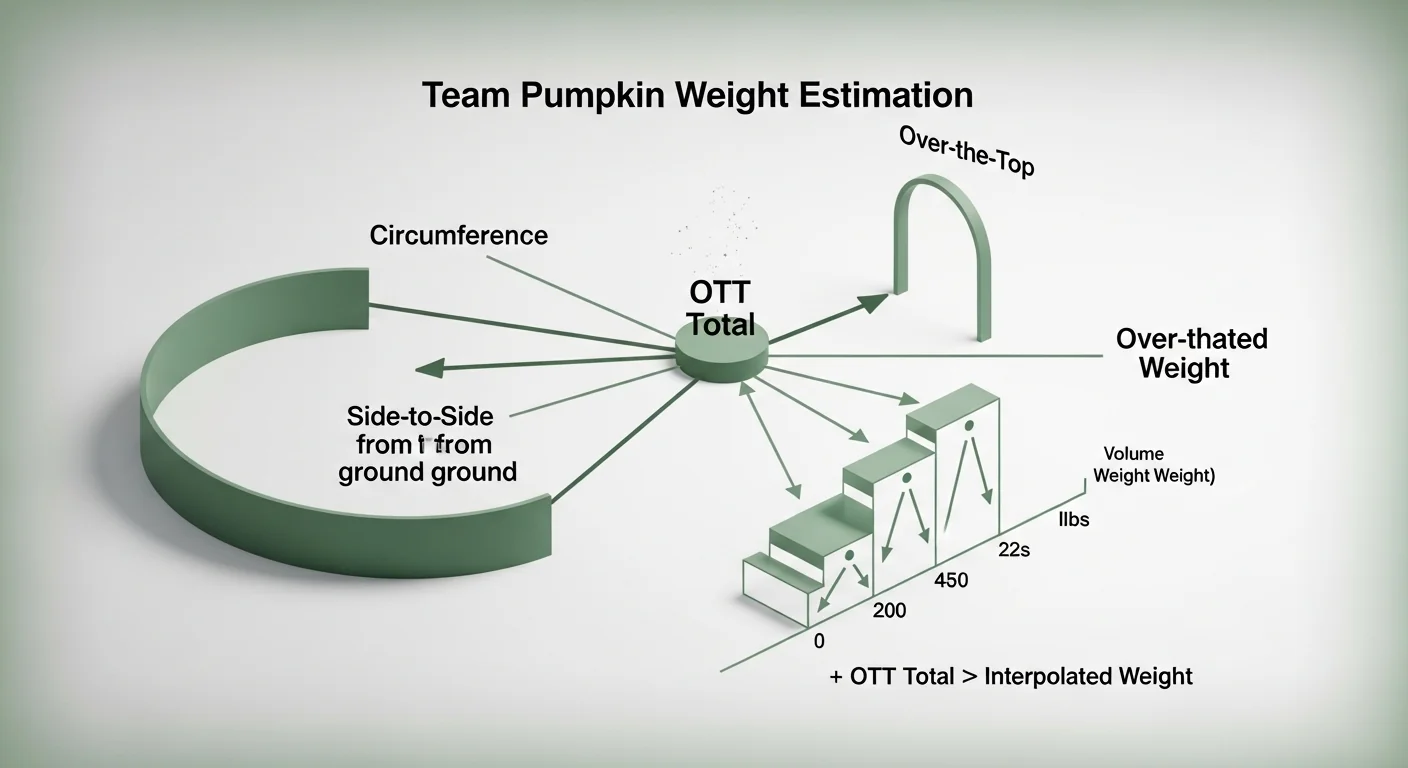
- Step 1 - Sum the three measurements: OTT Total = Circumference (in) + Side-to-Side (in) + Over-the-Top (in). All three values must be in the same unit (inches).
- Step 2 - Table lookup with interpolation: The OTT Total is matched against the Team Pumpkin standard lookup table, which maps OTT values from 50 to 300 inches to weight in pounds. If the OTT Total falls between two table entries, the calculator performs linear interpolation: Weight = Weight_low + ((OTT - OTT_low) / (OTT_high - OTT_low)) x (Weight_high - Weight_low).
- Step 3 - Extrapolation above 300 inches: For OTT Totals above 300 inches, the calculator extends the trend of the final two table entries using the same slope. This extrapolated region carries greater uncertainty and is labeled clearly in the results.
- Step 4 - Metric conversion: The pound result is multiplied by 0.453592 to produce kilograms, rounded to one decimal place.
- Step 5 - Record gap: The world-record reference weight of 2,749 lb is subtracted from the estimated weight to produce the gap displayed in the results panel.
Rounding rule: Estimated weight in pounds is displayed as a rounded integer for display purposes. The underlying interpolated value is used for the record gap calculation before rounding.
Assumptions and Limits
- The Team Pumpkin lookup table was developed for Atlantic Giant pumpkin varieties. Other giant vegetable species will produce different density-to-shape ratios and different errors.
- The formula assumes a roughly symmetrical pumpkin. Heavily ribbed, flat, or lopsided specimens can produce estimates that are off by 10 to 15 lb or more.
- Measurements must be taken while the pumpkin is still attached to the vine and resting in its natural position. Rotating or lifting the pumpkin changes all three measurements.
- OTT Total values below 50 inches or above 700 inches are outside the validated range and will trigger an error. Inputs in this range are typically measurement errors.
- The weight estimate reflects current size, not final harvest weight. Pumpkins continue growing until the vine is cut.
- Post-harvest moisture loss is not modeled. A pumpkin transported to a weigh-off can lose measurable weight due to evaporation, especially in hot or dry conditions.
- The circumference input accepts values up to 700 inches, but the OTT Total is capped for valid range purposes. If individual inputs are large enough to push OTT Total outside 50 to 700 inches, an out-of-range error is shown.
Standards, Safety Checks, and "Secret Sauce" Warnings
Critical Warnings
- Do not share an estimated weight as a confirmed result. The OTT formula is a field estimate. Sharing a specific pound number publicly before an official weigh-off sets expectations that may not match the scale result. State clearly that any figure from this calculator is an estimate, not a verified weight.
- Flat or lopsided pumpkins will produce inflated estimates. The Team Pumpkin formula assumes a relatively round shape. A pumpkin that has spread wide but remained short will register a large Side-to-Side and Circumference, producing an OTT Total that implies a heavier round pumpkin than the actual specimen. Growers with unusually flat pumpkins should treat the estimate as an upper bound.
- A single measurement snapshot is not a growth trend. The OTT number alone does not tell you whether growth has slowed, stalled, or accelerated. Without weekly comparison data, you cannot tell if the pumpkin is on pace for its potential weight class.
- OTT Totals above 300 inches enter extrapolated territory. The published Team Pumpkin table extends to 300 inches. Values beyond that are extrapolated using the slope of the final table segment, and uncertainty grows with each inch above 300. If you are in this range, consult directly with weigh-off organizers who may have updated calibration data.
Minimum Standards for Competitive Entry
- Most established state-level weigh-off events target pumpkins in the 175-inch OTT range and above as meaningful competitive entries. Below this threshold, entries are often categorized separately or scored in a recreational division.
- The 175-inch marker in the gauge bar on this calculator corresponds to approximately 473 lb, which serves as the calculator's competitive threshold reference. This is not a universal official standard but represents the competitive entry zone recognized by most organized weigh-off events.
- For growers tracking growth conditions that affect whether a pumpkin reaches competitive size, the growing degree days calculator helps quantify accumulated heat units across the season, a key variable in giant pumpkin development.
Competitor Trap: Many online pumpkin weight calculators use simplified cubic approximations of the form Weight = (OTT / constant)^3, where the constant is often 1,473, 1,600, or another round number. These formulas diverge significantly from the Team Pumpkin lookup table at extreme weights, sometimes underestimating by 10 to 15% at OTT Totals above 250 inches. If you have seen a different weight estimate on another site for the same measurements, the discrepancy almost certainly comes from which formula that site implemented, not from a measurement error on your part.
Common Mistakes and Fixes
Mistake: Measuring Circumference at the Belly Instead of the Equator
The belly measurement runs under the pumpkin along the ground contact curve. Growers unfamiliar with the Team Pumpkin protocol sometimes measure this arc because it is the most accessible part of a large pumpkin. The belly measurement produces a smaller number than the true equatorial circumference, which understates the OTT Total and underestimates weight. The fix is to keep the tape parallel to the ground and at the widest horizontal ring of the pumpkin, not the widest point that includes the underside curve. For those who also track garden plot productivity, the plant spacing calculator is useful when planning how much ground area to allocate for a giant pumpkin vine in subsequent seasons, since these plants require substantially more space than standard varieties.
Mistake: Taking Side-to-Side as a Curved Surface Measurement
Side-to-Side is a straight-line distance, not a tape measurement conforming to the pumpkin's surface. When a tape is laid on the surface and measured from the widest left point to the widest right point, it follows the curvature of the pumpkin and produces a larger number than the straight-line width. That inflated value pushes OTT Total higher and produces an overestimate. Use a rigid ruler or hold the tape taut in a straight line across the pumpkin without letting it sag or conform to the surface.
Mistake: Using Yesterday's Measurements
A healthy Atlantic Giant pumpkin in peak growing season can add two to four inches of OTT per day under good conditions. Using measurements that are more than 24 to 48 hours old when assessing competitive status can put you in the wrong weight class entirely. Take measurements on the day you need the estimate, and always note the measurement date alongside the result for your records.
Mistake: Treating the Estimated Weight as a Weigh-Off Guarantee
Growers occasionally make logistical decisions, such as transportation arrangements or entry fee commitments, based on an OTT estimate alone. The estimate can be off by five to fifteen percent depending on pumpkin density, hollowness, and shape regularity. Use the estimate for planning and tracking, but confirm viability for high-stakes decisions by cross-referencing with an experienced grower who has physically assessed the specimen.
Mistake: Entering Metric Measurements Without Converting
All three input fields in this calculator expect measurements in inches. Entering centimeter values without conversion produces OTT Totals that are approximately 2.54 times too large, which places the estimate in an entirely wrong weight tier. The fix is to convert each centimeter value to inches by dividing by 2.54 before entry, or to remeasure with an inch-graduated tape.
Next Steps in Your Workflow
Once you have your estimated weight, the most useful immediate action is to record it alongside the measurement date and compare it to your previous readings. A consistent measurement log, taken at the same time of day under similar conditions, gives you a growth rate that is far more actionable than any single estimate. If the growth rate is slowing earlier than expected, that is diagnostic information about soil conditions, vine health, or accumulated growing heat, not just a number. Growers who track multiple crops side by side often benefit from the square foot gardening planner to understand how giant pumpkin vine footprint compares to the rest of their growing space.
If you are approaching a weigh-off date, the estimate from this calculator should inform your entry decision and transportation planning, but it should not replace a direct visual assessment by an experienced competitive grower. Contact your regional giant pumpkin growers association to connect with growers in your area who can provide a physical assessment. The succession planting chart is a practical resource for planning the following season once the current grow is complete, particularly if you intend to stagger multiple giant pumpkin starts to extend your competitive window.
FAQ
What is the Team Pumpkin formula?
The Team Pumpkin formula is a standard lookup table developed by competitive giant pumpkin growers that maps OTT Total (the sum of Circumference, Side-to-Side, and Over-the-Top measurements in inches) to an estimated weight in pounds. It uses tabulated data rather than a single mathematical expression, with linear interpolation between data points. It is the accepted standard at most organized weigh-off events for pre-weigh estimation.
How accurate is the OTT weight estimate?
For symmetrical Atlantic Giant specimens under typical growing conditions, the OTT estimate is generally within 5 to 15 percent of actual weigh-off weight. Accuracy decreases for pumpkins with unusual shapes, high hollow volume, or abnormal density. The estimate is reliable enough for growth tracking and competitive planning, but should not be treated as a guaranteed weigh-off result. Unusual specimens can fall outside this range.
Can I use this calculator for other large pumpkin varieties?
The Team Pumpkin lookup table was calibrated for Atlantic Giant (Cucurbita maxima) competition pumpkins. Applying it to other large varieties such as Howden, Cinderella, or Big Moon types will produce less accurate results because those varieties have different density-to-volume ratios. The formula may still give a useful order-of-magnitude estimate, but it should not be used for weigh-off planning with non-Atlantic-Giant specimens.
What does OTT Total mean exactly?
OTT Total is simply the arithmetic sum of all three tape measurements: Circumference plus Side-to-Side plus Over-the-Top, all in inches. It is not a single physical measurement around the pumpkin; it is a combined index value that feeds the Team Pumpkin weight table. The name reflects the Over-the-Top measurement being the centerpiece of the protocol, but all three inputs contribute to the final number.
Should I measure before or after harvest?
Always measure on the vine in the pumpkin's natural resting position. After harvest, pumpkins begin losing moisture and may shift shape as they settle, changing all three measurements. Measurements taken post-harvest feed different values into the formula than pre-harvest readings would, making comparisons across seasons or with other growers unreliable. For weigh-off planning, pre-harvest measurement is the standard protocol.
What is the current world record for giant pumpkin weight?
This calculator uses 2,749 lb as its world record reference, which represents the documented competitive record at the time of this tool's publication. World records in competitive giant pumpkin growing are updated annually at GPC-sanctioned weigh-off events. Always verify the current record with the Giant Pumpkin Commonwealth or your regional association before citing a specific figure for competitive or public purposes.
Conclusion
The pumpkin weight calculator on this page implements the Team Pumpkin standard formula, not one of the simplified cubic shortcuts that produce divergent results at the weights that matter most to competitive growers. Entering accurate Circumference, Side-to-Side, and Over-the-Top measurements gives you an estimate that is consistent with what weigh-off organizers and experienced growers use in the field. The record gap display turns an abstract weight number into a concrete competitive target.
The single most common mistake that undermines an otherwise good estimate is measuring circumference at the belly rather than the true equatorial plane. That one error alone can shift the OTT Total by a meaningful margin at larger sizes and place a pumpkin in the wrong competitive tier entirely. Take the equatorial measurement carefully, remeasure if the result seems unexpectedly high or low, and record your measurements with dates so you can track growth trajectory across the season. For growers who want to model light availability as a growth factor, the sun path calculator provides season-long sun angle and daylight data for any growing location.