
Most houseplant advice lumps all succulents and cacti into one dry-soil, full-sun bucket. That generic rule set is exactly what kills Christmas cacti. Schlumbergera species are epiphytes from Brazil’s coastal rainforests, not arid-zone survivors. They cling to tree branches in humid, dappled-light environments where roots breathe freely and never sit in baked-dry soil. Applying desert-cactus logic here triggers bud drop, root rot, and segment shriveling.
This guide reframes care around the plant’s actual biology. You will find a branching decision grid that separates bloom-rescue tactics from long-term growth strategies and propagation workflows. Every recommendation ties back to a measurable condition (temperature, light duration, soil drainage rate), not vague reminders to “water less.”
By the end, you will know exactly which of three paths fits your plant right now, which two actions to prioritize per path, and which common practice (letting the pot go bone-dry between waterings) is the fastest route to a leafless stump.
Bottom line: Match your care rhythm to the Christmas cactus’s rainforest calendar, not a desert playbook.
The Yield Grid Decision Grid
Choose the branch that matches your plant’s current state. Each branch leads to specific items in the list below.
Branch 1: Bloom Rescue (buds forming or dropping). Your plant is entering or in its flowering phase but buds are falling, segments look limp during bloom, or flowers open incompletely. The root cause is almost always a disruption to the darkness, temperature, or humidity regime during the 6-to-8-week bud-set window. Understanding light duration is foundational here. Recommended: Items 1, 4, 7, 8 below.
Branch 2: Steady-State Growth (no buds, healthy foliage). The plant is in its active growing season (roughly March through September in the Northern Hemisphere) and you want to optimize segment production and root health for a strong bloom cycle later. Recommended: Items 2, 5, 6, 9 below.
Branch 3: Propagation & Reset (starting new plants or rehabilitating a declining specimen). You are taking cuttings, repotting a root-bound plant, or salvaging a cactus with rotting basal segments. Recommended: Items 3, 10, 11, 12 below.
Quick Comparison Table
| Option | Key Mechanism | Best For | Decision Grid Branch | Effort Score |
|---|---|---|---|---|
| 1. Dark Period Enforcement | Uninterrupted 12–14 hr darkness for 6–8 weeks | Bud initiation and retention | Branch 1 | 4 |
| 2. Temperature Drop Protocol | Night temps 55–65°F during bud set | Triggering bloom cycle | Branch 2 | 2 |
| 3. Segment Propagation | Callus then root 3-segment cuttings | Multiplying plants | Branch 3 | 3 |
| 4. Bud Drop Prevention | Lock environment once buds appear | Plants actively budding | Branch 1 | 2 |
| 5. Epiphyte Soil Mix | Fast-draining, organic-rich, pH 5.5–6.2 | Root health | Branch 2 | 1 |
| 6. Growth-Phase Watering | Moist not wet during growth; reduce after bloom | All stages | Branch 2 | 3 |
| 7. Humidity Management | Pebble tray or humidifier; avoid misting buds | Indoor dry-air environments | Branch 1 | 2 |
| 8. Post-Bloom Rest | Cool room (around 12°C), reduced water for 2 months | After flowering | Branch 1 | 2 |
| 9. Fertilizer Timing | Half-strength balanced feed monthly in growth season | Active growth phase | Branch 2 | 3 |
| 10. Repotting Without Shock | Wait until pot-bound; use only 1 size up | Root-crowded plants | Branch 3 | 2 |
| 11. Ethylene Protection | Isolate from ripening fruit during bud phase | Kitchen or pantry plants | Branch 3 | 1 |
| 12. Pest Vigilance | Inspect segments monthly for scale and mealybugs | All plants | Branch 3 | 2 |
1. Dark Period Enforcement
Best for: Branch 1
What it is: A deliberate 6-to-8-week protocol where the plant receives 12 to 14 hours of uninterrupted darkness every night, starting in early autumn. This simulates the shortening day length of the Southern Hemisphere spring (the plant’s native clock) and triggers bud initiation.
Why it matters: Christmas cacti are short-day plants. Any light intrusion during the dark period (a table lamp, a streetlight through curtains, even a brief overhead light) can reset the hormonal signal and prevent bud formation. This is the single most common reason a healthy plant refuses to bloom.
Steps: (1) By late September, place the plant in a room that stays dark from roughly 6 PM to 8 AM. (2) If no such room exists, cover the plant with a breathable black cloth or paper bag each evening and remove it each morning. (3) Maintain this schedule for 6 to 8 consecutive weeks. (4) Once buds reach pea size, the plant can stay in its display spot.
Mistake to avoid: Peeking. Even five minutes of light mid-cycle can cause bud abortion that you will not see until weeks later.
2. Temperature Drop Protocol
Best for: Branch 2
Cool nights are not optional; they are the co-trigger alongside darkness. Target nighttime temperatures of 55°F to 65°F (13°C to 18°C) during the bud-set window. Daytime temperatures can stay at 65°F to 70°F. If your home stays uniformly warm year-round, place the plant near a window that cools at night or in an unheated spare room. Constant warmth above 70°F at night suppresses flowering regardless of how carefully you manage light.
3. Segment Propagation
Best for: Branch 3
Threshold rule: Use only cuttings with 3 to 4 healthy segments. Fewer segments lack the energy reserves to root reliably; more segments make the cutting top-heavy and slow to establish.
Adjustment: Twist the cutting off at the joint (do not cut with scissors, which crushes vascular tissue). Let the wound callus in open air for 24 to 48 hours before inserting the basal segment 1 inch deep into barely-moist potting mix. Keep in bright indirect light and do not water for the first 5 to 7 days. A similar callus-then-root approach applies to leaf-propagated succulents, though segment cuttings root faster. Roots typically emerge in 2 to 4 weeks at 70°F to 75°F.
4. Bud Drop Prevention
Best for: Branch 1
Use vs. skip: Once buds are visible, lock every variable. Do not rotate the pot, do not move the plant to a different room, do not change the watering cadence. Bud drop is a stress response, and the plant interprets any environmental shift as a threat.
Edge case: If you must move the plant (e.g., to a display table), mark the pot’s orientation relative to the light source with a piece of tape and replicate it exactly in the new location. Even a 90-degree rotation changes the light angle on developing buds enough to cause shedding. Also, keep the plant away from forced-air heating vents and exterior doors where temperature swings exceed 10°F in under an hour.
Pros: Preserves every bud through to full bloom. Cons: Requires discipline to resist rearranging during the 6-to-8-week bloom period.
5. Epiphyte Soil Mix
Best for: Branch 2
Standard cactus mix is too lean. Blend 2 parts peat moss or coco coir, 1 part perlite, and 1 part fine orchid bark. This combination holds moisture briefly but drains fast, mimicking the debris pockets in tree crotches where these plants naturally root. The ideal pH sits between 5.5 and 6.2. For a deeper dive into substrate composition, see this comparison of indoor succulent soil options. Avoid builder’s sand as a primary amendment; it compacts and reduces aeration.
6. Growth-Phase Watering
Best for: Branch 2
Threshold rule: During active growth (spring through summer), water when the top 1 to 2 inches of mix feel dry to the finger. During the post-bloom rest (typically February to March), let the top half of the pot dry before watering. During the pre-bloom cool period (September to October), reduce watering further: aim for just enough to prevent segment shriveling, roughly every 2 to 3 weeks depending on indoor humidity. A structured watering schedule helps, but the finger test always beats a calendar date. If your pot lacks drainage, repot immediately; Christmas cactus roots suffocate in standing water.
7. Humidity Management
Best for: Branch 1
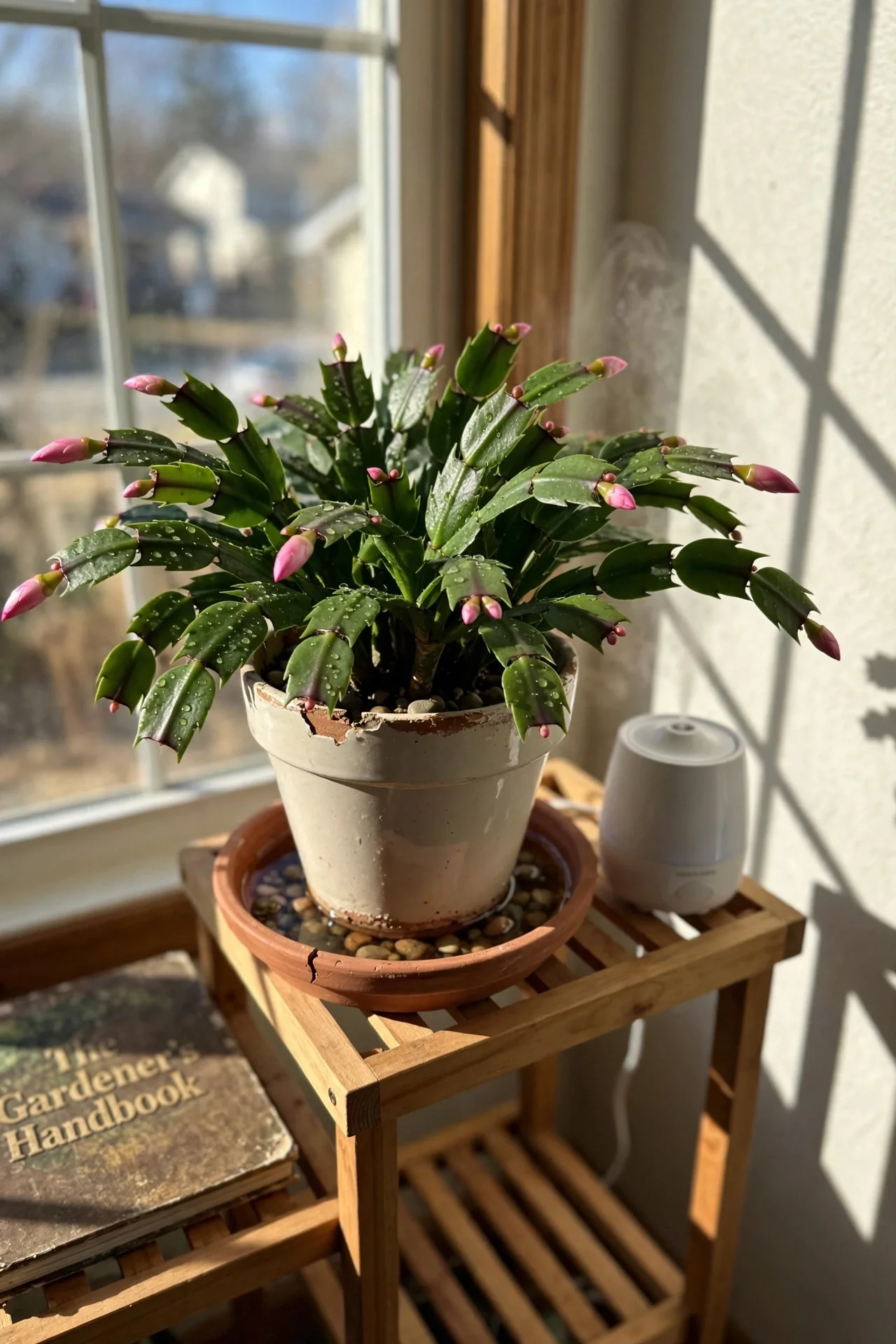
10-minute workflow: (1) Fill a shallow tray with pebbles and water so the water level sits just below the pebble tops. (2) Place the pot on the pebbles, not in the water. (3) Refill the tray as water evaporates, typically every 4 to 7 days. This raises the microclimate humidity around the plant without wetting the roots.
Upgrade option: A small room humidifier set to maintain 50–60% relative humidity in the immediate plant zone. Avoid misting the plant directly during bud and bloom phases; water droplets on petals cause botrytis spotting. If segments look wrinkled despite adequate soil moisture, low humidity is the likely culprit.
8. Post-Bloom Rest
Best for: Branch 1
After the last flower drops, move the plant to a cool room (around 12°C or 54°F) and reduce watering to roughly once every 3 to 4 weeks for 2 months. This rest period is not a “nice to have”; it allows the plant to redirect resources from flowering back into segment growth. Skip this step, and the following year’s bloom will be sparse or absent. Resume normal watering and feeding when new segment growth appears at the tips.
9. Fertilizer Timing
Best for: Branch 2
Use vs. skip: Feed monthly from April through August with a balanced water-soluble fertilizer (e.g., 20-20-20) diluted to half strength. Stop all fertilization by early September. Late-season feeding during bud set encourages vegetative growth at the expense of flowers.
Edge case: If you repotted within the last 6 months, skip fertilizer entirely. Fresh potting mix contains enough nutrients for one growing season, and over-fertilizing a newly potted plant causes salt burn on tender roots. Yellowing segments during the growth season often signal magnesium deficiency; in that case, a single application of Epsom salts (1 teaspoon per gallon of water) corrects it.
Pros: Consistent feeding builds robust segments that support heavy bloom. Cons: Fertilizer build-up in non-draining pots quickly turns toxic.
10. Repotting Without Shock
Best for: Branch 3
What it is: A deliberate, low-trauma repotting strategy that respects the Christmas cactus’s preference for being moderately root-bound.
Why it matters: Over-potting into a container more than 1 inch wider than the current root ball creates a large volume of unused mix that stays wet too long, promoting root rot. This plant blooms more reliably when roots are snug.
Steps: (1) Repot only when roots emerge from drainage holes or water runs straight through without being absorbed. (2) Choose a pot with ample drainage holes, no more than 1 inch larger in diameter than the current pot. (3) Repot in late winter or early spring, right after the post-bloom rest period ends. (4) Tease out only the outer circling roots; do not disturb the central root ball. For a full walkthrough of the technique, see this repotting guide for succulents. (5) Wait 5 to 7 days before watering to let damaged roots heal.
Mistake to avoid: Repotting a plant that is actively budding or blooming. The stress almost guarantees bud drop.
11. Ethylene Protection
Best for: Branch 3
Ripening apples, bananas, and tomatoes release ethylene gas, a plant hormone that accelerates senescence. In Christmas cacti, ethylene exposure during the bud phase triggers bud abscission. If your plant lives in the kitchen, move it to another room from September through December. This factor is widely overlooked but documented in horticultural research on Schlumbergera postharvest handling. The fix costs nothing and takes 30 seconds.
12. Pest Vigilance
Best for: Branch 3
Threshold rule: Inspect segment joints and the soil line monthly using a magnifying glass or phone macro lens. Scale insects appear as small brown bumps that scrape off with a fingernail. Mealybugs leave cottony white residue in segment crevices. If you find either, isolate the plant immediately. For a deeper look at armored pests on cacti, refer to this guide on identifying and treating scale. Early-stage infestations respond to a cotton swab dipped in 70% isopropyl alcohol applied directly to each pest. Repeat every 5 to 7 days for 3 weeks to catch hatching crawlers. Systemic insecticidal soap is the fallback for widespread infestation.
Starter Stack (What to Choose First)
Branch 1: Bloom Rescue Starter
Begin with Item 1 (Dark Period Enforcement) and Item 4 (Bud Drop Prevention). Dark cycling initiates the hormonal cascade for bud formation; locking the environment once buds appear keeps them on the plant. Together these two actions address the top two causes of bloom failure: light pollution and environmental instability. Expect to invest 5 minutes daily for 6 to 8 weeks (covering/uncovering the plant) plus a one-time placement decision. No special equipment needed beyond a cardboard box or dark cloth.
Branch 2: Steady-State Growth Starter
Begin with Item 5 (Epiphyte Soil Mix) and Item 6 (Growth-Phase Watering). Fix the root environment first; everything else (fertilizer uptake, drought tolerance, pest resistance) follows from healthy roots in appropriate substrate. Mixing a batch of soil takes about 15 minutes and costs roughly $12 to $18 for components that will fill multiple pots. Pair this with the finger-test watering approach: check the top 2 inches of mix every 4 to 7 days during the growing season and water only when dry.
Branch 3: Propagation & Reset Starter
Begin with Item 3 (Segment Propagation) and Item 10 (Repotting Without Shock). If the parent plant is declining, taking healthy cuttings preserves its genetics while you troubleshoot the original. If it is simply root-bound, a careful up-potting restores vigor. Propagation costs nothing beyond a small pot and some leftover soil mix. Rooting takes 2 to 4 weeks; repotting takes about 20 minutes including the 5-to-7-day no-water healing window afterward.
When This Won’t Work
Failure condition 1: The plant has advanced basal stem rot. If the lowest segments are mushy, brown, and easily detach from the central stem, the rot has likely reached the vascular core. At this stage, improving watering habits will not reverse the damage. The correct alternative: take healthy segment cuttings from the upper portion of the plant and propagate them as described in Item 3. Discard the original root ball and sterilize the pot before reusing it.
Failure condition 2: The plant has never bloomed despite correct light cycling and temperature drops, and segments are thin and pale. This suggests the plant is not a Christmas cactus (Schlumbergera x buckleyi) but a Thanksgiving cactus (Schlumbergera truncata) with different segment morphology and a slightly earlier bloom window. The care protocols overlap but the timing shifts by roughly 4 weeks. If bloom consistently misses the holiday window but occurs in late November, you are caring for a Thanksgiving cactus. The same grid applies; simply start the dark-period protocol 4 weeks earlier next season. For a broader comparison of cactus types and their care divergence, see this overview of cactus versus succulent needs.
Choosing the Right Option for Your Situation
Budget Threshold
If your budget is under $15, focus on Items 4 (Bud Drop Prevention), 2 (Temperature Drop Protocol), and 11 (Ethylene Protection). These three cost nothing and deliver the highest impact per dollar spent. Soil amendments and humidifiers can follow later once the plant’s bloom cycle is stabilized.
Time Threshold
If you have fewer than 10 minutes per week for plant care, prioritize Items 5 (Epiphyte Soil Mix, a one-time effort), 8 (Post-Bloom Rest, seasonal), and 12 (Pest Vigilance, monthly). Avoid Items 1 (Dark Period Enforcement) and 7 (Humidity Management), which require daily or near-daily attention for weeks at a stretch.
Technical Constraint: Window Orientation
An east-facing window is ideal; it delivers bright indirect light without the scorching afternoon heat of a south or west exposure. If your only available window faces north, supplement with a full-spectrum grow light positioned 12 to 18 inches above the plant for 10 to 12 hours daily during the growth season. If the only window faces south, place the plant 3 to 4 feet back from the glass or behind a sheer curtain to diffuse direct rays.
Yes/No Checklist:
- Can you provide 12 to 14 hours of uninterrupted darkness daily for 6 to 8 weeks in autumn? Yes / No
- Can you maintain nighttime temperatures between 55°F and 65°F during that same window? Yes / No
- Does your pot have at least one drainage hole and a saucer that does not trap standing water? Yes / No
- Can you commit to not moving or rotating the plant from the moment buds appear until the last flower drops? Yes / No
Expert Q&A
Why does my Christmas cactus drop buds when I bring it home from the store?
The plant experiences three simultaneous shocks: a change in light intensity, a shift in temperature (from greenhouse to home), and vibration during transport. Each factor alone can trigger bud abscission. Combined, bud drop is nearly certain. Place the plant in its permanent spot immediately and expect that the current bloom cycle may be lost. Next year’s buds, set in your consistent home environment, will hold.
Can a Christmas cactus survive outdoors in summer?
Yes, in USDA zones 10 and above, and in cooler zones during frost-free months. Place it in full shade or dappled light only; direct outdoor sun burns segments within hours. Bring it back inside when nighttime temperatures drop below 50°F (10°C). Outdoor summer placement often accelerates segment growth due to increased humidity and air circulation.
Why are the segments turning red or purple?
Red or purple pigmentation signals stress from one of three sources: excessive direct light, phosphorus deficiency, or prolonged drought. Move the plant to a shadier spot first. If color does not revert to green within 2 to 3 weeks, apply a half-strength balanced fertilizer. If segments are also wrinkled, increase watering frequency slightly while maintaining good drainage.
Is bottom-watering better for Christmas cactus?
Bottom-watering is effective for evenly rehydrating a severely dried-out root ball, but it should not be the default method. Salts from fertilizer accumulate in the top layer of mix and need occasional top-down flushing. Use bottom-watering as a once-per-season reset, not a weekly routine. Always discard any water that remains in the saucer after 30 minutes.
How do I tell a Christmas cactus from a Thanksgiving cactus?
Look at the flattened stem segments (phylloclades). Christmas cactus segments have rounded, scalloped edges with no points. Thanksgiving cactus segments have 2 to 4 saw-tooth points along each edge. Bloom time also differs: Thanksgiving cactus flowers in November; true Christmas cactus flowers closer to late December or January. The care protocols are identical; only the calendar timing shifts.
Conclusion
The single decision that determines whether a Christmas cactus thrives or declines is whether you treat it as an epiphyte or a desert plant. Every other care variable (water volume, fertilizer strength, pot size) flows from that fundamental distinction. The most common mistake is letting the mix go bone-dry between waterings during the growing season; this plant tolerates dryness during rest periods but needs consistent, modest moisture when actively producing segments and buds.
If you take one action after reading this guide, make it the 6-to-8-week dark-period protocol starting in late September. For a complementary look at how to manage watering across the entire year, see this seasonal watering schedule for cacti.