
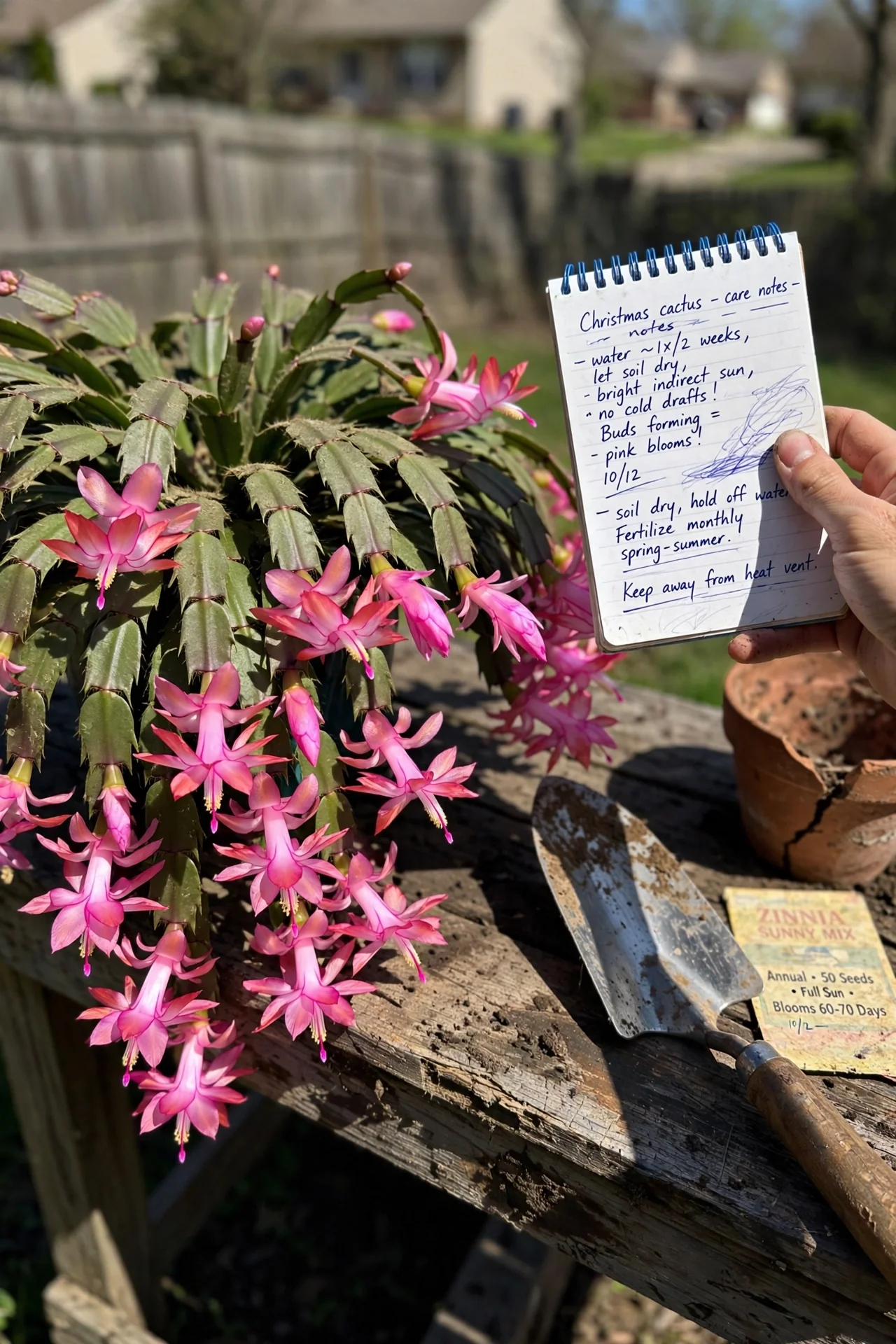
Most “Christmas cactus ideas” listicles throw 20 craft projects at you and hope one sticks. The real sorting problem is simpler: you either have a plant that will not bloom, a plant you want to display beautifully right now, or you need a gift that will not embarrass you by February. This article sorts every idea by which problem it actually solves.
Scope: all ideas below involve a living Schlumbergera (Christmas or Thanksgiving cactus). We skip artificial plants, crochet patterns, and desert-cactus-decorated-as-Christmas-tree projects. Those are festive, but they answer a different search.
By the end, you will know which three ideas match your current season, time budget, and risk tolerance, plus which two ideas to avoid if your plant’s buds have already set.
Bottom line: Pick the branch that matches your calendar and your plant’s condition first; the specific idea matters less than the timing match.
The Yield Grid Decision Grid
All ideas below fall into three branches. Pick the branch that fits your situation now.
Branch 1: My plant won’t bloom. Your Christmas cactus is healthy, green, and growing, but refuses to set buds. You are willing to manage light and temperature for 6 to 8 weeks. Recommended: Items 1, 5, 6 below.
Branch 2: My plant is blooming or loaded with buds right now. You need display, staging, and gift-wrapping strategies that do not disturb buds or cause bud blast. Recommended: Items 2, 7, 10 below.
Branch 3: I want to give a Christmas cactus as a gift. You are propagating, packaging, or selecting a plant for someone else. The recipient may or may not know how to keep it alive. Recommended: Items 3, 4, 8, 9 below.
If you are still building your baseline care routine, start with our watering schedule framework (the same seasonal-logic approach applies to Christmas cactus with adjusted intervals).
Quick Comparison Table
| Option | Key Mechanism | Best For | Decision Grid Branch | Effort Score (1–5) |
|---|---|---|---|---|
| 1. Short-Day Dark Treatment | 14-hour uninterrupted darkness for 6–8 weeks | Non-blooming plant, September–October start | Branch 1 | 5 |
| 2. Elevation Display Stand | Vertical staging without moving the plant | Budded plant, entryway or side table | Branch 2 | 1 |
| 3. Propagation Station Gift | Root 2–3 segment cuttings in soil or water | Budget gifting, spring timing | Branch 3 | 3 |
| 4. Cachepot Upgrade Kit | Drop-in decorative pot, no repotting | Instant presentation upgrade | Branch 3 | 1 |
| 5. Temperature-Only Bud Trigger | Cool nights at 50–55°F, no dark manipulation | Unheated porch or cool bedroom in fall | Branch 1 | 2 |
| 6. Post-Bloom Restart Prune | Prune up to 1/3 of plant after flowering | Leggy plant, January–February timing | Branch 1 | 2 |
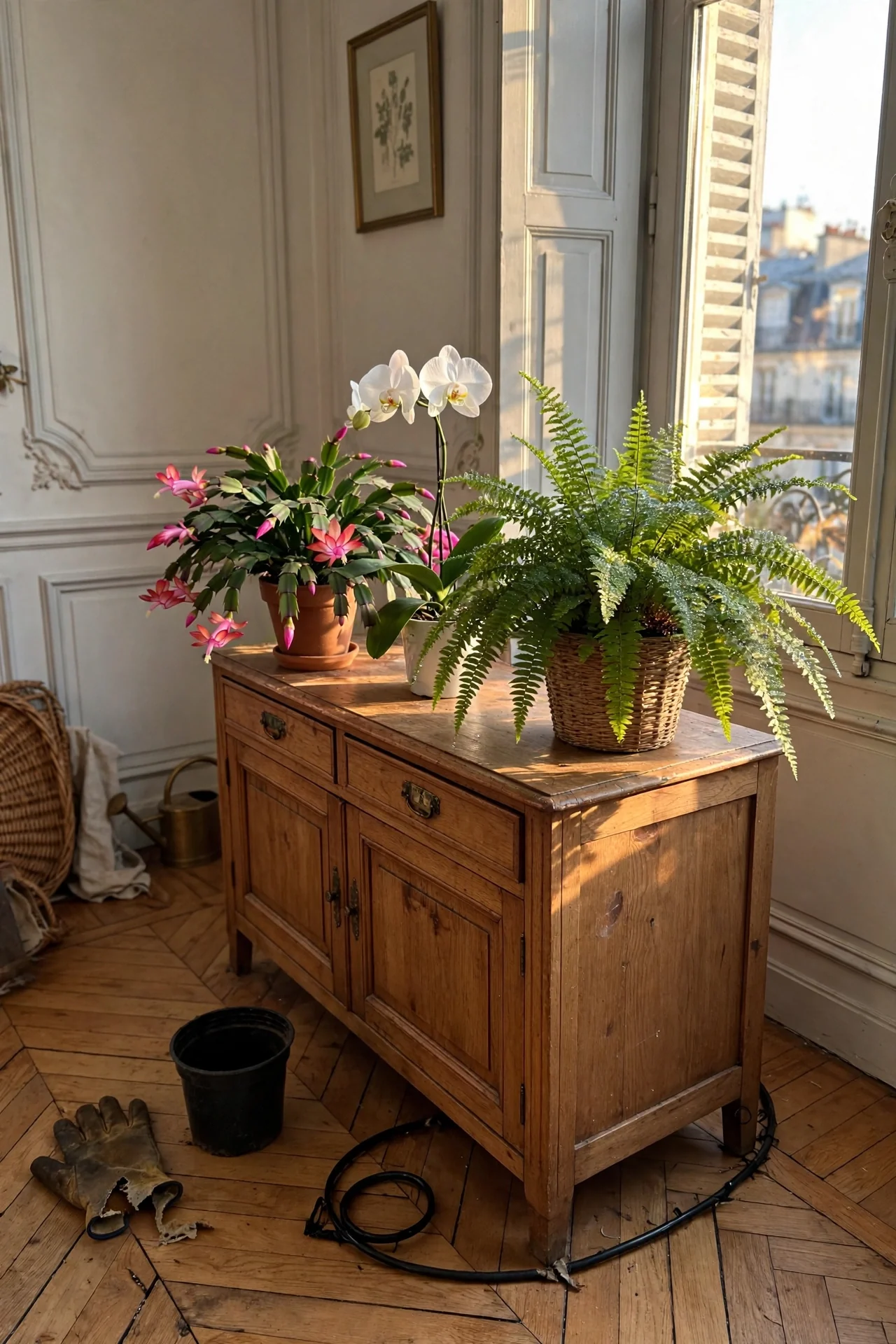
| 7. Companion Plant Holiday Grouping | Cluster with orchids, ferns, or African violets | Blooming plant, shared humidity needs | Branch 2 | 1 |
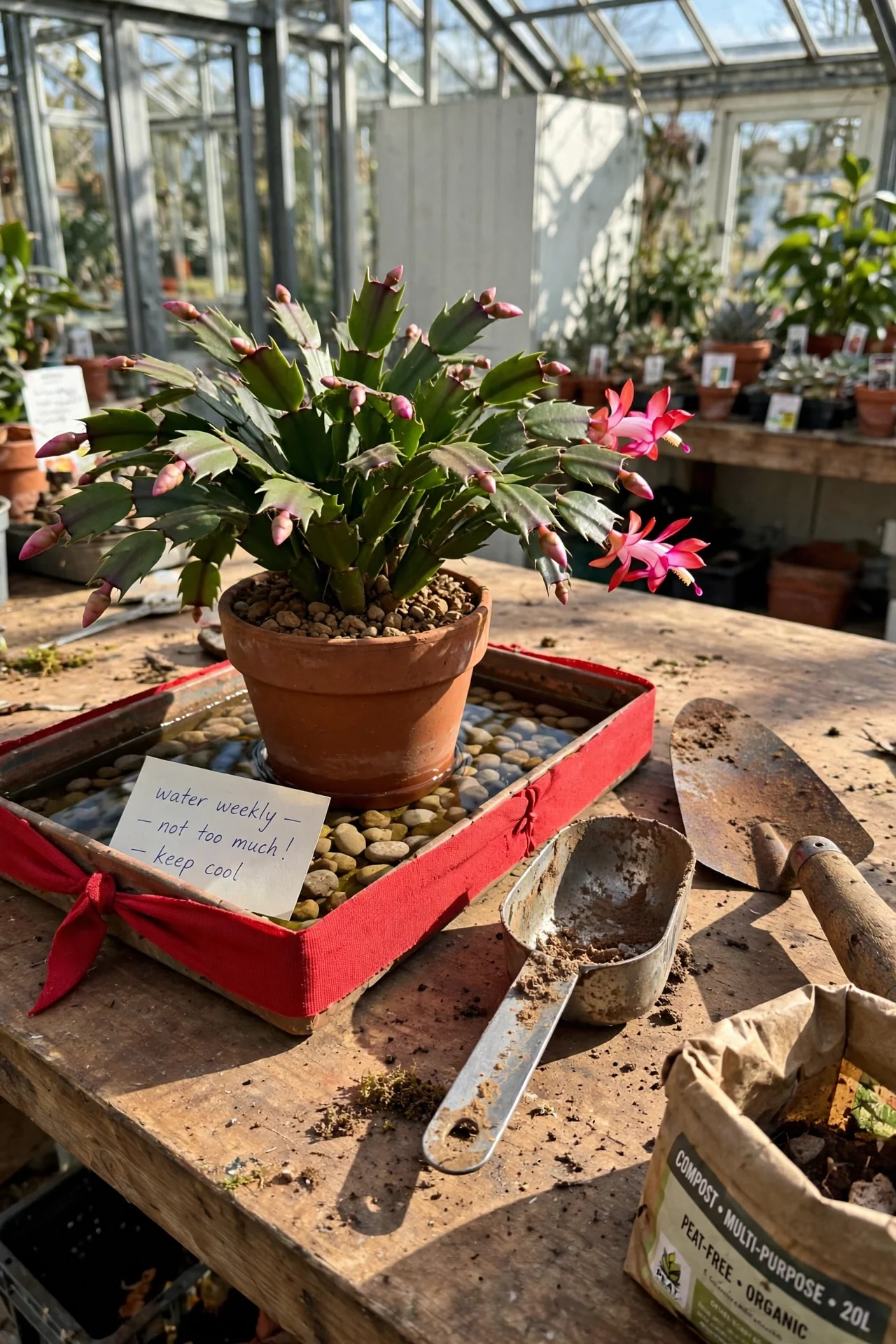
| 8. Pebble Tray + Gift Wrap Combo | Humidity tray hidden inside decorative gift wrap | Gifting to dry-home recipients | Branch 3 | 2 |
| 9. Blooming-Phase Delivery Strategy | Transport plant only when buds are tight and unopened | Gifting at peak holiday timing | Branch 3 | 3 |
| 10. East-Facing Window Staging | Gentle morning light for bloom longevity | Blooming plant, east or north window access | Branch 2 | 1 |
1. Short-Day Dark Treatment (The 14-Hour Method)
Best for: Branch 1 (non-blooming plant)
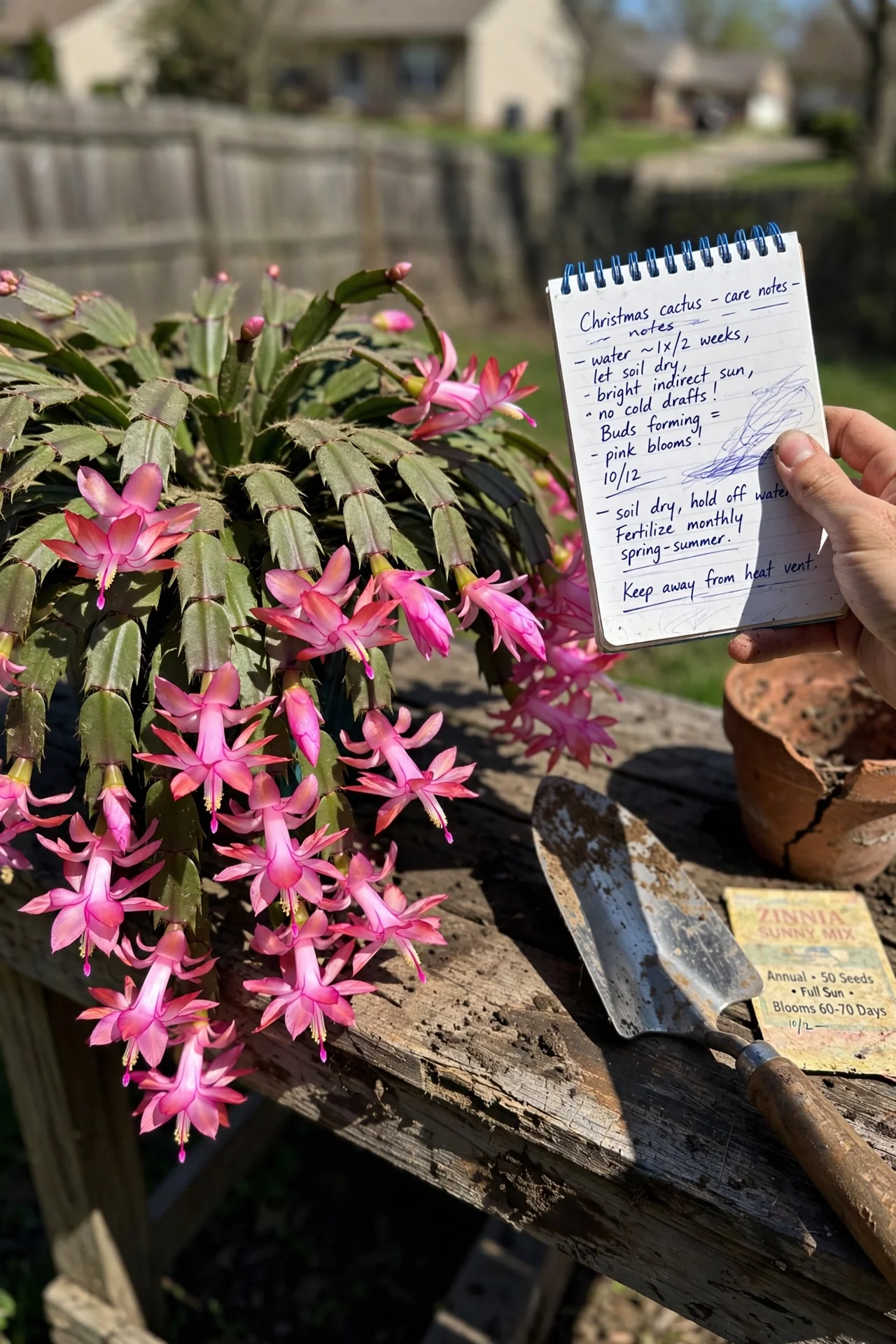
Christmas cactus is a short-day plant. Flower buds initiate only when nights are long and uninterrupted. Starting around mid-September to early October, provide 14 hours of complete darkness every 24-hour cycle for 6 to 8 consecutive weeks. During the remaining 10 hours, place the plant in bright but indirect light.
The critical constraint most sources skip: “uninterrupted” means zero light. Even a lamp turned on for 30 seconds during the dark period can reset the hormonal clock. Use a closet that nobody opens after 6 PM, or cover the plant with a black cloth or cardboard box. If night temperatures stay between 55°F and 70°F, 13 hours of darkness suffices. If temperatures stay above 70°F, extend darkness to 15 hours. Once buds are visible at the tips of stem segments (typically 6 to 8 weeks after starting treatment), you can return the plant to normal lighting and warmer temperatures.
The most common mistake is continuing to fertilize during the dark treatment. Stop all fertilizer from mid-September until buds are fully formed. High-nitrogen feeding during the short-day window suppresses bud initiation and encourages foliage growth instead.
2. Elevation Display Stand
Best for: Branch 2 (budded plant)
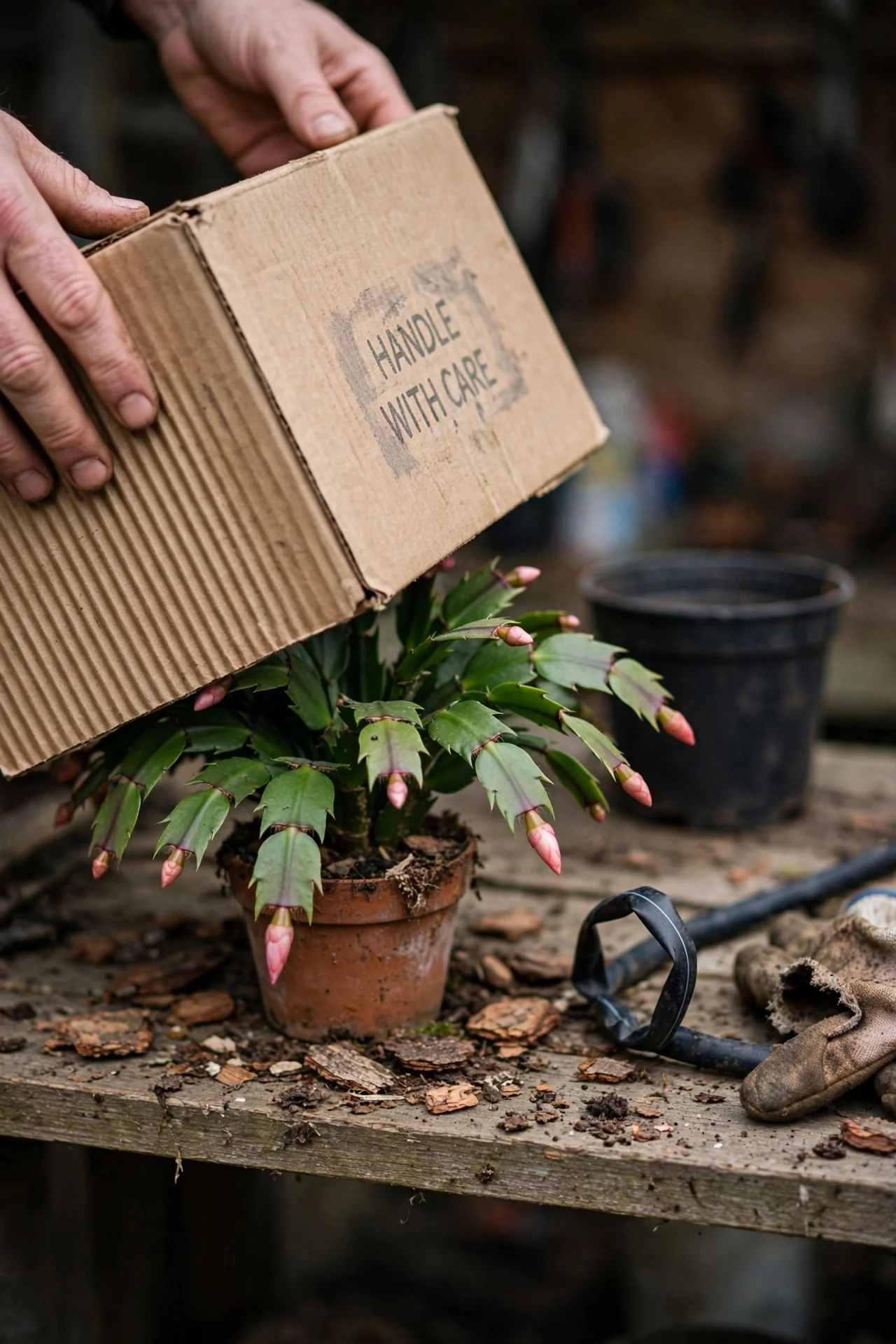
A Christmas cactus in full bloom has a trailing habit that disappears on a low table. Elevate the pot on a plant stand, column pedestal, or stack of books so the cascading stems hang freely at eye level. This requires no repotting and zero disturbance to buds. For plants wider than 18 inches, use a stand with a footprint at least 10 inches across to prevent tipping. Pair with a neutral pot cover so the flower color remains the focal point.
3. Propagation Station Gift
Best for: Branch 3 (gifting)
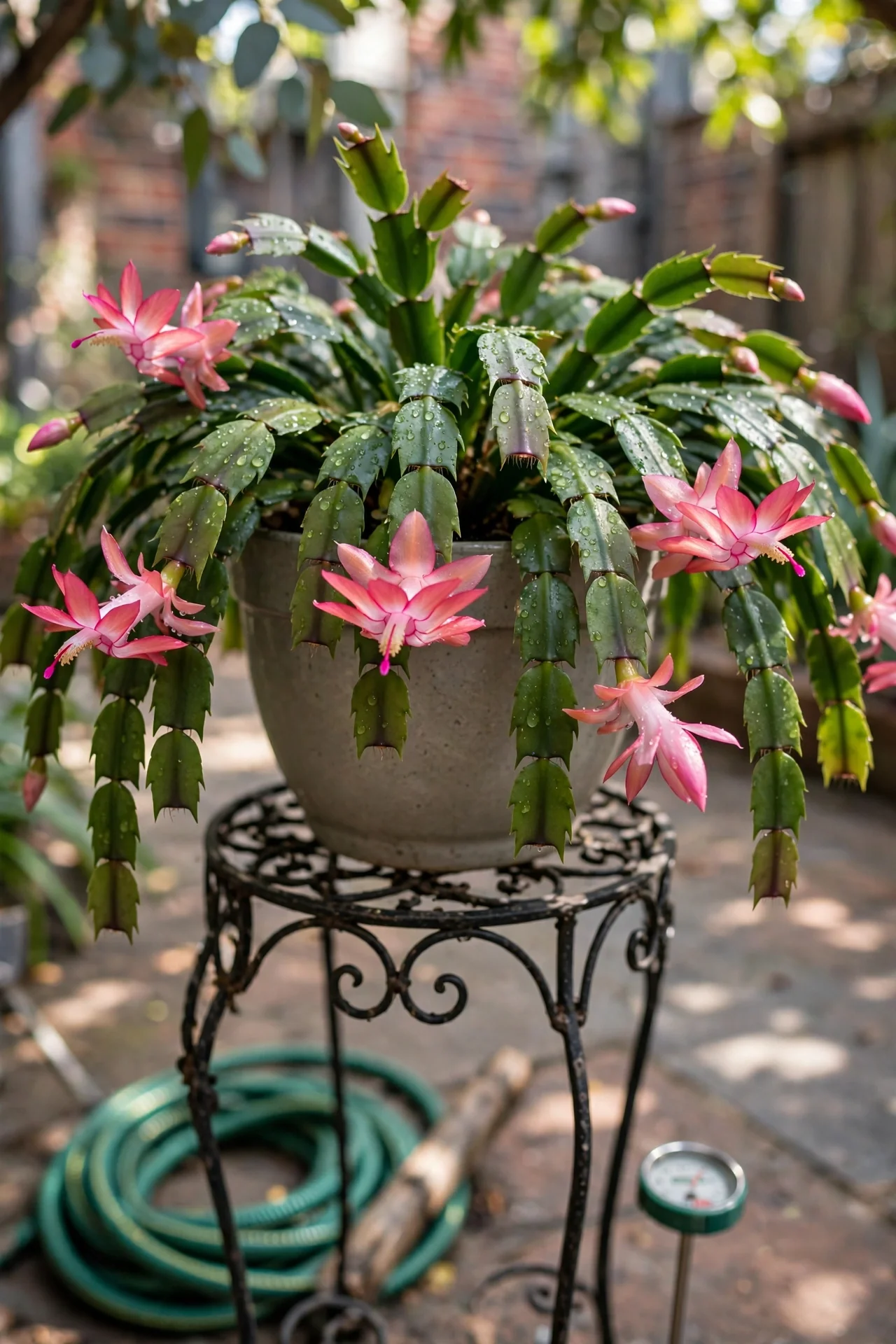
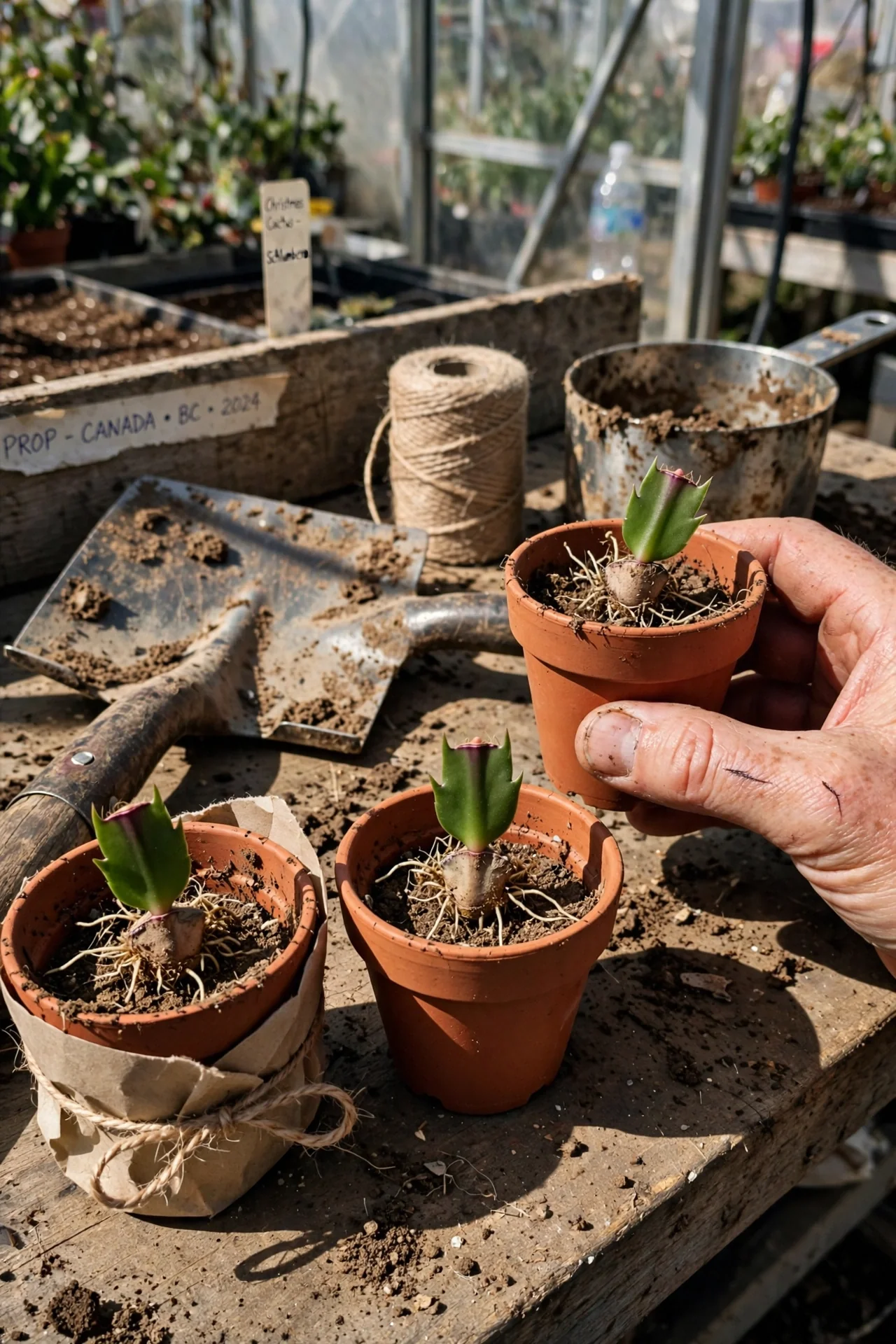
Instead of giving a full plant, gift a rooted cutting in a small container. Take 2 to 3 healthy stem segments from a mature plant after flowering ends (January through March). Let the cut ends callus for 24 to 48 hours in a dry spot with indirect light. Plant the bottom segment about 1 inch deep in a 3-inch pot filled with a mix of 1 part potting soil to 1 part perlite. Water sparingly: keep the medium barely moist, not wet, until roots develop in 4 to 6 weeks. The recipient gets a plant that has already survived the hardest phase, and you spend under $5 on materials.
For a presentation upgrade, wrap the nursery pot in kraft paper and tie it with twine, then nestle it inside a small decorative container from our orchid pot ideas collection (the same visual principles transfer directly).
4. Cachepot Upgrade Kit
Best for: Branch 3 (gifting)
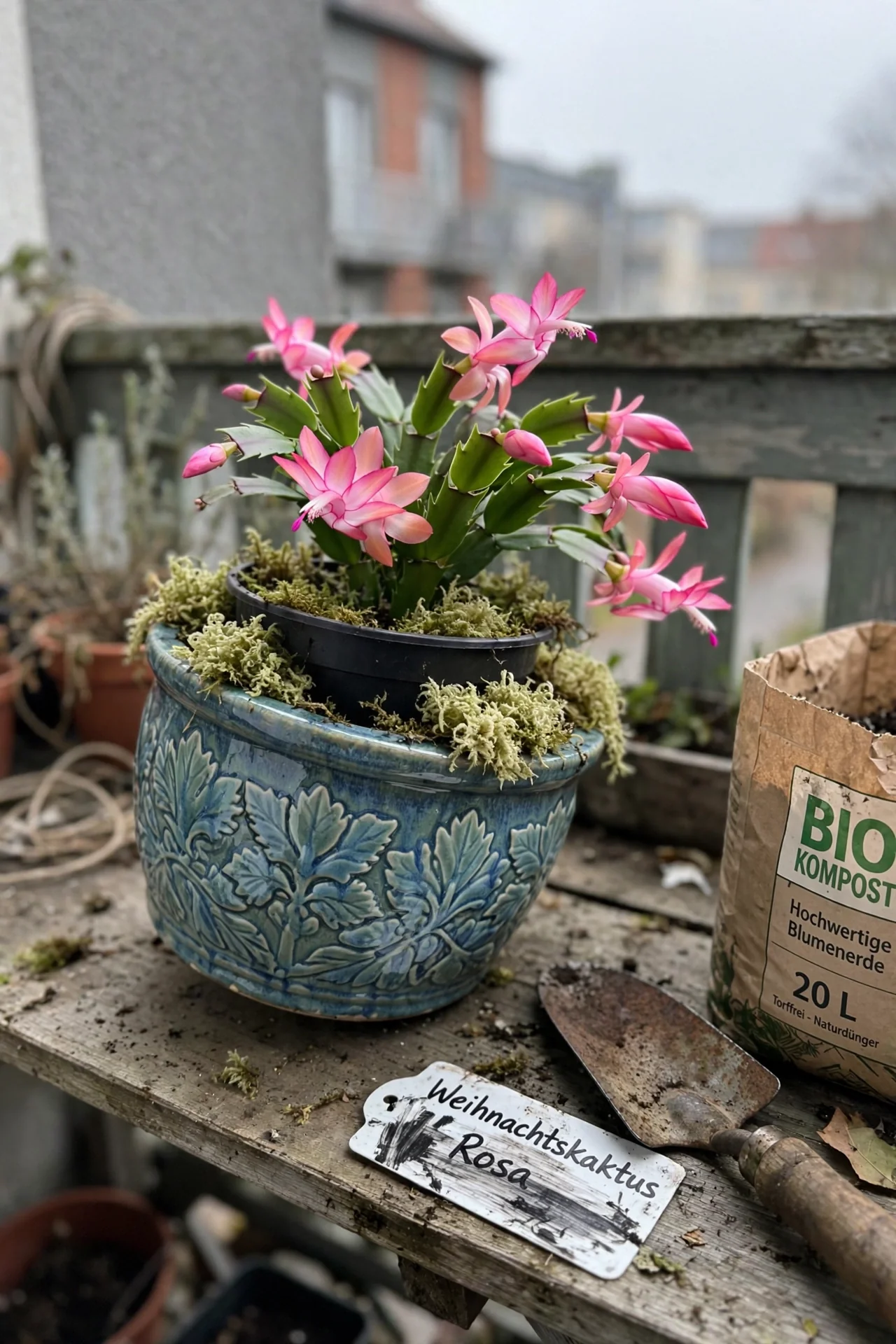
The cachepot strategy avoids repotting entirely. Buy or repurpose a decorative container that is 1 to 2 inches wider than the grow pot. Drop the entire nursery pot inside. No root disturbance means zero bud blast risk. Add a thin layer of sphagnum moss on top to hide the grow pot rim. This works especially well with ceramic or glazed containers that have no drainage hole: the inner grow pot handles drainage, and the outer container catches drips. Choose a container with a depth at least as deep as the grow pot to avoid restricting the trailing stems.
5. Temperature-Only Bud Trigger
Best for: Branch 1 (non-blooming plant)
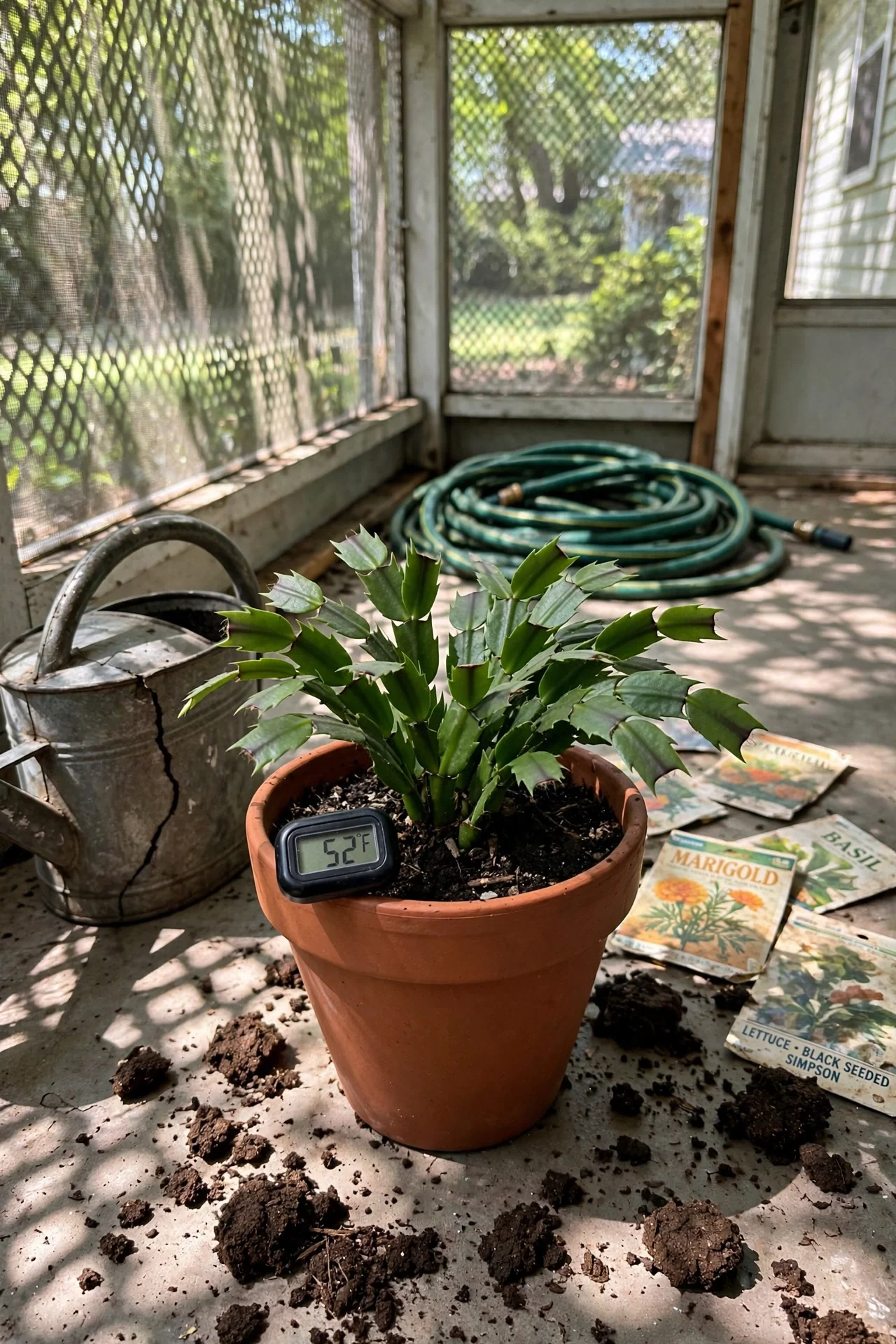
If you cannot manage daily dark treatments, cool night temperatures alone can induce bud set. Keep the plant in a location where nighttime temperatures stay between 50°F and 55°F for at least 4 consecutive weeks starting in late September. An unheated spare bedroom, enclosed porch, or cool basement works. Daytime temperatures can rise to 65°F to 70°F. This method is less reliable than the full short-day treatment, but it succeeds when natural autumn photoperiod and cooling coincide. Reduce watering frequency to every 2 to 3 weeks during this period; slightly dry soil stress can enhance bud initiation.
6. Post-Bloom Restart Prune
Best for: Branch 1 (non-blooming plant, post-flowering timing)
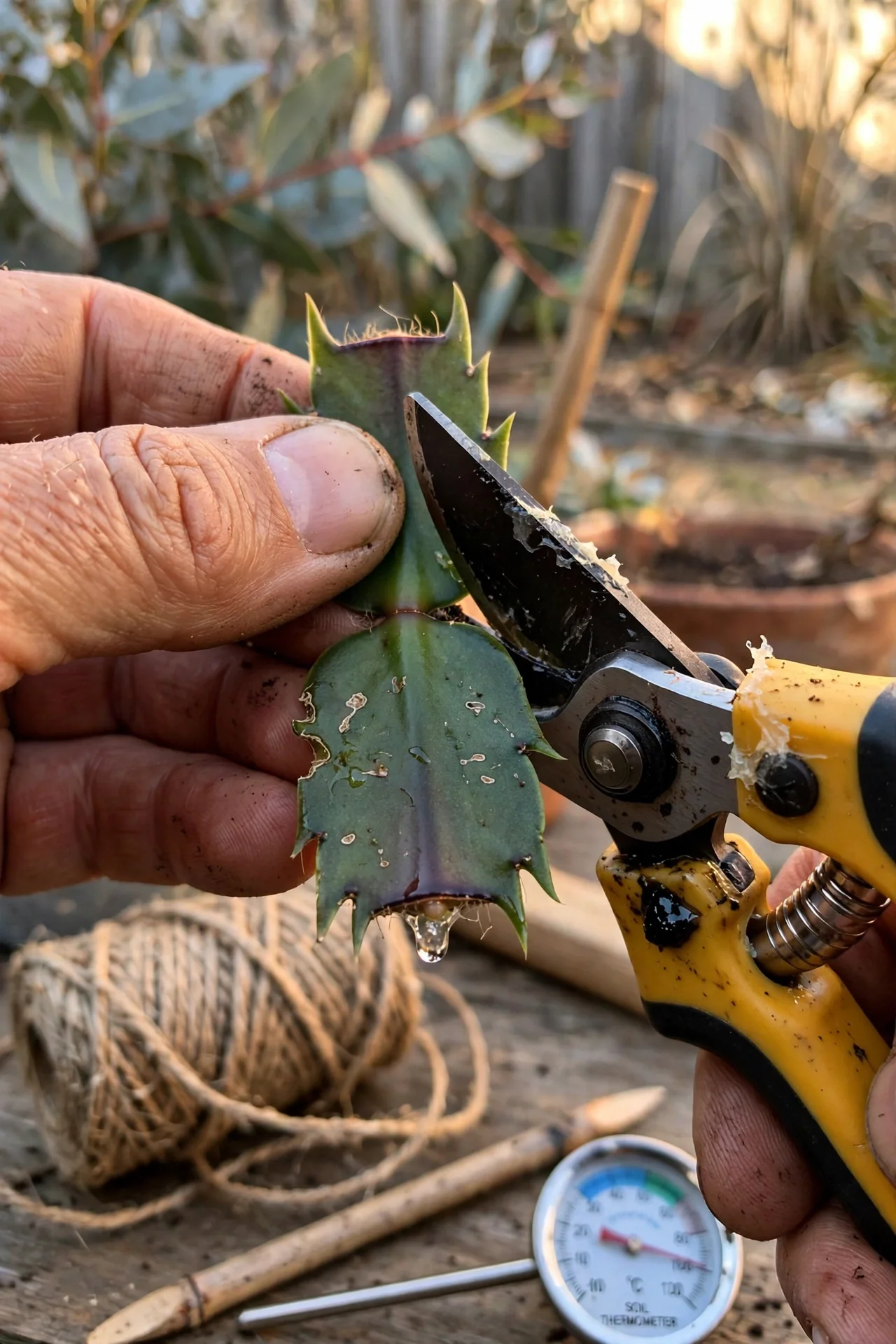
If your plant bloomed sparsely or has become leggy, prune it back immediately after flowering finishes (January to February). Remove up to one-third of the total stem length, cutting just above a segment joint. Do not cut into woody, corky stems; new growth rarely emerges from fully lignified tissue. Each cut triggers branching from the next joint down, creating a fuller plant with more potential bloom sites the following season. Save the healthy pruned segments for propagation (see item 3). Avoid pruning after March: new growth that emerges too late in spring may not mature in time to set buds that fall.
7. Companion Plant Holiday Grouping
Best for: Branch 2 (blooming plant)
Cluster your flowering Christmas cactus with plants that share similar humidity and indirect-light preferences. Orchids, African violets, Boston ferns, and peace lilies all thrive in bright filtered light and appreciate the elevated humidity a plant grouping creates. This arrangement increases local humidity around the buds (reducing bud blast) and transforms a single pot into an intentional holiday vignette. Keep all pots on individual saucers or a shared pebble tray so watering one plant does not drown another.
If you want the grouping to feel cohesive, vary pot heights and textures using ideas from our orchid arrangement guide (the layering principles apply across houseplants).
8. Pebble Tray + Gift Wrap Combo
Best for: Branch 3 (gifting to dry-home recipients)
A Christmas cactus in a home with forced-air heating may drop buds within days from low humidity. Build a pebble tray into the gift: fill a shallow, waterproof tray with a single layer of pebbles, add water to just below the pebble surface, and set the pot on top. As water evaporates, it creates a localized humid zone around the plant. Wrap the tray and pot together with wide ribbon so the recipient unwraps the humidity solution along with the plant. Include a small note: “Add water to the pebbles when they look dry.”
9. Blooming-Phase Delivery Strategy
Best for: Branch 3 (gifting)
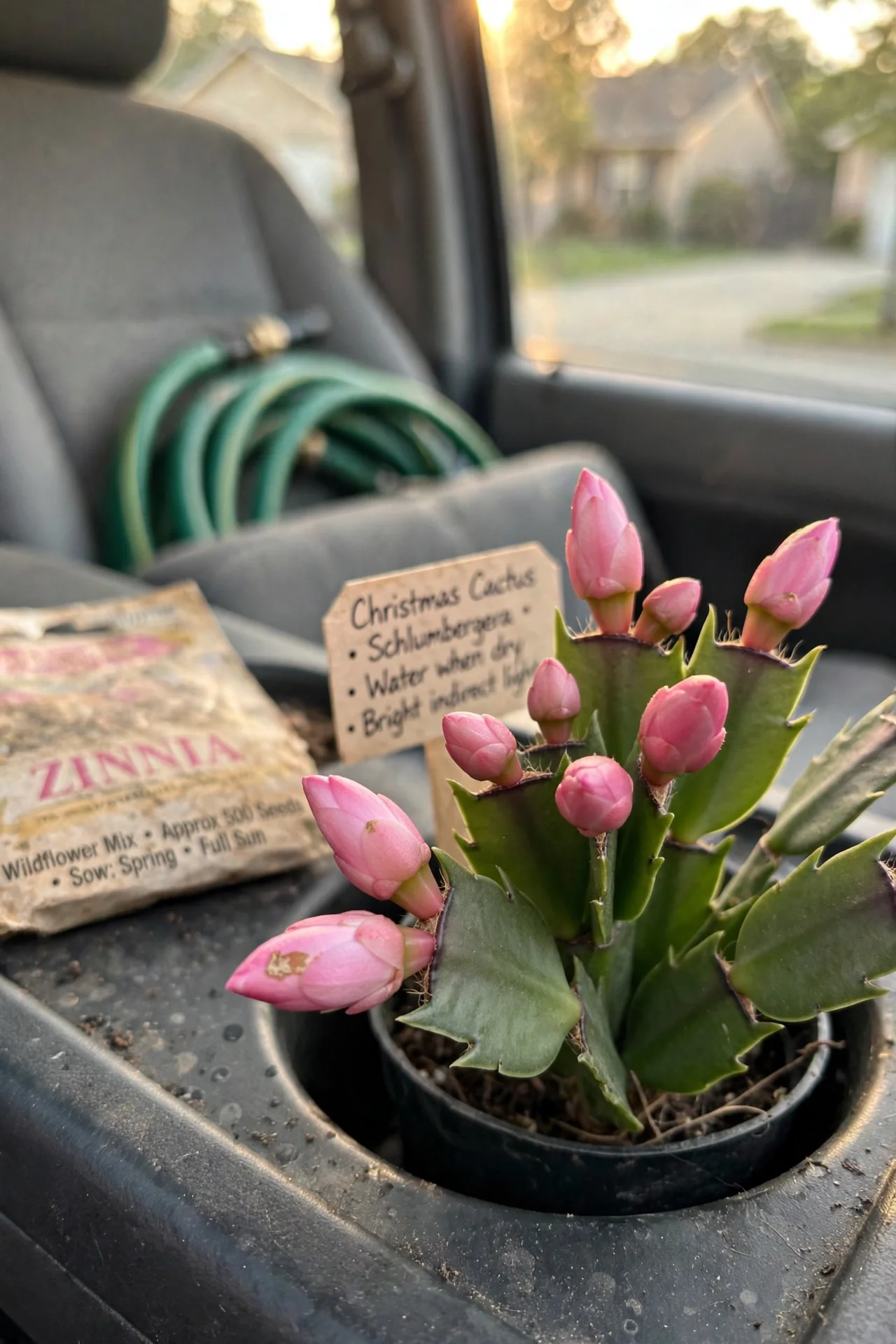
Transporting a Christmas cactus with open flowers invites bud drop. The safest delivery window is when buds are swollen, showing color at the tips, but not yet unfurled. This stage is sometimes called “tight bud” or “color-crack.” At this point, buds are less sensitive to vibration and temperature fluctuations than fully open blooms. If you must transport a plant in full flower, wrap the pot and base in paper, leave the stems and blooms uncovered, and keep the car interior between 60°F and 70°F. Avoid placing the plant near a heat vent or cold window during the drive. Allow 24 hours of settling time at the destination before the recipient moves or rearranges the plant.
10. East-Facing Window Staging
Best for: Branch 2 (blooming plant)
Once buds are open, light quality determines bloom longevity. An east-facing window provides gentle morning sun for 2 to 4 hours and bright indirect light the rest of the day. This keeps flowers vibrant without the leaf bleaching or bud scorching that south- and west-facing windows can cause. If an east window is not available, a north-facing window works well too. For south or west windows, place the plant at least 3 feet back from the glass or filter the light through a sheer curtain. Avoid moving the plant once flowers open; even a quarter-turn rotation can cause the plant to drop blooms as it reorients to the light source.
For more display concepts that work with flowering houseplants, browse our orchid centerpiece ideas (the staging logic transfers directly to Christmas cactus).
Starter Stack (What to Choose First)
Branch 1 Starter: Bud Trigger Combo
Start with the Temperature-Only Bud Trigger (item 5) and add Short-Day Dark Treatment (item 1) only if buds do not appear after 4 weeks of cool nights. Synergy: cool nights reduce the number of darkness hours you need to manage. Time estimate: 5 minutes daily for 6 weeks if both methods are combined. Cost: $0 to $5 for a cardboard box or black cloth.
Branch 2 Starter: Display Confidence Combo
Pair the East-Facing Window Staging (item 10) with an Elevation Display Stand (item 2). Synergy: correct light extends bloom life while elevation shows off the cascading form. Time estimate: 10 minutes to reposition the plant and set up a stand. Cost: $0 to $30 if buying a plant stand.
Branch 3 Starter: Gift-Ready Combo
Combine the Cachepot Upgrade Kit (item 4) with the Pebble Tray + Gift Wrap Combo (item 8). Synergy: the cachepot makes the plant look finished; the pebble tray solves the recipient’s dry-air problem before it starts. Time estimate: 20 minutes to assemble. Cost: $10 to $25 for a cachepot and pebbles.
When This Won’t Work
Condition 1: The plant is a Thanksgiving cactus sold as a Christmas cactus. Most commercially available “Christmas cacti” are actually Schlumbergera truncata (Thanksgiving cactus), which naturally blooms 4 to 6 weeks earlier than true Christmas cactus (Schlumbergera x buckleyi). If your plant has pointed, claw-like teeth on the stem margins, it is a truncata type. No amount of dark treatment in December will make a Thanksgiving cactus bloom at Christmas; its internal clock already ran in November. The fix is to accept the plant’s natural timing and enjoy the blooms whenever they appear, or purchase a verified S. x buckleyi from a specialty grower.
Condition 2: The plant is recovering from root rot or severe dehydration. A Christmas cactus with mushy, translucent stem segments or roots that are brown and slimy (not firm and white) cannot support blooming. Dark treatments, fertilizer, and display staging are wasted on a plant in survival mode. Remove the plant from its pot, trim away all rotten roots with sterilized scissors, and repot in fresh well-draining mix (1 part potting soil, 2 parts peat moss, 1 part perlite or coarse sand). Wait until you see active new growth before attempting any bud-trigger method. If you are building a terrarium or mounted display after recovery, our orchid mounting ideas page covers attachment techniques that work for epiphytic cacti too.
Choosing the Right Option for Your Situation
Budget Threshold
If your budget is under $10, stick to items 1, 5, 6, and 10. These require no purchase beyond what you likely already have: a cardboard box, a cool room, and a pair of scissors. Items 2, 4, and 8 may require a pot or stand purchase ($15 to $40). Items 3 and 9 have negligible materials cost but require timing precision.
Time Threshold
If you have 5 minutes per day, items 1 and 9 are feasible (moving a plant or box daily). If you have 30 minutes once and want to be done, choose items 2, 4, 7, or 10. Items 3 and 6 require a focused 30-minute session once, then weeks of passive waiting.
Technical Constraint: Buds Already Present
If buds are already visible, do not move the plant, change its light exposure, alter watering frequency, or repot it. Any of these changes can trigger bud blast. Only items 2, 4, 7, and 10 are safe with existing buds. Items 1, 5, 6, and 9 are for plants without buds. Item 8 is safe if applied carefully without repositioning the pot.
Quick Yes/No Checklist:
Buds visible on the plant? → Yes: use items 2, 4, 7, 10 only.
Is it September or October? → Yes: items 1 and 5 can trigger holiday blooms.
Do you need a gift for someone with no plant experience? → Yes: include item 8 (pebble tray) in your gift.
Is the plant showing wilted or mushy segments? → Yes: skip all items; address root health first.
Expert Q&A
Why does my Christmas cactus bloom in November instead of December?
Your plant is likely a Thanksgiving cactus (Schlumbergera truncata), identifiable by pointed, claw-like teeth on stem segment edges. True Christmas cactus (S. x buckleyi) has rounded, scalloped margins and blooms later. Most commercially sold plants are truncata types. The naming is a retail convention, not a botanical guarantee.
Can I use ice cubes to water a Christmas cactus?
Not recommended. Christmas cacti are tropical epiphytes, not desert cacti. Ice-cold water shocks the roots and can cause bud drop. Use room-temperature water and apply it to the soil surface until it drains from the pot bottom. Water only when the top inch of soil feels dry.
How long can a Christmas cactus live with proper care?
Documented specimens have survived 70 to over 100 years when passed through generations. These long-lived plants develop woody, corky basal stems and can reach 3 to 4 feet in diameter. The key to longevity is avoiding overwatering and repotting only every 3 to 4 years into a container just 1 to 2 inches larger.
Is Christmas cactus toxic to cats and dogs?
Christmas cactus (Schlumbergera species) is classified as non-toxic to cats, dogs, and horses by the ASPCA. However, ingesting large quantities of the fibrous stem segments can cause mild gastrointestinal upset, vomiting, or diarrhea in some pets. The plant is a safer holiday choice than poinsettias or lilies.
What soil pH does a Christmas cactus need?
The optimal pH range is 5.5 to 6.2, which is mildly acidic. Most standard potting mixes fall within this range. If you are mixing your own soil, combine 1 part sterile potting soil, 2 parts peat moss, and 1 part perlite or coarse sand. Peat moss naturally acidifies the mix and improves drainage.
Conclusion
The single biggest mistake with Christmas cactus ideas is starting at the wrong point on the calendar. If buds are already set, any technique that involves moving, repotting, or changing the light cycle will undo weeks of the plant’s work. Match your action to the plant’s current stage, not the date on your wish list.
Next step: Identify whether you are in Branch 1, 2, or 3 right now, then execute exactly one idea from that branch. If you are planning ahead for next year’s bloom cycle, our orchid gift ideas page includes seasonal timing logic that applies to any flowering houseplant gift.