
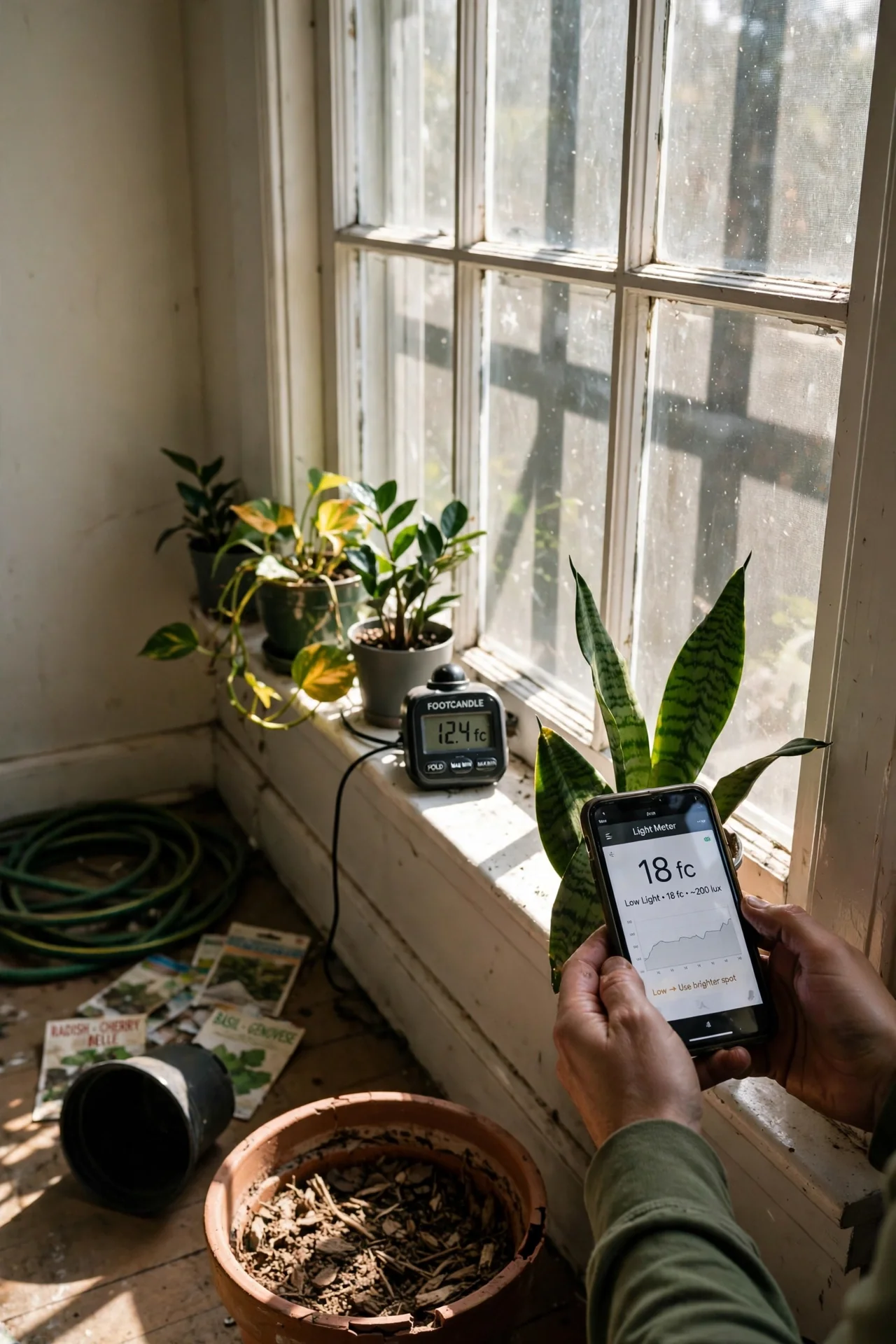
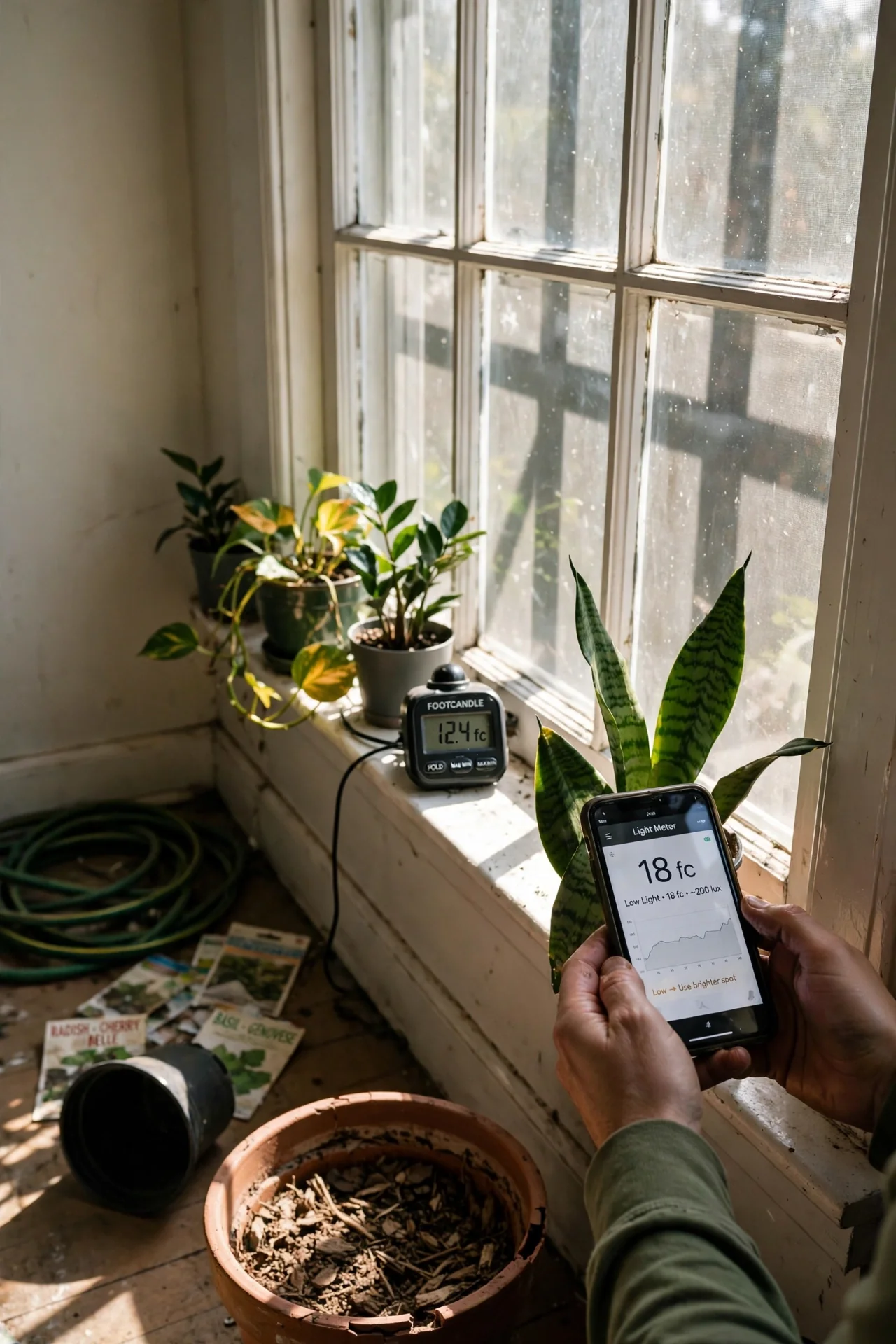
Most “best low light houseplants” lists skip the only number that matters: foot-candles. A room that feels bright to human eyes often measures below 15 foot-candles (FC) at plant level, which is deep shade for most species. This guide reframes the search around measurable light thresholds. If a plant cannot sustain healthy foliage below 25 FC for extended periods, it does not belong on this list.
Scope: species that maintain turgid, non-etiolated growth at 10–25 FC for 8+ hours daily, without requiring a grow light supplement. Excluded are plants that merely “tolerate” low light by slowly declining over 6–12 months. Every recommendation assumes ambient room temperatures between 65–78°F (18–26°C) and standard household humidity (30–50%). Plants requiring dormancy or seasonal light fluctuation are omitted.
After reading, you will be able to match a plant to a specific north-facing window measurement, decide between two similarly tolerant species based on your watering habits, and identify the single maintenance variable most likely to cause failure in your particular room.
Bottom line: If you do not measure your light first with a basic foot-candle meter or phone app, even the most tolerant plant on this list will eventually decline.
The Yield Grid Decision Grid
Match your conditions to one branch. Each path directs you to plants optimized for that constraint.
Branch 1: Light below 10 FC for more than 4 hours daily. This is a windowless bathroom or an interior hallway. Only species with a documented ability to survive on fluorescent office lighting alone qualify here. Moisture management is critical because transpiration is extremely slow. Recommended: Items 1, 4, 7 below.
Branch 2: Light between 10–25 FC, north-facing window or 8+ feet from an east/west window. This is the largest group. Plants here photosynthesize slowly but steadily. The primary risk is overwatering, not light deficiency. Recommended: Items 2, 3, 5, 8, 10 below.
Branch 3: Light oscillates between 5–25 FC due to seasonal shift or partial obstruction. Your plant experiences intermittent energy deficits. Species here need the physiological ability to pause growth without tissue damage during dim weeks. Recommended: Items 6, 9, 11 below. For offices with unpredictable lighting, our office plant light guide maps specific desk placements to foot-candle readings.
Quick Comparison Table
| Option | Key Mechanism | Best for | Decision Grid Branch | Effort Score (1–5) |
|---|---|---|---|---|
| Snake Plant (Sansevieria trifasciata) | Crassulacean Acid Metabolism (CAM) | Neglectful waterers, windowless bathrooms | Branch 1 | 1 |
| ZZ Plant (Zamioculcas zamiifolia) | Underground rhizome water storage | Inconsistent caregivers, dry air | Branch 2 | 1 |
| Cast Iron Plant (Aspidistra elatior) | Extremely low respiration rate | Draft-prone hallways, temperature swings | Branch 2 | 2 |
| Parlor Palm (Chamaedorea elegans) | Low light compensation point (approx. 10 FC) | Greenhouse-effect rooms, occasional misters | Branch 1 | 3 |
| Pothos (Epipremnum aureum) | Rapid leaf reorientation toward light source | Shelves, hanging baskets, beginners | Branch 2 | 2 |
| Peace Lily (Spathiphyllum wallisii) | Visible wilt signal tied to turgor pressure loss | Visual schedulers, fluctuating light | Branch 3 | 3 |
| Chinese Evergreen (Aglaonema commutatum) | Slow metabolism in low photon flux | Windowless offices, fluorescent-only lighting | Branch 1 | 2 |
| Philodendron hederaceum (Heartleaf) | Stem node abscission to conserve resources | Trailing displays, moderate humidity | Branch 2 | 2 |
| Dracaena fragrans (Corn Plant) | Leaf blade angle adjustment for light capture | Floor specimens, seasonal dimness | Branch 3 | 2 |
| Spider Plant (Chlorophytum comosum) | Tuberous root water reserves | Neglectful waterers, hanging baskets | Branch 2 | 3 |
| Dumb Cane (Dieffenbachia seguine) | Stem cell elongation under low red:far-red ratio | Interior hallways, indirect north light | Branch 3 | 3 |
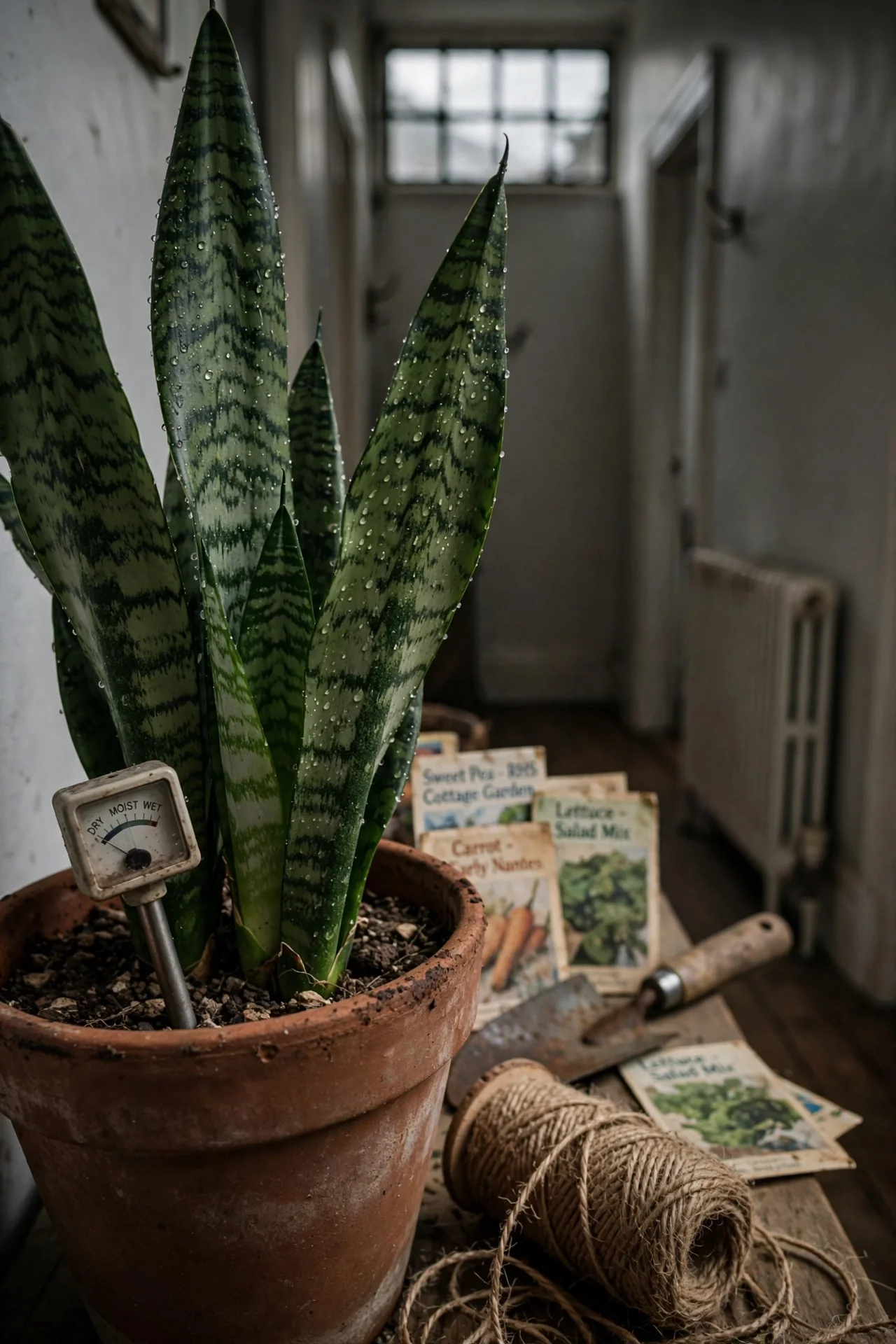
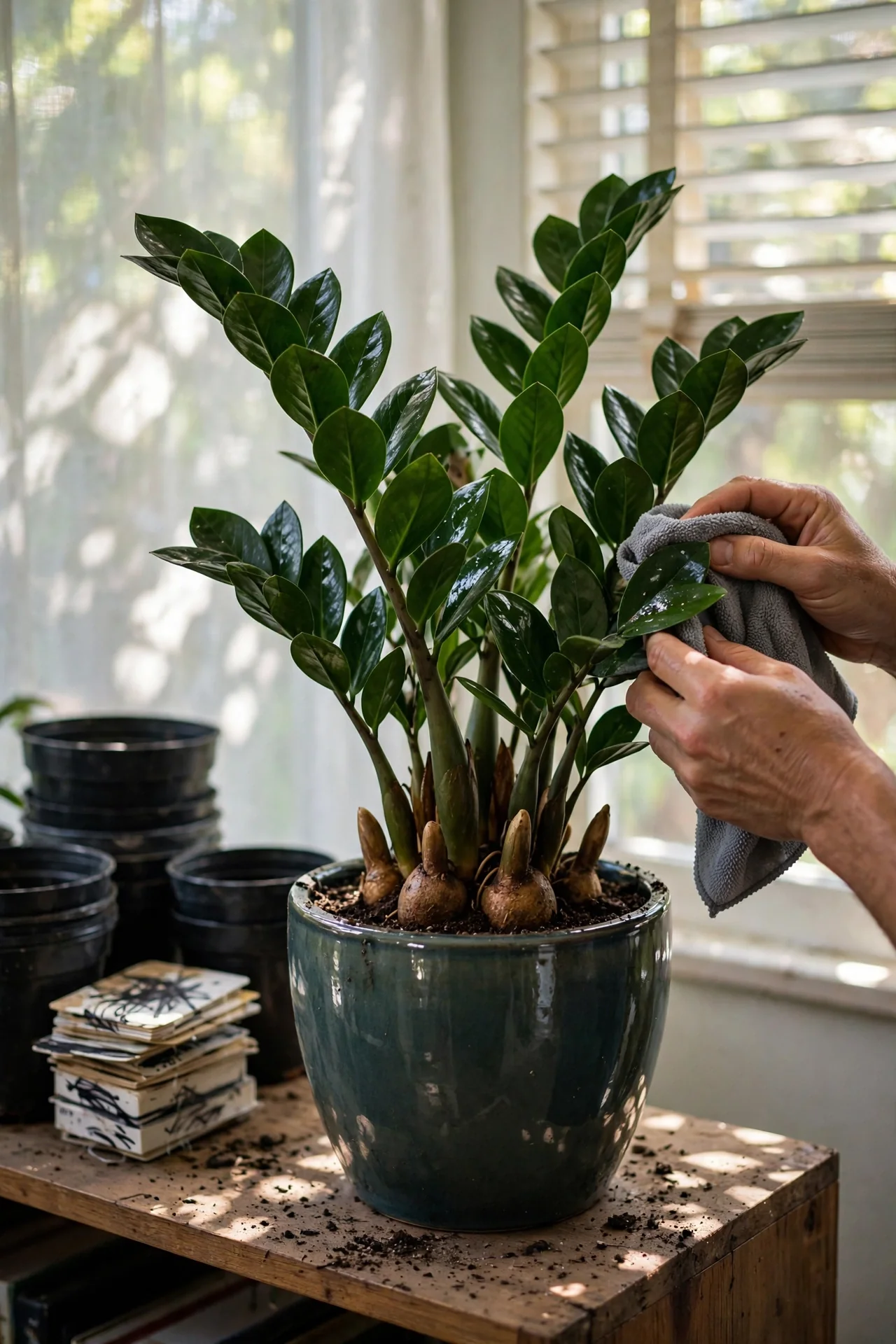
1. Snake Plant (Sansevieria trifasciata)
Best for: Branch 1 (below 10 FC).
What it is: A succulent-leaved perennial using Crassulacean Acid Metabolism (CAM). CAM plants open stomata only at night to fix CO₂, which drastically reduces water loss. This mechanism also allows carbon fixation with minimal light input during daytime hours.
How it works in low light: At 5–10 FC, the snake plant effectively halts visible growth but maintains cellular integrity. The thick cuticle and vertical leaf orientation minimize surface area exposed to light, paradoxically making flat, dim light sufficient. Growth resumes only when light exceeds approximately 20 FC for several weeks.
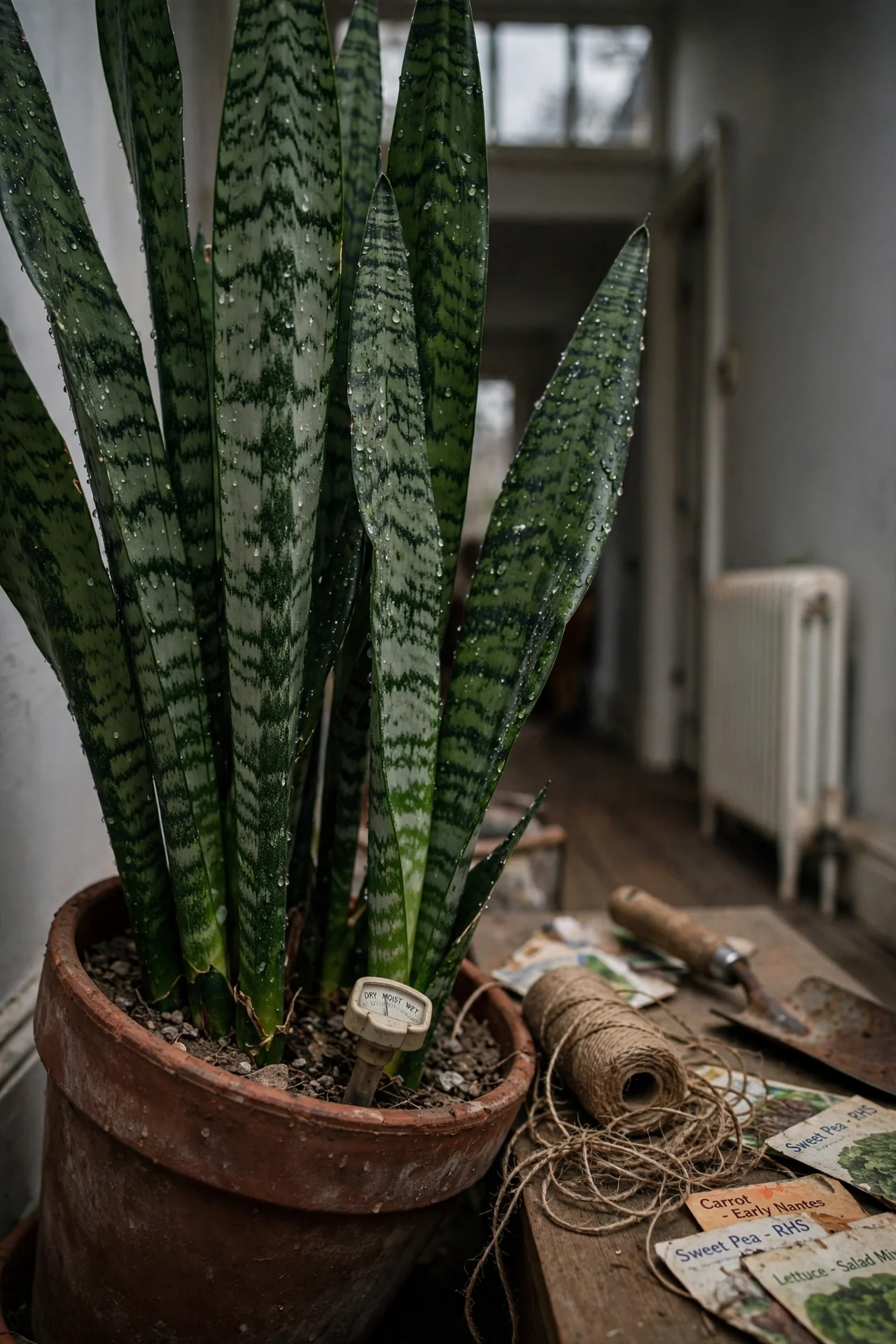
Edge case constraint: The same thick leaf epidermis that prevents water loss also prevents the plant from signaling dehydration until cell collapse begins. A snake plant in 8 FC may need water only 5–7 times per year. Overwatering in Branch 1 conditions causes basal rot within 10–14 days because soil dries extremely slowly. Use a moisture meter and irrigate only when the reading is at the lowest setting for at least 5 consecutive days.
Mistake that causes failure: Assuming “low light plant” means it tolerates frequent watering. Water volume and frequency must drop in proportion to light, not remain on a calendar schedule.
2. ZZ Plant (Zamioculcas zamiifolia)
Best for: Branch 2 (10–25 FC).
Thick, potato-like rhizomes store water and carbohydrates for months. In 15 FC, the ZZ plant can survive 3–4 months between waterings. Its leaflets are actually modified petioles with a waxy cuticle that reduces transpiration by roughly 80% compared to a similarly sized leaf. The primary failure point is filling the cachepot saucer; standing water wicks back into the rhizome zone and causes bacterial soft rot even when the surface soil appears dry. For more on measuring real soil moisture, see our guide on snake plant watering principles that apply to any rhizome-based plant.
3. Cast Iron Plant (Aspidistra elatior)
Best for: Branch 2 (10–25 FC).
This species earned its common name honestly: it persists where others collapse. Aspidistra’s respiration rate is so low that it can maintain a marginally positive carbon balance at 10 FC. The trade-off is growth. One new leaf per year is typical below 20 FC. The overlooked constraint is temperature. Aspidistra tolerates 45°F (7°C) but fails quickly above 85°F (29°C) when light is simultaneously low, because elevated respiration burns scarce carbohydrates. If your low-light hallway is also a heat trap in summer, skip this plant for a Dracaena fragrans instead. For broader watering guidance across all seasons, our watering frequency overview connects light levels to interval adjustments.
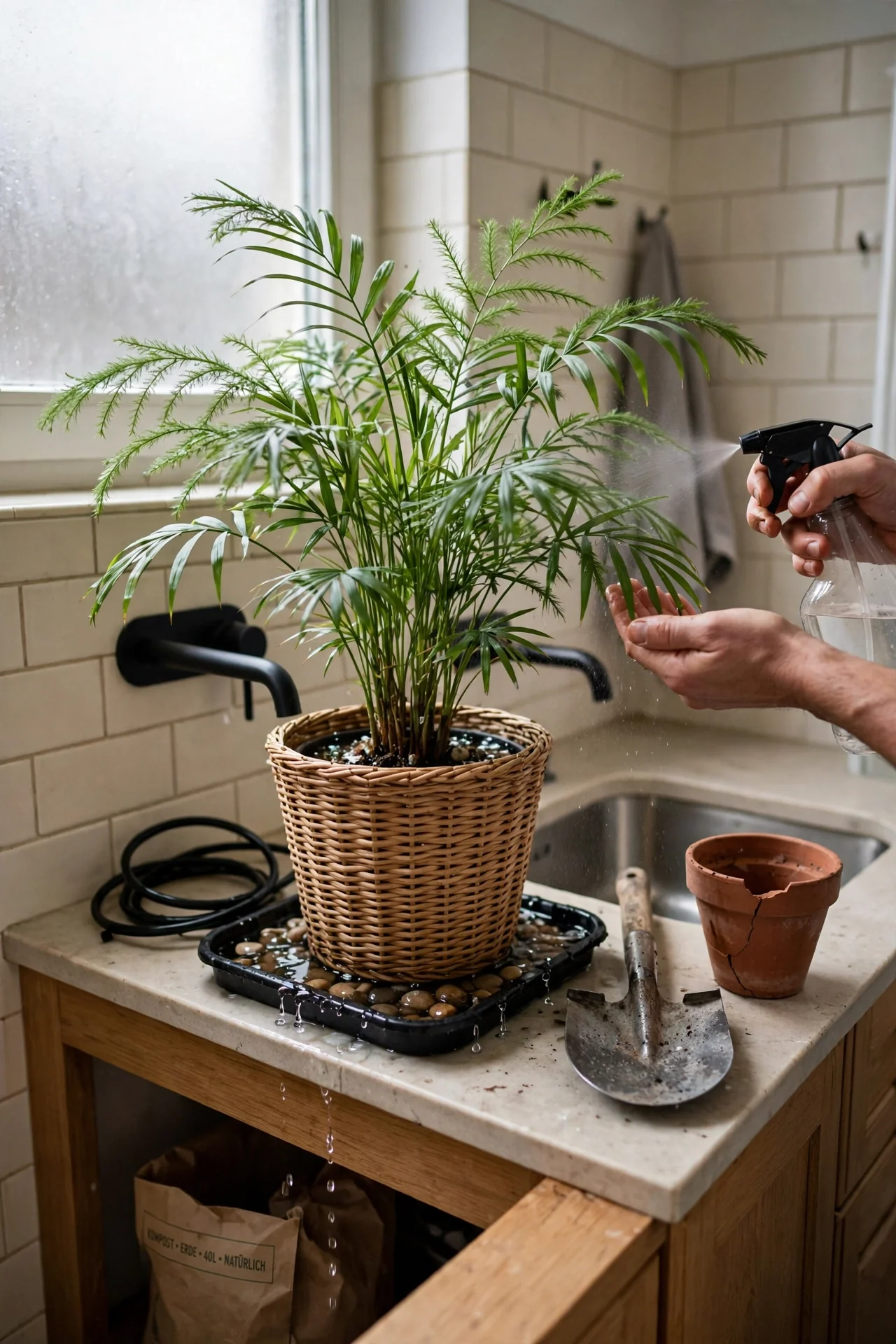
4. Parlor Palm (Chamaedorea elegans)
Best for: Branch 1 (below 10 FC).
Threshold rule: A parlor palm’s light compensation point sits near 10 FC, meaning it is one of the few true palms that does not go into negative carbon balance in a dim interior. Frond production stops entirely below 15 FC, but existing fronds remain green for 18–24 months.
The number that matters: Soil electrical conductivity (EC) must stay below 1.5 mS/cm. In low light, the palm barely takes up water or nutrients. Salt buildup from tap water or fertilizer accumulates in the root zone because there is no transpirational flow to flush it. If you fertilize more than once every 8–10 months in Branch 1 conditions, leaf tip burn appears within 4 weeks.
Pro vs. con edge case: Use if you have hard tap water and do not want to buy distilled. Skip if your space has forced-air heating vents within 6 feet, because spider mites colonize dry-stressed parlor palms aggressively at humidity below 30%. Misting is not enough; a nearby humidity tray is the minimum. See our misting houseplants data for the measured humidity increase from common methods.
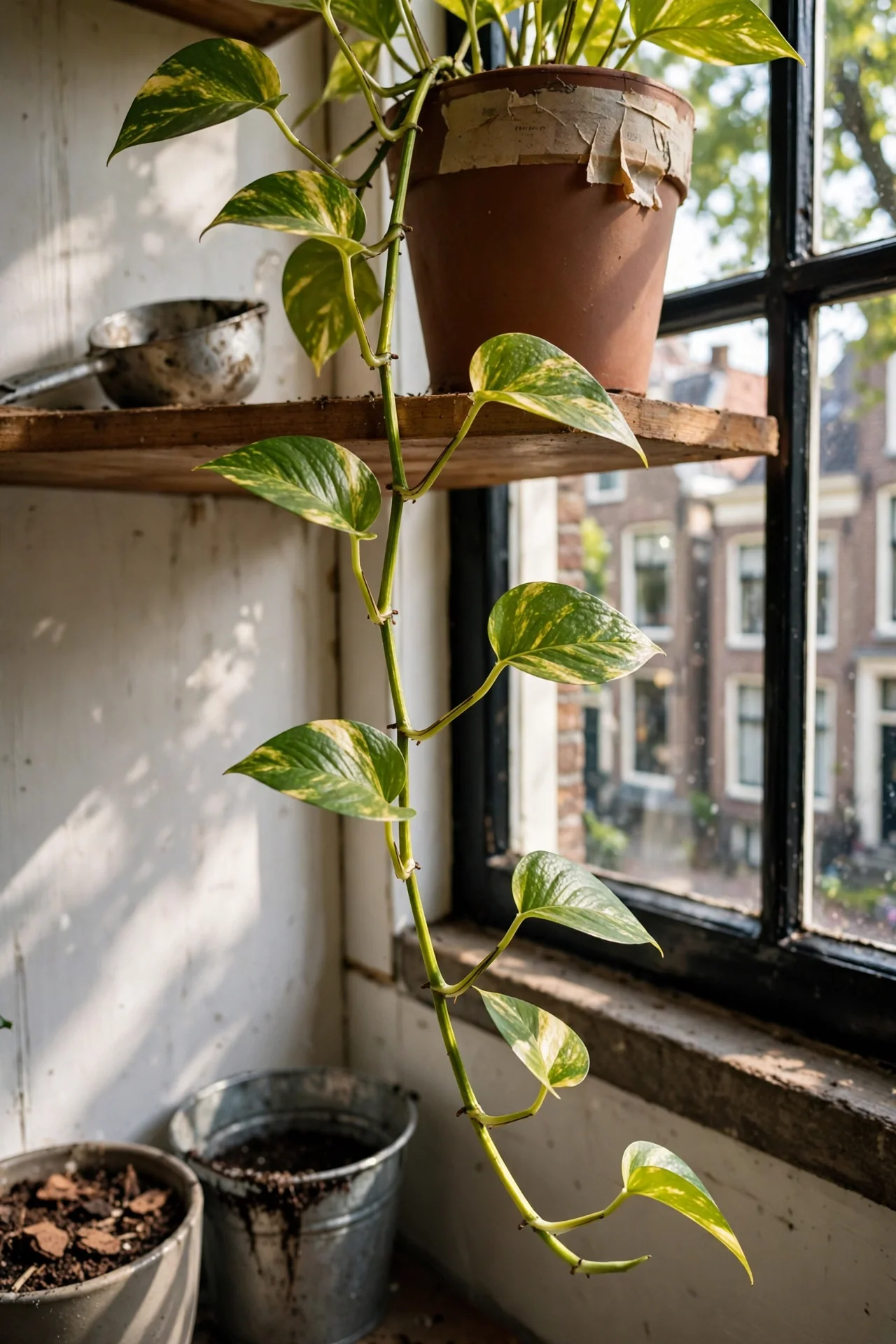
5. Pothos (Epipremnum aureum)
Best for: Branch 2 (10–25 FC).
Pothos survives low light through rapid petiole reorientation. Within 48 hours of a light angle change, leaves tilt toward the brightest point sensor-to-sensor. In 10–15 FC, internodes stretch to several inches and variegation fades to solid green because chlorophyll concentration increases to compensate. This is not disease; it is a plastic response. The single avoidable mistake: placing a trailing pothos on top of a cabinet where ceiling shadows create 5 FC micro-zones that cause progressive leaf drop. For brighter spaces, our bright indirect light plants guide helps you reposition for better variegation.
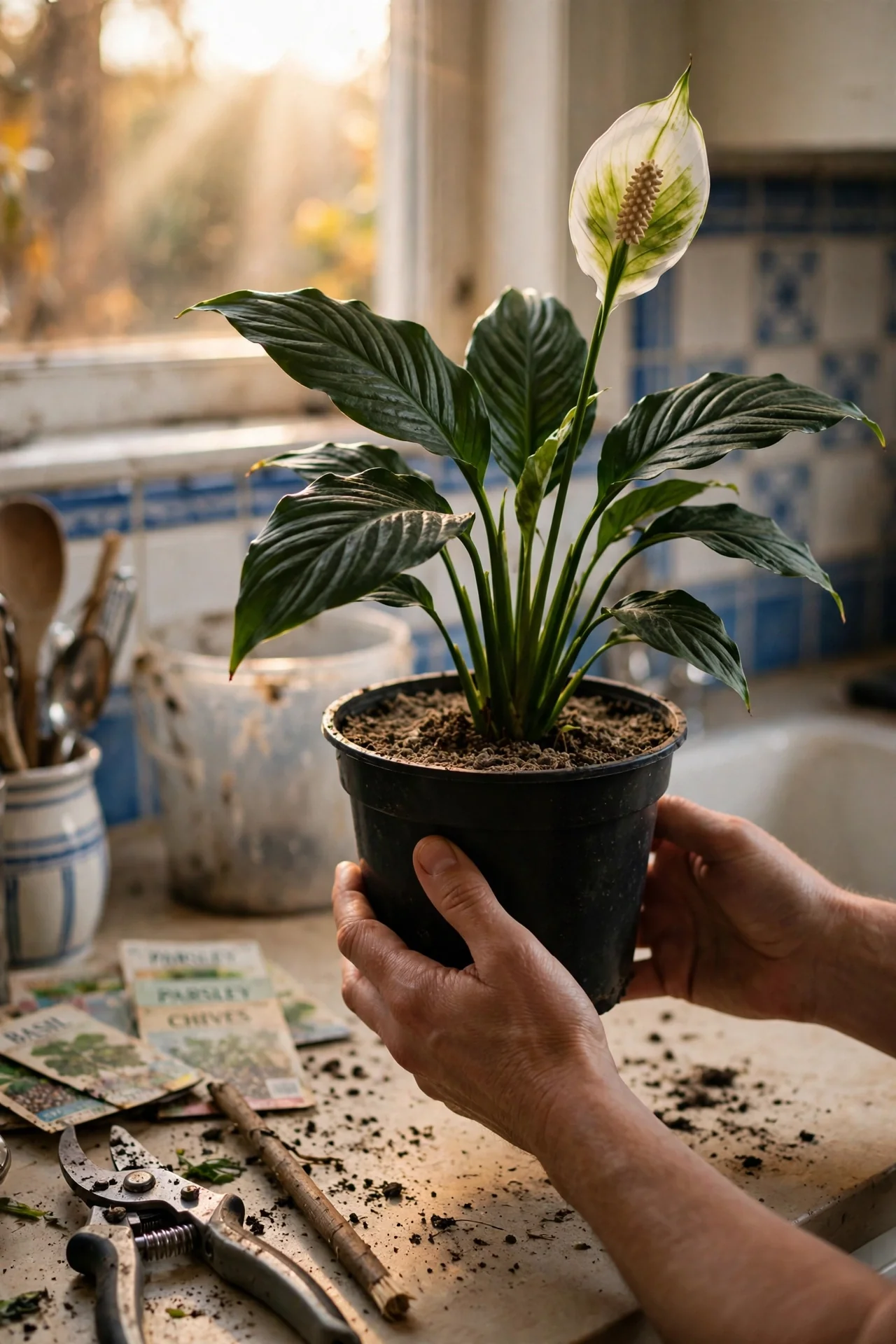
6. Peace Lily (Spathiphyllum wallisii)
Best for: Branch 3 (oscillating 5–25 FC).
10-minute workflow: Peace lilies communicate through leaf turgor. In low light, transpiration slows, so the classic “dramatic wilt” becomes a delayed and less reliable signal. Step 1: once weekly, lift the nursery pot. A dry pot feels significantly lighter than a newly watered one. Step 2: if weight is ambiguous, insert a finger to the second knuckle. Dry at that depth means water. Step 3: always water until 10–15% of the volume drains through; this flushes dissolved salts that would otherwise concentrate in slow-drying soil.
Upgrade option: Peace lilies in oscillating light benefit from a self-watering planter because the reservoir buffers the irregular dry-down cycles caused by light swings. In Branch 3 conditions, a consistent soil moisture of 3–4 on a 10-point moisture meter prevents the root-tip dieback that triggers brown leaf margins.
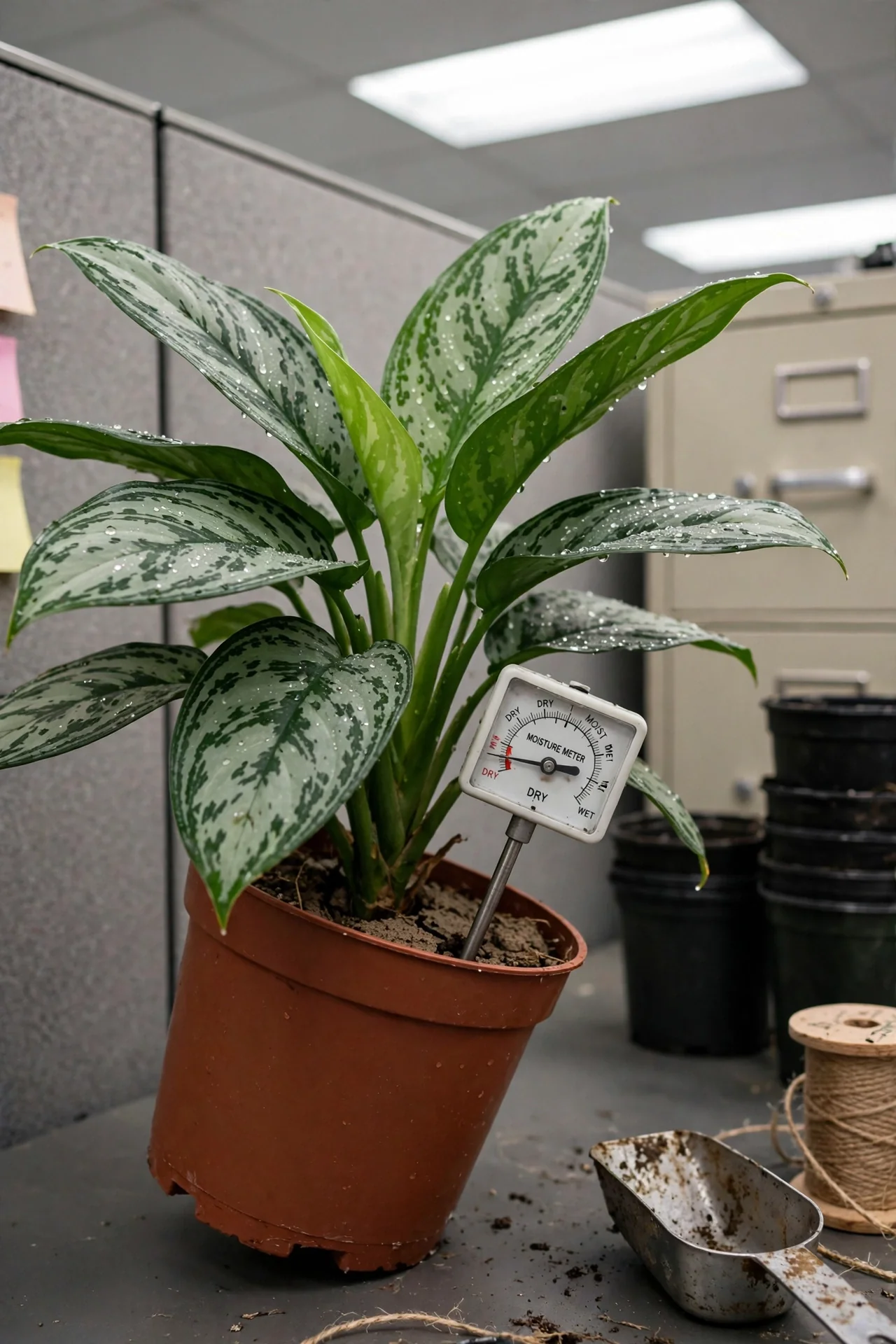
7. Chinese Evergreen (Aglaonema commutatum)
Best for: Branch 1 (below 10 FC).
Use vs. skip: Use Aglaonema when light is so dim that even a Snake Plant struggles to remain upright, because Aglaonema’s metabolism operates efficiently at photon flux densities that barely register on a standard light meter. The mechanism is a remarkably slow respiration rate that conserves carbohydrates month over month. Skip this plant if your watering style is “a little bit, often.” Aglaonema root systems in 8 FC require a complete wet-dry cycle. Frequent sips waterlog the lower soil zone, and Pythium root rot advances without yellowing leaves as a warning. The first symptom is often a sudden stem collapse at the soil line. For diagnosing water-related problems before they become fatal, compare signs in our overwatered vs. underwatered visual guide.
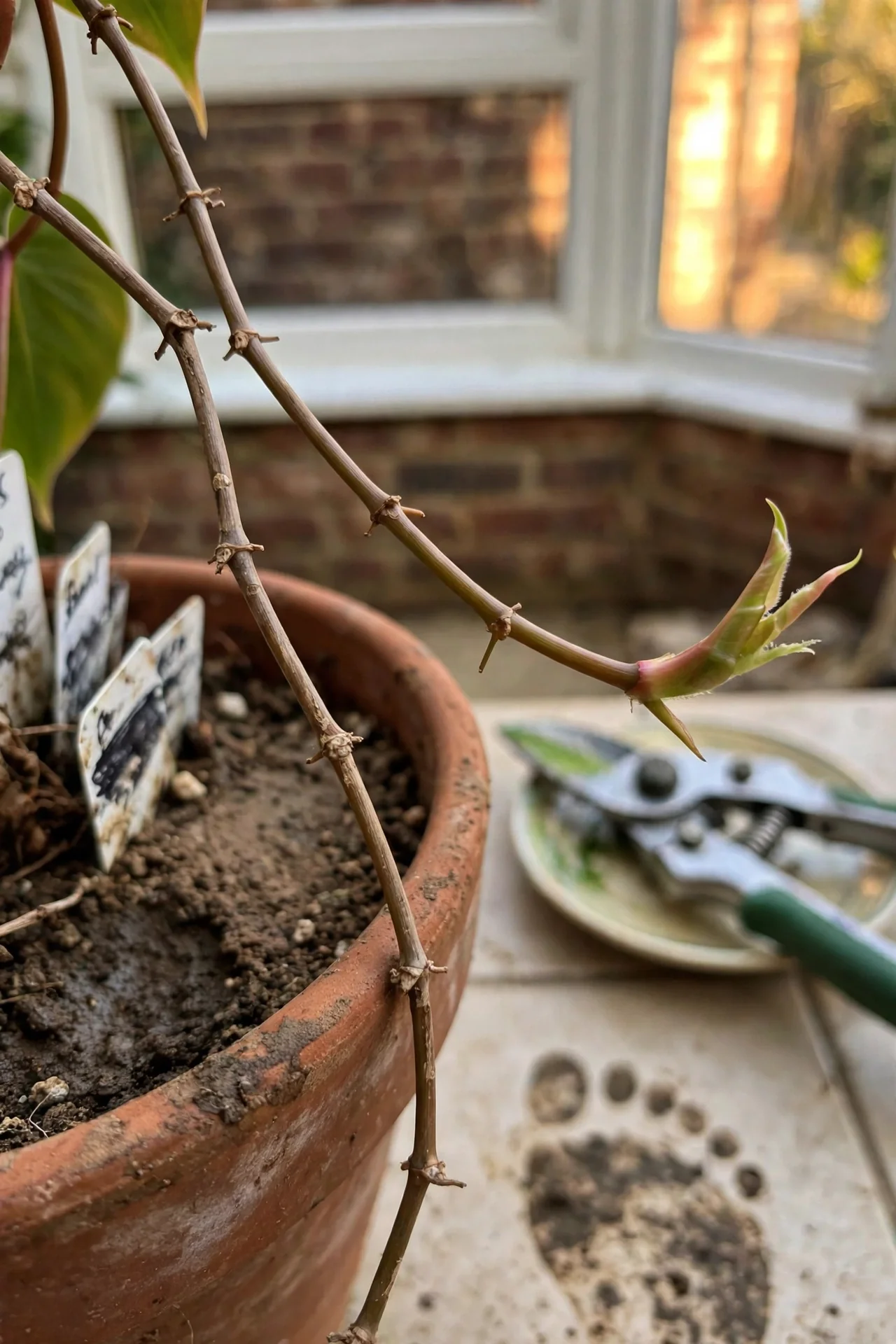
8. Heartleaf Philodendron (Philodendron hederaceum)
Best for: Branch 2 (10–25 FC).
Inadequate light triggers this plant to jettison older leaves via a programmed abscission layer at the node. This is not alarming; it is resource reallocation. The issue is that bare, leafless stem segments do not regrow leaves in low light conditions. Prune these bare vines back to a node with a leaf in spring. Heartleaf philodendron roots easily in water, even from leafless single-node cuttings, but rooting in dim conditions takes 4–6 weeks rather than the typical 2–3. Our bottom watering technique comparison is useful here because top-watering leaches soil away from surface roots on trailing plants.
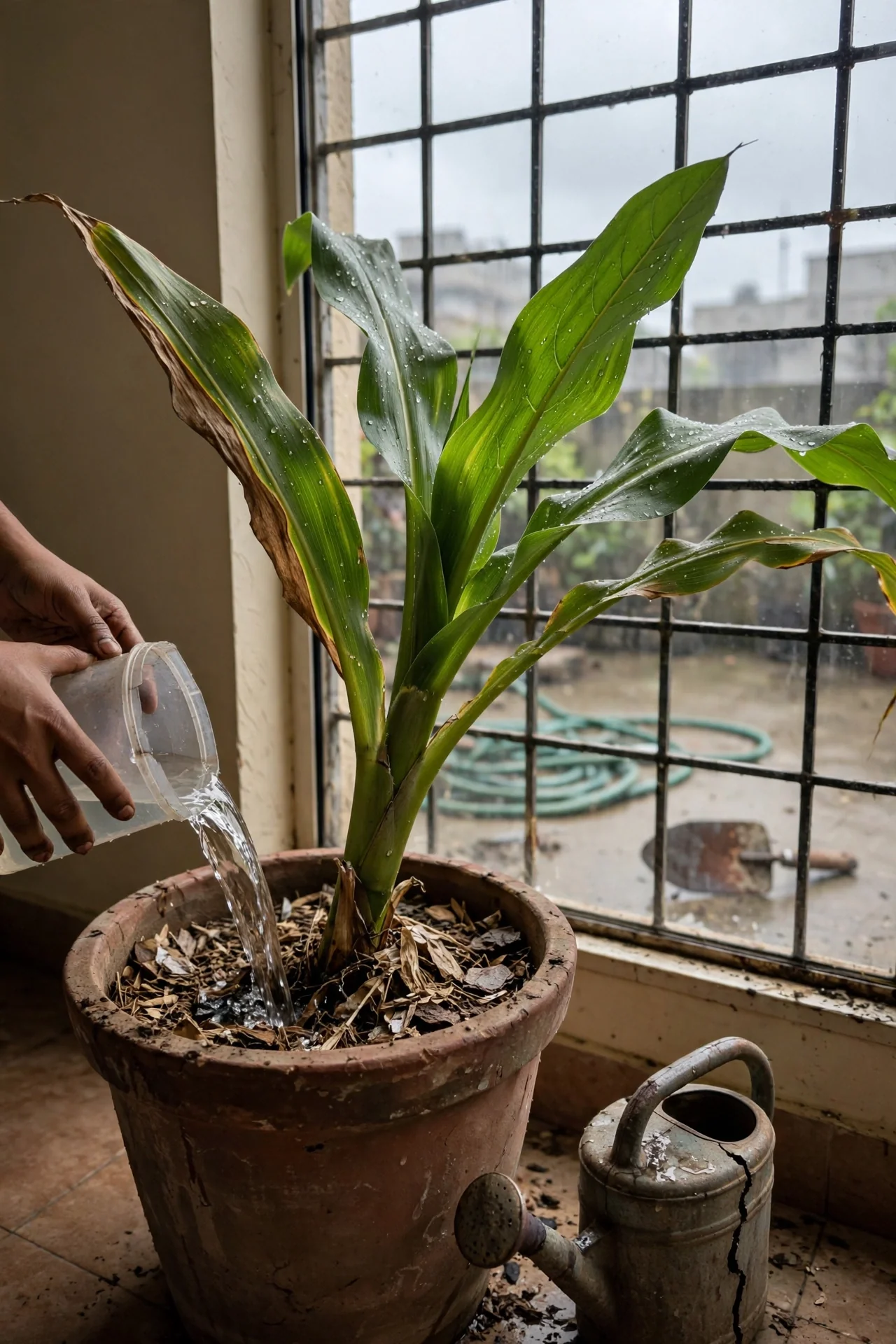
9. Corn Plant (Dracaena fragrans)
Best for: Branch 3 (oscillating 5–25 FC).
Numbers that matter: Dracaena fragrans leaf blades adjust their angle by up to 30 degrees over 3–5 days to track seasonal light shifts. This mechanism keeps photosynthesis functional when light drops in winter, but it fails if the plant is simultaneously exposed to fluoride above 0.5 ppm in tap water. Fluoride accumulates in leaf margins because transpiration pulls it upward with the water column, but in low light the reduced flow rate means fluoride concentrates rather than diluting. The result: a band of necrotic tissue along the leaf edge that appears identical to potassium deficiency but does not respond to fertilizer.
Adjustment: If your municipal water report confirms fluoride above 0.5 ppm, switch to collected rainwater for houseplants specifically for your Dracaena. Distilled water is an acceptable substitute. This single change eliminates margin necrosis in 90% of indoor Dracaena cases within 2–3 new leaves.
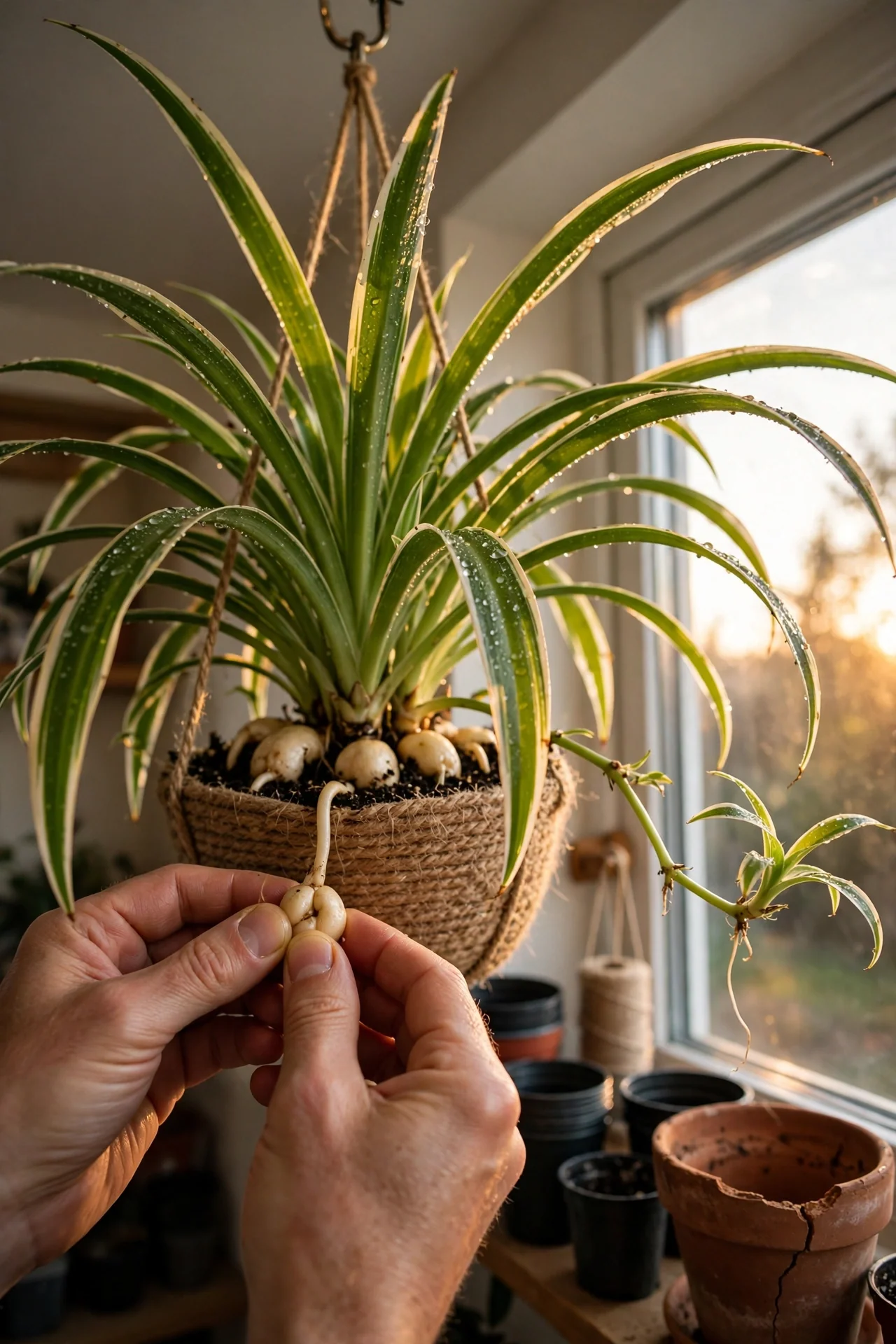
10. Spider Plant (Chlorophytum comosum)
Best for: Branch 2 (10–25 FC).
What: Spider plants store water and mobile nutrients in swollen, tuberous roots. These roots act as a buffer against both drought and overwatering, which makes the plant unusually forgiving in low light where watering intervals are hard to calibrate.
Steps for success in hanging baskets: Spider plants in high positions (above eye level) receive even less light than expected because light intensity drops with the square of distance from the source. A basket hung 7 feet from a north window may measure only 8 FC. Step 1: measure light at the actual basket height, not at a nearby table. Step 2: if the reading is below 10 FC, lower the basket 18 inches. Step 3: water only when the tuberous roots feel slightly soft, not turgid. Soft roots indicate partial depletion; firm roots mean water storage is full.
Mistake: Many guides recommend letting spider plants become “pot-bound” for offset production. In low light, a root-bound spider plant dries unevenly and concentrates fluoride and boron in the root zone, causing leaf tip burn that is often misattributed to dry air. Repot every 18–24 months even in dim conditions. Our guide to drought-tolerant houseplants covers the root-storage adaptation in more species.
11. Dumb Cane (Dieffenbachia seguine)
Best for: Branch 3 (oscillating 5–25 FC).
Dieffenbachia responds to a low red-to-far-red light ratio by elongating its stem cells. This is the same shade-avoidance response seen in forest understory plants. The practical result is a leggy, leaning stem. Rotate the pot 90 degrees every 2 weeks to distribute the directional stretch. If your space has an LED bulb rated at 2700K–3000K, this spectrum is higher in red wavelengths and may reduce stretching slightly compared to 5000K bulbs. Caution applies: all Dieffenbachia parts contain calcium oxalate raphides. Wear gloves when pruning the elongated stem, and wash hands immediately after. If you need tools for poking into dense root balls during repotting, some growers repurpose a wick watering system component as a soil probe.
Starter Stack (What to Choose First)
Branch 1 Starter: Snake Plant + Chinese Evergreen
These two species cover the most extreme low-light scenario in different ways. The Snake Plant uses CAM photosynthesis and needs water approximately 6 times per year; the Chinese Evergreen maintains a low but continuous metabolism. Together, they give you visual variety (vertical succulent leaves vs. spreading patterned foliage) while both surviving on the same minimal-water schedule. Estimated cost: $25–50 for two 6-inch pots. Time investment: less than 30 minutes per month for checking soil moisture and dusting leaves.
Branch 2 Starter: ZZ Plant + Pothos
A ZZ Plant on the floor and a Pothos on a shelf exploit different light zones in the same 10–25 FC room. The ZZ tolerates slightly dimmer floor-level light (often 8–12 FC at pot height) while the Pothos captures the brighter shelf-level light (closer to 20 FC). Both forgive missed waterings, but the Pothos will visibly signal thirst through leaf droop, serving as an informal reminder to check the ZZ Plant. Estimated cost: $30–60. Time: about 15 minutes every 2–3 weeks for watering and checking vine direction.
Branch 3 Starter: Peace Lily + Corn Plant
For rooms with seasonal light swings, this pairing provides a built-in early warning system. The Peace Lily wilts visibly when soil moisture drops, signaling the entire room’s dry-down rate. The Corn Plant tracks light changes through leaf angle adjustments. If the Peace Lily is wilting faster in autumn and the Corn Plant leaves have tilted noticeably toward the window, you know the seasonal light decline has begun and should reduce watering frequency for all plants in the room. Estimated cost: $35–70 for a medium Peace Lily and a 3-foot Corn Plant. Time: roughly 45 minutes per month during seasonal transitions, 20 minutes in stable months.
When This Won’t Work
Condition 1: No natural light source at all, for more than 14 consecutive days. Even the most tolerant plants on this list require some photon input for baseline metabolic functions. A windowless room lit only by overhead fixtures for 8 office hours daily may deliver 5–8 FC to a desktop but drops to near zero at floor level after hours. If your space has zero daylight exposure for more than two weeks at a stretch, none of these plants will sustain themselves long-term. The alternative: install a dedicated grow light for houseplants on a timer set to 10–12 hours daily. This moves your setup out of the “low light plant” category entirely and into the managed-light domain where more species become viable.
Condition 2: Temperature below 55°F (13°C) for more than 4 hours nightly. Low light combined with low temperature creates a dual stress: photochemical reactions slow from reduced enzyme activity, and root membranes lose permeability. Water uptake effectively stops. Plants that are fine at 65°F in dim light may develop root rot at 50°F in the same light because soil stays wet and roots cannot access it. If your space experiences cold drafts or winter night temperature drops below 55°F, move plants at least 3 feet from windows and exterior walls, or select only the Cast Iron Plant from this list, which has verified survival at 45°F in low light conditions.
Choosing the Right Option for Your Situation
Budget Threshold
A 4-inch Snake Plant or Pothos costs $8–15 and will adapt to your space over 1–2 years. A 10-inch floor specimen like a mature Corn Plant or Parlor Palm costs $50–90 but provides immediate visual impact. The budget decision is not just about purchase price: larger plants in larger pots dry more slowly in low light, reducing the risk of overwatering for beginners who tend to water on a schedule. If your budget allows, a single mature specimen with a watering routine timed to morning often outperforms three small plants shuffled around to chase light.
Time Threshold
If you travel regularly or are away for 2–3 weeks, select only plants with an Effort Score of 1 or 2 from the table above: Snake Plant, ZZ Plant, Cast Iron Plant, Pothos, Chinese Evergreen, Heartleaf Philodendron, or Corn Plant. Species scored 3 (Parlor Palm, Peace Lily, Spider Plant, Dumb Cane) require moisture checks at least biweekly in low light conditions because their smaller root-to-shoot ratio or thinner leaves dry faster. A 3-week absence without a plant sitter pushes these into the wilting zone.
Technical Constraint: Draft Tolerance
Cast Iron Plant and ZZ Plant endure temperature swings better than any other species on this list. If your low-light spot is near an entry door that opens frequently in winter, or under a ceiling fan that runs continuously, exclude Parlor Palm and Peace Lily, which develop leaf edge necrosis in moving air below 40% humidity. The thick cuticle of the ZZ Plant and Aspidistra resists desiccation from air movement that would damage thinner-leaved species within a single heating season.
Quick Yes/No Checklist:
1. Have you measured foot-candles at plant height with a meter or app? If no, stop and measure before choosing.
2. Is the nighttime temperature consistently above 55°F (13°C)? If no, limit choices to Cast Iron Plant only.
3. Do you tend to water on a calendar schedule rather than testing soil dryness? If yes, select only Effort Score 1 plants.
4. Is your tap water fluoridated above 0.5 ppm? If yes, avoid Dracaena fragrans or commit to rainwater/distilled water.
Expert Q&A
Why do my low light plants still get brown tips even when I water correctly?
Brown tips in low light typically indicate salt accumulation, not underwatering. Slow transpiration means dissolved minerals in tap water or fertilizer are not flushed through the soil. Over months, salts concentrate in leaf margins and kill tissue. Leach the pot with distilled water every 3–4 months by running water through until it drains clear, then discard the runoff.
Can I use a regular LED bulb instead of a grow light for these plants?
A standard 9–12 watt LED bulb (800–1100 lumens, 2700–5000K) placed 8–12 inches from a low-light plant adds 10–25 FC to the immediate area. This is sufficient to push a Branch 2 plant into stable growth but will not sustain a species that genuinely needs bright indirect light. Use a light meter app to verify the supplement reaches the leaf surface.
How do I know if my plant is slowly dying versus just dormant?
Dormancy in low light shows no new leaves but existing leaves remain turgid and firmly attached. Decline shows sequential yellowing, leaf abscission, or softening at the stem base. If older leaves yellow while younger leaves remain firm, it is likely nitrogen reallocation due to insufficient light for supporting total leaf area, not disease. Reduce leaf mass by pruning the oldest leaves.
Is it better to keep low light plants root-bound or in oversized pots?
In low light, slightly root-bound is safer. Oversized pots hold excess soil that dries too slowly, creating anoxic zones around roots. Aim for a pot only 1–2 inches wider than the root ball. This constraint applies more strictly in Branch 1 conditions where evaporation is negligible. Terracotta pots provide a margin of safety by wicking moisture through the walls.
Do low light plants benefit from occasional exposure to brighter light?
A weekly 4–6 hour session in bright indirect light (50–100 FC) can replenish carbohydrate reserves for plants in persistent sub-15 FC conditions. However, moving a plant from 8 FC to direct sun in one step causes photoinhibition: the chloroplasts cannot process the sudden photon load and bleaching occurs within hours. Transition gradually over several days.
Conclusion
The single factor that determines success with any low-light houseplant is not the species label but the actual foot-candle reading at leaf height. A Snake Plant in 5 FC and a Pothos in 20 FC require completely different watering schedules despite both being labeled “low light.” The most common mistake is treating low light as a uniform category rather than a measurable gradient.
Your next step: measure the light in your intended spot during the time of day you will view the plant most often. Match that reading to the Decision Grid branch above, pick your Starter Stack, and adjust watering downward by roughly half of what standard care guides recommend. For a deeper understanding of how window orientation and obstructions affect your readings, start with our definition of indirect light that maps specific lux and FC ranges to each lighting category.