
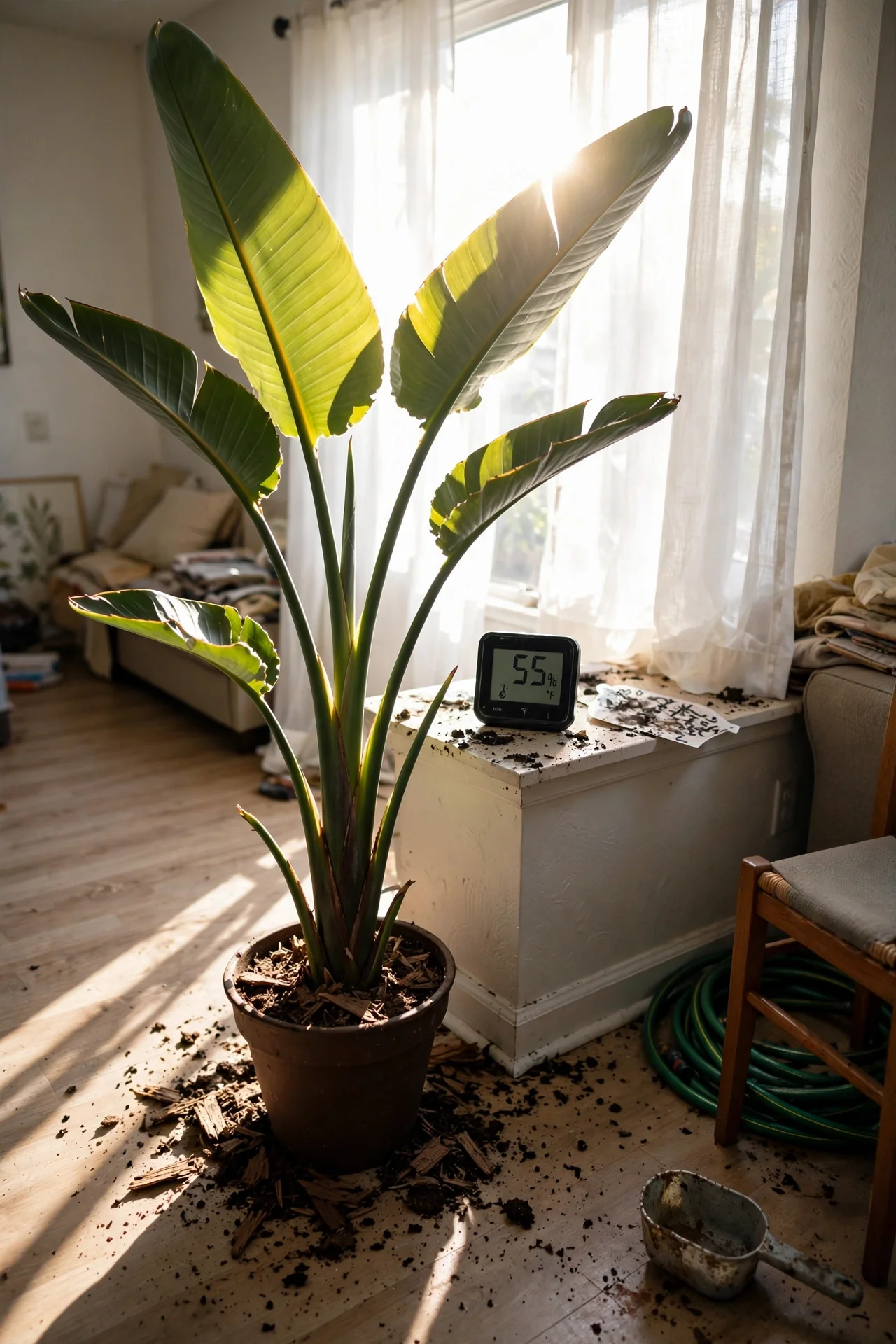
Most indoor bird of paradise advice treats every home like a greenhouse. This guide takes the opposite approach. Instead of listing generic care steps, it sorts your situation into one of three distinct paths based on measurable conditions: the light your room actually receives, the height your ceilings allow, and the time you can commit each week. When you pick the right branch first, the plant’s needs stop feeling like demands and start falling into place.
We focused on ten indoor strategies that cover light management, watering systems, feeding, and structural support. Outdoor planting, pest eradication routines, and soil chemistry deep-dives are excluded. Every tactic here is chosen because it solves a specific mismatch between the plant’s natural preferences and the reality of your living space.
By the end, you will know which branch fits your home, see exactly how each option lines up in a side-by-side budget comparison in multiple currencies, and have a starter stack of just two items to begin with. No guesswork, no overcomplicated routines.
Bottom line: Identify your light and space bracket first, then pick the two-item starter stack from that branch; the rest is optional refinement.
The Yield Grid Decision Grid
Sort yourself into one of these three branches. Each branch comes with recommended items from the list that lean into your strengths instead of fighting your constraints.
Branch 1: High Natural Light & Ample Floor Space. You receive at least 6 hours of direct sun through a south- or west-facing window, and your ceiling is above 9 ft (2.7 m). This is the classic “tropical statement plant” scenario. If you want to see how another high-light tropical behaves under similar conditions, our monstera care guide covers comparable light requirements. Recommended: Items 1, 4, 7, 10 below.
Branch 2: Moderate Light & Compact Quarters. Your bird of paradise sits in an east- or filtered west-facing window with 3 to 5 hours of bright indirect light, and ceilings are under 8 ft (2.4 m). The goal is to maximize what limited light you have without letting the plant outgrow its space too fast. Recommended: Items 2, 5, 8 below.
Branch 3: Low Light or Time-Constrained Care. You have a north-facing window or rely on artificial light, or you can dedicate no more than 10 minutes per week to plant care. This path relies on technology and seasonal moves to fill the gaps. Recommended: Items 3, 6, 9 below.
Quick Comparison Table
| Option | Key mechanism | Best for | Decision Grid Branch | Budget Tier |
|---|---|---|---|---|
| 1. South-Facing Window Setup | Direct solar gain with diffuser management | Homes with unobstructed south/west glass | Branch 1 | Low: under $50 USD / £40 / CA$65 / A$75 / ₹3,500 / R900 / €45 |
| 2. East Window Shelf Maximizer | Gentle morning light positioning | East-facing rooms with limited floor space | Branch 2 | Low: under $50 USD / £40 / CA$65 / A$75 / ₹3,500 / R900 / €45 |
| 3. Humidifier Stack | Maintained 50–60% relative humidity zone | Dry indoor air in any light branch | Branch 3 | Medium: $50–$150 USD / £40–£120 / CA$65–$200 / A$75–$225 / ₹3,500–₹10,500 / R900–R2,700 / €45–€135 |
| 4. Full-Spectrum LED Panel Rig | Controlled photon delivery replacing missing sunlight | North-facing rooms or windowless corners | Branch 3 | High: above $150 / £120 / CA$200 / A$225 / ₹10,500 / R2,700 / €135 |
| 5. Self-Watering Pot Conversion | Capillary action or reservoir slow-release | Busy owners in moderate light | Branch 2 | Low: under $50 USD / £40 / CA$65 / A$75 / ₹3,500 / R900 / €45 |
| 6. Seasonal Outdoor Rotation | Summer sun catch-up in protected outdoor spot | People with balcony/patio access, any indoor light | Branch 3 | Low: under $50 USD / £40 / CA$65 / A$75 / ₹3,500 / R900 / €45 |
| 7. Root-Bound Containment Tactic | Pot restriction to trigger flowering response | Large, mature plants in Branch 1 spaces | Branch 1 | Low: under $50 USD / £40 / CA$65 / A$75 / ₹3,500 / R900 / €45 |
| 8. Leaf Cleaning and Inspection Routine | Manual dust removal and pest check | Any branch, especially lower light where dust cuts efficiency | Branch 2 | Low: under $50 USD / £40 / CA$65 / A$75 / ₹3,500 / R900 / €45 |
| 9. Controlled-Release Fertilizer Sticks | Osmotic nutrient release timed to soil temperature | Forgetful feeders in any branch | Branch 3 | Low: under $50 USD / £40 / CA$65 / A$75 / ₹3,500 / R900 / €45 |
| 10. Vertical Stake and Leaf Support System | Physical bracing to guide upright form | Tall, leaning specimens in open spaces | Branch 1 | Low: under $50 USD / £40 / CA$65 / A$75 / ₹3,500 / R900 / €45 |
1. The South-Facing Window Setup
Best for: Branch 1
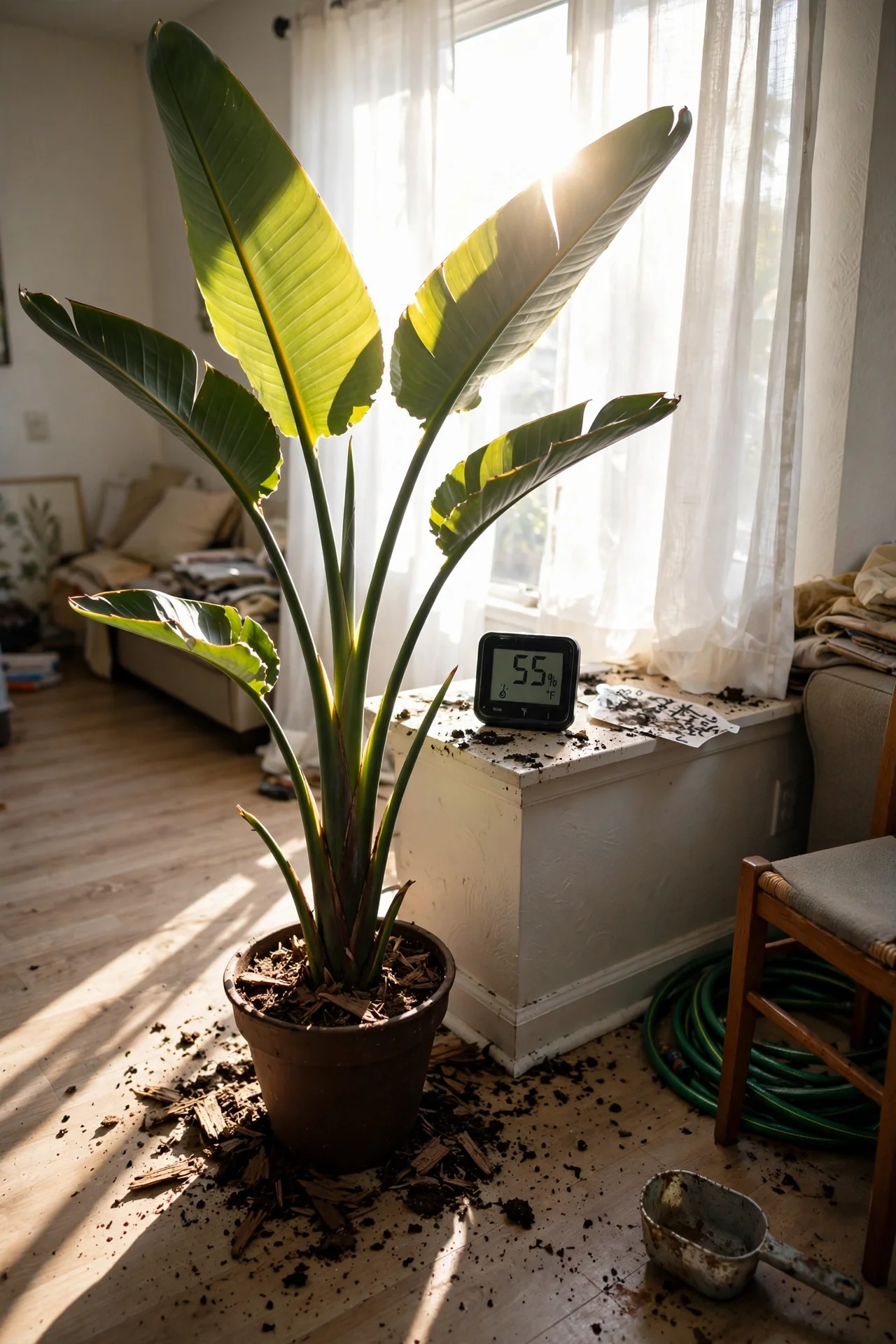
Blueprint: What, For, Steps, Mistake. This setup exploits direct solar radiation to fuel large leaves and potential blooms. What you need: a south- or southwest-facing window, a sheer curtain, and a sturdy plant stand. The plant goes 2 to 3 feet away from the glass to prevent leaf scorch during summer afternoons. For: anyone with high natural light who wants a low-tech, low-cost path to a thriving bird of paradise. Steps: (1) Confirm the spot receives direct sun for at least 6 hours from spring through fall. (2) Install a sheer curtain to act as a diffuser when UV index is high. (3) Rotate the pot one-quarter turn every month to keep growth even. (4) In winter at latitudes above 50°N (e.g., Scotland, southern Canada), add a compact LED bulb for 2 extra hours of light if the window’s intensity drops below 2,000 lux. Mistake to avoid: placing the plant flush against the glass, which can cause thermal leaf burn within a single afternoon. Similar high-light lovers such as croton follow the same placement rules; see our croton care guide for more on managing direct sun.
2. East Window Shelf Maximizer
Best for: Branch 2
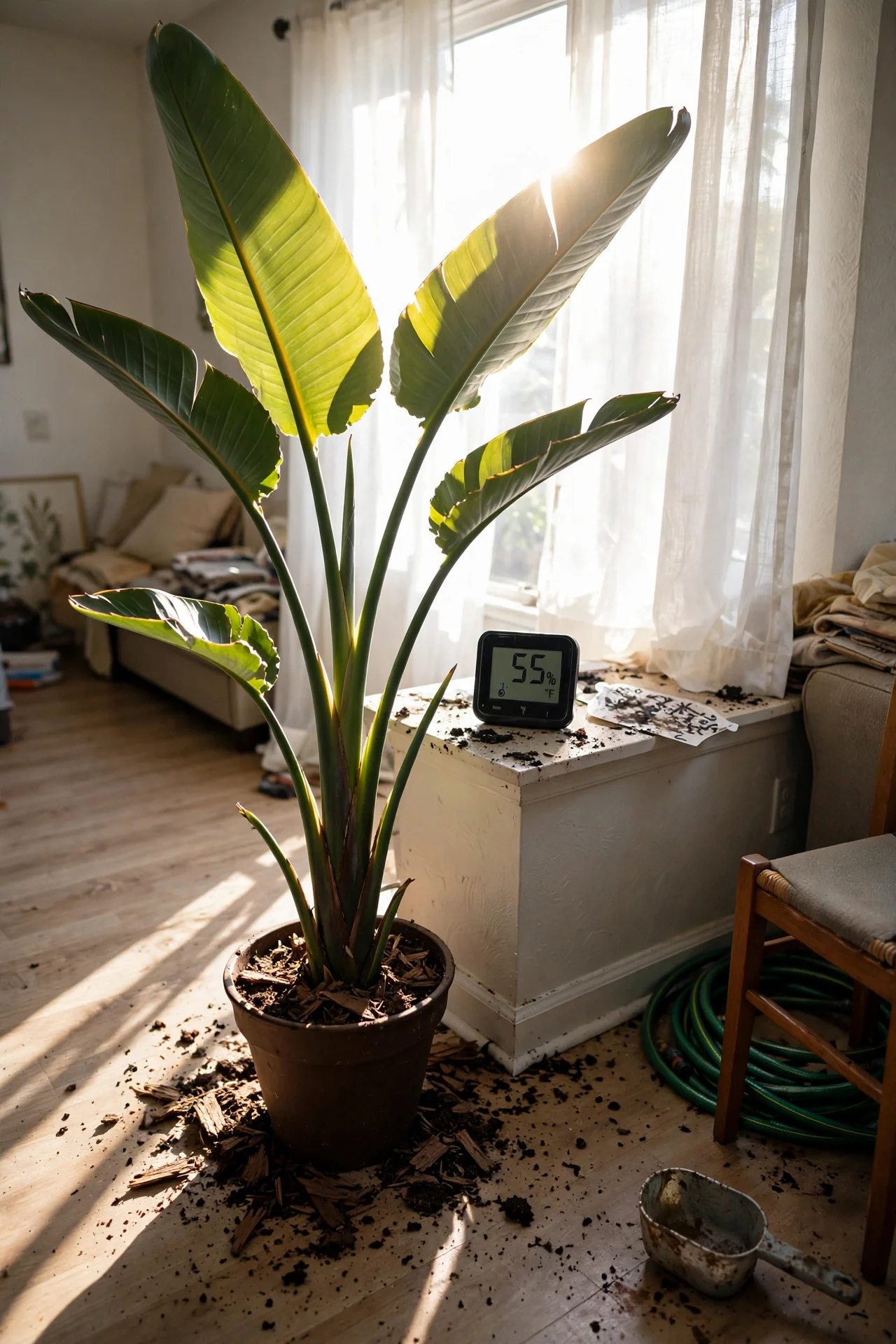
Use vs Skip. Use this method if you have an east-facing window where morning sun lasts 3 to 4 hours and the sill or a narrow shelf can support the pot. Pros: gentle light eliminates scorch risk, and the compact footprint suits apartments. Cons: light is rarely strong enough to trigger flower production. Edge case: skip it if a neighboring building or large tree blocks morning sun before 10 a.m. In that scenario, move the plant to a west-facing window with a sheer curtain instead.
3. The Humidifier Stack
Best for: Branch 3
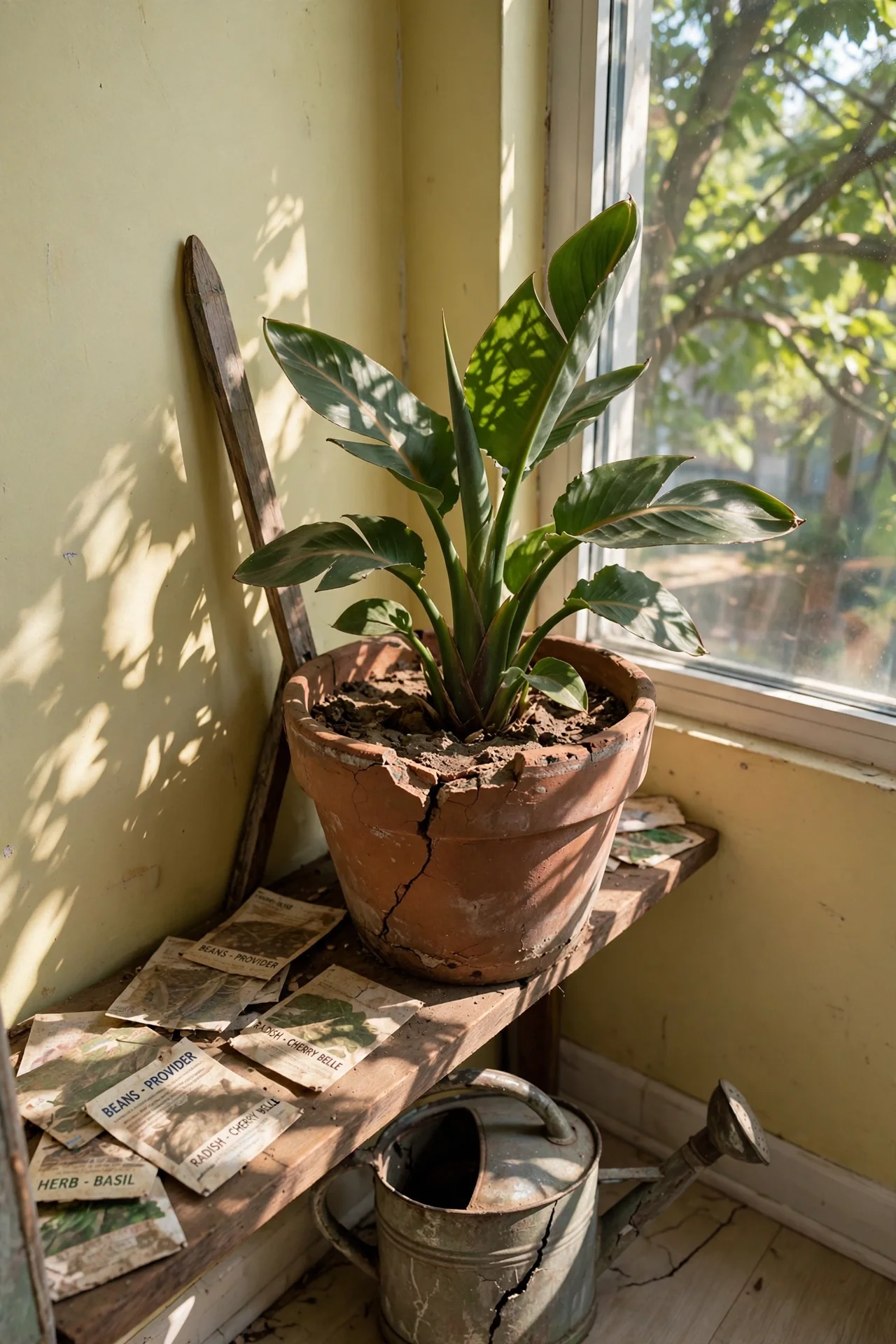
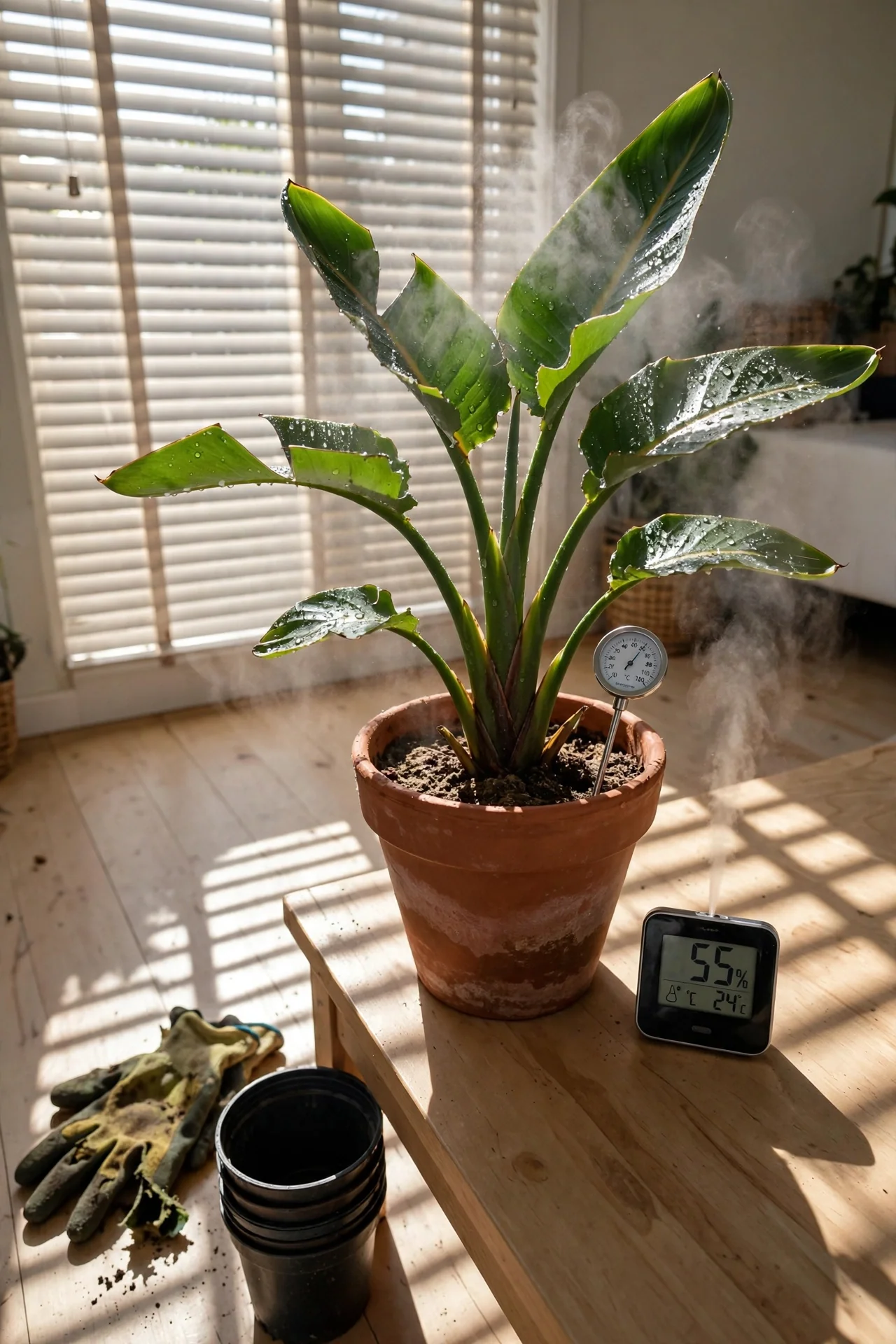
Threshold Rule. Bird of paradise leaves stay turgid and resist splitting when relative humidity stays between 50% and 60%. Place a digital hygrometer at leaf height and check at midday. If readings fall below 40% for more than 3 consecutive days, run an ultrasonic humidifier near the plant on a timer, set to cycle 15 minutes on, 45 minutes off during daylight. In very dry climates (indoor humidity routinely below 30%), supplement by grouping the bird of paradise with other transpiring plants on a pebble tray. Avoid misting as a primary strategy; it spikes humidity only briefly and can leave mineral deposits on foliage. For more humidity-sensitive companions, our calathea care instructions show similar grouping tactics.
4. Full-Spectrum LED Panel Rig
Best for: Branch 3
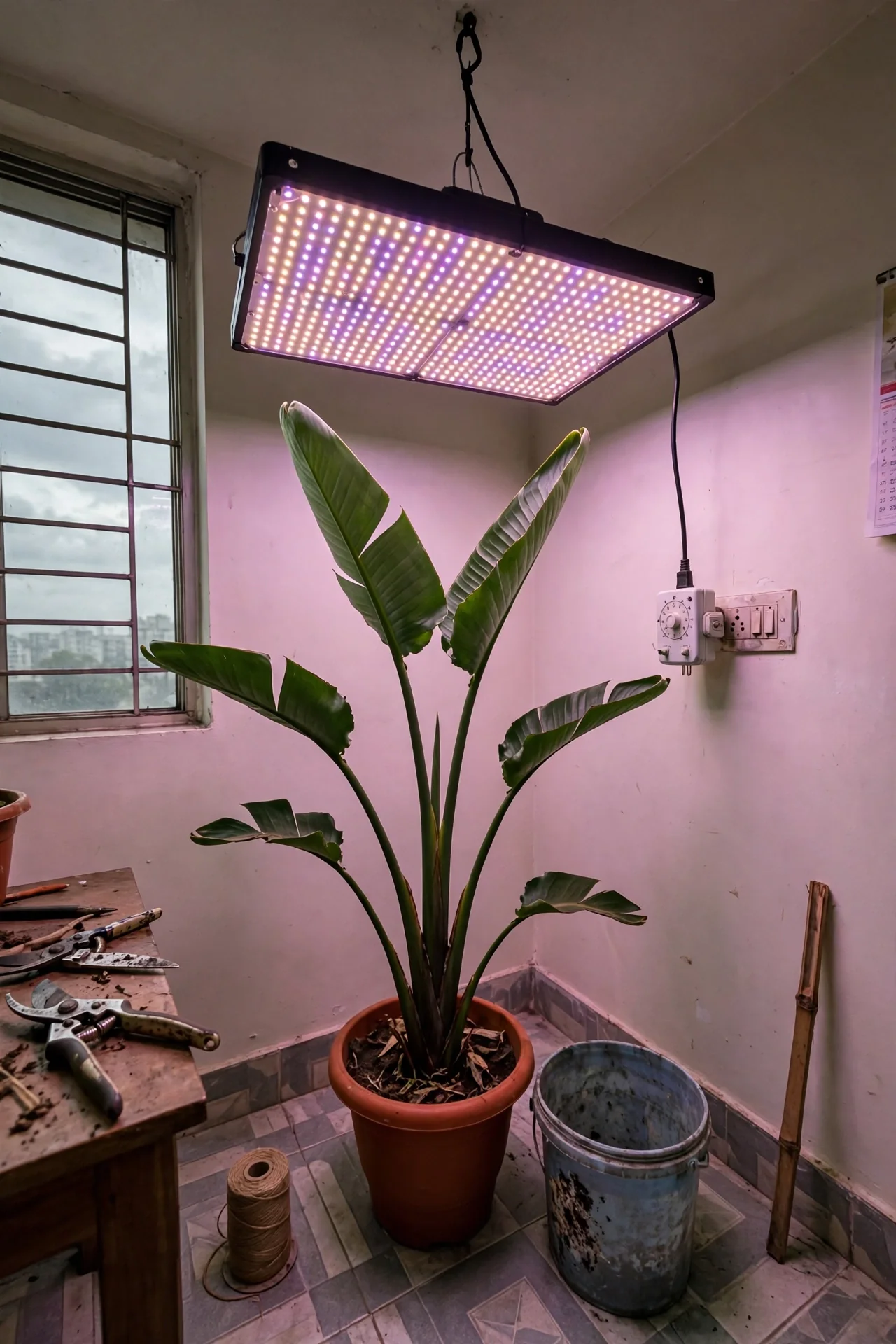
10-Minute Workflow. This rig provides the photosynthetic photon flux that a north-facing room or windowless corner lacks. Steps: (1) Mount a full-spectrum LED panel rated at 40 to 60 watts actual draw on an adjustable hanger 12 inches above the top leaves. (2) Plug the panel into a mechanical timer set for 12 hours on, 12 hours off, synced with daylight hours. (3) Once a month, wipe the panel’s diodes with a dry microfiber cloth to maintain output. (4) Every two months, raise the panel by 2 inches as new leaves emerge to prevent light stress. Upgrade option: add a dimmable driver and a PAR meter to fine-tune intensity around 300 to 400 µmol/m²/s at leaf level, matching the high end of indoor tropical needs. For another plant that responds well to this kind of supplemental light, check our rubber plant care page.
5. Self-Watering Pot Conversion
Best for: Branch 2
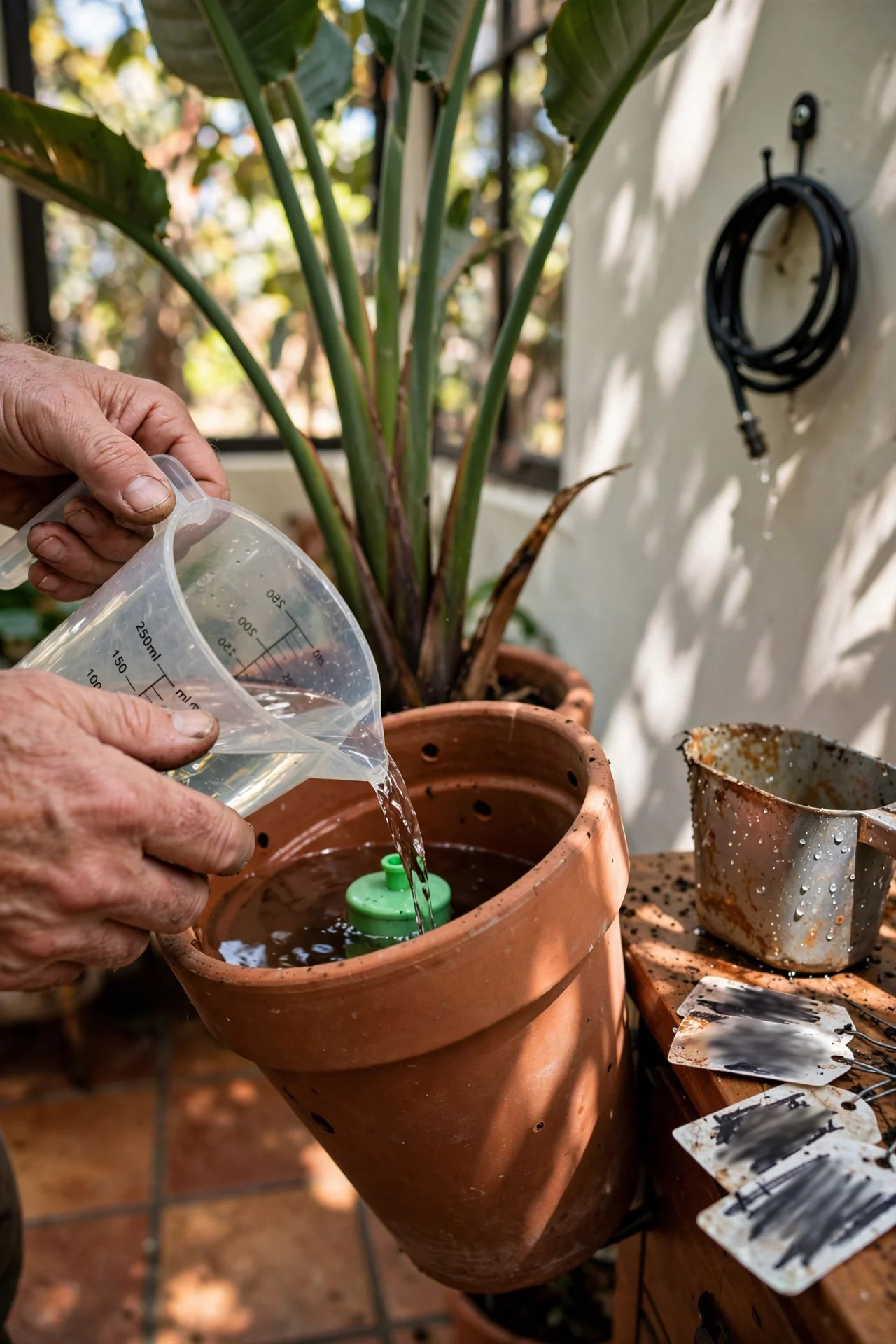
Use vs Skip. Use a self-watering pot if you travel often or tend to forget watering, and your space has moderate light so the soil dries at a predictable pace. Pros: consistent root-zone moisture reduces leaf curl and tip browning. Cons: in winter when growth slows, the reservoir can keep the root zone too wet, promoting fungus gnats. Skip this setup if you are prone to topping off the reservoir without checking soil moisture first, or if your home stays cool (below 65°F/18°C) for long stretches, because cold wet soil invites root rot.
6. Seasonal Outdoor Rotation
Best for: Branch 3
Threshold Rule. Move the pot outdoors when nighttime temperatures consistently stay above 50°F (10°C) and daytime highs exceed 70°F (21°C). Start by placing it in full shade for 5 days, then dappled shade for another 5 days, before letting it receive morning direct sun. This 10-day acclimation prevents sunburn. Bring the plant back inside before autumn nights dip below 50°F. The outdoor stint acts as a light bank for the darker months indoors. Schefflera plants follow a similar outdoor rotation rhythm; details in our schefflera care guide can help you time the transition.
7. Root-Bound Containment Tactic
Best for: Branch 1
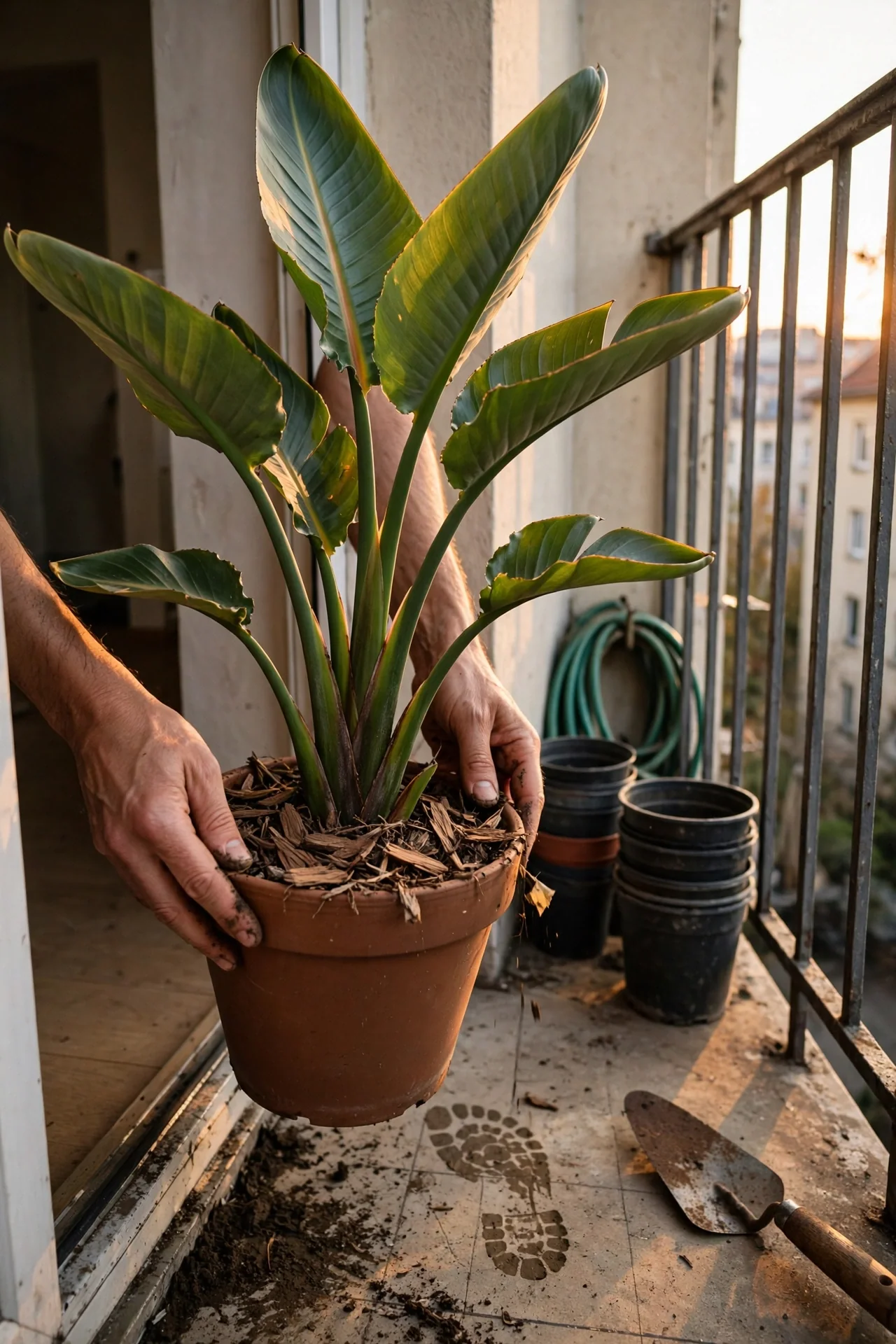
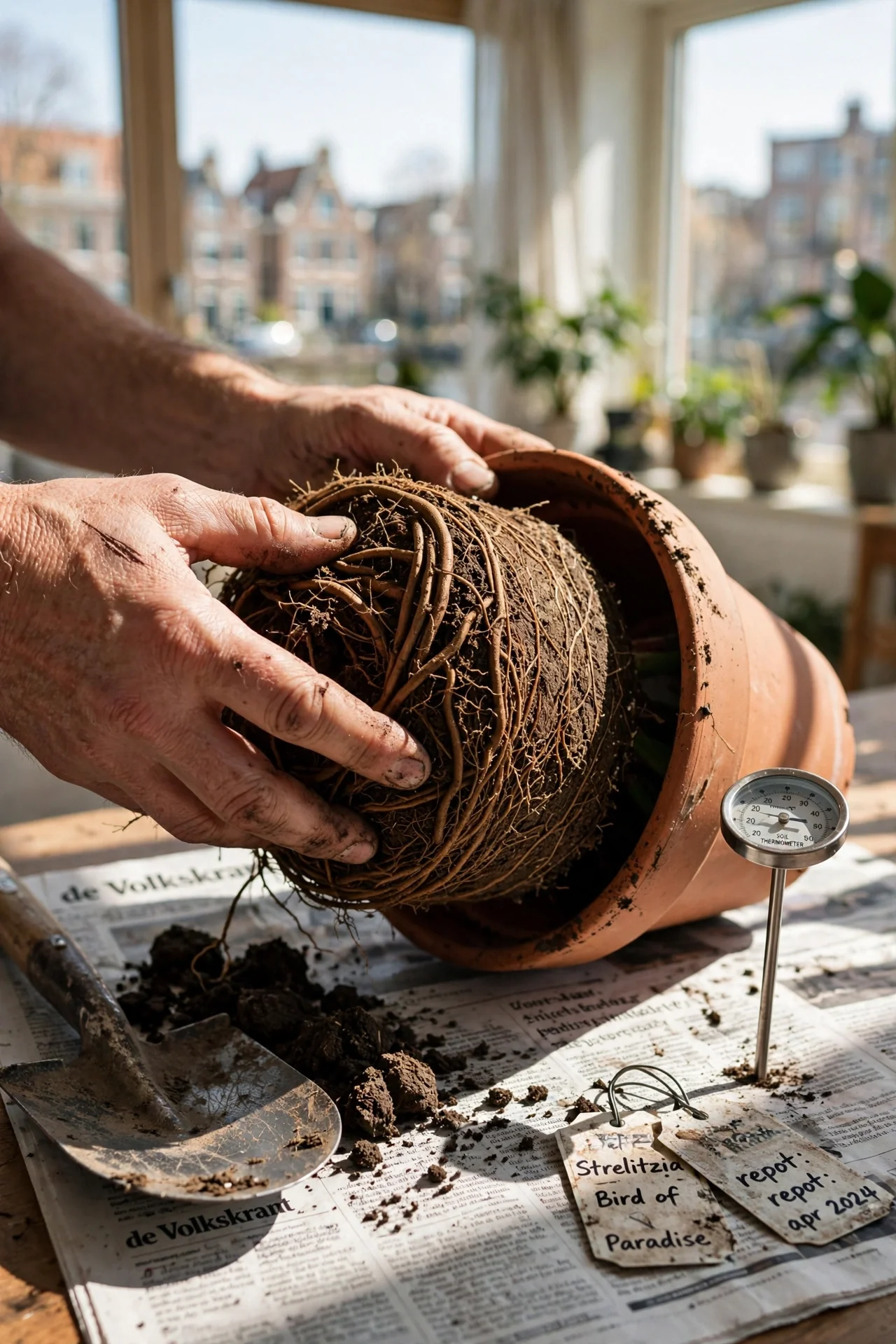
Blueprint: What, For, Steps, Mistake. Bird of paradise often blooms more readily when roots are moderately confined. What you need: a pot only 1 to 2 inches wider than the root ball, plus a well-draining mix. For: mature plants at least 4 to 5 years old that have been healthy for a full growing season in Branch 1 light. Steps: (1) Slide the root ball out and check for circling roots. If roots circle the bottom quarter but you still see soil, leave it. (2) Top-dress with 1 inch of fresh compost once a year instead of repotting. (3) Repot only when roots push the plant upward out of the container or water runs straight through without absorbing. Mistake to avoid: moving a root-bound bird of paradise into an oversized pot. The extra soil holds too much moisture and can stall flowering for years. This root-bound principle also benefits many aroids; our philodendron care guide explains similar container sizing tactics.
8. Leaf Cleaning and Inspection Routine
Best for: Branch 2
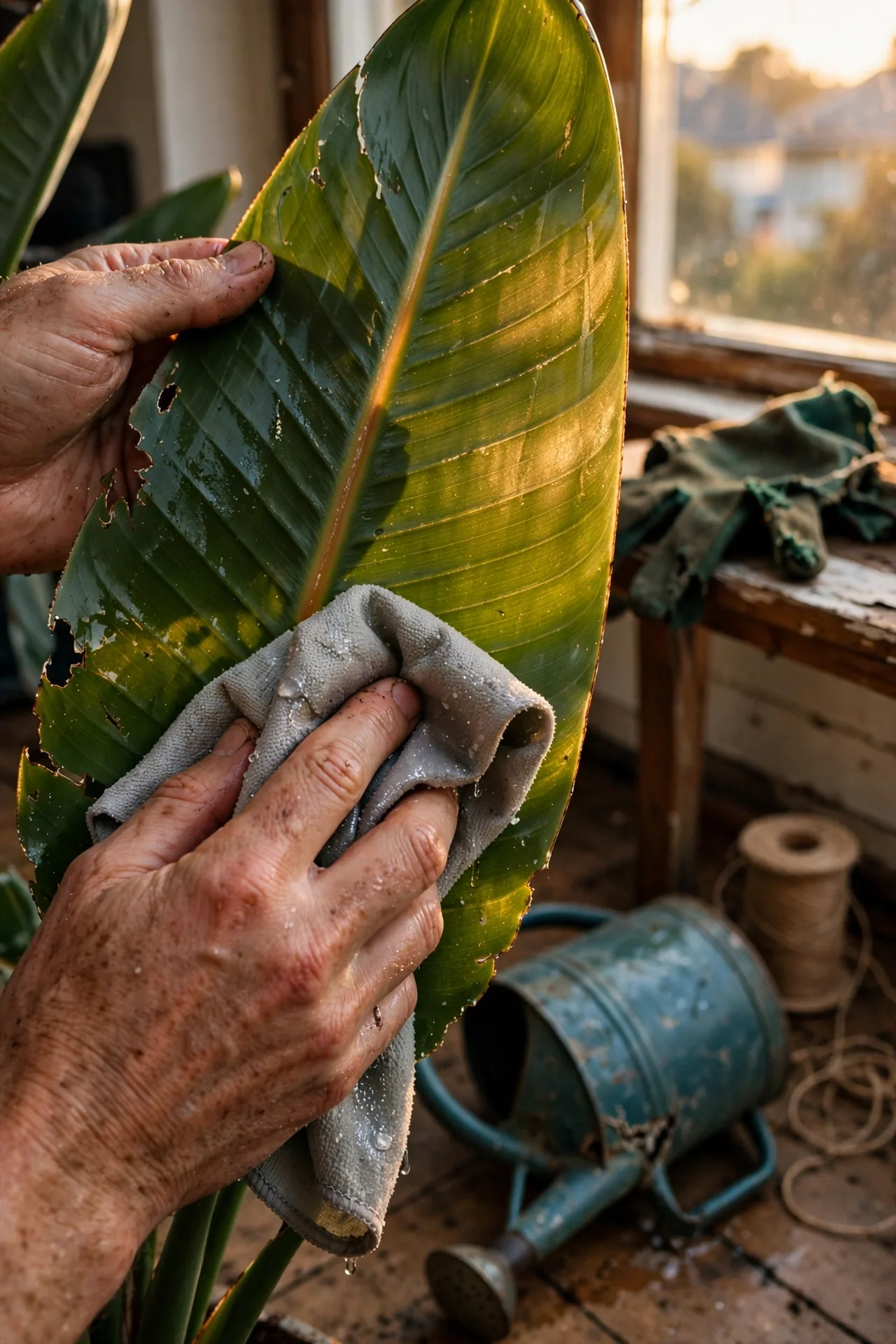
Use vs Skip. Use a damp microfiber cloth to wipe both sides of each leaf every 2 to 3 weeks if dust accumulates quickly, especially in homes with forced-air heating. Pros: clean leaves photosynthesize more efficiently, and you spot pests like spider mites before populations explode. Cons: overhandling can bruise young emerging leaves. Skip dedicated leaf shine sprays, which can clog stomata with silicone or oil. If your plant is small (under 3 feet), a monthly shower using a handheld sprayer in the bathtub does the job faster without risk of mechanical damage.
9. Controlled-Release Fertilizer Sticks
Best for: Branch 3
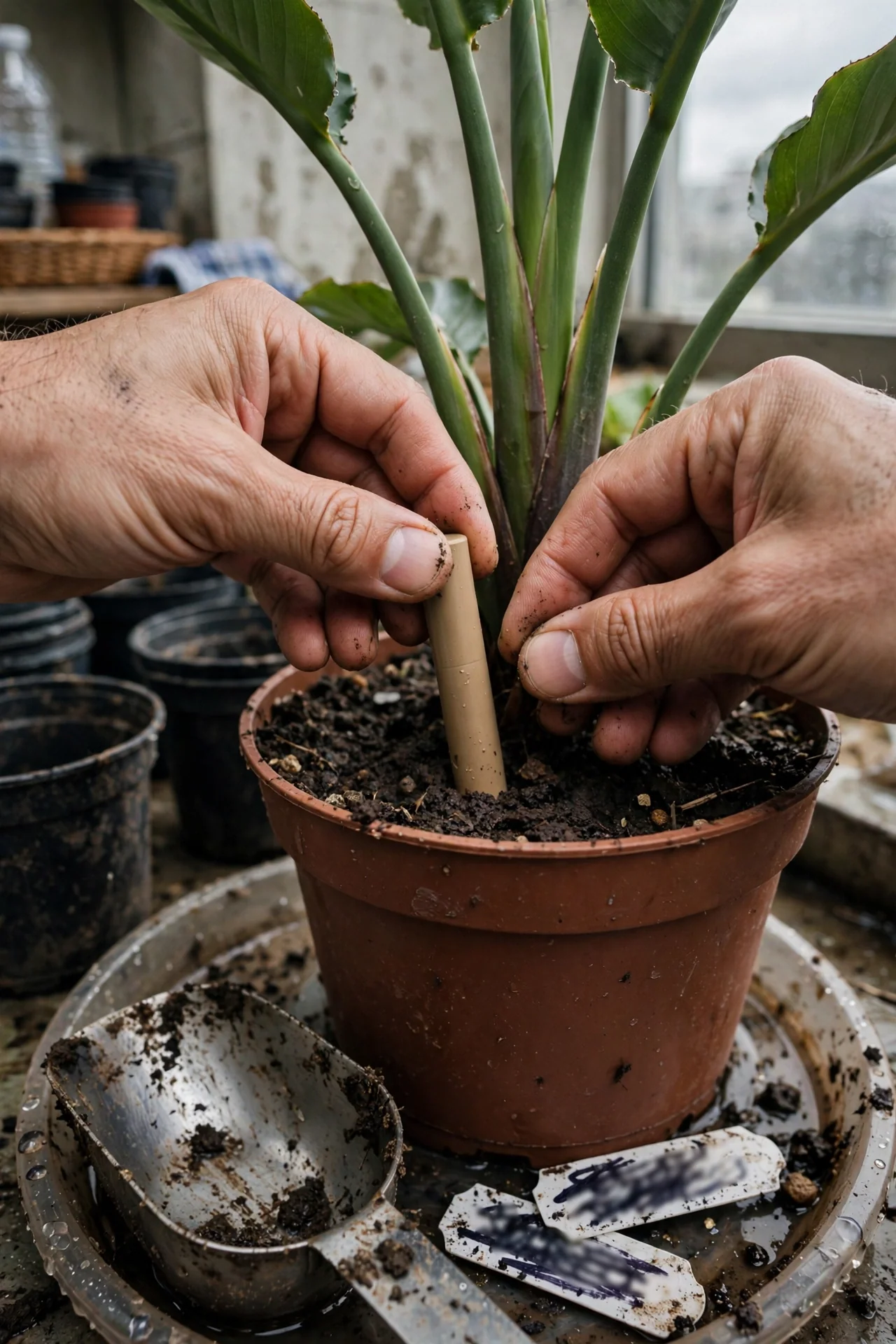
Threshold Rule. Insert one balanced NPK 14-14-14 stick per 6-inch pot diameter when soil temperature is above 65°F (18°C). Stick release lasts roughly 5 to 6 months. Reapply in early spring and again in late summer if temperatures remain warm. If older leaves turn yellow while veins stay green despite the sticks, pause feeding and flush the soil with distilled water to clear possible salt buildup. In low-light Branch 3 conditions, reduce the dose by using half a stick to prevent weak, leggy growth. Heavy feeders like alocasia respond to similar slow-release schedules, as described in our alocasia care overview.
10. Vertical Stake and Leaf Support System
Best for: Branch 1
Blueprint: What, For, Steps, Mistake. Tall bird of paradise plants in open spaces often lean toward the light, and large leaf stalks can bend under their own weight. What you need: a 4- to 5-foot bamboo or powder-coated metal stake, soft plant ties, and a rubber mallet. For: specimens over 4 feet tall that are starting to tilt or where leaves block walkways. Steps: (1) Insert the stake 3 inches from the main stem, driving it to the bottom of the pot to avoid root damage. (2) Loop a soft tie around the stem and stake in a figure-eight, leaving a finger-width gap so the stem can thicken. (3) Attach ties at three points: base, midpoint, and just below the newest leaf. (4) Check ties monthly and loosen any that feel tight. Mistake: using wire, zip ties, or tight string, which can cut into the petiole and create entry points for rot. For more indoor structural ideas, our monstera trellis ideas page covers flexible supports that work for large tropicals.
Starter Stack (What to Choose First)
Branch 1 Starter Stack: South-Facing Window Setup + Root-Bound Containment Tactic
Pair the window placement strategy with deliberate root restriction. The direct sun fuels robust growth, while the slightly tight pot channels energy into flowering instead of excess foliage. Together, you get a low-maintenance, bloom-focused system. Cost estimate: under $50 for a sheer curtain and a quality pot. Time commitment: less than 10 minutes per week, mostly for rotation and occasional top-dressing.
Branch 2 Starter Stack: East Window Shelf Maximizer + Self-Watering Pot Conversion
Combine the gentle light of an east window with a self-watering reservoir. The soft morning sun reduces leaf stress, and the reservoir keeps moisture steady in a compact footprint. This stack shines in apartments where floor space is tight. Cost estimate: low, typically under $60 for a shelf unit and a basic self-watering insert. Time: refill the reservoir every 5 to 7 days, a 1-minute task.
Branch 3 Starter Stack: Full-Spectrum LED Panel Rig + Controlled-Release Fertilizer Sticks
Use the LED panel to deliver consistent light and the fertilizer sticks to provide a steady nutrient baseline without weekly mixing. The light drives photosynthesis in a dim room, while the sticks release food on autopilot. Cost estimate: high for the light (often $120 and up), low for sticks. Time: set the timer once, then check water and sticks monthly.
When This Won’t Work
Failure condition one: persistent humidity below 30%. If your indoor air remains desert-dry despite a humidifier running continuously, bird of paradise leaves will keep splitting and developing brown edges regardless of watering or light. In that case, switch to a plant that tolerates dry air, such as a snake plant, or seal the room and use a larger evaporative humidifier. An alternative low-light-tolerant option with forgiving humidity needs is dieffenbachia; our dieffenbachia care guide details its requirements.
Failure condition two: deep shade with no possibility of artificial light. If the only available spot receives under 50 foot-candles for the entire day and you cannot install a grow light due to lease restrictions or layout, the bird of paradise will slowly yellow and stop producing new leaves. The alternative action is to relocate the plant to a brighter room or accept that a high-light tropical isn’t viable in that spot.
Choosing the Right Option for Your Situation
Budget Threshold
If your total plant setup budget is under $50, stick to Branch 1 or Branch 2 options that use existing windows and simple pots. Skip high-cost LED panels unless you find a reliable secondhand unit. The most affordable route is the south-facing window plus basic saucer.
Time Threshold
If you have less than 10 minutes per week for plant care, prioritize self-watering pots and slow-release fertilizer sticks. Avoid methods that demand weekly mixing or frequent moves. The self-watering pot and stick combo in Branch 2 or 3 keeps your involvement minimal.
Technical Constraint: Ceiling Height
If your ceiling is below 8 feet, a full-size Strelitzia nicolai will quickly hit the ceiling. Choose the smaller Strelitzia reginae and pair it with the east window shelf strategy to slow vertical growth. The root-bound tactic also helps limit size.
Yes/No Checklist:
- Can you provide at least 3 hours of bright indirect light daily? (Yes = move forward; No = rethink location or add LED.)
- Is your indoor humidity reliably above 40%? (Yes = good; No = plan a humidifier or plant group.)
- Do you have enough floor space for a pot at least 12 inches wide? (Yes = large plant possible; No = shelf or compact setup.)
- Can you commit to checking water needs weekly? (Yes = any branch; No = self-watering pot.)
Expert Q&A
Can bird of paradise bloom indoors without direct sun?
Flowering indoors is rare even with direct sun. Without any direct rays, the plant will likely produce only foliage. To raise bloom odds, add a full-spectrum LED delivering at least 300 µmol/m²/s for 12 hours daily and restrict root space, though success is not guaranteed in pure indirect light.
Why are my indoor bird of paradise leaves curling inward even though I water regularly?
Leaf curl often signals low humidity, not just dry soil. Check with a hygrometer. If humidity is below 40%, the plant loses water faster than roots can replace it. Increase humidity with a humidifier, group plants, or move the pot away from heating vents. Also verify that the root ball isn’t compacted and repelling water.
What is the smallest bird of paradise variety for a low ceiling?
Strelitzia reginae typically stays under 5 to 6 feet indoors, with some compact cultivars like ‘Mandela’s Gold’ reaching 4 feet. Strelitzia juncea, the rush-leaved type, is even narrower and shorter but grows more slowly. Avoid Strelitzia nicolai, which can hit 10 feet indoors.
How do I remove sticky residue from my indoor bird of paradise leaves?
Sticky residue is usually honeydew from scale insects or aphids. Wipe leaves with a cloth dipped in a solution of 1 teaspoon mild liquid soap per quart of water, then rinse with plain water. Inspect leaf undersides and stem joints for tiny brown bumps (scale). Treat repeatedly every 5 days for 3 cycles to break the life stage.
Is tap water with fluoride safe for bird of paradise plants?
Bird of paradise is moderately sensitive to fluoride and soluble salts. Tip burn on older leaves can appear if your municipal water is fluoridated above 1 ppm. Use rainwater, distilled water, or let tap water sit overnight to dissipate chlorine (though fluoride won’t evaporate). Flush soil every 2 months to reduce salt accumulation.
Conclusion
The single most important decision is which branch matches your actual light and time reality. Trying to force a high-light strategy in a dim apartment sets you up for chronic leaf loss and frustration. The number one mistake is buying the tallest bird of paradise you can find without checking if your brightest window can sustain it.
Once you know your branch, start with the two-item starter stack and let the plant stabilize for a season before adding extra tactics. For a different tropical that thrives with similar humidity and light-aware routines, explore our hoya care guide.