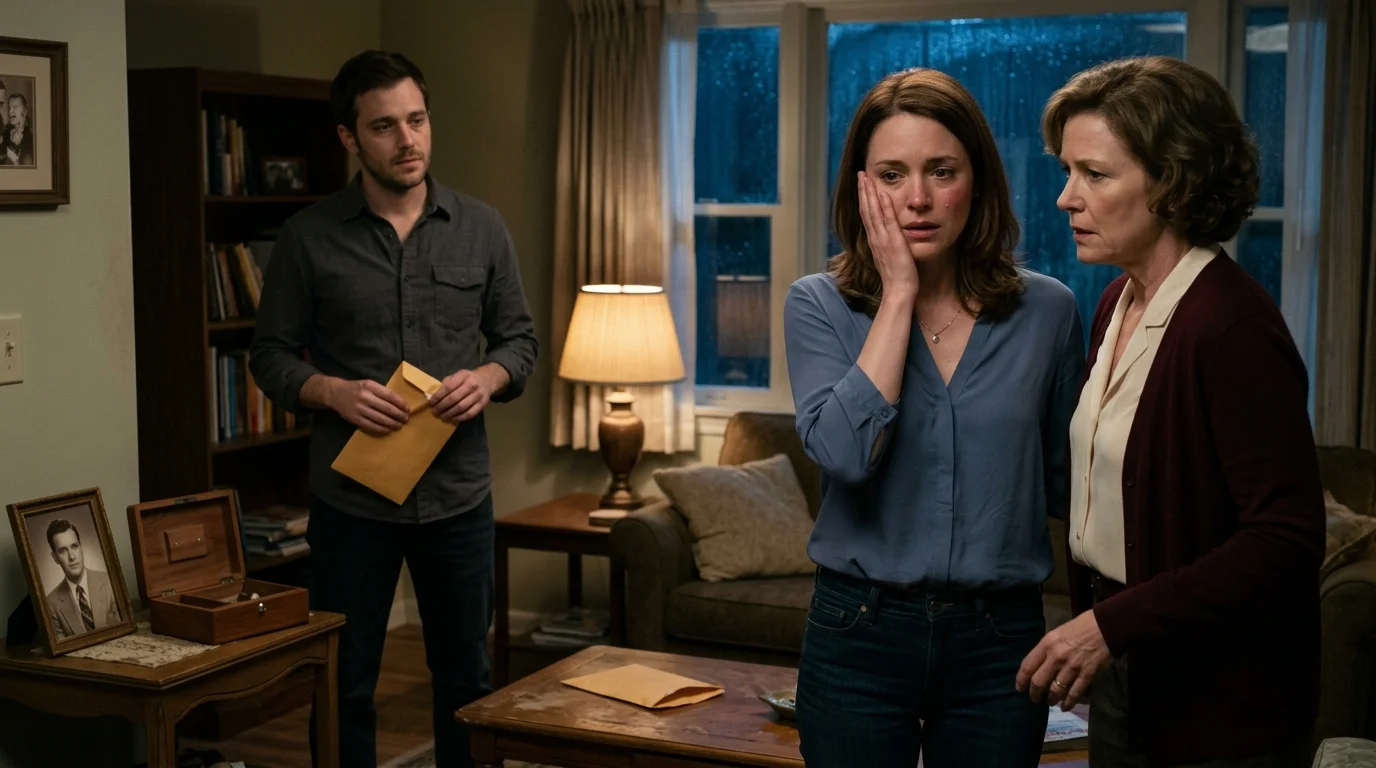
“I know that now.”
Claire looked through the kitchen window at the gray morning sky. She wanted to believe her mother, but belief had never been the problem. The problem was what Margaret did when the truth became inconvenient.
“Mom, I’m not going to pretend this is resolved because you’re sorry.”
“I understand.”
“Do you? Because I need you to understand that I won’t give Daniel more money. I won’t cover his debts. And I won’t accept being blamed if he faces consequences.”
Margaret drew a shaky breath. “I won’t ask you to.”
“You already did, when you slapped me.”
“I know.”
The apology sounded different this time. There was no demand that Claire calm down, no reference to family loyalty, no suggestion that she had caused the problem by speaking too loudly.
It was not enough to repair everything, but it was a beginning.
Before they ended the call, Margaret told Claire she had found another envelope among Robert’s papers. It contained the records of the original inheritance arrangement and the amounts that had been removed.
“I’ll give everything to your lawyer,” Margaret said. “You shouldn’t have to chase me for it.”
Claire closed her eyes.
“Thank you.”
It was the first useful thing her mother had offered since the money disappeared.
The Brother Who Finally Stopped Running
Daniel did not call until a week later.
His first message was short: Can we talk? I need to explain.
Claire replied that she would meet him in a public place, but she would not lend him money or agree to keep anything secret.
They met at a small café near her workplace. Daniel arrived early and had already ordered coffee. He looked as though he had not slept properly in days.
For once, he did not begin with an excuse.
“I stole the money,” he said.
Claire set her cup down.
“I know.”
“I kept thinking I could put it back before anyone noticed. Every time I lost more, I convinced myself I could recover it. Then I took more because I couldn’t face what I’d already done.”
“Why didn’t you stop?”
Daniel looked at his hands. “Because I was ashamed. And because Mom always helped me out.”
Claire waited.
“I knew she’d protect me,” he continued. “I didn’t think about what it meant for you. I just thought about getting through the next day.”
“That doesn’t make it less selfish.”
“I know.”
He reached into his jacket and placed a folded sheet of paper on the table. It was a repayment proposal prepared with help from a financial counselor. He had contacted a gambling-support service and arranged an assessment. He had also spoken to his employer about additional shifts.
Claire read the page carefully.
The plan was modest. It would take time. It did not promise that everything would be fixed by next month, and it did not ask Claire to trust him on the strength of his word alone.
That mattered.
“I can’t promise you I’ll forgive you soon,” she said.
“I don’t expect you to.”
“And I won’t give you access to my accounts, my savings, or my home.”
“You shouldn’t.”
“If you miss a payment, I’ll follow the legal process. I won’t lie for you.”
Daniel nodded.
For the first time in years, he seemed to understand that love and rescue were not the same thing.
“I am sorry,” he said. “Not because Mom is upset. Not because you might take legal action. I’m sorry because Dad trusted us, and I used the money he left you to avoid dealing with my own life.”
Claire looked at her brother. She could see the familiar charm, the same face that had once persuaded their mother to forgive every broken promise. But she could also see fear, shame, and the beginnings of something that might become responsibility.
She did not mistake that possibility for proof.
“Then show me,” she said.
Daniel folded his hands. “I will.”
They finished their coffee without trying to force the conversation into something warm. When they stood to leave, Daniel did not ask for a hug. Claire did not offer one.
It was an uncomfortable ending, but an honest one.
For their family, that was new.
The Price of Repair
The next several months were difficult.
The attorney helped Claire document the missing funds and establish a formal repayment arrangement. Margaret provided the financial records she had previously hidden. The process revealed exactly how much had been taken, when the withdrawals occurred, and which expenses had been paid from Claire’s inheritance.
Some money could be traced directly. Some had already been spent. There was no magical account waiting to restore everything overnight.
Daniel had to sell his car and reduce his expenses. He attended counseling and began making regular payments. The first payment was small, but it arrived on time. The second arrived on time, too.
Claire kept records of both.
Margaret, meanwhile, began attending counseling herself. She had to confront the way fear had shaped her decisions: fear of losing Daniel, fear of being judged, fear that admitting a mistake would destroy the family.
For years, she had confused protecting her son with protecting him from consequences. She had also assumed Claire would remain strong enough to absorb whatever damage was left behind.
When she finally spoke to Claire about it, she did not ask to be excused.
“I told myself you were the strong one,” Margaret said during a visit to Claire’s apartment. “I thought you could handle disappointment better than Daniel could. So I kept asking you to handle more.”
Claire looked at her mother across the small kitchen table.
“That didn’t mean it hurt less.”
“I know. I should have known.”
Margaret’s eyes were wet, but she did not reach for Claire’s hand or ask her to make the moment easier.
“I cannot undo the slap,” she said. “I cannot undo what I did with the money. But I can stop asking you to pretend it didn’t happen.”
Claire felt something inside her loosen—not forgiveness, exactly, but the possibility of a relationship that no longer depended on silence.
“That’s what I need,” she said. “Honesty, even when it makes you uncomfortable.”
Margaret nodded.
It was not a dramatic reconciliation. There were no promises that the family would become close again, no declaration that everything was forgiven.
There was only a mother finally listening and a daughter no longer willing to disappear inside someone else’s needs.
A Key of Her Own
Nearly a year after the money vanished, Claire stood inside a small apartment with cream-colored walls, an old wooden floor, and a kitchen window that filled the room with morning light.
It was not the perfect apartment she had imagined as a teenager. The kitchen was narrow, the bathroom needed updating, and the bedroom was barely large enough for a bed and a dresser.
But it was hers.
The inheritance had not returned all at once. Daniel’s payments, Claire’s own savings, and a revised budget had helped her reach the deposit she needed. The process had been slower and more difficult than she had planned, but she had reached the goal without sacrificing her boundaries.
On the windowsill, she placed three small pots of herbs.
Then she took the key from her pocket and held it in her palm.
She thought of her father, of his careful handwriting, and of the words he had left for her: You deserve a home where you feel safe, respected, and free.
Her phone buzzed.
A message from Daniel appeared.
I sent this month’s payment. I know it doesn’t fix anything, but I wanted you to know I kept my promise.
Claire looked at the message for a moment before replying.
I received it. Keep doing the work.
It was not a declaration of forgiveness. It was an acknowledgment of effort.
A second message arrived, this time from Margaret.
I’m proud of you. I hope I can earn back your trust, one honest day at a time.
Claire read it twice.
She did not rush to answer. Instead, she walked to the window and opened it. Cool air drifted into the apartment, carrying the smell of wet pavement after an overnight shower.
For years, she had believed the only way to keep her family was to be endlessly patient, endlessly understanding, endlessly willing to make room for everyone else’s mistakes.
She finally understood that a family could survive the truth, but only if its members were willing to stop hiding behind one another.
Her brother had stolen her money. Her mother had protected him and struck the person asking for justice. Neither act could be erased by regret.
But the future did not have to repeat the past.
Daniel would have to earn trust through actions, not promises. Margaret would have to learn that loving one child did not justify wounding the other. Claire would have to accept that she could love her family without making herself responsible for saving them.
She placed the key on the kitchen counter and smiled faintly at the little pots of herbs.
The money had been important. It had represented years of effort, her father’s final gift, and the beginning of the independent life she had worked toward.
But the greatest thing she had recovered was not a sum in a bank account.
It was the right to decide what happened next.
That evening, Margaret called to ask whether she could visit the new apartment. Claire considered the request before answering.
“Yes,” she said. “But we need to talk honestly when you come.”
“I understand.”
“And if either of us needs a break, we’ll take one. No shouting. No pretending.”
“All right.”
Claire ended the call and looked around her quiet kitchen. There was still pain to work through. There might be arguments ahead. Forgiveness, if it came, would not arrive on a schedule.
But she no longer needed to rush it.
She had spent years trying to prove that she deserved to be treated fairly. Now she understood that fairness was not a prize she had to earn by being the most patient person in the room.
It was a boundary she was allowed to set.
Claire turned off the kitchen light and walked toward the open window, where the last light of the evening rested across the floor.
For the first time in a long time, she did not feel responsible for fixing everyone else’s life.
She could finally begin living her own.