
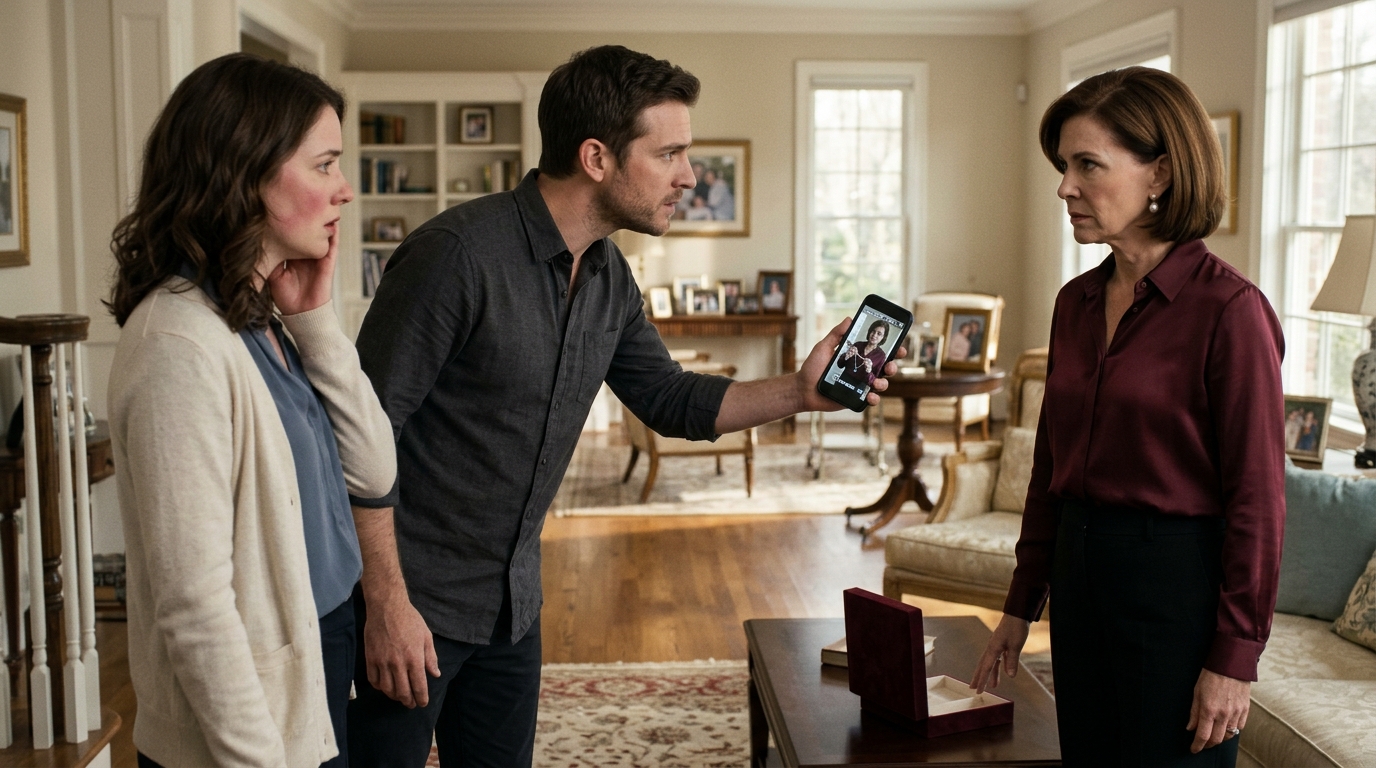
“Where is my necklace? You stole it!”
Margaret Bennett’s voice cut through the living room before Claire could even put down her cup of coffee.

The older woman stood beside the sofa, clutching an open burgundy jewelry box. Her face was flushed with anger, and her fingers trembled around the velvet case.
Claire stared at her. “What are you talking about?”
“My diamond necklace. The one my mother left me. It was in my bedroom this morning, and now it’s gone!”
Daniel, Claire’s husband, looked up from his phone. He had been answering a work message, expecting another ordinary Sunday at his parents’ house. Instead, his mother was glaring at his wife as if she had already delivered a guilty verdict.
“Mom, have you checked everywhere?” he asked.
Margaret rounded on him. “Do you think I’m senile? I know exactly where I left it!”
Then she looked directly at Claire.
“You were upstairs earlier.”
“I went to get my jacket,” Claire replied. “That’s all.”
Margaret stepped closer. “And you expect me to believe that?”
Claire’s expression hardened. “You can believe whatever you want, but don’t accuse me of stealing something I haven’t touched.”
The slap came so quickly that Daniel barely had time to move.
Margaret struck Claire across the cheek.
Claire stumbled half a step, one hand flying to her face. For a moment, nobody spoke. The sound seemed to hang in the room, louder than the clock ticking above the fireplace.
Daniel stood up.
“Mom! What is wrong with you?”
Margaret barely glanced at him. “She stole from me!”
“You don’t know that!” Claire said, her voice shaking.
“I saw you near my room!”
“Then check the cameras!” Claire shot back.
For the first time, Margaret hesitated.
Daniel noticed.
And so did Claire.
Margaret quickly recovered her composure and pointed toward Claire’s handbag, which lay on the sofa.
“Fine. Let’s see what’s inside.”
“Don’t touch my things,” Claire warned.
But Margaret had already grabbed the bag.
She tipped it over the coffee table. A wallet, keys, tissues, and a small packet of mints scattered across the wood. Daniel stared at the objects. There was no necklace.
Margaret looked furious, but not surprised enough.
“She’s lying!” she insisted.
Daniel stepped between the two women. “Mom, stop. You’re making this worse.”
“Worse?” Margaret laughed bitterly. “I let this woman into my family, and now she’s robbing me!”
Claire’s eyes filled with tears, but she refused to look away.
“I married your son. I didn’t marry your possessions.”
The words struck harder than Margaret expected.
From the hallway, a quiet voice interrupted them.
“Daniel, check the bedroom camera.”
Evelyn Brooks, the family’s longtime housekeeper, stood near the doorway. Her face was pale, and her hands were clasped tightly in front of her.
Margaret turned sharply.
“Evelyn, stay out of this.”
But Evelyn looked at Daniel.
“Please. Just check it.”
Daniel took out his phone and opened the home’s security application. His thumb moved quickly across the screen as he searched the recording from Margaret’s bedroom.
Margaret stepped toward him.
“Daniel, don’t you dare!”
He looked up at his mother.
Then the video loaded.
The room fell silent.
On the screen, Margaret entered her bedroom wearing the same burgundy blouse she had on now. She walked toward her dresser, opened the jewelry box, and lifted the diamond necklace with its distinctive oval sapphire pendant.
She looked toward the bedroom door.
Then she closed her fingers around the necklace and carried it out of the camera’s view.
Daniel slowly raised his eyes.
“You had it all along?”
Margaret’s face lost its color.
Claire lowered her hand from her cheek.
For the first time that afternoon, Margaret had no accusation ready.
And Daniel realized that the missing necklace was only the beginning.
The Woman Who Always Had to Be Right
Margaret had spent thirty years building a life in which nobody questioned her.
Her husband, Robert, had been a successful property developer. Their home was large, their neighborhood prestigious, and their family photographs carefully arranged throughout the house. Even after Robert’s death three years earlier, Margaret continued to manage every detail of family life as though the entire household depended on her approval.
Daniel was her only child.
She had raised him to be polite, successful, and obedient. He had learned early that disagreeing with his mother could turn a pleasant evening into hours of cold silence.
Claire had never understood that system.
She had grown up in a modest household where people argued, apologized, and moved on. Her parents had taught her that respect did not mean accepting every demand. When she married Daniel two years earlier, she genuinely believed she was joining a family that would eventually become her own.
At first, Margaret had seemed welcoming.
She invited Claire to lunch, complimented her clothes, and insisted that Daniel deserved a woman who understood the importance of family.
The trouble began after the wedding.
Margaret criticized Claire’s cooking, questioned her career choices, and suggested that Daniel could have married someone with a more prestigious background. She made remarks about Claire’s family whenever she felt challenged.
At dinner parties, she introduced Claire as “Daniel’s wife” without mentioning her name.
When Claire objected, Daniel would say, “You know how Mom is. Just don’t take it personally.”
Claire had tried.
She had tried through birthdays, holidays, and uncomfortable Sunday dinners. She had tried because she loved Daniel and hoped that patience would eventually soften his mother’s attitude.
But every compromise seemed to invite another demand.
The slap had crossed a line that could not be erased by pretending it had never happened.
Now, standing beside the coffee table, Claire watched Daniel hold the phone while his mother struggled to find an explanation.
“It’s not what you think,” Margaret finally said.
Daniel stared at her. “Then tell us what it is.”
Margaret glanced toward Evelyn.
“You have no idea what you’re talking about,” she snapped.
Evelyn’s expression changed. For years, she had cleaned the house, prepared meals, organized appointments, and quietly witnessed the family’s private struggles. She had never been someone who enjoyed interfering in other people’s affairs.
But she had also watched Margaret humiliate Claire again and again.
And she had seen something that morning that she could no longer ignore.
“I know what I saw,” Evelyn said.
Margaret’s voice dropped to a dangerous whisper. “You work for this family.”
“I do,” Evelyn replied. “And I won’t lie for it.”
Daniel looked at the security footage again.
“Mom, why did you take the necklace?”
Margaret folded her arms.
“Because I wanted to know how far Claire would go.”
Claire stared at her in disbelief.
“You staged this?”
“I wanted to see whether you would admit what you’d done.”
“What I’d done?” Claire repeated. “You slapped me in front of your son because you wanted to test me?”
Margaret lifted her chin. “If you had nothing to hide, you wouldn’t be so upset.”
Daniel’s expression hardened.
“Enough.”
The single word surprised everyone, including him.
He turned to Claire. “Let’s go.”
Claire collected her belongings from the table. Her hands were still trembling, but she refused to let Margaret see her cry.
As Daniel guided her toward the door, his mother called after him.
“If you walk out with her, don’t expect me to forget it!”
Daniel stopped.
For a second, the old fear returned. He pictured the silent treatment, the accusations, and the guilt that had followed every disagreement since childhood.
Then he looked at Claire’s reddened cheek.
“I think you’ve forgotten something already,” he said. “She’s my wife.”
He opened the door.
And left.
A Marriage Full of Unspoken Things
The drive home was quiet.
Daniel kept both hands on the steering wheel. Claire sat beside him, staring through the passenger window at houses passing in the afternoon sunlight.
He wanted to apologize. He wanted to explain that he had not known his mother would go so far. He wanted to tell Claire that everything would be different now.
But he had made those promises before.
Finally, Claire spoke.
“How long?”
Daniel glanced at her. “How long what?”
“How long have you known she treats me like this?”
He swallowed.
“I knew she could be difficult.”
“That’s not what I asked.”
He tightened his grip on the wheel.
“I knew she made comments. I knew she criticized you. I didn’t know she would—”
“Slap me?”
He fell silent.
Claire turned toward him.
“You watched her question my honesty for two years. Every time I asked you to stand up for me, you told me to ignore her. Today, she emptied my handbag in front of you. She accused me of being a thief. And before you could stop her, she hit me.”
“I should have stopped her.”
“Yes,” Claire said. “You should have.”
There was no shouting in her voice now. Somehow, that made the words more painful.
Daniel had always thought of himself as a good husband. He paid the bills, helped around the apartment, and remembered their anniversary. He believed that loving Claire meant making her comfortable.
He had never fully understood that love also required him to protect their relationship from the people who threatened it, even when those people shared his blood.
“I am sorry,” he said.
Claire looked away.
“I believe you’re sorry. But I need to know what happens the next time she decides I’m the problem.”
“There won’t be a next time.”
She gave him a tired look.
“You can’t promise me what your mother will do. You can only promise me what you will do.”
He had no answer.
At home, Claire went into their bedroom and closed the door. Daniel remained in the living room, replaying the footage on his phone.
He watched his mother enter the bedroom again.
She had not looked confused. She had not searched the room. She had known exactly where the necklace was.
He enlarged the video.
A few seconds before she lifted the necklace, Margaret opened a drawer and removed a small white envelope. She slipped it into the pocket of her trousers before taking the jewelry.
Daniel paused the footage.
What was in the envelope?
He called Evelyn.
She answered after several rings.
“Daniel?”
“I’m sorry about what happened today,” he said. “I shouldn’t have let Mom treat Claire that way.”
“No,” Evelyn replied gently. “You shouldn’t have.”
He accepted the rebuke.
“Can I ask you something? Did you see what happened before Mom took the necklace?”
Evelyn hesitated.
“I saw her leave the study with some papers. She looked upset. She told me to say nothing about it.”
“What papers?”
“I don’t know. But your mother has been receiving calls from the bank. More than usual.”
Daniel sat upright.
“What bank?”
“The one that handles your father’s estate, I believe.”
His father had left behind a substantial property portfolio, several investment accounts, and a family trust. Daniel knew the broad outline of the estate, but his mother managed most of its day-to-day affairs.
“Did she say anything else?”
Evelyn paused.
“She asked me whether the bedroom camera recorded the dresser clearly.”
Daniel felt a chill run down his spine.
“Before or after she took the necklace?”
“Before.”
He ended the call and looked toward the closed bedroom door.
His mother hadn’t simply lost control.
She had planned something.
And he needed to know why.
The Envelope in the Drawer
The next morning, Daniel drove to his mother’s house alone.
Margaret opened the door wearing a cream sweater and perfectly arranged makeup. If she had slept badly, she concealed it well.
“I wondered when you would come back,” she said.
“Where’s the necklace?”
“In my bedroom.”
“That’s not what I asked.”
Her expression tightened.
Daniel walked into the living room but did not sit down.
“Why did you take it? Why did you let me believe Claire had stolen it?”
Margaret closed the front door.
“Because I wanted you to see what kind of woman you married.”
“You mean the woman you slapped?”
“Don’t exaggerate.”
Daniel stared at her.
“Don’t ever tell me that again.”
For a moment, Margaret looked genuinely surprised. She had spent years dismissing her son’s discomfort with a few sharp words. She had not expected him to challenge her so directly.
“You’ve changed,” she said.
“No. I’ve finally stopped pretending I don’t see what’s happening.”
Margaret walked toward the fireplace.
“Your father would never have allowed a stranger to divide this family.”
“Claire isn’t a stranger. She’s my wife.”
“She has turned you against me.”
“No, Mom. You did that yourself.”
The words seemed to strike something deep inside Margaret. Her eyes narrowed, but she did not respond immediately.
Daniel remembered the envelope visible in the security footage.
“What was in the white envelope you took from the study?”
Margaret went still.
“What envelope?”
“The one you put in your pocket before taking the necklace.”
“You’ve been watching recordings of me?”
“You told me to check the cameras. I did.”
Margaret looked toward the hallway.
For the first time, Daniel saw something beneath her anger that he couldn’t easily identify.
Fear.
“Those papers have nothing to do with Claire,” she said.
“Then show me.”
“I don’t have to explain my private affairs to you.”
“Fine. But I’m going to find out what happened.”
He turned toward the door.
“Daniel.”
He stopped but did not turn around.
“Your father trusted me to protect this family,” Margaret said.
“Then protect it by telling the truth.”
He left before she could answer.
Back at his apartment, Claire was sitting at the kitchen table with a cup of tea. The mark on her cheek had faded, but Daniel knew that the humiliation would take longer to disappear.
He told her about the envelope and Evelyn’s observations.
Claire listened without interrupting.
“Do you think she took the necklace because she wanted to frame me,” she asked, “or because she wanted to hide something else?”
“I don’t know.”
“Then don’t decide what happened before we have the facts.”
Daniel nodded. It was the kind of calm judgment he had always admired in Claire, although he had not always listened to it.
They agreed to meet Evelyn that evening.
They would ask her what she had seen, then review the available footage together. If Margaret had used the necklace to stage an accusation, they needed to understand what she was trying to accomplish.
Neither of them expected what Evelyn brought with her.
A small folder.
Inside were copies of documents that had been left on the study desk.
The Secret Behind the Accusation
Evelyn arrived just after seven.
She looked uncomfortable as she placed the folder on the kitchen table.
“I didn’t want to take anything that wasn’t mine,” she explained. “But I thought someone needed to know.”
Daniel opened the folder.
The first page was a letter from a bank concerning an overdue loan secured against one of the family’s commercial properties. The second contained a summary of outstanding payments. The third was a notice requesting further documentation about a recent withdrawal from an estate account.
Daniel read the pages twice.
“How much is the outstanding debt?”
Evelyn pointed to the figure near the bottom of the first page.
It was substantially more than he had expected.
His father had owned several properties, but some were financed through loans. Daniel had assumed that the estate was financially secure because Margaret had always insisted that everything was under control.
Now the documents suggested otherwise.
“Did Dad know about this?” he asked.
“I couldn’t tell you,” Evelyn said. “Your mother handled the accounts after he died.”
Claire leaned forward.
“What does the withdrawal notice mean?”
Daniel read the letter again.
“The bank is asking for supporting documents for a transfer from an account connected to the estate.”
“Was the transfer authorized?”
“I can’t tell from this.”
The amount was large enough to explain why Margaret had been receiving calls. But it did not explain the necklace.
Claire looked at the folder.
“Could the necklace have been sold?”
“Maybe,” Daniel said. “But the recording shows her holding it that morning.”
Evelyn shook her head.
“She wasn’t planning to sell it. At least, not then. I saw her put it in a small locked box in the study afterward.”
Daniel looked up.
“You saw her put it away?”
“Yes. She told me not to mention it to anyone.”
The room fell quiet.
Margaret had taken the necklace from her bedroom, hidden it, and then accused Claire of stealing it.
The accusation had been deliberate.
But why?
Claire spoke first.
“She wanted you to choose between us.”
Daniel looked at her.
“She thought that if you believed I was a thief, you would have to defend your family by sending me away. And if I left, she wouldn’t have to explain anything else.”
It was a plausible explanation, but something still didn’t fit.
Daniel picked up the bank letter.
His mother had been frightened about money before the necklace disappeared. She had wanted the family to believe that Claire was dishonest, but she had also been protecting the secret of the estate.
Perhaps the accusation served two purposes: it gave Margaret a way to attack Claire and distracted everyone from the documents.
Daniel called his father’s former estate attorney, Robert Ellis, whose number was still saved in his contacts.
After explaining the situation, he asked whether there had been any recent concerns about the estate.
Robert was careful.
“I can’t discuss confidential matters without reviewing my authority to do so,” he said. “But I can tell you that your father established clear procedures for significant withdrawals. If you’re concerned about a transaction, we should arrange a meeting and review the records properly.”
Daniel thanked him and ended the call.
He didn’t yet know whether his mother had broken any rules. The papers were concerning, but they weren’t proof of wrongdoing.
Still, he knew one thing with certainty.
Claire had never stolen the necklace.
And Margaret had knowingly tried to make everyone believe she had.
The Second Recording
The following afternoon, Daniel returned to his mother’s house with Claire.
He had asked Margaret to meet them in the living room. She initially refused, then agreed when he told her that he had seen the security footage and the documents from the study.
She was already waiting when they arrived.
The sapphire necklace lay on the coffee table beside the burgundy velvet box.
“I assume you came for this,” Margaret said.
Claire remained standing.
“No. We came for the truth.”
Margaret looked at Daniel.
“You brought her here to interrogate me?”
“I brought my wife because you humiliated her in this room. She deserves to hear you explain yourself.”
Margaret’s jaw tightened.
“I was angry. I made a mistake.”
“You didn’t make one mistake,” Daniel replied. “You took the necklace, hid it, accused Claire of stealing it, and slapped her when she denied it.”
“I never intended for things to go so far.”
Claire spoke quietly.
“You struck me before you even gave me a chance to explain.”
Margaret turned toward her.
“You have no idea what I’ve been dealing with.”
“Then tell us.”
For a moment, Margaret seemed ready to refuse. Then she sat down.
She admitted that the estate had financial problems. Some of the family’s properties were losing money, and the bank had demanded repayment of a loan. She had been trying to sell an investment property, but the transaction had stalled.
She had not told Daniel because she feared he would discover how poorly she had managed the estate since Robert’s death.
“I wanted to fix everything before anyone found out,” she said.
Daniel remained cautious.
“What about the transfer?”
Margaret looked down at her hands.
She said the transfer had been intended to cover an urgent payment connected to one of the properties. She insisted that she had not stolen money, but she admitted that the paperwork was incomplete.
“We’ll review it with the attorney,” Daniel said. “I’m not going to accuse you of something we haven’t established.”
Margaret looked almost relieved.
Then Claire asked the question that had been hanging over the room since the day before.
“Why did you choose me?”
Margaret looked up.
“What?”
“Why did you decide to frame me? You could have admitted you misplaced the necklace. You could have told Daniel about the financial problems. Instead, you made me the villain.”
Margaret’s eyes flashed.
“Because you were already pulling him away from me!”
Daniel stared at her.
“That’s what this is about?”
“You have no idea what it’s like to lose your husband and then watch your only child build a life that no longer needs you.”
Claire’s expression softened slightly, but she did not move closer.
“You didn’t lose Daniel when he married me. You made him afraid to disagree with you.”
Margaret looked toward her son, expecting him to defend her.
He didn’t.
For years, he had confused his mother’s unhappiness with his own responsibility. If she was angry, he tried to make peace. If she criticized Claire, he asked Claire to be patient. If his mother demanded loyalty, he gave it to her, even when doing so hurt the person he had promised to protect.
He finally understood that avoiding conflict had never kept the family together.
It had simply allowed the conflict to continue.
“You wanted me to choose,” Daniel said. “You wanted me to believe Claire was a thief so I would send her away.”
Margaret said nothing.
“But I won’t do that. Not now. Not ever.”
She began to cry.
It wasn’t the controlled, angry expression Daniel was accustomed to seeing. For a moment, she looked like a woman who had lost control of a life she had spent years trying to manage.
“I was scared,” she whispered.
Daniel’s voice softened, but his words remained firm.
“Then you should have asked for help.”
“I couldn’t let anyone think I’d failed.”
Claire looked at the necklace.
“So you decided I should pay for it instead.”
Margaret closed her eyes.
She had no answer.
An Apology Is Not a Reset Button
Margaret pushed the necklace toward Daniel.
“Take it,” she said. “It’s yours to deal with.”
Daniel did not touch it.
“No. It’s yours. And so is the responsibility for what happened.”
Margaret looked wounded.
“I’m your mother.”
“And Claire is my wife. Neither relationship gives us permission to hurt someone and demand that they forget it.”
Claire watched him carefully. It was the first time he had said those words without looking at her to see whether his mother would be offended.
Margaret turned to Claire.
“I am sorry I slapped you.”
Claire took a slow breath.
“Thank you for apologizing.”
Margaret seemed to expect more.
Claire continued.
“But I’m not going to tell you everything is fine. You accused me of theft in front of your family, emptied my handbag, and hit me. You tried to destroy my reputation because you were afraid of losing control.”
“I know.”
“Do you? Because the next time you’re frightened or angry, I need to know that you won’t decide I’m the easiest person to blame.”
Margaret looked down at the necklace.
“I don’t know how to make you trust me again.”
“You start by telling the truth, even when it makes you look bad.”
Daniel placed the bank documents on the table.
“We’re going to meet with Dad’s attorney. We’ll find out exactly what happened with the accounts, and we’ll make a plan for the debts. But there will be no more hiding things or using Claire as a distraction.”
Margaret nodded reluctantly.
“And until Claire feels safe around you again, we won’t be coming here for family dinners or visits,” Daniel added.
Margaret looked up sharply.
“You would cut me out of your life over one incident?”
“One incident?” Claire repeated. “You have been hurting me for years. Today was simply the moment you went too far.”
Daniel reached for Claire’s hand.
“We’re not punishing you, Mom. We’re setting a boundary. If you want a relationship with us, it has to be built on respect.”
Margaret stared at their joined hands.
She seemed ready to argue, but the words never came.
For once, Daniel did not fill the silence for her.
He and Claire left together.
Outside, the air was cool, and the afternoon light had begun to fade. Claire stopped beside the car.
“Thank you,” she said.
Daniel turned toward her. “For what?”
“For finally speaking up.”
He looked ashamed.
“I should have done it a long time ago.”
“Yes,” Claire said. “You should have.”
He nodded, accepting the truth without defending himself.
“I’m going to work on that. Not just with my mother. With us.”
Claire squeezed his hand, but she did not promise that everything would be all right.
Their marriage had survived the accusation, but it would need more than one difficult conversation to repair the damage caused by years of silence.
For now, it was enough that Daniel had finally understood what she needed from him.
Not a husband who would promise to keep the peace.
A husband who would stand beside her when keeping the peace meant asking her to accept the unacceptable.
Six Months Later
The estate attorney eventually reviewed the outstanding loan, the incomplete transfer records, and the family’s remaining assets. The financial problems were serious, but they could be addressed through a structured repayment plan and the sale of one underperforming property.
There was no evidence that Claire had taken anything, and Margaret’s decision to stage the necklace’s disappearance remained exactly what it had been: a deliberate attempt to manipulate her family.
Margaret cooperated with the review and acknowledged that she had concealed financial information out of fear and pride. She also accepted responsibility for the way she had treated Claire.
The apology did not instantly restore their relationship.
For several weeks, Daniel and Claire kept their distance. Margaret sent messages, sometimes asking how they were doing, sometimes apologizing again. Claire replied when she felt ready. She did not agree to visits simply because Margaret wanted them.
Daniel began setting boundaries without waiting for a crisis. When his mother criticized Claire, he ended the conversation. When Margaret tried to make him responsible for her loneliness, he reminded her that they could love her without surrendering their independence.
Slowly, Margaret began to understand that a family relationship could not be maintained through fear.
One Sunday afternoon, she invited them to lunch.
Claire agreed to come, but only after Daniel confirmed that Evelyn would be there and that they could leave whenever they wished.
When they arrived, Margaret greeted them at the door.
She wore a simple blue dress and no jewelry except her wedding ring.
“I’m glad you came,” she said.
Claire nodded politely.
They sat at the dining table. The conversation was awkward at first, but Margaret made a genuine effort to ask Claire about her work and listen to the answers. She did not interrupt or turn the conversation toward herself.
After lunch, Margaret asked Claire if she would speak with her privately.
Daniel looked at his wife, leaving the decision to her.
Claire agreed.
In the living room, Margaret opened a small box and removed the diamond necklace. The sapphire pendant caught the afternoon light.
“I wanted you to have this,” Margaret said.
Claire looked at the necklace but did not reach for it.
“Why?”
“Because I owe you more than an apology.”
Claire studied her face.
Margaret swallowed.
“My mother gave it to me when I got married. I always thought that protecting it meant protecting my family. But I used it to hurt you, and I nearly destroyed the trust between my son and me.”
She held the box out.
“I don’t expect you to forgive me because of a necklace. I just wanted you to know that I understand what I did.”
Claire considered the offer.
Then she gently pushed the box back toward Margaret.
“Keep it. It’s part of your history.”
Margaret looked surprised.
“Are you sure?”
“Yes. I don’t need your jewelry to prove that I belong in this family.”
For a moment, neither woman spoke.
Then Margaret nodded.
“I understand.”
It was not a perfect reconciliation. There were still uncomfortable memories, difficult conversations, and moments when Margaret slipped into old habits. But she began to correct herself instead of insisting that everyone else was too sensitive.
Claire, in turn, allowed the relationship to improve at a pace that felt safe to her. She did not forget the slap, and she did not pretend it had been harmless. She simply stopped allowing that moment to determine every moment that followed.
Daniel learned that his responsibility was not to choose which woman deserved his love. It was to ensure that neither relationship required him to betray his values or tolerate cruelty.
A year later, the family gathered for a small birthday dinner at Daniel and Claire’s home.
Margaret arrived carrying a cake she had baked herself. She asked Claire where to put it rather than assuming she could take over the kitchen. When Claire offered her a plate, Margaret thanked her.
The change was small.
But it was real.
As the evening ended, Margaret stood beside Claire near the doorway.
“I know things aren’t the same as they were,” she said.
Claire nodded. “They shouldn’t be.”
Margaret accepted that answer without argument.
“I hope, one day, we can build something better.”
Claire looked at her for a long moment.
“We can. But we have to keep choosing honesty.”
Margaret nodded.
For the first time, neither woman needed to win the conversation.
After Margaret left, Daniel wrapped his arms around Claire from behind.
“Do you think she’ll ever completely change?” he asked.
Claire leaned against him.
“I don’t know.”
He kissed her hair.
“Fair enough.”
She turned in his arms.
“But I know something else,” she said.
“What?”
“Love doesn’t mean letting someone hurt you just because you don’t want to lose them.”
Daniel thought about the afternoon when his mother had slapped his wife, and how close he had come to allowing fear to dictate his response once again.
He understood now that loyalty was not blind obedience, and forgiveness was not the same as pretending nothing had happened.
Some relationships could be repaired. Others could only survive with distance. The difference depended on whether the people involved were willing to take responsibility for the harm they had caused.
Claire reached for his hand.
Together, they turned off the lights and walked upstairs.
The necklace remained in Margaret’s possession, the family accounts were being handled transparently, and the truth no longer needed to hide behind accusations.
The slap had changed their family forever.
But it had also revealed the one thing they could no longer afford to ignore: a family is not protected by keeping its secrets. It is protected by telling the truth, even when the truth is painful.