
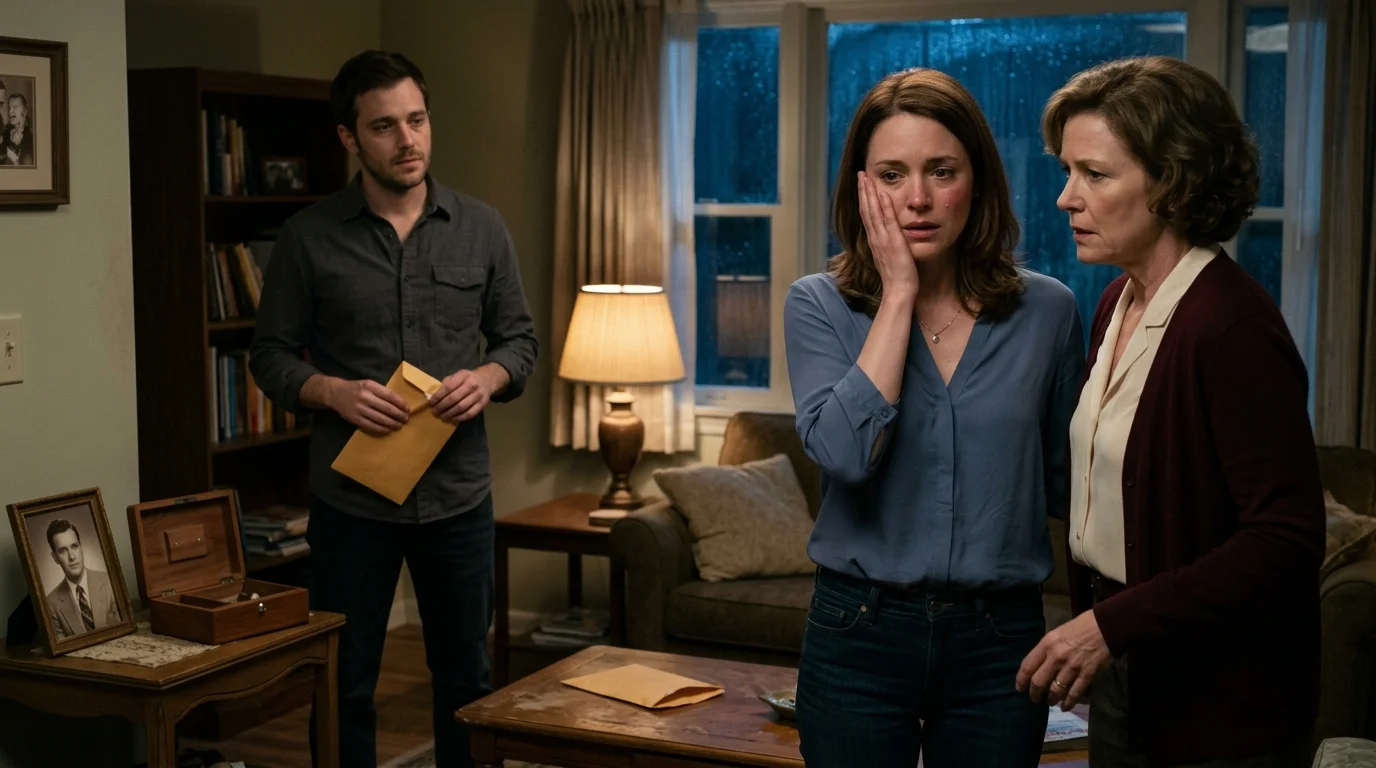
Claire gave a disbelieving laugh. “And what pressure have I been under? Do you know how long it took me to save enough for a deposit before Dad left me that money? Do you know how many weekends I worked? How many times I told myself I could wait another year?”
Margaret’s mouth tightened.
“Your brother could lose everything.”
“And I can’t?”
No one answered.
Claire reached for her phone on the coffee table.
Daniel immediately stepped forward. “What are you doing?”
“Calling the bank. And then I’m calling a lawyer.”
Margaret’s eyes widened. “You wouldn’t do that to your own family.”
Claire looked at her.
“You just hit your own daughter because she asked about money her father left her.”
The room fell silent.
For the first time that evening, Margaret had no ready reply.
The Missing Transfer
Claire did not leave immediately.
She stood by the coffee table, phone in hand, and asked Daniel one final question.
“How much is left?”
Daniel’s lips parted, but Margaret answered first.
“Claire, listen to me. We can work this out without involving strangers.”
“I’m asking him.”
Daniel rubbed his face. “There isn’t much left.”
“How much?”
He looked at their mother.
“Daniel!”
“Four thousand,” he muttered. “Maybe a little less.”
Claire felt the room tilt around her.
“Twenty-four thousand dollars,” she said. “You took twenty-four thousand dollars, and you’re telling me four thousand might be left?”
“I didn’t take it all at once.”
“That makes it better?”
“No! It doesn’t.” Daniel’s voice rose. “I know what I did.”
“Then why did you let Mom blame me for asking?”
He stared at the floor.
Margaret stepped forward. “He was trying to fix it.”
Claire turned toward her. “With what money?”
Margaret’s eyes filled with tears. “I thought I could help him repay it before you noticed.”
The admission seemed to remove the air from the room.
“You knew,” Claire whispered.
Margaret nodded once.
“You knew he had taken my money.”
“I was going to replace it.”
“With what?”
Margaret’s lips trembled.
Claire glanced at the open cash box, then at the framed photograph of her father. Robert’s face smiled from behind the glass, unaware of the secret his family had built around his final gift.
“Did Dad know?” Claire asked.
“No,” Margaret said quickly. “Your father would never have allowed this.”
“That is exactly why you hid it.”
Margaret began to cry. Claire felt a familiar instinct to comfort her, to cross the room and put an arm around her mother’s shoulders. She had done it countless times, even when she was the one who had been hurt.
This time, she stayed where she was.
“Tell me what happened to the rest.”
Margaret pressed her hands together. “Before your father died, there were some medical bills. I used part of the money to cover expenses when the insurance reimbursement was delayed. I thought I could put it back.”
Claire stared at her.
“How much?”
“Six thousand dollars.”
Daniel closed his eyes.
Claire turned slowly toward him. “You knew about that, too?”
“I found out later.”
“And you still took the rest?”
Daniel’s shoulders sagged. “I thought I could win enough to replace it.”
The answer was so familiar that Claire almost laughed. It was the same excuse he had used for years: one more attempt, one more chance, one more promise that the next time would make everything right.
“You both used money that wasn’t yours,” she said. “And then you let me walk into this room believing I was the problem.”
Margaret shook her head. “I never wanted to hurt you.”
“But you did.”
The words were quiet, and that made them harder to dismiss.
Claire left the house that night without accepting an apology. She drove to her apartment, sat at the kitchen table, and called her closest friend, Emily. She explained what had happened in fragments, stopping whenever her voice failed.
Emily listened without interrupting.
When Claire finished, her friend said, “You don’t have to decide whether to forgive them tonight. You only have to decide what protects you tomorrow.”
For the first time since the confrontation, Claire felt her breathing settle.
She opened her laptop and searched for the documents her father had prepared. She had copies of the inheritance paperwork, bank records, and the receipt for the cash box. Her father had insisted she keep everything organized.
At the time, she had thought he was being overly cautious.
Now, she was grateful.
The next morning, Claire contacted the bank and a local attorney. She learned that some of the money had been held in an account before it was withdrawn, and that the records could help establish what had happened. She also discovered that the cash box contained an envelope with her father’s handwritten instructions.
The envelope was not empty.
Inside was a note addressed to Claire.
Her Father’s Last Instruction
Claire recognized Robert’s handwriting immediately: compact, slightly slanted letters written in the blue ink he always used.
Claire,
If you are reading this, I hope it means you are ready to take the next step toward the life you have worked so hard to build.
This money is yours. I want you to use it without guilt. You have always felt responsible for keeping everyone around you comfortable, but being a good daughter does not mean putting your own future last.
I love your brother. I want him to find his way. But helping someone cannot mean removing every consequence from their choices.
Take care of your mother, but do not confuse taking care of her with carrying every burden for her.
You deserve a home where you feel safe, respected, and free to become whoever you want to be.
Love, Dad.
Claire read the note twice.
Then she cried—not only because the money was missing, but because her father had understood something she had spent years trying to explain to herself.
She had believed that being a good daughter meant staying available, even when availability became an excuse for others to take more than she could give. She had believed that keeping the peace was the same as keeping the family together.
Robert had known better.
The note did not erase what Margaret and Daniel had done. It did, however, make Claire’s next decision clearer.
She would not let the missing money disappear into another promise.
She would document everything, pursue repayment formally, and stop lending money she could not afford to lose. If Daniel wanted to rebuild his life, he would have to do the work himself.
If Margaret wanted to repair their relationship, she would have to face the truth without demanding immediate forgiveness.
For the first time, Claire understood that boundaries were not punishments.
They were a way of making honesty possible.
The First Honest Conversation
Three days later, Margaret called.
Claire watched the phone ring on the kitchen counter. She nearly let it go to voicemail, but she decided she was ready to hear what her mother had to say.
“Claire?” Margaret sounded exhausted. “Can we talk?”
“About what?”
“About what happened.”
Claire sat down. “I’m listening.”
Margaret began with an apology, then stopped and started again.
“I should never have hit you.”
“No,” Claire said. “You shouldn’t have.”
“I was frightened. Daniel told me he was going to repay the money. I wanted to believe him.”
“You could have told me.”
“I know.”
“You could have asked me for help. You could have told me the truth about the medical bills. I might have been upset, but at least I would have known what was happening.”
Margaret was quiet.
“I was ashamed,” she finally admitted. “I kept thinking I could fix it before you found out.”
“You weren’t fixing it. You were hiding it.”