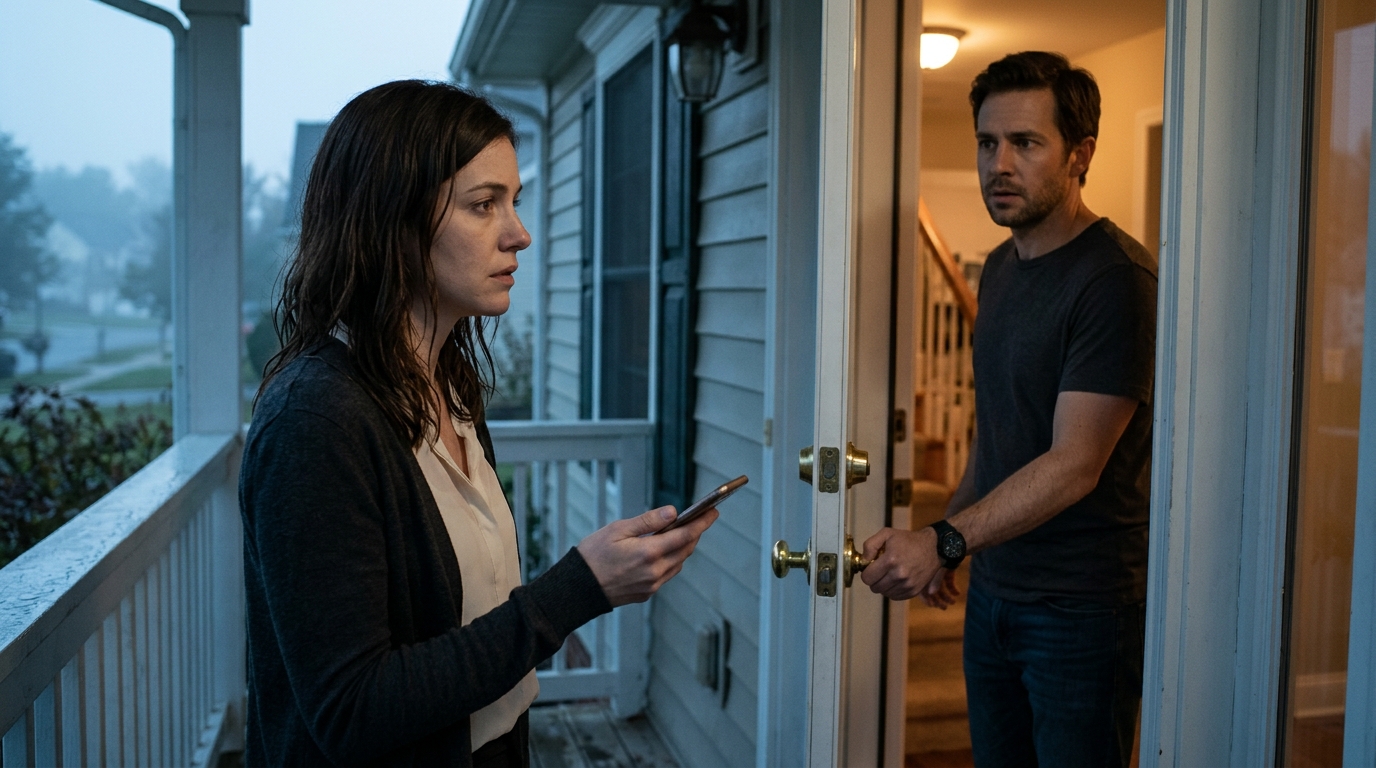
Then she took her overnight bag upstairs and packed enough clothes for several days.
Daniel stood at the bottom of the staircase.
“Where are you going?”
“Somewhere I can sleep without wondering whether you’ll lock me out again.”
He did not stop her.
The confrontation Daniel couldn’t control
Over the next week, the story Daniel had tried to construct began falling apart.
The bank reviewed the disputed transfers and credit documents. Emily supplied the information requested and followed the procedures for protecting her accounts. Her attorney advised her not to sign anything Daniel presented or agree to take responsibility for business debts without independent legal review.
Rachel provided her preserved emails and accounting records to the appropriate investigators.
The evidence did not instantly resolve every question. The origin of the disputed signature required further examination, and the full extent of the business debt remained uncertain. But the records established a timeline that contradicted Daniel’s account of events.
Then Daniel made one mistake too many.
He sent a message to their family group chat claiming Emily had abandoned the marriage after confessing to an affair.
Emily’s mother-in-law, Margaret, called her that afternoon.
“Daniel says you’ve been seeing someone,” Margaret began.
Emily closed her eyes.
“Did he also tell you he locked me outside all night?”
There was a long silence.
“No,” Margaret admitted.
“Did he tell you about the missing savings?”
Another silence.
Emily did not send Margaret an angry speech or ask her to choose sides. She sent her a brief explanation and offered to share the financial documents if she wanted to understand what had happened.
Margaret visited Emily the following day.
She looked through the records slowly, stopping at the email in which Daniel had written that Emily trusted him with the finances.
“That’s my son,” she whispered.
“Yes,” Emily said. “It is.”
Margaret’s eyes filled with tears. She wanted to defend him, but she could no longer reconcile his behavior with the story he had told her.
“I don’t know how he became this person.”
Emily thought of the porch, the cold, the rejected calls.
“Maybe he didn’t become him overnight,” she said. “Maybe I just kept explaining away the parts I didn’t want to see.”
Margaret did not ask Emily to return to Daniel. Before leaving, she promised to cooperate if the financial investigation required information she possessed about the business.
For the first time, Daniel’s accusations were no longer enough to control the conversation.
What the messages revealed
A month later, Rachel contacted Emily with an update.
The investigators had uncovered additional records connecting the business account to payments for Vanessa’s apartment. Vanessa had believed Daniel was separating from Emily and that his finances were stable. She had not known the money came from a credit line that Emily disputed or from their joint savings.
When Vanessa learned the facts, she agreed to provide relevant messages and documents.
Emily did not feel satisfaction at the thought of another woman being deceived. She felt exhausted by the number of people who had been given different versions of the same story.
Daniel had told Emily that she was unfaithful.
He had told Rachel that Emily approved the financial transfers.
He had told Vanessa that his marriage was effectively over.
He had told Margaret that Emily had abandoned him.
Each version served the same purpose: it placed him in the position of the injured party and made someone else responsible for the consequences.
But the records were consistent in a way his explanations were not.
The disputed transfers had dates. The emails had timestamps. The credit documents had account references. The messages showed what he had told different people and when he had told them.
Daniel’s own attempt to create a record of Emily’s supposed betrayal had become part of the evidence against his credibility.
Emily’s attorney advised her to remain careful about public accusations while the financial and legal matters were being reviewed. She followed that advice. She did not post the emails online or contact Vanessa to argue about who had been the more important woman in Daniel’s life.
She focused on protecting herself.
Her bank helped her secure her personal accounts. Her attorney guided her through the next steps in separating the marital finances and challenging obligations she said she had not authorized. The process was frustrating, expensive, and slower than she wanted.
There were still unanswered questions.
But she was no longer required to accept Daniel’s explanations as facts simply because he spoke with confidence.
The final door
Three months after the night on the porch, Emily returned to the house with her attorney to collect the rest of her belongings.
Daniel was waiting in the living room.
He looked tired. The expensive confidence he had once carried seemed to have drained away. His charcoal T-shirt had been replaced by a button-down shirt, but his familiar black watch remained on his wrist.
“I never wanted things to go this far,” he said.
Emily packed a framed photograph from the shelf.
“You wanted me to believe your version of everything.”
“I was under pressure.”
“So was I.”
He followed her into the hallway.
“Can’t we talk without lawyers? We were happy once.”
She stopped beside the front door.
They had been happy. That was the hardest part to explain to anyone who wanted the marriage to be a simple story of a good woman and a bad man. Their life had contained real tenderness. Daniel had once known exactly how she liked her tea and could recognize her footsteps in the hallway. They had laughed until midnight over terrible movies and planned holidays they never took.
Those memories had not been imaginary.
But neither were the locked door, the missing money, or the documents bearing her name.
“I loved you,” Emily said. “I believed you when you said we were building a future together.”
“We can still fix this.”
“You can take responsibility for what you did. You can answer the questions you avoided. But you can’t ask me to return to a marriage where I have to prove I’m innocent every time you need someone else to blame.”
Daniel’s eyes filled with tears.
For a moment, Emily nearly reached for him. Habit was powerful. She had spent years trying to soothe his anger and repair every distance between them.
Then she remembered the cold porch steps and the seventeen unanswered calls.
She picked up her final bag.
“Emily,” he said.
She turned.
“Did you ever cheat on me?”
The question was so familiar that she almost laughed.
“No,” she replied. “But I did make one mistake. I kept believing that if I loved you enough, you’d eventually treat me with respect.”
She opened the door.
Outside, the morning was bright and clear. The brass lock caught the sunlight. Emily stepped over the threshold without waiting for permission.
Daniel remained inside.
This time, she was the one who closed the door.
A different kind of beginning
The separation did not make Emily’s life instantly easy.
She moved into a small apartment near her workplace. She learned to check her bank statements regularly, ask questions when something looked wrong, and distinguish privacy from secrecy. Some nights, she woke convinced she could hear Daniel turning the lock.
Healing arrived in unremarkable moments.
A quiet breakfast she did not have to defend. A paycheck that remained in her account. A weekend spent with friends without explaining every hour. The simple relief of knowing that a disagreement would not end with someone deciding whether she deserved shelter.
The financial case took months to untangle. The exact legal consequences depended on the evidence, the agreements involved, and the decisions made by the relevant institutions. Emily did not receive a miraculous settlement or discover a hidden fortune. She rebuilt her life through careful decisions, professional advice, and the support of people who respected her boundaries.
Rachel eventually sent her a final message.
I’m sorry I believed him when he said you knew.
Emily read it, then replied:
You helped me find the truth when you could have stayed silent. What matters now is what we do with it.
She kept a copy of the message from that first dawn. Not because she wanted to relive the worst morning of her life, but because it reminded her how close she had come to believing Daniel’s accusations.
He had wanted her to defend herself endlessly. He had wanted her to focus on proving that she was faithful while he concealed the evidence of his own betrayal.
For a while, she had done exactly that.
But the message had forced a different question into the open: what was he so afraid she would discover?
The answer changed everything.
Emily never learned whether Daniel’s first accusation had come from genuine suspicion, deliberate manipulation, or a mixture of both. In the end, she no longer needed to solve that particular mystery.
She knew what he had done. She knew what she had not done. And she understood that she did not need his permission to trust her own experience.
On the first anniversary of the night he locked her outside, Emily sat beside the window of her apartment with a cup of tea. Rain tapped gently against the glass.
She thought about the woman who had sat on the porch, shivering and waiting for the door to open.
She wished she could tell that woman that the morning would not bring an easy answer. It would bring something better: the beginning of a life in which she no longer had to earn basic kindness.
Emily set down her cup and turned off the light.
For the first time in years, the silence around her felt peaceful.
The door was locked, the key was in her own hand, and nobody could use it to decide whether she belonged.