

The sound of ripping silk cut through the music.
Claire Whitmore stood beneath the ballroom chandelier, clutching the torn shoulder of her emerald-green gown. Before anyone could ask what had happened, she spun toward her younger sister.
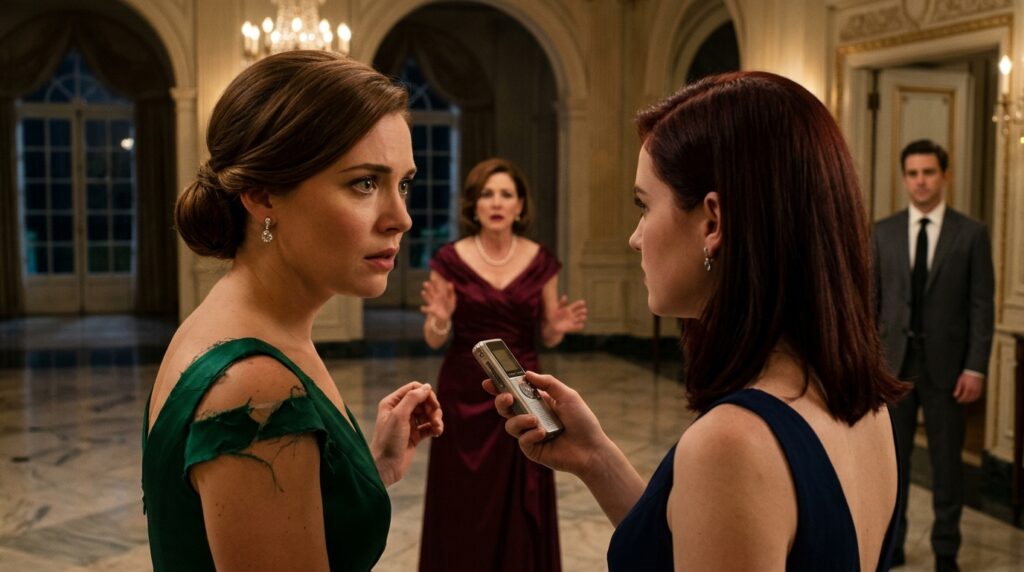
“Look what your jealous little hands have done!”
Emily stared at her.
The two sisters stood in the center of their mother’s mansion, surrounded by guests who had come to celebrate Claire’s engagement. Crystal glasses gleamed beneath the golden lights. A string quartet fell silent. Every face turned toward them.
Emily lifted her hands. “I never touched you.”
Claire’s eyes filled with tears so quickly that Emily almost wondered whether they had been waiting there all along.
“Of course you didn’t,” Claire said bitterly. “You never do anything wrong, do you?”
Their mother, Margaret, pushed through the gathering crowd.
“What is going on?”
“Your daughter destroyed my dress,” Claire replied, pointing at Emily. “On my engagement night.”
Margaret’s expression hardened.
“Security. Search her purse.”
Emily felt the familiar pressure of an old wound opening inside her chest. For twenty-four years, she had watched her older sister turn disagreements into performances and mistakes into accusations. Somehow, Claire always became the victim, and Emily always became the problem.
But tonight was different.
Tonight, Emily had brought something with her that Claire had never expected to see.
And Claire had just given her a reason to use it.
The sister everyone believed
The Whitmore family had money, influence, and a reputation for generosity. Their late father, Richard, had built a successful property business before establishing a charitable foundation that funded scholarships for students from struggling families.
After his death two years earlier, Margaret took control of the foundation’s public affairs. Claire became its director, managing events and donor relationships. Emily, who had studied accounting before leaving university to help their mother recover from a difficult period, volunteered to organize some of the foundation’s records.
It was supposed to be temporary.
Instead, Emily discovered that several payments recorded as scholarship distributions had no matching recipient confirmations.
When she mentioned the discrepancies to Claire, her sister laughed.
“You’re looking at incomplete paperwork,” Claire had said. “You have no idea how complicated these things are.”
Emily had asked to see the original statements.
Claire refused.
A week later, Margaret accused Emily of mishandling a folder of donor receipts. Claire said she had seen Emily carrying it. Emily denied taking it, but no one listened.
That was how things worked in their family. Claire spoke with confidence. Emily explained herself. The family believed Claire.
Their father had been the only person who consistently noticed the difference between confidence and honesty.
After his funeral, Emily found an old note in his desk drawer. It contained a sentence he had once said to her when she was sixteen:
The truth doesn’t become less true because nobody wants to hear it.
She kept the note inside her bedside table.
She had needed it more often than she cared to admit.
Now, at Claire’s engagement party, a security guard was approaching her with an apologetic expression.
“Miss Whitmore, please hand me your purse.”
Emily looked at her mother. “You’re really going to let her do this?”
Margaret’s jaw tightened. “If you have nothing to hide, there is no reason to object.”
Claire folded her arms carefully, protecting the torn seam of her dress as if the injury were proof of a crime.
“Search it,” she said. “Let everyone see what she’s capable of.”
Emily looked at the faces around her. Some guests seemed uncomfortable. Others were already whispering.
She could have handed over the purse.
Instead, she took one step toward Claire.
“You should be careful about what you ask people to look for.”
For the first time that evening, Claire’s expression faltered.
Only for a second.
Then she smiled.
“Is that a threat?”
“No,” Emily said. “It’s a warning.”
The perfect accident
Three hours before the party, Claire had stood alone in the upstairs dressing room, staring at herself in the mirror.
Her gown had cost more than some people earned in six months. The designer had delivered it that afternoon, and Claire had spent twenty minutes adjusting the neckline until it sat perfectly.
She looked beautiful.
She also looked frightened.
On the dressing table lay a printed bank statement, two foundation transfer records, and a letter from an auditor requesting explanations for several payments.
The amounts were not enormous individually. Together, however, they formed a pattern that would be difficult to explain.
Money intended for scholarships had been transferred to a consulting company. That company had paid invoices for event management, travel, and personal services. Several invoices had no supporting contracts.
Claire had approved them.
She had told herself that the money would be replaced. Her engagement had brought expensive expectations, and she had grown accustomed to living as if financial limits applied only to other people.
Then Emily began asking questions.
Claire had spent the previous week trying to discover how much her sister knew. Emily had said very little, which made the silence worse.
The auditor’s letter had arrived that morning.
Claire had read it three times before making a decision.
If Margaret discovered the missing money, Claire would lose her position in the foundation. If the donors found out, the family name would become a public scandal. Daniel might postpone the wedding. He might even leave.
And Emily, who had always been the inconvenient daughter, would become the person who had exposed everything.
Unless Claire gave everyone a different story to believe.
She picked up the dress.
With a small sewing scissors from the dressing table, she cut the right shoulder seam, then pulled the fabric until the tear looked irregular. She practiced an expression of disbelief in the mirror.
She could almost hear the questions already.
Who had done it?
Who would be jealous enough to ruin her engagement?
The answer would be obvious, she decided, if she made it obvious enough.
Emily had been the family’s disappointment for years. She had abandoned her accounting degree, questioned the foundation’s accounts, and refused to flatter Claire in front of guests.
All Claire needed was a believable accusation.
The plan depended on one assumption: nobody would ask what had happened before the dress tore.
She never considered that Daniel might have evidence of his own.
The recorder
Back in the ballroom, Claire extended her hand toward the security guard.
“Her purse. Now.”
Emily held it close to her side.
“I’ll open it myself.”
She unclasped the small black bag and searched inside. Her fingers found her phone, a lipstick, a folded tissue, and the silver voice recorder she had borrowed from Daniel earlier that afternoon.
She took it out.
A tiny red light blinked against the polished metal.
Claire stopped breathing for a moment.
Daniel stood in the doorway behind Margaret. He had been speaking with one of the guests when the argument began. Now he was watching the recorder as if it were a loaded weapon.
Emily turned it over in her hand.
“Do you recognize this?”
Claire forced a laugh. “It’s a recorder. So what?”
“Then you won’t mind hearing what’s on it.”
“Emily, don’t be ridiculous.”
Emily pressed a button.
A burst of static crackled through the tiny speaker. Then Claire’s own voice emerged, clear enough for everyone nearby to hear.
“Once Emily takes the blame, nobody will check the foundation accounts.”
The ballroom seemed to shrink around her.
Claire lunged.
“Turn that off!”
Emily pulled the recorder away.
The recording continued for another second, capturing the beginning of a reply before Emily stopped it.
No one spoke.
Margaret looked from the recorder to Claire. Her face had gone pale.
“What did you just say?”
Claire shook her head quickly. “That’s taken out of context.”
“Which context?” Emily asked. “The one where you planned to blame me for the dress? Or the one where you were trying to keep people from examining the foundation’s accounts?”
“You have no idea what you’re talking about.”
“Then explain it.”
Claire turned toward Daniel.
“Tell them. You know how she manipulates things.”
Daniel did not answer immediately. He looked at Emily, then at Claire.
“I didn’t record that conversation intentionally,” he said. “My phone was recording a voice note when Claire came into the dressing room earlier. I only discovered the clip afterward.”
Claire’s mouth opened, but no sound came out.
Daniel continued, his voice low and controlled.
“I heard enough to know something was wrong. I came downstairs because I wanted to talk to you before the party ended.”
“You were supposed to be on my side,” Claire whispered.
“I was supposed to be marrying someone I could trust.”
The words struck harder than a shout.
Claire looked around the ballroom. The guests who had watched her accuse Emily were now watching her struggle to invent an explanation.
For the first time, she had no easy answer.
But she was not ready to surrender.
She pointed at Emily.
“She stole that recording. She’s been investigating me for months. She probably edited it!”
Emily felt anger rise, but this time she did not let it control her voice.
“You cut your own dress. You accused me. You demanded that my purse be searched. You did all of that because you thought everyone would believe you before anyone asked a question.”