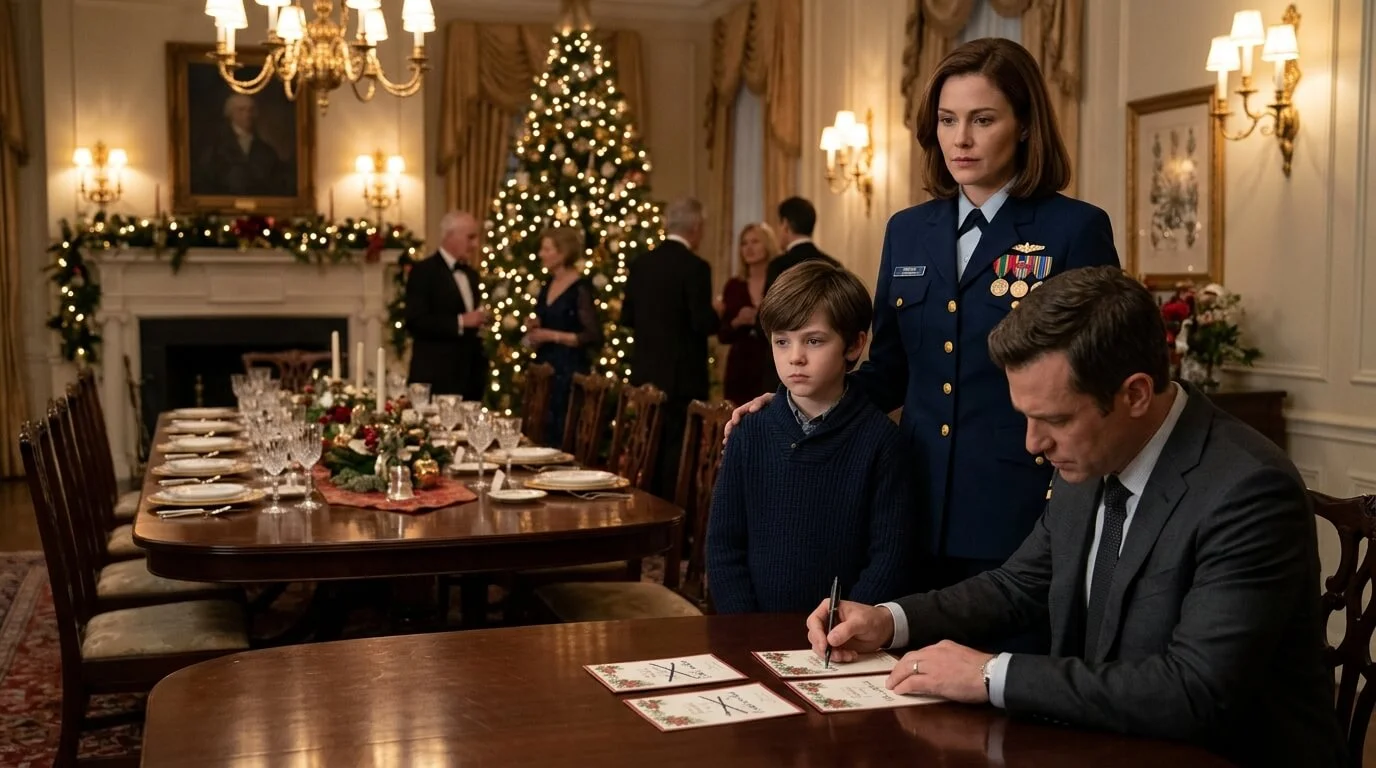
“You should have asked.”
Andrew lowered his head.
Lucas wanted to know whether Andrew had ever seen their photographs.
He admitted that he had not.
Charlotte asked whether he had ever bought them birthday presents.
He said no.
Grace looked at him.
“Did you forget our names?”
Andrew’s eyes filled with tears.
“No. I never knew them.”
Rebecca watched the exchange without interrupting.
She had imagined Andrew apologizing for years.
But hearing him struggle to answer the children’s questions made her understand something important.
An apology could not return eight birthdays.
It could not recreate school mornings, family holidays, hospital visits, or the thousands of ordinary moments in which the children had grown without him.
Andrew asked whether he could see them again.
Benjamin looked at Rebecca.
She did not answer for him.
“Maybe later,” he said.
Andrew nodded.
It was the first time that evening he accepted a boundary without arguing.
Meanwhile, Eleanor had begun explaining what happened after Rebecca’s first letters arrived.
Charles had been concerned about the family’s reputation and Andrew’s military career. He ordered the family office to intercept correspondence and prevent the pregnancy from becoming a public subject.
Eleanor initially agreed.
She convinced herself the arrangement would be temporary.
But as Rebecca continued writing, Charles insisted that the information remain hidden.
Eleanor signed for some deliveries. Other correspondence was placed in an administrative cabinet.
The family later maintained that Andrew had never received reliable evidence of the pregnancy.
Eleanor knew that was false.
The family foundation records added another troubling dimension.
During the review of the Whitmore Foundation, investigators had identified transactions that required further explanation.
Certain private family expenses appeared in accounts associated with charitable administration.
The documents Rebecca had encountered also suggested that the family office had kept personal correspondence separate from Andrew’s official records.
She had preserved the material because she understood the importance of original documentation.
She had provided it to the appropriate investigators rather than attempting to conduct an investigation herself.
Charles insisted the accounting decisions had been legitimate.
Eleanor disagreed.
Victoria left the mansion before the dinner was served.
She told Andrew she needed time to reconsider their engagement.
The following weeks were difficult.
Andrew requested copies of the children’s school photographs and asked whether he could begin writing to them.
Rebecca agreed to pass along letters, but she made one condition.
He could not use the children to seek forgiveness for himself.
He would have to answer their questions honestly.
His first letter was awkward.
He apologized for missing their birthdays and explained that he had accepted information without checking whether it was true.
Benjamin read it twice.
Lucas asked whether Andrew really wanted to know them.
Charlotte wanted to know whether he would attend their school events.
Grace asked whether he remembered that she was the smallest baby.
Andrew replied to each question.
He did not demand that they call him Dad.
He did not ask Rebecca to return to him.
Instead, he began accepting the consequences of his decisions.
The foundation investigation continued independently.
Financial records were reviewed, relevant administrators were interviewed, and Charles stepped away from his public leadership responsibilities while the questions were examined.
Eleanor provided additional records concerning the correspondence.
Andrew also supplied documents showing what his family had told him about Rebecca.
The investigators would determine the appropriate conclusions about the foundation’s financial administration.
Rebecca did not interfere with that process.
Her priority remained her children.
Several months later, Benjamin agreed to meet Andrew in a public garden.
Lucas came too.
Charlotte and Grace joined them after discussing the arrangement with their mother.
The first meeting was uncomfortable.
Andrew brought no expensive gifts.
He simply listened.
Benjamin asked about his military career.
Lucas wanted to know why the family had such a large house.
Charlotte asked why Andrew had never checked whether the babies were real.
Grace showed him a drawing of four children standing beside their mother.
Andrew studied it carefully.
“Which one is you?” he asked.
Grace pointed to the smallest figure.
“That’s me.”
He smiled sadly.
“I can see that.”
Rebecca watched from a nearby bench.
She did not feel compelled to intervene.
The children were discovering their own feelings about their father, and they deserved the freedom to make those decisions.
Andrew eventually understood that becoming part of their lives would require patience.
He began attending agreed visits and learned about their schoolwork, friendships, and interests.
He never expected Rebecca to pretend the past had disappeared.
She never promised that the children would forgive him.
They moved forward slowly.
Eleanor also began writing to the children.
Rebecca allowed the correspondence, but she made it clear that forgiveness would be their decision.
Charles remained distant.
The family name that had once controlled every conversation could no longer dictate what the children believed about themselves.
The next Christmas, Rebecca hosted dinner at her own home.
There was no grand mansion, no expensive guest list, and no attempt to impress important visitors.
There was a crowded kitchen, Christmas music, and four children arguing about who would place the star on the tree.
Andrew arrived for a short visit after the children agreed.
He carried a small box of Christmas ornaments.
Benjamin opened the door.
“Are you helping us decorate?”
Andrew smiled.
“If you want me to.”
Benjamin stepped aside.
Inside, Rebecca watched the children return to the tree.
Four stockings hung beside the fireplace.
Each had a name carefully written across it.
Benjamin.
Lucas.
Charlotte.
Grace.
Rebecca remembered the Christmas dinner when Andrew had crossed out those same names.
This time, nobody had to ask whether they belonged.
She had spent eight years building a life for her children without the people who had denied their existence.
And she had learned that a family was not defined by a surname, a mansion, or the number of important people sitting around a dinner table.
It was defined by the people who chose to stand beside you.
That Christmas, Rebecca finally understood that the four children Andrew had tried to exclude had never needed his family’s permission to belong.
They had always been a family.