
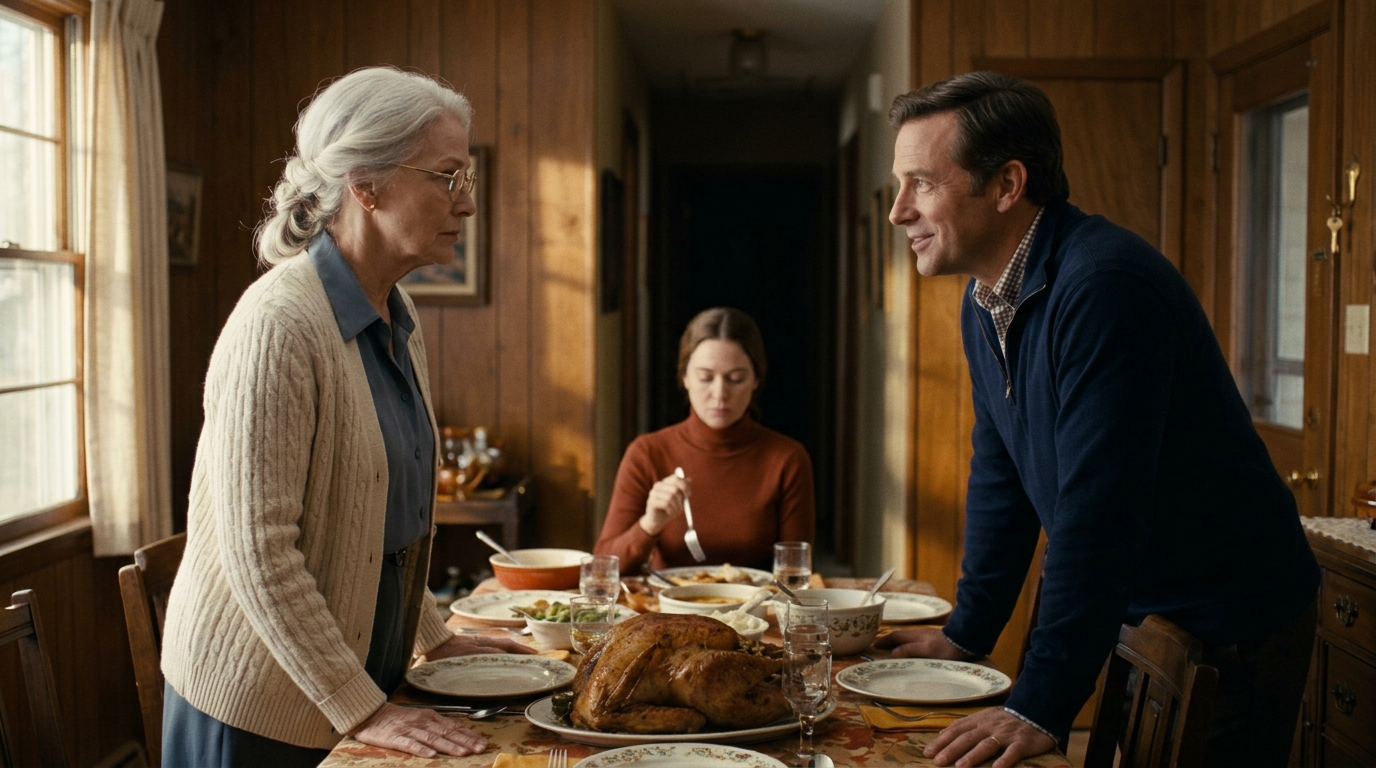
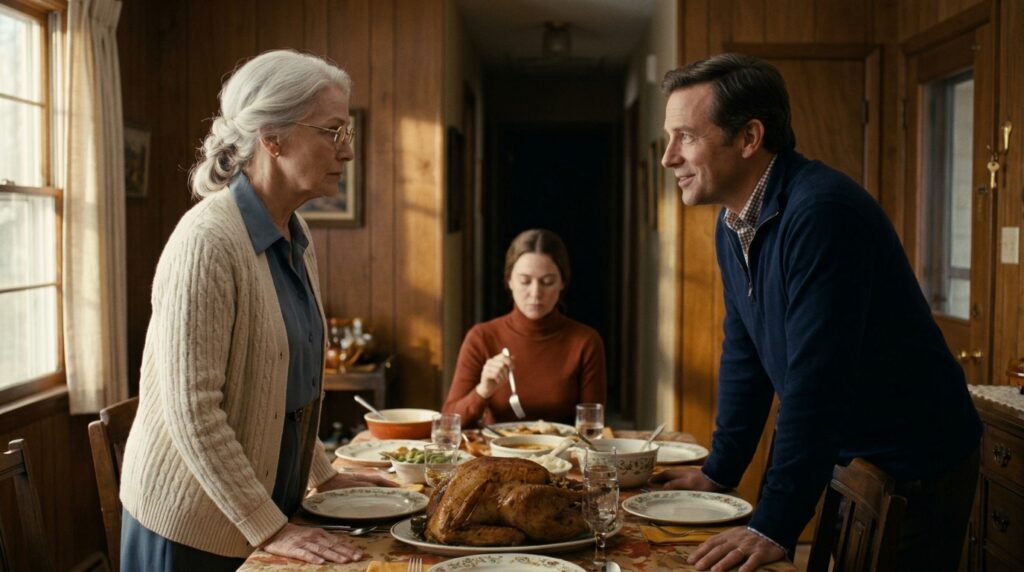
The key ring came off the brass hook by the back door at 4:41 on Thanksgiving afternoon, and Lorraine Beckett watched it go.
She was carrying the second platter of turkey into the dining room. Derek stood at the sideboard with his phone in one hand and her keys in the other, and he did not hide it. He turned the ring once on his finger, the way a man checks the weight of a tool before he lends it out, and passed it across to his brother.
Ray closed his fist around it and slid it into his coat pocket.
“Those are my keys,” Lorraine said.
“Family keys now,” Derek said. He said it kindly. That was the part that stayed with her afterward, not the taking but the kindness of it, the way he smiled around the table and the table smiled back at him.
There were six of them in the house. Pauline, Derek’s mother, arrived at noon with two suitcases and a hanging bag and never once asked where she would sleep. Ray and Doreen, his brother and his brother’s wife, had carried three plastic storage tubs down the basement steps before the turkey was even out of the oven. Kendra, Derek’s sister, brought her son Tyler, who was seventeen, and a folding cot still zipped inside its box. And Marlon, a cousin from Toledo that Lorraine had met twice in her life, who had parked behind her garage and had not moved the car since.
Six people. Six extra chairs at her table. Not one of them placed there by her.
“Mom takes the front room,” Derek said, carving. “Ray and Doreen get the basement, I’ll have the egress cut in next week. Kendra’s got Tyler in the den. Marlon, you’re in the room off the kitchen.”
Lorraine set the platter down. She was seventy-two years old, she had buried her husband in that house, and she had learned a long time ago that the loudest person at a table is usually the one who owns the least of it.
“Six of you?” she said.
“Thanksgiving,” Derek said, as though that answered something.
“Not one room here is yours to give.”
The table went quiet in the way a table goes quiet when the food is good and the subject is not. Pauline studied her yams. Marlon looked at the ceiling. Ray’s jaw worked, once, and then he reached for the bread.
And Nadine, Lorraine’s only child, forty-four years old and sitting eight inches from her husband’s elbow, put her fork down, folded her hands in her lap, and said nothing at all. That was the detail Lorraine noticed. Not Derek’s entitlement — she had seen that in small doses for nineteen years. Nadine’s folded hands.
Later, at the sideboard, with the plates stacked and the gravy going cold, Derek came to pour himself another finger of bourbon and Lorraine came to put the salt away, and the two of them stood close enough that nobody at the table could hear her.
“You’re seventy-two,” he said, before she could. “Somebody has to run it.”
“You stopped paying in April. Every dime.”
The smile did not move, but something behind it did, like a door closing in another room. He set the glass down on the sideboard an inch too hard.
“Sixty-eight thousand, Derek. Due December first,” Lorraine said, quietly, into the space between them, and walked away with the salt.
Nadine was standing at the end of the table with a stack of plates in her hands and a face like a struck match. She had heard the last two things and not the first one, which is the worst arrangement of a conversation there is.
“Mama,” Nadine said later, in the kitchen, when the dishwasher was running and the coffee had gone cold in the pot. “Let it be one night.”
“One night of what, honey?”
“Of being the house everybody comes to.”
“I have been the house everybody comes to for forty-one years,” Lorraine said. “Your father and I bought this place in the spring. There were no curtains and no grass and we ate supper on the floor for a month. I know exactly what this house is.” She wiped the counter. “What I don’t know is why your husband just handed my keys to his brother like a tip.”
Nadine’s face did something complicated. Then it stopped doing it. “He’s been under a lot of pressure.”
“Aren’t we all.”
The pressure had a name, and a date, and a number, and Lorraine had known all three of them since the fall of 2019. But she did not say so at her own sink, on Thanksgiving night, with her daughter’s hands shaking around a dish towel. She had been a bookkeeper for thirty-one years at the Harpers Landing water district, and one of the things thirty-one years of other people’s arithmetic teaches you is that you do not correct a person in front of a room. You assemble the file, and then you let the numbers speak in their own voice.