

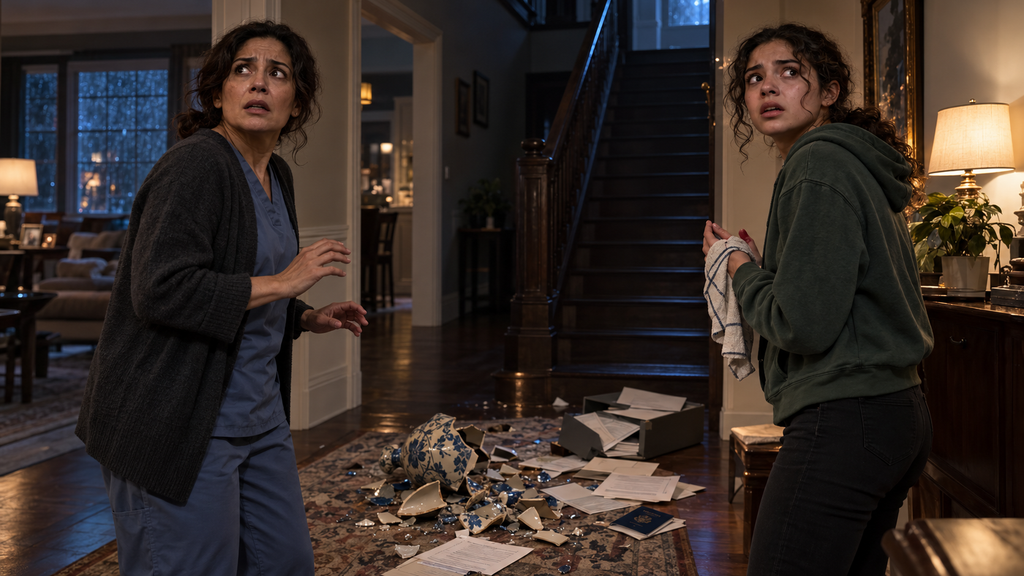
The first thing Lena Mercer saw when she opened her front door was the blue-and-cream vase in pieces on the living-room floor.
The second was her seventeen-year-old daughter, Maya, kneeling beside it, one hand wrapped in a dish towel. The brass-edged document box from the shelf stood open. Papers had scattered beneath the coffee table. In the space where her mother’s vase had stood for thirteen years, the wall was blank.
“You broke your grandmother’s vase!” Lena said.
She struck Maya across the cheek before the girl could stand. The sound was small and terrible in the narrow room.
Maya’s head turned. She did not cry. She stared at her mother with a kind of shocked recognition that Lena would remember long after the bruising had faded.
“You didn’t even ask who did.”
Lena looked at the broken porcelain, then at the open box. “Then who did?”
“Dad. He came back for our passports.”
“He can’t. The judge ordered him away.”
“Eli grabbed his passport and ran upstairs.” Maya lifted her own blue passport from the floor, keeping her injured hand close to her chest.
“Where’s Eli?”
“Bathroom. Dad’s trying to break in.”
Three hard blows shook the upstairs bathroom door.
Lena had spent the last six weeks teaching her children that they were finally safe. Now her son was trapped upstairs with the man she had promised would never come through their door again. And she had just hit the one person trying to protect him.
Ten minutes earlier, Maya had been helping Eli with a spelling worksheet at the kitchen table. He was nine, particular about the points on his pencils, and stubborn enough to erase a correct answer if the letters looked crooked. Rain dragged pale lines down the back window. Lena was finishing a late shift at the county hospital, and the house was full of ordinary sounds: the dryer turning, a pan warming on the stove, the thump of Eli’s socked feet against a chair rung.
Maya had been listening for other sounds, too.
Ever since Grant moved out, the side door by the laundry room had refused to latch without an extra shove. He had installed it himself years ago, proudly explaining the bargain he’d found on the hardware. When Lena changed the front locks after the court hearing, Maya asked about the side door. Lena said a locksmith would look at it on Friday. Friday was tomorrow.
The knob turned just as Eli finished writing because.
Grant Mercer stepped inside wearing the navy work jacket he had owned since Maya was in grade school. Rain dotted its tan collar. His short sandy hair was wet and flattened against his temples. He looked smaller than he had during their last argument, but his voice was the same: quiet in a way that demanded everyone else lower theirs.
“Your mother’s not home,” he said. It was not a question.
Maya stood between him and the table. “You need to leave.”
“I’m picking up a few things. Don’t make this complicated.”
“You’re not allowed here.”
He glanced at Eli, then smiled with only half his mouth. “Hey, buddy. I brought you something.” He pulled a packet of sour candy from his pocket. Eli stared at it without moving.
The temporary protection order had been issued after Grant shoved Lena into a doorframe and threatened to take Eli away if she sought custody. Maya had heard him say the words. She had helped her mother photograph the damaged frame. She had watched Lena tremble while signing the petition and watched her steady her pen when she reached the children’s names.
Now Grant stood in the kitchen as though the past six weeks had been a misunderstanding.
Maya picked up her phone. “I’m calling the police.”
“You can call whoever you want.” His eyes shifted toward the living room. “Where’s the gray box?”
Maya didn’t answer. She knew the box: a heavy fire-resistant case holding their birth certificates, passports, insurance papers, and the court order. Lena had moved it from the bedroom closet to the living-room shelf so she could take documents to her lawyer without waking the kids. Maya had told her the shelf wasn’t a good hiding place. Lena had agreed to move it back that weekend.
Grant saw the direction of Maya’s glance.
He crossed the living room and pulled the box forward. Its corner scraped the ceramic vase made by Lena’s mother, Ruth, who had died eighteen months earlier. The vase was painted with crooked blue leaves. Ruth had given it to Lena and Grant when they bought the house, saying they would need something beautiful to look at during hard winters.
“Don’t touch that,” Maya said.
Grant flicked the box’s catches open. The vase wobbled. Maya lunged for it, but his elbow caught the narrow neck. Porcelain struck the edge of the oak shelf and shattered on the floor.
For an instant all three of them froze.
Then Grant looked at Maya and said, almost conversationally, “Your mother will think you did that.”
He knelt over the passports. There were three blue covers. He took Eli’s and Maya’s, then reached for the folder of custody papers.
Eli moved before Maya could warn him. The boy had watched his father shove his mother months ago; he had not forgotten what a quiet voice could become. He slipped the passport with his photograph from Grant’s open hand and ran toward the stairs.
“Eli!” Grant shouted.
The boy was already climbing. Grant followed, taking the steps two at a time.
Maya grabbed her phone and dialed 911. She told the dispatcher their address, that a man under a protective order had entered the house, and that her nine-year-old brother was upstairs. The dispatcher asked where the man was. Maya heard the bathroom door slam and the bolt slide home.
“Outside the bathroom,” she whispered. “He’s outside the bathroom.”
“Stay on the line,” the dispatcher said. “Officers are coming. Do not confront him.”
Maya left the call connected and set the phone behind the armchair so Grant wouldn’t see its lit screen if he returned. She grabbed her passport from the floor and tried to gather the papers, afraid he would come back for them. A sharp edge sliced her palm. She wrapped it in the dish towel from the kitchen.
Then she heard Lena’s car in the driveway.
Maya opened her mouth to shout a warning. Before she could, she bent to pick up her passport, which had slid beneath the console table. Lena pushed inside, still in her slate-blue scrubs beneath a charcoal cardigan, her face exhausted after twelve hours of caring for people who were not her children. Her gaze landed on the shattered vase and the girl bending beside it.
What followed took only seconds.
After the three blows upstairs, Lena felt the blood drain from her face. She saw what grief and exhaustion had kept her from seeing: Maya’s shaking fingers, the open document box, the papers flung far beyond the vase, the slash across the girl’s palm. These were not signs of careless play. They were signs of a struggle.
“I’m sorry,” Lena whispered.
Maya recoiled when she reached for her. “Not now.”