
The question “what is the best time of day to water” implies a single universal answer, as if plants read a clock. They do not. The real decision is not about a fixed hour but about matching water availability to the moment your plant is physiologically prepared to absorb it. That moment is dictated by its circadian rhythm, a 24-hour biological cycle that regulates stomatal opening, root hydraulic conductance, and photosynthetic readiness. Align watering with this rhythm and you stop fighting your plant’s biology; misalign it and even correct watering volumes can create stress.
This guide reframes the question entirely. You will not find a one-size-fits-all time stamp. Instead, you will learn to read three signals: your plant’s type (which determines its internal clock), your indoor environment (light, humidity, air flow), and your own schedule constraints. The goal is not perfection but a deliberate choice among several viable windows, each with specific trade-offs.
By the end, you will be able to identify your plant’s active water-uptake window, understand when evening watering is acceptable (and when it is not), and select a routine that minimizes disease risk without demanding a lifestyle overhaul. You will also know the one common piece of advice that is provably wrong for container-grown houseplants.
Bottom line: Water when your plant’s stomata are open and transpiration is active, which for most houseplants means early to mid-morning under your indoor light schedule.
The Yield Grid Decision Grid
Before choosing a watering time, answer two questions: What type of plant do you have, and what is your indoor light schedule? The grid below sorts every houseplant scenario into three branches. Each branch leads to a different optimal window.
Branch 1: Foliage Plants Under Natural or Bright Indirect Light (e.g., Monstera, Fiddle Leaf Fig, Pothos, Calathea)
These plants have pronounced circadian rhythms. Their stomata open shortly after dawn (or lights-on) and peak conductance occurs within 2 to 4 hours. Watering during this window maximizes uptake and minimizes leaf-wetness duration. If your light source is a window, water within 1 hour of sunrise. If it is a grow light on a timer, water within 1 hour of lights-on. For more on matching light to plant needs, see Monstera light needs and Fiddle Leaf Fig light requirements.
Recommended: Items 1, 4, 7 below.
Branch 2: Succulents, Cacti, and Drought-Tolerant Species (e.g., Snake Plant, ZZ Plant, Jade)
These plants use Crassulacean Acid Metabolism (CAM). Their stomata open at night to capture CO2 and close during the day to conserve water. Watering in the late afternoon or early evening, when stomata are about to open, allows roots to absorb moisture before the nocturnal gas-exchange phase begins. Morning watering is not harmful but less efficient. For more on drought-adapted species, see Drought-tolerant houseplants.
Recommended: Items 5, 8, 10 below.
Branch 3: Schedule-Constrained Growers (You Water When You Can)
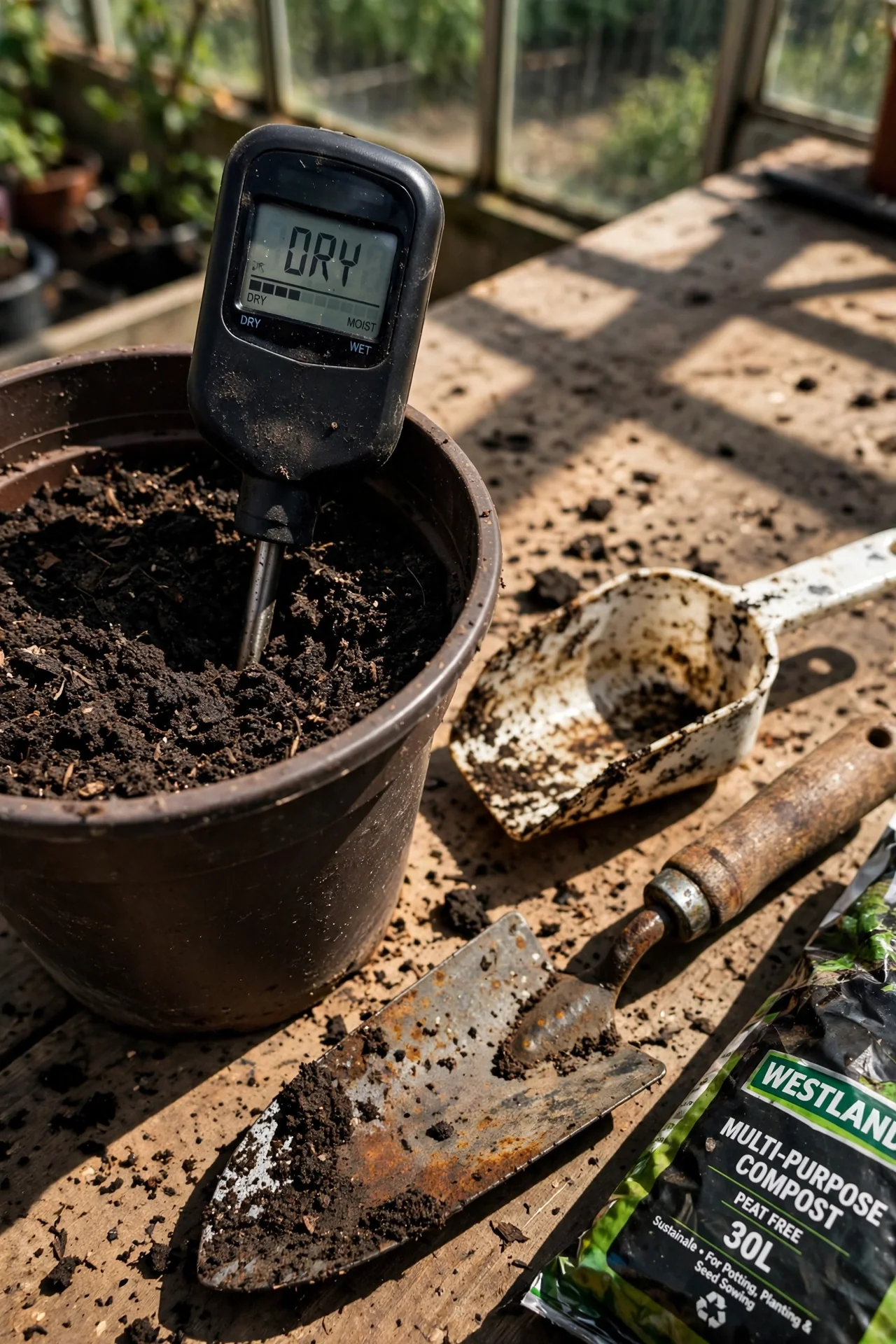
If your only available window is midday or late evening, you can still water effectively by adjusting your method. Direct water to the soil surface only, avoiding foliage. Ensure strong air circulation for at least 2 hours post-watering. Use a moisture meter for plants to confirm actual need before watering, since schedule-based watering often leads to overwatering. Self-watering systems can also decouple timing from your availability; explore self-watering planters for indoor use.
Recommended: Items 2, 6, 9 below.
Quick Comparison Table
| Option | Key Mechanism | Best For | Decision Grid Branch | Effort Score |
|---|---|---|---|---|
| Early Morning | Circadian alignment | Foliage plants | Branch 1 | 2 |
| Late Morning | Compromise window | Schedule-constrained | Branch 3 | 1 |
| Midday | Emergency only | Wilting plants | Branch 3 | 5 |
| Afternoon | Container cooling | Potted outdoor-indoor | Branch 1 | 3 |
| Early Evening | Reduced evaporation | Succulents/CAM plants | Branch 2 | 2 |
| Late Night | Risk-managed only | Dry climates | Branch 3 | 4 |
| When-Dry Method | Soil-moisture triggered | All plants | All branches | 3 |
| Tech-Assisted | Sensor/timer automated | Frequent travelers | Branch 3 | 1 |
| Seasonal Shift | Light-cycle adjusted | Temperate climates | All branches | 4 |
| Vacation Rule | Pre-departure saturation | Travelers | Branch 2 | 2 |
Early Morning (Within 1 Hour of Sunrise or Lights-On)
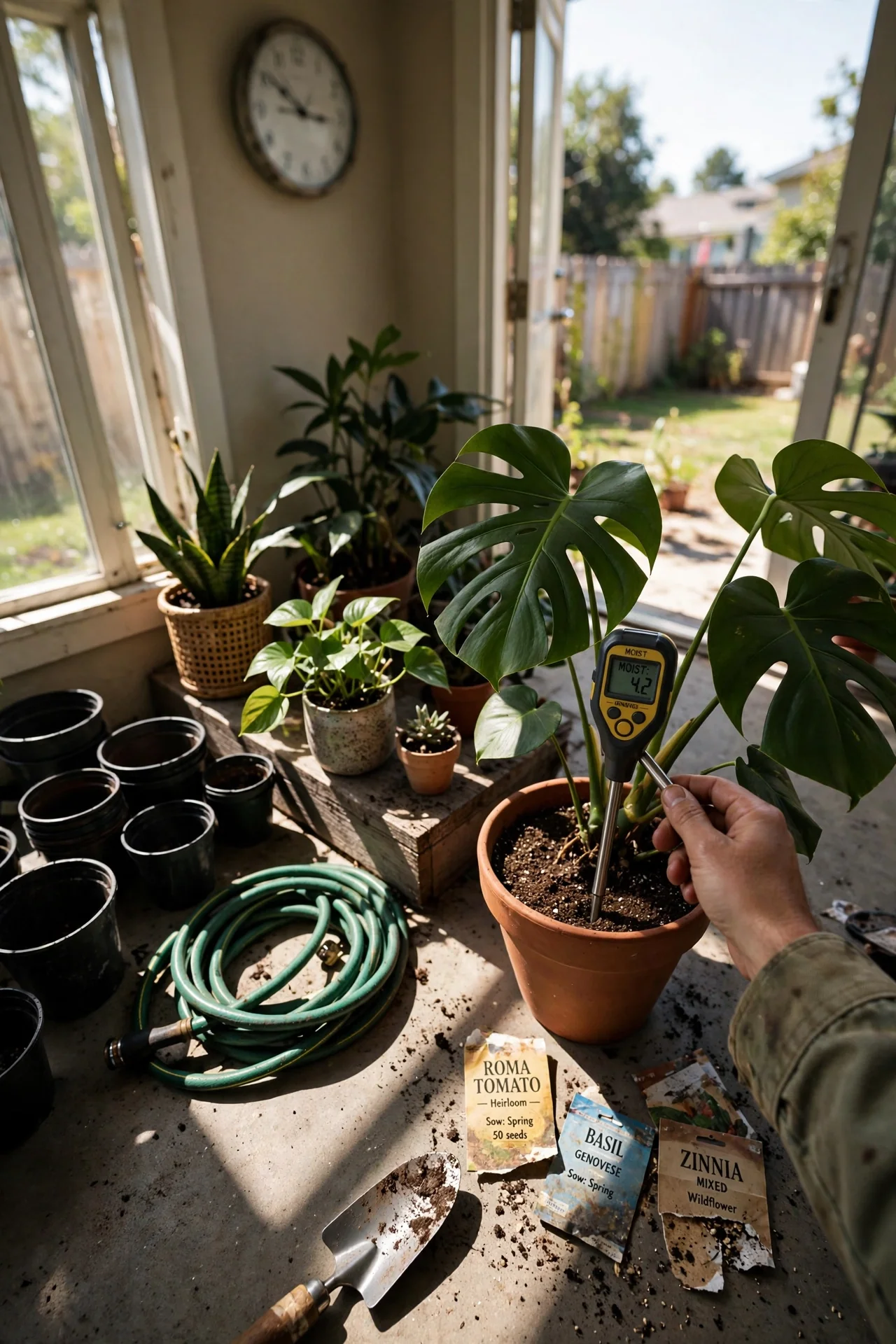
Best for: Branch 1 (Foliage plants under natural or bright indirect light)
Blueprint: What, For, Steps, Common Mistake
What: Watering within the first 60 minutes after your plant’s light source activates.
For: Monstera, Pothos, Philodendron, Calathea, Ferns, and most tropical foliage plants.
Steps: (1) Confirm the top 1 to 2 inches of soil are dry. (2) Apply room-temperature water evenly across the soil surface until it drains from the bottom. (3) After 15 minutes, discard any water remaining in the saucer. (4) Ensure the plant receives its normal light exposure immediately after watering.
Mistake: Watering at sunrise but then leaving the plant in a dark room. Stomata open in response to light; without light, transpiration stalls and the soil stays wet longer, negating the benefit of morning timing.
This window aligns with peak root hydraulic conductance, which research shows is regulated by the plant’s circadian clock and reaches its maximum in the early part of the photoperiod. For plants under grow lights, “morning” is whenever your timer switches on. A reliable timer for grow lights ensures consistent light cycles so your watering rhythm stays predictable.
Late Morning (9 AM to 11 AM, or 2 to 4 Hours After Lights-On)
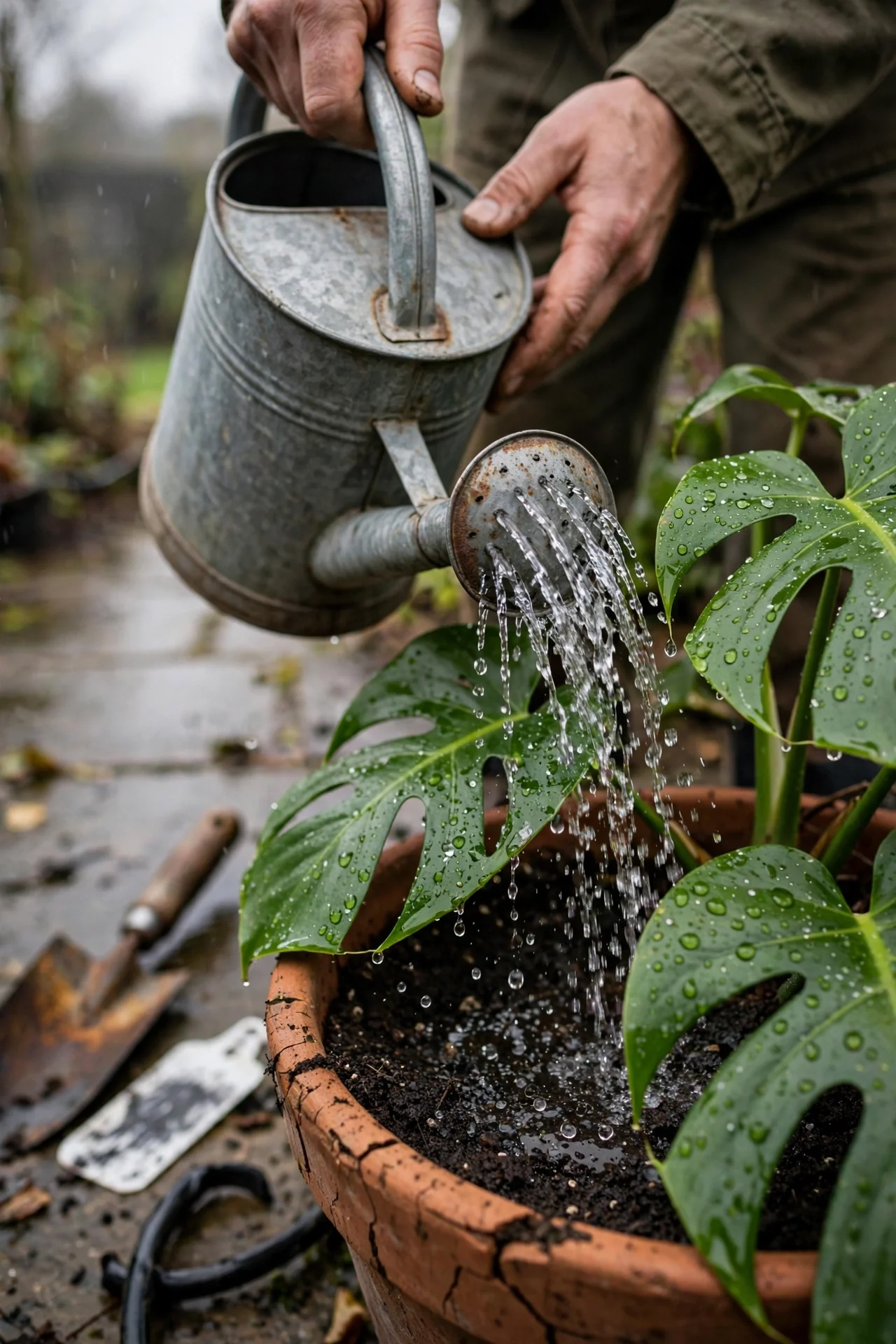
Best for: Branch 3 (Schedule-constrained growers)
Use vs Skip
Use if: Your early morning is unavailable and you have foliage plants in bright indirect light. Stomata are still open and transpiration is active. Evaporation loss is modest indoors.
Skip if: Your plant sits in direct sun through a south-facing window after 10 AM. Water droplets on leaves can act as lenses, causing localized burn on sensitive species like Calathea or African Violet. Water the soil directly if you must use this window.
This is the most practical window for many indoor gardeners. The key adjustment is avoiding leaf wetness when direct sun will hit the plant within 2 hours.
Midday (11 AM to 2 PM): The Emergency-Only Zone
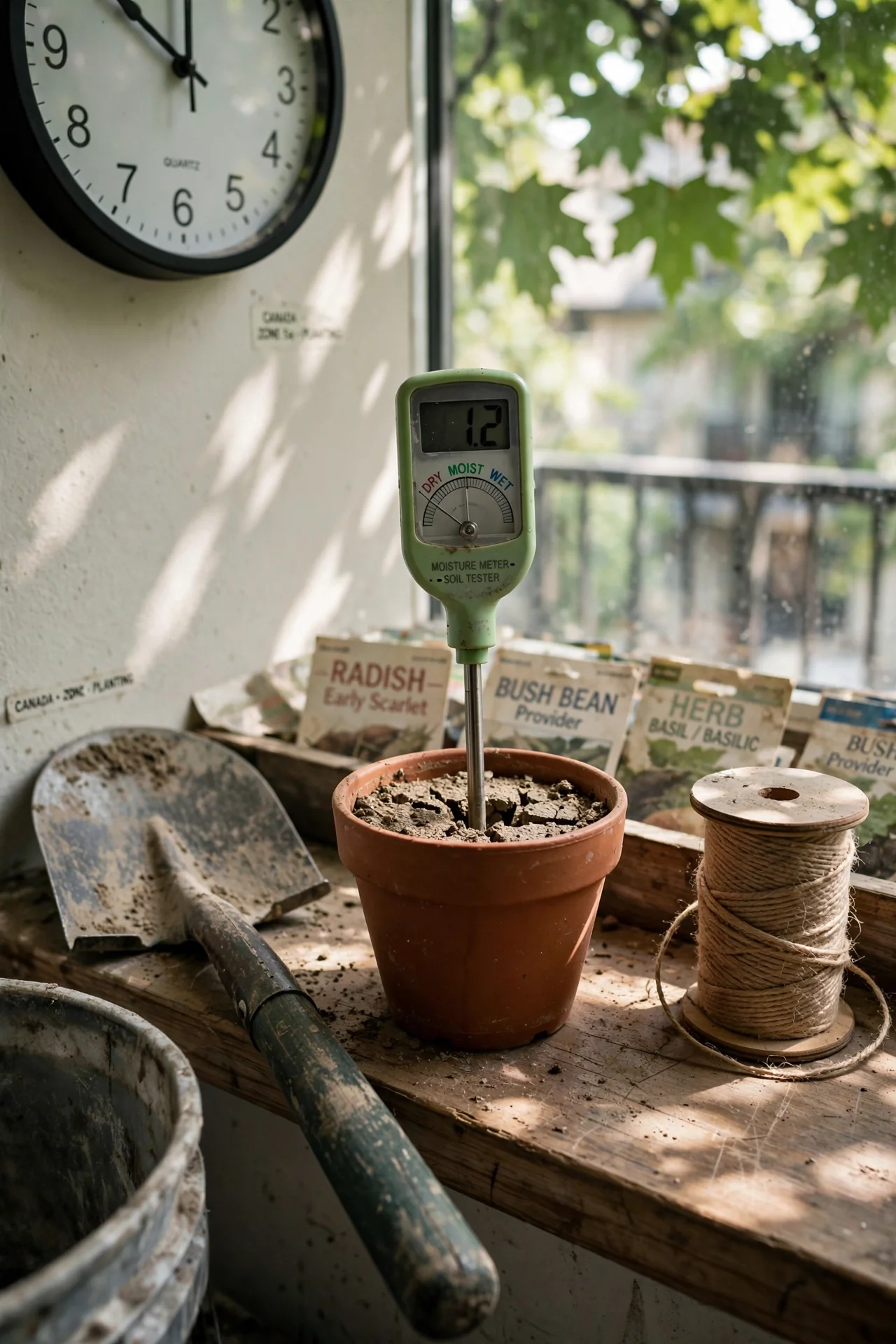
Best for: Branch 3 (Schedule-constrained, emergency use only)
Threshold Rule
The threshold that matters here is leaf temperature, not clock time. If your plant’s leaves feel warm to the touch (above roughly 30°C or 86°F), watering the foliage can cause thermal shock. Water only the soil, and use water that is room temperature, not cold from the tap. If a plant is visibly wilted at midday, a small soil-only watering can prevent permanent wilting; the full watering should still happen during the next optimal window.
Indoor midday watering is less problematic than outdoor because ultraviolet intensity is filtered by glass. However, the plant’s transpiration rate peaks during this period, meaning water moves through the plant quickly. For more on managing light intensity, see understanding indirect light.
Afternoon (2 PM to 5 PM): The Container Plant Exception
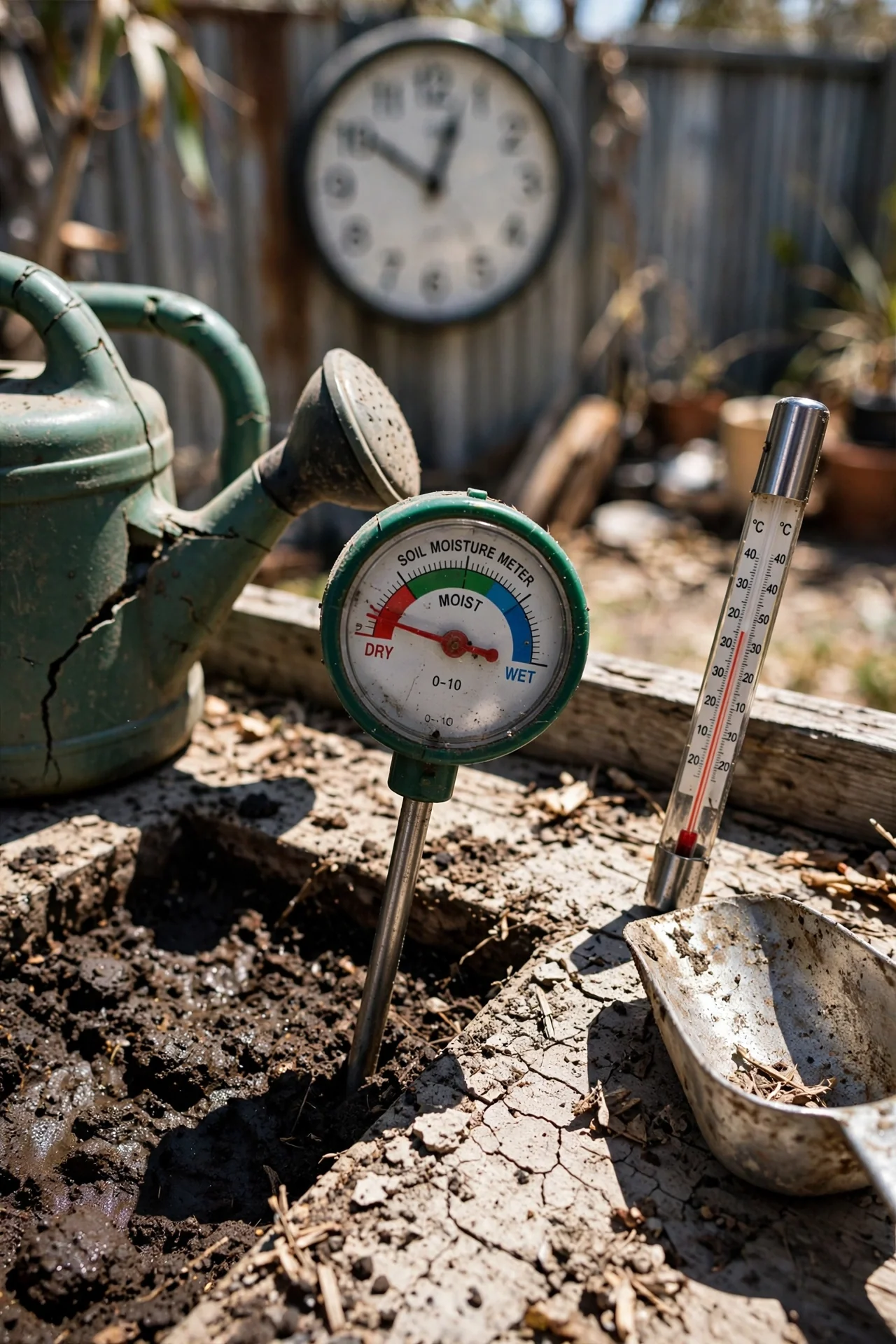
Best for: Branch 1 (Foliage plants, specifically container-grown specimens)
10-Minute Workflow
Minute 0-2: Check soil moisture with a meter or finger. If dry beyond the top 2 inches, proceed.
Minute 2-5: Apply water slowly to the soil surface until drainage begins. Use a watering can with a narrow spout to target the soil, not the leaves.
Minute 5-8: Rotate the pot 180 degrees if the plant leans toward light, ensuring even exposure for the rest of the day.
Minute 8-10: Empty the drainage saucer and wipe any splashed water from leaves with a dry cloth.
Upgrade Option: Use rainwater for houseplants instead of tap water to avoid chlorine and mineral buildup, especially beneficial for Calathea and other sensitive species.
A 2002 study by Warren and Bilderback (Journal of Environmental Horticulture) found that container-grown plants watered in the afternoon actually showed healthier, stronger growth compared to those watered in the early morning. The proposed mechanism is that afternoon watering cools the root zone during the hottest part of the day, reducing heat stress on root tissues. This finding contradicts the common advice to never water in the afternoon, but it applies specifically to container plants where the soil volume is limited and root-zone temperature matters more.
Early Evening (5 PM to 8 PM, Before Sunset)
Best for: Branch 2 (Succulents, cacti, and CAM photosynthesis plants)
Use vs Skip
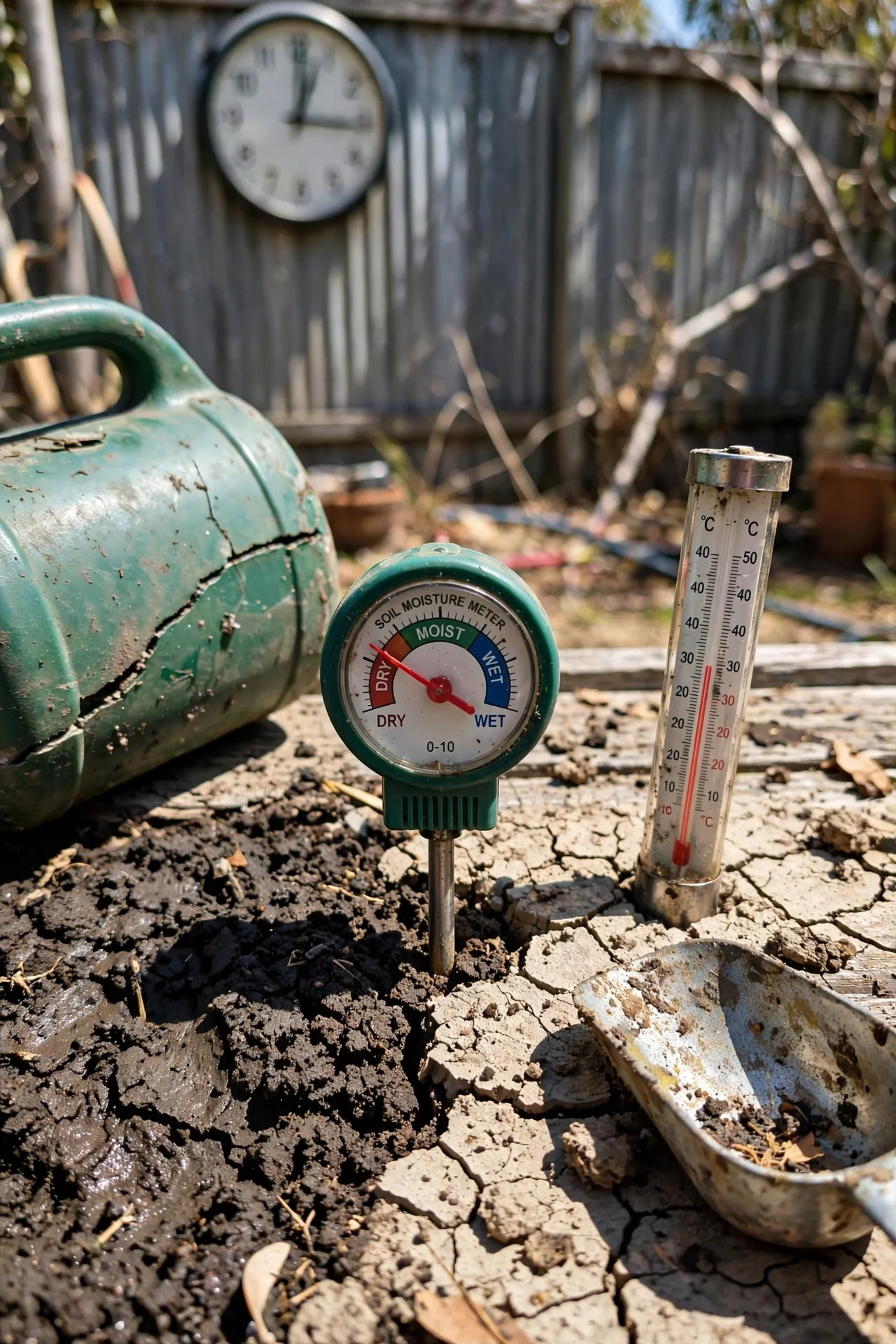
Use if: You grow Jade, Aloe, Snake Plants, ZZ Plants, or other CAM species. These plants open stomata at night. Watering in the early evening, when indoor temperatures are still warm, allows roots to absorb moisture before the nocturnal gas-exchange phase begins.
Skip if: Your indoor humidity exceeds 60 percent and air circulation is poor. In these conditions, evening watering can leave soil wet for more than 12 hours, increasing the risk of root rot even for drought-tolerant species. For more on watering succulents, see Snake Plant watering guidelines.
Late Evening and Night (After 8 PM): The Risk Window
Best for: Branch 3 (Only in dry climates with strong air circulation)
Threshold Rule
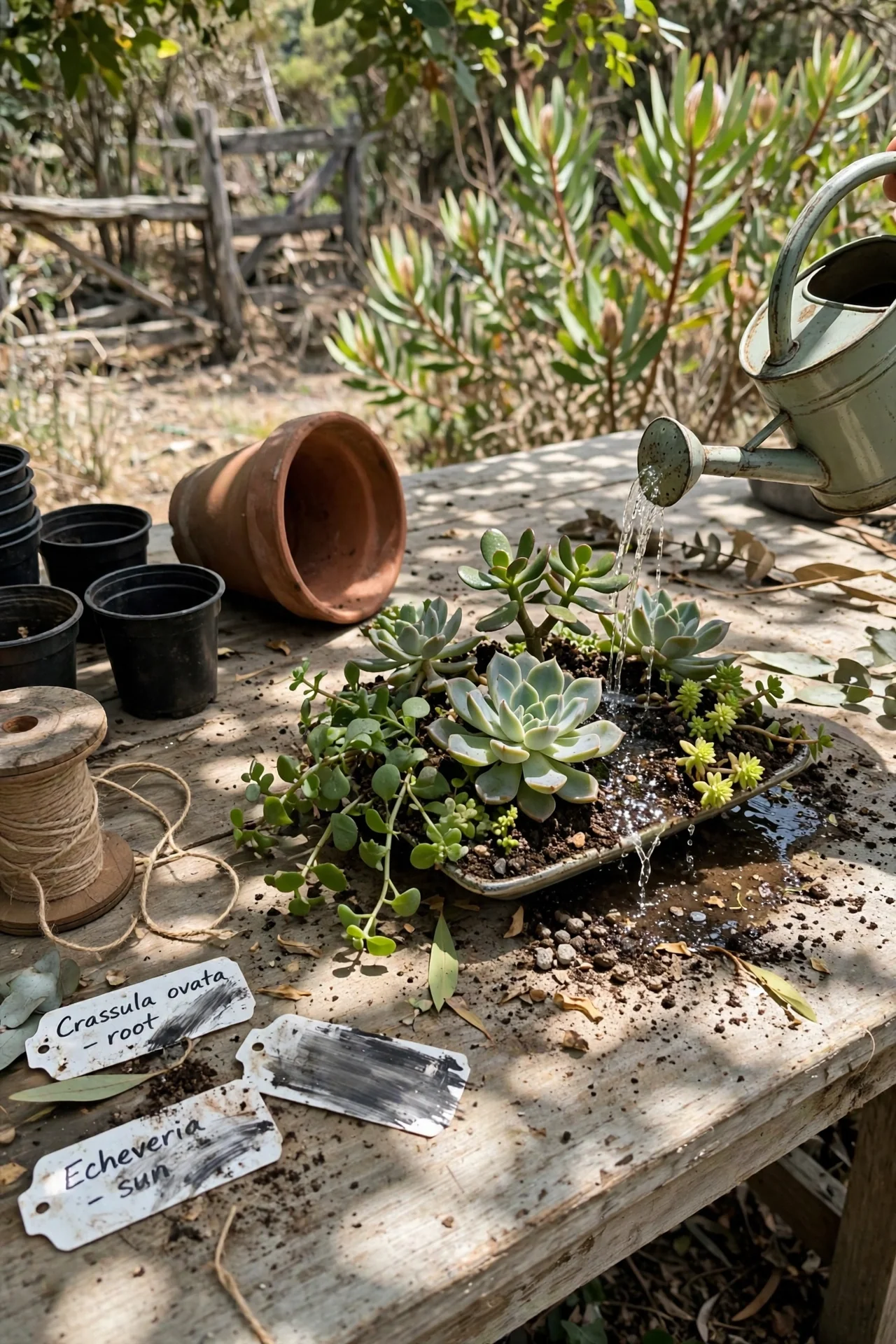
The critical threshold is leaf-wetness duration. If leaves remain wet for more than 6 hours in darkness, fungal spore germination risk increases substantially. Indoor environments with central heating or air conditioning often have low humidity (below 40 percent), which reduces this risk. The rule: if you must water at night, water only the soil, never the foliage, and ensure a fan or open window provides air movement for at least 2 hours afterward. Using a moisture meter before watering prevents adding moisture to already-wet soil, the most common cause of nighttime root rot.
Watering at night is not universally harmful. In arid climates like Arizona or inland California, where daytime evaporation is extreme, nighttime watering is a standard water-conservation practice. The difference is that these environments have low ambient humidity, so soil dries faster even in darkness.
The “When Dry” Method: Soil-First Timing
Best for: All branches
Blueprint: What, For, Steps, Common Mistake
What: Decoupling watering time from the clock entirely and triggering watering based solely on soil moisture.
For: Any houseplant owner who struggles with fixed schedules, or anyone whose plants vary widely in pot size, soil type, and species.
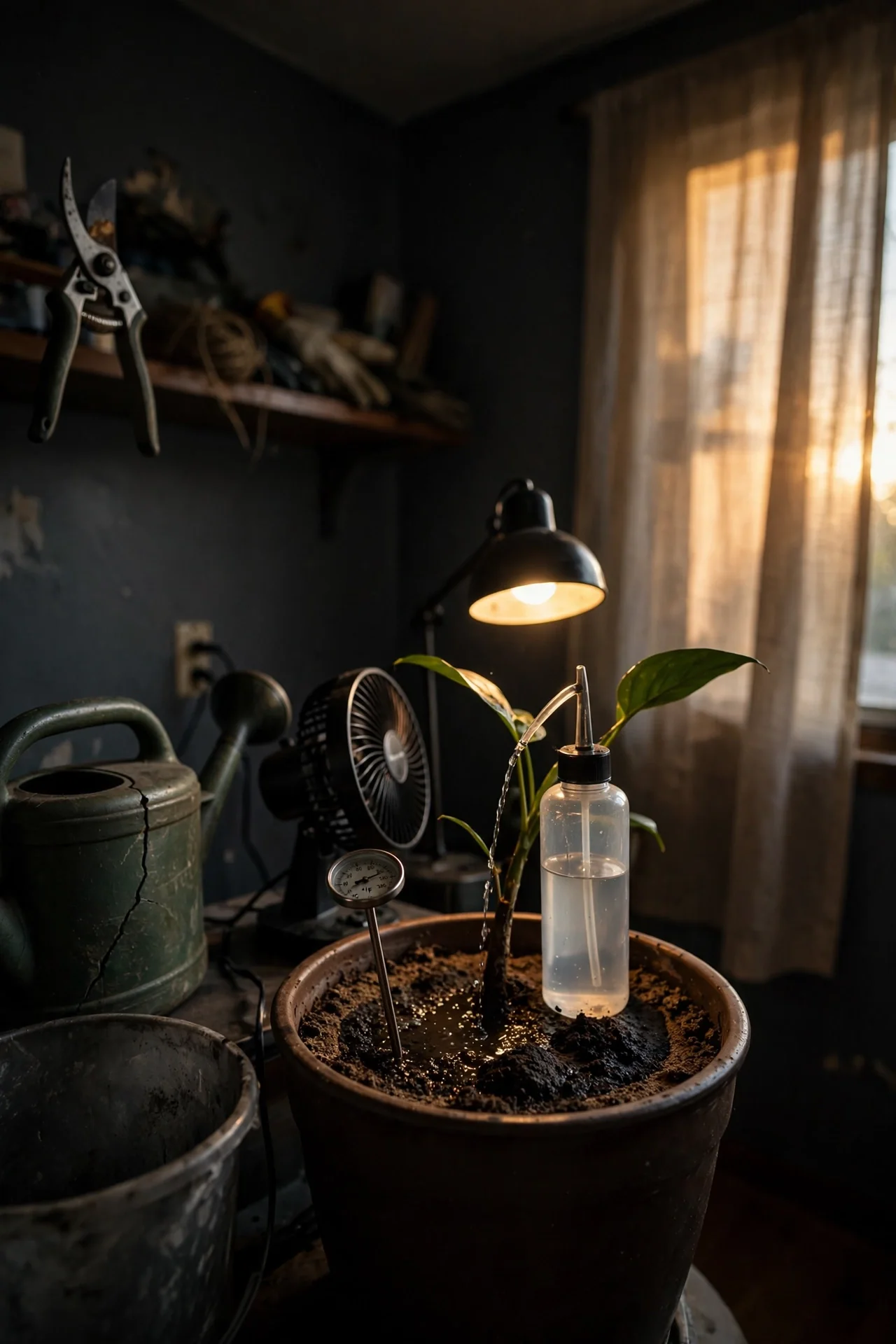
Steps: (1) Insert a finger or moisture meter 2 inches into the soil. (2) If dry, water at whatever time of day you discover it, provided you follow the leaf-wetness rules for that time window. (3) If moist, wait 24 hours and check again.
Mistake: Using a calendar (“I water every Sunday”) instead of a moisture check. This is the single most common cause of overwatering, which kills more houseplants than any other mistake. The distinction between overwatered vs underwatered symptoms is essential reading if you are unsure.
This method is the true answer that most quick-tip articles miss. If you always check soil moisture before watering, the exact time of day matters far less. The “when dry” approach also solves for seasonal shifts: in winter, soil dries slower, so you naturally water less often without changing your rule.
Tech-Assisted Timing: Sensors, Timers, and Smart Systems
Best for: Branch 3 (Schedule-constrained and frequent travelers)
10-Minute Workflow
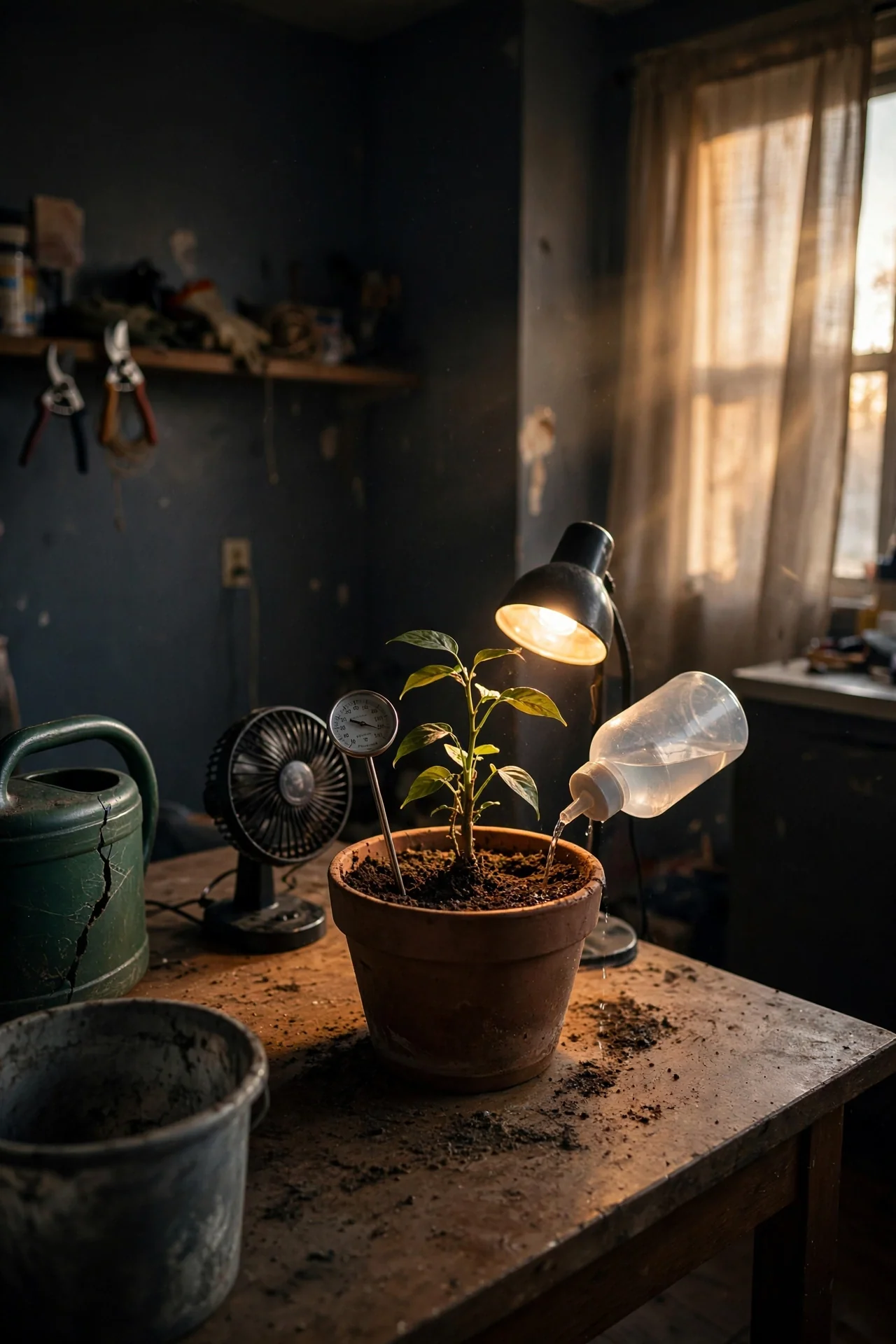
Minute 0-2: Insert a soil moisture sensor with a digital readout into the pot. Calibrate if required.
Minute 2-5: Review the reading. Most sensors use a 1-to-10 scale; water when the reading drops to 3 or below for most tropical plants, or 1 to 2 for succulents.
Minute 5-8: If using a wick watering system, check that the wick is still in contact with both the water reservoir and the soil. Refill the reservoir as needed.
Minute 8-10: Log the date and sensor reading in a simple note (digital or paper). Over time, this reveals patterns specific to each plant and season.
Upgrade Option: A programmable grow light timer paired with a smart irrigation controller can fully automate the light-water sync, especially valuable for hydroponic or semi-hydroponic setups.
Seasonal Clock Shift: Adjusting Watering Time as Light Changes
Best for: All branches, especially in temperate climates (US, UK, Canada, northern Europe)
Threshold Rule
In summer, sunrise may be as early as 5 AM and sunset after 9 PM in northern latitudes. In winter, sunrise can be as late as 8 AM with sunset before 4 PM. The plant’s circadian clock tracks this photoperiod shift. The rule: adjust your watering time by roughly 30 minutes per month as the seasons change. Water at 6 AM in June may become 8 AM in December. If using grow lights, keep the photoperiod consistent (12 to 14 hours for most tropicals) and water at the same relative time after lights-on year-round. For more on light management, see grow lights for houseplants and LED grow light distance guidelines.
The Vacation Rule: Watering Before You Leave
Best for: Branch 2 (Drought-tolerant plants, and any plant owner planning travel)
Use vs Skip
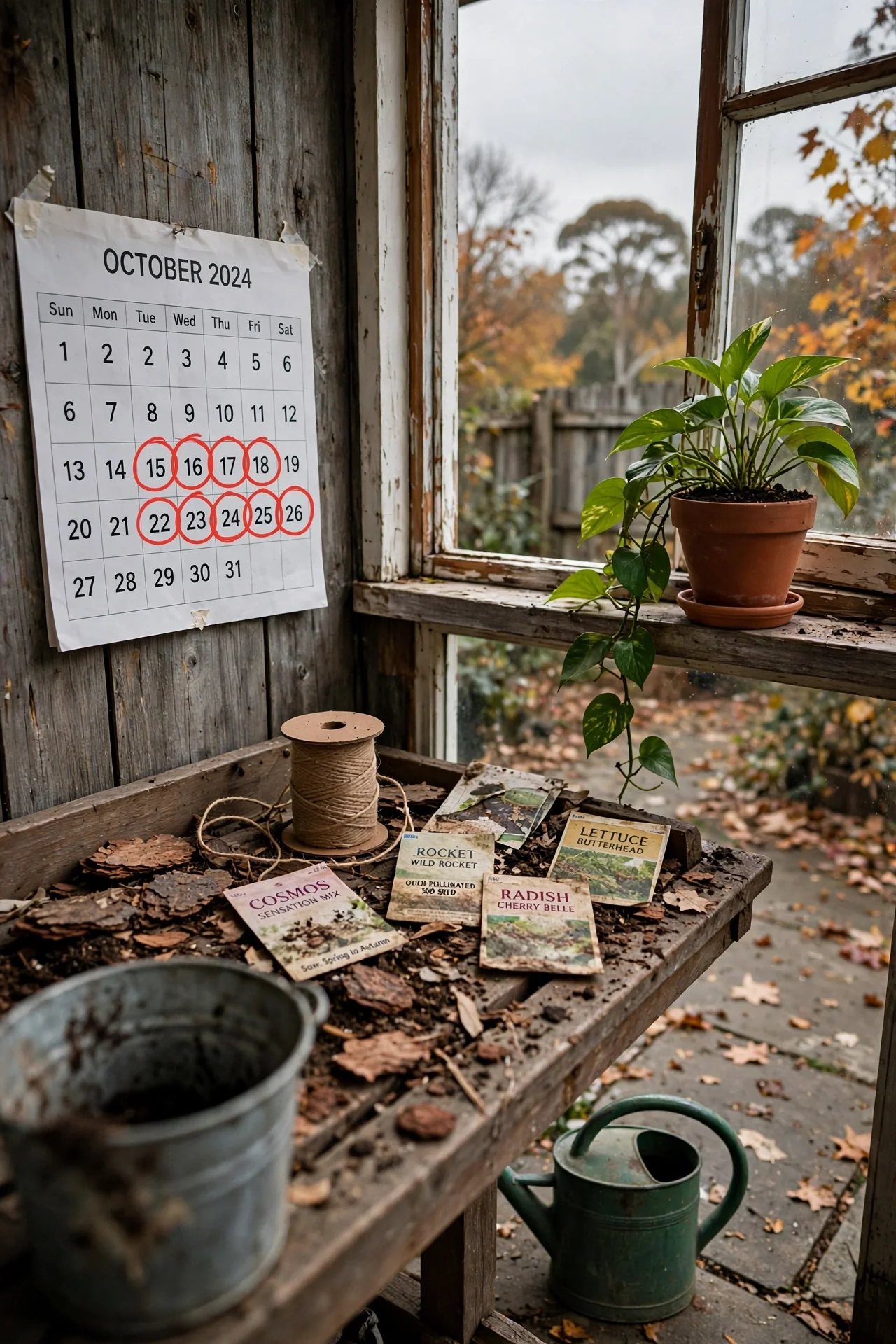
Use if: You are leaving for more than 5 days. Water thoroughly 12 to 24 hours before departure, in the morning if possible, so the plant has a full day of transpiration to distribute the water through its tissues before you leave. Move plants away from direct sun to reduce water loss while you are gone.
Skip if: You are leaving for fewer than 4 days and have already watered within the past 2 days. Most houseplants can handle a short dry period without intervention. Overwatering before a short trip is riskier than slight underwatering.
A self-watering planter or wick system is the most reliable vacation solution, decoupling watering time from your presence entirely. For plants that cannot tolerate drying, a wick watering setup can maintain consistent moisture for up to 2 weeks.
Starter Stack (What to Choose First)
Branch 1 Starter: Foliage Plant Morning Routine
Combine Item 1 (Early Morning) with Item 7 (When-Dry Method). Water only when the top 2 inches are dry, and when you do, do it within 1 hour of lights-on. This pairing prevents both overwatering and circadian misalignment. Estimated cost: free. Time investment: 5 minutes, 1 to 2 times per week in growing season.
Branch 2 Starter: Succulent Evening Routine
Combine Item 5 (Early Evening) with Item 10 (Vacation Rule). Water in the early evening every 2 to 4 weeks, only when soil is completely dry. This matches CAM photosynthesis timing and minimizes evaporation. If you travel, water thoroughly the evening before departure. Estimated cost: free. Time investment: 5 minutes, once every 2 to 4 weeks.
Branch 3 Starter: Tech-Enabled Flexible Routine
Combine Item 8 (Tech-Assisted Timing) with Item 2 (Late Morning). A moisture sensor eliminates guesswork; late morning provides a practical window that aligns reasonably well with most plants’ active periods. Estimated cost: $10 to $30 for a basic moisture meter. Time investment: 5 minutes, on an as-needed basis.
When This Won’t Work
Failure condition 1: Chronically wet soil regardless of timing. If you water at the “perfect” time but your soil drains poorly or your pot lacks drainage holes, roots sit in saturated conditions. The circadian advantage is wiped out by anoxia. In this scenario, no watering schedule will save the plant. Repot into a well-draining mix appropriate for the species and confirm drainage holes are present and unblocked. For guidance on watering method, compare bottom watering vs top watering to see which method suits your soil type.
Failure condition 2: Watering at the right time with the wrong water temperature. If you apply cold water (below roughly 10°C or 50°F) directly from an outdoor tap in winter, you can shock root tissues regardless of circadian alignment. Tropical plants are especially sensitive; root-cell membrane function is impaired at low temperatures, reducing water uptake even when stomata are open. Let water sit at room temperature for at least 2 hours before applying, or use a rainwater collection system stored indoors.
Choosing the Right Option for Your Situation
Budget Threshold
If your plant-care budget is under $20, prioritize Item 7 (When-Dry Method) paired with whichever time window matches your plant type (Item 1 for foliage, Item 5 for succulents). A basic moisture meter costs approximately $10 and is the highest-value tool for avoiding both overwatering and poor timing.
Time Threshold
If you have fewer than 5 minutes per day for plant care, adopt Item 8 (Tech-Assisted). A wick-watering system or self-watering planter requires refilling every 1 to 2 weeks. Pair it with a timer for grow lights to lock in a consistent light-water cycle without daily involvement.
Technical Constraint: Water Quality
If your tap water is hard (mineral deposits visible on faucets), water timing interacts with mineral uptake. Morning watering, when transpiration is highest, increases the rate at which dissolved minerals are drawn into leaf tissues, potentially accelerating tip burn in sensitive plants like Spider Plants and Dracaena. Use rainwater or filtered water for these species, or water in the evening when transpiration is lower, reducing mineral transport to leaves.
Yes/No Checklist
- Do you check soil moisture before every watering? If no, start there before optimizing time of day.
- Does your pot have drainage holes? If no, fix this before anything else.
- Is your plant a succulent or cactus? If yes, water in the early evening. If no, water in the morning.
- Do you run a fan or have good air circulation? If no, avoid evening watering entirely.
Expert Q&A
Does the best watering time change if I use a grow light instead of sunlight?
Yes. With grow lights, “morning” is whenever the light turns on. Set your timer for a consistent 12- to 14-hour photoperiod and water within 1 hour of lights-on. The plant’s circadian clock entrains to the light schedule, not to actual solar time. Consistency matters more than matching the sun.
Can I water orchids at the same time as my other houseplants?
Orchids, particularly Phalaenopsis, are CAM plants that benefit from morning watering despite their succulent-like metabolism. The reason is that their aerial roots need to dry quickly after watering to prevent rot. Morning watering gives roots all day to dry. Evening watering leaves roots wet overnight, increasing crown-rot risk.
Is misting subject to the same timing rules as watering?
Misting adds negligible water to the soil but does wet leaf surfaces. Mist in the morning so leaves dry by evening. Nighttime misting in still air creates the same fungal risk as nighttime watering. If you rely on misting for humidity, consider a humidifier instead; it raises ambient humidity without wetting leaves.
Does water temperature affect the best time to water?
Indirectly, yes. Cold water applied in the morning when roots are coolest (before the grow space warms up) can slow uptake. Room-temperature water is always recommended. In winter, water that has sat indoors overnight is better than water drawn straight from a cold tap at 6 AM.
Should I water differently on very humid days versus dry days?
Yes. On humid days (indoor humidity above 65 percent), the soil dries slower and leaf wetness persists longer. Even morning watering may not dry fully by evening. On these days, reduce the volume of water applied by roughly one-third and ensure a fan runs for at least 2 hours after watering.
Conclusion
The single most important decision you can make about watering time is to stop treating it as a fixed appointment and start treating it as a variable that responds to plant type, light cycle, and soil moisture. The research is clear: morning watering benefits most foliage plants because it aligns with stomatal opening and photosynthetic activity. But the afternoon exception for container plants, and the evening preference for CAM succulents, prove that “always water in the morning” is an oversimplification.
The number one mistake is watering on a calendar schedule without checking soil moisture first. No time of day can compensate for watering a plant that does not need water. Use the Decision Grid above to identify your branch, adopt the corresponding starter stack, and adjust seasonally. For the complete picture on watering frequency, see how often to water houseplants.