
Movement One — The Children Who Were Never Invited
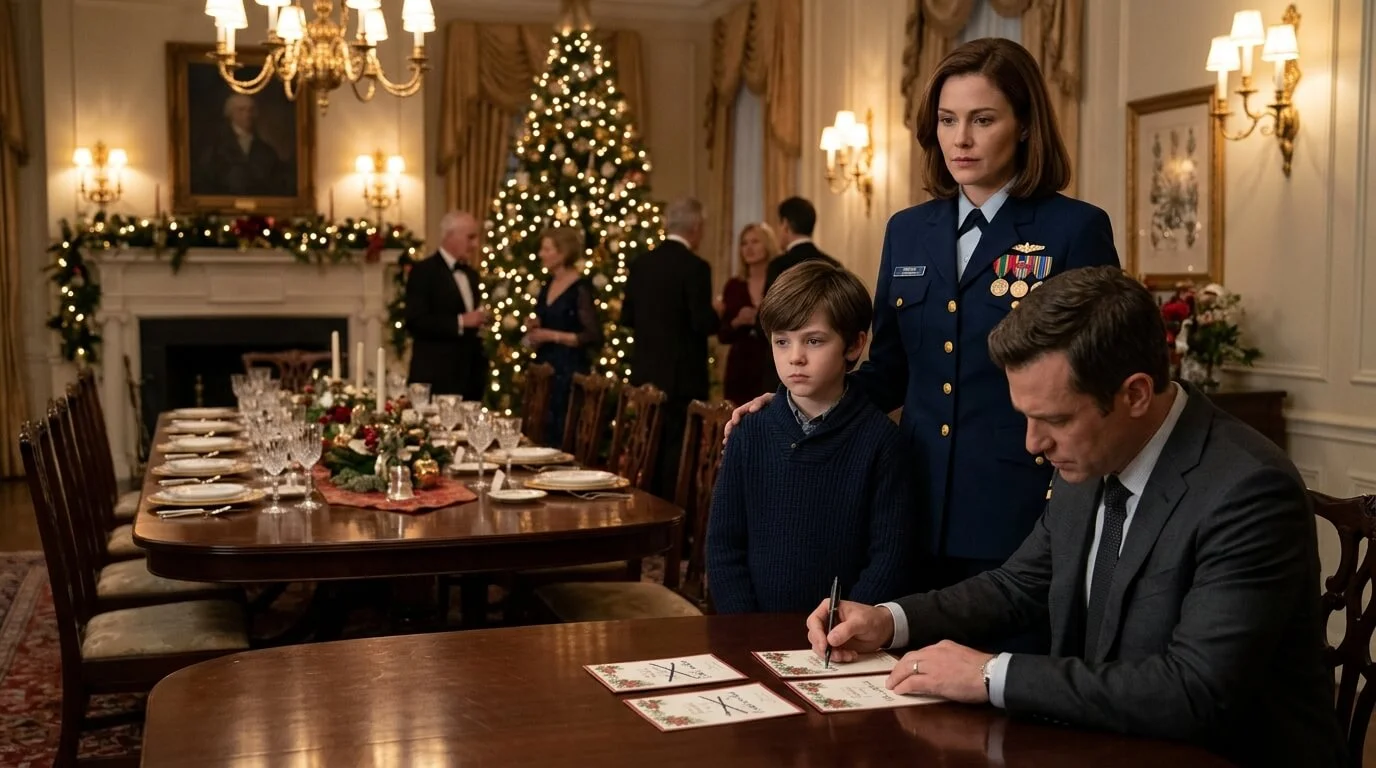
Andrew Whitmore was holding a black pen when Benjamin noticed what he was doing.
The eight-year-old stood beside the enormous mahogany dining table, watching Andrew cross out four names from the Christmas dinner place cards.
Benjamin recognized the names immediately.
Benjamin.
Lucas.
Charlotte.
Grace.
“Mom, why are our names crossed off?”
Andrew stopped writing.
For a moment, he looked uncomfortable. Then he pushed the cards aside.
“This dinner is for invited family.”
Rebecca Whitmore stood at the entrance of the dining room, wearing her navy-blue Coast Guard dress uniform. Behind her stood the four children Andrew had not seen in eight years.
The room became quiet.
Rebecca had imagined this moment many times, although never quite like this. She had imagined Andrew looking surprised, perhaps embarrassed, possibly even ashamed. She had imagined his parents struggling to explain why they had ignored every attempt she had made to contact them.
But she had never imagined him crossing out his own children’s names in front of them.
Charlotte stepped forward.
“But you invited us, didn’t you?”
Andrew opened his mouth but found no immediate answer.
Lucas looked toward the older woman sitting at the opposite end of the table.
“Grandma signed for all eleven letters.”
Eleanor Whitmore froze.
Grace looked at Andrew.
“Then why did you hide them?”
Rebecca reached into her handbag and placed a sealed cream-colored envelope on the table.
That was when Andrew recognized his mother’s handwriting.
Eight years earlier, Rebecca had believed that the man she married understood what family meant.
She had met Andrew at a military leadership conference in Annapolis. She was a young Coast Guard officer, determined to build a career through hard work. Andrew was an Army captain from a prominent Virginia military family.
He was charming, confident, and accustomed to a world where people recognized his surname.
His father, retired Lieutenant General Charles Whitmore, had spent decades building the family’s reputation. His mother, Eleanor, maintained their mansion and social connections with extraordinary care.
Rebecca came from a very different background.
Her father had been a small-town firefighter, and her mother had worked as a public-school librarian. They had taught her that a person’s character mattered more than their possessions.
Andrew initially admired that independence.
They married eighteen months after meeting, in a small chapel overlooking the Chesapeake Bay.
For a while, their differences seemed unimportant.
But as Andrew’s career progressed, he began expecting Rebecca to make sacrifices for his ambitions.
He wanted her to leave active service eventually. She refused to abandon a profession she had worked so hard to build.
Their disagreements became more frequent.
Then Rebecca discovered she was pregnant.
She initially expected Andrew to be happy.
Instead, he immediately began discussing the overseas assignment he hoped to receive.
Several weeks later, an ultrasound revealed that Rebecca was carrying quadruplets.
Four babies.
She was frightened by the medical challenges but overwhelmed by happiness.
Andrew questioned the doctor’s findings and accused Rebecca of creating an obstacle to his career.
Their marriage deteriorated quickly.
He eventually filed for divorce.
Outside the courthouse, Rebecca made one final attempt to reach him.
“Whatever happens between us, these babies deserve to know you.”
Andrew looked away.
“I can’t build my entire future around something I never agreed to.”
He left.
Rebecca delivered the babies prematurely, and all four required specialized neonatal care.
She spent weeks moving between their incubators, learning their individual cries and celebrating every improvement.
Benjamin was the loudest.
Lucas was observant.
Charlotte was curious and stubborn.
Grace was the smallest, and she frequently wrapped her fingers around Rebecca’s hand.
Andrew never visited.
Rebecca sent medical updates and photographs. She wrote letters explaining that the babies were healthy enough to come home.
She contacted Andrew’s parents too.
But the letters came back, and the family insisted Andrew had received nothing.
Rebecca kept every returned envelope.
There were eleven.
She eventually stopped expecting a response and concentrated on raising her children.
She returned to work, developed her career, and eventually became a respected Coast Guard commander.
Her children grew up in a loving home.
They knew their father lived somewhere in Virginia, but Rebecca refused to teach them to hate him.
When Benjamin asked why Andrew never called, she explained that adults sometimes made decisions that hurt other people.
She never told them that their existence had been deliberately hidden.
Then, shortly before Christmas, Andrew sent an invitation.
He wanted Rebecca to attend his family’s annual celebration. His fiancée, Victoria Hayes, would also be present.
Rebecca found the invitation strange.
Why would a man who had ignored her for eight years suddenly want her at his family dinner?
Benjamin noticed the envelope on the kitchen counter.
“Is that from our dad?”
Rebecca nodded.
“Does he want to meet us?”
“He invited me to dinner.”
Charlotte looked up from her drawing.
“Why didn’t he invite us?”
Rebecca had no answer.
Lucas examined the invitation.
“Maybe he doesn’t know we’re coming.”
Grace quietly asked whether they should bring him a Christmas present.
Rebecca smiled gently.
“You don’t have to bring anyone anything they haven’t earned.”
The children decided they wanted to attend.
Rebecca explained that the evening might be uncomfortable and promised they could leave whenever they wanted.
Then she opened the drawer where she kept the eleven returned letters.
She examined the delivery receipts again.
One envelope carried a confirmation showing that it had reached the Whitmore estate.
The signature was Eleanor’s.
Rebecca remembered how strange that had seemed when she first received the returned correspondence.
Why would Eleanor sign for a letter and then allow the family to claim it had never arrived?
There was another development.
Rebecca had recently been asked to provide information to investigators examining financial irregularities connected to the Whitmore Family Foundation.
The organization publicly supported military families, veterans, and educational programs.
Rebecca’s experience in military service and charitable administration made her a useful source of background information.
During the review, she encountered references to administrative records that appeared connected to the family office.
Some documents suggested that correspondence concerning her pregnancy had been deliberately separated from Andrew’s personal records.
She preserved her original evidence and provided relevant material through the appropriate investigative channels.
She had not planned to confront the family at Christmas.
But the invitation made her realize that she finally had an opportunity to ask the questions that had followed her for years.
On Christmas Eve, she dressed in her formal uniform.
The four children dressed carefully.
Benjamin chose his navy sweater. Lucas wore gray. Charlotte selected her red velvet dress, while Grace wore a cream cardigan.
Rebecca placed the cream-colored envelope inside her handbag.
Then they drove to the Whitmore mansion.
Movement Two — Four Questions Nobody Could Answer
The mansion looked exactly as Rebecca remembered.
Warm lights shone through its tall windows. A large Christmas tree stood near the entrance, and guests were already gathering in the dining room.
Andrew stood beside Victoria, his fiancée.