
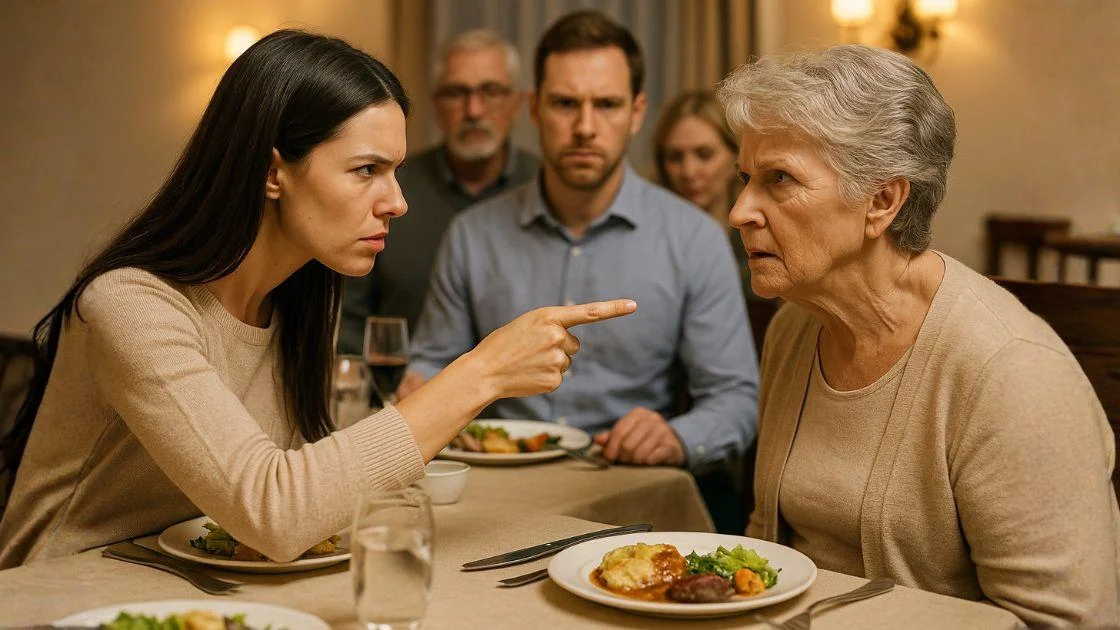
At 6:40 p.m., Brooke yanked the serving platter from my hands and leaned close.
“Keep your voice down. Nineteen guests are watching.”
I caught the platter before it hit the floor. Gravy streaked the white tablecloth.
“This is my cabin. Why is there a sale price?”
Brooke set a glossy estimate beside my plate.
“Daniel and I were offered two hundred forty thousand.”
“Mom, it’s only an estimate,” Daniel said, lowering the carving knife.
I reached toward the hall cabinet.
“Then explain Dad’s envelope.”
The platter tilted. Gravy ran across the white tablecloth and dripped onto the floor. I caught its edge before it fell, but a spoon struck the boards with a sharp clatter. Around the long dining table, conversations stopped one by one.
I was sixty-eight years old. I had hosted Thanksgiving in the cedar cabin for thirty-two years, first with my husband, Robert, and then alone after he died. I knew which floorboard complained near the pantry, how the old oven ran hot on the left, and how the lake looked when the afternoon light turned copper. I also knew how to keep my face still when someone tried to make me feel small.
Brooke mistook that stillness for surrender.
She was my son Daniel’s new wife. They had married in June, and she had treated the cabin as if it were a wedding gift neither Robert nor I had ever agreed to give. She had already replaced the guest-room curtains, moved my cookbooks into a box, and told Daniel that the upstairs room would make a perfect office once I “started spending winters somewhere easier.”
Daniel had heard every remark. Each time, he found something else to look at.
That afternoon, the cabin was full. Nineteen Thanksgiving guests crowded the dining room and the adjoining sitting room: my sister Ruth, Robert’s cousins, Daniel’s college friends, neighbors from the lake road, and Brooke’s parents. The windows had fogged from the food and the woodstove. Coats hung over the stair rail. A football game murmured from the television with the sound turned low.
I had spent two days preparing the meal. Brooke had arrived an hour before dinner with a spreadsheet of seating assignments and a list of “small improvements” she wanted to make before next summer. She had also brought a folder from a real-estate agent. I had seen the agent’s card sticking out of it.
When I asked what it was, Brooke smiled and said she and Daniel were “just looking at possibilities.”
Now she set the platter down as if I were an unreliable caterer.
“I wasn’t correcting you,” I said. “I was telling you the gravy boat belongs on the sideboard, not beside the hot dish.”
Brooke leaned close enough for me to smell her perfume. “This is exactly what I mean. You turn every little thing into a public disagreement.”
“It’s my dining room.”
Her smile tightened. “And that is why we need to talk about the next chapter.”
Daniel stood at the end of the table, carving knife in his hand. He had Robert’s broad shoulders and the same small crease between his eyebrows. When he was a boy, that crease appeared whenever he knew he had done something wrong. It was there now.
“Mom,” he said, “can we not do this today?”
I looked at him. “I didn’t start it.”
Brooke lifted her glass. “No one is attacking you. We’re trying to make a plan that works for everyone.”
“Then say the plan.”
She glanced toward her parents, who exchanged a look. Her father, Martin, folded his napkin into a neat square. Her mother studied the centerpiece. The guests had become very interested in their plates.
Brooke opened the folder and placed a glossy page beside the gravy-stained cloth. A photograph of the cabin filled the top half. Under it sat a suggested listing price: $240,000.
My hand rested on the edge of the table.
“You had an agent value my home?”
“Our home,” Brooke corrected. “Daniel grew up here. We want to make sure the property doesn’t sit empty or become a burden.”
“I live here.”
“For now,” she said, and then, softer but somehow louder, “Please don’t make this embarrassing.”
Daniel set the knife down. “Brooke, maybe we should wait.”
She turned on him. “We have waited. We’ve been patient. You said your father wanted this place to stay in the family.”
“My father said a lot of things,” I replied. “He also signed papers.”
Brooke laughed once, a thin sound. “What papers?”
I didn’t answer. Not yet.
Three weeks before Robert died, he had asked me to drive him to the law office in town. His illness had made him tired, but his mind was clear. He had spent the morning reviewing the family trust with our attorney, Helen Price. He wanted the cabin to pass to me outright, not to Daniel, not to a future spouse, and not to anyone who might pressure me to sell it. The rest of the estate was arranged separately. Robert had explained his reasons in his own words, and Helen had documented his instructions, checked his capacity, and supervised the signing.
I had not told Daniel the details. Robert had asked me to wait until I needed to. At the time, I thought that day might never come.
Brooke pushed the listing page toward me. “We can use the money to get you somewhere smaller and put the rest toward a place of our own. It makes sense.”
“Did Daniel agree to that?”
She answered for him. “We’re married. We make decisions together.”
I looked at my son. “Did you?”
He rubbed his thumb over the handle of the carving knife. “I thought we were going to discuss it privately.”
“You discussed selling my home with a stranger before discussing it with me.”
“Mom, it was only an estimate.”
“An estimate with a price and a plan.”
Brooke reached for the platter again, as if moving the food might move the conversation. “This is why I asked you to keep your voice down. You’re upsetting everyone.”
I glanced around the room. Ruth had stopped pretending to eat. One of Robert’s cousins had lowered his fork. Brooke’s father looked uncomfortable, but he still said nothing.
I could have raised my voice. I could have listed every thing Brooke had moved, every instruction she had given, every time Daniel had stood nearby and let her do it. Instead, I picked up the spoon from the floor, wiped it with a clean napkin, and set it beside my plate.
Then I asked Daniel one question.
“Did you tell her the cabin was hers to sell?”
He opened his mouth. Brooke put a hand on his arm.
“Daniel doesn’t have to answer an interrogation,” she said.
That was when I understood the purpose of the dinner. It was not a family conversation. It was a performance. Brooke wanted witnesses to see me as confused, difficult, and too emotional to make decisions. If I objected, she could point to my objection. If I stayed quiet, she could call my silence agreement.
I folded the listing page once and placed it beside my plate.
“Dinner is getting cold,” I said.
Brooke gave a small, satisfied nod. She believed the moment had passed.
But I had noticed something else. The folder contained a second page, and beneath it was the name of the law office that had prepared the proposed sale documents. It was not Helen’s office. It was a firm Brooke had chosen without asking me.
I rose, went to the hall cabinet, and returned with a cream envelope. Robert’s handwriting crossed the front. I had kept it there since the week after his funeral, exactly where he told me to keep it.
Brooke saw it and stopped smiling.
“What is that?” she asked.
I laid it beside the listing photograph. “The reason you should have asked before inviting an agent into my life.”
Daniel took one step toward the table. “Mom, what did Dad do?”
I slid one finger beneath the envelope flap.
And every guest leaned forward.
MOVEMENT TWO: THE ENVELOPE ROBERT LEFT
The envelope was heavier than it looked. Inside were copies of the trust amendment, the deed transfer, and a letter Robert had written after meeting with Helen. I had read them so many times that I knew where the pages had been folded. I had not brought them out to frighten Brooke. I had brought them because she had made a claim about a home she did not own.