
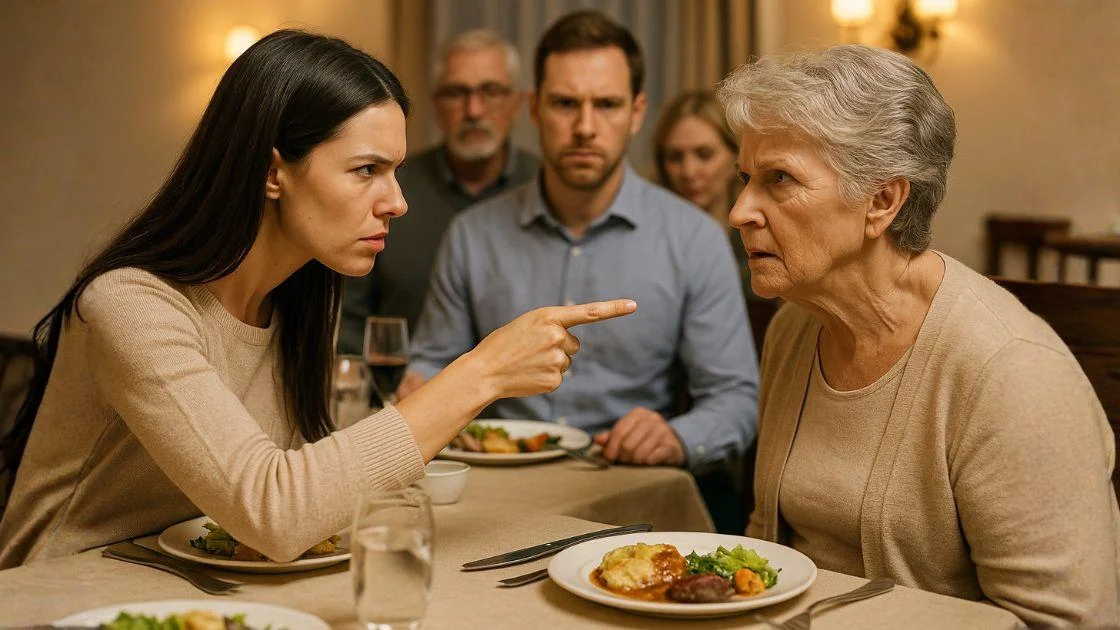
Brooke reached for the envelope. I put my palm over it.
“Don’t,” I said.
Her cheeks colored. “You can’t wave legal papers around and expect us to understand what they mean.”
“Then let the attorney explain them.”
I took out Helen’s business card and placed it on top of the envelope. Daniel stared at it. He knew Helen. She had handled Robert’s business affairs for years, prepared our wills, and helped us establish the trust after the cabin’s roof needed replacing. She was not a stranger I had found to win an argument.
Brooke glanced at the card. “We already have an agent.”
“This isn’t about an agent.”
“Then what is it about?”
I opened the first page and turned it so the table could see the heading. I did not read every legal paragraph. I read the sentence Helen had marked with a yellow tab: Robert’s share and interest in the cabin was to pass to me, outright and free of any claim by a beneficiary of the remainder of the trust.
The cabin had been Robert’s before our marriage. Over the years, we had repaired it together, paid its taxes from our joint account, and filled it with the ordinary evidence of a shared life. But the title and the trust had always been handled carefully. Robert wanted me to have a secure home for as long as I wanted it. He had told Helen that he did not want Daniel to inherit a property that could become leverage over me.
The amendment was signed, witnessed, and notarized three weeks before Robert died. Helen had met with him alone before I entered the office. She had asked him to explain what he was changing and why. He answered without prompting. She had documented the meeting and kept the original with the trust records. The recorded deed now reflected the transfer.
Brooke stared at the page as if the words might rearrange themselves.
“That can’t be right,” she said. “Daniel is his son.”
“Yes,” I replied. “And Robert loved him. This wasn’t a punishment. It was a decision about where I would live.”
Daniel took the paper. His eyes moved over the paragraph, then returned to the marked sentence. “Dad never told me.”
“He told you he wanted me safe here.”
“He said the cabin should stay in the family.”
“It is still in the family. I am your family.”
For a moment Daniel looked like the boy who used to sit on the porch steps after a scraped knee, waiting for me to decide whether it hurt enough for a bandage. Then he looked at Brooke.
She was no longer trying to look gracious. “You told me he was leaving it to you.”
Daniel swallowed. “I thought he was.”
“You told me we could make plans.”
“I thought we could talk about it.”
“You said it was practically ours.”
He lowered the document. “I shouldn’t have said that.”
The guests stayed quiet. The only sounds were the woodstove ticking and the football announcer murmuring from the sitting room. Ruth moved her chair closer to mine. I did not need her to defend me, but I was grateful she had stopped pretending the scene was normal.
Brooke turned toward the guests. “This is a private family matter. I don’t know why everyone has to sit here and watch.”
“You made it public,” I said. “You brought a sale price to Thanksgiving and asked me to keep my voice down.”
Her father finally spoke. “Brooke, perhaps we should go.”
She ignored him. “The cabin needs work. The steps are uneven. The heating system is old. You can’t manage all of this forever.”
“I can decide what I can manage.”
“You’re being stubborn.”
“No. I’m being clear.”
I took out Robert’s letter. The paper was folded in thirds. His handwriting leaned slightly to the right, the way it had on birthday cards and grocery lists. I had read the letter alone on the first anniversary of his death, then put it away. It was not a legal instrument. It was a private explanation, written for me and for Daniel if the day came when he needed to understand.
I did not read the whole thing aloud. I read only the part Robert had underlined: “I want you to have the cabin without having to ask anyone’s permission to stay. If Daniel ever forgets that, remind him that a home is not a prize to be claimed. It is a place where people should be safe.”
Daniel sat down.
Brooke’s mother reached for her water glass. Her father stood, then sat again, unsure whether leaving would make matters worse. The guests were no longer watching me. They were watching the people who had arrived believing the house was already theirs.
Brooke pointed at the papers. “So what happens to Daniel? He gets nothing?”
“That isn’t what the document says,” I replied. “It says the cabin is mine. Robert made other arrangements for the rest of the trust. I am not going to discuss every part of his estate at a dinner table.”
“Convenient.”
“Necessary.”
Daniel looked up. “Mom, why didn’t you tell me?”
I thought about the weeks after the funeral. He had been exhausted and grieving. I had wanted to believe that he would ask what Robert had arranged, rather than assume. Then came the wedding, the new furniture plans, and Brooke’s confident references to “our place.” I had postponed the conversation because I did not want my son’s first months of marriage to begin with a fight about property.
“I should have told you sooner,” I said. “But not telling you did not make the cabin yours.”
He nodded, though he did not look relieved.
Brooke gathered the listing pages into a sharp stack. “We are not finished.”
“No,” I said. “We aren’t.”
I called Helen from the kitchen. She answered on the second ring. I put the call on speaker, told her what had happened, and asked her to confirm the documents without discussing anything beyond the cabin. Helen did not sound surprised. She asked whether I was safe, whether anyone had threatened me, and whether I wanted her to come over. I said I was safe, but I wanted her to explain the recorded transfer to everyone present.
She agreed to come.
The wait lasted less than half an hour, but it changed the room. People began to move again. Ruth carried the gravy boat to the sideboard. Robert’s cousin helped clear the fallen spoon and wipe the table. Brooke remained standing beside Daniel, her arms folded, while her parents quietly put on their coats.
Daniel approached me near the kitchen doorway.
“I didn’t know she had brought a listing price,” he said.
“But you knew she wanted to sell.”
“I thought it was just talk.”
“You heard her tell me to find somewhere smaller.”
He looked down. “I should have stopped it.”
“Yes.”
He waited for me to soften the answer. I didn’t.
When Helen arrived, she carried a slim leather case and a copy of the recorded deed. She greeted me, then introduced herself to the guests who did not know her. She confirmed that Robert had amended the trust while competent, that the required formalities had been completed, and that the cabin had been transferred to me alone. She explained that Daniel had no authority to list it, sign for it, or promise it to anyone.
Brooke asked whether the transfer could be challenged.
Helen answered carefully. “Anyone can ask a court to review a document. That does not mean there is a valid basis to overturn it. The records show that Robert received independent legal advice, understood the change, and signed it properly.”
Then Helen set the recorded deed on the table.
The same table where Brooke had placed the $240,000 estimate.
That was the moment the performance ended. Not because anyone shouted, but because the facts no longer depended on my ability to defend myself. The paper was there. The date was there. Robert’s wishes were there.
I watched Daniel read the deed again. He did not ask for a copy. He did not argue. He looked at the empty place where his father used to sit and pressed his lips together.
Brooke finally picked up her coat.
“We should leave,” she said.
Daniel did not move.
MOVEMENT THREE: WHAT A HOME IS FOR
Helen stayed long enough to make sure I understood the next steps. She recommended that I keep the original documents in a secure place, provide a certified copy to anyone who needed proof of ownership, and avoid signing anything Brooke or an agent might send. She also advised me to communicate in writing if anyone continued making claims about the property.
I thanked her and walked her to the door. Outside, the cold had sharpened. The lake was dark beneath the trees, and the porch light made a small gold circle on the steps. Helen squeezed my hand before she left.