“You handled that well,” she said.
“I wish I hadn’t needed to.”
“So do I.”
When I returned, the guests had begun to leave. Ruth was wrapping leftovers. Martin and his wife stood near the entryway, looking embarrassed. Martin apologized for not speaking sooner. I told him that the next time he saw someone being humiliated in their own home, he should not wait for a lawyer to arrive before saying something kind.
He nodded and left with his wife.
Brooke was by the coat rack, scrolling through her phone. Daniel stood several feet away, still holding the copy of the deed. They looked like two people who had arrived together and discovered they had not been telling each other the same story.
“Are you coming?” Brooke asked him.
“I need to talk to Mom.”
“We can talk in the car.”
“No. We need to talk here.”
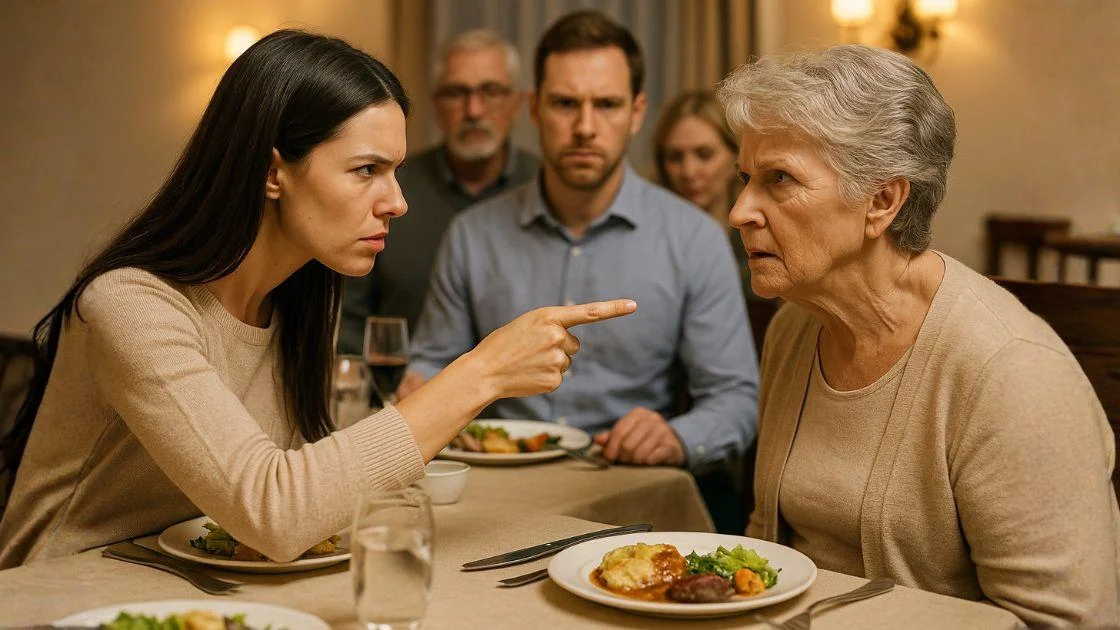
Brooke’s eyes narrowed. “You’re choosing this over your wife?”
Daniel took a breath. “I’m choosing to stop pretending I didn’t hear what happened.”
She looked at me. “You must be pleased.”
I was tired, but I did not want to turn her anger into another argument. “I wanted to eat Thanksgiving dinner in peace. I wanted you to treat me like a person whose home this is.”
“You’ve made me look terrible in front of everyone.”
“I didn’t bring a sale estimate to the table.”
She opened her mouth, then shut it. Her father called her name from the porch. She pulled on her coat and walked out without another word.
Daniel remained. He set the deed on the sideboard and helped Ruth carry dishes into the kitchen. For several minutes, neither of us spoke. The ordinary work felt almost ceremonial: stacking plates, rinsing serving spoons, wrapping the remaining pie. The house was returning to itself.
At last he said, “I knew she wanted to sell. I didn’t think she’d announce it tonight.”
“You knew she wanted me to leave.”
He nodded.
“Why didn’t you say anything?”
He rinsed a plate too long. “Because I didn’t want a fight. Because I thought if I stayed out of it, she’d calm down. Because I didn’t want to admit I had let her make decisions about something that wasn’t mine.”
Those were not good reasons. They were, at least, honest ones.
“Your father never wanted you to feel shut out,” I said. “But he also didn’t want me to spend the rest of my life asking permission to stay in my own home.”
Daniel dried his hands. “I miss him.”
“So do I.”
“I thought he would have left it to me eventually.”
“He left you memories here. He left you the right to visit. He left you the chance to be a good son. He did not leave you ownership.”
Daniel looked toward the dining room. “I don’t know how to fix this.”
“Start by telling the truth. Not the version that makes you look better. The truth.”
He nodded again.
That night he drove home alone. He called the next morning and asked if he could come by. I said yes, but I told him Brooke would need to call me herself if she wanted to discuss the cabin. I would not negotiate through him.
He arrived with coffee and a small box of Robert’s old photographs. He had found them in the back of a closet while looking for a winter coat. We sat at the kitchen table and went through them. There was Robert on the dock holding a fish that was mostly tail. There was Daniel at ten, wearing a life jacket backward. There was a picture of the three of us in front of the cabin before the porch had been rebuilt.
Daniel laughed at that one. Then his face changed.
“I told Brooke Dad promised me the cabin,” he said. “Not exactly those words. I told her I expected it to be mine one day.”
“Why?”
“Because I thought it would be. I never asked him. I just assumed.”
“An assumption can become a promise in someone else’s mind.”
“I know.”
He told me Brooke had been talking about buying a larger house closer to her work. They had debts from the wedding and had been looking at properties they could not comfortably afford. Brooke believed selling the cabin would give them the down payment they needed. Daniel had allowed that belief to grow because it made their plans feel possible. He had not told her that the cabin was not his to offer.
That explained the pressure. It did not excuse it.
“Did you know she had contacted an agent?” I asked.
“She said she wanted a valuation. I thought it was harmless.”
“Did you tell her she could invite the agent here?”
“No.”
“Did you tell her she could move my things?”
He looked ashamed. “No.”
“Then you need to understand that silence can still help someone do harm.”
He stayed for lunch. We did not solve everything. He asked if I would consider letting them visit in the summer, and I told him that was a different question from ownership. I would welcome him when we could be together respectfully. Brooke would be welcome if she could accept that I made the decisions about the cabin. Neither of them would be allowed to treat my home as an asset waiting to be converted into cash.
A week later, Brooke sent a message asking to meet. I agreed to a short conversation at a café in town, not at the cabin. She arrived with no folder and no agent’s card. She said she had felt embarrassed and cornered at Thanksgiving. I listened.
Then she said, “I thought Daniel had told you we were planning to sell.”
“He told me nothing. You told me.”
She looked down at her coffee. “I shouldn’t have brought the estimate.”
“No.”
“And I shouldn’t have spoken to you like that.”
“No,” I said again. “You shouldn’t have.”
She seemed to expect a longer speech, perhaps one that would make the apology easier. I did not give her one. An apology could be a beginning, but it could not rewrite what had happened.
She said they had withdrawn from the agent conversation. I told her I had not asked them to do that; they had never had authority to begin it. She nodded, and for the first time, she did not argue.
We did not become close. Trust is not restored by one careful conversation, and I did not need to pretend otherwise. But we established a boundary: no one would discuss selling, renting, renovating, or transferring the cabin unless I raised the subject. If I ever chose to make a change, I would speak to my attorney and decide on my own timetable.
The following spring, I had the porch steps repaired and the heating system inspected. I paid for the work from my own account. I kept the upstairs room as it was, except for replacing the curtains Brooke had chosen with the simple linen ones Robert liked. I planted new rosemary beside the kitchen door. The cabin did not need to become a museum of my marriage, but it did not need to become someone else’s project either.
Daniel began visiting on his own. Sometimes he came for an afternoon. Sometimes he stayed overnight in the room where he had slept as a child. He learned to ask before moving anything. He also learned that an invitation was not a deed, and that being loved did not mean being entitled.
In October, I hosted Thanksgiving again. I invited Ruth, the cousins, a few neighbors, and Daniel. I did not invite a crowd to prove anything. Brooke came too, after asking whether I was comfortable with it. I said she could come as a guest.
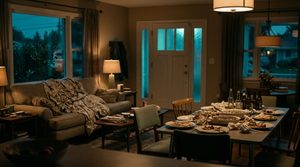
The table was set with the old plates. The gravy boat stood on the sideboard. The repaired steps no longer creaked beneath the weight of arriving feet. When Brooke reached for a serving platter, she paused and asked where I wanted it.
“Beside the potatoes is fine,” I said.
She carried it there.
No one made a speech about the previous year. No one needed to. The difference was in the small things: Daniel asked if I wanted help before taking a dish from my hands; Brooke waited for my answer before opening a cupboard; the guests spoke to me instead of around me.
After dinner, I stepped onto the porch with a cup of tea. The lake was still, the trees dark against the last strip of evening sky. Through the window I could see Daniel laughing with Ruth, and Brooke listening rather than directing. It was not a perfect family. It was not a magical forgiveness. It was a room in which people had begun to understand where they stood.
I thought of Robert’s letter, tucked safely away with the trust papers. He had not left me a weapon. He had left me a choice: the freedom to remain, to welcome people, to set limits, and to decide what home meant.
The cabin was mine alone. That did not mean I had to live in it alone.
I went back inside, placed my cup beside the gravy boat, and took my seat at the head of the table. This time, when I spoke, no one asked me to lower my voice.